Wahrnehmen: What do you do when the past visits you?

You will know the truth, and the truth will set you free (John 8:32).

In an online forum, fans of Leonard Cohen debate the title of his song, “One of us cannot be wrong” (leonardcohenforum.com). The song seems to be about a failing romantic relationship.

The term has also been used as a joke between two people who disagree on something. Any argument, it seems, presumes that someone must always be right. And, therefore, someone else must also always be wrong.

Saint Paul in his letter to the Romans throws a wrench into this kind of dualism. “For all have sinned and fall short of the glory of God” (Romans 3:23). Therefore, no one is right. And no one is wrong. No one, ultimately, can claim higher moral ground.

In today’s Gospel reading for Reformation Sunday, Jesus says, “Everyone who sins is a slave to sin” (John 8:34). In other words, human beings – we are all in the same boat. And, therefore, we need to learn to co-exist, peaceably, even with our enemies.

But only the truth will “set you free” (John 8:32).

Ok. So, what is truth? Pilate asked Jesus this question (John 18:38). It’s normal to go into our heads to figure that one out. In today’s Gospel, those who believed in Jesus misinterpreted his teaching by thinking they didn’t need to be made free because they were not slaves, literally.

We can, and have to this day two thousand years later, argued and debated what this truth is. Martin Luther in the 16th century, who launched the Reformation, offered his interpretation by focusing theological truth on the unconditional grace of God, which implies accepting, loving, and caring for everyone unconditionally.

But not every Christian feels comfortable with that message. We’d rather slip back into that comfortable dualism of believing “one of us cannot be wrong.”

Maybe the way to knowing the truth starts by examining how we receive the truth. Perhaps we first need to set the context for that truth giving and receiving. How is it given? Who is there? What’s going on?

In Martin Luther’s mother tongue, the German language, the word truth is “Wahrheit”. But German offers a helpful nuance by introducing a verb, an action word, for the word truth: “Wahrnehmen” loosely means perceiving, or as I’ve already mentioned, truth-receiving.

Truth is about how we receive it. It is not just a thought, or doctrine floating up here somewhere. It is contextual. It’s on the ground, in our lives. It is integral to what we do as much as what we think.

I can hear the wheels turning in your heads. You might argue with me here, saying the main theological point of Martin Luther’s Reformation is that we are made right with God not by doing good works. We are made right, or justified, with God by God’s grace alone. We can’t earn God’s favour because even the good we try to do has a downside. Nothing we do is a perfect thing with 0-negative consequence. We are truly dependent on God’s grace.

But because our actions – all of them – yield at least some negative consequence, doesn’t mean we remain passive or don’t try. Recognizing our sinful nature doesn’t translate to inactivity based in fear of making a mistake – because we will anyway no matter what we do! Proclaiming the primacy of God’s grace in everyone’s life doesn’t mean we don’t reach out, take risks, and express our faith in loving deeds.

It takes practice. Luther did say, “Sin boldly! But trust in God’s grace even more!” Wahrnehmen.

Mother Theresa said, “Love cannot remain by itself – it has no meaning. Love must be put into action, and that action is service” (Dyer, 2010, p. 99). In other words, love, compassion, mercy and forgiveness – all these grace-words mean absolutely nothing if we let them remain only in our individual lives, or only in our heads. Wahrnehmen.

What Jesus did for us on the cross and empty tomb was that he led the way for us, showed us the way and modelled for us the pattern, the way to follow. What Jesus did for us is not just for our intellectual benefit, not just for disputation in order to arrive at some level of doctrinal purity.

We are created and called for a purpose: To follow faithfully despite the mistakes we are bound to make on the way. It takes practice and exercising our spiritual muscles. Early in any exercise regime, it feels awkward.

In her book on overcoming grief, Sue Morris (2018) suggests writing with your other hand (pp. 26-27). Try writing your name and address with your non-dominant hand. Write as neatly as you can.

How does it feel? How does your writing compare to when you write with your dominant hand? Did you have to concentrate more? Did it feel strange?

“Being able to write effectively with your other hand would require a lot of practice … Even after many years of experience, writing with your non-dominant hand may never feel as effortless as writing with your dominant hand” (pp. 27-28).

A similar thing happens in grief, after a loved one has died. Even though you know how to live just like you know how to write, your life now feels awkward and unfamiliar. It takes more concentration, effort and energy. Any transition in life, even positive ones, involve loss and change. Transitions involve new learning and a period of adjustment.

As we practice, nevertheless, we can experience God’s loving presence. In the receiving of grace, we discover a deep source of strength flowing through us. We discover that in giving we begin to receive even more.

In practising faith, the truth frees us from the prisons of our own compulsive self-centredness. In practising faith, we learn again that, though the results are never perfect and even though our actions are always flawed, the truth of God’s grace is realized in deeds of love, serving others unconditionally, and courage to try something new.

And when we arrive one day at heaven’s gates, one thing we can be certain of: God will never fault us for loving too much, caring too much, showing mercy and compassion too much.

Thanks be to God, for the truth in Christ, who indeed sets us free.

Martin Luther, in his words, offers a blessing to us: “May God, who has led and called you to a knowledge of the truth, strengthen and preserve you to his praise and glory. To him and to his grace I commend you. Amen” (Owen, 1993).
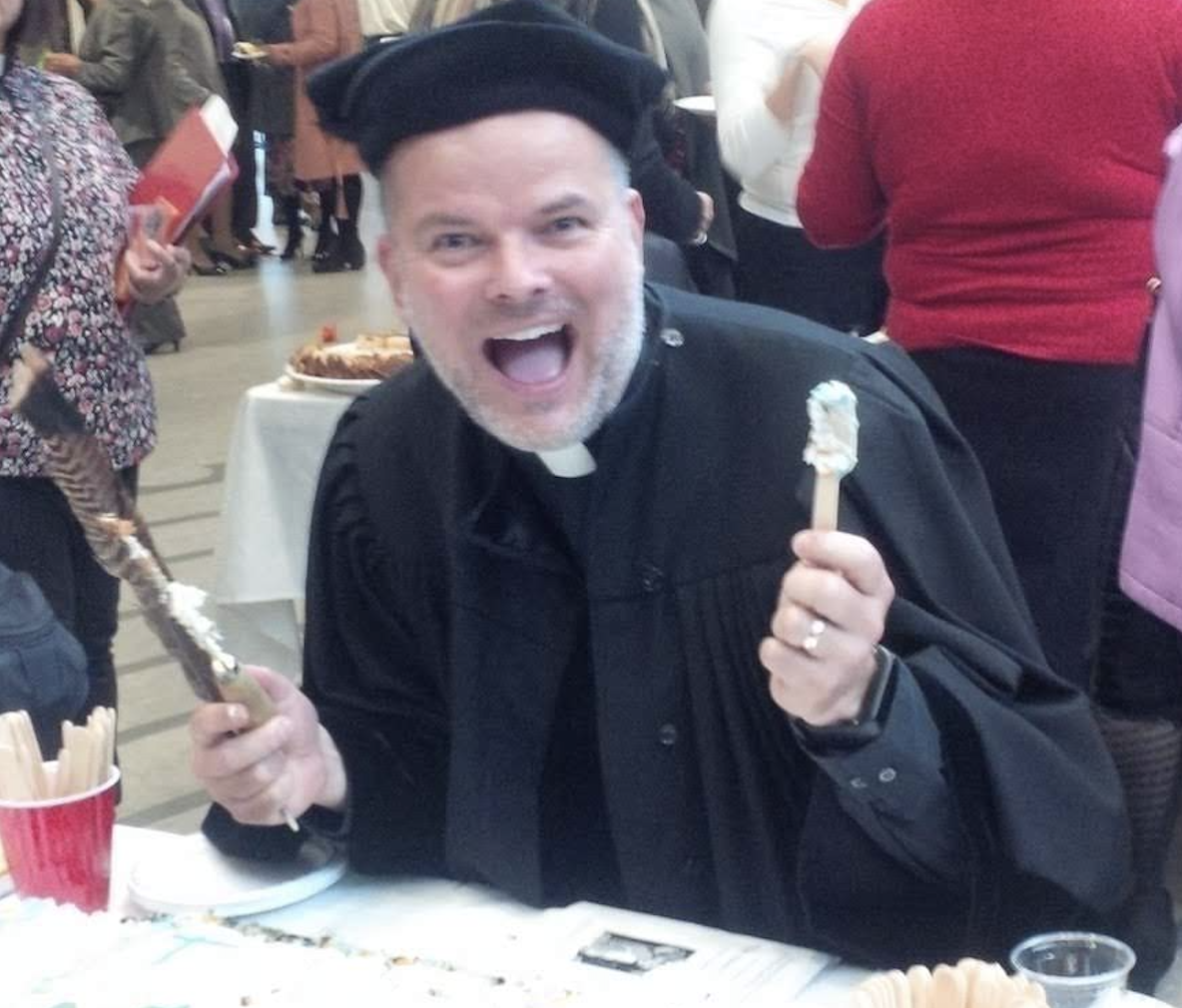
Blast from the past: Ottawa Lutherans celebrate 500 years of Reformation in 2017

References:

Iazariuk. (2007, December 25). I think the title gives the interpretation, but I may be wrong [Comment on the online forum post One of us can’t be wrong – interpretations please.]. leonardcohenforum.com. https://www.leonardcohenforum.com/viewtopic.php?t=9931

Dyer, W. W. (2010). The shift: Taking your life from ambition to meaning. Hay House, Inc.

Morris, S. (2018). Overcoming grief (2nd ed.). Robinson.

Owen, B. (Ed.). (1993). Daily readings from Luther’s writings. Augsburg Fortress.

Hold the middle, hold the tension

A Pentecostal minister, an Orthodox priest, an Anglican reverend, a Methodist pastor, a Mennonite leader, a Roman Catholic Cardinal and a Lutheran walked into a … sounds like the beginning of a bad joke. Or a good one!

No joke. They all walked together into an auditorium in front of hundreds of Lutherans at the 13th Assembly of the Lutheran World Federation last month in Krakow Poland. I was there. And I listened carefully as each leader from their respective church reflected on the meaning of grace – a bedrock theme for Lutherans, especially.

Today is Reformation Sunday. Traditionally this day has been celebrated by Lutherans as a victory day for the triumph of Lutheranism, the history of Martin Luther and the reformers, against the abuses of the Roman Catholic Church in 16th century.

In my youth especially this celebration heightened for me the divisions between Christian denominations, especially vis-à-vis the Roman Catholics. We were the winners. We were right. They were wrong. We had the truth. They did not.

In this culture of divisiveness, often leading to violence, the Protestant Reformation unfortunately fanned the flames of hatred even among Christians, to this day. We only have the historical record in Europe to prove that, as well as local Ottawa Valley stories to expose the depth of the division between Protestants and Catholics.[1]

But we’ve come a long way in over five hundred years, including vis-à-vis Roman Catholics. Are there still differences? Yes, to be sure. But theologically, the doctrine of justification by grace is something most Christians agree on today. The Lutheran Church has matured greatly over the centuries—and I would argue for the better. We are no longer a 16th century church.

All the ecumenical guests at the LWF Assembly last month—the Mennonite, Methodist, Anglican, Orthodox, Roman Catholic, and Pentecostal—spoke passionately about grace, and God’s relationship with us. What did the General Secretary[2] of the Lutheran World Federation—a PhD scholar herself—say?

She began by citing one of Martin Luther’s famous paradoxes. It is found in On the Freedom of a Christian (1520. Luther wrote, “A Christian is utterly free, lord of all, subject to none. A Christian is utterly dutiful, servant of all, subject to all.” This paradox holds the tension, and joins “lord” and “servant” in one person.

In other words, it’s not just one side of it. It’s not just being “utterly free, lord of all, subject to none” – which is the popular understanding of freedom in this land today, is it not? Freedom in Christ, and in a life of faith, involves holding the tension between “utterly free” on the one hand and “servant of all” on the other. The paradox asks us to consider both/and. And not just slip into an easy either/or fix.

How can we live out this paradox, this tension, in a life of faith today? Recently, Lutheran bishops and leaders made public statements on the war in the Middle East.

In her letter, presiding Bishop Elizabeth Eaton of the Evangelical Lutheran Church in America wrote,

“Dear church, As Lutherans, we are accustomed to holding tension between two truths. Thus the ELCA denounces the egregious acts of Hamas, acts that have led to unspeakable loss of life and hope. At the same time the ELCA denounces the indiscriminate retaliation of Israel against the Palestinian people, both Christian and Muslim.”[3]

A few days ago, our Canadian Lutheran bishops also issued a statement on the Israel-Hamas war. Again, listen to the language of both/and: “We are concerned about the rise in antisemitic and anti-Islamic words and actions in our communities and across the world. We pray that all people of faith may embody peace rather than incite hate. 

They continue, “Please join us in prayer and concern for the region. For those who mourn their dead on both sides of the conflict. For the hostages and their families, afraid for their lives. For those who have been maimed and injured. For those who have lost their homes. For those who have not been able to move to safety. For the opening of a humanitarian corridor into Gaza. For a peaceful solution to this war. That the war may not escalate into neighbouring countries.”[4]

In Matthew’s Gospel, Jesus says, “I have come to call not the righteous but sinners.”[5] St Paul later taught that “Everyone has sinned.”[6] No one is 100% right in any dispute. And no one is 100% wrong in any dispute. The way forward is learning to hold the tension inside of us, in the world outside of us. And finding a middle ground. Both/And.

Another theme emphasized throughout the LWF Assembly in Poland last month was the Cross of Christ—a central image in Luther’s theology. The cross has two beams, holds the middle between two directions.

Being human and living by faith is neither perfectly consistent—something many of us sitting here likely want—nor is living by faith total chaos—a stance describing much of post-modernism and even atheism.[7] To be a Christian today is to hold the contradictions with God, with Jesus, who held the tension on the cross and thereby showed us the way to new life.

The cross is holding the middle. The cross holds the tension. The world, reality, is neither perfectly consistent nor totally chaotic. We can therefore forgive reality in the world, in humanity, for being what it is. And work for what is right and loving.

There is a cost for holding the contradictions within yourself, to be sure. Things are not always, easily, nor quickly resolved. But the gift, the grace is that nothing is lost. No one is left behind. Nothing is wasted. You belong. They all belong. It all belongs, in the arms of God’s mercy.

In this short Gospel text for Reformation, Jesus says, “continue in my word”. [8]  Other translations—the New King James, among others—have it: “abide in my word”. I like that, too.

“Word” and “Truth”. What are we to make of these loaded statements by Jesus? Elsewhere in John’s Gospel, Jesus says, “I am the truth.”[9] Then, in the first chapter of John’s Gospel—one we will hear in full at Christmas: “The Word became flesh and lived among us … full of grace and truth.”[10] Therefore, as Martin Luther himself emphasized, the “Word” is Jesus. And he is also the “Truth”. Now, read the Gospel for today again substituting “Jesus” wherever the words “truth” and “word” appear.

It’s good to compare translations of the bible. I referred to the New King James Version earlier in comparison to the New Revised Standard Version. Sometimes inspiring insights emerge when you do this. In a recent Indigenous translation of the New Testament, verse 35 is truly illuminating for me: “A slave is not a member of the family and will not always live with the family. But a son of the family always has a home.”[11]

Even when you leave, for whatever reason. Even, on many levels, when life takes you away from home. Even when the journey of faith means going away, far away. You belong.

In Christ, you always have a home. There is always a place for you at the table. No matter your denomination, your religious background, or lack thereof, no matter your starting point—you can always come back and find your home, in Christ Jesus.


[1] In Eganville, Ontario, most Protestants lived on one side of the Bonnechere River and Catholics on the other side. Curiously, and tragically, both Grace Lutheran Church and St James Catholic Church buildings burned down in the 1990s.

[2] The Rev. Dr. Anne Burghardt

[3] Bishop Eaton issues statement on Israel-Hamas war , emphasis mine.

[4] ELCIC bishops issue statement on Israel-Hamas war , emphases mine.

[5] Matthew 9:13

[6] Romans 5:12

[7] Richard Rohr, Things Hidden: Scripture as Spirituality (Cincinnati Ohio: St Anthony Messenger Press, 2008), p.204.

[8] John 8:31-36, NRSV

[9] John 14:6

[10] John 1:14

[11] John 8:35, First Nations Version: An Indigenous Translation of the New Testament (Illinois: InterVarsity Press, 2021), p.183

Hold the middle, hold the tension — a sermon for Reformation Sunday 2023 (Rev. Martin Malina)

Free Hugs! (Just Kidding, Don’t Touch Me)

audio for sermon, “Free Hugs!” by Martin Malina

For my birthday, my daughter gave this t-shirt to me with the words: “Free Hugs!!! (Just Kidding, Don’t Touch Me)”. I laugh, not only because it appeals to certain personality-types. But also because it’s a paradox that describes our times so well.

On the one hand, the invitation for ‘free hugs’ is in keeping with the message of grace—in the Lutheran tradition we will say especially today on Reformation Sunday. God’s grace is free! God’s love is free! All good things are free! Even hugs. ‘Let’s hug!’

At the same time, and especially in a pandemic , this message of ‘free hugs for all’ has been tempered by public health protections to keep us from physical proximity from and touch with others. And even as legal protections are lifted, so many are choosing freely to keep those protections in place—like masking and physical distancing. So, ‘Let’s not hug!’

We’ve had to live in the tension between the message—which we thought meant one thing—and the reality—which looked like the opposite of the message. And living in this in between place, trying to hold both seemingly irreconcilable truths has been difficult to say the least.

What do we do? ‘Let’s Hug!’ or ‘Don’t Touch Me!’ Whatever we do, we are leaning into a new thing for both.

Yesterday the confirmation class went into downtown Ottawa, right into the Market area of Vanier. We stood outside on a street corner and handed out pieces of pie to anyone who wanted. Freely. Without any cost to them.

Mostly the poor and homeless responded to our invitation. The pies went quickly. Some just wanted one piece. Others wanted many more pieces. And we gave them out, without condition. Without limit. Until they were all gone.

Afterwards we debriefed the experience with the youth and had a conversation about how it felt to give without cost or expectation of anything in return. This is not an easy frame of mind for us to accept, even in the church, and even in a Lutheran church where our main doctrine or belief you would say is the unconditional grace of God. Because we are so used to counting the cost and looking for ‘what’s in it for me’.

The confirmation class practised grace because the grace of God towards us creates the community of faith. Because of the loving way God is with us we practice loving others. “Forgive us our sins, as we forgive others,” we pray in the Lord’s Prayer. And this was the basis of the new covenant God made with Israel. The prophet Jeremiah announces the new thing that God is doing to renew God’s relationship with us, and consequently introducing the defining character of human relationships and community in faith.

There’s the old covenant and the new covenant. The old covenant is based on rules and the obligation of the people to follow them, with consequence. The old covenant is based on ‘what’s in it for me’ thinking. Israel failed at that project. The Babylonian exile resulted. The new covenant, born of the exile, still holds the rules, but now with a twist: “I will write my law on their hearts,” says the Lord.[3]

Our faith as Lutherans and as Christians is in a God who embraces the earth and all that is in it, a God who embraces our humanity in Jesus, a God who gets hands dirty in our dirt and who bleeds for us. This is a God who initiates a loving relationship with us, with no conditions attached. And so, God touches our hearts.

An old woodcutter leads a donkey piled high with brushwood along a narrow mountain road. The wood slips and falls to the ground. As the man struggles to raise it, the king—disguised as a commoner—passes that way and stops to help. His hands embrace the thorns, his back bends to the task. The old man mumbles, “Thank you,” as the king rides on ahead to meet his waiting attendants.

The woodcutter continues down the mountain track, eventually catching up with the royal company. To his horror, he discovers who has helped him with his load. “I made a king stack wood for me,” he cries in dismay.

But the king smiles and offers to buy his donkey’s load, letting the woodcutter name a price he thinks fair. A gleam of understanding comes into the old woodcutter’s eye, and he explains that such wood can’t be sold cheaply. Ten bags of gold, he figures to be its worth. The king’s attendants laugh, saying the whole lot isn’t worth two barley grains. But the woodcutter insists that a great hand has touched these thorns … pointing to the bloodstains on the rough kindling.

“The wood itself is worthless, I agree – It is the touch which gives it dignity.”

The woodcutter knows the worth of a king’s touch. And the king, in turn, finds his boldness again in love irresistible.[7]

There is no better time than in the turmoil and disruption of the pandemic, to assert the new covenant. It is important that Jeremiah, most anguished of the prophets, speaks this hope, for only one in anguish could hope so deeply. Here is another paradox: That only when we have exhausted all our resources, confessed our need, do we discover the grace of God.

God’s grace brings forth willingness for glad obedience. We don’t do God’s will because we have to, are forced to, or guilted into doing, or feel obligated, or because we fear punishment. But we follow God because we are free to do it, no longer bound by the legality of it. But doing it because it is the right thing to do. “The truth will make you free,” says Jesus in the Gospel for Reformation Day.[4]

This new initiative on God’s part is grounded in God’s readiness to forgive all of Israel’s sins. The passage from Jeremiah announces God’s readiness to move beyond conditionality to a free embrace of Israel, to a new faithfulness with no strings attached. That divine readiness is matched by an anticipated readiness of Israel now to obey the commandments that are so intimately inscribed inside of every person.[5]

At a time when we feel all our resources have been exhausted, when we feel we can’t do anything more, we hear the promise that God makes the first move of grace, a move which makes all things new on earth.[6] God appeals to that still small voice within us, each one of you, in your hearts, to respond freely, with love. 

God surprises us on the path of our lives by picking the pieces up that we will have spilled along the way. God makes the first move of grace, embraces our reality. God hugs us. God’s hands get dirty and bloody in the process. But God won’t go back and escape into a faraway heaven. No, God is committed to walking with us, and living in us, the rest of the way.


[3] Jeremiah 31:31-34

[4] John 8:31-36

[5] Walter Brueggemann, https://www.bibleodyssey.org:443/en/passages/main-articles/new-covenant-jer-31

[6] Walter Brueggemann, https://www.religion-online.org/article/covenant-as-a-subversive-paradigm/

[7] Belden C. Lane, The Great Conversation: Nature and the Care of the Soul (New York: Oxford University Press, 2019), p.60-61.

Reformation-Murmuration

audio version of sermon, “Reformation-Murmuration” by Martin Malina

“…you will know the truth …”[1]

I stopped there. How will we know the truth? Is ‘truth’ even possible? When we don’t believe someone – a family member, a politician, the media, a friend – when we don’t believe what they say is true, how can we believe what was written down thousands of years ago to be true? How can we believe anything?

When Jesus says these promising, affirming words to his disciples two thousand years ago – “…you will know the truth …” – I’m not sure we do.

Maybe because our post-Enlightment mind regards truth exclusively as doctrinal, contractive, individualistic and competitive rather than something more intuitive, collective and freeing in our nature.

In the post-Reformation era, we have become like chickens, scrapping and scraping only for ourselves, ruffling another person’s feathers, or another church’s, so we feel better or superior. That truth is what I have, but you don’t.

And it’s not even what Martin Luther wanted—a separate, autonomous denomination. He wanted to reform the church, not split it into what is today some 30,000 Protestant denominations worldwide.

Maybe we need to look upward. Rather than be like the chickens, maybe the birds can show us the truth. Have you heard what the birds do when they fly together?

It rhymes with Reformation … Murmuration. So, whenever you hear the word ‘reformation’ from now on, I hope you think of ‘murmuration.’. What is ‘murmuration’?

Murmuration happens when the flock of birds—specifically starlings—move like synchronized swimmers or a well-choreographed dance troupe. Like bird ballet, they fly dark flowing against the white clouds. 

And when they fly together and swirl in a repeating, coordinated ever-changing pattern they seem to be connected somehow. They twist and turn and change direction at a moment’s notice.

Wired Magazine described murmuration like this:

“Each starling in a flock is connected to every other. 

When a flock turns in unison, it’s a phase transition.

 When a neighbor moves, so do you.

At the individual level, the rules guiding this are relatively simple.

 Depending on the flock’s size and speed and its members’ flight physiologies, the large-scale pattern changes. 

What’s complicated, or at least unknown, is how criticality it is created and maintained.” 

How does the murmuration begin? Often the starlings gather as night approaches. In the twilight, the dance begins with a few birds, but gradually other starlings arrive, then more and more, until they all join together in one massive flock. Their movements create patterns, streams, circles, and trails. Suddenly they plunge downward then swoop and sail skyward. As they twist and turn in tight formation, amazingly they swirl but never collide.

“What music do they hear? Who leads them? Who taught them such grace? …Maybe God is dancing with them and that is unknown, there, and unseen.”[2]

“I know all the birds of the air, and all that moves in the field is mine.”[3]

So, to God, each starling is important to creating the murmuration. The result, however, is a whole that is greater than the sum of individual parts. It’s the story of the bible.

Recall, then:

God was saving Israel, not just Abraham.

God was saving Israel, the nation, not just Joseph, Isaac, or Jacob.

God was always saving people, not just individuals. And, in the last two thousand years,

God was saving the church, not just Martin Luther, John Calvin, Ulrich Zwingli, or Henry the VIII’s marriage.

God was saving the church for all time—the people as a whole—and not just individuals of the 16th century. Nor just individuals today.

Reformation is “historical and social, and not just individual.”[4]

Martin Luther, the individual, was important in God’s story. Martin Luther inaugurated the Protestant Reformation on October 31, 1517—exactly 504 years ago today—by pinning up a sheet of paper on the large, wooden doors of the Wittenberg Castle Church in Germany. That piece of paper contained some 95 arguments against what Martin Luther believed were abuses in the religious practices and beliefs of the Roman Catholic Church at the time.

Fuelled by geo-political forces and social unrest in Europe. Power struggles between Pope and Princes, Emperor and economies — all these helped shape the course of what happened with the church, far beyond what Martin Luther was essentially all about. Because Reformation, in the end, is a movement in history and a movement of Spirit in the hearts of people continually changing and transforming, and going somewhere. Reformation was and is a gift—reforms in the 16th century were needed and good. But Reformation is also given to us as a calling—something we continue to work at and move towards. Never perfect, yet aspiring towards the vision of God.

Not negative. Not stuck, static. Not fixated, nor constricted. Not divided, autonomous nor conflicted out of some sentimental view of the past. But dynamic, transformative, unitive and flowing towards God’s vision, God’s future.

What is truth, then? Christ is the truth.[5] And Reformation, like murmuration, is participation in Christ. Each of us is a character inside of a story that is being written in cooperation with God and the rest of humanity. Christ in, and through us.

God is not ‘out there’. We don’t look at reality, we look from reality. We’re in the middle of it now; we’re a part of it. The murmuration. We are being chosen. We are being led. We are an instance in both the agony and ecstasy of God that is already happening inside you and inside of me.[6]

“You will know the truth and the truth will make you free.” This is the language of the bible. It describes what already is happening in us and around us. We already know it. And maybe now, only intuitively. But God is there. God is here.

And all you can do is say yes to it. And join in the never-ending dance.


[1] The Gospel for Reformation Day, from John 8:31-36.

[2] Jean Wise, “Mystical Murmuration” (www.healthyspirituality.org, 6 February 2014), https://healthyspirituality.org/mystical-murmuration/

[3] Psalm 50:11

[4] Richard Rohr, “Participation is the only way” Life as Participation (Daily Meditations, http://www.cac.org), 10 Sept 2021

[5] “I am the way, the truth and the life,” Jesus said. (John 14:6)

[6] Richard Rohr, “Being Instruments of God”, ibid., 5 Sept 2021

Love in the balance

“You will know the truth, and the truth will make you free”

–Jesus (John 8:31)

Are you ‘covid-careless’; or, ‘covid-paranoid’? – two expressions I’ve heard used quite often.

Do you lean towards hyper-vigilance, and self-preservation-ism? Are you overly paranoid? Do these pandemic times stoke your battle cry (which has always been there, just underneath the surface) for hunkering down and keeping that big, bad world out there, out there? It certainly helps if your life circumstances allow you to cocoon.

Or, does that needle lean towards a denial or avoidance of the problem? Do you believe things are normal and criticize the ‘cancel culture’ of limiting economic and social interaction these days? Do you defy the mask-wearing practice, calling this a large-scale hoax?

Before pointing fingers of judgement upon others, we are well first to recognize our own tendency, and locate ourselves on that spectrum between those polar opposites. Confessing our own bias, we are making our bid to change for the better. We recognize our need to grow from our fear to be more faithful and trusting, grow from our self-centredness to love another.

Are we willing to change and grow?

I’d like you to imagine with me a tightrope, a long one, fastened at both ends. At each end, identify for yourself opposite responses to a problem you face. For example, above, I gave the difference between being covid-paranoid and covid-careless. The key, I believe, in our maturity in faith is to recognize where we are on that line, and move towards the opposite pole.

Many scriptures are actually constructed to contain both the problem and its resolution. But not everyone will see it the same way, depending on your perspective. Some will see first the problem; for them, they need to work hard towards a resolution. Others will first see a sunny disposition; for them, they need to work towards acceptance of hard truth. Neither is bad; just a different starting point.

You can see this tensive balance in the famous Reformation Psalm, 46. Here are the words that Martin Luther used to compose the well-known hymn, A Mighty Fortress is our God. While the words of Psalm do not literally equate God with a ‘mighty fortress’, Martin Luther made that interpretative leap, and his powerful image has stuck with us for the past five hundred years.

But the “city of God” is not ‘the city is God’. The city belongs to God. God is present in the city. But a bricks-and-mortar fortress of impregnability and impressive show, God is not. At least not according to the Psalm.

God is our refuge and strength and a very present help in trouble. But, it is fair to ask, how is God our refuge? A vengeful warrior on the battlefield? A fortress building? How do we see God? How is God revealed to us? We can’t be too hard on Martin Luther for his loosey-goosy interpretation in the words of his hymn. Because he gets it right almost everywhere else where it comes to our relationship with God.

We can stay with the Psalm in order to find a way of knowing God amidst the trials of life. Because towards the end of the Psalm, another image of God is resolved: Not as military buttress and fighting machine against evil. But someone who makes peace: He makes wars to cease to the end of the earth; he breaks the bow and shatters the spear …

On the one end of the spectrum we see the fulcrum of might and earthly power in all its dazzling display of strength against the opposition. On the other end of the spectrum we begin to tread into unknown spiritual territory for many of us: Be still, and know that God is.

Again, the question is: in which direction, to which end of the spectrum, do you lean? And, having confessed this in all honesty, the spiritual path, the path of growth and maturity in faith, calls you to see the good on the other end of the spectrum. And go in that direction. Rather than merely judge others on the other side, we move towards them!

If we imagine a tightrope, a long one, I wonder about where along this tightrope, this spectrum, you can bounce higher? It’s in the middle isn’t it? But if you stay very close to either extreme end of the tightrope, you’re not going to bounce very high at all. You might never fall off, but you won’t really ever live, either. Because the purpose of walking on that line of tension in the first place, is to follow Christ, and follow that path to growth and the joy of living in God’s love.

The love of God resolves the either/or tensions in our lives. Whether you tend toward being covid-paranoid or covid-careless. Whether you see a glorious, all powerful God waving a victory flag on the battlefield of life, or a bleeding, tortured and dying man on a cross bearing the world’s evil.

If you are more covid-paranoid, maybe for you the challenge is to move your attention away from self-preoccupation toward another, and to practice safe ways to connect nonetheless with others. Thus loosening the grip of fear over your life.

If you are more covid-careless, maybe for you the challenge is to consider your own potential contribution to the problem. Maybe you need to consider others’ health and well-being, especially those who are vulnerable. Communal health is just as important as your own. Thus putting a few more limits on yourself and sacrificing your own pride a bit.

In both cases, the starting point is your own bias. And, the practice of love is at stake. Love hangs in the balance. And love is an expression both of God’s freedom and ours.

The love of God is non-possessive; we don’t own the other and we don’t control the other’s behaviour. This is a difficult practice, because we don’t want to start with ourselves. We’d rather first point at someone else’s problem or fault.

Let’s say as a parent we continue to make choices in place of our children as they grow into adulthood; that is, we understandably want to spare them from suffering the consequences of a choice they might have to regret.

Yet it is a lack of love on our part to do so, since by forbidding them to risk aren’t we essentially trying to shield ourselves from possible suffering? Aren’t we being selfish? Aren’t we really trying to protect ourselves from the anguish we will feel each time our children do something different from what to us seemed best for them?

Alternatively, when we allow our children to make decisions, and therefore to take risks, we will worry, yes. We suffer the freedom we have given them. It’s being a parent.

We are God’s children. And God loves us. And God will free us. “The truth will make you free,” Jesus said.[1] Therefore, God will suffer with us, as we are given the freedom to act. God sheds tears alongside us when we suffer the consequences of our misdeeds. God rejoices alongside us when we make meaningful movement forward in our lives. Yes, this is risky. But that is love.

The Psalmist has good advice: “Be still.” When we are still before God, and we slow down our compulsive, impulsive ways of thinking and behaving, love sinks into and germinates in our open hearts. In our stillness, we learn to pay attention to others. In the love of Christ, we move freely to love others as we are so loved.


[1] John 8:31

The God who forgets

The prophet Jeremiah describes a remarkable characteristic of God. He says God will “remember no more”[1]Israel’s sins. In other words, God forgets things. Now, I’m not sure we are accustomed to perceiving God in this way. In fact, I would wager many of us will be unsettled, even disturbed, by this notion.

If God is God Almighty, all-knowing, all-everything – then how is it God will intentionally forget something about us? It’s hard to believe that God is telling the truth, here. In fact, I’m not sure we would get excited by believing in a God who isn’t all-powerful and all-knowing.

The other night was a good sports night for me. On the same night Toronto FC won their do-or-die game against New York to advance to the Eastern Conference Final in Major League Soccer. The same night, the Ottawa Senators won their second hockey game of the year! Winning is not easy for that team these days, so that win was huge. It’s a good feeling to win!

It’s invigorating and stimulating to compete, especially when you win. Indeed, we live in a world of winners and losers. And all the hype on the fields of play mirrors the values with which we live day to day.

To be better than the other. To be more beautiful than the other. To be more skilled, have more luck, be more privileged than the other. And life becomes this rat-race to establish yourself ‘over and against’ the other – to beat out your biggest competition for a position on the team, to nail that audition and get that role in the play instead of someone else.

Often climbing to the top means climbing over someone else. It’s the zero-sum game of life. We say, it’s a dog-eat-dog world out there, where it’s survival of the fittest. Whether or not we like it, we take it as normative even defensible. We shrug our shoulders and say, “that’s the way it is.”

God, however, does not compete. This is the remarkable thing about the biblical witness of God in light of the Gospel. God does not fight for space in this world. God does not need it. There is this self-withdrawing feel to God’s presence. Here, we would affirm the central paradox in Christianity: In God’s absence we find God’s presence; or, in death there is life.

God will remember their sins no more. Because if God was to remember their sins, God would still be in the game. The game of tit-for-tat, the game of revenge, retribution and punishment for sin. The game of reward for good works. The game of earning and deserving God’s favour.

But no. There is a new game in town. And it’s not really a game anymore – at least not one with winners and losers. It’s a new covenant and a new promise from God. Where everyone and everything in creation is a winner.

God will make us all winners. How? Almighty God will release a grip on the tug-of-war rope. God will let go of the imposing forces of the battle ground. God will forget. God will not compete for space in our lives. God will not compete for space in this world. God will forgive. God will ease our anxiety about all the harsh lines in our world.

The dividing walls between people, nations and teams will no longer carry weight. In God’s giving-up, they become largely irrelevant. The dividing walls in our hearts collapse into the total-immersion love of God. These dividing walls dissolve in the self-giving of a God who ‘emptied himself’ of all pretense to glory. And, taking the form of absolute humility – ‘being born in human likeness’ and ‘obedient’ even to the point of ‘death on a cross’[2]– God gives us abundant life.

In this vision, austerity is not the path because nothing is scarce. Self-denial is no longer needed. We don’t operate in a transactional reality where God is concerned. Because God is in all of life – even in the places we thought God could not be. There is so much to see. There is so much abundance everywhere!

Therefore God is in the glories of physical and mental achievement just as much as God is in the depression and defeat of Alzheimer’s disease. God is in the accomplishment and success of youthful enterprise as much as God is in the tears of failure. God in the beauty of creation as much as in the ugly storms. God is in the cyberworld of Tik Tok and Snap Chat as much as God is in the dusty pages of books long left on a shelf. God is in the nicest neighbourhoods and ivory towers as much as in the ghettos of poverty.

In the world of faith, too! God is among the Roman Catholics as much as God is among the Lutherans. God is among the Muslims and the Hindus as much as God is among Jews and Christians. Lutherans have a prayer schedule where we pray for a different Anglican congregation in the area every Sunday. Did you know that on their prayer list, today – Reformation Sunday—Anglican parishes in Ottawa are praying for Lutherans?

Will we see God everywhere in our lives? Will we rejoice and be glad because God is the God of the Cross and Empty Tomb? Will we seek to work towards a world in which all people can see the face of God in each other?

Today is Reformation Sunday. In the Lutheran tradition a big deal. One of the hallmark sayings of Reformation is that we are a church ‘ecclesia reformata, semper reformanda’ – the church reformed, always reforming. We have seen how, since 1517 when Luther nailed those 95 arguments for reform on the Wittenberg Church door, the church has changed over five hundred years. Always reforming, always growing, always deepening in the love of God for all people.

Let’s continue in that tradition. Let’s continue in God’s word!


[1]Jeremiah 31:34

[2]Philippians 2:5-11

The angel

I know an angel.

She’s the deli counter server who smiles when taking my order.

He’s the fourteen-year-old who dreams of winning $10 million to give to Parkinson’s research because his grandpa suffers from the disease.

They’re in the bus shelter laughing and giving hi-fives and kisses to friends who do not share the same skin colour, age, language and physical ability.

She’s the one who comes in the nursing home room to encourage with a soft and happy voice.

She challenges world leaders to pay attention to and do something about the climate crisis.

I know an angel.

Today, and every year on September 29, the church recognizes the annual festival, “Michael and all Angels”. In the bible, we acknowledge the popular ones: Gabriel, who brought news to Mary of God’s intention to give her Jesus. And, Michael the great protector whom we read about in Daniel and Revelation.

Herein lies one of those very grey areas for Lutherans who have, in our recent history, become increasingly nervous about the angels. Why is that?

In the Confirmation class which started this past week, we closed our time together by praying Martin Luther’s evening blessing: “I give thanks to you, heavenly Father, through Jesus Christ your dear Son, that you have graciously protected me today. I ask you to forgive me all my sins, where I have done wrong, and graciously to protect me tonight. Into your hands I commend myself: my body, my soul, and all that is mine. Let your holy angel be with me, so that the wicked foe may have no power over me. Amen.”[1][emphasis mine]

By the way he prayed, we can tell Martin Luther believed in angels. On the other hand, Luther didn’t care too much for those parts of the bible that suggested allegory—those so-called apocalyptic descriptions that described futuristic, other-worldly, colourful, image-rich portrayals of angels, arch-angels, cherubim and seraphim, of sword-wielding horseman, dragons and giant wheels in the sky. Luther consequently relegated these scriptures to a lower priority for the biblically literate.

“Angels cannot be our intermediaries between us and God,” we reformers insist. “There is only one mediator and that is Christ,” we claim. Christ alone, we’ve made things simple. Concrete. More about this in a minute …

And yet, at the same time, we cannot deny the reality and the truth, that just beyond the thin curtain of our awareness and perception there lies a dimension of reality in which we, too, participate—for good and for evil. Our highly trained, rational minds—thanks to the Reformation and Enlightenment eras of the last few centuries—have made us suspicious and skeptical of making such risky forays into those ambiguous, beyond-rational notions. We just don’t know what to do with that part. We just don’t know …

The Buddhist monk Thich Nhat Hanh tells a beautiful story about an experience he had following his mother’s death: “The day my mother died I wrote in my journal, ‘A serious misfortune in my life has arrived.’ I suffered for more than one year after the passing away of my mother.

‘But one night in the highlands of Vietnam, I was sleeping in the hut of my hermitage. I dreamed of my mother. I saw myself sitting with her, and we were having a wonderful talk. She looked young and beautiful, her hair flowing down. It was so pleasant to sit there and talk with her as if she had never died.

‘When I woke up it was about two in the morning, and I felt very strongly that I had never lost my mother. The impression that my mother was still with me was very clear. I understood then that the idea of having lost my mother was just an idea. It was obvious in that moment that my mother is always alive in me.”[2]

Perhaps you, too, can point to these subtle yet profound moments—especially following a loss or some great suffering or deepest love—when the cloud breaks, the sun streams through, a bird calls, an image flashes across your vision, a dream’s effect captivates you, a momentary feeling of peace and well-being engulfs you, a stranger impresses you in some unexpected, surprising way.

This is real. People talk to me about these experiences all the time. We can’t put our finger on it. We can’t rationalize our way through it. Well, we try, by talking about neural impulses and undigested fats in our bellies. But here we go again, dealing with our discomfort by reaching for yet another rational explanation. But can we explain away these experiences? Should we?

It’s easy to place religion into the esoteric realms of doctrinal outer-space. That’s our head space whose thoughts, theories and machinations serve to disconnect us from what is, right in front of us. And, sadly this state has almost exclusively defined the Reformation since the days of Martin Luther.

What about our bodies? What about our feelings? What about the natural occurrences in our daily lives? Are these not the purview of God as well?

Martin Luther insisted on the real, the tangible, as a valid and powerful expression of the divine. A faith that is characterized by the incarnation—Word becoming flesh—is a faith that cannot deny what we see, hear, taste and feel. When God became human in Jesus. When the Holy Spirit indwells in our hearts, our bodies. When we eat the body of Christ in the sacrament. God makes our reality God’s domain. Angels among us. The spiritual becomes tangible. Matter is, and has always been, the hiding place for God.

One of the clever jingles of the TSN1200 radio station in Ottawa is their oft-repeated phrase introducing whatever sport they broadcast: “The Sens play here” (NHL hockey); “The NFL plays here (football)”; “The RedBlacks play here”(CFL football); “The Fury play here” (soccer); “The 67s play here” (junior hockey).

That needs to be the church’s motto: “God plays here.” In real, tangible, visible, ways. “God plays here” among mortals, among real people in real situations. “God plays here” along with the angels and archangels.

We may not be able to figure it out completely. We may not know the mind and ways of God fully. We may not know this spiritual realm that interplays with our own. We may not even be able to rationalize it in the usual ways. And yet, we trust.

In the last line of the Evening Blessing from the Small Catechism, Martin Luther, after praying for the holy angel to be with him, he gives the following instruction:

“Then you are to go to sleep quickly and cheerfully.” And falling asleep quickly and cheerfully can only happen when, despite our inability to have all the solutions and figure out all our problems, we can feel that it will be well with my soul.

God will make God’s ways and purposes knowable to us, in the regular grind, routines and ordinary circumstances of our lives.

May you know some angels, too.

Trust.


[1]Martin Luther, “Small Catechism” in Evangelical Lutheran Worship (Augsburg Fortress, 2006), p.1162.

[2]Thich Nhat Hanh, No Death, No Fear: Comforting Wisdom for Life (Riverhead Books: 2002), p.5.

God loves us uniquely, not exclusively

Some things Jesus says offend our most sacred held values.

In today’s Gospel Jesus basically turns against family. As one who drove 6000 kilometers this summer in a car with my family and then spent four intense but good days with extended family in Poland, I recoil at these words of Jesus. If we take Jesus’ demand literally, he is telling us outright to ‘hate’ our father, mother, wife and children and give up all our possessions.[1]How’s that for ‘family values’?

We cannot ignore this statement of Jesus, as much as we may want to. When we see the other places Jesus comments on family we begin to notice a theme emerge. Jesus redefines ‘family’ who shares not bloodlines but a common awareness of following Jesus and God’s mission.[2]

How do we pick up our cross and be faithful in following Jesus? How do we deal with this word ‘hate’ which brings up un-gospel-like connotations of division, conflict, anger and even violence?

In a historical fiction by Ken Follet entitled A Column of Fire he describes the early, raw conflict between Protestants and Catholics. Set in 1558, just some forty years after Martin Luther inaugurated the Reformation, Follet portrays through his characters the mindset of religious combatants in England and France.

In small towns where this religious war was waged in families and churches, to be caught with prohibited books from the ‘other side’ meant certain and immediate death. Underground Protestants were indiscriminately persecuted with the full force of the law when outed in Catholic regions. And vice versa. I had forgotten to appreciate the depth of the hatred that existed between coreligionists in the decades following the spread of Protestantism in Europe.

Early in the book we are introduced to Rollo. Rollo hates Protestants who are inflicting his English town. He bemoans the subversive, rule-breaking Protestants who are trying to alter Christian doctrines that had been taught in the old town cathedral unchanged for centuries. “The truth was for eternity,”[3]he pronounces. This truth is like the huge foundation stones of cathedral building which cannot be moved.

Of course, from today’s vantage point five hundred years later, we lay aside these trifling objections. Over the last fifty years especially culminating in the Joint Declaration on the Doctrine of Justificationin 1999, Catholics and Protestants together testify to the salvation that is bestowed only in Christ and by grace alone. In that almost incredible agreement, the objections and cause of divisions of the sixteenth century between the Roman Catholic church and reformers were officially removed.

Rollo’s problem was that he equated his interpretation of the truth with the truth itself. He believed his ‘take’ on the truth was the only take to make. And everyone else who didn’t conform to his take was excluded. In other words, his worldview was exclusive. Love of God, grace of God—these were exclusive gifts of God to a select few who conformed.

And damned be the rest.

Today, while the historical differences between Catholics and Protestants melt in the context of a changing cultural reality in the Western world, these troubling tendencies towards conformity, like-mindedness and exclusiveness nevertheless still persist in both Catholic and Lutheran circles worldwide and denominationally.

Think of the eye-glasses we wear. Some, to shield against the sun. Some glasses for short-sightedness, some for far-sightedness. Some glasses are bi-focal. Others are progressive lens. Important questions to ask in any study of scripture or tradition are: What lens do you use—your lens of experience, upbringing, learning, personality, opinion, background—what lens of interpretation do you bring to a reading of holy scripture?

What do you normally see in scripture? What do you first notice? The law? The gospel? Do you regard the bible as a legal book, or a historical book primarily? Or, do you look for promise, hope, forgiveness? Do you presume a punishing God who looks for mistakes and the follies of humanity? Or, do you see a loving God? Why? What are you afraid of? What are you looking for?

These are not easy questions to pose to oneself. But following Jesus is not blind. Obedience in the vision of Jesus is not like flotsam, driftwood, floating hither and yon.

Discipleship is a call to a commitment with focus and intention. Following Jesus calls each of us to a thought-probing, deliberative process in which we grow our ability and confidence to ask of ourselves the tough questions about life and living not only about God but especially of ourselves.

These types of questions are important to get some handle on before you can claim any part of the truth. In short, an honest self-awareness is necessary for healthy relating—whether relating to scripture or to someone else.

In families, relationships and organizations that are healthy, vital and growing, what do you see? I see people who are respected for their unique contribution to the whole. I see people who may be very different from each other and still value their own contribution because they know they are valued by others. Not because they conform. Not because they wear identical eye-glasses of interpretation. Not because someone else tells them what to do. Not because they ‘tow the party line.’ Not because they are like-minded in all things religious.

I know it’s not time to think of snow, yet. But I came across this past week an image of the snowflake. Of all the billions of people on this planet, no two are exactly alike. Even, as I am, an identical twin—I am not exactly like my brother. Of all the snowflakes that fall from the sky, no two are exactly alike.  Not one is a duplicate. Each is unique.

I don’t take the word ‘hate’ in the Gospel reading to mean we have license from God now to say and do violence to those we love most. That would constitute a false interpretation of scripture.

I do take this to mean we cannot, dare not, make any claim on another’s life. We do not own another person. We do not claim ownership and control them emotionally, psychologically, even spiritually. We are not responsible for another person.

Our growth with those we love means we release our claim over their lives, if we’ve ever had one or thought we had. I believe that is what Jesus is getting at here. Parents, even, are advised to remember that their role in raising children is to prepare those children for the world, and then release them to the world. In any relationship, blood-lined or missional—we do not control, own, or claim anything over another person.

And this is not easy with regards to letting go of our emotional attachments. But not claiming anything over another doesn’t mean we cut ourselves off from them, cutting all ties and never seeing them again. Releasing our emotional grip on another doesn’t mean we do not love them anymore. Letting go our claim over their lives doesn’t mean we do not care for them anymore. It just means we are not ultimately in charge of their lives. God is.

This can be a freeing prospect.

In reflecting on the cost of discipleship, Dietrich Bonhoeffer wrote, “The call to discipleship is a gift of grace.”[4]It’s a call to freedom and transformation which is what Jesus nurtures in us: to grow, to move, to change for the better as persons created in the image of God.

And, what is more, when all those unique snowflakes fall to the ground what accumulates is a blanket of snow—that has its recuperative and restorative purpose upon the earth. Unique, yet each contributes to the whole.

God doesn’t love us exclusively. As if we ought to be better than ‘them’. God loves uniquely. Being faithful is not about comparison, competition, being better than someone else. God loves us uniquely not exclusively. That means, our take on the truth is partial. Someone else’s take on the truth is also partial. Each of us in God’s family brings something unique to the whole of the truth.

To follow Jesus is to practice the letting go of the ego’s compulsions, and embrace God’s unconditional love and grace for you. So, following Jesus is not about being perfect, or copying someone else’s ‘saintliness’. It is, quite simply, being authentically you and affirming the stranger, in God’s love for all.


[1]Luke 14:25-33

[2]See Luke 12:51-53, 14:12, 18:29-30

[3]Ken Follet, A Column of Fire (New York: Viking Books/Penguin Random House, 2017) p.76.

[4]Cited by Emilie M. Townes in David L. Bartlett & Barbara Brown Taylor, eds. Feasting on the Word: Preaching the Revised Common Lectionary Year C Volume 4 (Kentucky: WJK Press, 2010), p.48.

What is Jesus doing?

I have a small humidifier for my guitar. I combine special crystals with distilled water in a small tube that I insert between the strings. This helps prevent the hardwood casing of the guitar from cracking and splitting. I need to keep filling the small tube with water at least once a week during the dry months of winter to preserve the wood.

At this time of year in Canada, especially under the influence of a continental climate, the air is dry. Very. But we don’t even notice or think about it. The only way I know it’s really dry when it’s so cold is my skin is itchy and my hands get cracked and rough. Also, a device at home tells me the humidity levels are quite low around 20-30%. Not only does our skin pay the price in dry conditions, our organs internally need hydration. So, we have to drink more water.

It’s hard to imagine, but we can actually be dehydrated in the winter. And these conditions are not overtly noticeable, really. Unless we pay attention to our skin or check the humidistat, it’s not apparent.

When we consider faith, or spirituality, we enter into a level of awareness similar to our awareness of water around us, or lack thereof. It’s not immediately nor easily perceptible where the water is or goes.

When we approach a problem or a challenge in life with the good intention of bringing our faith to bear on it, we must first uncover our way of thinking about it. Because how we think about it influences the choices we make.

Here are a couple ways of thinking that we are usually not aware of, in the choices and decisions we make. These are ways of thinking that the Gospel for today exposes.[1]

First, underneath all our words and actions often lurks the virus of dualism. ‘Dual’ means, two: Either/Or, This or That; This belongs and That doesn’t belong. This mental strategy exists just below the level of consciousness, and is ingrained in our western thinking especially since the Enlightenment and Reformation. This way of thinking has dominated our approach to faith, even though it was not the way of thinking of those who first scribed the biblical stories.

For example, John the Baptist in the Gospel story today says that he baptizes with water but the one coming after him will baptize with Spirit and fire.[2]We may comprehend this dualistically, suggesting that Jesus was not going to use water in his baptismal ministry. We then interpret this is as: In Christian baptism, water is irrelevant, unnecessary. After all, if Jesus, Son of God, won’t baptize with water, why should we? … and so on and so on.

You see how dualism creeps into our encounter with Scripture? It doesn’t help, then, that nowhere in the New Testament do we see Jesus performing anybaptisms, let alone with water, Spirit or fire.

When we get up in-the-head with these Gospel texts, we easily can get ourselves into a twisted, confused state. We start fighting amongst ourselves over right-thinking, doctrine and the efficacy of baptism. The church divides and we see in the history, especially after the Reformation, a proliferation of denominations. And how well has dividing-over-doctrine worked for us?

But, what if the solution lies in another way of thinking? It’s interesting that in our thinking that can go astray in this Gospel text, we do get some helpful cues to help us out of the quagmire of dualism:

“Repent!” is John the Baptist’s primary message which we see clearly in the other Gospels,[3]and earlier in the Gospel of Luke.[4]The Greek word, metanoia, translated as “repent”, literally means ‘to change your mind’. Then Saint Paul comes along and instructs, “Be transformed by a renewal of your mind.”[5]So, repentance does not start by changing bad habits, or feeling guilty for bad behaviour. Repentance is not fundamentally moralistic.

First, repentance means changing our way of thinking about a problem. Repentance means looking at a challenge in a completely different way from the way you’ve always thought about it. The message of repentance is about nurturing a healthy self-critique about your thought-process, and changing it. Once the mind is changed, hopefully the heart will soon follow.

So, from this text, what if it’s not either/or but both/and? What if water, fire and Spirit were all important aspects of our experience and expression of baptism in Christ? And nothing was being excluded from the mix?

Because from the story of creation in the book of Genesis, the Spirit hovers over the water and God speaks to create. So, in Baptism the ‘word’ and ‘water’ are vehicles of God to create something new in you.[6]

We don’t often think about our need for water, especially in a country like Canada where fresh drinking water abounds. After all, over 60% of our bodies are made up of water and most of this planet is covered by water. How can we take it for granted? How can we not see it?

Water, in its various states—frozen, liquid, gas—is integral to all of creation. It is pervasive. We cannot get away from it, or remove ourselves somehow from its all-encompassing reality. We cannot divide it out, easily. It cannot exist, apart from anything else in the natural world. Water connects all things. And we can only participate in its existence within and all around us. We belong to it; it belongs to us.

Often when the Baptism of our Lord comes up in the church calendar, we immediately think this story must primarily be about our baptism. Here is another way of thinking that we don’t usually uncover: a lifestyle that places the ultimate onus on us, individually.

So, this story gives us license, we presume, to make it all about us: our faith, our work, our sin, our need to somehow earn God’s favour by seeking out baptism or proving the worthiness of our faith. The upshot of this story of Jesus’ baptism must, therefore, mean we need to imitate Jesus as best as we can.

But what about asking another question? Instead of the popular question, “What would Jesus do?”, what about asking, “What is Jesus doing?”[7]

The first question—What would Jesus do?— assumes that the Savior is on the sidelines of our lives and that the burden of life and work is on our shoulders. When we seek to imitate Jesus’ life, we presume the Savior is not really saving but is setting impossibly high standards that we attempt to imitate by doing what we assume he would do if he were in our situation.

But to be clear, we do not imitate the Savior’s life; we participate in it. In first century context, this Gospel story has less to do with the nature of Jesus and more with his purpose.[8]

“What is Jesus doing?” is built on the conviction that he is alive, reigning, and at work in our lives. In other words, he is in our situation. And that changes everything, first about our thinking then also our mission. Instead of believing that the work of Christ is done-and-over and that now it is our turn to try to imitate his life and work, we take on the identity of being witnesses who watch and testify to his continued work of salvation that is unfolding before our eyes.

Obviously, Jesus’ incarnation, ministry, cross, and resurrection make up the decisive turning point in the great drama of salvation. But the Kingdom is still coming. And it doesn’t come through ourefforts at doing Christ’s work. It comes through the ongoing ministry of the ascended and reigning Son of God, who completes his own work through the Holy Spirit so that we may participate in what Jesus is doing.[9]

Not, what would Jesus do. Rather, what is Jesus doing.

So, Baptism gives us a physical assurance that our final destiny is no longer determined by the brokenness of our world and lives and twisted ways of thinking. Baptism gives us a physical assurance that our final destiny is the realm of God already breaking in all around us. Baptism is an invisible mark initiating us into a community that anticipates the fullness of God’s kingdom.[10]Baptism calls us to pay attention to what Jesus is doing all around us, like water.

God’s voice from heaven identifies Jesus as God’s son, in whom God is well pleased. The Baptism of our Lord is not what we are about, but about what God is up to in Jesus. If anything, this text calls us to choose how we will align ourselves with the purposes of God in Christ, in the world around us today.

To that end, when we love others, when we have mercy on others, when we show compassion, and affirm all people and creation—these are worthy strategies to align ourselves with what God is doing to make everything belong.

May the grace of God, like water, wash us and surround us in hope and in thanksgiving for all that belongs to God.


[1]Luke 3:15-17,21-22; Baptism of our Lord, Year C, Revised Common Lectionary

[2]Luke 3:16

[3]For example, see Matthew 3:1-2 and Mark 1:4

[4]Luke 3:8

[5]Romans 12:2

[6]Donald W. Johnson, Praying the Catechism  (Augsburg Fortress, 2008)

[7]M.Craig Barnes, The Pastor as Minor Poet: Texts and Subtexts in the Ministerial Life (Grand Rapids Michigan: William B. Eerdmans Publishing Company, 2009), p.59.

[8]Ronald J. Allen, “Commentary on Luke 3:15-17,21-22” in workpreacher.org for January 13, 2019

[9]Barnes,ibid.

[10]Ibid.

Christmas, now

Just a couple of years before he died, Martin Luther preached one of his last Christmas sermons. In it, he challenged his 16thcentury German congregation to bring the nativity into the present moment – the present reality.

Martin Luther described the squalor and desperation swirling around Mary and Joseph arriving late in Bethlehem and not finding room in the inn, leaving them to give birth to Jesus in a small barn out back. Then, he said:

 There are many of you in this congregation who think to yourselves: “If only I had been there! How quick I would have been to help the baby! I would have washed his linen!” … [Well] Why don’t you do it now? You have Christ in your neighbour. You ought to serve them, for what you do to your neighbour in need you do to the Lord Christ himself.[1] That was preached in 1543.

At Christmas 2018, we are not just called to hear the story again, but to be in it, part of it.[2]

Essentially, Martin Luther was getting at the meaning of Christmas for his contemporaries. And for us, today. How can we be inspired by the children, the music, the gifts we bring at Christmas to step out of the nativity ‘play’, and into the real story unfolding around us today?

We share in the communion tonight. In the chaos, noise and crowd, celebrating the sacrament might not fit our idea of a neat-and-tidy, perfect Christmas service. It’s hard to sentimentalize the Eucharist.

But it’s important to offer it tonight. Because the sacrament brings us to the present moment. The meal tells the story of Jesus being in our hearts—not decades ago when things were golden and sweet in our memories, not two thousand years ago, not in the Martin Luther’s day, not lost in words of scripture alone—but right here, right now, in the present day, in our own experience of life in this world.

Receiving the bread and cup doesn’t mean your life is perfect, doesn’t mean you are now ready for Christmas, doesn’t mean y our life is in order and worthy of God.

When you receive the Communion, you are affirming that God is somewhere in the mess and chaos of your life. Our life. Emmanuel–God with us.

Celebrating Christ’s birth does not bring us outof history, it involves us with it—in the present time.[3]The Christmas story gets lived out by our attention and care for the dark shadows in our own hearts, as well as reaching out to vulnerable people in our world.

I heard with dismay on the local radio station last week that the City of Ottawa is putting up 230 families in cheap hotels this Christmas, where they have to live for over a year before social housing spots open up. Talk about conditions of squalor entire families, all of them poor, need to live in at Christmas. And we’re not talking about a handful. Two Hundred and Thirty families, in Ottawa alone.

Have we considered that when we pray for and help in whatever way we can these people, we are serving Christ himself? After all, our Lord was a refugee himself right after his birth, fleeing to Egypt with his parents to get away from Herod’s violent and murderous intent.[4]

Popular TSN Hockey Insider Bob McKenzie just came out with a book this Fall entitled: “Everyday Hockey Heroes: Inspiring Stories on and off the Ice”[5]

In one chapter about an inspiring Ottawa story, Bob McKenzie relays the words of Karina Potvin, a minor hockey coach. She writes: “So much about Canada is welcoming. Well, except maybe our winters, but they’re a small price to pay in order to play hockey …”

As Karina watched on the news refugees being greeted at the airport, she writes: “I knew I wanted to help these new Canadians feel at home. I just wasn’t sure how.

“A few months later I was at practice when I saw one of my fellow coaches … coming towards the bench … [he had a] new idea for Reach Out. Reach Out is a program in our hockey association that helps low income families pay for equipment and registration fees so that their kids can join our league …

“‘You know how my wife and I have been working with some of the Syrian families who have settled here in Ottawa?’ He went on, ‘We took a family to …[a] game last week, and their sons absolutely loved it. They had never heard of hockey before, but they want to play.’

Karina ended up coaching three boys—Mohammed, Ahmad and Ismael—who quickly got the hang of skating. “They’re all over the ice!”

“The three boys breathed hockey all day, every day. As did their parents. By midseason, the parents were typical Canadian hockey moms and dads.

“One Arabic word I learned was hebbak which means “I love you.” Sometimes when we were on the bench, I would turn to Mohammed and say it. He always gave me a strange look.

“’Yeah, I just told you that I love you. Because you’re playing really well tonight and listening to us coaches.’

“He shook his head, ‘Coach Karina, you’re weird.’

“’If you ever make the NHL and they ask you who was your first and favourite coach, you have to say Coach Karina.’

“’Yes, of course.’ He laughed.

“’And if you ever play for the Senators, you have to get me tickets.’ Every time I said this, he would smile and reply, ‘Yes. Yes. Yes.’”

Just imagine: The year before, these kids had been in a refugee camp in Lebanon. Now, they were playing hockey just like so many other kids in Canada.[6]

May the first Christmas story become alive and real for you, as the Christ child is born anew in your hearts thisday.

Here are the words of American writer Madeleine L’Engle in a poem entitled “First Coming”:

He did not wait till the world was ready,
till men and nations were at peace.
He came when the Heavens were unsteady,
and prisoners cried out for release.

He did not wait for the perfect time.
He came when the need was deep and great.
He dined with sinners in all their grime,
turned water into wine.

He did not wait till hearts were pure.
In joy he came to a tarnished world of sin and doubt.
To a world like ours, of anguished shame
he came, and his Light would not go out.

He came to a world which did not mesh,
to heal its tangles, shield its scorn.
In the mystery of the Word made Flesh
the Maker of the stars was born.

We cannot wait till the world is sane
to raise our songs with joyful voice,
for to share our grief, to touch our pain,
He came with Love: Rejoice! Rejoice!

Merry Christmas!

[1]Martin Luther, Christmas Sermon, 1543; Matthew 25:45

[2]Lcfaithinthenight.blogspot.com, 19 Dec 2018, (Lutherans Connect, @LuTConnect).

[3]Gustavo Gutierrez, cited in LutheransConnect, ibid.

[4]Matthew 2:13-15

[5]With Jim Lang (Toronto: Simon & Schuster, 2018)

[6]The full story in ibid., p.45-56