
Can you catch it?

When I was younger I enjoyed playing catch using a softball or baseball. My catch partner and I would stand at a distance from each other, and we would toss, whip, lob, sidearm, underhand, windmill or basically throw the ball in various combinations of the above.

That simple, and for me rather therapeutic, repetitive motion – back-and-forth—impressed upon me the truth that whether the ball is successfully caught doesn’t just depend on the catcher. Whether the ball is successfully caught depends to a large degree how accurately the ball is thrown. Assuming you want your ball partner to catch the ball!

You need to throw the ball in such a way to match the catcher’s ability, attention in the moment, stance and glove position. The one throwing the ball needs to pay attention to and know the catcher. Throwing and catching the ball is a relationship in which both parties have to do their part for the exercise to work.

Which then reminds me of a popular saying in the church I have heard over the years: That faith is not taught as much as it is caught. The ball of faith, if it is to be successfully passed on, needs to be thrown in a way that the catcher can catch it. Because every individual is unique and has different abilities, personality, and capacity, the gift of faith—if it is to stick and not be dropped—needs to come at them in a way they can handle it.

No one size fits all. The ball of faith has wings to fly in a manner in which each of us can perceive it, appreciate it, and let it enter into our life. On our part, to throw the ball of faith, we need to reach people through their point of view, not our own. In other words, we need a relationship with them to seek to understand their tendency, their perspective, and then speak their language (Rubin, 2017).

One of the most significant scientific facts in existence is something we cannot directly see, touch, taste, or even smell. But we can feel it on our skin. Planet Earth is wrapped in 5,600 million million tons of air, and most of the time most of the air is moving (Mahany, 2023, p. 93). While wind is elusive, hard to define, one thing it is for sure: Wind is impossible to ignore.

photo by Martin Malina (Long Beach WA, July 21, 2017)

The winds have been particularly noticeable of late. They have been strong enough to send us the smoke caused by wildfires in Western Canada. Over the past few years, we have witnessed the effects of powerful windstorms here in Ottawa – toppling ancient trees, downing lines, throwing damaging debris.

A couple of weeks ago, a Chinese paraglider was caught in a powerful updraft sending him some nine kilometres straight upward until he was piercing the edge of the atmosphere with air temperatures near -40 degrees Celsius. Most para-gliders caught in this unfortunate circumstance don’t survive. Miraculously, he did (TWN, 2025).

Indeed, wind is elusive, dangerous. We cannot contain it, control it, nor even predict its behaviour. No wonder for people of faith the world over and since the beginning of time have made the wind, air, breath synonymous with the divine (Mahany, 2023).

There is movement in the scriptures assigned for this season after the resurrection of Jesus leading into this Pentecost Sunday. There is movement with the Spirit. The Spirit descends on the disciples gathering in Jerusalem with “the sound like the rush of a violent wind” (Acts 2:1-21). Elsewhere in the bible, Jesus breathes the Spirit into the disciples (John 20:22). God’s breath moves over creation (Genesis 1:2). “Even the winds and waves obey” the the disciples notice after Jesus stills the storm on Lake Galilee (Matthew 8:27).

The question of faith confronting the disciples after Easter was, what happens now when Jesus, the founder of the community, is no longer around? Is the community left on its own, with no access to Jesus’ presence or transformative power (Bay, 2010)? Has the wind, the breath of God, stopped blowing?

Has Jesus dropped the ball? Have the disciples? The disciples, essentially, are anticipating their grief at losing access – physical access – to their loved one in Jesus. And they don’t know what to do without him.

The question of faith is how to live amidst the perceived absence. Pentecost answers the question of grief. Because one important aspect of healing is that we are no longer defined by our losses. While the pain of grief stays with us our whole life long, who we are now is not defined by what happened then. Not because we’ve forgotten. Healing is not forgetting.

But we are now defined by what the connection to our lost loved one means to us today, now. They live in us. They live in some way in the world today. Who we are and who they are, are no longer defined by what caused our painful grieving in the first place. Instead, we are defined today by those around us who hold us, accept us, and give us encouragement on the way.

“Show us the Father,” demands Philip (John 14:8). Jesus rebukes Philip. Philip wants to see, touch, taste, control, contain, put a lock on his apprehension of faith. No, no, Jesus says to Philip and to you and to me. You know God already. You don’t need to put God in a box in order to believe. God is already with you, in you. “You know [God],” Jesus responds, “because God abides with you, and God will be in you” (John 14:17).

God is already with you, in you. The life of Jesus, through the coming Spirit of God, lives in you, through you, around you! So, act like it!

We take a breath some 20-30 thousand times a day. Yet, are we aware when we even just take one? If you do anything on this Pentecost Sunday that is spiritual and life giving, just breathe with awareness that you do. Breathe in God’s love, God’s presence. Breathe out – return the gift of God’s life and love into the world by your loving actions for your neighbour.

Jesus throws the ball of faith towards us. And it’s not that we have to catch it one way. We don’t need to be afraid of dropping it. When we are aware of the presence of Jesus, when we face him and lift our hands to catch the ball, Jesus throws it at us in a way we can receive it. Because Jesus knows us. Jesus is in a relationship of love with us. God created us. And the Spirit lifts the ball and carries it into our hearts so that we can catch it.

Thanks be to God.

References:

Bay, E. C. (2010). Pastoral perspective: John 14:8-27. In D. L. Bartlett & B. B. Taylor (Eds.). Feasting on the Word: Preaching the Revised Common Lectionary Year C, Volume 3 (pp. 20-24). Westminster John Knox Press.

Mahany, B. (2023). The book of nature: The astonishing beauty of God’s first sacred text. Broadleaf Books.

Rubin, G. (2017). The four tendencies: The indispensable personality profiles that reveal how to make your life better (and other people’s lives better, too). Harmony Books.

The Weather Network (2025). Paraglider sucked nearly 9 km up into the frigid atmosphere [Video]. Newsflare/Reuters. https://www.theweathernetwork.com/en/video/Ke6uK9sn?playlist=JRE9lq9q
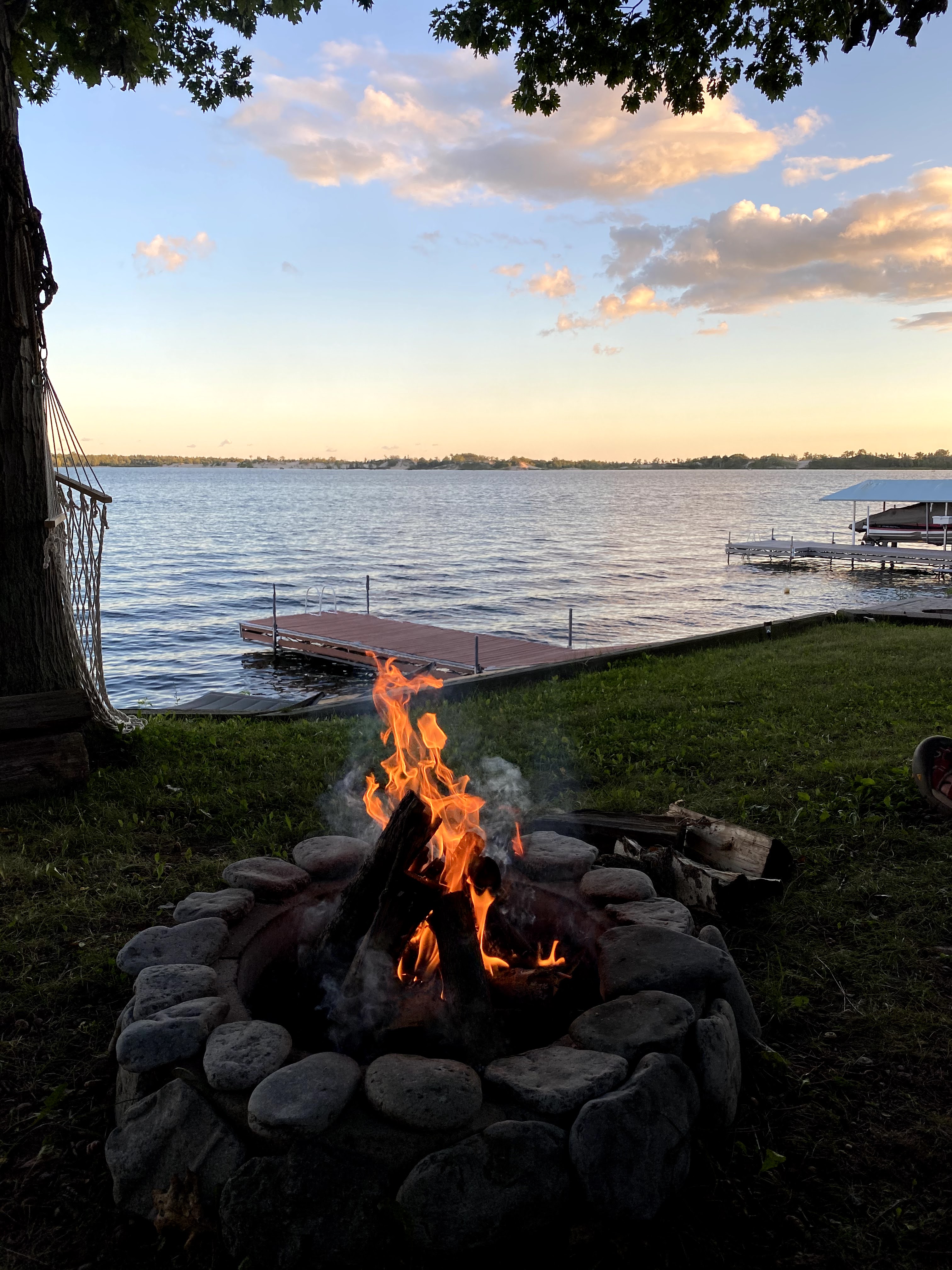
Candles and campfires

The sermon today is about containing the flames. Recognizing limits. Respecting boundaries. Without recognizing limits, respecting boundaries and containing the impulse energy, we have problems. Even big ones.

Wildfires are already burning out of control in Western Canada this year (Tait et al., 2024). Hopefully the upcoming wildfire season won’t be as bad as last year’s, when a record eighteen and a half million hectares went up in flames—an area twice the size of Portugal—shattering the previous annual record almost three times over (Milman, 2023). The signs aren’t good. Even locally. I don’t recall ever having a fire ban in effect already at the end of March, as we had early this Spring in the Ottawa Valley.

In the Gospel for today, Pentecost Sunday, Jesus announces limits that we would do well to acknowledge. “I still have many things to say to you,” he tells his disciples. “But you cannot bear them now” (John 15:12). To curb our insatiable desire to know it all now. The limits of knowing everything. The limits of our capacity to understand the whole truth all at once. Can we live with that? Can we live positively in that state of constant unknowing?

What Jesus points to in this Holy Spirit season of the church is our transformation, our growth in the Spirit. And this transformation is not a one-time-event that happens on the surface of things. It is an ongoing process, a deepening journey regardless of our age and life experience. We never stop learning. We never stop realizing that we don’t know it all.

One of my favourite activities year-round but in the summer I can take it outside, is lighting a small flame. Inside, it’s candles. Outside, it’s in a fire pit. But fire pits have a circle of stones or a steel wheel drum encasing, encircling and holding the otherwise dangerous fire.

The shape of the container is important. Most candles and campfires are round. The fire of passion, of love, of deep feeling is contained in the circle. The circular container describes anything we can see in its wholeness and three-dimensional depth, slowly coming into focus. (McGilchrist, 2019, p. 447). How so?

I’ve never thought about it this way, but circular motion actually brings together opposite points. Perpetually. Difference is not something to avoid or deny in striving for unity, for harmony. The unity, the oneness, of which Jesus prayed for his disciples in the Gospel last week (John 17: 11), is not a melting pot where distinctions are suppressed or erased. The truth is quite the opposite.

Two wildflowers growing at this time of year illustrate the value of difference. Canada Goldenrod and New England Aster grow together. Especially when the soil is damp enough, neither normally grows alone in the fields (W. Kimmerer, 2015, p. 40). The gold of goldenrod and the deep royal purple of aster, together. According to botanist, scientist and writer Robin Wall Kimmerer, each by itself is a “botanical superlative” (p. 41). Together, however, the visual effect is stunning. Purple and gold.

Why do they stand beside each other when they could grow alone? A random event that just happens to be beautiful? But Einstein himself, the consummate scientist, said that “God doesn’t play dice with the universe.”

According to the colour wheel, of course, purple and gold are complementary colours, as different in nature as could be. In an 1890 paper on colour perception, Goethe, who was both a scientist and poet, wrote that “the colors diametrically opposed to each other … are those which reciprocally evoke each other in the eye” (cited in W. Kimmerer, p.45).

So, why do goldenrod and asters grow together and not apart, alone? Because, in short, pollination.

Though bees perceive many flowers differently than humans do, due to their ability to perceive additional spectra such as ultraviolet radiation, it is not the case when it comes to goldenrods and asters. “As it turns out, golden rod and asters appear very similarly to bee eyes and human eyes … Their striking contrast when they grow together makes them the most attractive target in the whole meadow, a beacon for bees … Growing together, both receive more pollinator visits than they would if they were growing alone” (W. Kimmerer, p. 46).

To perceive contrast and difference, is better for the whole. In our growth, spiritually, we see the world more fully when we see both, when we recognize and value difference. Belonging to the circle, being one with another is a statement of faith that in our diversity we find unity. In our differences we grow and benefit not only ourselves but the whole world.

The church is not an exclusive country club for a select, elite few who are like minded and all look the same. The church is for all. The church realizes its true identity the more diverse it is, the more variety of people we encounter in the circle is a testimony to the truth of God’s design, God’s reign. It was true on that first day of Pentecost (Acts 2:1-21). And it is true today.

The circle of our planet’s atmosphere protects us, on a large scale, from the sun’s fire. The northern lights, or the aurora borealis, are beautiful dancing ribbons of light that have captivated people for millennia. Some of you got up in the middle of the night last week to witness this cinematic atmospheric event in Canada. But for all its beauty, this spectacular light show is a rather violent event. 

The northern lights are created when energized particles from the sun slam into Earth’s upper atmosphere at speeds of up to 72 million kilometres per hour. But our planet’s magnetic field protects us from the onslaught (Space.com).

We need containment, as humans, why? Because our love is not perfect. Our love fails time and time again. And we give in so often to the dangerous fires of hatred and impulsive action that excludes and harms others.

Nevertheless, there are moments. Our human perspective can perceive moments of the unbounded, universal, fire of God when we literally and spiritually look to the heavens. This incredible power, witnessed by God’s creation, is a power reflecting God’s love for us all.

God’s fiery love cannot be doused. God’s love reigns. Because the “ruler of this world has been condemned” (John 16:11). The ruler of our hating impulses, the ruler of our retributive justice, our violence, the ruler of the unbridled flames of this fire will be doused. And the reign of God will unite and hold us all in loving embrace forever.

References:

McGilchrist, I. (2019). The master and his emissary: The divided brain and the making of the western world (2nd Ed.). Yale University Press.

Milman, O. (2023, November 9) After a record year of wildfires, will Canada ever be the same again? The Guardian. https://www.theguardian.com/world/2023/nov/09/canada-wildfire-record-climate-crisis – :~:text=Fire ravaged Canada in 2023,record nearly three times over

Tait, C., Woo, A., Link, H., & Arnett, K. (2024, May 14). Fort McMurray residents to evacuate as wildfire approaches community. The Globe and Mail. https://www.theglobeandmail.com/canada/article-fort-mcmurray-residents-ordered-to-evacuate-as-wildfire-approaches/

W. Kimmerer, R. (2015). Braiding sweetgrass: Indigenous wisdom, scientific knowledge and the teachings of plants. Penguin.

And so it begins

The chancel on Pentecost-Confirmation Sunday (Faith Ottawa, photo by M.Malina, 2023)

Dear Confirmands,

Confession: Over the past two years of meeting and Confirmation programs, we’ve barely skimmed the surface of what we can know about the Christian faith from a Lutheran perspective:

We’ve just scratched the surface of the biblical story and sacraments. We’ve only dipped our toes into the shallows of the otherwise deep waters.  We’ve said the Lord’s Prayer together and read through the Creed. We’ve talked about the Commandments and affirmed Article Four of the Augsburg Confession—that we are saved by grace alone and nothing we can do or know will ultimately save us.

And maybe that’s the point. Because here we are confirming you today! Despite what from one perspective can be seen as a rather lean program. And yet our action today underscores this fundamental Lutheran belief: We cannot by our own strength and efforts earn God’s favour.

Many of our senior members will be eager to tell your stories of large confirmation classes where they had to sit for hours memorizing scriptures, learning by heart the entire catechism and singing the Reformation hymns like “A Mighty Fortress is Our God”. And that’s not even describing the anxiety surrounding the final exam before their confirmation.

Another confession: I think we have long passed the day of doing confirmation that way.

And still you are today being confirmed in the faith. Besides affirming we are saved by grace alone, our action today underscores another very important understanding of our faith: Confirmation merely emphasizes you are at the start of a journey today, not the end of it.

Over the last several months groups of Lutheran youth leaders from around the world—specifically from Africa, Europe and the Americas—gathered to set priorities for the church today. These priorities will be part of the deliberations at the Lutheran World Federation Assembly in Poland which I will attend in September later this year.

Some of these priorities agreed by Lutheran youth leaders, ages 18-30, were: eco-theology, justice in community, inclusive and accessible churches, youth leadership and mental health.[1] Clearly there is a future for the church because there is so much to be done by you and others your age. And you’ve already started on this journey:

Even though you didn’t memorize anything, or read through every word or explanation in Martin Luther’s catechism, you did feed the hungry and provide clothing to the poor. You did plant a garden. You did, by handing out coffee and slices of pie, put a smile on the faces of homeless people in downtown Ottawa. You ate together, shared laughs and silly stories. You engaged in service projects around the city. You worshipped and prayed together.

But it’s not over. Those activities can and will happen again. The one word we should eradicate from the lexicon and culture of Confirmation Sunday is ‘graduation’. You are not graduating today. You haven’t completed anything, really.

Today is not a graduation. It’s really the start. It’s a journey you are on—we are all on—to grow in faith. That’s why each of you is receiving the gift of a small tree–a white spruce. Because like anything that grows, it will need regular care and nurturing. And it will grow over time.

You may doubt everything we do today. And that’s ok. It’s a journey. You may not be sure of God today and what God promises you. And that’s ok.

It’s ok because what we did accomplish these past couple of years was community. Not perfectly. But we related with one another, and spent time together doing meaningful things. We got to know each other a bit. And when one of us was missing from class, we asked about them—where they were and how they were doing.

And that’s what the church today needs: Forming relationships in faith. And maybe for some of us older ones, re-forming relationships of faith.

Confirmation is an affirmation of faith—a saying yes to everything good. To our baptism. To God’s grace. Saying, even though we may not be 100% sure and even though we don’t know everything, we do know this:

God loves you and God will be with you forever. God loves everyone else and will be with us forever.


[1] Scan recent posts in the Lutheran World Federation Youth Instagram account @lwfyouth https://www.instagram.com/lwfyouth/

And so it begins”; a sermon for Pentecost-Confirmation Sunday, by Rev. Martin Malina, May 2023