
A verse from Saint Paul captured my attention this week. He writes to the Romans: Do not be conformed to this age, but be transformed by the renewing of the mind, so that you may discern what is the will of God—what is good and acceptable and perfect (12:2).
Life in Christ, being a Christian, being faithful means renewing your mind. During this season of Lent, we are called in the liturgy to repent and return to the Lord.
Repentance means “an action or process” (Miriam-Webster Dictionary) of changing something. It is a changed action as much as a change of mind, toward what is good and right.
What stops you from living out the best version of yourself? Because God has entrusted you with gifts. I know many of you share your gifts with others and the church. There are many! And there are different kinds of gifts. But sometimes we hold back. Sometimes we feel we don’t have what it takes. So, what keeps you from celebrating those gifts and offering them in the community?
Thankfully, the Gospel of Luke emphasizes the persistence of God’s mercy and grace despite the stubborn obstacles that keep us from experiencing the joy of life in Christ. In today’s story from Luke 15 – the famous story of the Prodigal Son – it is God’s grace in the wake of estrangement, sin, and jealousy.
The focal point in the story is, of course, the youngest son who leaves home. The reader is invited to follow his story, his perspective. We are drawn to his journey. This is the person of interest.
It’s not that God doesn’t identify with the Father’s actions. It’s not that God doesn’t care for the older son, or any other character in the story. But God is particularly interested in the Prodigal Son.
Why? Is it because this person changes? The youngest son follows through on a different course of action when he realizes that things are not working out very well for him. So, when he hits rock bottom, he changes direction. That’s the gift, the grace upon which this story hinges.
It’s not to say, “Go and make mistakes!” It’s not to say, “Go, intentionally hit rock bottom in your life!” No. Rather, it is to say, “Don’t let your mistakes keep you from continuing to act, reaching out, trying to do good.” It is to say, “Don’t let fear keep you from taking risks, changing your tack, and trying something better.”
But beware! For those who value action—doing something—and want to do better to repair the problems in the world, we may be tempted to cheat and take a short cut.
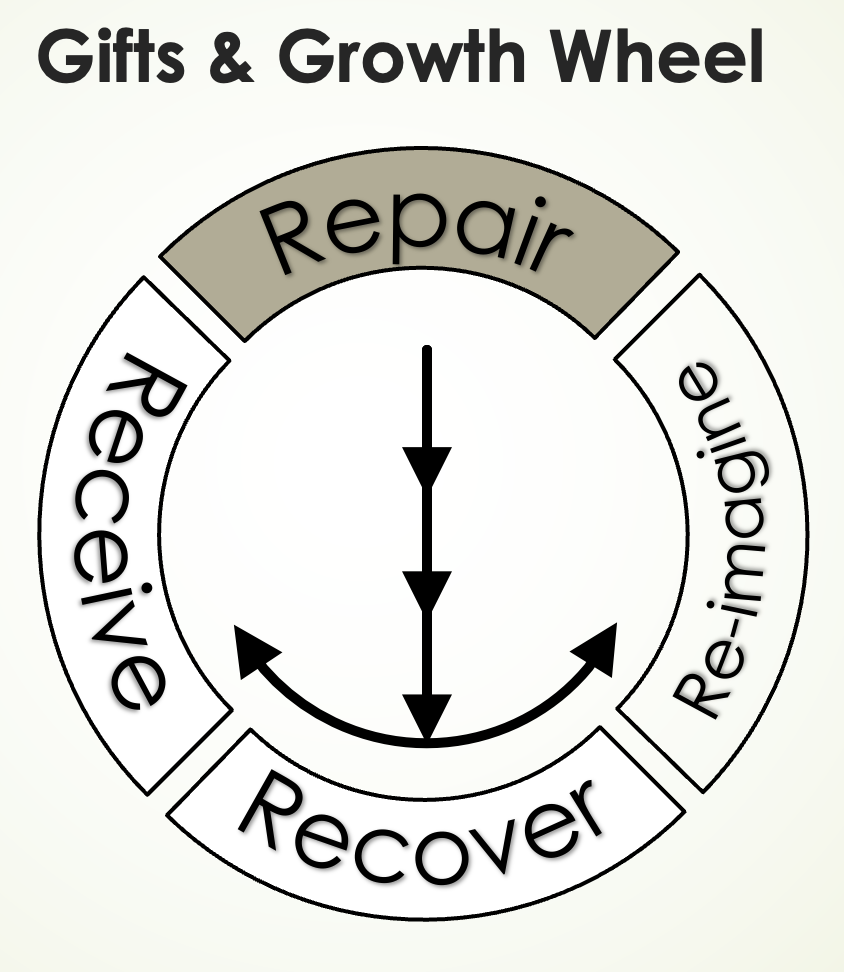
Because to go to the thinker/Re-imaginers closest to you on the Wheel first, this might keep you trapped in justifying inaction, ironically. There’s always a reason, a rationale, not to do something, even good. We may over-think it.
Or, if you first go to the Receivers closest to you on the other side, you may trip into despair and isolation. In other words, you may just give up. It’s easy to get discouraged when your action, your work, your decisions take a downward turn.
No, for the action-oriented person to grow, they must first cross the floor and visit the Recover quadrant on the opposite side of the Wheel. To recover the heart, the feelings, the source of one’s identity. To recover the story of one’s life. To recover a sense of belonging to oneself, to others, to creation and to God. The heart-centred gifts of others will complement your own. You need them as much as they need you.
A concrete way to do this is to recover the lost traditions, rituals of one’s own faith and history. To find the anchor, again. And like a rubber band, to pull back in order to fly ahead with integrity and effectiveness.
But this means changing directions, changing one’s response to the world. What are some examples of right action?
Ask for help when you need it, seek forgiveness, embrace with open arms someone who has chosen a different path, embrace with open arms and accept the person who holds different values than you, take the initiative to reach out to others, to be with them and do good things together with them, care for creation with concrete acts of generosity and grace, vote in elections, commit to a spiritual discipline and practice of daily prayer, act and make different lifestyle choices, for the better. Etc. Etc.
In recent history, who are people you know who have experienced changes in their lives because of their faith? Who might first come to mind? In our church history it may be the likes of Martin Luther from the 16th century, and even Dietrich Bonhoeffer in the 20th century. But what about Martin Niemöller, who was a contemporary of Bonhoeffer’s? Have you heard of Martin Niemöller?
Martin Niemöller was a German Lutheran pastor. Most North Americans associate his name with the famous words inscribed on the wall of the United States Holocaust Memorial Museum in Washington:
First they came for the Communists
And I did not speak out
Because I was not a Communist
Then they came for the Socialists
And I did not speak out
Because I was not a Socialist
Then they came for the trade unionists
And I did not speak out
Because I was not a trade unionist
Then they came for the Jews
And I did not speak out
Because I was not a Jew
Then they came for me
And there was no one left
To speak out for me.
“Pastor Niemöller wasn’t just being poetic. That’s his life story. He was a German nationalist who, in the 1920s and early 1930s, supported Hitler and the Nazis. He hated Communism and socialism and workers — he believed that they had betrayed Germany in the aftermath of WWI. He worked against the Weimar Republic, thinking it to be politically weak and corrupt. Indeed, Niemöller voted for the Nazis, even in the 1933 elections which handed Germany over to Hitler.
“In short, Martin Niemöller not only did not speak out. He actively worked for a political movement to go after Communists, socialists, workers, and Jews … anyone whom he believed undermined the honor of the German nation.
“But Niemöller began to change his mind when Hitler interfered with church policies and applied racial tests to both clergy and laity, even insisting that German churches refrain from teaching or reading from the Old Testament.
“Niemöller’s resistance started when the Nazis applied their brutal and racist agenda to the church — Niemöller’s church, the community he most cared about, was vowed to serve, and led.” His changed action came about because he recovered the heart of his faith, his identity in the church, and the practices that made him Christian. And acted on it.
“Then, [Niemöller] realized that they were coming for him, too. It took him a while. It was a process. But he spoke out. He preached against Hitler and Nazism. He was one of the founders of the Confessing Church. He was detained several times between 1934 and 1937. Then, in 1937, he was arrested for treason and spent the next seven years in various prisons and concentration camps, including Dachau” (Butler Bass, 2025).
After recovering their authenticity, their true identity, action-oriented people can become Repairers. Being a Repairer as a spiritual gift is a greatly needed gift today. It is doing the right thing at the right time which will have positive effects even when those effects might not be immediately apparent. The church needs more Repairers today especially.
The last few weeks we have visited three of the four quadrants on the Gifts and Growth Wheel. Are you a Receiver – someone who reminds the rest of us of the faithfulness, the grace and the prevalence of God’s mercy? Or, are you a Re-imaginer – who thinks and reimagines a vision of God’s meaning and purpose in today’s world? Finally, are you a Repairer who will act righteously and guide others into active service in Christ’s name?
We have one more quadrant to visit next week. And no matter where you begin on this Wheel, we need everyone’s gifts to balance the wheel and help empower the church to faithfulness as we seek – like the Prodigal Son – to return to our home and be embraced by the Father at the end of all our toiling. Thanks be to God!
References:
Butler Bass, D. (2025, February 19). Forget Bonhoeffer. This is the Niemöller moment [Blog]. The Cottage/Substack. https://dianabutlerbass.substack.com/p/forget-bonhoeffer-this-is-the-niemoller?utm_campaign=email-half-post&r=66hlp&utm_source=substack&utm_medium=email
Miriam-Webster Dictionary. (2025). https://www.merriam-webster.com/dictionary/repentance
 Raspberryman