The pathways through the forest are tricky, these days. With winter and spring battling it out for seasonal supremacy, the snow-melt leaves walking paths uneven and icy. It’s a challenge simply to keep on the path.
I make my way through the Grove with a destination in mind. But the forested parkland is marked with a web-like array of criss-crossing trails of dog-walkers, ski-enthusiasts, snow-shoers and joggers. So I leave it up to the inspiration of the moment to choose which path I take, keeping in mind where I eventually hope to end up.
But there are options. I’m reminded of the Psalmist who doesn’t just talk of one path describing the Lord’s way, but of many: “All the paths of the Lord are steadfast love and faithfulness” (Psalm 25:9-10). And so I have some fun deciding which path to take; that is, which one is suited more to my abilities and interest on that day.
In describing the kingdom of God to Nicodemus, Jesus talks of salvation, and being born again (John 3:1-17). In case Nicodemus is tempted to believe life events such as birth and re-birth are something he can direct and control, Jesus talks about the nature of God’s work in the matter: “The wind blows where it chooses, and you hear the sound of it, but you do not know where it comes from or where it goes” (v.8). There’s a wild, free, untethered quality integral to the journey of life and faith.
To be sure, some pathways are easier — wide, flat and well-trodden. Others require me to focus more my attention on where I place my feet, lest I trip over an exposed tree root or sink into foot-deep snow. One thing is for sure: It’s very satisfying to discover a new path I never knew was there, a path that gives me a new perspective on the forest, regardless how uneven or narrow it is.
To the casual observer I may appear directionless, lost, wending my way around and through the Grove. Some may wonder what I’m doing in there. Is there not something more productive I should be up to rather than wandering in the forest? Sometimes going to worship, participating in activities of the church, engaging the ministry and mission of God in the community may seem rudderless, unproductive.
This faith journey can appear to some rather cavalier and pointless — a glorified hobby of self-indulgence and of no real consequence: Because Christians like everyone else suffer and experience the difficulties that everyone does. What sets us apart? Why bother?
When the hardships come as they do to us all, the journey of the faithful starts to nudge at something deeper inside us. Deep down, though on the surface it may look otherwise, we know we are not lost in our wandering. We look up, from time to time. When the journey gets difficult, it’s natural and rather tempting to look down all the time, to be constantly turned in on oneself, to see only one’s own problems and disregard altogether the world ‘out there’.
When the journey of life gets difficult, our hearts are nevertheless open and free to accept the gift of faith. This gift of faith declares in our hearts the conviction that: I am not alone, in this dark, dangerous forest of my life. I am not alone.
There is a broad consensus that Psalm 121 was not expressed in the faith life of ancient Israel by individuals, on their own, by themselves. In other words, these words weren’t spoken originally between one person and God. It’s not about ‘me and sweet Jesus’.
It was a song sung responsively as a congregation, an assembly, a caravan, on the road together from Jericho — some 1500 feet below sea level — up to Jerusalem where God’s presence awaited in the temple of the Lord. The structure of the poem suggests a question-answer kind of liturgy between various voices — voices assuring one another of the hope they had on this dangerous road. A hope they would find by lifting their gaze towards their destination.
In this stance to life, individuals would be guarded against falling into the trap of feeling isolated in their suffering. At the same time, the different voices would challenge any potential “misery-finds-company” quality in relationship. Ample differentiation in the community encouraged the paradox of ‘hopeful realism’ on the journey of life; that is, on the one hand not denying the pain of the journey; but, doing so in the conviction that ‘death has not the last word’.
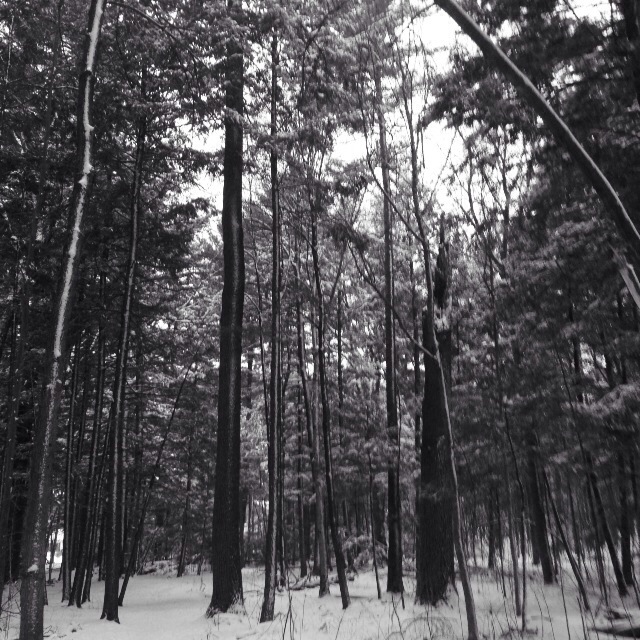
The predominantly old-growth stand of Hemlock trees in the Grove through which I wander contrasts with the white of snow on the ground. Even during the brightest part of the day, this is a relatively dark spot in the forest. And I can’t see where the path leads through the thick, coniferous growth. Nevertheless, I can’t help but occasionally look up, with a smile on my face. The trees reach to the sky, reminding me of the direction of our faith.
When we step out on our journey — whatever that journey is — we can do so with confidence and trust in the One who calls us and sends us out on the path. You may be embarking on a new journey in your life — a journey to change jobs, move to a new home, a journey of exploring a new relationship, or renewing old ones; your journey may be a challenge to live with the reality of increased physical limits, or, dealing with a newly diagnosed illness. You may find yourself at a cross-road in your life. So, what do you do?
At those moments of decision and sometimes despair, think again when you are tempted to feel that you are lost, and that you are alone on this journey. Because you belong to the church — the Body of Christ — to share in prayer and song on this road we travel together. And you know, in faith, the end of the story, the end of the road — which is good.
Some helpful thoughts on the journey of faith come from Charles Foster’s “The Sacred Journey” and Alan Roxburgh / M.Scott Borden in “Introducing the Missional Church”


 Raspberryman