
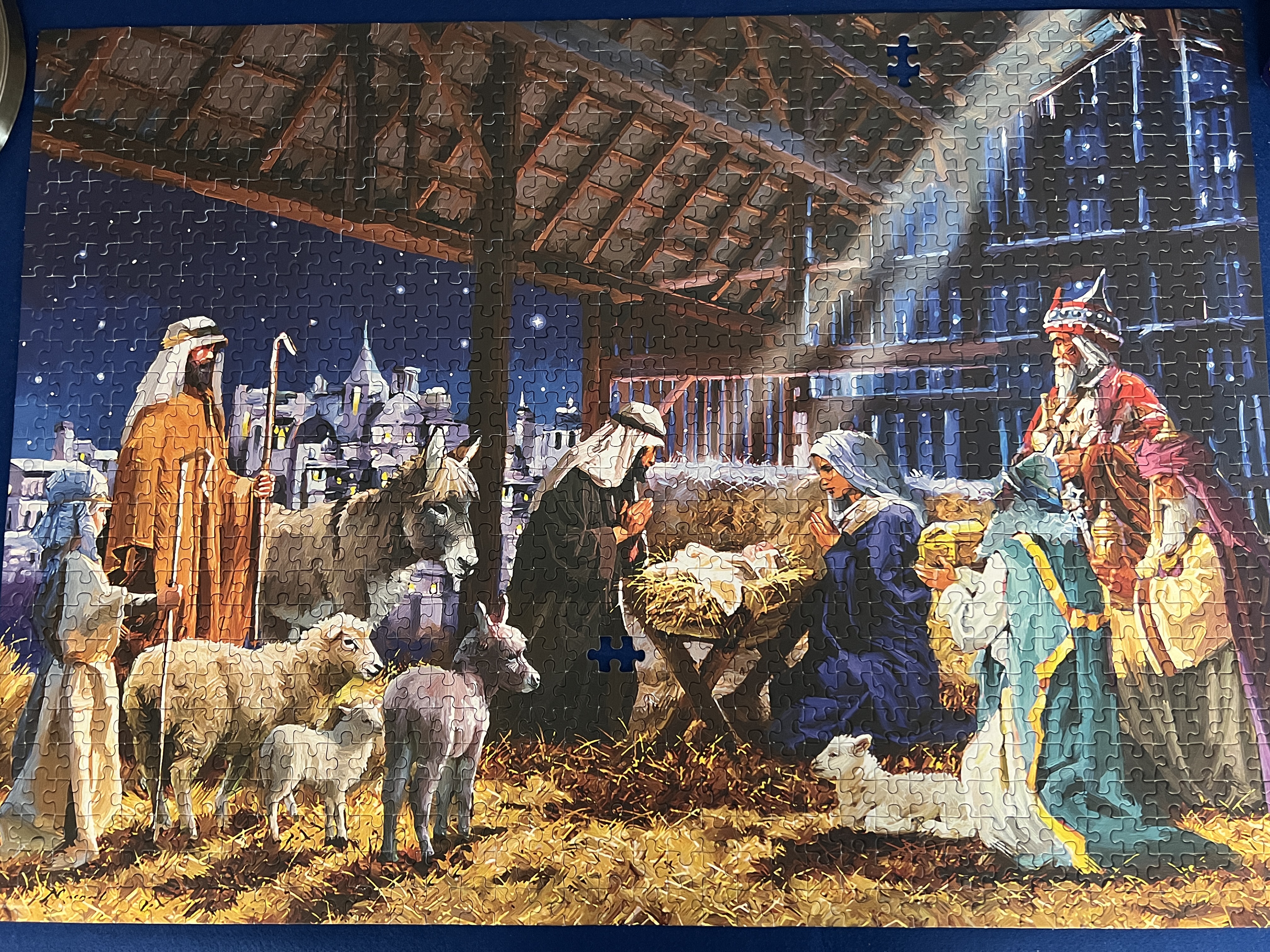
It is finished! The 1000-piece nativity puzzle is now done. Thank you to all who contributed – whether you fitted only one piece or sat for hours in the narthex over the past month and a half, putting it all together. It is complete.
Or is it?
Upon closer observation of the photo above you might notice there are two pieces missing. Just two, out of a 1000. But two, nonetheless. Sucked up in the vacuum cleaner, stuck on the bottom of someone’s boots, or dropped inadvertently in someone’s pant pocket. Who knows? How does that make you feel?
You might think, like me, of parables in the bible where Jesus leaves the 99 sheep to go searching for the one lost sheep (Luke 15:1-7), or the parable in which a woman searches her whole house to find that one, lost coin (Luke 15:8-10).
Whatever you may want to say about Paul’s writing in his letter to the Corinthian church, it has a clear meaning: Every piece matters. Every part is important for the whole (1 Corinthians 12:12-31a) to function well. All the gifts perform vital roles for the overall health and wellbeing of the body.
Paul even goes as far to say, “those members of the body that we think less honorable we clothe with greater honor, and our less respectable members are treated with greater respect, whereas our more respectable members do not need this” (v. 23-24).
In her book Fierce Love, the Rev. Dr. Jacqui Lewis refers to the Zulu concept of ubuntu which means, “I am who I am because we are who we are.” This phrase resonates with Paul’s words in 1 Corinthians. We, the body of Christ, are deeply interrelated, united by one Spirit. Perhaps we could say, “I am Christ in the world because we are Christ in the world” (Lewis, 2021, p. 11).
If each of us is worthy because together we are, this leads us to ask a very relevant question for all our families, communities, teams, groups, neighbourhoods, and nations: What parts are missing? Whose voices are not being heard? What members of the body have been ignored, overlooked, even marginalized, treated as unimportant?
In preparation for the annual meeting later this winter, the council is now searching, as we normally do at the end of terms, for a couple new members to serve. In choosing leaders on council, we can ask the same question: Whose voices in the congregation are not yet represented, nor being heard? Who is not at the table?
I love the children’s book I’ve used for Communion instruction. It’s called, “A Place for You.” The theme is inclusion. That is why in the invitation to the Communion table I will often say, “You are invited without exception.” Because Jesus loves everyone and welcomes all to the table of God’s grace.
The missing pieces challenge us to support and lift up everyone.
In the Gospel for today (Luke 4:14-21) Jesus returns to his hometown Nazareth, the place he grew up, the place where everyone knew who he was as a child. The scroll is given to him – the scroll of the prophet Isaiah – to read publicly. He has no choice which scroll to use. But, from everything Isaiah has to say, Jesus chooses this one particular text.
He could have read anything. The prophet’s words fill a big book, some 66 chapters long. Yet, Jesus focuses on this part. He makes it a point to remind the good people of Nazareth whose marginalized voices God has heard, and whom now God’s people are called to lift up.
What captivates the crowd, as all the eyes of those in the synagogue were fixed on him, was that Jesus distinguished himself, his new role, his mission now as the voice of God to declare what people of faith were called to do with Jesus: to bring good news to the poor, to release the captive, to recover the sight of those who are blind and let the oppressed go free – the economically poor, the incarcerated, the disabled, and the migrant. They belong at the table, too.
This is now the job of the body of Christ to proclaim, in our words and actions. How do we proclaim the words of Jesus in our daily lives? How do we follow Jesus?
In the science fiction dystopian television series Silo (Yost, 2023), 10,000 people have lived for decades in an underground bunker in the shape of a cylinder over a hundred floors deep. They’ve lived in the silo because the air outside is poisoned. At least that’s what they’ve been told.
A mechanic, Juliette Nichols, uses a modified hazmat-type suit to leave the silo and survive outside. But all the people inside don’t know where she has gone or whether she’s still alive. People start to question the truth. A rebellion grows.
A group of mechanics living at the bottom of the silo claim those privileged living closer to the top have not been telling the truth about what is really going on outside the silo. The rebels rally around a spray-painted symbol “JL” and chant “Juliette Lives!” to galvanize their faith.
In Jesus’ day, we have to remember they didn’t have microphones. The Nazarenes would pack the synagogue to listen to the speaker. To make sure everyone got the gist of the speaker’s message especially those at the back of the room, those closest to the speaker would repeat in a loud voice together a phrase the speaker just said. This method of getting the word out is called “the people’s microphone,” the practice of amplifying voices without a sound system (Augsburg Fortress, 2025).
This method requires attentive ears—those nearest must hear and respond to the call of the speaker—and it requires the community’s unified work, lifting up the speaker’s voice together.
Yes, “JL” is our call, too. But for us it is “Jesus Lives!” “Jesus Lives!” is a sign of hope for the fulfillment of what is being called upon the living body of Christ today
But if bringing good news to the poor and releasing the captive was Jesus’ purpose and mission, all evidence today points to the contrary. Had Jesus failed? Has the church failed? Many today, I know, feel that it has on many levels. Because so many people still suffer. And will suffer.
Perhaps a vision of a perfect world free from all suffering is not what Jesus meant. Because if we follow in his steps: From that early synagogue worship service to the hills of Galilee, on the road to Jerusalem, and the way of the cross, we discover that suffering is not God’s will.
Rather, what is God’s will is life in the face of suffering. What is God’s will is courage in the face of fear. What is God’s will is faith in the face of doubt and love in the face of hatred and prejudice. God’s will is to call these things out of the hurt and brokenness that we are and that we find around us. “With Christ, the prophecy is fulfilled, in you and in me” (Evenson, 2025). Because “JL!” Jesus lives. Thanks be to God!
References:
Evenson, B. (2025, January 26). Comments from the cloud of witnesses; Third Sunday after Epiphany /lectionary 3, year C. Augsburg Fortress. https://members.sundaysandseasons.com
Lewis, J. (2021). Fierce love: A bold path to ferocious courage and rule-breaking kindness that can heal the world. Harmony Books.
Yost, G. (Creator). (2023-present). Silo [TV series]. Apple TV+.















 Raspberryman