Transforming vision

One of the most impressive cinematic visual effects in recent years comes from the “Transformers” film, when for the first time we see how a yellow Camaro is transformed before our very eyes into the character, Bumblebee – the mechanical, robot-like giant. Every part of the sports car shifts, rotates, elevates, turns and clicks into a new position in matter of seconds, revealing a completely different being – from car to robot.

But that’s just it: Every part of the car is necessary in the transformation. In other words, each piece of the car finds a place in the robot: the fender becomes the forehead; the headlights become the eyes; the tires become part of the joints in elbows and knees, etc. Nothing is discarded. The automobile – literally – is just changed, seen in a new light.

I suspect sometimes we resist the notion of our transformation because we anticipate or feel un-genuinely forced into becoming someone we are not. Especially in the church. On the other hand, we may resist the notion of our transformation because we are so convinced that there’s nothing good in our lives to begin with. So, what’s the point?

Because of these hang ups, we may give up. And we discard altogether the notion of ‘change’, defending the status quo of our lives even when we are not happy with the way things are. We justify philosophies that insist that human nature never changes; people will always be the same. And what is more, our nature is evil and beset forevermore with sin. If there is any good within us, it doesn’t last long and we cycle back into sinful patterns. Cynicism reigns supreme.

We can’t, however, ignore the witness of the Holy Scriptures. I don’t have to give you a complete catalogue of examples from the Gospels that shows how people around Jesus change. Whether directly the recipients of Jesus’ healing touch, which is obvious; or, the way the disciples – by the end of the journey with Jesus do exhibit moments of ‘aha’! Just read again the Easter stories such as the Emmaus walk (Luke 24:13ff), and the confident confessions of faith from the disciples – the likes of Nathanael, Peter, and Martha (Matthew 14:33;16:16; John 1:49;11:27).

It is evident from the witness of Scripture that if the disciples are not completely changed by the end of the story, they are certainly a journey that is changing their lives, forever (i.e. transformation).

But it takes time. It is a journey, after all. If the disciples are like the yellow Camaro in the film, “Transformers”, changing into Bumblebee, their transformation is more like what happens when you hit the slow motion button at that moment in the movie!

But what really changes? Are they still not the same person? After Jesus raised from the dead, the disciples went back to their day jobs – fishing by the Sea of Galilee; though they have seen and touched the risen Lord, were they not still the same people? When Moses came down from Mount Sinai with the Ten Commandments, his facing shining after being in the presence of God – he was transformed, to be sure (Exodus 24:16-17;34:29); And yet he was still Moses – every part of him! When Jesus was transformed into a shining, glowing being on the Mount of Transfiguration, was he still not Jesus – every part of him (Matthew 17:1-9)?

An ex-soldier reflected with a concerned friend how war affects people in different ways: “Most soldiers get sick on the spot after killing someone for the first time; for others, it just whets their appetite for more.”

“Combat changes people,” the friend said trying to explain the traumatic effects of the battlefield on the human psyche.

“No,” the veteran replied. “Combat reveals who they truly are.”

Perhaps we have misunderstood this notion of ‘change’. In our linear, logical ways of thinking, we have perhaps overlooked a deeper dimension of our lives. Jesus changed, yes, on the mountain. But he didn’t really change. He was revealed, if but for a moment, as he truly is. Admittedly, as a mystery to us. And yet, we, with the disciples, get a glimpse of his divine nature, in this story. We don’t see a different Jesus. We just see a little more of who he really is: Someone beyond all human understanding, at very least.

This may not appear a satisfying answer for inquiring minds. Neither was it for Peter, James and John. At first, Peter belts out in pious bravado: “It is good Lord, that we are here!” (Matthew 17:4) It doesn’t take too long for Peter and his cohorts to fall trembling, flat on the ground, terrified of what they are seeing (Matthew 17:6).

How do we make sense of this incomprehensible God? What do we do when all our assumptions are shaken at their core? Who is God? Who is Jesus? What is happening, here, in my life?

I consider this story of the Transfiguration of the Lord a template, an allegory, for most experiences of our lives that we would view as ‘life-changing’ – good and bad experiences. Any event of our lives that brings us to our knees in fear and uncertainty: whenever we find ourselves wondering, “Why, Lord?” Or, on the other hand, whenever we are able to raise our hands in praise of God’s goodness, standing before a wondrous act of God.

In either case, the end of the story is more about God the Creator and Jesus, God’s Son. When the disciples are slain in fear on the ground after witnessing a most spectacular special-effect display of divine mystery and wonder, when Jesus notices the trauma of his friends ….

It’s as if, suddenly, all is quiet and all the ‘special effects’ of the Transfiguration melt into the background. Two things come into focus at the end to help the disciples gain their feet again: Jesus’ gentle words: “Do not be afraid”. And, his loving touch.

The disciples, who have just witnessed Jesus, as he truly is, are on the path of discovering who they, truly are in God’s eyes: Loved and touched by the hands of the Creator, soon to be crucified – a touch to ensure them that no matter what – even through death – they will never be alone. God is with them, “Emanuel” (Matthew 1:23), God with us.

We come into our true selves because of who Jesus is, as a reflection of the mystery of the divine. Like a tiny acorn holds the full capacity of being a giant tree, we hold the capacity of everything we yearn to become – because of Jesus. His light shines on us, warms our hearts, and causes our emergence.

It’s our relationship to Jesus, then, that defines our transformation. Listen to the words of Maryetta Anschutz who describes an artist’s creation: “An artist knows that everything he or she creates depends less on the subject matter and far more on the subject’s relationship to the light. In sculpture, photography, painting, or drawing, the artist simply depicts the reflection of light off an object or an idea.

“The still life of an apple can be flat, dull, and uninspiring, or it can evoke emotion, reaction, and transcendence. What evokes the response [the change] is not the object; it is how the artist presents it in the light …” (p.456, “Feasting on the Word” Year A Volume 1, eds. David Bartlett & Barbara Brown Taylor, JKP Kentucky, 2010). We are transformed, each and every ordinary one of us, into the beauty that Christ sees in us, and that we are.

Perhaps the challenge and call upon our lives from this holy story, is first and foremost a call to exercise the vision of God. That is, we are challenged to see anew all that is – the ordinary, the common place, the routine, the unspectacular, the every day. We are called to look upon one another, one self, each other, the people on the street upon the highways and byways of our regular lives – in the light and perspective of God. Not to deny the blemishes that are ever present – the cracks, the brokenness, the sin. But to appreciate the beauty of the way things already are, in the sight and vision of God the Creator, the master Artist.

In this way, then, transformation is neither a threat nor a fright. It is permission to become, and let emerge, what is already there. Hold what is there to the light of Christ, who stands always beside us, beckoning with his loving touch and assuring us, “I am with you always, even unto the end of the age” (Matthew 28:20).

Thanks be to God.

The virus of perfectionism & the healing acme of God’s love

I remember at the conclusion of my qualifying exam as a seminarian seeking a call to serve as a pastor of a church, the lead examiner made only one suggestion.

Sitting before the bishop and an examining committee for over an hour –  hearing me answer questions about church doctrine, dealing with conflict, upholding the Gospel in a pluralistic society, defining God’s mission, etc. – I remember being taken aback with their summarizing statements at the end of it all:

They said, essentially: “From the sounds of it, Martin, you will have to work on one thing. And this may cause you problems down the road if you don’t navigate this issue well. So this is what you will have to practice, right from the start …

“The first time you lead worship one Sunday morning as a pastor of that congregation, when you notice the paraments on the altar are crooked, or not hanging in a symmetrically-perfect fashion, resist at all costs the urge to correct it.”

Here I was all concerned about issues of theological integrity, confessional adherence, denominational survival and biblical interpretation of controversial proportions – and what the leadership of the church was most concerned about was not what I believed so much, but how I, a future pastor, would exercise my leadership among the people of God.

At first, I was convinced they were missing the point. But the more I reflected on this and the more mileage I clocked over the years in pastoral leadership, I came to appreciate very much their advice. Perfectionism is like a virus, and can lead to many bad things not only in leadership but in the practice of faith:

Perfectionism is why I give up too quickly on many a handy-man project at home whenever it doesn’t work out the way I expect it to. Applied to a life of faith, perfectionism, I have discovered, leads only to discouragement, depression and a low self-esteem. Perfectionism, closely related to the need to please others, places undue pressure and unhealthy stress on our lives. Perfectionism makes religion out of following a bunch of rules. Perfectionism keeps us stuck in negative, self-depreciating cycles of thinking.

Have you, too, caught the perfectionism bug? Laurence Freeman, recipient of the Order of Canada a couple of years ago, said that his greatest success in life was to learn that his failures were more important than his successes (audio, “The Virus of Perfectionism”, http://www.meditatio.ca). I am certain his comments reflect the testimonies of many successful business people and those who are at the top of their fields who confess that the most important ingredient in achieving success is the long list of the failures that preceded it.

And then we confront a text like we read today (Matthew 5:48) when Jesus says: “Be perfect, as your Father in heaven is perfect.” What are we to make of that? Does God want us to be perfect, and avoid all possibility of failure, at all costs?

I think we have to be very careful in our understanding of this word, as we practice our faith, day to day. As I have struggled with perfectionism I have come to appreciate the flip-side of this coin:

It is born deep within the human soul to want things to be right, proper, good. We are, after all, created in God’s image. And part of this reflection manifested in each other is to seek God’s glory – which is beautiful, holy, perfect, right – full of dignity and yes, perfection.

So, we ought not repress nor deny this natural yearning within our very being. But what is the difference between acknowledging and celebrating this longing deep within us, and falling into the trap of perfectionism?

“Be perfect, as your Father in heaven is perfect.” I suspect we get hung up on the first part of that sentence all too often; but maybe it would do us well to start with the second half of that sentence.

How is God ‘perfect’? We know from the Gospel that should we want to understand God the Father, we need first to look at Jesus (John 14:7). So, what kind of perfectionism – if we can call it that – did Jesus demonstrate?

When folks ask me: “Why did Jesus have to die on the cross?” I approach the question of the atonement in this way: Is there a better way for God to demonstrate God’s absolute and steadfast love for us than by laying down his life for us (John 10:11) – by letting go and giving up that which is most precious to us all? If anything, Jesus’ death proves to us God’s unyielding, uncompromising and unconditional love for each one of us, in a way to which we could humanly relate.

And second, is there a better way for God to demonstrate absolute power over death and Satan for all time, than by God becoming completely vulnerable through Jesus to the consequences of that evil on earth – which was the unjust condemning of an innocent person to death?

Yes, Jesus could have walked away from Jerusalem. Yes, Jesus could have called down the forces of heaven to save him from the Cross and pound the devil to pulp before our very eyes. That might be a more satisfying approach. But that would have been playing the earthly game; that would have been playing by the rules of the forces of evil: force for force, might for might. Who comes out on top?

But Jesus chose to pull the rug out from under Satan’s legs. Jesus chose to limit his divine self (Philippians 2:5-11) in human form, and to suffer and die as a human completely vulnerable to an unjust evil. If anything, Jesus’ resurrection proves to us God’s absolute power for all time over death and the devil.

My favourite part of Mel Gibson’s film, “The Passion of the Christ”, is the last ten seconds of what feels like a very long movie: When Satan realizes, in agony, for the first time how he has been defeated. Now, that’s a perfect ending to a really graphic presentation of Jesus’ suffering and death.

That’s why Jesus died on the cross. To show us how perfect God is, in God’s love for us. We can’t do it perfectly; we will always miss the mark to some extent. But God is “perfect” love (1 John 4).

God’s love (hesed in Hebrew) is steadfast and unbounding, even to the point of complete vulnerability, letting go – for our sake and for all people. Jesus showed us the way of everlasting life for every human being of every time and every place. He said, “Love your enemies and pray for those who persecute you, so that you may be children of God; for he makes his sun rise on the evil and on the good, and sends rain on the righteous and on the unrighteous.” (Matthew 5:44-45)

The way of Jesus is the way to wholeness, completeness, in God’s eternal love, regardless of any and all human divisions within us and out there.

It’s not an easy way, to follow this perfect love. This way of Jesus doesn’t follow earthly rules of power plays, obsessive self-preservation and competitive perfectionism. Saint Paul prayed that God take away the thorn in his side (2 Corinthians 12:1-10). Presumably Paul asked for this so that he could be better at his job preaching the Gospel of Jesus. But God’s answer would nip Paul’s perfectionism in the bud. God’s answer was, ‘no.’

In fact, Paul’s weakness would be a far more effective way of showing God’s power. What would appear as ‘foolishness’ in the eyes of the world, would in truth be an effective witness to God’s power and God’s love, through Paul’s weakness.

God does not want us to be perfect. Because God does not want us to give up. God does not want us to give up on the journey of faith, no matter how difficult or how unpopular it may become at times. God just wants us to be faithful – to stay on the path, to doing what we can – not out of perfectionistic motivations but out of the heart of God’s love and power working through our imperfection.

And I think God wants us to be vulnerable to one another; that we are not afraid of showing and confessing our weaknesses, our shortcomings and our failures to one another. In the church, we don’t have to wear masks of perfectionism. We are, after all, broken people. That is the truth. But Jesus’ body, too, was broken, for the love of the world. And what is the church, but the Body of Christ?

We are vulnerable to each other, open to one another’s pain and one another’s truth, why? So we can find wholeness, healing, on our journey that begins now on earth and finds completion, perfection, in the world to come.

We are vulnerable to each other, open to one another’s pain and one another’s truth, why? So we can share the truth of God’s love to all people, effectively, genuinely and authentically.

Thank you, Jesus, for accepting us in your perfect love. Amen.

If only there were one use for salt

To melt ice

and soften stone cold, unyielding hearts

with words and acts of love, compassion, understanding, gentleness;

To preserve food

and persevere, don’t give up!

for the future is worth the hard work of the present;

To add flavour

Rejoice and savour the simple gifts of life

from what is ordinary, can also yield fulsome taste;

To create thirst

and point to the One, Jesus

who is the source of life-giving water

and who quenches the thirsty.

So many uses for salt

All good, all necessary,

Born from the earth, a grounded creation.

Which is your saltiness? Are you giving it?

Whose other saltiness will you appreciate today?

Because it all matters to God

Last weekend, my family visited the Biodome in Montreal. Situated right beside the Olympic Stadium, it used to house the cycling competitions during the 1976 Summer Olympics. But in recent years it was converted into four distinct and self-contained eco-systems from diverse regions in North and South America.

My favourite was the eco-system from South America, for its lush, tropical environment: humid, warm, pungent air; broad leaf palm trees; and, a host of diverse animals – crocodiles, capybaras and scarlet ibis birds.

Our nine-year-old daughter’s favourite animal is the turtle. She spent a lot of time gazing down onto the mossy ground of the rainforest where the yellow-spotted turtle made its home.

When the guide asked us if we had any questions, my daughter wondered where the baby turtles were. The guide said that it was getting more and more difficult for them to obtain babies since they were very vulnerable in that stage of life; indeed it seems that natural selection is making the turtle an extinct species.

Without their fully developed shell in which the adult turtle could retreat to hide and keep safe from predators, the infant turtles are getting far too susceptible to a premature death and more difficult to protect. Who knows? Maybe the turtle with its shelled existence is going the way of the dodo bird.

The religious people in Jesus’ day felt they were up against a formidable predator in the Roman occupation of Palestine. The Gospel of Matthew was written about the time when the Roman legions were laying siege to eventually destroy the temple in Jerusalem in 70 C.E. and fetter out any Zealots who violently opposed the occupation.

With their temple under attack, the anxious people of God were asking questions of identity and purpose: Who are we and what are we to do? How can it be that God’s holy city and temple are occupied territory? What does this say about God’s relationship with us? How does God want us to respond to this dark and murky reality of life?

This is the social and political context to which Jesus spoke, on the hillside near Capernaum overlooking the Sea of Galilee. This Gospel text (Matthew 5:13-20) forms part of the famous Sermon on the Mount in which Jesus outlined the values and purpose of the kingdom of God “that is near” (4:17).

It is a situation not completely unlike our own. When you consider the history of Christianity over the past two millennia, we find ourselves today in a similar, challenging circumstance: the institution of the church is diminished to the point of demise in many quarters. Christendom, once mighty, powerful and dominant in the western world, is relegated now in our society to the point of obscurity and irrelevance.

Many are asking those same questions: Who are we, and what are we to do? How can it be that God’s nation is “occupied” territory? How does God want us to respond to this dark and uncertain reality of life?

It is a natural instinct for many who, when under stress and pressure and the burden of fear, retreat under the shell – as a turtle does. One response to the perceived threat is to strengthen the walls between sacred and secular. Against the wiles of the crazy, dangerous world ‘out there’ we escape into our private and safe domains of home, property and religious purity. And build a fortress. But is this the right strategy? Or, does it spell, like the turtle, possible extinction?

Amidst the threats against the practice of faith in first century Palestine and twenty-first century Canada, Jesus preaches another way.

Amidst these threats, Jesus challenged Israel to be Israel, just as he challenges us to be ourselves in faith today. Jesus did not say, “You must become salt of the earth by pulling yourself up by your own bootstraps.” Jesus did not say, “You must one day down the road when everything is perfect in the world again, or when you can somehow make yourself worthy of it, become the light.”

Jesus announced, to remind them and us: “You ARE the salt of the earth.” “You ARE the light of the world, right now, right here, in the world as it is, in your life as it is now with all its uncertainty, and in all its darkness.” We don’t have to hide nor retreat behind fortress walls. The solution is in somehow activating saltiness and brightness within us.

So, how do we do that? If there were to be only one way of doing God’s will; if there were only one way of being a Christian – then I’m not sure Jesus would talk in parables and present metaphors and images like salt and light – images open to a multitude of functions and capabilities. Jesus would just spell it out in the letter of the law.

But no. Salt and Light. It’s as if he is saying: Given all the uses of salt, and the various applications of light – how do you fit in?

When Jesus uses the image of light, he makes the point not to hide it under a bushel, but make sure everyone can see it (Matthew 5:14-16). But if others are to see the light, in what conditions do we let it shine? At the noontime of a bright, sunny day?

We will have to shine it in the darkness. After all, people don’t notice a light – whether a flashlight or candle – in the brightness of day. But at night. When all is dark. When you can’t see everything clearly. When the way is uncertain. Where shadows lengthen.

That’s where we are to go. Into places of darkness, in the world and in our own lives: Where people suffer hunger, homelessness and rejection; Where we harbor unhealthy secrets within our souls. This may not seem very religious. This activity may not be easy or make us feel good. But it is where Jesus calls us “to follow him”.

Annie Dillard writes, “You do not have to sit outside in the dark. If, however, you want to look at the stars, you will find that darkness is necessary.” (p.43, Teaching a Stone to Talk: Expeditions and Encounters, New York: Harper, 1992)

Why do we go into the darkness of the world? Why should we take these risks, and expose even our own weaknesses and vulnerability?

Because this world matters to God. All of it. Not some utopic fantasy of what it could be without all the stains of human sin splattered all over the place. But this world in all its complexities, challenges, difficulties, problems.

Just like the weeds and the wheat – what did Jesus instruct his disciples in telling that parable? (Matthew 13:24-30) – To leave the wheat and weeds together, and God will take care of separating out the two when the time comes.

This world matters to God. Our human condition matters to God. Otherwise, Jesus would not have come the way he did:

  1. Jesus appeared in the dust of first century Palestine. Often throughout the Gospels, the writers take pains to indicate the time and place of the event they are recording. For example, the Gospel of Matthew opens with a detailed account, name for name, of the genealogy of Jesus (Matthew 1:1ff). The Word became flesh. God entered humanity, in a specific time and place in history. Jesus fully embodied both human and divine. The incarnation was, and is, not some abstract notion removed from life on earth. Jesus was born into this world.
  2. When Jesus died on the cross, the veil in the temple ripped in half (Matthew 27:51; Mark 15:38), symbolically abolishing the distinction between sacred and secular for all time. No longer would religious life be divided into neat categories that separated the faithful from real life, from engagement with the world as it is.
  3. In the ancient (Apostles’) creed of the church we say we believe in the “resurrection of the body”; by placing value on our own bodies in following Jesus we claim continuity between this world and the next. That means that laughing, grieving, crying, caring, walking, working, making love – doing all those things that are part of regular living in our own skin – these are all sacramental activities. These activities, Jesus preaches, are the building blocks of the kingdom of God.

The stuff of earth matters to God. And that’s why we reflect the light of Christ in the darkness of it.

By going the way of Jesus to reflect his light in a dark world, we discover a great grace: that we already have and are all that we need and God needs, to fulfill God’s purposes for us and for the world, in this time and in this place.

Bane and Blessing

In the popular Brothers Grimm fairy tale, “Rapunzel”, that was in recent years adapted for the big screen in the movie “Tangled”, the main character, Rapunzel, has extremely long hair. This is her gift, it would appear.

But the evil witch has locked her in a room at the top of a tall tower without any entrance or exit except a window near the top. The witch and the prince climb up to the room where Rapunzel lives, by calling for Rapunzel to let down her long hair; they use her hair like a rope ladder.

But Rapunzel never uses her gift of long hair to free herself from her entrapment. While others recognized the gift she had, for better or for worse, why couldn’t she just cut off her own hair? Why could Rapunzel not use her gift, especially if it meant freedom? She had what she needed to be free!

Was it her strong emotional attachment to her hair that prevented her from living life truly, freely? If only she could let go and surrender that which was most precious to her….

In the famous Beatitudes, Jesus described the ‘blessedness’ of those in the kingdom of God. How can we understand this ‘blessing’? This Sermon on the Mount does not read like a self-help manual for the successful, in the twenty-first century. There is something counter-cultural going on here; something paradoxical, even radical.

It seems to suggest to me that to be followers of Christ we must also be able to see in ourselves what we see in others: the bane and the blessing, the good and bad, both/and. It is, on the one hand, to recognize the sinner in ourselves, and to forgive – let go, surrender – ourselves of that sin. And not let it rule us.

To recognize, embrace and confess the poverty of spirit within us.

To explore and acknowledge places of grief and loss in our own lives.

To practice humility with others, a stance that recognizes God as the “source of our life” (1 Cor 1:30).

To identify and name our own hungers, longings and thirst for righteousness.

To be merciful unto ourselves, to begin with.

To search after the purity of our own heart.

To share the gift of peace that is within us.

And to endure the persecution and suffering we all encounter in whatever form, for Christ’s sake.

It’s easy to point the finger, and see it in others, and preserve our own sense of self. It’s easy to do nothing and ‘wait’ for someone to come and save you from your problems (like Rapunzel), without noticing the resources you have yourself to do the right thing, even it means starting by confessing your own sin.

The Gospel of Jesus, while being simple is not easy. Therefore, we need not shy away from seeking after the ‘blessing’ of God upon our lives in our honest, simple, vulnerable selves. We need not hold back from coming to God in all our sinfulness, because God won’t hold back his love to us.

“Consider your own call …: not many of you were wise by human standards, not many were powerful, not many were of noble birth. But God chose what is foolish in the world to shame the wise; God chose what is weak in the world to shame the strong. God chose what is low and despised in the world, things that are not…” Paul writes (1 Cor 1:26-28).

Spiritual greats over the centuries have recognized this truth of God. St Augustine says, “In my deepest wound I see your glory and it dazzles me.” Julian of Norwich put it, “God sees the wounds, and sees them not as scars but as honors … God does not blame us for them.” Paul wrote elsewhere, defining God as one “who creates life out of death and calls into being what does not exist” (Romans 4:17).

On the cross, Jesus reconciled all these divisions in himself (Ephesians 2:10). It was, and is, the pattern of his life with us, as the Scriptures testify: Jesus himself was crucified between a good thief and a bad thief, hanging between heaven and earth, holding on to both his divinity and humanity, expelled as a problem for both religion and state.

His dying – his absolute letting go – upended any religious program that said, ‘You need to earn your worth and favour with God.’ Letting go is the nature of all true spirituality. Letting go is the nature of any genuine reconciliation. Letting go is the engine of meaningful and lasting transformation. And these are all, admittedly, a mystery – a paradox.

For Rapunzel, we cannot blame her for being attached to her hair; after all, it was a gift. Why would she want to cut it off – for any reason? Why would she want to give that up? It was such a deep part of her identity.

When we see Jesus on the cross, we see that our faith is about being ‘attached’ in love. Jesus instructs his followers in the Golden Rule to “love your neighbour as yourself” (Matthew 22:39, Mark 12:31, Luke 10:27).

But there’s a price, a cost, to pay for it. When you love someone, and act out of love for them, there is always the risk of pain and we will suffer for it. If we love, we give ourselves to feel the pain of the world. Love will simply lead us to the cross.

Sometimes the worst possible circumstances in our lives turn out to be the greatest gift – and vice versa. Because our greatest gift can be the source of our downfall; or, at very least, keep us from become the people God called us to be. Yet, it is in the collision and letting go of these opposites, where the blessing is realized.

Listen to the witness of a Catholic priest who visited the Philippines:

“I saw so many shining eyes in the Philippines, yet these are souls who have been eaten up and spit out by life. The Filipinos are a people with so little. I celebrated a Sunday Mass in a squatter’s camp. Shacks all around. Yet they were so excited that ‘Fodder’ was coming. The kids met me to lead me into the barrio. Out of these shacks came kids in perfectly clean clothes. I don’t know how the mothers kept them so clean. They were all dressed up for Sunday Mass. The boys all got their guitars, and it was the big event of the week. They have something we have lost.

“I felt like telling them, ‘You live in a dump by our standards, but do you know what you have? You’re not cynical like we are. You’re all smiling. Why should you be smiling? You don’t have any reason to smile. You live in a shack! It smells like garbage. But you have father and mother and clear, simple identity.’”

Then, this priest confesses: “I don’t know who trained them to do this, but you constantly feel your hand taken by the little Filipino children. They take your hand and put it to their head. They don’t ask you to bless them. They take it from you. It made me weep. For they have their souls yet! They have light, they have hope. The little children call you ‘Fodder, Fodder,’ and I think when they pull blessings out of you, blessings really come forth.

“They are ready for the blessing. They believe in the blessing, and you are not really sure if it was there until they saw it, expected it, and demanded it. These are the blessed of the earth,” he concludes.

These are ones who don’t need to be taught the faith. They live it. They live the mystery of life and death, blessing and loss. They’re okay with paradox, even if they can’t articulate it as such. They don’t need everything explained to them. They just love. And bless. And are blessed.

They, indeed, have the light of Christ. And they know it, deep down, in their souls.

Apart from the reference to Rapunzel and the film, Tangled, most of this reflection is adapted from Chapter 6, “Return to the Sacred” in Richard Rohr’s book, “Everything Belongs”

A public journey

In the opening scenes of J.R.R. Tolkien’s “The Hobbit: An Unexpected Journey” on the big screen, Bilbo Baggins is faced with a momentous choice: Will he respond to the wizard Gandalf’s invitation to join the company of dwarves on an adventure? Or, will he remain safe and sound in the Shire and the comforts of his burrow?

We meet Bilbo as someone who cherishes his home. And we sympathize. We see how much he values the simple and predictable routines that give him security and peace: his regular meal times, his books, and pleasant sits on his front patio smoking a pipe looking upon the passersby. This is when Gandalf first encounters Bilbo with the invitation to join him on an important mission. Nothing comes of it, and Gandalf leaves.

Leading a rather solitary life, Bilbo is disturbed out of his comfort zone one evening soon thereafter when a company of dwarves invades his home, his cupboards and his routines in a boisterous celebration. Initially unawares of the purpose of this offensive invasion of privacy, Bilbo resents the dwarves and all their carousing, indulgence, eating and singing.

Then Gandalf appears again to put to Bilbo their need for a ‘thief’ to join their troupe in an attempt to recover the treasures of the dwarves’ lost kingdom. To comply, Bilbo must sign a contract, promising no guarantee of success or safety on this journey.

Bilbo resists this offer, turning it down flatly.  Too much risk. No guarantees of success. Too much to lose. Early in the morning, Bilbo wakes from his ‘nightmare’ to an empty house. The party is over. The lively group has just left on their journey, without him. All has returned to peace and quiet.

We watch Bilbo as he pauses amidst his seeming peace. We can only guess at the churning of his mind over the experience and invitation of the previous evening. Then, without warning, he erupts with speed and diligence, gathering only a few belongings in a bag. And runs out the door.

What finally convinced Bilbo to join in on this unexpected journey? How did Bilbo embark on this journey that would transform him from a unassuming, small hobbit into the hero of the story? What tipped the scales?

Was it Gandalf’s gentle yet persistent invitations and promptings? Was it meeting people who were real, genuine, authentic, people who would be forming his community on this journey, friends that would stand by him through thick and thin? Did he realize that in all his comfort and isolation and privacy in the Shire, he was missing something essential in life?

The Gospel from Matthew (4:12-23) reads like a grand opening of the start of Jesus’ journey, his ministry. The reading makes a broad sweep across time and scriptures to land at the disciples feet with invitation, and locate Jesus’ ministry in the synagogue at Capernaum. And there, in the synagogue the crowds came to listen to Jesus’ announce the coming kingdom of God.

Last week, from the Gospel of John, Jesus’ first question to his disciples was: “What do you seek? What are you looking for?” (John 1:38) In the Psalm for today (27:4), we read that the Psalmist seeks the Lord in his temple. Indeed, the people come to a public place for worship, to encounter truth, find peace and hear the message of love from God.

If the image of the temple, or synagogue, or church means anything to us today, it is the public gathering place for worship. Our deepest desires are met, not in isolation, but in community. Our deepest longing are satisfied not in the privacy of our individual lives, but in the public realm. It’s a bit counter-intuitive for some personalities — like it was for Bilbo who thought that his life would be complete in the safety, security and solitude of his home and hearth.

But deep down, he must have realized that there was something missing in his self-serving program for life. That his true self, his true calling and his growth as a person lay not in being by himself, but with his friends, in community, together on the ‘unexpected’ adventure of life.

I think this is part of the reason how those first disciples of Jesus were able to drop their fishing nets and follow Jesus, immediately. They knew that following Jesus would enrich their lives in ways no other self-seeking, self-centred, individualistic approach to life could do. Growth in faith is not a private enterprise, but a public expression. Faith is done together, not apart. In this way, we are assured of the eternal support and love from God through all the difficulties of life. And we grow and mature.

In the Psalm, God’s protection and support also includes being placed high upon a rock (27:5) — a vulnerable place to be, where the whole world can see you. Being a Christian and following Jesus is not just about seeking comfort nor is it about keeping things the same. Following God assumes some personal risk, no guarantees, and losing things. But the growth and transformation come about by this journey with others may very well be what we need to get through the dark times.

I was moved reading the story of “a beloved, longtime church member who was wracked with worry about his son. Sunday after Sunday the man returned to the sanctuary. When the congregation sang its hymns, he stood without a hymnal. He listened to the familiar tunes, but he had lost his voice for singing. The congregation’s alleluias felt far off.

“One Sunday he rose during the time of congregational prayer. He offered a prayer of thanksgiving for the people in those pews. He thanked his fellow churchgoers for keeping the faith when he could not, for singing hymns when he could not, for seeing the goodness of God when his eyes were too cloudy to see it.

“To be sure, his concern for his son continued. But he had begun to recognize again the source of his strength. His words were his own, but they echoed an ancient faith: God is my light and my salvation. God is the stronghold of my life. I will sing to the Lord.” (Andrew Nagy-Benson, Feasting on the Word Year A Volume 1, p.277)

The wrong sign

When a road sign indicates something that you don’t expect is the case, it makes me wonder who is behind the seeming prank. What are they up to? What’s their point?

A couple of summers ago when we drove to Florida, a road sign caught my attention. It was hot when we passed through South Carolina and Georgia on the I-95 where many bridges line the route over various waterways and rivers. I can still remember the heat radiating off the hard-top on the interstate.

So you can understand why I did a double-take coming on to several of these bridges seeing a road sign that depicted a thermometer whose temperature hovered around freezing; above the thermometer was shown a car sliding out of control: “Bridge freezes first,” the sign warned.

Are you kidding me? Seriously? On the one hand, the image is true; as a Canadian surviving and driving on our highways during a rather hard winter, I know that when the temperature is below freezing, the highway can be very slippery. But in the southern U.S.? Perhaps last month that was the case there. But I have to confess a deep reservation that they would experience this danger on a regular basis even at this time of year. In fact, we could use some more of that signage up here in Canada.

One of my favourite Old Testament scholars, Walter Brueggemann, once joked in lecture that a metaphor, or a sign, is only good to a certain point. When you make an argument that is supported well by a metaphor, we say it’s a good metaphor. But when the limits of the metaphor become apparent, the one making the point uses the excuse, “Well, it’s just a metaphor.”

I wonder if that’s not the case with some of the metaphors, or images, we read in the bible. Let’s look at the image that describes Jesus as the “Lamb of God” (John 1:29-42) in our Gospel text today. There is something about that metaphor, that sign, that rings very true. But there is also something about that sign that just doesn’t make sense.

For example: A lamb in the temple rituals of the ancient Israelites was offered as a sacrifice to atone for the sins of the people. But if Jesus is now that lamb, why does a wrathful God have to be satisfied by the death of someone, let alone His only begotten son?

After all, God is Almighty. God can do anything. God is fundamentally loving and forgiving (1 John 4:7-21). If God needed to be satisfied by the death of Jesus to atone for our sins, why couldn’t God have simply exercised what Jesus instructed his disciples to forgive “70×7” (Matthew 18:22)? Why couldn’t God forgive, as many times as is necessary (i.e. infinitely), every person on earth in every place and time?

I read this week (pastordawn.wordpress.com) that the actual phrase, “Lamb of God” comes from the Jewish religious rites of Yom Kipper. It was during this festival celebrating the Day of Atonement that two unblemished lambs were brought to the temple to bear the sins of the people. But one was then set free into the wilderness.

The ritual around the Day of Atonement had at its central aim, to be united with God, to be reconciled with God. People were aware of and acknowledged their sin. That is what sin is – when we ‘miss the mark’ in faith. This confession was understood as a way towards that ultimate goal of reconciliation with God, a reconciliation that begins in our life on earth.

What happened to Jesus was an injustice. Jesus dying on the cross was a bad thing. He died wrongfully. Just like so many people today suffer injustice on a large scale – dying in wars, brutalized unjustly. God the Father was first to shed a tear when Jesus died; God is first to shed a tear when one of his followers – that’s us – suffers.

But as is often the case, God makes something out of nothing good. The willingness on the part of Jesus to give his whole self unto a wrongful death carries an important message to us. This is the good news, the Gospel: Jesus death and resurrection gives us permission to live life fully in our humanity. Jesus death and resurrection gives us permission to respond positively to Jesus’ invitation – as he made to Andrew and Simon – to “come and see” what God is all about, to embrace our walk on earth with others in faith. Jesus death and resurrection gives us permission even to embrace our own earthly death.

Because this life on earth matters. We are on the path to reconciliation with God that begins in this time and place. We are together on this faith journey to be united with God. Our lives are being transformed in the waters of baptism and in daily walk in faith. This is good news. As I said, one of the first disciples of Jesus identified in this text is Simon; already, early on in his discipleship, Jesus invites him into the transformed life, symbolized by changing his name from Simon to Cephas – the Rock, Peter.

As the liturgy of Holy Communion articulates it well: Jesus, “who on the Cross, opened to us the way of everlasting life” that is to say, to become fully united with God; to respond to that earthly journey towards union with God, a union that will one day be complete, beyond death.

The word “diabolical” comes from two Greek words meaning “to throw apart.” If something or someone is diabolical, that someone or something is dividing and separating that which could be united and at peace. The evil one tears the fabric of life apart. In contrast, the Spirit of God seeks to make one out of two; the Spirit comes to mend, soften and heal.

“Here is the Lamb of God who takes away the sin of the world!” cries the Baptist. How does Jesus ‘take away’ the sin of the world? The Son of God accomplishes this through forgiveness. Forgiveness is the M.O. of Jesus. Jesus gives his life for us, on the Cross. His sacrifice is an act of forgiveness. And, as such, unyielding love.

Richard Rohr points out that about two-thirds of Jesus’ teachings are about forgiveness; about a third of all the parables of Jesus, directly and indirectly, have to do with forgiveness (p.133-134, Everything Belongs). The growth and positive change that we experience in our lives because of following Jesus come about not because of a fear of punishment from a wrathful, legalistically-bound God who demands sacrifice in order to be satisfied. The growth and positive change in our lives happens through tears of confession and assurances of forgiveness more so than through threats and punishments.

That’s the powerful and most important meaning of the images of Lamb and Cross that we associate with Jesus: Forgiveness is God’s entry into powerlessness, humility. When we encounter the living Jesus in our own lives, we find someone not against us, but someone who is definitely for us!

The goal of faith is not separation, but union – union with God. We may call it getting to heaven, or being saved – however we describe it. But, ultimately discipleship is about bringing together, rather than dividing. True religion is about union. To live in conscious union, relationship, with God is what it means to “be saved”. To be restored, united, in Christ today is to be restored, united within the living Body of Christ, which is the Church. We are the hands and feet and eyes of Christ in the world today.

To exercise a ministry of reconciliation can only be done with great humility and grace. This was the dominant posture of Jesus’ work on earth: that he submitted himself to be baptized by John, that he knelt to wash the feet of his disciples, that he willingly made himself vulnerable in every human way possible, even unto death on a cross (Philippians 2).

Going into the World Junior Hockey Tournament or the Olympics, Canada is always one of the strong favourites. And given the high expectations, and with the entire nation looking on – there is, to say the least, a lot of pressure on the Canadians to win it all. I heard on the news that during the preliminary round of the World Juniors in 2010 in Buffalo, rather than making the mistake of being over-confident and arrogant, the coach then, Dave Cameron, taught his players to be humble in the face of all the attention and competition. Be humble. Interesting – especially in the highly competitive dog-eat-dog culture, we have the Canadian coach teaching his players the value and wisdom of humility.

In the church, and in the faithful living-out of the Gospel of Jesus Christ, however, it’s not some winning and some losing. It’s about doing both, winning and losing – doing both not apart and divided and competitive – but doing both together with grace and humility.

In humility, we can forgive and let go. In humility, we can see the other’s point of view. In humility we can see others as they are, created and loved in God’s image. In humility we can grow in faith in the ministry of reconciliation.

Let us pray that in all that we are and do, we seek to mend, to heal, and to unite that which has been divided in and among, and around us.

The visible signs of unity in the church can be today the most significant. Let’s watch for these signs.

A new baptism

The violin can be one of the most difficult instruments to master. I know, because I try to play it, from time to time. And it isn’t easy to play well. So I appreciated this poem that reflects a baptismal understanding recognizing the touch of God on our lives:

“’Twas battered, scarred and the auctioneer thought is scarcely worth his while – to waste his time on the old violin, but held it up with a smile, ‘What am I bid, good people’ – he cried – ‘who will start the bidding for me? A dollar, a dollar, now two, only two – two dollars, and who will make it three – but no!’

“From the room far back a gray-haired woman came forward and picked up the bow. Then wiping the dust from the old violin, and tightening up the strings she played a melody pure and sweet as sweet as an angel sings.

“The music ceased and the auctioneer with a voice that was quiet and low, said: ‘What am I bid for the old violin?’ And held it up with the bow. ‘A thousand dollars, and who will make it two – two thousand and who will make it three? Three thousand one, three thousand twice and going and gone’, said he.

“The people cheered, but some of them said, ‘We don’t quite understand, what changed its worth?’ Swiftly came the reply: ‘The touch of the Master’s hand.’”

Our lives, sometimes, can be out of tune, and tattered and torn with sin. Our lives can therefore feel ‘cheap’ and useless – much like the old violin. But then the Master comes, alighting our lives with the loving touch of the Spirit of God. God touched us in our baptism and we can never be the same again. We are of priceless worth to God.

Our lives are transformed, changed for the better, when what we do and who we are resonates and harmonizes with the purposes of God. We are in our baptism called to be servants and co-workers with the living Jesus in the ministry of the church.

If there is any similarity between Jesus’ baptism and our baptism, it is in discovering and embracing the unique purpose of our life. What was Jesus’ purpose? His mission?

Because Jesus didn’t need baptism in the same way we practice the first sacrament today. Jesus’ baptism was meant for Jesus alone, in first century Palestine; after all, the heavens were opened “to him” (Matthew 3:16), Matthew records, presumably to him alone. Jesus had a singular and primary purpose to fulfill as the Son of God. It was to be his job alone to take away the sin of the world. Not anyone else’s.

Jesus’ ‘baptism’ was really an inauguration for Jesus to begin his earthly ministry in that time and place. If anything, we catch a glimpse of the intimate relationship between Jesus and his ‘abba’ – God the Father and the Holy Spirit. Jesus is baptized in order to fulfill the purpose of God to bring salvation to us. This is what is meant when Jesus says his baptism is meant to “fulfill all righteousness” (v.15). God was doing something here to accomplish the salvation of the world through Jesus.

And God would accomplish this through Jesus in at least a couple of ways: First, through Jesus, God makes all things new. Just as Jesus transformed the Passover Meal into the Holy Communion, the Lord’s Supper; just as he transformed and gave new meaning to the Hebrew Scriptures; so, he made baptism a new thing.

In response to Jesus’ command recorded in the last chapter of the Gospel of Matthew (28:19) – to go and make disciples of all nations, baptizing them in the name of the Father, the Son and the Holy Spirit – Christian baptism is primarily an act of the triune God. Baptism is done ‘in the name of’ God. In baptism, God acts. Baptism is God’s doing now, not our doing. God is the primary actor.

Through the sacraments God promises to be united to us in love, to bring us into the community of faith, and to nourish us on the journey. Through the sacraments, God promises to adopt us as God’s precious children whom God will never abandon. In my baptism, I believe God promised to love me, to forgive me, to nurture me and stay with me, “even unto the end of the age” (Matthew 28:20), no matter what I do.

We belong to God, we call ourselves Christian, not because we made it that way. But because God wanted us. We are God’s children, and we have God’s touch on us. Thereby, God also accomplishes through Jesus our salvation: by coming to us and being in us, and calling us to serve in the name of Jesus.

God identifies with us — with humanity — by becoming human and going through all the motions of being human. God identifies with us in order to transform out lives. That is what ‘salvation’ means — transformation. Not only is salvation about heaven, but also about being transformed in our lives on earth.

The Belmont Abbey and College in North Carolina was built on property that was once a large southern plantation. In a far back corner of the property, the monks found a huge, granite stone upon which men, women and children stood a couple centuries ago to be sold as slaves.

The monks took the stone and hollowed a little bowl in the top. Then they carried the rock into the abbey’s chapel where to this day it serves as a baptismal font. The engraving on the baptismal font reads: “Upon this rock, people were once sold into slavery. Now, upon this rock, through the waters of baptism, people become free children of God.”

That font is a wonderful symbol of the new life, new beginning, new start we always receive because of our baptism into Christ.

Our baptismal font is placed at the centre of our sanctuary. It is placed there so that every worshiper be confronted by it every Sunday morning. It is placed there so that those who come and go from the church be persistently and constantly reminded that they have been baptized, grafted as members of the Body of Christ, the church, marked and identified as a Christian disciple.

I would ask that each of us remember our own baptism – as Martin Luther did every morning washing his face with water – as an affirmation of our own calling, purpose and mission in Christ. What are we called to do for Christ? What is our unique mission? What have our lives together been formed — grafted — to accomplish in Christ’s name?

When we ‘live out’ our baptismal calling to be God’s hands and feet in this world, in this time and place, we can be confident God says to us: “you are my beloved daughter or son, with whom I am well pleased.”

Thanks be to God.

Thanks to Rev. Joanna Malina for providing me with some of the illustrations described here, from her own reservoir of experience.

When the gift seems strange

Because of the nature of my work, I cannot travel, like many Canadians do, to warmer climes during the holidays. I confess having fantasized celebrating Christmas Day or Easter morning in the tropics.

I imagine watching a sunrise over the liquid horizon, feeling the warm ocean breezes on my sun-bronzed skin and hearing the crackle of palm leaves above me. I squish my toes into the still-cool pristine sands beneath me and breathe in the salty air. I turn to those sharing the scene beside me, and say: “Merry Christmas”. And we burst into singing together, over the thunder of the crashing surf nearby, “Silent Night, Holy Night”.

I have to confess, I would like to experience this one day. I’m putting it on my bucket list. But I wonder: Will I then miss the typical experience of us northerners who are familiar with a winter setting for the celebration of these holy events? Will I feel I have missed something integral to the experience of a Christmas celebration without the frigid temperatures and snow-laden environs?

Those of you who have experienced a Christmas in a setting that is totally foreign to our typical Canadian winter climate, I’m interested in hearing from you. How did you feel? What did you think? Would you do it again?

As I reflect on our time-worn traditions, I confess how often I put so much emphasis on the ‘window dressing’ of the event, as if what makes the experience enjoyable for me depends on decisions I make or on how much I can control the circumstances. However, in all truth, achieving that ‘picture perfect’ Christmas depends in large part on forces beyond my control; for example, the weather. So, I am caught in-between pretending I can manage an ideal experience whose outcome is ultimately beyond my control.

The real question, therefore, is: How can I receive the gift of Christmas despite the circumstances of my life?

After the worship, we are holding our now annual ‘Epiphany potluck lunch’. Considering the origin of this church tradition, we are practising the spiritual discipline of receiving a gift, unexpectedly. Some of the first potluck meals in North America were held in 1843 at St Paul’s Church in Chicago, which served a large wave of German immigrants swelling Chicago. They held regular potlucks — communal meals where guests brought their own food (from a paper written by Daniel Sack on the social meaning of church socials).

But the original practice was in the spirit of spontaneity. The food was provided for an unexpected guest, but according to the ‘luck of the pot’. There was little or no control over what kinds of food people brought. Yet, attendees rejoiced in whatever they received, however mismatched or unbalanced the contents of meal ended up being. It was, after all, a gift.

In the Christmas story called “The Fussy Angel” which I read in worship on Christmas Eve, the angel assigned by God to look over the Christ child on the night of his birth was frustrated with the imperfect, out of control, events surrounding the Holy Birth.

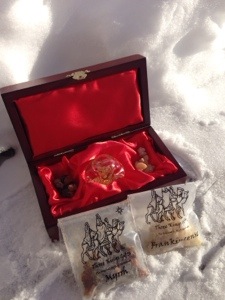
He chastised the Wise Men for their pricey and pretty yet wholly impractical and useless gifts. “If you were truly wise,” griped the angel, “you would have known that what we need is hot water and towels; goat’s milk and bread; twenty diapers and some soap to wash them with.” Not gold, frankincense and myrrh! (p.15-16, Mary Arnold, “The Fussy Angel”, Ignatius Press, 1995). Yet, the Christ child accepts these gifts, however impractical.

The gifts, of course, hold symbolic meaning: the gold – for a king; the spices – used in burial practices of the time.These gifts point to the identity and purpose of God made human in Jesus Christ, whose destination was the Cross and the empty tomb of Easter.

Admittedly, the whole story about astrologers bringing strange gifts to a child in a strange land sounds somewhat exotic, not real.  It is filled with strange incidents, strange gifts, and strangers encountering one another.

At the same time, there is meaning here. Should we but pause to consider the deeper, sometimes hidden, levels of our experience we may appreciate the gift anew, however strange.

The movie “The Best Exotic Marigold Hotel” (Fox Searchlight, 2012) tells of a group of seniors who head off to an inexpensive retirement home in exotic India. As unfamiliar and sometimes frustrating as the experience is, when one character asks why he likes it so much, he replies: “The lights, the colours, the vibrancy; the way people see life as a privilege, not as a right.”

Perhaps Epiphany can open our eyes as well to the holy revealed in what we may have previously thought of as strange, foreign, outside our experience.

Perhaps you have celebrated Christmas and New Year’s this year differently from ‘the norm’ — in a different setting, with different people, outside your comfort zone. Perhaps this Christmas was the first without a loved one. Or, perhaps your life circumstances are changing due to ill health. Admittedly, these are all situations to which, on the surface, we may react even reject outright if we had a choice.

But the Christ child teaches us something important: He didn’t reject those outlandish, impractical and useless gifts brought to him by, of all people, foreigners from the East. Instead, he welcomed them into their home with giggles, gurgles, and laughter.

And this grace, this gift of freedom, is infectious. It liberates us to receive and rejoice in the gifts of life, however small and strange they may at first appear.

20140103-110930.jpg

Spelling the Word

We are in the season of gift-giving. But during Christmas we must also be able to receive those gifts given to us. And receiving that gift, celebrating it, using it – can be just as challenging if not more so than giving.

The question throughout Advent – the four weeks of preparation before Christmas – challenged us to watch and wait, to let go and forgive, to shed those distractions of our lives, to give of ourselves for the sake of others. These were the disciplines of Advent.

But now the gift of Christ is given to us. The Gospel states that the light of the world has come; the light has shone in the darkness, a light no darkness can overcome. This is the gift of God, the life of Jesus, to the world (John 1:3-5)

How shall we receive this most precious gift? And how does this gift make a positive difference in our lives shrouded in darkness?

The answer may lie in how well you can spell. How’s your spelling? I learned how to spell by doing reps; I had to practice spelling a word. I also learned how to spell by getting beyond the disappointment of the mistakes, mistakes which were bound to happen no matter how good I was at spelling.

The famous artist, Rembrandt (1606-1669), painted the “Holy Family” in the 17th century. In the painting, he portrays the nativity as if it were an event taking place in 17th century Holland. The attire and furnishings are what one would find in a typical Dutch home from Rembrandt’s own day.

In addition to Joseph standing and an angel hovering in the background, Mary is seated at the centre of the painting with an opened, well-thumbed book, presumably the Bible, held open by her left hand. Her right hand, on the top of a rocking cradle, has pulled aside a covering to reveal a soundly sleeping Jesus. Mary’s head is turned from the book to gaze upon the infant.

Whether or not Rembrandt intended it, the painting represents different ways to encounter and understand the ‘word of God’:

On the one hand, there are the Scriptures, the book that Mary has been reading as Jesus sleeps and Joseph works in the background. The Word of God is to be found in the Bible. We read the words and find we are addressed by the Word of God. We read them again and again – like learning how to spell. That is why the book is well-thumbed. Rembrandt pictures Mary as one who knows well the word of God and who ponders it in her heart.

But she does not ponder the page alone. She also ponders the infant beside her, “the Word made flesh”, rather than the Word made paper and ink. The Word is a blood-warmed, breath-enlivened human sleeping beside his mother.

I have the impression looking at this painting that when Mary returns to her reading, she will understand what she reads at a greater depth because she has encountered the Word through the Word made flesh. At the same time, when she tends to the child, she will understand the child at a greater depth because she has encountered the Word through the words in the book. Back and forth between Word made flesh and Word through words is the pattern suggested by Rembrandt’s painting.

This is how we learn to ‘spell’ our baptism in Christ — learning not only the words in the Bible, but more importantly for us Christians living in the 21st century, learning to know the living Christ in our hearts and in others and in the world today. “The Word became flesh and lived among us” (John 1:14).

How do we live Christ in the world today? How do we tend to the Christ child in our midst?

Let the light be seen! Let the good gift of Christ within us shine forth anew, for the world to see! Those words are spoken at every baptism to the baptized: “Let your light so shine before others that they may see your good works and glorify your Father in heaven!” (Matthew 5:16). The light wasn’t meant to be hidden under a bushel, but put on a lampstand (Matthew 5:15)!

You hold the light of Christ in your heart. There is no justification to hide it. There is some good there that the world so desperately needs. And you have it!

A royal priesthood we are! A holy nation! God’s own people! In order that we might proclaim Christ (1Peter 2:9). Martin Luther argued for the ‘priesthood of believers’. In other words, we all receive the grace of God for ministry, not just the religious professionals. That is why the baptized receives a crown – we are all now princes and princesses in the kingdom of God.

How do we live out our priesthood?

Another artist, perhaps not as well known, lived during the same time as Rembrandt. George Herbert’s life (1593-1633) overlapped with Rembrandt’s. Although the poet and painter may never have met or even known of each other’s work, I find it interesting to consider Rembrandt’s “Holy Family” in light of some lines from Herbert’s poem that resonate with the first chapter of John’s Gospel: “We say amiss, this or that is; Thy word is all, if we could spell.”

How do we ‘spell’ the Word of God? Listen to a portion of a poem written by Thomas Troeger (in Feasting on the Word Year A Volume 1, WJK Press, Louisville, 2010, p.189-193):

“How do you spell the word? /Where do you search and look – /Amidst the chaos and cries you’ve heard /Or in a well-thumbed book? /Hold back the swift reply, /The pious, worn cliché … /Instead, let all you do /Embody truth and grace, /And you will spell the word anew /In every time and every place.”

I must admit I had to practice a few times spelling ‘Kirubakaran’ before getting it right. Every name has meaning – this is also something we learn from the Christmas story: starting with the name of the newborn Messiah, Jesus – Immanuel, God is with us – the salvation of the world (Matthew 1:18/Isaiah 7:14). I was pleased when you told me that the name Roselyn takes, in your native language, means literally – “Christ who gives mercy.”

Today, as Rose is baptized, she receives the great gift of Christ in her life. May she grow to know, and live out, this mercy, forgiveness and grace.

May we all spell the word anew in every time and every place.