
Lift, and open the gates!

I reacted with sadness and sympathy looking at the photo of my friend’s dog whose entire face, chest and front legs were pierced with dozens — maybe even hundreds — of the sharp quills of a porcupine.
The photo was taken of the dog in the back of the car on the way to the vet, and she seemed stable enough — like the look of someone who knows they’ve been stung and know they just need to hold it together for a bit longer.

I felt sorry for that dog because it was simply being true to its nature — maybe motivated by a natural impulse to be friendly and play with another creature. Unfortunately, good intentions don’t always yield the desired results in relationships. Often, expressions of love and care are misunderstood. And the response can sting — just like this poor dog! I wonder if this dog will ever approach another porcupine again with such exuberance. 

On All Saints Sunday, Christians remember not only those who have gone before us who now taste and see the glory of God in eternity. We also reflect on the “communion of saints” on earth. And, like we did last Sunday during the celebration of the Reformation, we ask the good question: Who are we? Who are the saints? What qualifies a Christian for sainthood, beginning in this life?

Psalm 24 may suggest that no one living can belong to this glorious, virtuous group of people. Only those with clean hands and pure hearts who do not swear deceitfully (v.4) can qualify. A sharp tone of exclusivity rings throughout our tradition. Since I am not good enough, and will never be good enough, I have nothing good to offer. And so I will grovel in the dirt, turned in on myself and my sins.

Such negativity dominates our way of life. We don’t see abundance, we see scarcity. We don’t see forgiveness of sins as much as we love to talk about and dwell on our sinfulness. We don’t see the good, we see the bad. It’s a dangerous world out there, after all, and so we need to build closed, protective fortresses around us. And therefore, we get stuck in a self-centred, self-inhibiting style of life. Who am I to be able to offer anything of value? Let alone be counted among the saints?!

The bible’s poetry, today from the Psalms, offers insight into this problem. The Scriptures reveal a way of emphasizing what is important. Really important. We see this method most in the Hebrew scriptures — the Old Testament Psalms and prophets: Repetition.

Repetition of words and phrases underscores a sense of urgency or jubilation. In the Psalm for today — 24 — certain phrases are repeated. The context is a massive procession coming up the road to Jerusalem; God is returning to the temple being restored in the city of God. 

And as the people ascend to the walls, the cry goes out not once (v.7-10), but several times: “Lift up your heads, O gates! and be lifted up, O ancient doors! that the King of glory may come in.” (x2) The general image of ‘lifting up’, in fact appears almost half a dozen times in this short Psalm. What emphasis is being sought by the Psalmist, here?

The insistence of lifting up the gates mounts beyond the request to raise the gate just high enough, or the doors just wide enough, for the King of glory to enter and then to be slammed shut in the face of the others in the procession. Rather, the intent is for the gates to be raised so high above the walls that they will never need to be shut again. The intent is for the doors to be flung off their hinges, in order that the seekers and followers of the Lamb may follow him, redeemed and welcomed, into the courts of God. (1)

“The barriers to paradise, like the stone rolled away from the empty tomb in the garden, have been pushed aside to give us unfettered access to behold the smiling face of a gracious and accepting God, whose mercy, rather than our own merits, enables us to pass through the open door.”

We need to remember and appreciate who our King of glory is: A man, named Jesus, who encountered in his short life on earth all that we must endure and suffer. Our God is a God who became one of us in order to fully appreciate our own station in life. God understands our human weaknesses, suffers and endures with us on the road up to Jerusalem, and longs to welcome us into the divine presence. 

Ours is a God who bears the scars and wounds of crucifixion, even in his resurrected form. God is one who identifies with us seekers and wanderers who bear the scars of life, the woundedness of sin — and yet who long for something more: a deeper communion with God and the saintly procession going to Jerusalem together.

If we want to know God, we must know and accept ourselves; if we want to accept ourselves, we must know and accept God. Who are we? Well, perhaps we first need to ask: Who is God? Clean hands, a pure heart, a humble spirit, integrity and honesty — these are infinitely more difficult and subtle a list of characteristics suggested by this Psalm than the mandates against theft and adultery and the taking of another life (as in the Ten Commandments).

The qualifiers for sainthood are not a cut and dry check list easily accomplished like completing a shopping list. Rather, the qualifiers for sainthood are worked out in a life-long journey and sometimes seesaw struggle with the One who despite bearing the scars of suffering is the only One with clean hands and a pure heart.

Who are we? Well, then, Who is God? In Jesus, God is the One who welcomes us all into the holy city, whose cry goes out to lift up those gates — I mean, really lift up those gates — forever — in order to let in that whole procession of rag-tag, diverse, wounded, broken followers!

Knowing who we are, appreciating fully the grace and acceptance of us by a God who knows us, what do we have to lose? We can offer what little and what much we have to help others. We can use the gifts we have been given for the sake of the other, and with others, on this journey. We don’t have to be afraid. We can take the risk to reach out — not worried about the results but only convinced of the value of what we do.

Whether we have been stung by the quills of disappointment; whether we have been hurt by the failures of our lives; whether we have been weighted down by the pressures of performance in work and play; whether we endure the pain of physical, mental, emotional illness; whether we grieve through the losses of life — we are still on the way! And will always be!

The highlight for me during the clerics cycling challenge (clericchallenge.com) was the finish line, when we all crossed together. This experience symbolized for me what the culture of Christian community ought to feel like and be like.

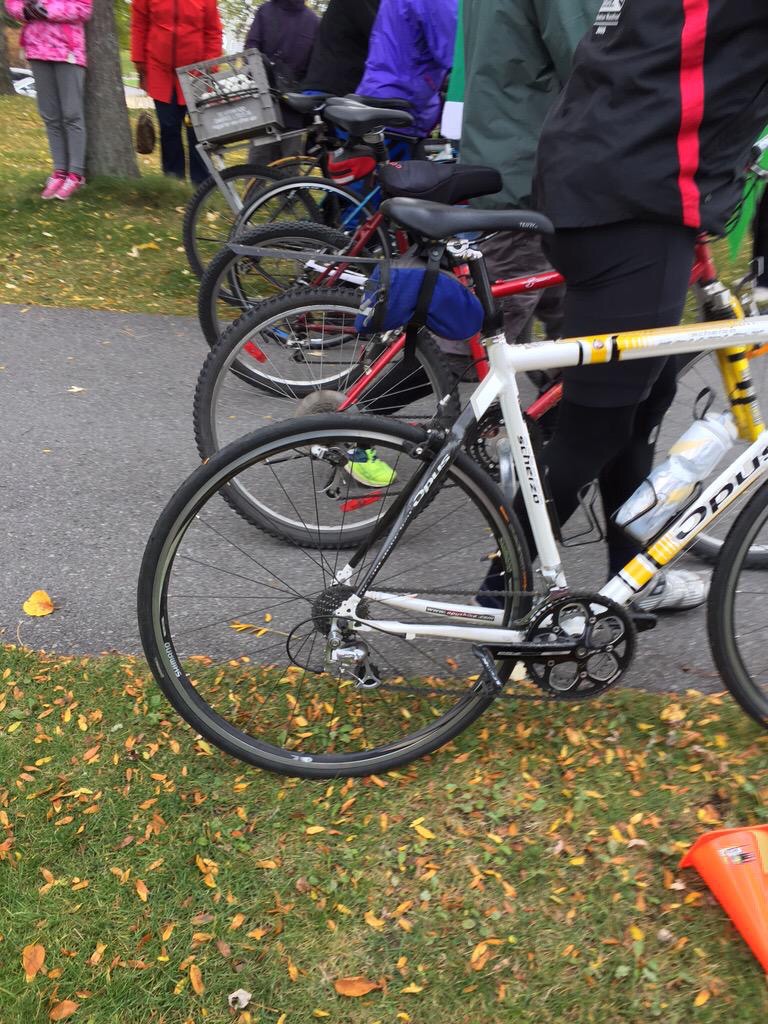
   
 We are part of a holy procession led by the King of Glory whose destination is sure. We have nothing to lose. If God’s grace is extended even to the generation of seekers (v.6), then we have nothing to lose. If what we are about is not a competition, then we have nothing to lose. If we don’t need to find fault in the other to prove our own self-worth, then we have nothing to lose. If it’s not about one-up-man-ship, then we can go for broke and not worry about it. If we don’t need to question who our Saviour is — who already accomplished for us our salvation — we don’t need to doubt our final destination. Then, why not share now what we have with others on this road?

All the saints on earth, despite the scars of life we bear, have gifts to share with other seekers on that journey. What gifts and blessings of God reflect in your life? In discerning this, remember: It’s not up to you alone! We don’t need to be perfect. We gain the gates not by our own merit or even hard work. Ours is the victory only because of the One for whose reason the gates are lifted in the first place.

Thanks be to God!
(1) — Michael Morgan in David L. Bartlett & Barbara Brown Taylor, eds. of “Feasting on the Word Year B, Volume 4” Fortress Press, 2009, p.228

‘One little word’

“Long ago your ancestors — Terah and his sons Abraham and Nahor — lived beyond the Euphrates and served other gods …. Now … choose this day whom you will serve, whether the gods your ancestors served in the region beyond the River or the gods of the Amorites in whose land you are living; but as for me and my household, we will serve the Lord.” (Joshua 24:2,15)

“Finally, be strong in the Lord and in the strength of his power. Put on the whole armour of God, so that you may be able to stand against the wiles of the devil. For our struggle is not against enemies of blood and flesh, but against the rulers, against the authorities, against the cosmic powers of this present darkness, against the spiritual forces of evil in the heavenly places … ” (Ephesians 6:10-12)

My mother told me the story of a dramatic stand made by Christians against Hitler on Easter Sunday 1942 in Norway: The Nazis had insisted that every Lutheran congregation praise God for Hitler’s rule over the Norwegians. The Lutheran Church considered this blasphemy, and refused. Every Norwegian Church closed that Easter Sunday morning. And instead they agreed to worship in the afternoon.

Later that day in one of the villages the people assembled in the market place. And because they were scared, they began singing what Lutherans have sung for over 400 years when they were afraid: “A Mighty Fortress is our God, a bulwark never failing …”

And they slowly began to walk to the steps of the village church — only to find the doors locked and guarded by a company of SS soldiers with submachine guns trained at them. When the Christians arrived at the front steps, having finished the first verse of Martin Luther’s famous hymn, an SS officer grabbed a woman holding a baby in her arms and said: “One more verse and she gets it first”, pointing the weapon at her head.

In the tense silence, the people, not knowing what to do, looked down at their feet.

And then, a single, soft, quivering voice began … 

“Though hordes of devils fill the land, all threatening to devour us, we tremble not, unmoved we stand, they cannot overpower us. Let this world’s tyrant rage … his might is doomed to fail. God’s judgement must prevail. One little word subdues him.”

It was the voice of the woman holding the baby. “One little word subdues him.” The soldiers were the ones in a moment of indecision who looked down at their boots. And then quietly they shuffled out of sight to let the worshippers enter the church.

One little word subdues him. Not a loud trumpet call. Not an explosion of spectacular proportions. Not an air strike obliterating the enemy. Not a bravado that denies human frailty and vulnerability. Not eloquent oration. Not a motivational speech rallying the crowd into a frenzy. One little word subdues him.

The themes of ‘standing up against evil’ and ‘taking a stand’ pervade the scriptures assigned for this Sunday. We must choose our god. We must stand up. Especially in the context of a multi-faith community. But how do we do this when all we want to do is stare down at our feet, immobilized with fear?

Because we are surrounded by diverse peoples. And that isn’t going to change. At least we can relate to the Ephesians. The Christians in Ephesus were probably taken to worship the emperor at the newly constructed temple of Domitian; Ephesus in the first century was also a thriving commercial city and the cultic centre of goddess Artemis. (Haruko Nawata  Ward, Feasting on the Word Year B Vol 3 Fortress Press, 2009, p.376). Christians were challenged to be confident in their faith amidst challenging times. Change some of the names, and it feels a bit like Canada in the 21st century!

And as simple as we sometimes may want to reduce the question of evil, the scriptures present a more subtle and systemic view of evil. In other words, evil is not just a little red man with a pitch fork sitting on your shoulder tempting you to do something bad. Evil is also, and more significantly, about forces beyond the immediately ‘individual’, into the realms of politics, world history, economics. 

More than against “flesh and blood” evil is also about certain patterns of thinking. Our attitudes and underlying beliefs and assumptions about people of other faiths and values.

Standing up against evil and taking a stand is just is as much to do with changing the way we think about ‘them’. Standing up against evil is about repudiating ways of thinking and unspoken assumptions that have only served to hurt and damage other people. Sometimes the way we think — the common sense assumptions of our culture — are downright evil and wrong. Let me give you an example:

This past summer at the national convention of the Evangelical Lutheran Church in Canada (ELCIC), the church voted to repudiate the “doctrine of discovery”. This doctrine is different from our normal understanding of a statement of faith. But it was a belief that resulted in untold damage to the aboriginal populations of North America. It was the reason aboriginal children were taken from their homes, families and communities to suffer — many of them — in the so-called Indian Residential Schools in the last century.

The doctrine of discovery was the underpinning belief that resulted in the first explorers labelling Aboriginal people as “beasts of the field and forest”, and prompted governments to justify “killing the Indian in the child.” The doctrine of discovery made the residential schools places where native children were not permitted to speak their own language, practice their own religion, nor attend with their own siblings or have any contact with their parents while they were at school. How evil is that!?

So what is this doctrine of discovery that the ELCIC repudiated? Basically, it was a system of belief based in the discovery of North America, as if nothing of inherent value existed here before ‘we’ arrived. When the explorers landed on the shores of Iceland and then Turtle Island (i.e. North America), the land appeared to be unoccupied in the ways of western Europe. The explorers therefore believed it was theirs to acquire and own. When the explorers encountered native bands, there was this immediate disconnected with their values and culture and relationship with the land, understandably. Still, the settlers felt superior in their relationship to the native culture, believing — “What we have is better for you.” And moving from that doctrine into practices and policies of assimilation and subjugation like the residential schools.

I can anticipate your objection: But what to make of the Great Commission in Matthew 28:19 — when Jesus instructs his disciples to “Go therefore and make disciples of all nations”? Isn’t this what we have been supposed to do? – make others, force others to be like us? Aren’t we supposed to impose our values on the world, using any means at our disposal? Another English translation of the word, disciples, changes the tone significantly. When we read, “Go therefore and make learners of all nations”, we can see our task as learning. Disciples are essentially ‘learners’. Learning involves challenging current patterns of thinking, and going out into the world to share our faith. (Kristin Johnston Largen, Interreligious Learning &  Teaching, Fortress Press, Minneapolis 2014, p.109)

When I visited Jerusalem years ago, I was surrounded by at least three different world religions day in and day out. Muslim minarets blared out regular calls to prayer; orthodox Jews bowed at the wailing wall. And I, with a small group of Christians found a little apartment in the old city to gather around bible, cup and bread, to pray  and sing together. Few other times in my life have I ever felt as confident and grateful for my Christian faith than in a context  where other faiths and cultures came and tried to live together, even clashed.

Sharing our faith is not about one-up-man-ship. Sharing our faith is not a competition. It is simply being confident to talk to others when appropriate about what is most important to you. And, giving the other the freedom to do likewise. I think we still need to work on that in the church because I think we still believe it’s about a competition. That we have to fight, even, if necessary, to defend God — or our ideas of God. Be the winner, not the loser, in a winner-takes-all kind of world. It was in Jerusalem when I first realized that if there was any evil in the world, it started in me and my selfish, materialistic, self-acquiring vision for life.

Paul’s armour-of-God metaphor, like all metaphors, has limits and can even be problematic. Such a text has been interpreted throughout two thousand years of church and world history often as justification for violence against others. It is challenging maybe even impossible for us today to engage this text without the lens of history and the development of society and human culture through the ages — particularly with respect to warfare.

And that is why, as Lutherans especially are taught to do, I would not want to interpret this text without placing it beside another text from Paul’s letters, in this case, to ‘let scripture interpret scripture’. Listen now to another clothing analogy, where Paul speaks of what we ‘put on’ in Christ:

“As God’s chosen ones, holy and beloved, clothe yourselves with compassion, kindness, humility, meekness, and patience. Bear with one another and, if anyone has a complaint against another, forgive each other; just as the Lord has forgiven you, so you also must forgive. Above all, clothe yourselves with love, which binds everything together in perfect harmony. And let the peace of Christ rule in your hearts to which indeed you were called in one body. And be thankful …. And whatever you do, in word and deed, do everything in the name of the Lord Jesus, giving thanks to God the Father through him.” (Colossians 3:12-15,17)

Indeed, in this light, the belt of truth is the Gospel. The helmut of salvation is God’s eternal promise of love for us. The breast-plate of righteousness is a heart of compassion. The boots are actions that bring peace and goodwill to the world. The shield of faith is trusting in God’s grace. The sword of the Spirit is proclaiming the word of forgiveness, mercy and love.

One little word subdues him. An act of humility, not military aggression nor forceful imposition.

One little word subdues him. A word of forgiveness rather than condemnation, racism and judgement.

One little word subdues him. Something unexpected, surprising and even looked down upon by the world’s winners — that changes history. One little word — not born of competition, comparison and control, but born of surrender, release and trust. One little word, “I love you”, changes everything.

One little word is Jesus. God becomes human. A baby. A prophet. A teacher. A lamb taken to slaughter. One little word is greater than anything the world lives by. One little word whispered in a storm. One little word sung softly into the barrel of a machine gun. One little word nudging gently our hearts, saying to you: I love you. I forgive you. You are free. You will forever more be a child of God.

Now, tell the nations of the world the same. And act like you believe it. Because it’s true. Thanks be to God.

Your Word is true, on letting go

When I spent a year in Germany during my seminary days, I struggled in the first half of that year with feelings of being lost, without guidance, and without my usual supports in place. I was lonely: For the first time in my life, I wasn’t able to rely on my parents, and I didn’t have my twin brother close by to share a life experience. I felt depressed, rudderless, cut off, a ship floating aimlessly in the stormy ocean.

I was reminded of this turbulent time in my life after reading the Gospel text (Luke 21:5-19) for today. Jesus points to those external ‘structures’ in the lives of his disciples, structures that they have come to depend on for guidance, for a sense of purpose and identity – and tells them basically that they will crumble, that they will have to learn to do without the usual dependencies, that they will have to ‘lose’ these. They will be no more.

First, it’s the massive and impressive temple that Herod was building, adorned with decorations; the temple presented a glorious architectural masterpiece to the world. At the end of the text, Jesus mentions family – even those closest to us will be cut off from the path we are on. There is a profound losing that imbues this scripture today, not unlike what the Israelites had to experience when they were exiled from their land, their homes, their precious Jerusalem temple, some five hundred years before Christ. It is a pattern that is repeating again.

The first part in the path of faith – of true spirituality – is one of letting go, of releasing, of surrendering. If anyone has experienced even a margin of what that means, it’s never easy. It’s hard, especially when for most of your life you’ve placed so much energy and invested your emotions and stability in a building, a place, a person, a family – and then you have lose it.

Luke wrote this story in the Gospel some forty years after the life of Jesus. Remember, all of what we read in the Bible was for the longest time first shared by word of mouth – stories told to the community and from generation to generation. In the latter half of the first century A.D. these told stories about Jesus began to be written down in the form we see them today.

It’s important for me to mention this because Jesus’ prediction that the temple would be destroyed actually happened. In about 70 A.D. the Roman armies laid siege to Jerusalem to try to subdue the radical Jewish insurrection who were rebelling against Roman occupation of their land. The victorious Romans eventually toppled the impressive stone walls of the temple, leaving only what we see today – the famous western wall, or the “Wailing Wall”.

All this is to say, that Luke wrote these words of Jesus at a time when the rebellion was reaching its peak: “… the days will come when not one stone will be left upon another; all will be thrown down.” These written words carried extra emotional weight, it would seem to me, to those who first received them in the late first century. Because it was actually happening.

Early Christians were encouraged to trust Jesus, because what Jesus says is true! What Jesus promises will come to pass. This truth is consistent with the tradition of earlier scriptures, first echoed in the poetry emerging from the exile – “The grass withers, the flower fades – but the word of our God will stand forever” (Isaiah 40:7-8).

Though the path is full of suffering, one thing remains: the presence and purpose of God. This may give us a clue as to the meaning of Jesus’ closing words in the text: “By your endurance you will gain your souls.” Some translations have it, “by your patience”.

Since I opened with a personal story from my seminary days, I’ll bring here another story I heard from a seminary class studying ‘the end times’. For you to get this story, I need to remind you of how a liturgical church, such as ours, organizes our reading of the Bible. We follow a lectionary, which means that there are assigned readings not only for every Sunday of the year but for every day, even. You can find these assigned readings at the front of our worship books. The point is, after a three year cycle of following this ‘lectionary’, we will have basically read through the whole Bible.

So, these seminary students were engaged in a discussion of what Bible text they would choose if they had reason to believe that this was the Final Day. Some suggested John 3:16 – “For God so loved the world that he gave his only Son, so that whoever believes in him may not perish but have eternal life.” Others suggested Psalm 23 – “The Lord is my Shepherd, I shall not want, even though I walk through the darkest valley, I fear no evil …” Still others suggested the very last verses of the Bible from Revelation 22:20-21 – “The one who testifies to these things says, ‘Surely I am coming soon. Amen! Come, Lord Jesus (Maranatha). The grace of the Lord Jesus be with all the Saints. Amen!’”

But, the winning suggestion was – “I would preach on whatever Bible lesson was appointed as the Gospel for the day.”

A homeowner hired a gardener to plant a certain kind of tree. “But that kind of tree takes many years to mature,” the gardener protested. “Then get started with the planting,” the homeowner replied. “You do not have a moment to lose.”

If the first difficult part of the path of faith is surrendering, letting go, not identifying any longer with those structures on which we have come to depend heavily, the second part is the motivation to endure in the regular, daily task. It is full of promise, and new life.

Because those endings and beginnings in Christ are not our doing. We do not control our destiny, contrary to what so much of our culture preaches. We are called only to be faithful in our daily service, doing that which is set before us this day. We don’t know exactly how things will turn out. But we can take the risk and take the first step because we have the true promise of God:

Being aware of God’s faithfulness to us, being assured in the Word that what Jesus promises is true, we can be buoyed by a vibrant hope on the stormy ocean of life. We live every day as if it were the last, doing all that we can, doing the right thing, in the moment. And we cling to the assurance that God will not only do the rest, but much, much more!

In the last few months of my year abroad in Germany, I finally found my stride. Maybe it was because I knew ‘the end’ was coming; my time in Germany was coming to an end, and soon and very soon I would be returning home. Being aware of and confident in my returning home coming closer with each passing day, I was able to enjoy and fully enter each moment: I travelled with my friends, visited my families in Poland and Germany, breathed the air deeply, and went about finishing the tasks set before me.

In engaging my life fully, doing what I was called to do there – even though it wasn’t always easy – I now remember that time as one of those crucial, pivotal and cherished learning moments of my life. For, a true letting go yielded a wondrous new beginning.