
Let us pray. Heavenly God, you formed us in our mother’s womb and, in Jesus, welcomed children to come to you. Today we grieve the untimely end to a life that delighted you and us. Our hearts are torn, and we are burdened by our grief. Be with us as we walk this shadowed valley. Receive our tears. Hold space within us for hope’s return. Amen (All Creation Sings, 2020).
No words I can say will take the pain away. Our actions now must speak louder than any words. And what you are doing today, dear family, is showing up. And more than that you do an act of love, and an act of courage amidst this horrible loss. We are grieved, deeply saddened, our hearts are torn, as we prayed. Yet, you have given each other space and permission to feel what you must.
In this collective effort and in our humble actions today, we honour the life given to Leyla. We stake our ground, together today, and affirm that Leyla’s life made a difference in the world, and in the universe. Her life was a precious gift.
Recently I read (Coman, 2024) about a giant sycamore gap tree that enjoyed enormous popularity among visitors to Northumberland Park in England. This tree was used in many films. Because of its location it was a beautiful beacon and focal point in the park.
But in September 2023, the tree was felled in an act of vandalism. The outpouring of grief and anger was unprecedented, and a testament to the beauty and meaning it had offered many.
Was it over? Was this tree, that had offered such joy and beauty in the lives of many, no more?
In the following year seeds were harvested from the downed tree. Now, the seeds have grown to become saplings and are thriving. In a project called “Trees of Hope”, these tiny saplings from the felled tree are being given to people in prison, and many charities. In this way, the Sycamore Gap Tree will not only have its own offspring, but whose seeds are now being used for good.
When the tree came down, it wasn’t the end of it. It wasn’t over. And whatever is not over, is not lost. Never lost.
Dear family, you’ve experienced a seismic shift in your life these past weeks. The earth underneath you has opened up. And grief can sometimes feel like free-falling into the unknown abyss. It is true, life will never be the same again.
But when the ground shakes as in an earthquake, the trees shake. The pinecones fall to the ground. And the seeds within come out and are planted in the earth.
The Norway Spruce is common in Eastern Canada. One unique feature of this tree is its cones are the largest among all spruce varieties (Audubon, 2021). What does that mean? That means, lots and lots of seeds.
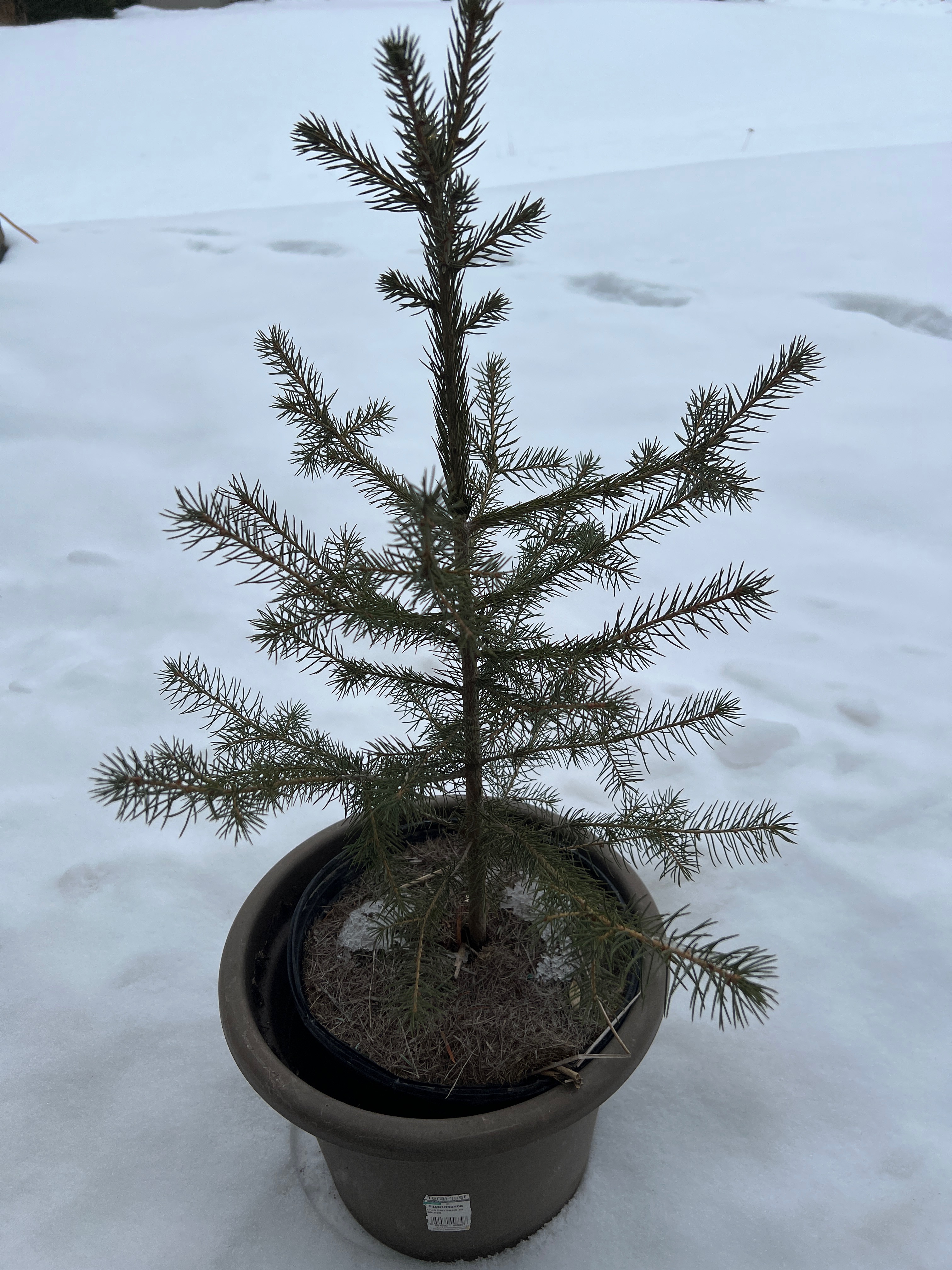
This sapling of Norway Spruce is now dormant for winter. It will need to be planted in the earth in the coming Spring. It needs lots of water, and it will grow. Perhaps during this wintertime, you can think of a place you’d like to plant it. In that simple act of planting a tree, there is this seed of hope that says maybe it’s not over; and because it’s not over, it’s not lost.
The cross of Christ, various legends have it, was made of varieties of wood ranging from dogwood to olive, to oak, to cypress. Whatever the blend or variety, the wood upon which Jesus died can be a sign and symbol of this close relationship between death and life. What dies finds a way to endure. What dies finds a way to live again. Our relationship with Leyla has changed, to be sure. But it isn’t over.
It is called the “tree of life”, both in the first book of the bible – Genesis (2:9) – and in the last book of the bible – Revelation (22:2). In the end, just as in the beginning, the tree of life promises that every ending marks a new beginning.
References:
All Creation Sings, Leaders Edition. (2020). Life passages and circumstances (p. 92) [adapted]. Augsburg Fortress.
Coman, S. (2024, December 9). Seeds of Hope: Day 8. Lutherans Connect. https://lcseedsofhope.blogspot.com/2024/12/day-8.html
National Audubon Society. (2021). Trees of North America. Knopf.

 Raspberryman