
I started by searching for coastal scenes, and ocean waves crashing on pristine beaches. Over time, as I would scroll through these short reels, the images became more extreme, and I saw larger waves sometimes amplified with AI – surfers riding thirty-foot giant whitecaps crashing off the coast of Portugal. Then, boats capsizing in North Atlantic storms. Then, tsunamis plowing through Asian sea-side villages. And, just the last day, it was a beach scene, to be sure. But the folks on the beach witnessed a volcano violently erupt not far from their Pacific Ocean-side setting.
What happened to the serene, coastal, picturesque scenes at sunset?
Unfortunately, a quirk of human behaviour is that on average we will stare at something negative and outrageous for a lot longer than we will stare at something positive and calm (Hari, 2022). We call it negativity bias.
Our attention is captivated more by the gruesome details of an airplane crash than someone handing out flowers on a street corner, even though flowers are better for you to look at than mangled bodies. Social media knows this and capitalizes on it, because the business plan is to get your attention on screen for as long as possible, which increases the chance you will buy something.
These social media algorithms capitalize on our negativity bias at best, radicalization at worst.
A major study found that for every word of moral outrage you add to your social media feed, your retweet/share rate will go up 20 percent. Specifically, the words that will increase your share rate most are “attack,” “bad” and “blame”. In YouTube, for example, words such as “hates”, “obliterates”, “slams”, “destroys” will get picked up more frequently. If you fill your Facebook posts with indignant disagreement, you’ll double your likes and shares. So, the social media algorithms will prioritize outraging you and angering you. “If it’s more enraging, it’s more engaging” (Hari, 2022, p. 131).
Should we be surprised, then, that when we read the bible, our negativity bias is already disproportionately stoked. What do we pick up first? What words or phrases do our eyes or ears dwell on? Which parts of scripture do we focus on?
He said to them, “The harvest is plentiful, but the laborers are few; therefore ask the Lord of the harvest to send out laborers into his harvest” (Luke 10:2).
I caught myself lingering on, “The labourers are few.” We often kneejerk into seeing the negative, don’t we? And then from that negativity bias we believe that there is something wrong with us. “I am not good enough when I’m not labouring in God’s harvest,” we self-talk. “What’s wrong with me?”
The problem, we conclude, are individual flaws whose only solution requires individual tweaks. We are individually broken, and the solution is bucking up and doing the right thing. Each of us have to do this, individually.
Of course, each one of us can indeed do our part and improve our self-control and discipline. But that alone isn’t going to solve the problem. It’s like trying to run up a downward-moving escalator.
Sure, there are always the exceptions, individuals who will heroically sprint to the top. But the vast majority of us will never make it, even though we may be giving it all we’ve got. There are larger forces at work, mostly against us.
Regarding our screen addiction, the problem about saying we need individually to be more disciplined is that there are a thousand engineers on the other side of your screen working against you.
Yes, we should take out our phones and turn off our notifications. Yes, we need to figure out our individual triggers and get help. But the human family is up against an environment designed to invade and raid our focus and which, to put it kindly, is negatively affecting our social and political culture.
“The answer is individuals making better choices” is the cruel optimism the dominant culture dishes out. Cruel, because, in the end, it doesn’t change anything. We are still getting more distracted, and our brains are being adversely affected despite all the effort we dedicate to individual self-improvement.
It’s easy to despair. It’s easy to shrug our shoulders and conclude that there is nothing we can do about it. And complain about how bad the world is getting, how everything is just falling apart. And give up. And continue doom scrolling.
“So let us not grow weary in doing what is right, for we will reap at harvest time, if we do not give up” (Galatians 6:9).
Let us persist in doing what is right. What does that look like? Doing the right thing?
“There’s the old metaphor that … villagers are at the river one day, and they notice a dead body come floating down the river. So they do the right thing. They take it out and they give it an appropriate burial. The next day two bodies come down the river and they do the appropriate thing and they bury the bodies. This goes on for a while, and finally they start to wonder – I wonder where these bodies are coming down the river [from], and if we should do something to stop that? So they go up the river to find out” (Hari, 2022, pp. 236-237).
The Gospel is not pouring pink on reality. It’s not pretending everything is fine when it is not. It’s not a cruel optimism the world dishes out, full of distraction and pretence. Nor is the Gospel about a doom and gloom, giving-up kind of despair for the world. Instead, the Gospel is about an authentic optimism.
That is where together, as a community, we build a solution that deals with underlying, systemic problems. That is where the church bands together to do the hard work, to go upriver.
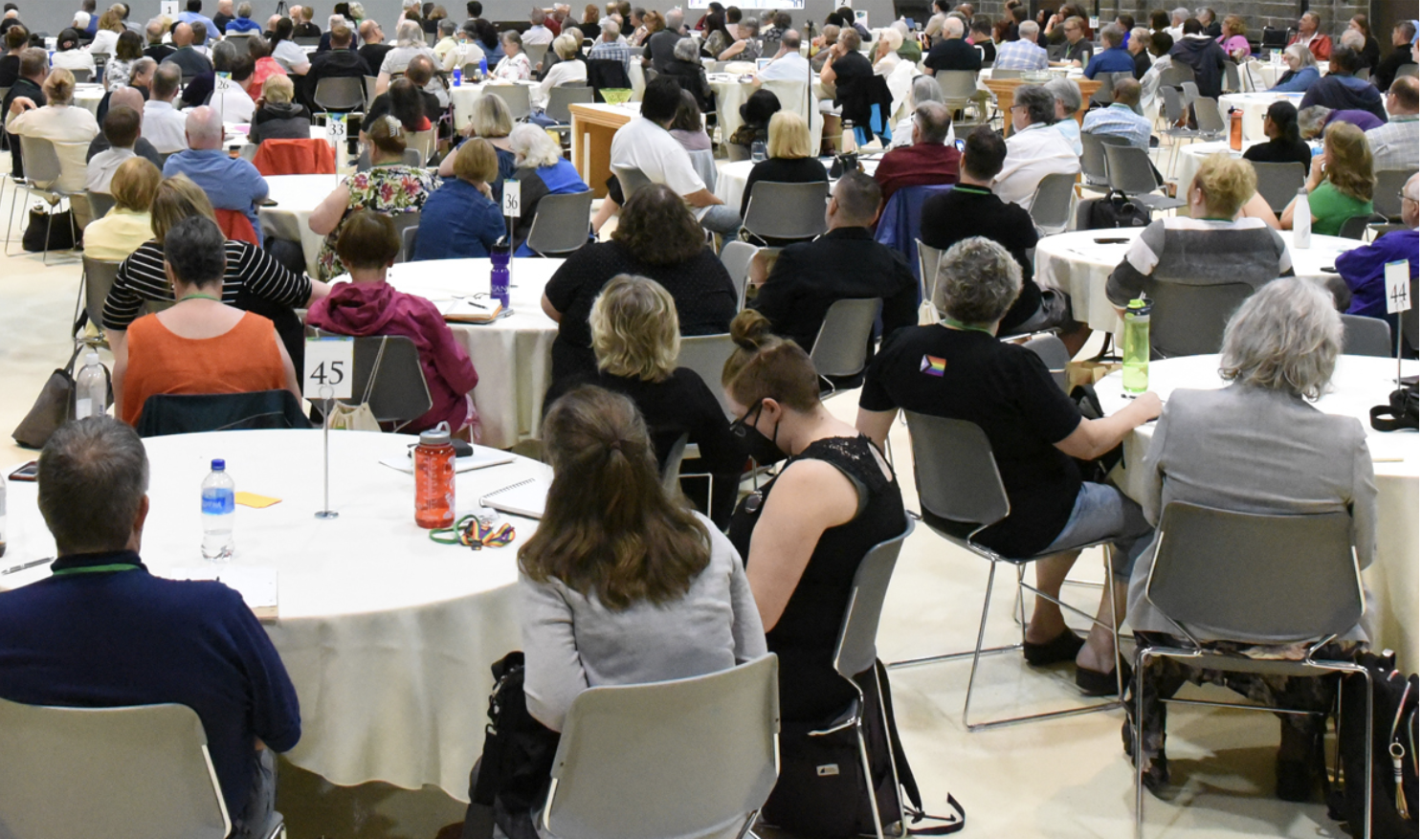
In a few days, the ELCIC national convention will meet in Winnipeg. Among important tasks such as electing a new national bishop and vice chair, we will be celebrating the 50th anniversary of the ordination of women. We will commemorate some of the first women, such as Pamela McGee who was the first in 1976, to be ordained in the ELCIC (Riachi, 2025).
The mid-1970s witnessed a huge change in our church, and in society. Think about how it was for women in the 1960s, in contrast. In 1962, for example, there were no women in the British cabinet, the U.S. cabinet or the Swiss government at all (Hari, 2022). In Canada, the statistics are only slightly better. For example, Grace MacInnis was the only woman elected to Parliament in the 1968 general election. What changed?
The advances made happened not because individuals self-improved and overcame their personal, private hangups. The advances made happened because of an intentional, organized community doing the right thing for a better world.
The church took scripture seriously, such as Paul’s words to the Galatians we have heard in the last few weeks: “There is no longer male and female, for all of you are one in Christ Jesus” (Galatians 3:28). And “For the whole law is summed up in a single commandment, ‘You shall love your neighbour as yourself’” (Galatians 5:14).
While we may celebrate 50 years of ordaining women in the ELCIC this year, so much sexism and misogyny remain, women still face huge barriers, and many of the advances that have been made continue to be under threat today. The work must continue.
Making a wrong right happen by a people working together to advocate and put pressure on the powers that be. The advances are made by a people who refuse to capitulate to the despair that nothing can be done about it. They don’t “grow weary”, as Paul’s words to us today encourage.
Why?
Because the harvest is plentiful. Because grace abounds. Yes, the world is a complicated and dangerous place. Yes, we face challenges to our wellbeing and health, every day.
But there’s another story in town. God’s presence fills the earth with beauty, light, life and love. There’s no stopping the goodness of God for all people. God’s persistence, God’s perseverance, God’s faithfulness never ends for all people. God doesn’t ever give up on us. God grants us what we need when we need it. And God’s gifts overflow.
The harvest is plentiful! That’s the truth. Thanks be to God.
References:
Hari, J. (2022). Stolen focus: Why you can’t pay attention – and how to think deeply again. Random House.
Riachi, M. (2025, June). Rejoicing in hope: A preview to the ELCIC national convention. Canada Lutheran, 40(4), 10-14.
 Raspberryman