
I am loved, therefore I am

During this season of Epiphany – which means ‘revelation’ – we will again uncover the identity of God made flesh in Jesus.

How will we do that? While Epiphany is a positive celebration of the meaning of the “Word made flesh” (John 1:14), this season also introduces an identity crisis swirling around Jesus throughout the centuries. It also confers that same identity crisis upon his followers. Who is this Jesus? And who are we?

Who is Jesus? It may comfort, or disturb, us to realize that even while Jesus walked the earth over two thousand years ago, those around him didn’t always ‘see’ him for who he was. Even at spectacular events such as the transfiguration or after Jesus performed miracles of healing, some confused him for the prophet Elijah who in the tradition was promised to return (Mark 9:9-13; Matthew 11:2-15). Some mistook Jesus for a political Messiah who was expected to liberate the oppressed Jews from Roman occupation of the Holy Lands (Matthew 21:1-11). And, even when Jesus appeared to his disciples after his death and resurrection, “some doubted” (Matthew 28:17). The scriptures do not hide this confusion about Jesus’ identity.

So Christians today need not be perplexed nor overly hard on themselves if they, too, struggle to understand this Jesus whom God announces at his baptism: “You are my Son, the Beloved, with you I am well pleased” (Luke 3:22). Paradoxical doctrines claiming that Jesus is fully divine and fully human, are not easy for the human mind to grasp.

Which suggests to me that to understand Jesus’ identity is not so much to get vexed and lost in doctrines about Jesus. It is rather to see what he does and listen to what he says. Brother David Vryhof of the Society of the Saint John the Evangelist writes, “If you would know what God is like, discover what Jesus is like. Listen to his words, observe his actions, notice his values and priorities, see how he lives his life. And follow him.” (1)

French philosopher and mathematician Rene Descartes’ famous claim, “I think, therefore I am”, is not helpful here. More appropriate for the Christian today is, “I do, therefore I am”. Or, better yet, “I am loved, therefore I am.” This latter statement especially reflects the values demonstrated in Jesus’ life. I am loved, therefore I am.

Vryhof goes on to tell a story by Soren Kierkegaard: “Once upon a time, there was a powerful and wise king who fell in love with a beautiful maiden who lived in his kingdom. The king’s problem was this: how to tell her of his love?

“He called for the best and brightest of his consultants and asked their advice. He wanted to do this in the best and most proper way – and, of course, he hoped his love would be cherished by the maiden and returned. But when all of his advisors had had their say, the king was left disappointed. For every one of them had counselled him in the same way:

“‘Show up at the maiden’s house,’ they said, ‘dressed in all your royal finery. Dazzle her with the power of your presence and with your riches. Overwhelm her with expensive gifts. What girl could resist? Who would reject such an opportunity, or turn away from such an honor? Who would possibly refuse a king? And if need be,’ they added, ‘you can always command her to become your wife.’

“But the king, being wise, was unhappy with this advice. He wanted the maiden to love him for himself and not for his position and power. Love freely given must be freely returned or it isn’t really love. Certainly, the girl could be impressed, even overwhelmed. And of course she could be coerced and might even ‘learn’ to love the king eventually. But the king saw that if he followed this counsel he would never know if she really loved him for himself or simply for the comforts and privileges that queenship offered.

“So the king decided against the advice of his counsellors. He chose instead to strip himself of his glory and power. He put on the clothes of a poor peasant and walked to the maiden’s cottage to declare his love for her.” (2)

This story by Kierkegaard parallels closely the meaning of Christmas — of why Jesus came, and what kind of person Jesus is — “who, though he was in the form of God, did not regard equality with God as something to be exploited, but emptied himself, taking the form of a slave, being born in human likeness” (Philippians 2:6-7). 

Who is Jesus? Jesus is God in love with us, and in us. And how do we know Jesus lives with and in our lives today? These questions lead to: Who are we?

We are who we are because of Jesus’ love for us. We are beloved, because of what God did in Jesus. Therefore, we are given the gift of God’s presence in Christ through the Holy Spirit. We have it in us. Yes, we do! And we exercise that gift in relationship with others. Who we are with, with whom we spend most of our time, where we commune with others — these are vital questions of spiritual, personal growth.

Who we are in Christ also begs the question of our nature — our growth, our changing, our transforming: Do we change? Can we change, for the better? Does being a Christian change our lives? Do you believe that?

I have over the years heard some argue that we do not change, really. We are locked in for life, the way we are, regardless of circumstance, regardless of where we are and with whom we live our lives. Nature. 

Others are more optimistic. On my good days I believe in the capacity of humans to change for the better. But this depends, I believe, on the quality of our relationships. Whether or not we change for the better depends largely with whom we spend most of our time. Nurture.

I believe most of us contain all the parts necessary for a healthy existence. Even a faithful one. At my baptism as an infant I believe God gave me the gift – the seed – of the Holy Spirit. At which times, or to which degree, that seed would mature and be expressed has depended largely on with whom I spend my time. 

Our families, our friends, our communities have a great influence over our lives. Because just by being with them, they will bring out of us the good and/or the bad. Their presence in relation to us hooks into some aspect of our life and pulls that aspect out. It is the quality of the ‘links’ between us that will determine what emerges from our souls. The old adage is true: “Show me your friends, and I’ll know who you are.”

Which also signifies the importance of hanging out with Jesus, in prayer. Jesus is integral to our relational world. Being intentional is critical here. The more you spend time with Jesus in the Body of Christ – the church, the more you spend time with Jesus in prayer and contemplation, the more you connect with Jesus in his mission to care for the poor — all of these things will over time bring out the good that is already in you.

The bottom line message of Christianity is that all creation matters because of God’s creative love in Jesus. We are created each of us from the spilling out of God’s love to the world. Therefore we are. Therefore we do.

(1) Br. David Vryhof, posted on the front page of the website of The Society of Saint John the Evangelist (www.ssje.org) on Tuesday, January 5, 2016

(2) cited by Br. David Vryhof, “God Has Spoken to Us By a Son”, posted on December 25, 2009 on the website of The Society of Saint John the Evangelist (www.ssje.org)

After the holidays ‘Christmas’ begins

A poem written by Howard Thurman former dean of the chapel at Harvard and a Quaker pupil caught my attention today –

The Work of Christmas
When the star in the sky is gone,
When the Kings and Princes are home, When the shepherds are back with their flocks, The real work of Christmas begins: To find the lost, To heal the broken,To feed the hungry, To free the prisoner,To make peace between nations, To bring Christ to all, To make music in the heart.

Grant us peace

This evening we find ourselves at the threshold of all that Christmas anticipates. Our sight is therefore narrowly focused on the immediate. After all the waiting and the long journey, Mary and Joseph have finally arrived at the place of nativity, in Bethlehem.

And, like any expectant father and mother, they find themselves embroiled in the hustle and bustle that immediately precedes birth. Christmas Eve is therefore all about a sense of ‘place’.

Everything happens here, on this holy night. We are drawn to this place in this time to remember and re-enact what happened on that very first, special holy night. At one moment in history, God entered the world on that first Christmas. In a specific time, at a specific place — the town of Bethlehem.

The children re-created the version of the Christmas story according to Luke. And they made sure we got into the roles and felt that sense of place — the innkeeper’s door, the manger scene in that town surrounded by shepherd’s fields under a starry night.

It was that small, dusty, ordinary, rather plain and dull place that was to receive the greatest gift of all time — the gift of God incarnate. Bethlehem was the scene of the glorious host of heaven entering into the world. But, “How could anything good come out of Nazareth?” was the condescending yet prevalent attitude expressed by an early disciple of Jesus (John 1:46). How could it be that Bethlehem and its ragtag cast of characters would receive this gift?

Indeed, receiving gifts is just as important as giving gifts at Christmas. I think, in our achievement, accomplishment and success -oriented culture, it is more difficult to truly open our hearts and unconditionally receive a gift of great joy. When we don’t feel like we have to somehow return the favour, or earn it by our hard work. I think for many of us busy-bodies, to stop and just be — before any active response — is tough to do.
We are so used to ‘providing for’, doing it, giving it, expending our energy, performing, succeeding; or, God-forbid failing at succeeding, accomplishing by our acts of heroism — to care for another, to make it happen for others. We are compulsive in our drive to be a champion of something or another.

You’d think we were the Messiah coming to save the world by observing some of our actions.

I heard from several of you this Advent how you haven’t this time around either decorated or baked or ‘checked off the list’ all the things you’ve normally done in years past. And this was cause for moments of anxiety: “Would Christmas be the same?” And what a gift it was to hear from you confess that, indeed, Christmas has come to you at a more meaningful level as ever before.

Could it be, because we are slowly learning, simply, to receive the gift that comes, despite us?

One of the oldest prayers and carols in the Christian tradition, originally expressed in Latin: Dona Nobis Pacem — give us peace. “Peace on earth” is the purpose of Christ-coming. The peace we seek in our lives. And for that to happen, we need first to relinquish our Messianic compulsions. We need to recognize and accept our human limitations. And that is good. Because when we can release our grip — or at least loosen it for a moment — could we, then, have peace.

O Little Town of Bethlehem signifies this gift of peace. Why? Precisely because it is un-spectacular. It is not an exceptional town in the region of Nazareth. You would not find Bethlehem listed prominently in the Frommer’s tour guide books from the 1st century. Maybe that’s why it took the Magi some time to get there. It’s like one of the ‘if you blink you’ll miss it’ crossroad hamlets that dot the rural landscape of our land.

If you drive down highway 41 south from Pembroke through Eganville towards Denbigh, you pass by one of those blue-coloured town signs with the word “Khartoum” written on it. Khartoum, Ontario — do you know it? It is actually a town — but you might count three houses driving by amidst the pine, spruce and rock-lined, winding roadway. Khartoum is like the Bethlehem of Ontario.
Perhaps because expectations are low. Why so many don’t have peace at Christmas is because expectations are so crazy and unreasonable at this time of year. Again, assuming ‘we make Christmas happen’. But this is not the message of the Gospel of Jesus Christ. We do not make Christmas happen.

The Gospel — the good news — of Christmas is that the baby Jesus had to rely on this ragtag cast of characters to survive. The holy child, the divine made flesh, the almighty God — became vulnerable. God had to wait. God had to receive the gift of these imperfect characters, these unimpressive, un-extraordinary people. Jesus the baby had to receive their gifts of protection, love, care, and support. In order to be the greatest gift for us, God had to receive our imperfect gifts. God waits to receive our imperfect gifts, our offerings, our giving.

I’m learning something as I begin the second half of my life: The art of letting God come to me. It’s not dissimilar from the the concept espoused by those who coach sports, who advise: “Let the game come to you.” They make reference, of course, to players and teams on a winning streak who play loosely, who are not trying too hard, who don’t hold their sticks or bats too tightly; And, who nevertheless concentrate, who are in the flow, in the zone. Yes.

But they are not making it happen. They are not driving it too hard. Doing too much. Nor are they over-stating their presence, pushing it. Let it come to you, rather than trying to make it happen — this is the practical yet difficult challenge at Christmas.

Christian writer and teacher, Henri Nouwen, wrote: “Christmas is the renewed invitation not to be afraid, and let God …be our companion”. Allow God — whose love is greater than our own hearts and minds can comprehend — come to us. (Henri Nouwen, “Gracias!” in “Advent and Christmas Wisdom from Henri J.M Nouwen”)

A birthing experience will force all closely involved into a receptive state of being — as uncomfortable as that might be for some of us control freaks. We do need to just let it happen when it will. Let the gift come to us.

The unconditional love, unconditional positive regard, the faithfulness of God in us, the trust of the baby Jesus — these truths bring us all to a level playing field. There is no them-and-us. There is no outsider in God’s realm. There is no hierarchy of social standing. There is no moral-achievement program here. There is no ladder to climb.

Rather, God climbs down the ladder to us, just as we are. Because God’s love for us is so great. That is the message of Christmas. That is the peace that we seek.

Let there be peace on earth and goodwill among all people! Merry Christmas!

Bethlehem: house of bread

There’s only one problem with the nativity set. Do you notice? All the characters are in place and accounted-for. 

But no stable. No barn. No shelter for the Christ-child, Mary, Joseph, the shepherds and Magi. Not to mention all the animals.

I think in the nativity set around the altar we accounted for this obvious ‘missing piece’ by placing all the matching pieces right beside a figure of a church building. There’s something that feels right about doing that, despite the historical disconnect between modern church building and the first century birth we celebrate this holy season of Christmas.

Because Jesus needs a house. Significant, isn’t it, that Bethlehem in Hebrew means, “house of bread”? Bethlehem, the town of David (Luke 2:4), was foretold by the prophets of old: “But you, Bethlehem, too small to be among the clans of Judah, From you shall come forth for me one who is to be ruler in Israel; Whose origin is from of old, from ancient times” –Micah 5:1. Bethlehem was the ‘house’ into which Jesus was born. And Jesus, then became the house wherein all who sought God would find comfort and rest.

Is this not what we celebrate at Christmas? Our homes, places of comfort, places where we find our roots, our grounding, places where we meet and live with those beloved to us. These nativity scenes adorning the altar normally form part of our Christmas decorations in our homes. They, in a sense, bring Jesus — the house of all people — into our houses, our homes. Into our lives.

At Christmas we sing for Jesus to come into our lives. But do we think of what it would mean for us to make room for the Christ? And welcoming the stranger?

In a verse from the hymn, “Christ Be our Light” we sing —

Longing for shelter, many are homeless. Longing for warmth, many are cold. Make us your building, sheltering others, walls made of living stone. 

Christ, be our light! Shine in our hearts. Shine through the darkness. Christ, be our light! Shine in your church gathered today. (1)

Many times in the Gospels, Jesus describes the “kingdom of God”. One of my favourite images is from Mark (4:32), where Jesus compares God’s reign to a small seed that ” … becomes the greatest of all shrubs, and puts forth large branches, so that the birds of the air can make nests in its shade.”
This image gives an all-encompassing, expansive vision of what God intends: a home for all creatures great and small.

Of course, the problem is, that so many people don’t have this shelter, this safety, this home. And it’s not just a spiritual reality. It’s also a material, earth-bound reality.

After all, Jesus himself, was a refugee. After his birth, Jesus’ parents Joseph and Mary had to flee the threat of persecution in their home country. In Matthew (2:13) we read: “… an angel of the Lord appeared to Joseph in a dream and said, ‘Get up, take the child and his mother, and flee to Egypt, and remain there until I tell you; for Herod is about to search for the child, to destroy him.” Jesus, Christians believe, is the Son of God. And this God we worship experienced, on earth, what it means to be a refugee and to be homeless.

Jesus, the comforting house and home for all — like the giant tree housing all the creatures of the earth — knew what it was to be without home, without shelter.

Elsewhere in Matthew (8:20) as Jesus exercises his ministry of compassion, healing and grace to the downtrodden, he reminds those who listen: “Foxes have holes and birds of air have nests, but the Son of Man has nowhere to lay his head.”

We are called, therefore, to care precisely for those who are homeless, who are refugees today as if we are loving God. Sri Lanken theologian D.T. Niles stated: “Christianity is one beggar telling another beggar where to find bread.” (2).

Where do we find this ‘bread’ today? Because we will not travel to Bethlehem to find Jesus, like the Shepherds and the Magi did over two thousand y ears ago. Today we may ask God as the righteous did of old: “Lord, when was it that we saw you hungry and gave you food, or thirsty and gave you something to drink? And when was it that we saw you a stranger and welcomed you, or naked and gave you clothing? And when was it that we saw you sick or in prison and visited you?” And Jesus answers, “Truly I tell you, just as you did it to least of these … you did it to me.” (Matthew 25:37-40)

And, in so doing, we reveal the truth that the author of the last book of the Bible expressed: “See, the home of God is among mortals!”(Revelation 21:3). God’s home in Christ Jesus is here on earth, among those who need the “bread of life” (John 6:35). 

Our job this Christmas as all year round is to feed the hungry and house the homeless. Because Jesus has come into this world. He is out there. And he calls to us. Waiting for us to respond. To be and make home for us all.

(1) “Christ Be Our Light” Evangelical Lutheran Worship, Augsburg Fortress, 2006 #715

(2) Joseph R. Jeter in David L. Bartlett, Barbara Brown Taylor & Kimberley Bracken Long, eds., “Feasting on the Word: Advent Companion” WJK Press, Kentucky, 2014, p.65

The apple of the eye

Guard me as the apple of the eye; Hide me in the shadow of your wings. (Psalm 17:8)

Last week’s children’s chat got me thinking even more. I told the story of ‘that mom’ who carried with her everywhere the biggest purse you could imagine. Everywhere she went her two young children trundled behind. And everywhere her kids went, so did she.

Mom was prepared for every contingency. When one of the kids fell in the school yard and scraped his knee, out came the bandaids. When the other ripped her shirt sleeve on the sharp edge of the door at school, out came the needle, thread and scissor set. And even though they left in the morning without a cloud in the sky, if by the end of the day rain showers dumped a deluge, out came the rain poncho. She carried everything you ever needed in that purse.

Or so we thought. I asked the kids what else she should have in her purse. “Some snacks, in case they became hungry.” “A flashlight in case the lights went out wherever they were.” etc. etc. So, she didn’t have everything you could imagine they would need. As prepared as she was, Mom wasn’t prepared for everything. She would also have to go by faith.

“Faith in what?” In Advent, the church has traditionally prepared for Jesus’ coming — in the four weeks leading to Christmas. Our faith, it would seem, leaned heavily on our ability, or lack thereof, to be prepared. Have we done everything we could to be purged of our sin? To be purified? Have we repented enough? Done enough penance? Confessed all our sins? And changed our ways? 

Have we done everything we can to be prepared for Christmas? Bought all the presents? Sent out all the cards? Cleaned and decorated the house? Finalized the invitations, menus and schedules?

Are we ever prepared enough? I’ve talked to more and more people over the years saying they are simply not doing everything any more. It’s too much. And they’re not going to worry about if things aren’t just perfect, anymore. I think they’re onto something. Because the truth is, faith-in-us is only (a small) part of the equation.

Would Jesus still come at Christmas even if we were not totally prepared? Of course. Therefore, a significant part of the Advent message is to emphasize that not only do we do what we can ‘to prepare’, we must also receive everything that we experience in life — the good and the bad — as God’s way of preparing us for the coming of the Lord. In the end, the Lord’s coming is not dependent on how well we prepare. Because Jesus is coming anyway, ready or not!

When we appreciate that everything that happens in our lives is God’s way of preparing us, could we not approach life’s circumstances with a heart of faith and trust rather than resentment and despair? When we appreciate the trials and tribulations of life as the way God is, in the words of the prophet Malachi, “refining” and “purifying” (3:1-4) our lives, would we not then have peace?

How can we ‘see’ the Lord’s hand in all the circumstances of life? I think ‘seeing’ is the key. And I’m not speaking merely of the physical ability of seeing. It’s more of a deepened awareness and perception of reality.

The origin of the phrase “apple of the eye” refers to the reflection of oneself that can be seen in another’s pupil. To hold someone as the ‘apple of the eye’, means that they are close enough to the beholder that they could see their own reflection in the beholder’s pupil. As a metaphor for God’s love, this phrase builds on the idea of humankind having been built in God’s image. We are close enough to God that we can see our own reflection in Him, and He in us. (1)

So, the purpose of ‘preparation’ and ‘purification’ goes beyond merely removing the impurities. Apparently, a silversmith knows that the refining process is complete only when you can observe your own image reflected in the mirror-like surface of the metal. (2)

If that is the case, the prophet Malachi implies that God’s image in us is restored precisely through the challenges and difficulties of life. Not apart from them. This is the peace we find. The prophet’s message is that we are deemed good and righteous when once again God’s image is reflected in our lives. 

The end point is not the pain or discomfort. We often get stuck there, and give up. The point is God being made manifest in who we are and what we do with our lives. And this takes time. And lots of work. And the gift of faith, to see God always close by. And trust, that whenever I take one step toward God, God takes ten steps toward me.

Questions of purpose, therefore, are important to ask in this season. For many good reasons. Especially when what occupies us in the ‘shopping season’ often distracts us from what is most important in our lives. The prophet is annoyed by the peoples’ wayward practices. How can God’s image be reflected in a selfish, me-first, immediate-gratification motivated people?

Who are we? And who are we called to be? John the Baptist’s cries in the wilderness echo the ancient prophets’ messaging (Luke 3). Stop distracting yourself to death! Return to the source and the ground of your being! Reclaim your true self, your original reflection of God’s goodness in creation.

In a year-end letter from the treasurer of the Eastern Synod to all congregational pastors and treasurers, Keith Myra offers some helpful, universal suggestions around financial issues facing churches today. One of his reminders states: Remember, “The church is not a club — membership does NOT have its privileges.” 

Here, he suggests that especially during this time of year our redemption does not lie in: “What can I get out of life, the church, my family, the economy.” Our redemption does not lie in: “What is in it for me?” And, “It’s up to me!” Rather, the church has always proclaimed the message of Jesus Christ, which is about: “What can I first give to others?” “How does my life reflect God’s image to the world?” “What does the life of Jesus call forth from me?”

We are chosen and loved, yes. Even so, in the end God choosing us is not for privilege, but for a purpose. Belonging to God introduces a great purpose and an important mission.
There is a reason for which we are being purified! And it points beyond the warm fuzzies of this holiday season. It points to actions in the world by Christians that communicate God’s love for all — especially to those without hope, without home, without peace. Then, every valley shall be filled, every mountain and hill be made low … the rough ways made smotth and all flesh shall see the salvation of God. (Luke 3:5-6)

Poet Christina Rossetti writes this prayer:
Lord, purge our eyes to see /Within the seed a tree, /Within the glowing egg a bird, /Within the shroud a butterfly, /Till, taught by such we see /Beyond all creatures, Thee /And hearken to Thy tender word /And hear its “Fear not: it is I” (3)

Amen.

(1) Lutherans Connect, “The Trees of Jesse: Day 3” lcadventdevotional2015blogspot.ca
(2) in David L. Bartlett, Barabara Brown Taylor & Kimberly Bracken Long eds. “Feasting on the Word: Advent Companion” WJK Press, Kentucky, 2014, p.32

(3) Christina Rossetti, from “Judge not according to the appearance”  

Questioning for the truth

Jesus answered, “Do you ask this on your own, or did others tell you about me?” (John 18:34)

Well over a hundred times in the Gospels (Matthew, Mark, Luke, John) Jesus asks a question. Jesus, the Teacher, does not give answers as much as he asks the right question.

And the question aims to reveal the truth. Good teachers will ask questions. And those who learn, who follow, will appreciate the importance of understanding the question.

Laurence Freeman tells of a time in his youth when he struggled with math in school. Finally he and some of his friends went to a bookstore in London, England, and found a copy of the math textbook they were using in class. The teacher’s edition had all the answers in the back.

Overnight, his marks shot up. Succeeding in math was no longer a problem. But the problem was that even though he had all the right answers, he still didn’t understand the questions. He was no better off in learning anything.

As people of faith living in this time of history, are we not so preoccupied with finding the right answers? We want answers to questions about ordinary life as much as the biggies — life after death, the nature of God, the final judgement, the end times, who will go to heaven and who will go to hell. We want answers. And, we will be satisfied only with right answers.

And yet, the point of the Christian life is to understand what is behind the question. Jesus uncovers the truth by helping others understand what the questions mean. We ought to appreciate this, since Jesus often “answered” a question by asking another question, as is the case in this trail scene with Pilate.

What is Jesus getting at with Pilate? In truth, as many have indicated, this scene might better be called “Pilate on trial”. Pilate, though supposedly in control, is completely trapped in fear. Pilate’s line of questioning betrays his his true goals. And his captivity.

These days it is common to speak of defining one’s values and clarifying one’s goals in life. Othersie we drift, rudderless. Without setting goals we become guilty of living LBWA (Life By Wandering Around). Or, without taking the effort and time to articulate values and goals, we become subject to “the tyranny of the immediate” and react to events rather than doing that which is most meaningful to us. Being honest and open with our values and deepest desires is not an easy task. Yet honestly living out of our deepest held values makes us more authentic and real. (1)

Pilate’s true goals? Being honest could not be the true goal of Pilate. Rather, staying in power had to be his aim. Authenticity would have to be thrown out the window. He questioned Jesus to find a technicality on which to condemn Jesus — in order to appease the crowd and religious leaders. “So, you are a king?” is a question designed to catch Jesus in a capital offense.

“Do you ask this on your own, or did others tell you about me?” Jesus asks. Is Pilate not bound in his effort to stay in control? Is that not Pilate’s real goal, regardless of the cost — to stay in control of his life ‘as is’? Pilate is trapped. I have the feeling Pilate has to hide his true convictions, his honest questions, and his haunting fears. Jesus sees right through the smoke and mirrors.

There, before Pilate, Jesus seeks to encounter the real Pilate, the one who in truth is utterly trapped in his desperate effort to stay in control. There, Jesus gives himself to be with the true person who is Pilate. There, Jesus invites Pilate to be vulnerable, transparent, to share how it is with him, to utter the truth of his own life. (2)

My uncle living in Poland tells of a time at the end of the Second World War when the Soviets established control over Eastern Europe. My uncle, a German by origin, felt trapped. Caring for his wife and two young girls in an economically depressed part of Europe, he faced a significant decision to ‘prove’ himself: He could either reject the offer to become a card-holding member of the Communist party — which would be consistent with his beliefs — but face the potentially dire consequences. Or, as it turned out to be, he ‘paid his dues’ and became officially a Communist.

I remember he spoke to me years ago about how difficult that was. On Sundays he would sneak in and out of church through a back door to avoid scrutiny by the authorities. He and his family enjoyed the security and material benefits of his decision. Yet, on a deeper level he never felt entirely at ease with his decision, living a double life.

I share this not to condemn my uncle. In the same breath I sympathize with Pilate. I would struggle with and probably make similar decisions if I were in their shoes. My point is that living the truth is not an easy, simplistic reality in our world.

In our encounter with the living Lord and King, Jesus Christ, we are invited nevertheless to strive for the truth. We are invited to be authentic, transparent, vulnerable. We are invited to share the utter truth of our lives with one another in the church — the Body of Christ. We are called to face the truth about our lives, the truth Jesus holds up before us. We must look at what is right and what is wrong in our actions and attitudes towards others and within ourselves. As Emilie Townes puts it, we must “look deeply into who we are and what we have become, to try to live into what we can and should be.” (3)

I agree with those who say that people are leaving the church today not because they reject the teaching of Jesus. They are leaving the church because of the actions of those in the church. The problem is not what we say we believe. Truth is not simply born out of an intellectual discourse and debate. The problem is the actions — or lack thereof — that are supposed to flow from what we say we believe, into every dark corner of our lives.

Is not the truth Jesus wants us to see, what we are doing with our lives? Our behaviour? What we say to others? Our decisions? Is it possible to speak of truth as something that is done, rather than something that is merely believed or thought of?

We therefore challenge ourselves to look beyond what we think, to the truth found in God, as represented by Jesus. Jesus encounters us daily to help uncover the deeper truth of our lives, and invites us to speak and act authentically out of that truth which is larger than any of us individually. Our encounter with Jesus pulls us out of our self-centredness into that expansive, eternal realm that is the kingdom of God. And we act, beginning in our lives on earth according to the values of the Reign of Christ.

“Everyone who belongs to truth listens to my voice,” says Jesus to Pilate. Even to Pilate Jesus offers to be the good shepherd – the good shepherding king – who, when his sheep listen to his voice, are led into abundant life. (John 10)

God the creator is love and grace. The truth of God comes from beyond our hypocrisy and failures. The truth of God comes from outside of our sordid and mis-guided attempts to act accordingly. The truth of God comes from a divine heart that is willing to put Jesus’ life on the line, for us. Jesus giving of his whole life for our sake speaks of an ultimate action, despite ours, that is all love, forgiveness and grace.

This truth can help us sort through all that competes in life for our attention and energy. We may encounter truth as a challenge from God. But it is also a gift God gives to us through infinite love and grace.

(1) Paul R. Trimm, “Successful Self-Management; Increasing Your Personal Effectiveness” Revised Edition, Logical Operations, 2015, p.14-19

(2) Pete Peery in David Bartlett & Barbara Brown Taylor, eds. “Feasting on the Word” Year B Volume 4, WJK Press, 2009, p.333-337

(3) ibid., p.336

Lift, and open the gates!

I reacted with sadness and sympathy looking at the photo of my friend’s dog whose entire face, chest and front legs were pierced with dozens — maybe even hundreds — of the sharp quills of a porcupine.
The photo was taken of the dog in the back of the car on the way to the vet, and she seemed stable enough — like the look of someone who knows they’ve been stung and know they just need to hold it together for a bit longer.

I felt sorry for that dog because it was simply being true to its nature — maybe motivated by a natural impulse to be friendly and play with another creature. Unfortunately, good intentions don’t always yield the desired results in relationships. Often, expressions of love and care are misunderstood. And the response can sting — just like this poor dog! I wonder if this dog will ever approach another porcupine again with such exuberance. 

On All Saints Sunday, Christians remember not only those who have gone before us who now taste and see the glory of God in eternity. We also reflect on the “communion of saints” on earth. And, like we did last Sunday during the celebration of the Reformation, we ask the good question: Who are we? Who are the saints? What qualifies a Christian for sainthood, beginning in this life?

Psalm 24 may suggest that no one living can belong to this glorious, virtuous group of people. Only those with clean hands and pure hearts who do not swear deceitfully (v.4) can qualify. A sharp tone of exclusivity rings throughout our tradition. Since I am not good enough, and will never be good enough, I have nothing good to offer. And so I will grovel in the dirt, turned in on myself and my sins.

Such negativity dominates our way of life. We don’t see abundance, we see scarcity. We don’t see forgiveness of sins as much as we love to talk about and dwell on our sinfulness. We don’t see the good, we see the bad. It’s a dangerous world out there, after all, and so we need to build closed, protective fortresses around us. And therefore, we get stuck in a self-centred, self-inhibiting style of life. Who am I to be able to offer anything of value? Let alone be counted among the saints?!

The bible’s poetry, today from the Psalms, offers insight into this problem. The Scriptures reveal a way of emphasizing what is important. Really important. We see this method most in the Hebrew scriptures — the Old Testament Psalms and prophets: Repetition.

Repetition of words and phrases underscores a sense of urgency or jubilation. In the Psalm for today — 24 — certain phrases are repeated. The context is a massive procession coming up the road to Jerusalem; God is returning to the temple being restored in the city of God. 

And as the people ascend to the walls, the cry goes out not once (v.7-10), but several times: “Lift up your heads, O gates! and be lifted up, O ancient doors! that the King of glory may come in.” (x2) The general image of ‘lifting up’, in fact appears almost half a dozen times in this short Psalm. What emphasis is being sought by the Psalmist, here?

The insistence of lifting up the gates mounts beyond the request to raise the gate just high enough, or the doors just wide enough, for the King of glory to enter and then to be slammed shut in the face of the others in the procession. Rather, the intent is for the gates to be raised so high above the walls that they will never need to be shut again. The intent is for the doors to be flung off their hinges, in order that the seekers and followers of the Lamb may follow him, redeemed and welcomed, into the courts of God. (1)

“The barriers to paradise, like the stone rolled away from the empty tomb in the garden, have been pushed aside to give us unfettered access to behold the smiling face of a gracious and accepting God, whose mercy, rather than our own merits, enables us to pass through the open door.”

We need to remember and appreciate who our King of glory is: A man, named Jesus, who encountered in his short life on earth all that we must endure and suffer. Our God is a God who became one of us in order to fully appreciate our own station in life. God understands our human weaknesses, suffers and endures with us on the road up to Jerusalem, and longs to welcome us into the divine presence. 

Ours is a God who bears the scars and wounds of crucifixion, even in his resurrected form. God is one who identifies with us seekers and wanderers who bear the scars of life, the woundedness of sin — and yet who long for something more: a deeper communion with God and the saintly procession going to Jerusalem together.

If we want to know God, we must know and accept ourselves; if we want to accept ourselves, we must know and accept God. Who are we? Well, perhaps we first need to ask: Who is God? Clean hands, a pure heart, a humble spirit, integrity and honesty — these are infinitely more difficult and subtle a list of characteristics suggested by this Psalm than the mandates against theft and adultery and the taking of another life (as in the Ten Commandments).

The qualifiers for sainthood are not a cut and dry check list easily accomplished like completing a shopping list. Rather, the qualifiers for sainthood are worked out in a life-long journey and sometimes seesaw struggle with the One who despite bearing the scars of suffering is the only One with clean hands and a pure heart.

Who are we? Well, then, Who is God? In Jesus, God is the One who welcomes us all into the holy city, whose cry goes out to lift up those gates — I mean, really lift up those gates — forever — in order to let in that whole procession of rag-tag, diverse, wounded, broken followers!

Knowing who we are, appreciating fully the grace and acceptance of us by a God who knows us, what do we have to lose? We can offer what little and what much we have to help others. We can use the gifts we have been given for the sake of the other, and with others, on this journey. We don’t have to be afraid. We can take the risk to reach out — not worried about the results but only convinced of the value of what we do.

Whether we have been stung by the quills of disappointment; whether we have been hurt by the failures of our lives; whether we have been weighted down by the pressures of performance in work and play; whether we endure the pain of physical, mental, emotional illness; whether we grieve through the losses of life — we are still on the way! And will always be!

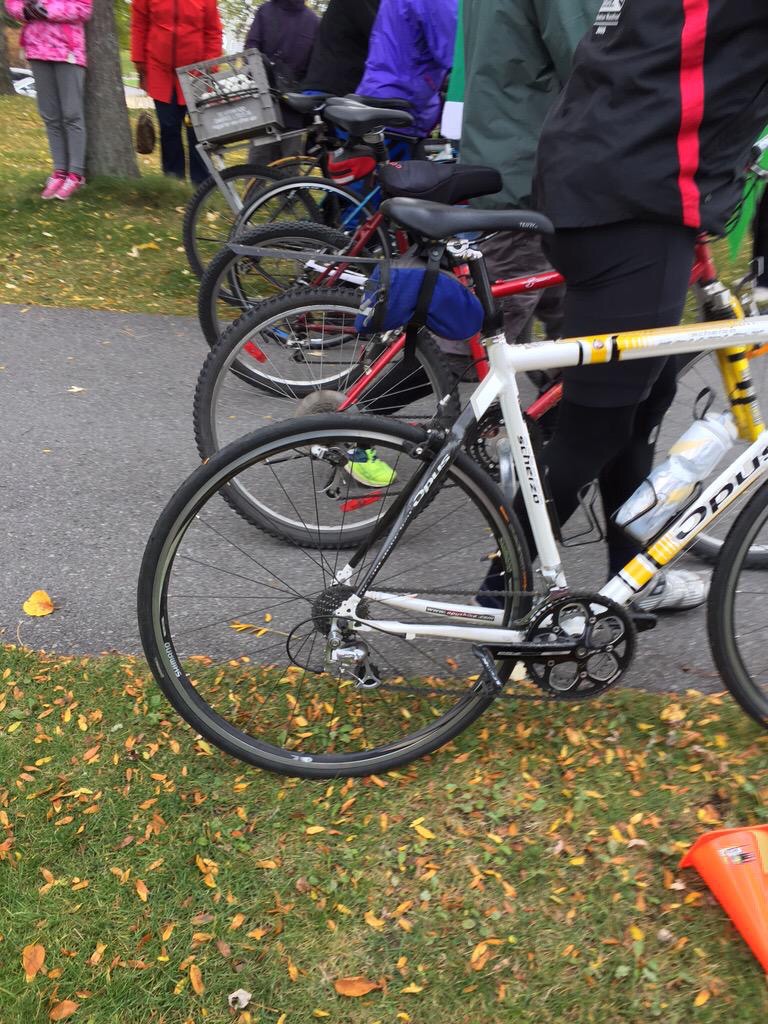
The highlight for me during the clerics cycling challenge (clericchallenge.com) was the finish line, when we all crossed together. This experience symbolized for me what the culture of Christian community ought to feel like and be like.

   
 We are part of a holy procession led by the King of Glory whose destination is sure. We have nothing to lose. If God’s grace is extended even to the generation of seekers (v.6), then we have nothing to lose. If what we are about is not a competition, then we have nothing to lose. If we don’t need to find fault in the other to prove our own self-worth, then we have nothing to lose. If it’s not about one-up-man-ship, then we can go for broke and not worry about it. If we don’t need to question who our Saviour is — who already accomplished for us our salvation — we don’t need to doubt our final destination. Then, why not share now what we have with others on this road?

All the saints on earth, despite the scars of life we bear, have gifts to share with other seekers on that journey. What gifts and blessings of God reflect in your life? In discerning this, remember: It’s not up to you alone! We don’t need to be perfect. We gain the gates not by our own merit or even hard work. Ours is the victory only because of the One for whose reason the gates are lifted in the first place.

Thanks be to God!
(1) — Michael Morgan in David L. Bartlett & Barbara Brown Taylor, eds. of “Feasting on the Word Year B, Volume 4” Fortress Press, 2009, p.228

Prayer for Reformation Sunday

We give you thanks, loving God, for  your unconditional love and grace to us and all people. Help us be moved to your heart, Christ Jesus, as our motivation, our desire, our passion for the decisions we make in our congregations. By your Holy Spirit, keep us steadfast in your Word, and continue to bless us in mission for and with others, so all may have dignity and all may live in hope. Amen

Reformation Themes 2017

The Day of Reformation (October 31) for Protestants, and especially Lutherans, calls us back to basic questions about who we are, as people of faith. Celebrating this day gives us the opportunity to ask again, “Who are we in the variety of religious expression on a diverse, social landscape?” And what do we have to offer?

For Protestants, the word itself may give us a clue. Protestants have often identified themselves as protesting against something. Many of us know the history: In 1517 Martin Luther nailed those 95 arguments on the doors of the Wittenberg Church. “Theses”, we’ve called them, were statements against certain religious practices and beliefs in the 16 century church. “Here I stand” has become a popular Martin Luther quote as he stood his ground and accounted for his beliefs before the Pope and Emperor at the famous meeting in Worms, Germany, shortly thereafter.
Many of us remember the Lutheran legacy as substantially a theological assertion: that you cannot ‘buy’ your way into heaven (by purchasing indulgences); rather, we are justified by grace through faith. Faith and salvation are fundamentally gifts from God.
And this is why the Lutheran World Federation (LWF) — a worldwide communion of 144 national churches — has come up with the theme of “Liberated by God’s Grace” for the 500th anniversary in 2017, commemorating Luther’s first protestant act in Wittenberg. Its sub-themes resonate with the indulgence debate: “Salvation not for sale; Humans not for sale; Creation not for sale.” 
In the pronouncement of these themes Lutherans worldwide and in Canada are claiming that we are not only celebrating something that happened in history. We are also asserting that we are a continually reforming church; that century-old themes can be relevant even today.
“Salvation – not for sale; Humans – not for sale; Creation – not for sale”. When something is not for sale, it is not on the market. We can not procure it by our means — any material means for that matter. When something is not for sale, it is a gift. We cannot possess it, in the same way we can never really possess God, salvation, anyone else, nor can we possess the earth.
The world today wants us to think and believe we can. We therefore delude ourselves into thinking and believing that we can buy salvation, that by our own hands, efforts and hard work we can earn God’s favour, God’s forgiveness. Do we go to church because we feel we need to manage our spirituality more as an insurance policy against hell, even though we are not sure about living out the mission of Jesus today? But God’s love in Jesus is unconditional. It is free. We have nothing to lose in positively living out our faith. Really! “Salvation — not for sale!”
Second, humans: It’s incredible that in the 21st century, there is still slavery practiced in the world; according to a 2013 study, there are still some 30 million slaves in the world today. Even in Canada, young people are gone missing and forced into the sex trade. Many Aboriginal women have disappeared, some murdered and some no doubt exploited in some despicable way. But, we claim: “Humans — not for sale!” What are we doing about this?
Finally, creation: As I said, our culture wants us to believe we can buy it. In fact, a recent survey measuring happiness revealed that our happiness is often dependent on ‘owning’ property. While the exchange of goods is in many ways an important building block of our economy, how differently would we look on our lives if creation (the environment, the land, the water and the resources therein) was not only something we must buy, possess and exploit for profit — but simply given as a gift from God that we share with all people? “Creation — not for sale!” Is finding meaning and purpose in life not the real sources of happiness? (“Money Really Can Buy Happiness, Study Shows”, thecanadianencylopedia.ca, 2013)
The confirmation class last week planted a tree in our church yard. Not only did we do this to respond to one of the Reformation challenges of our church (Evangelical Lutheran Church in Canada) to plant 500,000 trees by 2017, we performed a loving and caring act towards God’s beautiful creation which we share with all living creatures.
  
When it comes down to it, and we are honest, we must confess that it is often very difficult to be loving. It is challenging, even though we say we believe in a God who loves us unconditionally, loves the world unconditionally, loves creation unconditionally. 

So, how can we learn to love better?