Christmas Day – our gift is good enough

This Christmas message begins two months ago, on Halloween night. Yes, Halloween, when the goblins, skeletons, super-heroes and pirates were out in full force trick-o’-treating. 

It was a dark night. And pouring rain. But the children were determined to fill their sacks with as much candy as possible. 

Even the parents were in on it. In Arnprior, this made the local news: One Dad had lifted the large, tented car port from its moorings. Then he found three more willing parents to help him carry it like a giant umbrella down the street, protecting the dozens of huddled, costumed children from the relentless rain. 

When there is a will there is a way. Nothing was going to stop these folks on their mission to get the children as many treats as humanly possible. Talk about commitment. Dedication. Sacrifice. Self-reliance. For a cause.

Then, I heard of one grandparent who decided to give out candy at their door the same Halloween night, but here in Ottawa. He was going to get in on the spirit of it all and dress up himself. But, this time, he was going to shock his costumed visitors.

So, imagine with me the scene: Let’s say on Halloween you are going house to house with your pillow bag already brimming full of candy, pop and chips. And as you walk up the lane to the front door of thishouse, you start noticing something a bit off: 

Bright Christmas lights are hung around the front door frame and porch, blinking in blues, reds, greens and yellows. Ok. And when the front door opens, who is standing there, but Santa Claus! And he is ringing a hand bell and calling in a booming voice: “Ho! Ho! Ho!”

The grandparent who did this (sometimes adults will dress up as Santa Claus, you know!) reported to me afterwards about one little princess who stood at the door, dripping wet from the rain, mouth gaping open, eyes popping out. And she stood there for what seemed as an eternity. You could see the wheels in her head turning, wondering what on earth to do.

Finally, she made up her mind. The little girl placed her snack-and-candy-laden sack on ground and with two hands reached deep into the pillow case, pulled out fists full of treats and handed it all over to Santa. “Merry Christmas, Santa,” she said. I think it was Santa who was momentarily caught off guard, wondering what to do.

At Christmas, there’s a lot of pressure to perform with our giving. Today, it’s almost unheard of to limit a gift to $5. Today, if you’re not spending hundreds of dollars, will it impress? Yet, many will give in impressive ways – their time, energy, passion, money, and a gift for everyone on the list. Yes, we can say that it’s indeed better to give than to receive.[1]Yes, we can perhaps even point to times when it felt good to do so. 

But what if we feel there’s no more gas in the tank? What if we feel like we have no more to give. That we can’t keep up. We may decide not to give out any gifts because of this pressure we feel to impress. The emotional and digestive roller coaster, that is often what we experience over the holidays, may leave us spent, exhausted and hating people, hating ourselves. What more, on earth, can I give to anyone, let alone God?

Long ago, followers of Christ began to commemorate the coming of Jesus at the darkest time of the year. It was probably no accident that God came into the world when everything seemed so dark, so hopeless and helpless.

In the Gospel today from John, we read: “The light shines in the darkness, and the darkness cannot overcome it.”[2]These words of hope are central to the first chapter in John’s Gospel. It is then no accident that we today celebrate Christmas just days after the winter solstice, December 21, which in the northern hemisphere is literally the darkest time of the year. 

In John’s telling there are no angel choruses. In John’s telling there are no shepherds tending flock. In John’s telling there are no wise men travelling from afar. In John’s telling there isn’t even a baby lying in a manger with Joseph and Mary looking on. Those are the stories Matthew and Luke tell. 

In John, the message is about the meaningof God becoming human, the word made flesh. At Christmas, we’re not just talking about getting ready, waiting and getting prepared for the little baby Jesus to be born. That already happened two thousand years ago! What Christians have been doing every year since is welcoming the Christ that is forever being born in the human soul and into history of every time and place.[3]

Ancient Christians knew very well that this Jesus, his teaching, his message, his life, his spirit, his example, leads us to the way of life itself. The way of life where we take care for one another and the world, loving God and each other as children of God.

In John’s Gospel the way of life in Christ is gift. Pure gift. God is with us – Emanuel. God now lives in us, and is born in us. There’s nothing we can or can’t do that changes God’s intention to come to us in love, over and over again.

When we pray at Jesus’ coming into this world, we are admitting a truth that flies in the face of our heroic attempts at Christmas – attempts to get something more out of it for ourselves or for others, to impress others, to meet and exceed expectations, to perform well. Even when we give for the wrong reasons.

Maybe we do need, again, simply to kneel by the manger side where God is born in a baby – vulnerable, weak and helpless. Maybe we do need, again to kneel by the manger and remember that we did not choose to come into the world on our own. We did not choose our families of origin, our ethnicity, or our sexuality. While we were born with intelligence and with the capacity for learning, we did not arrive fully assembled nor did we come with instructions.

We are children of God, truly. In our honesty. In our vulnerability. In our instinct to turn to God. And that’s good enough for God. For God is with us now. The only instinct we had in the beginning – like baby Jesus did – once our lungs were clear after birth, the only instinct we had was to cry out for help as loudly as we could.[4]And that’s good enough for God. For God is with us now.

God receives us, as we are. At the manger side, there are no expectations, no need to put on a good impression or please anyone. We come as we are. The greatest gift we can bring to God and to life is our presence, our heart, our intention and attention.

What can I give him, poor as I am? If I were a shepherd I would bring a lamb; if I were a wise man, I would do my part; yet what I can I give him – give my heart.[5]And that prayer is good enough for God. For God is with us now.

Merry Christmas!


[1]Acts 20:35

[2]John 1:5,9

[3]Richard Rohr, “Incarnation – Celebrating an Eternal Advent” Richard Rohr’s Daily Meditation(www.cac.org, Tuesday, December 24, 2019).

[4]Br. Jim Woodrum, “Help – Brother, Give Us A Word” (Society of Saint John the Evangelist, December 4, 2019)

[5]“In the Bleak Midwinter” v.3 (Evangelical Lutheran Worship, Augsburg Fortress, 2006), Hymn 294

Christmas Eve – the greatest gift for getting it wrong

For over five centuries, Lutherans have asserted and proclaimed: grace is a gift. Meal time, especially during the holidays, is a great opportunity to experience grace.

Many of us will get together with friends, family, and coworkers for Christmas meals and potlucks. We sit at the same table and eat food that is shared among everyone at table. 

Where’s the grace? (besides the pre-meal prayer)

The grace in that experience, is being together. How often does that happen in today’s world? When family members are separated by vast distances unlike in any other time in human history. When coworkers can suspend their usual activities and work routines to just sit down and eat a meal together. When effort is made to make and/or bring food for all.

The grace is sharing food together despite the conflicts, the dislikes, the divisions and lines drawn between those around the table on account of political opinion, social standing, personality, past hurts.

The grace is found in those moments when, unexpectedly and surprisingly, a kind word is said between combatants, a genuine smile of thanksgiving is offered when ‘gifts’ are exchanged, or tears of forgiveness given and received are expressed.

On the surface, these moments may not change a whole lot, at least not immediately. But repeated often enough – Christmas comes every year – the seed sown deeply in the heart will one day sprout. ‘Mary treasured all these things and pondered them deeply in her heart’,[1]the scripture says. Sometimes, in the face of grace, all we can do is find a moment to appreciate and digest this gift. And let it grow in us. We are, each of us, the innkeeper who will decide whether or not to let Jesus in.

Celtic Thunder, the Irish, male group sings a powerful version of Silent Night that tells the story of Christmas at the Western Front in 1915. German and British soldiers stopped their fighting for a few moments Christmas Eve when one of the German soldiers – a lad of 21 years of age – started singing Silent Night.

Before long, combatants from both sides that had been avowed to killing each other were walking across no-man’s land. For a few moments they left their weapons behind, hugged each other and gave each other gifts of cigarettes and pots of wine.

But alas, the moment of grace passed. And before long they were shooting at each other again. And the 21-year-old soldier who had started the singing, did not make it to the morning.

Grace was given to those boys amidst the battle. In the singing of Silent Night, in the exchange of gifts, in the hugs and laughter, grace was still given.

Grace is a gift not for getting it right, but for getting it wrong.[2]And we human beings, throughout history, can get it awfully wrong. But this does not stop God.

God came into the world not at an ideal time when everyone was getting along. Herod was a paranoid despot about to wreak havoc in the land. In short, there was unrest in Palestine. Beneath the surface of all that might have appeared genteel in the little town of Bethlehem that holy night was broiling a call to arms by discontented zealots against Roman occupation. The military conflict would finally erupt some seventy years after Jesus’ birth with the destruction of Jerusalem.

God chose a particularly dark and disruptive time and place in history to enter in, as a vulnerable little baby boy born to a teenager in a barn for animals. Not a strategy for success, you might think, eh? On earth, nothing was going right.

But the grace of God knows no bounds. The grace of God enters into the thick of it. Not when everyone is getting along. But especially when everyone is getting it wrong.

The message of Christmas, in the end, is one of hope. Because no matter how bad or sad things get, it won’t stop God from prying into our consciences from time to time to tell us that God is never too far away. No matter how bad it gets, God is always with us. Emanuel. God with us.

Once we can accept that God is in all situations – not just the warm fuzzy moments decorated with visions from Hallmark – then everything becomes an occasion where some good can happen. God can and will use even bad situations for good.[3]This is the day God has made, let us rejoice and be glad in it!”[4]

Our task this Christmas – however you are observing it – is to look for and find the good, the true, and the beautiful in everything, even and most especially the problematic. Because the bad is never strong enough to counteract the good, however small or short-lived. “The light shines in the darkness, and the darkness cannot and never will overcome it.”[5]

Amen.


[1]Luke 2:19

[2]Richard Rohr, “Accountability Is Sustainability” Twelve-Step Spirituality: Part One (Daily Meditations, www.cac.org) Friday, December 13, 2019

[3]Richard Rohr, “Incarnation – Like Knows Like” Richard Rohr’s Daily Meditation (www.cac.org, Monday, December 23, 2019).

[4]Psalm 118:24

[5]John 1:5,9

Prayer as Silence – Advent sermon series 4

In this concluding sermon in a series on prayer this Advent, I invite you to consider prayer as silence. In the first, we acknowledged prayer as growth – that there come times in our lives when God invites us into a deeper communion of prayer; and so, a different way of praying. In the second sermon, we considered that the fundamental work of prayer was to listen – listen to the other and listen to God. Last week, we reflected upon an important type of prayer that often is missed especially during times of the year we are called to be happy; the lament makes our relationship with God real and our ultimate joy authentic.

The eagle changes its flying posture depending on the state of the air around it.  When in flight it encounters noisy, turbulent air, the eagle folds its wings straight down and underneath, riding the agitated, unstable winds in as compact a body mass as possible.

But when the air is calm high above the earth, the eagle will spread its massive wingspan to its farthest limits. It will expand its body mass to its fullest potential as it coasts and glides on the silent, peaceful air.

Silence gets a bad rap in the Protestant church especially. Since the Reformation and Enlightenment, we are suspicious of anything that is interior or to do with experience. When we still our minds, we are afraid that we will let the devil in! 

And, we will straight away point to bad silence – like the violence percolating beneath the surface of giving someone ‘the silent treatment’. Or, we rightly condemn the complacent, fearful silence in face of injustice. In both cases, words must be spoken. And better loudly at that!

Yet, there is a silence that is healing, transformational. We find it in nature. We find it in the stillness of predawn dew resting on flowers and blades of grass. We experience it the first night in the bush after driving all day away from the loud, noisy city. 

We also find silence in the bold action born of convicted hearts, action that happens behind-the-scenes. Not in the spectacular, the sensational. Not in attention-grabbing largess of personality shock-and-awe. But in the quiet, dedicated, barely perceptible giving of those who know themselves and respond to the still, small voice speaking in their hearts.

This is Joseph. He appears, indeed, to be the strong, silent type. But not because he is afraid to say or do anything. But because he has the courage to respond. He begins his risky venture with Mary “after waking from sleep.” Even though he went to bed “considering in his mind” all the problematic aspects of his relationship with Mary, “resolving” to leave her, his course of action changed dramatically after he stopped the busy-ness of his mind, the activity of his consciousness – as good and righteous as it was – and went to sleep. And dreamt.[1]

There is a difference between the absence of noise and silence. Something is already happening in this holy silence. Something we’ve been too busy, too rushed, too loud, too distracted to notice. Where God already is, in between the words, in between the spaces defined by our cerebral, ego-driven impulses and imaginations.

This is good, Lutheran theology! The grace of God already exists in our lives. We don’t have to make it happen. Really, we don’t! God is in the world, already. It is given. God is present. God is waiting for us, in the silence of our hearts. God is waiting, already, in the circumstances and situations of the world. God is always listening to us. 

But are we always listening to God? Are we willing to step into the river of God’s action and Spirit? Will we immerse ourselves into the prayer already flowing in our lives, a prayer flowing into the ocean of God’s presence and love? The late Thomas Keating was known to have said, “Silence is God’s first language; everything else is a poor translation.”[2]

It is in silence where we can be fully and truly who we are. We don’t have to hide anything. We don’t have to meet anyone’s expectations, put on a good impression or please anyone. We can let go and let all that is there come to the surface in the confidence that all of it is held in God’s love – the good, the bad and the ugly. We can stretch to our fullest without judgement. We may be, in truth, letting the devil out, not in.

May we step into the spaciousness of God’s mercy, peace and joy just waiting for us in the silence of God’s ever-present love. May we learn to pray in the gift of silence, especially when we may so desperately need it.


[1]Matthew 1:18-25

[2]Cited in Theresa Blythe, Fifty Ways to Pray: Practices from Many Traditions and Times(Nashville: Abingdon Press, 2006) p.32

Prayer as Lament – Advent sermon series 3

Traditionally, the Third Sunday of Advent is known as Gaudete Sunday, a command to rejoice! Be joyful!

In all the furtive busy-ness of getting ready for the big day, in all the running around and striving to check off everything on the ‘to do’ list before Christmas, carrying all the pressure and responsibility …

The church says: don’t take yourselves too seriously on this journey. There are times when we need to not just listen up, but lighten up. Gaudete!

Yes, we are on the path of transformation. And this path requires us to be intentional and disciplined. After all, Christmas is coming; there is much to prepare! It was Ignatius of Loyola, a contemporary of Martin Luther in the 16thcentury, who urged the church to “pray as if everything depended on God, and work as if everything depended on us.”[1]

Not bad advice. Except we won’t survive this journey if we don’t also take the foot off the gas pedal from time to time. Can we let things be as they are? Can we accept ourselves and rejoice even at the imperfection of our lives – the cracks in who we are? Or, have we deluded ourselves into thinking that only when everything is perfect, and finished, and just the way it ought to be, then, and only then, can we rejoice?

How can we be authentically joyful, especially when things aren’t the way they are supposed to be in our lives and in the world?

In our ordinary lives as much as in our worship and prayer, we have to make room for lament. Lament? It seems odd to suggest that on Gaudete Sunday of all days – the Sunday during Advent when we are called to rejoice – we offer our laments to God in prayer.

I’d like to suggest this is the path to expressing true joy. Lament as a necessary step on the path to true acceptance, hope and joy. So that our rejoicing isn’t just an extension of our culture’s surface ‘good cheer’ which often only masks deeper needs.

The Psalms, which are the primary prayer book for the ancient Israelites and Jews of Jesus’ day, are filled with laments. We read one together this morning.[2]Even Jesus, after his triumphal entry into Jerusalem on Palm Sunday, expressed his disappointment and sorrow over Jerusalem[3]. And then in the garden of Gethsemane the night before he died, Jesus prayed to God if only his cup of suffering could be taken away.[4]Jesus wept for the death of his friend Lazarus[5], and on the cross he cried out, “O God, why have you forsaken me!”[6]quoting a Psalm. Jesus was familiar with, and used often, the prayers of lament on his journey to new life.

Perhaps we are afraid that if we do take the foot off the gas pedal during this season of rush-rush, we might not very much like what comes to the surface. In that moment when we are not driven by our compulsions and distractions, what scary thing might emerge?

This season can be difficult for those, for example, who grieve the loss of loved ones especially when it is the first Christmas celebrated without them. We are supposed to feel happy, but we are burdened by a deep sadness of loss. And all those messages that declare we are to be ‘joyful’ only serve to deepen our sorrow. How, then, can we be joyful?

In the Academy Award winning movie, “Inside Out”, eleven-year-old Riley has moved to San Francisco, leaving behind her life in Minnesota. She and her five core emotions, Fear, Anger, Disgust, Sadness and Joy struggle to cope with her new life.

In the movie, each of these emotions is a separate character in the control room of Riley’s mind. Until the big move, it was always Joy who was in the driver’s seat. Joy determined how Riley processed events and situations in her life. Even if Riley, who loved to play hockey on the family pond, missed a shot on goal, Joy would step in and emphasize the bright, positive side of the situation. Sadness would always stand nearby, trying to be more influential in defining Riley’s experiences. But, until the move to San Francisco, Joy always won out.

When big events in our lives happen – events that are happy or sad – these change us and the way we look upon life. By Joy insisting on dominating, even when Riley experienced significant challenges at school and at home after the move, she became worse and worse, shutting out her parents and isolating herself.

It was only when Joy let Sadness take control, did Riley turn the corner. Riley became better in her new life when no emotion was denied, but given its rightful place given the circumstance. The emotions – especially Joy and Sadness – discovered that both have to take turns in the driver’s seat from time to time. Both/And. Not Either/Or.

Christianity did not combine opposites into some kind of favourable blend. Neither does having faith exclude, deny nor avoid one in favour of the other. Rather, our faith holds all dimensions of the human, and all the dimensions of the divine in vibrant and furious tension.[7]Like, the tension of becoming truly joyful when we can also offer our lament. When we can let sadness take the driver’s seat for a bit of that journey especially when it seems it’s supposed to be all about being happy all of the time.

In the Advent study group on prayer, we reviewed the various characteristics of a lament by looking at some Psalms. One characteristic will often escape our notice, maybe because it doesn’t fit our expectations of what lamenting is. You know, we think it’s all tears and gnashing of teeth and breast-beating and woe-is-me kind of stuff.

But a lament is not a lament unless it also carries the one who is praying into a place of confidence and trust in God. Maybe that’s why Jesus lamented so much. Because he was so faithful to Abba. Trusting in God his Father. Besides the obvious grievances and plea for help expressed in the Psalm, did you not also hear and feel joy born out of confidence and trust from the Psalmist’s words this morning?

“Restore us, O God; let your face shine upon us and we shall be saved. You have brought a vine out of Egypt; you cast out the nations and planted it … Turn now, O God of hosts, look down from heaven; behold and tend this vine; preserve what your right hand has planted … Let your hand be upon the one at your right hand, the one you have made so strong for yourself. And so will we never turn away from you; give us life, that we may call upon your name. Restore us, O Lord of hosts; let your face shine upon us, and we shall be saved.”[8]

Prayer as growth. Prayer as Listening. Prayer as Lament. On the road to Christmas.

[1]Cited in Patrick J. Howell, David L. Bartlett & Barbara Brown Taylor, eds. Feasting on the Word: Preaching the Revised Common Lectionary Year A Volume 1(Kentucky: WJK Press, 2010), p.65-66.

[2]Psalm 80; see also Psalms 74, 79, 85, 90.

[3]Matthew 22:37; Luke 13:34

[4]Matthew 26:39

[5]John 11:33-35

[6]Matthew 27:46, citing Psalm 22:1

[7]Howell, ibid., p.64

[8]Psalm 80:7-8,14-15,17-19

Life and love? Not just here

Why do you look for the living among the dead?

He is not here, but has arisen!

Where is Jesus now?

Around 13 million visitors a year flock to Notre Dame Cathedral in Paris. And that number has been growing in recent years, and will likely continue to grow now. After the fire there this past week, so many worldwide grieved at the seeming passing of this iconic and historical site.

Over a billion people in the last century alone have made a physical contact with that one particular site on the banks of the Seine River in France. Think of it. A significant portion of the world’s human population in modern history.

We are a people attached to certain places. And, then, we associate our identity, our families, our faith, our memories with those places—becoming attached to them. Losing them is akin to losing the meaning associated with that place. Losing them is losing ourselves.

Where is Jesus now? Where do we look for Christ today? In one place, only?

In the ashes of a burned-out sanctuary? At the homestead farm long ago abandoned? At the graveside tomb of a loved one? Only at the seaside, or only in gardens of splendour and glory? In the pages of the bible alone?

Can we even pin it down to one place, now? Can we experience Jesus only under certain conditions, when and where the stars are aligned in perfect order, where we feel God? And only there and then?

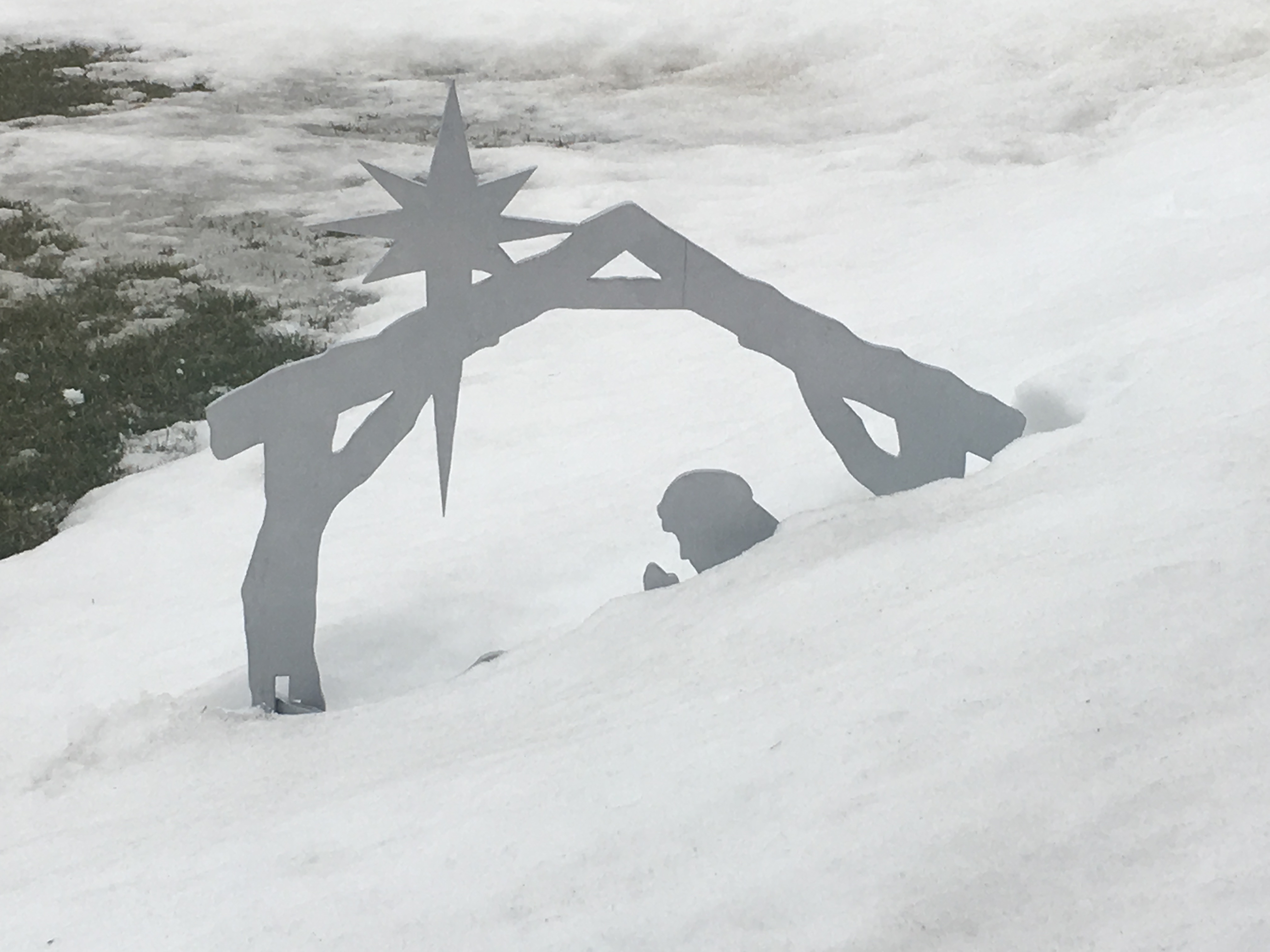
It was hard to believe that I would ever get the manger scene—our front-yard Christmas tableau—freed from the frozen ice last January. I joked that Jesus was snowed in with us. It felt like forever. And that it would probably be Easter by the time I would be able to free baby Jesus from the bonds of his snowy tomb.

Well, finally this past week, it was done! Baby Jesus’ resting place for the past half year now shows signs of new life in the ground even as the snow recedes.

IMG_8094

Jesus is no longer bound to a certain place and time in history. Easter has unfurled Christ to the whole world. The power of God’s love has unbound Jesus from a particular point in history and place; and, released the power of that love for all people, in every time and every place.

And, for all of creation.

Christmas and Easter are thus connected through the incarnation, the indwelling, the integration of the divine and material. While Christmas injected the divine into the DNA of humanity, announcing: “God is with us!”; Easter proclaims the universal imprint of God’s purpose through the Spirit of the living Jesus everywhere and in all things! Now, “God is for us!” Easter drives home and expands Christmas’ initial point.

Jesus isn’t in one place: 1stcentury Bethlehem, Nazareth, Galilee, Jerusalem, Golgotha.  Jesus is in every place, in all times:  2019 Canada. 1789 France. 1519 Wittenberg. 1348 Spain. 1215 England. 476 Rome. And that’s just looking backward … The future, too!

When French president Macron addressed the nation following the burning of Notre Dame, he talked about how the cathedral survived two world wars, about how the cathedral was looted and badly damaged in the French Revolution. And how it always survives. And how it will survive again, and be reconstructed.

Even through suffering, loss and death, the Spirit of hope, love and generosity prevails—throughout history! And sometimes unexpectedly. The love and life will come as a surprise. That is the nature of life.

In the winters of our lives, life will lie hidden and buried under banks of snow and ice. But under and in and within, life is literally waiting to erupt at just the right time, at just the right moment. Now it does. Because that is God’s desire for creation. Life and love.

That is God’s desire for Jacqueline who is this day baptized. That is God’s desire for each one of us. That is God’s desire, now, for everyone. The Easter message encourages each of us to release the loving Christ living in our hearts. The Easter message challenges us to act in ways that show that we aren’t saved until the whole world is saved. Because the wind of Christ’s presence now blows across the whole earth and over every creature, rock, tree and wave without inhibition, without boundary, without limitation. For all.

Today, Jesus is freed from the chains of death. Jesus is alive! Alleluia!

Amen!

Still snowed in – Lent 5

Even though it’s now less than two weeks till Easter Sunday, our Christmas tableau is still snowed into our front yard.

At least now — surprise! — we can see what’s there, what has been hidden deep under the snow for over three months.

The journey of Lent continues. More and more snow is melting. Much too slowly. The holy family and Christ child are now revealed, bit by bit.

Still not able to free Jesus from the frozen earth, I can recognize the gift hidden deep within a heart frozen in grief, in loss, in suffering.

And what a joy to discover that all along, Christ is there with me, even through the travail of a long winter’s journey in my life.

Snowed in: Lent 4

IMG_8077

The snow still covers most of the story from our awareness. Buried deep within our hearts the fullness of all that makes us who we are is waiting to emerge. On the slow and steady movement on the Lenten journey to the springtime release and new life, we must embrace what is revealed, good and bad.

The first figure that I recognize is Joseph, praying. Joseph, the father of Jesus. Joseph, the father. What in my soul does ‘father’ mean to me? My father, Jan, died this winter. His memory resonates in my heart and I still feel the pang of grief. What is his legacy– as father, pastor, male– in my life? Faithfulness. Vulnerability. Physical strength. Passion. Feeling. Human-ness …

What does the revelation of the springtime structures within your heart tell you about you? About God? About your relationship with others, this earth, and Jesus still waiting to be released from what binds him on earth? Jesus, still waiting to be expressed and resurrected in your heart anew?

On the journey, even though the snow still covers so much (in Eastern Ontario anyway!), let us be buoyed by true signs, indeed, that the snow is surely melting away.

With us, snowed-in

I wasn’t able to remove the Christmas manger scene from our front yard in time, before the snowstorms left everything buried. As we’ve approached Lent, the joke in our household is that Jesus, like us, is snowed-in.

IMG_8042

It likely won’t be until late April now when I will be able to remove the tableau from the frozen earth and its snowy cover. When will Jesus be set free from the tomblike confines of winter’s grip?

When exactly, no one knows. Meteorologists are calling for a cooler-than-normal late April /early May. It might be a while.

The Jesus story, for us, begins in winter around the winter solstice on Christmas Day. We begin again our Lenten pilgrimage in the throes of winter, when snow and ice cover everything. When will the sky brighten and warmer temperatures heat the ground again? When does the journey end?

The poet, Mary Oliver, who died in January of this year, wrote primarily about winter. In several pieces she twins snow with wisdom, the capacity to live with questions in silence, surrendering to its beauty. “I love this world,” she wrote, “but not for its answers.”[1]

I’ve considered Christianity to be a winter faith. We, as people of faith, live with many questions that are largely unanswerable. Why do we still live in a world beset by injustice, intolerance, hatred—despite all good effort in the name of Jesus to the contrary? Why death and disease? When will we find the answers to our deepest questions? Why? Why? Why? Winter is a time for questions.

And so, we continue to search, wander, and wonder with Jesus snowed-in, by our side.

But, is Jesus in over his head?

The temptation of Jesus—as this story is famously called—happens near the beginning of his divine calling and ministry.[2]He goes into the wilderness, the desert, for forty days. He goes into a place of harsh simplicity, stripped of all creaturely comforts, to serve a holy purpose.

We wonder, will he survive the challenge?

Given his life purpose on earth, he meets with what could be his greatest vulnerability—the seduction of power and its forceful implications. The man who is the Son of God, King of Kings, Lord of Lords, Almighty and Everlasting, the man whom people would look to for guidance and leadership, the man who many would lift onto a pedestal—would Jesus succumb to everyone’s expectation?

Would Jesus yield to the temptation that he, the Messiah, will now lead the revolt to free the suppressed and oppressed Judeans out from Roman occupation? Would he be the political rallying point around which the crowds would mobilize and generate an effective, political movement?

And, in fact, the evil one touches on this potential weakness. Notice in different ways each of the three temptations seduce Jesus to grab hold of power that would make him this kind of King: One who satisfies his every appetite and hunger using whatever means at his disposal; one who creates God in one’s own image by forcing God’s hands, one who offers blind obedience to those still ‘above’ them while climbing the ladder of ‘success’.

But that’s not what Jesus was going to be about. We know that. In order to embrace his true identity, what happens?

Jesus is first led by the Spirit into this vulnerable place, not away from it. He was to first meet this human, shadow side.

The point of Lenten discipline, whatever it may be for you, is to be led into that shadow place in our own lives that we, on our own, don’t want and even can’t go. The Spirit leads us to face that which we normally distract ourselves from, where we normally deny, avoid. What is that vulnerability for you?

What does the light and Spirit reveal in the dark corners of your life? Is it a fear? Is it a conversation you know needs to happen? Is it confronting a situation you have been trying to avoid? Is it coming to terms with what is really going on deep down in your heart?

How does Jesus respond to his temptation? How does he return to his identity in God?

The scriptural quotations he cites are signs of his true identity—his ‘touchstone’, if you will. The scriptures point to his true self. By citing the scripture, he reminds himself, he aligns himself, he allies himself, with what grounds him in who he is. By citing scripture he relies not on his own humanity and resources of his own making, but rather on God.

This text provides rich support for our own journeys of Lent. As we wander into the wilderness of our lives and continue to trudge through the snow wary of still slipping on the ice, as we wonder with our questions, we meet our own shadow sides. And are called to stay rooted in who and whose we are.

And what is your touchstone for remembering your identity in Christ? Is it scripture? Is it the bread and cup of the sacrament? Is it a song? Is it an act of repeated service for another? Is it a prayer?

In her poems about winter Madeleine L’Engle writes a word of hope for the journey:

“Snow does not obscure the shape of things. It outlines them, like an icy highlighter, revealing the deep structure of the world. We walk through the woods, seeing differently, and, when we glimpse the hidden structure, we ask questions even as we experience its stark beauty.”[3]

Writer-theologian, Diana Butler Bass takes it further: “Strangely I have found in my own life that it is only through a wintery spirituality that I am able to affirm summer and sunshine. A friend wrote me recently, ‘Winter reveals structure’. Only as the structure is firmly there are we able to dress it with the lovely trappings of spring, budding leaves, rosy blossoms. Winter is the quiet, fallow time when earth prepares for the rebirth of spring.”

The word, Lent, means ‘springtime’. While the Lenten journey begins in the frozen winter, we can say in faith that the purpose of the journey is to bring us to Spring. Because by the end of the Lenten season, the snow will be gone revealing the soft, verdant earth underneath where new life is just budding to sprout.

In the end, the disciplines of Lent, the questions we now pose and with which we struggle on the journey, these are gifts from God. They point us to God’s presence in our lives and in our world. In the end, that is what faithful observance of Lent is—“a grace-filled return to the Lord our God.”[4]

Who begins with us, snowed-in and under.


[1]Cited in Diana Butler Bass, The Cottage: A Winter Faith (January 18, 2019)

[2]Luke 4:1-13

[3]Madeleine L’Engle cited in Diana Butler Bass, ibid.

[4]Kimberly M. Van Driel, in David L. Bartlett & Barbara Brown Taylor, eds. Feasting on the Word: Preaching the Revised Common Lectionary Year C, Vol 2 (Kentucky: WJK Press, 2009), p.25.

Christmas Day – funeral sermon

Jesus said, ‘The kingdom of heaven is like treasure hidden in a field, which someone found and hid; then in his joy he goes and sells all that he has and buys that field. ‘Again, the kingdom of heaven is like a merchant in search of fine pearls; on finding one pearl of great value, he went and sold all that he had and bought it … For where your treasure is, there your heart will be also.’ (Matthew 13:44-46; 6:21)

“Your mother is always with you … She is Christmas morning.”

Though your mother veered away from the Italian version of her first name, “Santa”, because of its obvious English connotation to ‘Santa Claus’, there is too much about your mother’s journey to avoid mention of Christmas Day, the day she died.

Of course, “Santa”, in Italian means “Saint.” There is indeed something godly about your mother’s journey that can leave for us a legacy of love and hope. She was, after all, a saint. But a human, as well. As Martin Luther said about all of us—we are simultaneously saints and sinners.

The scriptures her brothers sent for inclusion in this service point, also, to an important part of how your mother was with you. Normally when we hear the words of Jesus: “the kingdom of heaven is like …” such and such when someone does so and so, we think of the job we must do to enter that kingdom.

That’s part of it. Your mother certainly demonstrated determination and tenacity. She showed a singularity of mind and spirit about the things she liked to do, and the way she did them: a religious person, attending to ritual and prayer her whole life long; a gardener and craftsperson, committed and caring to her family. Never forgetting birthdays and special anniversaries.

Stubbornness may be the other side of that coin of having a clear, focused intention to what she was all about. She strikes me as a person you would never need to wonder about what she really wanted or what she believed. Indeed, the kingdom of heaven is like when someone knows what they want, and with joys seeks it out leaving all else behind.

At the same time, the words of Jesus point to what God is all about. I also consider those scriptures about the kingdom of heaven as describing the character of God: A God who treasures your Mother as much as God treasures each one of us. And will stop at nothing to find us. And give up God’s very life on the cross—give up everything—in order to be with us and love us. Where God’s treasure is—in us—there God’s heart is also.

Again, this is the message of Christmas, the day your Mother died. A message of One who comes into our life even in the messiness and despair of being human. Born a vulnerable baby to poor, teenage parents in a backwater town of Bethlehem. The message of Christmas is about a God who ‘sells it all’ in order to be with us. In order to know us, really know us. To grieve with us. To enjoy with us. To walk with us this often difficult journey that your Mother knew all too well.

And, to give us a wonderful promise of one day being united with all whom we loved on earth, at the end of the road.

Thanks be to God.

Amen.

Meeting the unexpected

On New Year’s Eve, the roadway was completely covered in snow. All I could see in the waning light of day was the general shape of the roadbed curving slightly to the right in front of me.

I couldn’t see the customary yellow and white lines on the pavement to guide me. There were no tracks left in the snow of cars gone down this way recently. The snowfall was fresh and the road was not well-travelled.

I could control my speed, of course, but I didn’t have a lot to go on. Would I get home in one piece? First, I had to slow down. And even be prepared to stop.

The Magi were on a journey to arrive at the home of the young Christ child. Christmas cards and the popular mindset show the Magi at the baby Jesus’ side on the night he was born. But that is likely not the case.

The Gospel of Matthew indicates the Magi visited the holy family’s “house” in Bethlehem, hardly a description of a cave or stable for animals.[1]The Gospel of Luke, from which we read the birth narrative on Christmas Eve, does not mention the Magi.

The Magi were on a journey that took months if not years to accomplish. Their journey took time. Their coming to Jesus, so to speak, was not an immediate, instant, snap-of-the-fingers conversion. Their experience was slow, plodding and winding course across the deserts of the Middle East. On their journey to find Jesus, they had to have the long-view in mind. A whole lot of determination. And a commitment to the journey with all its fits and starts.

I also get the impression, reading through these verses from Matthew, that the Magi who were nearing the end of their long journey had to make in-the-moment changes to their plans. They had to check their assumptions and change their minds about initial expectations.

For example, at least half the Gospel text for today focuses on Herod. Initially, the Magi came to him in good faith, believing the Roman governor would sincerely help them. But an angel of the Lord had to steer them away, literally by a different road, and from Herod’s manipulating, plotting, fear-ridden treachery. The Magi had to trust ‘new information’ and make changes to their flight plan in mid-stream.

Then, the gifts. Three gifts: Gold, Frankincense and Myrrh. In biblical times, these gifts were usually given to a king or a person with highest status. Gold was such a gift. From the Hebrew scriptures, when The Queen of Sheba visited King Solomon she gave him precious gifts: “Arriving at Jerusalem with a very great caravan – with camels carrying spices, large quantities of gold, and precious stones” (1 Kings 10:2). The spices that she brought with her might very well have been frankincense and myrrh.

The gifts themselves are a powerful sign of what these visitors originally intended. The Magi were coming a long way to worship who they considered the true King. Not Herod. Not Rome. But the divine Son of God.

And, still, not what they expected.

The meaning of these gifts needs to be examined in light of Jesus’ life, death and resurrection. For us, what is ‘kingship’ in light of Christ—certainly not what we might first assume: glory, power, military strength and victory. Jesus’ journey took him through the defeat and humiliation of the cross. That’s the kind of kingship Jesus is about.

Myrrh represented healing. Healing in the light of Christ was not so much about an instant cure to earthly disease. But rather, healing is a transformation of the inner life of our attitudes and finding wholeness and grace in every moment of life, especially in the midst of suffering and pain. The king whom the Magi came to worship was a king who, in truth, represented values and meaning that countered—were at odds with—the values of the world.

And that is why this story starts the season of Epiphany in the church. Epiphany means, Revelation. The baby Jesus is revealed as the Son of God who shows us the way of God—God’s path of transformation and salvation. The season of Epiphany invites us to participatein this way. Participating in this journey asks us, like the first Magi, to be prepared to change course and examine our standing assumptions about God and the world.

It’s the manner in which the truth is revealed that ought to catch our attention in the biblical story. And this way is both apparent by what these three gifts mean, and by the expectations we first bring to this story.

For example: We assume and even say ‘it’s biblical’ that there were three men and they were three kings. But that’s not what the bible says. For all we know, there could have been a whole caravan of them. And what if some were women?

Although we sing, “We Three Kings of Orient Are,”, these visitors from the East were also not kings. The term Magi is a plural form of a word in Greek which means, literally, Zoroastrian priests.[2]And, maybe they earned the title ‘wise’ because of their skills in interpreting dreams and understanding astrology.

It’s as if the proverbial rug first needs to be pulled from underneath us before the truth is revealed. We don’t come to it straight on. Our expectations first need to be checked, and likely over time, over turned.

Once on New Year’s Eve when driving down a country road covered in snow in the middle of a blinding snow storm I thought I was driving in the middle of the road. I figured I best check that assumption. Thank God I did.

In a moment no other vehicle was passing, I stopped and opened the driver’s side door. With my boot, I scraped away the fluffy blanket of snow believing I would find the dark asphalt of the road and maybe even a lane marker painted on the hard top.

To my horror, I turned over stones and gravel, indicating I was already on the shoulder of the road. Had I not stopped at that moment, my vehicle was heading in the direction of the deep ditch on the side of the road.

Thank God, I had it in my mind to stop when I did, and scratch the surface of my belief. Then, I was able to change course.

The star finally stopped over Bethlehem, showing the Wise Ones where the destination of their journey lay. At this sign, “they were overwhelmed with joy.”[3]Arriving home in one piece from driving in less-than-ideal road conditions gave me a sense of joy. The joy comes because of the journey, maybe because the journey was difficult. Maybe because the journey called forth the best from you, to meet the challenges and make headway despite the journey’s challenges, pain and suffering.

The amazing thing is that God somehow brought the Magi–the Wise Ones–to the exact location of their hopes and dreams. Perhaps not what they expected at first. But this gift they surely recognized.

Here are some questions for reflection as we enter this new season after the Epiphany: What was the most important gift you received this holiday season? Did you expect it? Why is it important? How did you receive it?

God has given us the greatest gift in Jesus. Where we find him will be shown to us, on the journey. This grace continues throughout our lives.

May our trust grow in a God who has this uncanny ability to trust and have faith in us to get home. Let us pray: God, you led the Wise Ones by a star to find the Christ child. Lead us as we strive to follow you in living our faith. No matter how long it takes. No matter how winding the journey. Help us trust your promise to bring us home. Amen.


[1]Matthew 2:11

[2]Niveen Sarras, “Commentary on Matthew 2:1-12”, http://www.workingpreacher.org

[3]Matthew 2:10