On the road to Bethlehem

photo by Jessica Hawley Malina (July 16, 2024 / Hwy 4 between Ucluelet & Tofino BC)

It is a dark night. The cedars drape over the narrow, rocky path, blanketing out what dim starlight shines from the sky above.

A pregnant woman travels with her husband through dangerous territory in a tyrannical age, on the road to Ephrath – a small town on the outskirts of Jerusalem otherwise known as Bethlehem.

Who is this woman with her husband travelling at night?

This story is familiar in the bible. It is Rachel, going where the Lord God commanded. But the story doesn’t end well for Rachel. She dies in labour, on that road to Bethlehem, giving birth to Benjamin. And Rachel’s husband Jacob buries her by the road. He erects a grave in her honour and memory (Genesis 35:16-26).

Generations later, the lamenting prophet Jeremiah picks up the image of Rachel’s tomb on the road to Bethlehem, when the Babylonian captives are forced to march by it into exile (Jeremiah 31:15).

Tonight, Mary and Joseph follow the same path (Luke 2). After passing Rachel’s tomb on the way, Mary would no doubt have remembered the story of Rachel’s tragic end.

When she and Joseph make their anxious way on a dangerous road in the night to be registered in Joseph’s birthplace, what goes through Mary’s mind? Would she, like the faithful Rachel before her, also die on this road in labour? Would she, despite saying yes to God’s call, fail like the captives on their way to Babylon?

That dark night on the dangerous road to Bethlehem no doubt challenged her faith. Anyone who traveled on that rocky, darkened path to Bethlehem was reminded of the often-difficult realities facing God’s people throughout history.

You may be on an uncertain path, this Christmas. Thinking you are nonetheless on the right path, you still question your decision. Because there are reminders along the way from past experiences and memories, that cause you to doubt. And even though you believe you are on the right path, it is dark and hard to see the way. And you question God. Is God even there? Indeed, we travel a dangerous road tonight.

Like the prophet Isaiah, we complain God is nowhere in sight. We cry, O God, “You have hidden your face from us” (Isaiah 64:7).

When we find ourselves in the dark, what do we do?

Like Mary and Joseph making their way on the road to Bethlehem in the night, we can’t wait for sunny days. We keep moving forward in the dark, little by little. Like Mary and Joseph, we move, trusting that whatever challenges we face are already solved. The answer is out there, somewhere in the dark. We just haven’t come across it yet.

Let’s not forget, much of God’s created world relies on darkness as much as light. We need not fear the darkness. For plants and trees, seed germination takes place in the darkness of the soil below the ground. It is in darkness that the roots seek nutrients (Coman, 2024).

We require darkness for birth and growth in the human world as well, not just the seed in the ground, but the seed in the womb, the seed in our souls.

In the dark lie possibilities for intimacy, for rest, for healing. Although we may find journeying in the dark fearsome or confusing, it teaches us to rely on senses other than sight. In the process we learn that darkness bears the capacity for good, gives birth to the good.

What do we do when we find ourselves in the darkness of our own making or what the world has done?

Our work is to name the darkness for what it is and to find what it asks of us. What does the nighttime call us to do? Does the darkness ask a wrong to be made right, for justice to bring the dawn of hope to a night of terror? Does it ask for a candle to give warmth to the shadows, or for companions to hold us in our uncertainty and unknowing, or for a blanket to enfold us as we wait for the darkness to teach us what we need to know?

We need not fear the darkness of this Christmas Eve. It is a holy birth, after all, we celebrate this night.

At home this past Fall we installed LED sensor lights on the outside of the house. Our yard borders on a town pathway that leads into a back field. Sometimes people will take a short cut and walk down that path which has no lighting.

After being installed, two of the three sensor lights worked properly, coming on when sensing movement and shutting off after a minute or so. But the third one would not shut off. It remained on, even during the daytime. And no amount of fiddling with the settings could I get that light to turn off, apart from shutting down all three of them on the same breaker.

It was the light that would not turn off, the light that kept shining in the day when we didn’t notice it. The light was on, even when we didn’t see it.

“God came to us because God wanted to join us on the road, to listen to our story, and to help us realize that we are not walking in circles but moving towards the house of peace and joy.

“This is the great mystery of Christmas that continues to give us comfort and consolation: we are not alone on our journey [in the dark] … Christmas is the renewed invitation not to be afraid and let him – whose love is greater than our own hearts and minds can comprehend – be our companion” (Nouwen, 2004).

“In these … days of darkness and waiting, it may indeed seem that [at first] God’s face is hidden from our sight. But the sacred presence is there, breathing in the shadows” (Richardson, 1998, pp. 1-3).

It is a call to faith, darkness invites. A call to trust in the dawn and the sun that never stops shining. A call to trust in those who come alongside to travel with us to Bethlehem.

On that first Christmas Eve, indeed Mary was reminded of how not so well things turned out for the faithful people who went before her on that dangerous road to Bethlehem.

Yet, if anything, Mary was reminded of how God is there, in the darkness, once again, trying again. Trying again with people of faith to make a place in their lives for the coming of the Lord.

If anything, Mary was reminded that she was indeed on the right path in the dark, going in the direction God was making ready.

Mary Oliver, in her poem entitled “The Uses of Sorrow”, wrote:

Someone I loved once gave me
a box full of darkness
It took me years to understand that this, too, was a gift.

In the Christmas story, God’s face is revealed. The stars in the night sky over Bethlehem shine on a tiny baby’s face. In the midnight hours of that first Christmas, God came into the world in the face of a baby. The dark night gave birth to the greatest gift ever.

Thanks be to God! Merry Christmas!

References:

Coman, S. (2024, December 4). Seeds of hope. Lutherans Connect. https://lcseedsofhope.blogspot.com

Nouwen, H. (2004). Advent and Christmas wisdom from Henri J. Nouwen. Liguori Publications.

Richardson, J. (1998). Night visions: Searching the shadows of Advent and Christmas. United Church Press.
The Shepherd Promises: “I’ll be back” – a sermon for a family Christmas Eve

There’s a funny meme I saw on Facebook about getting into heaven. The caption reads: “The Eternal Screening Process”. The scene depicts St Peter at the head of a cordoned off area, on one side, containing a waiting crowd of people. He consults his computer to check which one of the humans are ‘approved’ to enter eternal glory. 

On the other side of the cordoned section is a wide-open corridor, where many dogs are running straight into heaven under a gate that reads: “Pre-Approved”.

So, if you are an animal person—someone who has pets at home or whose significant relationships are with animals—then the Christmas story is for you! Because several of the humans in this story are, frankly, a letdown:

The first roadblock the holy family encounters is a ‘No Vacancy’ sign hanging over the door to the Bethlehem Inn. There is no room for them here. There’s no place among humans for Mary to give birth to, to make room for, baby Jesus.

But the animals have room in their house, the stable, for the Lord. Their place becomes the holy site for Jesus’ birth. The animals are the heroes on the night Jesus was born. Maybe that’s why years later when Jesus told stories about the truth of God’s kingdom, he talked a lot about sheep.[1]

So, maybe the animals and those who cared for them—the shepherds—were always near and dear to Jesus’ heart. You could say that because of Jesus’ experience, God has a special forever-place in his heart for sheep and shepherds.

There are some ‘lost sheep’ in the congregation. Yes, literally. Small sheep figurines or stuffed animals, or ornaments, or cut-out wooden sheep for outdoor nativities—somewhere in sight, tucked away, or on a ledge, or hanging from something, or leaning against a wall. Ok! Those are all the hints I’m giving you!

I would ask the children in the congregation to find those sheep as quietly and as quickly as you can (there are 7) and bring them to the front where you can place them in the manger right beside Jesus where they belong.

After all, they need to go home. And they can take care of Jesus this Christmas night.

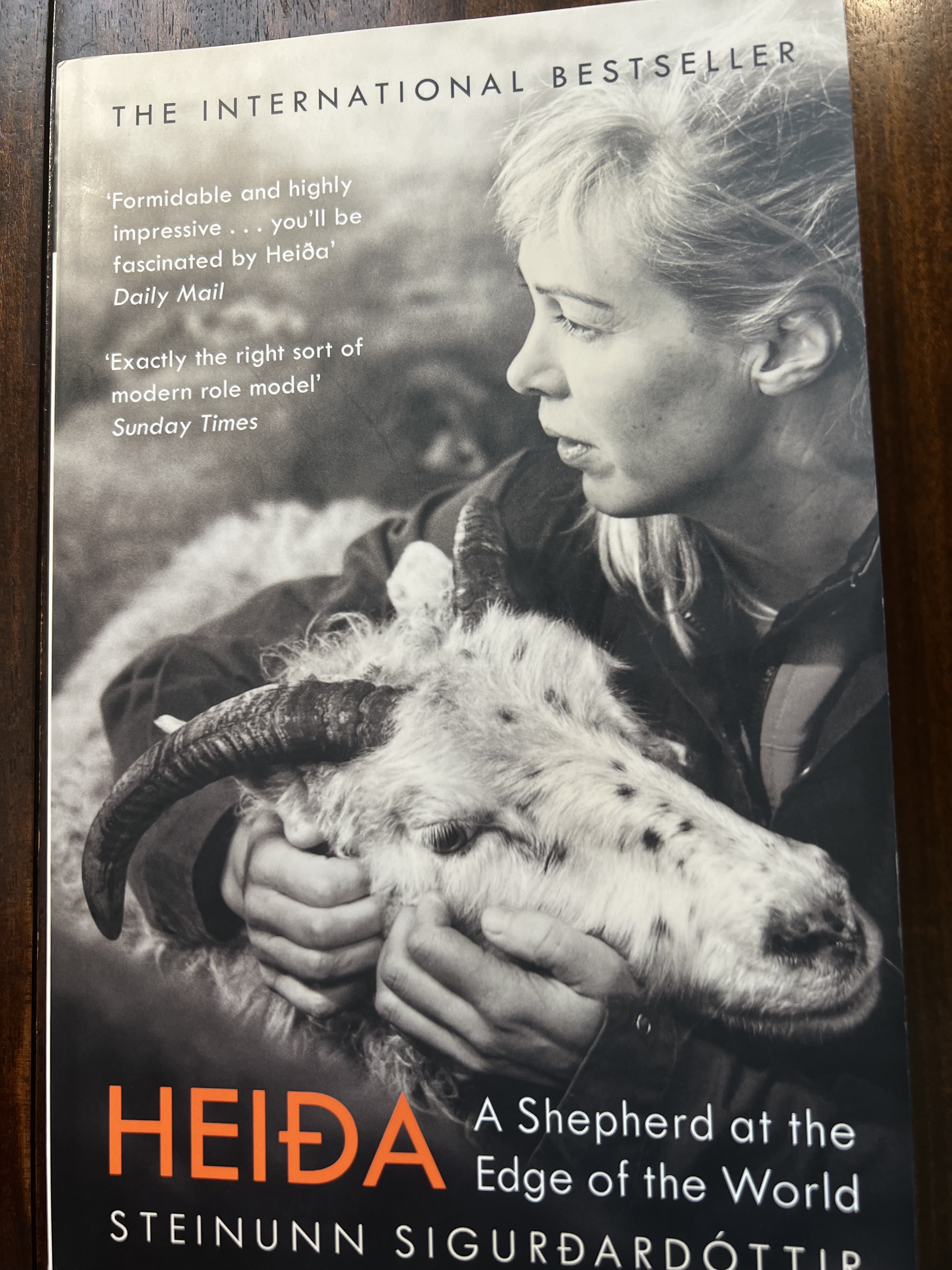
I’d like to introduce you to a modern-day shepherd. Her name is Heiða [pronounced ‘Hey-a’]. I first met her by reading the best-selling book, subtitled: “A Shepherd at the Edge of the World”.[2] Her job, as a farmer, is to raise and look after sheep. Some five hundred sheep.

Where do you think she does her shepherding job? What country? Here are a couple of hints: She does this in the last place on earth you would think shepherds do their job. And, while Heiða lives and farms at the edge of the world, her land has been farmed since the 12th century. Any guesses?

Her farm is located in Iceland. She says, “My land, which is vast by Icelandic standards, is mainly wilderness beyond the boundary of the highlands.”[3] There are no fences or walls surrounding this vast pastureland.

From the point of view of sheepherding, this is a significant detail. And might also explain why, in fact, there was room not in the inn but in the stable of Bethlehem. Perhaps not all the sheep were in the barn at the time, but rather out in the fields with the shepherds.

It’s a scary proposition for shepherds, and especially for Heiða whose hundreds of sheep will roam deep into the highlands and wilderness for weeks and months on end. Much of the book talks about how she and her neighbours will round up all the sheep at the end of the season—it’s an extensive, labour-intensive, time-consuming job. There’s lots of ground to cover! Some sheep get lost, indeed. But for the most part, year after year the shepherds herd all of their sheep back into the barns in time for winter.

In his story-telling Jesus implies we are sheep. So, let’s push that image further. Because if Jesus is the shepherd watching us flocks by night, he really does give us a lot of freedom to roam. It must take a very special God indeed to say to us: “Go. Go for a season. Be free. Make your choices. Explore the vast landscape. You’re on your own, for the most part and for a while. Take responsibility for yourself. And see you in a few months!”

We say God is in control. Well, in a metaphysical sense perhaps. Things we don’t really have any control over anyway – like where and when we are born, to whom we are born, what part of the world we are born into, and some of the big events of our lives. Yeah. We’re not in control, for sure. So, it’s good to say, God is.

But God is not in control of us. We are not puppets on a string. We are not forced to conform to others. No. Even though God is our God, our loving shepherd gives us the freedom to roam even at the proverbial “edge” of the world: being your own person, not trying to please everyone, not conforming to someone else’s expectations of you, pushing the boundaries of what’s possible, being creative, taking thought-out risks, changing things up when things need changing, being bold.

The good news is that no matter how far we go, with whom we roam, no matter the number of times we slip and fall, get stuck, get lost, we know one thing: We can count that the Good Shepherd will come and find us at the end of the season. We can trust God to bring us home when it’s time and especially in the night-times of our lives when it’s tough. We’ll never be lost forever. God will come for us, even in the darkest night.

We can echo the words of the Psalmist—

If I flew to the point of sunrise, or westward across the sea, your hand would still be guiding me, your right hand holding me.[4]

Heiða, in her book, talks about the biggest threat to her sheep: Do you know what that is? Hint: It’s been in the news a lot lately—volcanoes. The nearby volcano is called Katla. It erupts on average every fifty years. She lives and works these days expecting the old volcano to erupt and disrupt her efforts to keep the sheep safe.

When Jesus was born, the biggest threat may not have been a local volcano. It was King Herod, but just as volcanic was he in his efforts to kill any threats to his power. Jesus was born, amidst the animals, at a time when the world was under siege.

But we know how the story ends. Come back at Easter time to hear that one. Spoiler alert: In the end, the good guys win.

But for now, at this time of year when the nights are long and we groan under the weight of all the things that threaten, discourage, and dampen our spirits, be rest assured that we will again hear the voice of, and see, our loving shepherd coming over the hill to gather us back home.


[1] For example: “I am the shepherd, you are the sheep” (John 10:1-18); the lost sheep (Luke 15:1-7); the goats and the sheep story (Matthew 25:31-46).

[2] Steinunn Sigurðardóttir, translated by Philip Roughton, “Heiða: A Shepherd at the Edge of the World” (London: John Murray Publishers, 2020).

[3] Ibid., p.2.

[4] Psalm 139:9-10 (trans. Jerusalem Bible)

One light

In the Christmas Eve candlelight service we all light our individual candles to symbolize the light of Christ coming into the world.

In this ritual, there’s another symbol for these candles I’d like us to consider: These candles represent each one of us. The light of Christ shines in our very own lives.

I took a photo of one of the advent wreaths we constructed in our home this past month; you can see it below. To begin with we had four, good-sized pillar candles we set in a bed of stones. But the glass holder had a relatively small diameter. The only way they would all fit in the container was to place the four candles right beside each other so they were touching. 

As the four candles burned down, pretty soon we realized our mistake. They were too close to each other. The flames from the candles conspired to melt the wax in an accelerated, agitated fashion. The melted wax pooled quickly and often snuffed out the drowning wicks. We managed the candles as best as we could. But by the end all that was left was one amorphous blob of wax at the bottom of the bowl.

The candles burn much better when there is more space between each of them.

One of my favourite rituals of Christmas is shining all manner of lights. There are various and different kinds of lights—LED, flashing electrical lights for outdoor use, fairy white lights on boughs of spruce and pine, candlelight, and the list goes on. Yet all of them still do one thing: they provide light. It’s all about the light. These candles we light tonight belong to the one light of God. All light comes from God.

At a deeper level, we are all united, and share, in the light of Christ. All of it belongs to the One. At a deeper level, God overcomes whatever separates and divides us. In our common humanity, like all the wax pooling together at the bottom of the bowl, therein we find the one light in us all.

At Christmas, we often discover and experience our failings, weaknesses, and limitations in our relations. Amidst the intensity of those relationships, may we be reminded again of the good news of Christmas: That our individual lives–where necessary space is important–we still belong to a larger, brighter and ever-burning light. This is the life and love of God coming into the world at Christmas, and whose life and love is for the whole world.

Crooked Christmas Trees

sermon audio for “Crooked Christmas Trees” by Martin Malina
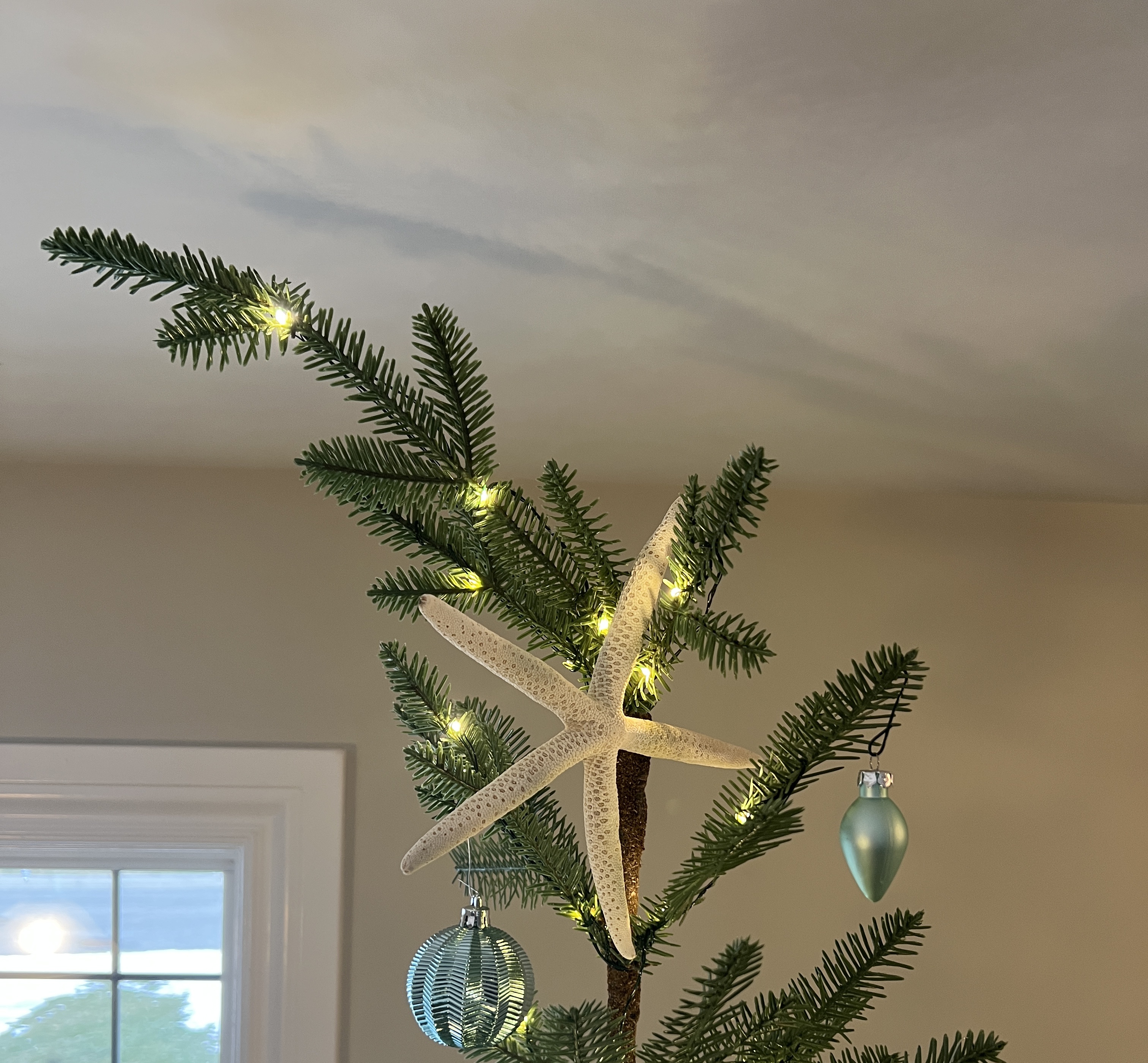
The star on a crooked branch (photo by Martin Malina, 2021)

I have tree problems, I must admit. The Christmas tree inside the house, and the trees outside our house, have certain challenges, you might say.

When I ordered our artificial Christmas tree some years ago, I wanted it to be tall enough to just reach the ceiling of our living room. So I ordered the 10-foot one. However when it arrived and I set it up in place, the tip was about 6 inches too long. So, I had to deal with a crooked tip. How would a star fit on top of my Christmas Tree?

The opposite problem existed outside. The tips, the leads, of two of my six white pine trees, now about 6 feet tall have fallen off because of the white pine blister fungus. These trees will lose their straight-line trunk as they grow and reach for the sky. 

When these tips fell off a couple months ago, I must admit I grieved this change of their life’s trajectory. The trees will have a crooked trunk from about six feet up. Their new branches near the top will eventually bend towards the sky. They will not look the way I had envisioned when I first planted the seedlings in a row at the back of our property.

When I did a book search on Amazon using the title “The Crooked Tree” I was surprised to find not one, but several books with this title. All of them were geared to Christmas time, and most of them offered a spiritual message.[1]

I guess I’m not alone in searching for meaning in a Christmas Tree that is not perfect, crooked in fact. Would we yearn for a celebration of Christ’s birth that was not encumbered by expectations we have, expectations that contribute to the stress of the season?

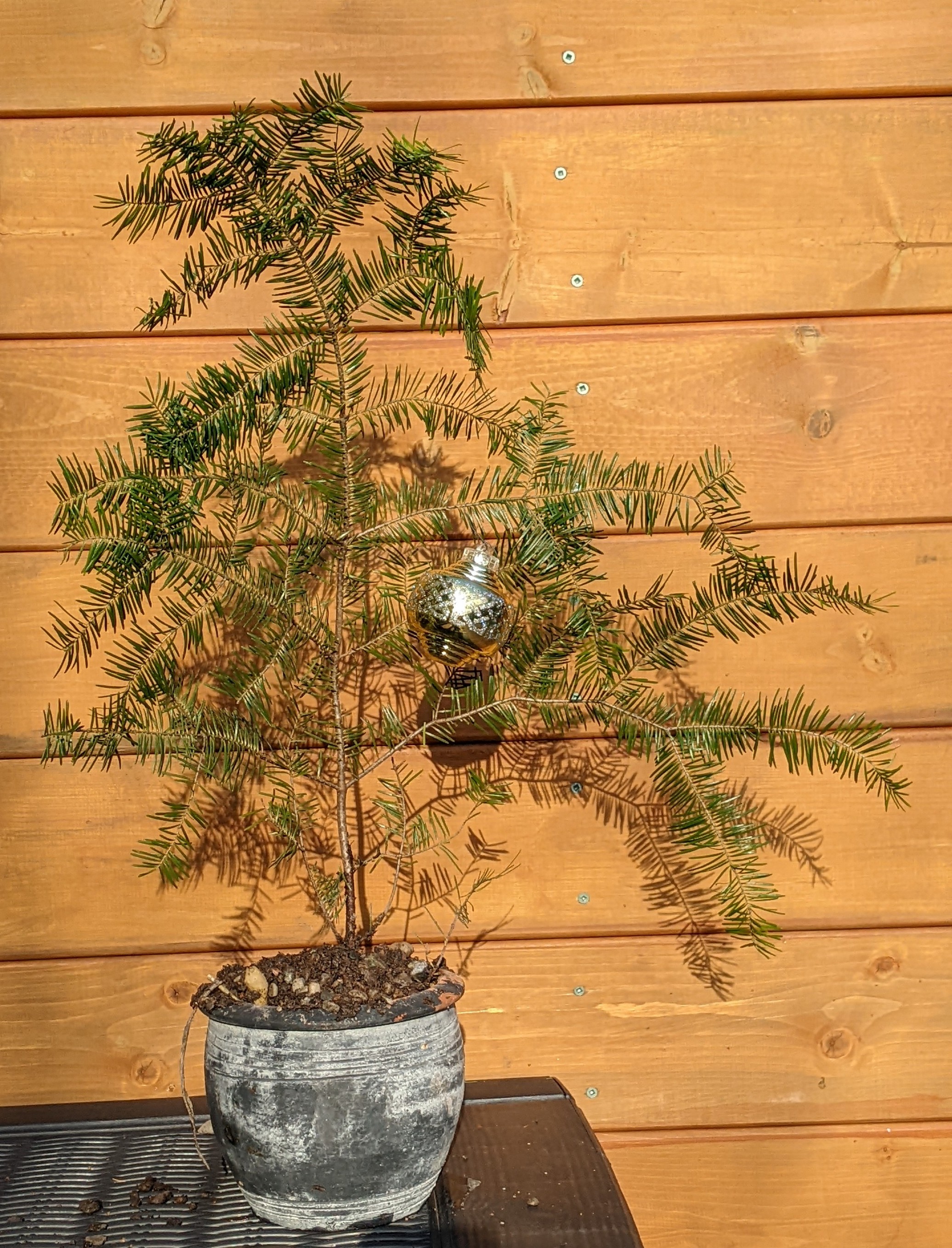
I love Charlie Brown Christmas trees – a 2-foot tall, low-leaning branch in a pot, really, bearing only one red ball which pulls down the tip. Whenever I see one in someone’s house, I gravitate towards it. 

A living branch (photo by Beth MacGillivray, 2021)

But when we set up our Charlie Brown Christmas trees, is it the only festive tree in the house? Or, is it meant only to serve some comic-relief, meant merely to complement the other more serious decorations in our homes? Do we make sure the real, dressed up, ‘perfect’ tree is centred in front of the picture window in the grand rooms of our homes? I’d be tempted to go there, I must admit.

I like the story about Martin Luther in the sixteenth century going into the bush before Christmas, cutting down and hauling in an evergreen tree to put candles on it. Lighted, these candles attached to the branches of the tree. They reminded Luther of the stars that he saw shining in the sky above. They filtered through branches of the forest around him. Martin Luther, of course, understood these lights to symbolize the light of Christ shining in the dark, the light coming into the world.

I will read later tonight from the first chapter of the Gospel of John describing the light coming into the world.[2] That is the meaning of Christmas—Jesus, Son of God, came to us. 

And what is more to this story of Jesus coming – the Light of the world shining in the night – is that God does not wait until the morning. God does not wait until midday when all is bright in our lives. God comes at night when the monsters creep in the shadows and our minds and hearts can’t see clearly.

Understand, God does not wait until everything is perfect. God does not wait until you find your way. God does not wait until you get it right. God does not wait until you fix all your problems. God does not wait until everything that is wrong is gone. God does not wait until COVID is over before coming into our lives.

Because on a crooked branch, there is still room. The top part of my Christmas tree can still hold a star. There is room aplenty on crooked branches to hold all manner of stars.

And God rejoices this night. God rejoices that the tree with crooked branches can bear the star, hold the light. And that is all we are: Christ-bearers, holders of the light. Our hearts, our lives, crooked and imperfect in every way imaginable, can still reflect and hold the light that has come. That, my friends, is good news.

It just makes me want to sing! “O Christmas tree, O Christmas tree …”


[1] A couple of books I have read recently – Damian Chandler, The Crooked Christmas Tree: The Beautiful Meaning of Jesus’ Birth (New York: Hachette Book Group Inc., 2017); and, Michael Tracey, The Crooked Christmas Tree (Michael Tracey, 2012).

[2] John 1:1-5

The good news this COVID Christmas

This Christmas Eve many of us worship in our homes.

I’ve asked you to bring and light a candle for the duration of this time of prayer online. Perhaps as we look to the weeks ahead, we’ll all be spending more time at home during the lockdown, and there will ample opportunity for you to create a space and time for prayer, and light your Christmas candle. In fact, you may want to light it for a few minutes each of the twelve days of Christmas.

Lighting a candle and pondering its flame is a simple act. Yet doing so provides you with a focus for prayer. It creates a holy space in your home. And brings an awareness of God’s presence closer to your heart.

Maybe that’s the good news in this COVID-Christmas. Because isn’t that the truly evangelical faith – to experience personally an encounter with the Lord? Not by going to some other place from where you live, sleep, eat and spend most of your days. Not in holy sanctuaries far away. Not somewhere you need to drive to or take a bus or walk. But right where you are. Right where you live.

Christmas is about God coming into our world. And for many of us this Christmas, our world is very close to home. Where the heart is. For all the missional work the church aspires to and the social gatherings many of us love in the public spaces of our lives, the faith at some point still needs to resonate in the heart of the believer. And that’s what this Christmas is about. Inviting us to press the reset button on faith, by starting at home, where we are.

In an email that I received from a friend a few weeks ago they signed off not with  “Sincerely” or “Best wishes” or “With warmest regards.” Rather they signed off their letter by writing “Keep negative.” Keep negative? What did they mean?

I reacted to that statement and I wondered if they were being brassy or making a dig at me, always trying to put a positive spin on everything. Were they trying to be funny? It seemed odd to sign off that way. Anyway, I asked what they had meant by ‘keep negative’. 

They laughed and said it was a COVID reference. Keep negative. That is, if and when you get tested for the coronavirus, they hoped I would get a negative result. Not a positive one.

It was my turn to laugh. Of course. And then I reflected, how easy it is for us to focus on the negative. It’s almost our default. Even when there is good news. We’re afraid that if we are overly positive the other shoe will drop and something bad is just waiting to happen. 

Even when there is so much for which to be thankful. Even when there is so much that we have. It’s easier to ‘keep negative’ and talk about what is not happening this Christmas, what is wrong in the world, how dark it is. The ‘good news’ can be staring us in the face, and we don’t acknowledge it. We choose to turn away from it.

Christmas is a time to focus on that single flame from that single candle surrounded by darkness and give thanks for the greatest gift of love and life in Christ. Christmas is ‘good news’ that we need to recognize, first in our own hearts. And then spread it to others around us.

The message of Christmas is that divinity and humanity unite – and we see that first and foremost in Jesus. But the purpose of Jesus was to bring that awareness and truth into our own lives. So, during this COVID Christmas we are pressed, indeed, to grapple with Christ in our own lives.

The image of a pregnant Mary carrying the Christ child to birth is an image to hold onto. This Christmas, we carry the Christ child in our own hearts. And if at first you can’t find Jesus there, take some time to explore the interior regions of your own soul. This Christmas, we are invited to traverse the inner landscape of our hearts, and discover the spirit of Christ lives there, too. Even where there is pain, illness and fear.

That Christ Jesus chooses to live there despite all that is not right — this is good news. And this news brings joy, peace, and hope. So, keep positive; there is good reason.

Christmas Eve – the greatest gift for getting it wrong

For over five centuries, Lutherans have asserted and proclaimed: grace is a gift. Meal time, especially during the holidays, is a great opportunity to experience grace.

Many of us will get together with friends, family, and coworkers for Christmas meals and potlucks. We sit at the same table and eat food that is shared among everyone at table. 

Where’s the grace? (besides the pre-meal prayer)

The grace in that experience, is being together. How often does that happen in today’s world? When family members are separated by vast distances unlike in any other time in human history. When coworkers can suspend their usual activities and work routines to just sit down and eat a meal together. When effort is made to make and/or bring food for all.

The grace is sharing food together despite the conflicts, the dislikes, the divisions and lines drawn between those around the table on account of political opinion, social standing, personality, past hurts.

The grace is found in those moments when, unexpectedly and surprisingly, a kind word is said between combatants, a genuine smile of thanksgiving is offered when ‘gifts’ are exchanged, or tears of forgiveness given and received are expressed.

On the surface, these moments may not change a whole lot, at least not immediately. But repeated often enough – Christmas comes every year – the seed sown deeply in the heart will one day sprout. ‘Mary treasured all these things and pondered them deeply in her heart’,[1]the scripture says. Sometimes, in the face of grace, all we can do is find a moment to appreciate and digest this gift. And let it grow in us. We are, each of us, the innkeeper who will decide whether or not to let Jesus in.

Celtic Thunder, the Irish, male group sings a powerful version of Silent Night that tells the story of Christmas at the Western Front in 1915. German and British soldiers stopped their fighting for a few moments Christmas Eve when one of the German soldiers – a lad of 21 years of age – started singing Silent Night.

Before long, combatants from both sides that had been avowed to killing each other were walking across no-man’s land. For a few moments they left their weapons behind, hugged each other and gave each other gifts of cigarettes and pots of wine.

But alas, the moment of grace passed. And before long they were shooting at each other again. And the 21-year-old soldier who had started the singing, did not make it to the morning.

Grace was given to those boys amidst the battle. In the singing of Silent Night, in the exchange of gifts, in the hugs and laughter, grace was still given.

Grace is a gift not for getting it right, but for getting it wrong.[2]And we human beings, throughout history, can get it awfully wrong. But this does not stop God.

God came into the world not at an ideal time when everyone was getting along. Herod was a paranoid despot about to wreak havoc in the land. In short, there was unrest in Palestine. Beneath the surface of all that might have appeared genteel in the little town of Bethlehem that holy night was broiling a call to arms by discontented zealots against Roman occupation. The military conflict would finally erupt some seventy years after Jesus’ birth with the destruction of Jerusalem.

God chose a particularly dark and disruptive time and place in history to enter in, as a vulnerable little baby boy born to a teenager in a barn for animals. Not a strategy for success, you might think, eh? On earth, nothing was going right.

But the grace of God knows no bounds. The grace of God enters into the thick of it. Not when everyone is getting along. But especially when everyone is getting it wrong.

The message of Christmas, in the end, is one of hope. Because no matter how bad or sad things get, it won’t stop God from prying into our consciences from time to time to tell us that God is never too far away. No matter how bad it gets, God is always with us. Emanuel. God with us.

Once we can accept that God is in all situations – not just the warm fuzzy moments decorated with visions from Hallmark – then everything becomes an occasion where some good can happen. God can and will use even bad situations for good.[3]This is the day God has made, let us rejoice and be glad in it!”[4]

Our task this Christmas – however you are observing it – is to look for and find the good, the true, and the beautiful in everything, even and most especially the problematic. Because the bad is never strong enough to counteract the good, however small or short-lived. “The light shines in the darkness, and the darkness cannot and never will overcome it.”[5]

Amen.


[1]Luke 2:19

[2]Richard Rohr, “Accountability Is Sustainability” Twelve-Step Spirituality: Part One (Daily Meditations, www.cac.org) Friday, December 13, 2019

[3]Richard Rohr, “Incarnation – Like Knows Like” Richard Rohr’s Daily Meditation (www.cac.org, Monday, December 23, 2019).

[4]Psalm 118:24

[5]John 1:5,9

Christmas, now

Just a couple of years before he died, Martin Luther preached one of his last Christmas sermons. In it, he challenged his 16thcentury German congregation to bring the nativity into the present moment – the present reality.

Martin Luther described the squalor and desperation swirling around Mary and Joseph arriving late in Bethlehem and not finding room in the inn, leaving them to give birth to Jesus in a small barn out back. Then, he said:

 There are many of you in this congregation who think to yourselves: “If only I had been there! How quick I would have been to help the baby! I would have washed his linen!” … [Well] Why don’t you do it now? You have Christ in your neighbour. You ought to serve them, for what you do to your neighbour in need you do to the Lord Christ himself.[1] That was preached in 1543.

At Christmas 2018, we are not just called to hear the story again, but to be in it, part of it.[2]

Essentially, Martin Luther was getting at the meaning of Christmas for his contemporaries. And for us, today. How can we be inspired by the children, the music, the gifts we bring at Christmas to step out of the nativity ‘play’, and into the real story unfolding around us today?

We share in the communion tonight. In the chaos, noise and crowd, celebrating the sacrament might not fit our idea of a neat-and-tidy, perfect Christmas service. It’s hard to sentimentalize the Eucharist.

But it’s important to offer it tonight. Because the sacrament brings us to the present moment. The meal tells the story of Jesus being in our hearts—not decades ago when things were golden and sweet in our memories, not two thousand years ago, not in the Martin Luther’s day, not lost in words of scripture alone—but right here, right now, in the present day, in our own experience of life in this world.

Receiving the bread and cup doesn’t mean your life is perfect, doesn’t mean you are now ready for Christmas, doesn’t mean y our life is in order and worthy of God.

When you receive the Communion, you are affirming that God is somewhere in the mess and chaos of your life. Our life. Emmanuel–God with us.

Celebrating Christ’s birth does not bring us outof history, it involves us with it—in the present time.[3]The Christmas story gets lived out by our attention and care for the dark shadows in our own hearts, as well as reaching out to vulnerable people in our world.

I heard with dismay on the local radio station last week that the City of Ottawa is putting up 230 families in cheap hotels this Christmas, where they have to live for over a year before social housing spots open up. Talk about conditions of squalor entire families, all of them poor, need to live in at Christmas. And we’re not talking about a handful. Two Hundred and Thirty families, in Ottawa alone.

Have we considered that when we pray for and help in whatever way we can these people, we are serving Christ himself? After all, our Lord was a refugee himself right after his birth, fleeing to Egypt with his parents to get away from Herod’s violent and murderous intent.[4]

Popular TSN Hockey Insider Bob McKenzie just came out with a book this Fall entitled: “Everyday Hockey Heroes: Inspiring Stories on and off the Ice”[5]

In one chapter about an inspiring Ottawa story, Bob McKenzie relays the words of Karina Potvin, a minor hockey coach. She writes: “So much about Canada is welcoming. Well, except maybe our winters, but they’re a small price to pay in order to play hockey …”

As Karina watched on the news refugees being greeted at the airport, she writes: “I knew I wanted to help these new Canadians feel at home. I just wasn’t sure how.

“A few months later I was at practice when I saw one of my fellow coaches … coming towards the bench … [he had a] new idea for Reach Out. Reach Out is a program in our hockey association that helps low income families pay for equipment and registration fees so that their kids can join our league …

“‘You know how my wife and I have been working with some of the Syrian families who have settled here in Ottawa?’ He went on, ‘We took a family to …[a] game last week, and their sons absolutely loved it. They had never heard of hockey before, but they want to play.’

Karina ended up coaching three boys—Mohammed, Ahmad and Ismael—who quickly got the hang of skating. “They’re all over the ice!”

“The three boys breathed hockey all day, every day. As did their parents. By midseason, the parents were typical Canadian hockey moms and dads.

“One Arabic word I learned was hebbak which means “I love you.” Sometimes when we were on the bench, I would turn to Mohammed and say it. He always gave me a strange look.

“’Yeah, I just told you that I love you. Because you’re playing really well tonight and listening to us coaches.’

“He shook his head, ‘Coach Karina, you’re weird.’

“’If you ever make the NHL and they ask you who was your first and favourite coach, you have to say Coach Karina.’

“’Yes, of course.’ He laughed.

“’And if you ever play for the Senators, you have to get me tickets.’ Every time I said this, he would smile and reply, ‘Yes. Yes. Yes.’”

Just imagine: The year before, these kids had been in a refugee camp in Lebanon. Now, they were playing hockey just like so many other kids in Canada.[6]

May the first Christmas story become alive and real for you, as the Christ child is born anew in your hearts thisday.

Here are the words of American writer Madeleine L’Engle in a poem entitled “First Coming”:

He did not wait till the world was ready,
till men and nations were at peace.
He came when the Heavens were unsteady,
and prisoners cried out for release.

He did not wait for the perfect time.
He came when the need was deep and great.
He dined with sinners in all their grime,
turned water into wine.

He did not wait till hearts were pure.
In joy he came to a tarnished world of sin and doubt.
To a world like ours, of anguished shame
he came, and his Light would not go out.

He came to a world which did not mesh,
to heal its tangles, shield its scorn.
In the mystery of the Word made Flesh
the Maker of the stars was born.

We cannot wait till the world is sane
to raise our songs with joyful voice,
for to share our grief, to touch our pain,
He came with Love: Rejoice! Rejoice!

Merry Christmas!

[1]Martin Luther, Christmas Sermon, 1543; Matthew 25:45

[2]Lcfaithinthenight.blogspot.com, 19 Dec 2018, (Lutherans Connect, @LuTConnect).

[3]Gustavo Gutierrez, cited in LutheransConnect, ibid.

[4]Matthew 2:13-15

[5]With Jim Lang (Toronto: Simon & Schuster, 2018)

[6]The full story in ibid., p.45-56

Grant us peace

This evening we find ourselves at the threshold of all that Christmas anticipates. Our sight is therefore narrowly focused on the immediate. After all the waiting and the long journey, Mary and Joseph have finally arrived at the place of nativity, in Bethlehem.

And, like any expectant father and mother, they find themselves embroiled in the hustle and bustle that immediately precedes birth. Christmas Eve is therefore all about a sense of ‘place’.

Everything happens here, on this holy night. We are drawn to this place in this time to remember and re-enact what happened on that very first, special holy night. At one moment in history, God entered the world on that first Christmas. In a specific time, at a specific place — the town of Bethlehem.

The children re-created the version of the Christmas story according to Luke. And they made sure we got into the roles and felt that sense of place — the innkeeper’s door, the manger scene in that town surrounded by shepherd’s fields under a starry night.

It was that small, dusty, ordinary, rather plain and dull place that was to receive the greatest gift of all time — the gift of God incarnate. Bethlehem was the scene of the glorious host of heaven entering into the world. But, “How could anything good come out of Nazareth?” was the condescending yet prevalent attitude expressed by an early disciple of Jesus (John 1:46). How could it be that Bethlehem and its ragtag cast of characters would receive this gift?

Indeed, receiving gifts is just as important as giving gifts at Christmas. I think, in our achievement, accomplishment and success -oriented culture, it is more difficult to truly open our hearts and unconditionally receive a gift of great joy. When we don’t feel like we have to somehow return the favour, or earn it by our hard work. I think for many of us busy-bodies, to stop and just be — before any active response — is tough to do.
We are so used to ‘providing for’, doing it, giving it, expending our energy, performing, succeeding; or, God-forbid failing at succeeding, accomplishing by our acts of heroism — to care for another, to make it happen for others. We are compulsive in our drive to be a champion of something or another.

You’d think we were the Messiah coming to save the world by observing some of our actions.

I heard from several of you this Advent how you haven’t this time around either decorated or baked or ‘checked off the list’ all the things you’ve normally done in years past. And this was cause for moments of anxiety: “Would Christmas be the same?” And what a gift it was to hear from you confess that, indeed, Christmas has come to you at a more meaningful level as ever before.

Could it be, because we are slowly learning, simply, to receive the gift that comes, despite us?

One of the oldest prayers and carols in the Christian tradition, originally expressed in Latin: Dona Nobis Pacem — give us peace. “Peace on earth” is the purpose of Christ-coming. The peace we seek in our lives. And for that to happen, we need first to relinquish our Messianic compulsions. We need to recognize and accept our human limitations. And that is good. Because when we can release our grip — or at least loosen it for a moment — could we, then, have peace.

O Little Town of Bethlehem signifies this gift of peace. Why? Precisely because it is un-spectacular. It is not an exceptional town in the region of Nazareth. You would not find Bethlehem listed prominently in the Frommer’s tour guide books from the 1st century. Maybe that’s why it took the Magi some time to get there. It’s like one of the ‘if you blink you’ll miss it’ crossroad hamlets that dot the rural landscape of our land.

If you drive down highway 41 south from Pembroke through Eganville towards Denbigh, you pass by one of those blue-coloured town signs with the word “Khartoum” written on it. Khartoum, Ontario — do you know it? It is actually a town — but you might count three houses driving by amidst the pine, spruce and rock-lined, winding roadway. Khartoum is like the Bethlehem of Ontario.
Perhaps because expectations are low. Why so many don’t have peace at Christmas is because expectations are so crazy and unreasonable at this time of year. Again, assuming ‘we make Christmas happen’. But this is not the message of the Gospel of Jesus Christ. We do not make Christmas happen.

The Gospel — the good news — of Christmas is that the baby Jesus had to rely on this ragtag cast of characters to survive. The holy child, the divine made flesh, the almighty God — became vulnerable. God had to wait. God had to receive the gift of these imperfect characters, these unimpressive, un-extraordinary people. Jesus the baby had to receive their gifts of protection, love, care, and support. In order to be the greatest gift for us, God had to receive our imperfect gifts. God waits to receive our imperfect gifts, our offerings, our giving.

I’m learning something as I begin the second half of my life: The art of letting God come to me. It’s not dissimilar from the the concept espoused by those who coach sports, who advise: “Let the game come to you.” They make reference, of course, to players and teams on a winning streak who play loosely, who are not trying too hard, who don’t hold their sticks or bats too tightly; And, who nevertheless concentrate, who are in the flow, in the zone. Yes.

But they are not making it happen. They are not driving it too hard. Doing too much. Nor are they over-stating their presence, pushing it. Let it come to you, rather than trying to make it happen — this is the practical yet difficult challenge at Christmas.

Christian writer and teacher, Henri Nouwen, wrote: “Christmas is the renewed invitation not to be afraid, and let God …be our companion”. Allow God — whose love is greater than our own hearts and minds can comprehend — come to us. (Henri Nouwen, “Gracias!” in “Advent and Christmas Wisdom from Henri J.M Nouwen”)

A birthing experience will force all closely involved into a receptive state of being — as uncomfortable as that might be for some of us control freaks. We do need to just let it happen when it will. Let the gift come to us.

The unconditional love, unconditional positive regard, the faithfulness of God in us, the trust of the baby Jesus — these truths bring us all to a level playing field. There is no them-and-us. There is no outsider in God’s realm. There is no hierarchy of social standing. There is no moral-achievement program here. There is no ladder to climb.

Rather, God climbs down the ladder to us, just as we are. Because God’s love for us is so great. That is the message of Christmas. That is the peace that we seek.

Let there be peace on earth and goodwill among all people! Merry Christmas!

Jesus is here

/home/wpcom/public_html/wp-content/blogs.dir/ee9/22468366/files/2014/12/img_0164-0.jpg

On Christmas Eve we come to see, and to pay attention to, the places where Jesus comes to us: Jesus is born into all the places of our lives. Jesus comes to us, wherever we are and go. The fact that Jesus — the King of Kings — was born in an animal stable (not a palace), to teenagers (not the rich and powerful) and whose first visitors were the ruddy shepherds (not the highly educated) — should tip us off to this truth: Jesus comes into the least expected places of our lives — not just here at church, or at the altar.
But in our homes, in our places of work, in the marketplaces, in our schools.
Merry Christmas!

Jesus is here

On Christmas Eve we come to see, and to pay attention to, the places where Jesus comes to us: Jesus is born into all the places of our lives. Jesus comes to us, wherever we are and go. The fact that Jesus — the King of Kings — was born in an animal stable (not a palace), to teenagers (not the rich and powerful) and whose first visitors were the ruddy shepherds (not the highly educated) — should tip us off to this truth: Jesus comes into the least expected places of our lives — not just here at church, or at the altar. But in our homes, in our places of work, in the marketplaces, in our schools.
Merry Christmas!