Gifts & Growth: Repair

A verse from Saint Paul captured my attention this week. He writes to the Romans: Do not be conformed to this age, but be transformed by the renewing of the mind, so that you may discern what is the will of God—what is good and acceptable and perfect (12:2).

Life in Christ, being a Christian, being faithful means renewing your mind. During this season of Lent, we are called in the liturgy to repent and return to the Lord.

Repentance means “an action or process” (Miriam-Webster Dictionary) of changing something. It is a changed action as much as a change of mind, toward what is good and right.

What stops you from living out the best version of yourself? Because God has entrusted you with gifts. I know many of you share your gifts with others and the church. There are many! And there are different kinds of gifts. But sometimes we hold back. Sometimes we feel we don’t have what it takes. So, what keeps you from celebrating those gifts and offering them in the community?

Thankfully, the Gospel of Luke emphasizes the persistence of God’s mercy and grace despite the stubborn obstacles that keep us from experiencing the joy of life in Christ. In today’s story from Luke 15 – the famous story of the Prodigal Son – it is God’s grace in the wake of estrangement, sin, and jealousy.

The focal point in the story is, of course, the youngest son who leaves home. The reader is invited to follow his story, his perspective. We are drawn to his journey. This is the person of interest.

It’s not that God doesn’t identify with the Father’s actions. It’s not that God doesn’t care for the older son, or any other character in the story. But God is particularly interested in the Prodigal Son.

Why? Is it because this person changes? The youngest son follows through on a different course of action when he realizes that things are not working out very well for him. So, when he hits rock bottom, he changes direction. That’s the gift, the grace upon which this story hinges.

It’s not to say, “Go and make mistakes!” It’s not to say, “Go, intentionally hit rock bottom in your life!” No. Rather, it is to say, “Don’t let your mistakes keep you from continuing to act, reaching out, trying to do good.” It is to say, “Don’t let fear keep you from taking risks, changing your tack, and trying something better.”

But beware! For those who value action—doing something—and want to do better to repair the problems in the world, we may be tempted to cheat and take a short cut.

copyright Martin Malina, 2025

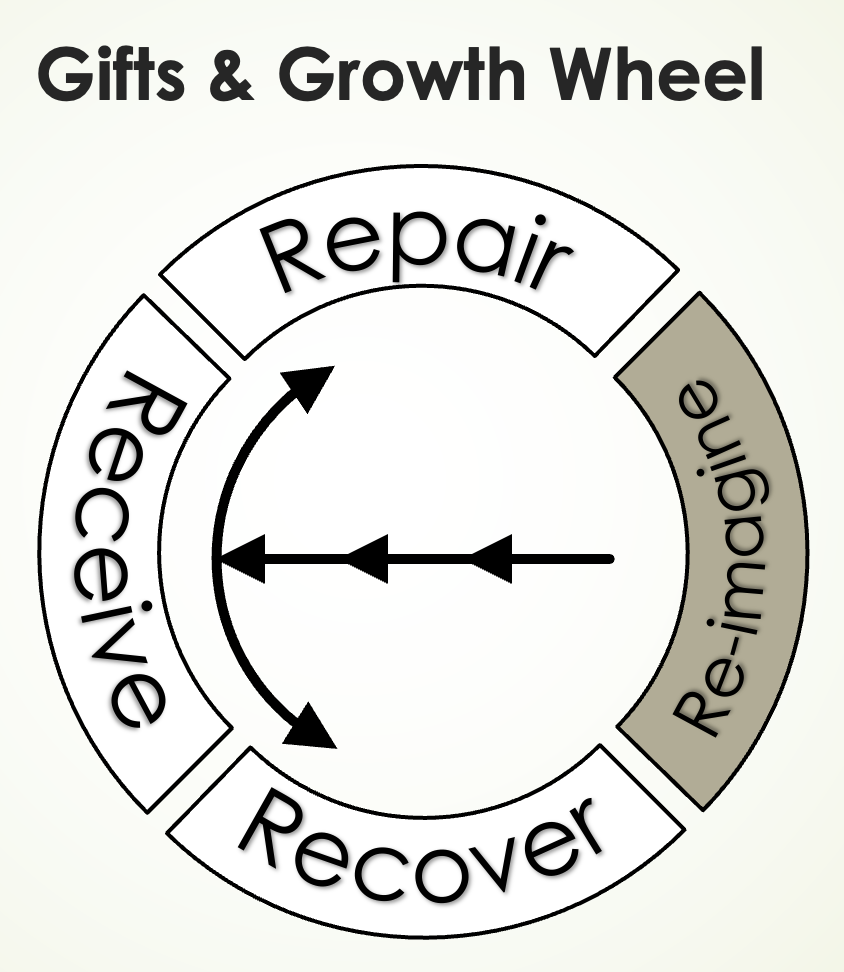
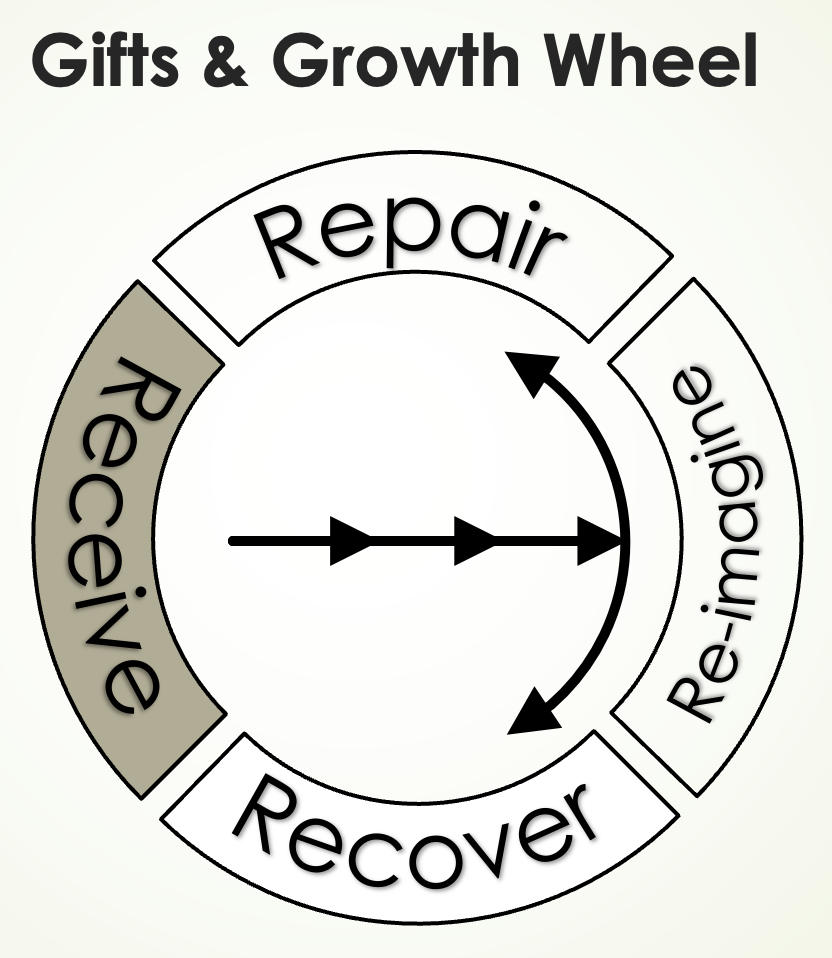
Because to go to the thinker/Re-imaginers closest to you on the Wheel first, this might keep you trapped in justifying inaction, ironically. There’s always a reason, a rationale, not to do something, even good. We may over-think it.

Or, if you first go to the Receivers closest to you on the other side, you may trip into despair and isolation. In other words, you may just give up. It’s easy to get discouraged when your action, your work, your decisions take a downward turn.

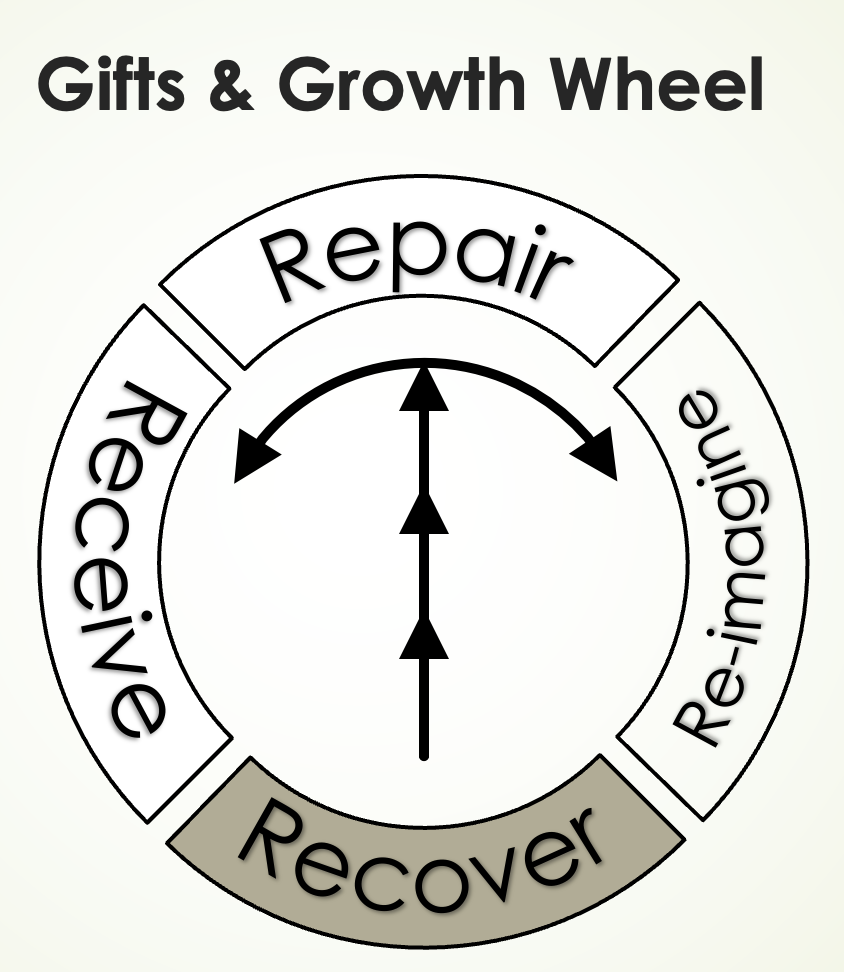
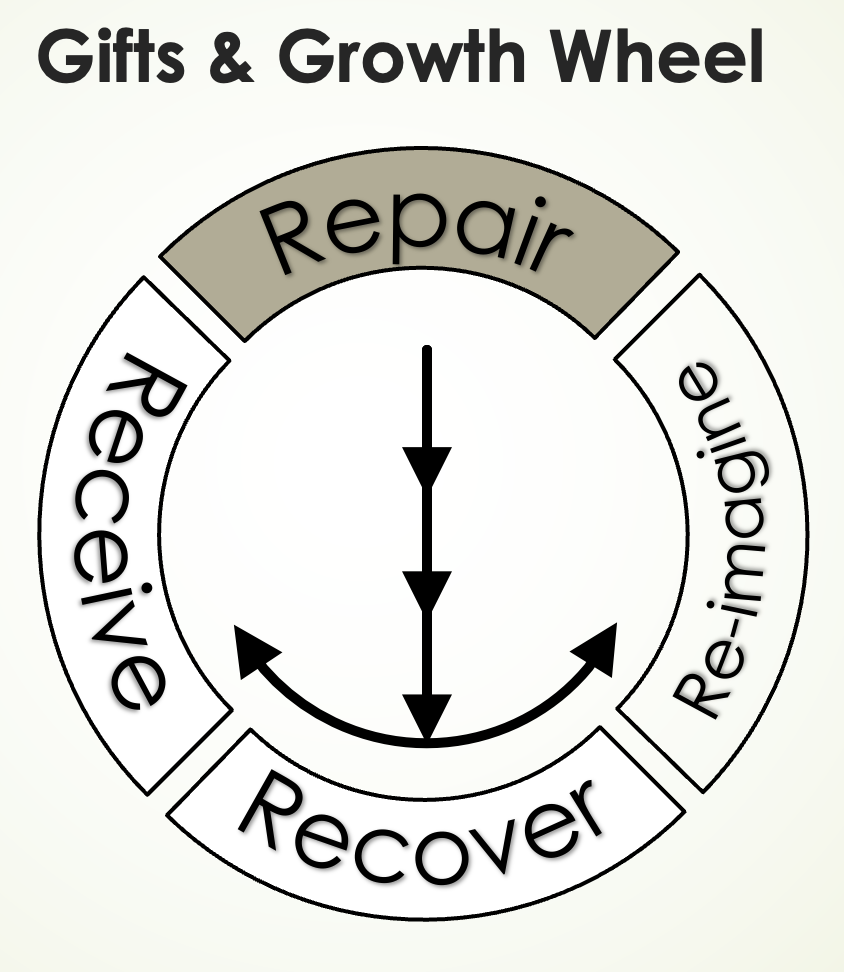
No, for the action-oriented person to grow, they must first cross the floor and visit the Recover quadrant on the opposite side of the Wheel. To recover the heart, the feelings, the source of one’s identity. To recover the story of one’s life. To recover a sense of belonging to oneself, to others, to creation and to God. The heart-centred gifts of others will complement your own. You need them as much as they need you.

A concrete way to do this is to recover the lost traditions, rituals of one’s own faith and history. To find the anchor, again. And like a rubber band, to pull back in order to fly ahead with integrity and effectiveness.

But this means changing directions, changing one’s response to the world. What are some examples of right action?

Ask for help when you need it, seek forgiveness, embrace with open arms someone who has chosen a different path, embrace with open arms and accept the person who holds different values than you, take the initiative to reach out to others, to be with them and do good things together with them, care for creation with concrete acts of generosity and grace, vote in elections, commit to a spiritual discipline and practice of daily prayer, act and make different lifestyle choices, for the better. Etc. Etc.

In recent history, who are people you know who have experienced changes in their lives because of their faith? Who might first come to mind? In our church history it may be the likes of Martin Luther from the 16th century, and even Dietrich Bonhoeffer in the 20th century. But what about Martin Niemöller, who was a contemporary of Bonhoeffer’s? Have you heard of Martin Niemöller?

Martin Niemöller was a German Lutheran pastor. Most North Americans associate his name with the famous words inscribed on the wall of the United States Holocaust Memorial Museum in Washington:

First they came for the Communists
And I did not speak out
Because I was not a Communist
Then they came for the Socialists
And I did not speak out
Because I was not a Socialist
Then they came for the trade unionists
And I did not speak out
Because I was not a trade unionist
Then they came for the Jews
And I did not speak out
Because I was not a Jew
Then they came for me
And there was no one left
To speak out for me.

“Pastor Niemöller wasn’t just being poetic. That’s his life story. He was a German nationalist who, in the 1920s and early 1930s, supported Hitler and the Nazis. He hated Communism and socialism and workers — he believed that they had betrayed Germany in the aftermath of WWI. He worked against the Weimar Republic, thinking it to be politically weak and corrupt. Indeed, Niemöller voted for the Nazis, even in the 1933 elections which handed Germany over to Hitler.

“In short, Martin Niemöller not only did not speak out. He actively worked for a political movement to go after Communists, socialists, workers, and Jews … anyone whom he believed undermined the honor of the German nation.

“But Niemöller began to change his mind when Hitler interfered with church policies and applied racial tests to both clergy and laity, even insisting that German churches refrain from teaching or reading from the Old Testament.

“Niemöller’s resistance started when the Nazis applied their brutal and racist agenda to the church — Niemöller’s church, the community he most cared about, was vowed to serve, and led.” His changed action came about because he recovered the heart of his faith, his identity in the church, and the practices that made him Christian. And acted on it.

“Then, [Niemöller] realized that they were coming for him, too. It took him a while. It was a process. But he spoke out. He preached against Hitler and Nazism. He was one of the founders of the Confessing Church. He was detained several times between 1934 and 1937. Then, in 1937, he was arrested for treason and spent the next seven years in various prisons and concentration camps, including Dachau” (Butler Bass, 2025).

After recovering their authenticity, their true identity, action-oriented people can become Repairers. Being a Repairer as a spiritual gift is a greatly needed gift today. It is doing the right thing at the right time which will have positive effects even when those effects might not be immediately apparent. The church needs more Repairers today especially.

The last few weeks we have visited three of the four quadrants on the Gifts and Growth Wheel. Are you a Receiver – someone who reminds the rest of us of the faithfulness, the grace and the prevalence of God’s mercy? Or, are you a Re-imaginer – who thinks and reimagines a vision of God’s meaning and purpose in today’s world? Finally, are you a Repairer who will act righteously and guide others into active service in Christ’s name?

We have one more quadrant to visit next week. And no matter where you begin on this Wheel, we need everyone’s gifts to balance the wheel and help empower the church to faithfulness as we seek – like the Prodigal Son – to return to our home and be embraced by the Father at the end of all our toiling. Thanks be to God!

References:

Butler Bass, D. (2025, February 19). Forget Bonhoeffer. This is the Niemöller moment [Blog]. The Cottage/Substack. https://dianabutlerbass.substack.com/p/forget-bonhoeffer-this-is-the-niemoller?utm_campaign=email-half-post&r=66hlp&utm_source=substack&utm_medium=email

Miriam-Webster Dictionary. (2025). https://www.merriam-webster.com/dictionary/repentance

Gifts & Growth: Re-imagine

This humorous story reflects the conundrum faced by those of us who tend to over-think and stay trapped in the mind:

A celebrated holy man is on his deathbed. His students are lined up in order of seniority to pay their respects, awaiting his final words with bated breath. Eventually, and with effort, the holy man opens his eyes, then addresses his most senior student.

“Life,” he declares, “is a river.” The student turns to the next most senior, and the message gets carried down the line: “The master says life is a river.” “The master says life is a river.” Only the most junior student, the last to receive the words, is naïve enough or daring enough to venture a question: “But what does the master mean, ‘life is a river’?” The query comes back up the line, until the senior student, trembling at the audacity of questioning the master, manages to blurt it out. “My master, I’m sorry, but what do you mean, ‘life is a river’?”

The old man is moments from expiring. But for one last time, he opens his eyes and regards the student in unblinking silence. Then, he shrugs and turns up his palms.

“All right,” he says, “So it’s not a river!” (adapted from Burkeman, 2024).

Moral of the story: Real wisdom doesn’t lie in getting life figured out. It lies in grasping the sense in which you will never get it completely figured out.

This proposition can be unsettling for those of us whose starting gift is being in our head. This is the gift of analysis, of thinking through and solving problems by acquiring more knowledge.

A “head spirituality” (Ware, 2000) favours what it can see, touch, and vividly imagine. It’s a concrete spirituality often expressed in concepts. Thought and belief are central to this highlighted quadrant on the Gifts and Growth Wheel. This spirituality is often recognized by focusing on doctrines, position papers, and theological argument. This gift is so important to the church and has likely dominated in the church since the Protestant Reformation.

The temptation can be to drill down deeper and remain stuck in the world of mental constructs and abstraction. The excess of this gift; that is, if head-types don’t commit to a journey of growth, is over intellectualizing one’s faith. It is to depend exclusively on rationalism and certainty.

The path of growth for the head type is first toward the Receivers who know to receive reality is at is without an initial compulsion to have to rationalize it or solve an intellectual problem. The Receivers, as we learned last week, are particularly gifted in simply experiencing the presence and celebrating the grace of God without having to understand it fully.

copyright Martin Malina, 2025

When the thinker follows the path of growth their true gift can bear fruit in the community and they become the Re-imaginers (Bailey, 2021). They come with solutions, but no longer according to the exclusivist agenda of the powers that be. Without going to the opposite side first can make head spirituality exclusive – either by creating a community only of like-minded people and/ or pursuing a course of action that excludes others and paints a line in the sand between ‘them and us’.

In the world of the bible, Jerusalem represented the powers that be. Jerusalem was the seat of religious and political power in the region. Jesus knew that prophetic ministry in the face of power was a dangerous activity. Jerusalem personified the power of the world that sowed division and discord. Those that spoke the truth of God’s kingdom in Jerusalem risked their lives. Jesus knew he was in the crosshairs. But what is surprising in this Gospel text (Luke 13:31-35) is Jesus’ reaction (Reese, 2016).

In the face of threats from Herod and the religious authorities, Jesus responds with love. He responds with a longing of love for the people of Jerusalem. Jesus’ response is the compassion of a mother. His lament evokes powerful imagery of mother hen embracing her chicks in protection and love. This is the longing of God for us, expressed through Jesus’ imagination. He re-imagines what it could be like even though Jerusalem would refuse the grace of God, even though Jerusalem will crucify him.

In the last century, the Berlin Wall represented a physical manifestation of the ideological battle between communism in the east and capitalism in the west.

In the early days of the Berlin Wall during the 1960s, emotions—anxiety, fear, anger—were running high.

Hostilities flared when truckloads of stinking garbage were dumped over the wall into West Berlin by those living in the eastern sector of the city.

West Berlin Mayor Willie Brandt was flooded with demands for revenge at this offence.        

Understandable. Tit for tat. You throw garbage at us. We’ll throw it right back!

But Willie Brandt responded in a unique way.

Mayor Brandt requested that flowers—hundreds of colourful, beautiful flowers—be brought to a specific place at the wall. Then, truckloads of these flowers were poured over the wall into East Berlin (Hays, 1997).

That act in the 1960s may not have immediately felled the wall. But history bears witness to the power of non-violent solutions. Almost thirty years later, in 1989, a peaceful candlelight vigil that started in a church and gathered tens of thousands brought down the Berlin Wall.

May we re-imagine our response in the conflicts and struggles of our days and lives. May we learn to start with grace, and love – the grace that Jesus imagined for us. May the flowers reign down where division and strife pretend to define the reality that God, over time, is shaping into something good, gracious and beautiful for everyone.

This is our Lenten hope.

References:

Bailey, J. (2021). To my beloveds: Letters on faith, race, loss, and radical hope. Chalice Press.

Burkeman, O. (2024). Meditations for mortals: Four weeks to embrace your limitations and make time for what counts. Allen Lane.

Hays, E. (1997). The old hermit’s almanac: Daily meditations for the journey of life. Forest of Peace.

Reese, R. A. (2016). Commentary on Luke 13:31-35. https://www.workingpreacher.org/commentaries/revised-common-lectionary/second-sunday-in-lent-3/commentary-on-luke-1331-35-3

Ware, C. (2000). Discover your spiritual type: A guide to individual and congregational growth. Alban Institute.

Gifts & Growth: Receive

Over the past year and a half, I’ve only looked at my guitar sitting in the corner of my home office. It has sat there, lonely, untouched, collecting dust. I have not picked it up once during this time.

So, when I finally did a few days ago, and started plucking a few notes, I wondered – what’s the point? What purpose does it serve to spend valuable time messing around on a musical instrument?

I’m not being really productive playing around on it. Learning a new song won’t yield perfection (to be sure!) and only reminds me of how much my skills have deteriorated by not playing it. Even though, for Lent, I’ve committed to picking it up each day for at least a few minutes at a time, those thoughts plague me: For what purpose? Is it worth the time?

You may have heard of the so-called “Marshmallow Experiments” (Burkeman, 2024), the first of which was conducted at Stanford University by Doctor Walter Mischel in 1970.

In these experiments, Mischel and his colleagues presented children with a single marshmallow and offered them a choice: They could eat it. Or they could wait alone in the room with it for ten minutes. If they succeeded in waiting ten minutes without eating that one marshmallow, they got one more. And so on.

As these experiments unfolded over time, the scientists were able to make some evidence-based conclusions. For one thing, participants who were able to resist temptation went on to enjoy better academic performance and physical health in later childhood, and demonstrated other positive differences as adults (Burkeman, 2024).

The self-discipline not to grab the first marshmallow became an invaluable trait for what’s commonly thought of as a successful, productive life.

Self-denial is a common messaging that we impose on ourselves, often without being aware we are doing so. In other words, we remain perpetually a Lenten people because we never really enjoy the gifts we have received, have amassed, have saved over time. In this mindset, we never get to Easter because we either don’t know how to embrace and receive the treasures we have been given and/or we feel guilty for enjoying gifts from God when we do receive them.

A Canadian Benedictine, the late John Main, was known to say that the greatest sin was not succumbing over and over again to tantalizing temptations. No, the greatest sin was not fully enjoying the good gifts that we have received from God’s bounty and grace.

What gifts have you received? Are they material blessings? But gifts are more than having lots of stuff. There is the gift of music, the talent for precision and patience in woodworking and building things, the gift of listening to another, the care for animals, for growing plants, flowers and vegetables. Gifts are also the gifts of our personalities, our characters, our abilities, our passions, our interests, what we’re good at doing, what we love doing, what we enjoy in each other and in the world.

What today’s scriptures point to is the temptation to believe that we are the source of and engine behind all these gifts and good things we experience in life.

What resulted in Jesus overcoming temptation in the desert was acknowledging the true source of his power in God (Luke 4:1-13). In the accompanying text from Deuteronomy (26:1-11), the temptation is not hunger but prosperity.

When things go well and the harvest is plentiful, the Israelites will be tempted to think that they are self-made. They will be tempted to believe that they have earned their prosperity. They have worked hard for it.

To counter this temptation, God instituted the ritual of first fruits to remind the Israelites that thanksgiving always had priority over self-congratulation (Oldenburg, 2025 March 9).

On this First Sunday in Lent it is good therefore to begin with the gift of receiving. Maybe Lent can be a reminder to us that what we may be so proud to boast about is not our doing. God is the source. We are the vessels. When we recognize our primary role as receptors of God’s grace, we can then let that gift flow through us and to the world around us.

This year, the Gospel of Luke travels with us throughout Lent. And Luke’s emphasis is celebrating the persistence of God’s grace and mercy despite stubborn obstacles.

In the series of sermons this Lent, I’ll look at four ‘R’s’ of faithful practice and growth: Receiving, Re-imagining, Repairing and Recovering (Bailey, 2021). Each of these is a great and important gift for the community of faith. We need Receivers as much as we need Re-imaginers, Repairers and Recoverers.

copyright Martin Malina, 2025

Each of us, depending on our individual strengths and gifts, will start in a different quadrant. There are some who are best positioned, because of their God-given personality and character, to start at the receiving end. Others will naturally begin by re-imagining; others first will move into repairing and others still will be best suited to start in the recovering quadrant of this circle.

But for growth and wholeness, a journey of faith is necessary. We can’t remain stuck in just one of the four quadrants. For the gift to bear fruit we need the whole circle, the whole community.

So, what do the Receivers offer? The Receivers are naturally disposed to acknowledge reality as it is – the good and the bad. The receivers among us can more easily accept their lot and enjoy what they have and who they are – without judgement.

Receiving – being able to accept what is – is an incredible gift. To see God’s work in all things. To trust in God’s grace to keep us going into an unknown and uncertain future. To be, as we are.

This spiritual gift is useful in both tempering the productivity bias in our hustle culture. It is to consider that all our accomplishments are for naught, and even a temptation, if they are not placed in the broader perspective of the origin of all good things. It is God’s mercy and grace that are fundamentally operative in our lives. Our gifts bear fruit when we acknowledge the true Source of them in God and God’s mercy.

But, as I said, remaining in this quadrant without the input of the other ‘Rs’ can leave the Receivers – or “mystics”, as they are sometimes called (Ware, 1995)—stuck. They are tempted into distorted thinking that in order to experience God’s presence they need to escape or check-out from the reality of this world.

It’s ironic that the Receivers can, on the one hand, more naturally than all others receive reality as it is. But, on the other hand, the Receivers are also the ones most likely tempted to remove and displace themselves from it. To avoid all the confusion and chaos of the world, Receivers are tempted to retreat into the comforts of their self-created worlds, their private realms.

That two-sides-of-the-same-coin dynamic is characteristic of all the gifts in the circle. Indeed, our greatest gift can be our greatest blind spot.

We all start somewhere on the wheel of gifts and growth. But, for growth to happen, where do we go from there?

The next movement for the receivers is towards the opposite quadrant. For the receivers, it’s towards re-imagining. The Re-imaginers are those who start with the gift of the mind, the gift of clear and constructive thinking. This is what the Receivers need. We’ll talk about the Re-imaginers next week.

Why, you ask, do we first go to the opposite side, and not to either side of the starting point? If the Receivers would first look to the Repairers on one side, Receivers’ action might not be the best course of action in a given situation. It would be like the Receiver realizing they had to do something good in the world, but choose an activity that isn’t relevant, or particularly helpful. Likely, because the Receiver hasn’t done their homework.

On the other side, if the Receivers would first look to the Recoverers, their action might lead to boundary issues. They might over-function, burn out and feel like they needed to do everything to take on the weight of the world and care for everyone, which of course is impossible.

We first need the opposite gift to correct the distortions associated with our starting place on the circle, before moving to the last two quadrants.

This arrowed pattern in the middle of the circle looks like an anchor, intentionally. This pattern of gifts and growth keeps us anchored in our movement towards balance and healthy growth for everyone. The writer to the Hebrews affirmed: “We have this hope as an anchor for the soul, firm and secure” (Hebrews 6:19).

Today, at the start of our Lenten pilgrimage the Receivers among us will say: Thank God! Receive, enjoy and delight in the gifts of God’s doing and grace in your life. You can enjoy that marshmallow that someone gives you today. Don’t deny it. It’s Ok!

In the words of the late Indigenous author Richard Wagamese: “Sure there’s stuff that needs doing, stuff to wade through and stuff to fix but there’s also the joy of small things: a hug, a conversation, playing a song all ragged and rough on an instrument, walking on the land, listening to great music or enjoying silence and a cup of tea. Rejoice. Fill yourself again” (Wagamese, 2021).

Receive.

References:

Bailey, J. (2021). To my beloveds: Letters on faith, race, loss, and radical hope. Chalice Press.

Oldenburg, M. W. (2025, March 9). Crafting the sermon; First Sunday in Lent, Year C. Augsburg Fortress. https://members.sundaysandseasons.com

Wagamese, R. (2021). Richard Wagamese selected: What comes from spirit. Douglas & McIntyre.

Ware, C. (1995). Discover your spiritual type: A guide to individual and congregational growth. Alban Institute.

It all evens out

What happens when your best friend starts saying things and doing things that offend and hurt? Our responses are varied. But it is our best friend who has suddenly created this division. And we don’t know what to do.

A Manitoba family took to heart a playful suggestion made by a journalist to deploy hockey sticks in a row in snowbanks on the border. They pasted on the blades of these hockey sticks googly-eyes to provide 24/7 surveillance (Proudfoot, 2025 February 5).

In the Gospel today (Luke 6:17-26), we observe both Jesus’ actions and words. But if just look at the words of the Beatitudes alone, taking them out of the setting of the narrative, this is tricky. At best it leaves us analyzing paradox and struggling with ambiguity. At worst, the words confuse us, and we dismiss them in frustration.

Because Jesus pulls the rug out from underneath our presumption of who is blessed, and who is cursed. It’s the opposite of what we believe:

We believe you are blessed if you are not poor. You are blessed when everyone adores you. You are blessed when you have material wealth, social status, and your reputation is intact. You are blessed when you are tough and negotiate to win in a world of winners and losers. You are blessed when you win, in any relationship – even with your best friend.

Taken alone, Jesus’ words may support this winner/loser mentality. Because there are the blessed and there are the ‘woe-ed’, those who are cursed. And where do we fit in that either/or framework? Are you one of the cursed, or the blessed?

“It was said of Rabbi Simcha Bunim that he carried two slips of paper, one in each pocket. On one he wrote: … ‘For my sake the world was created.’ On the other he wrote: … I am but dust and ashes.’ He would take out each slip of paper as necessary, as a reminder to himself” (Spitzer, as cited in Burkeman, 2024).

Thank God we also witness Jesus’ actions before he said a word. Before uttering those perplexing and sometimes confusing Beatitudes, we see him in action. His action sets the context. And what is he doing?

In Luke’s version of the Beatitudes (the Gospel of Matthew also records Jesus’ Sermon on the Mount in Matthew 5:1-12) Jesus “comes down … and stood on a level place” with all the people. In Luke’s version, it all evens out.

Not only do the divine and human come together on one plane of existence, so do all the diverse peoples gathering to watch and hear Jesus – “a great crowd of his disciples and a great multitude of people from all Judea, Jerusalem, and the coast of Tyre and Sidon” (v. 17).

And Jesus healed “all in the crowd” – the blessed and the cursed (v. 19), even before Jesus began to preach those divisive, perplexing words. Before any words, his actions demonstrated what all of us share – our common humanity.

So, what does it mean that he “healed” everyone? Let’s look at the meaning of the word, healing. In the original Greek, the word for healing means more than a mere cure. Healing, in the New Testament, is the same word as salvation, to restore, to make whole (Thayer’s Greek Lexicon, 2011). Healing is about re-establishing right relationship between humanity and God, between people. Healing is about reconciling the opposites, breaking down the polarization within us and around us (Kenny, 2025, January 28).

Amidst the division, the polarization in our lives and in the world, Jesus “healed all in the crowd”. Jesus introduced an ethical dimension for being in relationship, being a friend. Jesus was about reconciling relationships that appeared, on the surface, destined for damnation.

So, now the words of Jesus may make better sense when taken in the context of Jesus’ action, which demonstrated no enduring separation, no eternal division, but rather wholeness. Rabbi Bunim held awareness of both the good in him, and the bad. He held a high view and a low view of his humanity. Perhaps, therein lies the key. Both within us, and all around us in everyone, everything.

The writer, Anne Lamott suggests: “Everyone is screwed up, broken, clingy, and scared, even the people who seem to have it more or less together. They are much more like you than you would believe. So, try not to compare your insides to their outsides” (Lamott, cited in Burkeman, 2024).

Lamott’s dust and ashes’ low view, on the one hand suggests something important and humbling about God, about reality and our place within it. God came down to our level. God became human. And died a very human death, condemned and persecuted.

But if we have overly identified for so long with our sins, our fears, our judgements, our afflictions, our limits and weakness, and all the sins in the world today, if we stay at the cross, we get stuck in despair. That’s not where the story ended. That not what Jesus wants from us. He came down to our level, in order that we may be lifted up.

We need a high view that also recognizes our limitations and mortality. Because it does not follow, that who we are and our actions don’t matter.

They don’t matter if we feel pressured to be winners in every interaction, especially against those who are different from us. They don’t matter if we feel pressured to achieve an extraordinary standard of merit that feels like victory on the battlefield, or in a way that’s applauded by a multitude of people. They don’t matter if our winning means someone else must be the loser. That we are blessed and those on the other side of the border line are cursed.

What does matter is realizing our individual being is inseparable from everything and everyone else. Each of us is impossible to be and do without countless people we might normally think of as separate from us. After all, Jesus made no distinction in his actions. “He healed all in the crowd.”

Our actions do matter when, despite our limitations, our simple un-extraordinary actions make a positive difference to the person we encounter in each moment.

So, what we do for God as saints and sinners, blessed and cursed, we do for no other reason than nothing could be as enlivening and truer to God in this momentary situation we find ourselves. Jesus came down to our level and made God accessible to all people in every situation. Jesus loves and has hope for everyone.

There’s lots to be done. Take heart. The good thing about everything being messed up is that no matter where you look, there is great work, important work, to be done.

God has given us the opportunity, being born into the messy state of life on earth in this time in history, to do one small thing at a time. We may not matter that much, from one perspective, but we matter as much as anyone ever did.

References:

Burkeman, O. (2024). Meditations for mortals: Four weeks to embrace your limitations and make time for what counts. Penguin.

Kenny, A. (2025, January 28). Healing beyond the cure: Jesus’ healing ministry. Center for Action and Contemplation: Daily Meditations. https://www. https://cac.org/daily-meditations/healing-beyond-the-cure/

Proudfoot, S. (2025, February 2025). A Manitoba family deployed googly-eyed hockey sticks [YouTube]. The National, CBC News. https://youtu.be/Q2yg7tkglQA?si=tKA_R0dMAGeHf-kB

Thayer’s Greek Lexicon. (2011). Biblesoft Inc. https://www.biblehub.com/Greek/2390.htm

Freed to be, freed to act

(Photo by Martin Malina, Sandbanks Provincial Park Ontario, 2020)

After witnessing the miracle of Jesus providing the overabundance of fish Simon Peter says, “Go away from me Lord, for I am a sinful man” (Luke 5:1-11). In the presence of a great gift, Simon feels weak.

In the Epistle reading for today (1 Corinthians 15:1-11), Paul confesses, “I am the least of the apostles, unfit to be called an apostle …” In the presence of the divine, Paul realizes his weakness.

When Isaiah sees a vision of the glory of God, he beats his breast and cries, “Woe is me! I am lost, for I am a man of unclean lips, and I live among a people of unclean lips …” (Isaiah 6:1-8). Not only does he confess himself, but he also implicates his own people for failing and falling far short of the glory of God.

Simon Peter, Saint Paul and the prophet Isaiah, were all quick to announce their limits, faults, sins, and weaknesses in the presence of the divine. These are giants of faith and central biblical characters of God’s choosing to bear witness to the message and purpose of God.

When we experience God’s presence, when we experience a miracle, when we bear witness to something of God, we are faced first with our own failing, fault and weakness, which is not easy. It hurts. But we are not left with our broken selves alone. We are given a choice, to embrace who we are, and follow Jesus.

We are free to be, and freed to act.

We are freed to act because we accept what is truly most important. We are freed to act because we can live out of our true selves in Christ. This movement towards freedom from being ruled by our fears, however, is tough.

I remember as a kid freezing my hands outside on a cold winter’s day. They’d get so cold, not quite frostbitten. But when I came into the warm inside, they felt numb and got all red and puffy. My fingers stung for many minutes as the blood slowly returned to the tips of my fingers.

I remember complaining to my parents why they said it was good that my fingers hurt. For one thing, my fingers stinging was a sign that my blood was still flowing there and therefore were still alive! If I didn’t feel anything, that would be really bad.

This turn towards healing begins with honesty and vulnerability. The movement to our healing and transformation begins, like it did with Isaiah, Paul and Simon Peter, by entering on the ground floor with ourselves and others. And so, it begins by stinging.

Coming alive is scary. It hurts. When we realize we are seen in the glory of God’s all-pervasive light means we are changing. Jesus’ statement to Simon, “Do not be afraid” suggests that Simon was afraid bearing witness to the miracle. Because now, his life, should he choose to continue following and listening to Jesus, will change.

What is most important? To what are we making this shift? From what are turning away? What is the treasure we seek?

Fish were a valuable part of the economy in ancient Rome. But fishing was not an entrepreneurial, free enterprise. Fishing was controlled by Rome and profited only the elite. Since Caesar functionally owned Lake Galilee and all the creatures in it, the best of the catch belonged literally to him.

For fishers, like Simon Peter and his cohort, fishing was a subsistence work. Their work was not their own. After Rome got the biggest and best fish, that haul of fish would be heavily taxed in a system of tariffs, duties, and tributes. Those who caught the fish would see little from their sale, just enough to feed their families (Butler-Bass, 2025, February 9).

In that moment, it finally came to a head. In that moment, in the face of a miracle, Simon Peter is faced with the decision whether or not he will continue working for an oppressive regime, whether he will continue to follow Caesar and his unjust policies that benefited only the powerful and rich. Or, whether he will free himself from that.

Simon is not sure he can handle that shift of thinking, of understanding. Just a moment’s hesitation, perhaps. But he and his cohorts, in the end, “leave everything behind” and follow Jesus to treasure people not possessions. Because the treasure of God is not material wealth for the rich. The treasure of God is having compassion for all people.

“In the year 258 the Roman Empire, during one of its many persecutions of the church, ordered that the church turn over its treasure. The task fell to a young deacon named Lawrence who was given three days to complete it.

Immediately Lawrence sold all the liquid assets and gave that to the sick and the widows. He liquidated also all of the property and divided that up amongst the poor. On the third day, he appeared before the emperor who demanded to see the treasures of the church.

Lawrence just turned to behind him and there were the poor, the sick, the hungry, the naked, the stranger in the land, and the most vulnerable. And Lawrence said, ‘These are the treasurers of the church’.” (Eaton, 2025 February 3).

It hurts to let go. But, when it hurts, stay with it. The blood is flowing. God might just be revealing something important about who you are and who you are becoming in Christ, a beloved child of God freed to be, and freed to act.

References: 

Butler Bass, D. (2025, February 9). Sunday musings: Fishing trip … or something else? [blog]. The Cottage. https://dianabutlerbass.substack.com/p/sunday-musings-a12?utm_source=substack&utm_medium=email&utm_content=share

Eaton, E. (2025, February 3). The Evangelical Lutheran church in America. https://www.instagram.com/elca

Mirror mirror

Lake Kioshkokwi at Kiosk, Ontario (photo by Martin Malina, Sept 2022)

There’s always a reason not to act, not to do something. Even if that something is good, is right, is just and kind. Even if that something is God’s call on your life.

It can be dealing with something as ordinary as exercising or picking up the phone to call or text someone. Or it can be deciding on the big issues – relationships, jobs, opportunities – that can change the course of your life. There’s always a reason or reasons not to do those things.

At least we are in good company when we initially think and/or say, “no”, and justify our reasons for not acting on the nudge to pursue a good course of action. The prophet Jeremiah resisted the call of God because he believed himself not up to the task. He disqualified himself by not believing he had the abilities and the confidence to do what God asked him (1:4-10).

There’s always a reason not to do something. Fear is a powerful force. But fear is not evil per se. We have good cause to be afraid. But when our fearful avoidance and resistance overwhelms our pursuit of the good, “our overwhelming fears need to be overwhelmed by bigger and better things” (Bader-Saye, 2007, p. 60).

From where do these bigger and better things come? Contrary to what may first come to mind, these bigger and better things don’t stem from our achievements nor confidence in our abilities. These don’t qualify us in God’s eyes. Neither our resumé nor personality style justify our suitability for doing good. What does, is embracing, being and living out who we are created to be.

God saw who Jeremiah was in the goodness of his heart. God called Jeremiah back to himself, his true self. With all the conditioning of the world around him stripped bare, Jeremiah was called to embrace God’s love for and in himself.

“Mirror, Mirror, on the wall who is the fairest of them all?” The evil queen in the Snow-White fairytale is surprised not to see herself in the mirror. Instead, she sees Snow White. This revelation triggers a conflict between the queen and young Snow White and the Seven Dwarfs (Grimm & Grimm, 1812).

When we look for answers, what does the mirror reveal to us? In the face of conflict, it’s like a mirror is held up to expose the battle going on inside of us. Like the evil queen, we would rather see ourselves, have our opinions validated, have everyone else be like us, reflect who we are. The rage we direct at outsiders, others who are different, others who don’t reflect us, only reveals the conflict raging within ourselves. Being angry at the foreigner indicates a self-hatred more than anything.

Indeed, “We see in a mirror dimly,” writes Saint Paul in his treatise on love in 1 Corinthians 13. “But faith, hope and love remain. And the greatest is love.” Because we shall, one day, see face to face who we truly are in Christ. Beloved. Wipe that mirror clean! To see the goodness in others, the same goodness in you — the good we share.

When our mind’s eye clouds our vision, is it because we have forgotten who we truly are? How smudgy is our mirror? How distorted is our vision? Saint Paul says it is! So, then, look at Jesus.

When faced with the violence and acrimony of the crowd, notice Jesus neither disputes nor argues with them when they lead him to the edge of a cliff. Nor does he back down. He remembers who he is. He is solid in his identity.

And Jesus simply passes through them. He simply goes about his business of showing love to the outsider, just as Elijah was sent by God to care for the widow at Zarephath, and just as Naaman the Syrian was healed from his leprosy by the command of God (Luke 4:21-30).

Who are we? How do we keep from forgetting who we are as people of faith? Martin Luther understood Confession and Forgiveness as “a return and approach to baptism” (Luther, 2000, p. 466). Baptism is the sacrament sealing who we are – our identity in Christ. Every time we face the mirror and come true and honestly to ourselves, we recommit ourselves to baptism. In Confession and Forgiveness, we are being renewed by the love of God Paul described.

God’s love binds us together, not as isolated individuals, but into a whole community in Christ called to care for others and the world God created.

“Before I formed you in the womb I knew you, and before you were born, I consecrated you” (Jeremiah 1:5).

“I have been sustained by you ever since I was born; from my mother’s womb you have been my strength” (Psalm 71:6).

Though these words originated in the context of their lives, these two texts are not just for Jeremiah and the Psalmist. These two passages offer powerful words of hope for us as well: God knows us. God declares us, each of us, as sacred. We can lean on God. God protects us. These passages illustrate a lifelong conversation and a loving relationship between us and God.

Indeed, “today the scripture has been fulfilled in your hearing,” Jesus told the crowd in the synagogue (Luke 4:21), and Jesus tells us.

So, like to the prophets before us, God nudges us, whispering in our hearts the truth of who we are. And when we feel the tensions rise around and in us, we look for where God is in the world.

Maybe not in Nazareth. Maybe not in our own backyard, so to speak. Maybe God is active somewhere else, even in places and in people we least expect.

But that’s where God is, right now. And that’s where God is calling us to join in the Holy Spirit’s work there. Will we follow? Will we trust in the bigger and the better something that can overwhelm our fear?

Because there’s always a reason not to do something good. But what about the reasons to do something good? Remember who we are as followers of Jesus. Because divine love will never forget us.

References:

Bader-Saye, S. (2007). Following Jesus in a culture of fear. Brazos.

Grimm, J. & Grimm, W. (1812). Children’s and household tales. Germany.

Luther, M. (2000). Baptism, the large catechism. In R. Kolb & T. J. Wengert (Eds.), The book of concord (p. 466). Fortress.

Which pieces are missing?

(photo by Martin Malina)

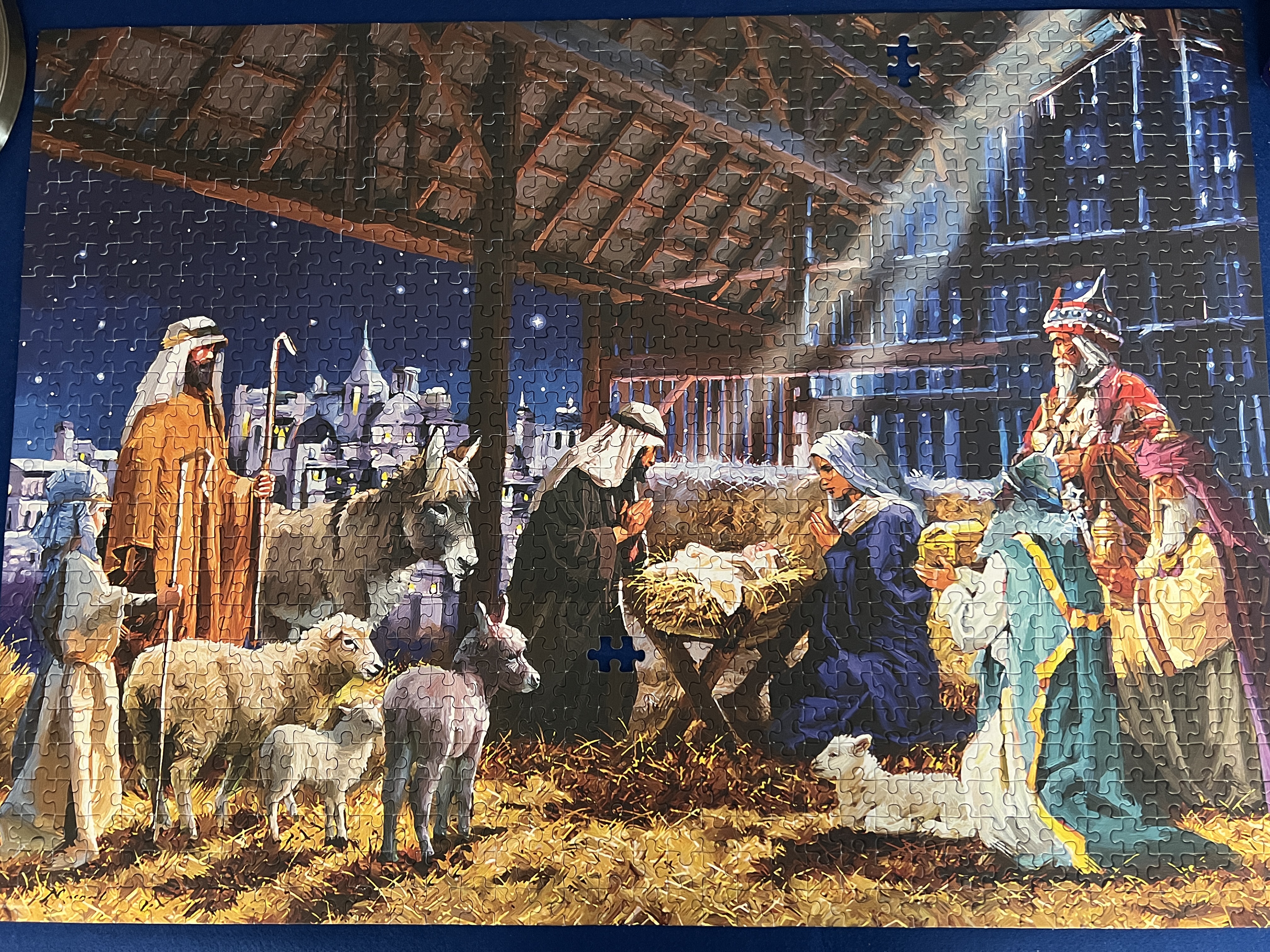
It is finished! The 1000-piece nativity puzzle is now done. Thank you to all who contributed – whether you fitted only one piece or sat for hours in the narthex over the past month and a half, putting it all together. It is complete.

Or is it?

Upon closer observation of the photo above you might notice there are two pieces missing. Just two, out of a 1000. But two, nonetheless. Sucked up in the vacuum cleaner, stuck on the bottom of someone’s boots, or dropped inadvertently in someone’s pant pocket. Who knows? How does that make you feel?

You might think, like me, of parables in the bible where Jesus leaves the 99 sheep to go searching for the one lost sheep (Luke 15:1-7), or the parable in which a woman searches her whole house to find that one, lost coin (Luke 15:8-10).

Whatever you may want to say about Paul’s writing in his letter to the Corinthian church, it has a clear meaning: Every piece matters. Every part is important for the whole (1 Corinthians 12:12-31a) to function well. All the gifts perform vital roles for the overall health and wellbeing of the body.

Paul even goes as far to say, “those members of the body that we think less honorable we clothe with greater honor, and our less respectable members are treated with greater respect, whereas our more respectable members do not need this” (v. 23-24).

In her book Fierce Love, the Rev. Dr. Jacqui Lewis refers to the Zulu concept of ubuntu which means, “I am who I am because we are who we are.” This phrase resonates with Paul’s words in 1 Corinthians. We, the body of Christ, are deeply interrelated, united by one Spirit. Perhaps we could say, “I am Christ in the world because we are Christ in the world” (Lewis, 2021, p. 11).

If each of us is worthy because together we are, this leads us to ask a very relevant question for all our families, communities, teams, groups, neighbourhoods, and nations: What parts are missing? Whose voices are not being heard? What members of the body have been ignored, overlooked, even marginalized, treated as unimportant?

In preparation for the annual meeting later this winter, the council is now searching, as we normally do at the end of terms, for a couple new members to serve. In choosing leaders on council, we can ask the same question: Whose voices in the congregation are not yet represented, nor being heard? Who is not at the table?

I love the children’s book I’ve used for Communion instruction. It’s called, “A Place for You.” The theme is inclusion. That is why in the invitation to the Communion table I will often say, “You are invited without exception.” Because Jesus loves everyone and welcomes all to the table of God’s grace.

The missing pieces challenge us to support and lift up everyone.

In the Gospel for today (Luke 4:14-21) Jesus returns to his hometown Nazareth, the place he grew up, the place where everyone knew who he was as a child. The scroll is given to him – the scroll of the prophet Isaiah – to read publicly. He has no choice which scroll to use. But, from everything Isaiah has to say, Jesus chooses this one particular text.

He could have read anything. The prophet’s words fill a big book, some 66 chapters long. Yet, Jesus focuses on this part. He makes it a point to remind the good people of Nazareth whose marginalized voices God has heard, and whom now God’s people are called to lift up.

What captivates the crowd, as all the eyes of those in the synagogue were fixed on him, was that Jesus distinguished himself, his new role, his mission now as the voice of God to declare what people of faith were called to do with Jesus: to bring good news to the poor, to release the captive, to recover the sight of those who are blind and let the oppressed go free – the economically poor, the incarcerated, the disabled, and the migrant. They belong at the table, too.

This is now the job of the body of Christ to proclaim, in our words and actions. How do we proclaim the words of Jesus in our daily lives? How do we follow Jesus?

In the science fiction dystopian television series Silo (Yost, 2023), 10,000 people have lived for decades in an underground bunker in the shape of a cylinder over a hundred floors deep. They’ve lived in the silo because the air outside is poisoned. At least that’s what they’ve been told.

A mechanic, Juliette Nichols, uses a modified hazmat-type suit to leave the silo and survive outside. But all the people inside don’t know where she has gone or whether she’s still alive. People start to question the truth. A rebellion grows.

A group of mechanics living at the bottom of the silo claim those privileged living closer to the top have not been telling the truth about what is really going on outside the silo. The rebels rally around a spray-painted symbol “JL” and chant “Juliette Lives!” to galvanize their faith.

In Jesus’ day, we have to remember they didn’t have microphones. The Nazarenes would pack the synagogue to listen to the speaker. To make sure everyone got the gist of the speaker’s message especially those at the back of the room, those closest to the speaker would repeat in a loud voice together a phrase the speaker just said. This method of getting the word out is called “the people’s microphone,” the practice of amplifying voices without a sound system (Augsburg Fortress, 2025).

This method requires attentive ears—those nearest must hear and respond to the call of the speaker—and it requires the community’s unified work, lifting up the speaker’s voice together.

Yes, “JL” is our call, too. But for us it is “Jesus Lives!” “Jesus Lives!” is a sign of hope for the fulfillment of what is being called upon the living body of Christ today

But if bringing good news to the poor and releasing the captive was Jesus’ purpose and mission, all evidence today points to the contrary. Had Jesus failed? Has the church failed? Many today, I know, feel that it has on many levels. Because so many people still suffer. And will suffer.

Perhaps a vision of a perfect world free from all suffering is not what Jesus meant. Because if we follow in his steps: From that early synagogue worship service to the hills of Galilee, on the road to Jerusalem, and the way of the cross, we discover that suffering is not God’s will.

Rather, what is God’s will is life in the face of suffering. What is God’s will is courage in the face of fear. What is God’s will is faith in the face of doubt and love in the face of hatred and prejudice. God’s will is to call these things out of the hurt and brokenness that we are and that we find around us. “With Christ, the prophecy is fulfilled, in you and in me” (Evenson, 2025). Because “JL!” Jesus lives. Thanks be to God!

References:

Evenson, B. (2025, January 26). Comments from the cloud of witnesses; Third Sunday after Epiphany /lectionary 3, year C. Augsburg Fortress. https://members.sundaysandseasons.com

Lewis, J. (2021). Fierce love: A bold path to ferocious courage and rule-breaking kindness that can heal the world. Harmony Books.

Yost, G. (Creator). (2023-present). Silo [TV series]. Apple TV+.

Present to Presence

photo by Martin Malina

About once a month I have lunch at Denny’s on Merivale with a dear friend of mine. His name is Jack Murta. He is a retired politician. He was a Member of Parliament from Manitoba in the late 1980s. A member of the Progressive Conservative Party, Jack served as the Minister of Tourism in the Brian Mulroney government.

Today, he sits on the Board of the Mission in downtown Ottawa and leads Christian Meditation groups there for people who are homeless. Jack and I spend a lot of our time talking about politicians and how they related with one another back in the day. Indeed, much of our conversation recalls the past.

In the Gospel reading for today (John 2:1-11), guests to a wedding party in Cana, Galilee, meet most likely in a garden setting, to celebrate a joyous occasion.

Certain clues in the story attract our attention. I’d like to point out, first, the empty jars normally filled with water used for the Jewish rite of purification. People engaging this rite did not drink the water. It stayed on the outside of their bodies when they immersed themselves in the bath.

The jars in this story direct peoples’ attention to their past, their Jewish tradition and ritual. The garden also was the usual setting where Jewish weddings took place, a reference to the Garden of Eden in the first book of the bible – Genesis (Shaia, 2021). The jars and garden are indicative of tradition, the past, the way things had always been done.

And not only does the Gospel look to the past, it points us to the future as well. “My hour has not yet come.” Jesus hints to Mary about his future path, when Jesus’ purpose will be fulfilled on the cross and by the empty tomb.

But it’s the present moment where the miracle—the sign—happens. It’s into the present moment that the Gospel ultimately draws us. “You have kept the good wine until now.” The steward recognizes Jesus’ act of bringing an unexpected gift for the guests.

And Jesus’ action in the present does more than merely get the bridegroom out of an embarrassing social faux pas. The unexpected gift is good wine, not normally offered late in the party. It’s in the present moment, even in an unpleasant situation, when people enjoy themselves.

Brain studies have examined where most of our time is spent thinking. They show that we spend most of our time thinking either about the past or the future; and, between these two, most of it is about the past. In other words, being fully present in the moment is not where we spend most of our time. And this is true even among young adults (Bellana et al., 2017).

Our thinking, entrenched in the past or fantasizing about the future, is also closely related to speech. Thoughts and words go hand in hand. Talking a lot is related to thinking a lot (about the past).

But in the Gospel, it’s more about what is not said that draws my attention. Mary does not tell Jesus what to do. She merely points to the problem. And leaves it up to her son.

The head steward didn’t know where the wine came from, but the servants knew because they drew the water for the jars as per Jesus’ instruction. How did they know it had turned to wine? Did they taste it, before and after? If it were left up to the dialogue alone, what was said out loud, we would be missing important pieces. There would be gaps in the story filled in only by observing behaviour.

As much as 80% of what is communicated takes place on the nonverbal level: our tone of voice, our body position and movement, our facial expressions, the direction of our eyes (Mehrabian, 1972).

What is more, if you want to be friendly, or hostile, your body language is over 12 times stronger in getting the message across than anything you might say (Argyle et al., 1971). What we do and how we do it speaks volumes. Words are important but have power only when anchored in the present reality. Simply pointing to the reality without judgement nor instruction, without any hint of direction nor evaluation, Mary said to Jesus: “They have no wine.” Fact.

Events and situations that bring us into the present reality are often not initially pleasant. We resist the present moment because we may be afraid of what we encounter there.

From the garden to the hospital. There aren’t other settings that bring us, force us, to the present moment more as in the hospital. When we are sick or visiting someone who is ill, or working in the hospital setting as a nurse, PSW, doctor – being there makes us grapple with the sometimes-harsh realities of the present moment.

And in that present moment, very few words are necessary when it comes down to it. The past, the future, these are all important and good. But when it comes down to it, presence is all we need in the present moment.

My friend, the retired Member of Parliament, Jack Murta, was also good friends with one of Speakers of the House of Commons at the time. And when you think about it – a politician Member of Parliament and a Speaker of the House – you can imagine the jokes about them entering a bar: There would be a lot of words spoken to say the least! Even the name – “Speaker” of the House – evokes images of a whole lot of verbiage. Words. Words. Words!

And yet, at the end of his long life, when this Speaker of House was dying in the hospital, he indicated he wanted to see Jack one last time. So, Jack drove to the hospital. And at this point the Speaker was no longer saying much of anything. But when Jack sat down beside him, the Speaker reached out and Jack took his hand in his own. And for many minutes they just sat there without saying a word. The touch of his hand was all the Speaker wanted and needed in that moment.

What mattered, what really mattered, was not the past on earth nor the future on earth. What mattered, what really mattered, was not saying a whole lot of words anymore. Because the joy of living even in that desperate moment, the true joy was found in the simple touch of another in the present moment.

I mentioned the water for the purification rite. It stayed on the outside of the human body. We don’t normally drink our bath water. Jesus performed a miracle of transformation: from water to wine.

When we celebrate Holy Communion, wine is offered. Jesus transformed an understanding of religion from external ritual to internal reality. We don’t wash our bodies with wine. We drink it. We bring it inside of us. We consume it. We digest it. It becomes part of us.

Holy Communion invites us to be present in the moment. To touch. To feel. To drink. To taste. To eat. Let this sacrament in which we participate weekly give us an occasion to practice being present to the holy Presence of God in Christ Jesus. So, with Christ’s presence in us now, we can be God’s loving presence in the world by what we say and what we do.

Behold, now is a very acceptable time; Behold, now is the day of salvation (2 Corinthians 6:2).

References:

Argyle, M., Akema, F., & Gilmour, R. (1971). The communication of friendly or hostile attitudes by verbal and nonverbal signals. European Journal of Social Psychology, 1, 385–402.

Bellana, B., Liu, Z. X., Diamond, N. B., Grady, C. L., & Moscovitch, M. (2017). Similarities and differences in the default mode network across rest, retrieval, and future imagining. Human Brain Mapping, 38, 1155-1171. https://doi.org/10.1002/hbm.23445

Mehrabian, A. (1972). Nonverbal communication. Aldine.

Shaia, A. J. (2021). Heart and mind: The four-gospel journey for radical transformation. Quadratos.

Love, in the book of life – a funeral sermon for losing someone you loved dearly

God’s love can’t be washed away (photo by Martin Malina, July 2018, Long Beach WS)

The ‘book of life’ is mentioned not only once in Revelation – this last book of the bible – but several times (3:5, 20:12, 20:15, 21:27), as well as in Philippians (4:3) and Exodus (32:32-33). The book of life is mentioned throughout the bible.

The book of life is an image that came to my mind after something you said to me recently that made me think about the length of the books we read.

Normally I don’t like reading big books with hundreds if not thousands of pages in it. I feel I don’t have time nor energy to plumb the depths and breadth of long books. I prefer short books, under a couple-hundred pages.

While a short book I can easily get a handle on, understand and keep track of all the characters, plot lines, and themes, there is one problem with short books. If it’s a good book, I don’t want it to end. When I reach the last page, I want more. So, it’s tough putting down a quick read that I really enjoyed.

Your beloved’s last words to you were, “I love you.” Indeed, you had a love story that ended too soon. In other words, the book was too short. And reading this love story, we all wanted more.

The thing about the book of life in the bible is that it is ongoing. People’s names are written in it. But it’s not closed, reserved only for the names of those who lived thousands of years ago. It is open, and names are continually added including, today, your loved one’s.

In the life of spirit, of faith, nothing ever ends. And while our flesh withers away on earth, our relations continue forever. While your relationship with your loved one changed at their death, it is not over. And therefore, your relationship with them is not lost. It has just changed. Their name, after all, is written in the book life, forever.

Your love story is not over. Another book in the series is being published. Part two. Because it is the book of life. Life and love never end.

Jesus said, “The hour has come for the Son of Man to be glorified. Very truly, I tell you, unless a grain of wheat falls into the earth and dies, the seed remains just a single grain; but if it dies, it bears much fruit.” (John 12:23-24)

Cats and birds – an epiphany

photo by Martin Malina (Aug 24, 2022, Driftwood Provincial Park, Ontario)

I was amazed at the dark and rich red colour of the cardinals I saw in Gatineau Park last week. I’ve seen cardinals before, but for some reason my experience of these many cardinals I saw in the trees along the Gatineau River appeared differently to me.

At first, I wondered if I was encountering the scarlet tanager. But no, the peaked heads, black collars and red wings were give-aways. Definitely cardinals.

The Day of Epiphany is tomorrow, January 6. It is, every year. So, today, we celebrate Epiphany Sunday. Epiphany means something revealed for what it truly is. In other words, ‘revelation’.

When it comes to the bible, we normally associate Epiphany with the star shining over Bethlehem and the arrival of visitors from the East bearing gifts for the Christ child (Matthew 2). The light image of the star goes with a common phrase we use when we have an epiphany: A light bulb comes on.

Two other very important biblical stories we will encounter in this season of Epiphany reveal Jesus for who he truly is. The first one is the Baptism of our Lord; we will read that story next week (Luke 3). The second is the Transfiguration of our Lord on the first Sunday in March which is the last Sunday in the season after Epiphany this year (Luke 9).

These stories show Jesus is not just a son of a carpenter born in Bethlehem and raised in Nazareth with common human interests, relationships and activities. Jesus is also given a mission on earth as the Son of God.

There are several common elements in both stories. Perhaps the most obvious is the voice from heaven – from a cloud – God’s voice declaring Jesus as God’s beloved. In the baptism story, the drama is made complete by a descending dove. Epiphany is about a great uncovering, a revealing of something important and worth paying attention to.

Therefore, how we respond is important. Our response to the stars, the doves and voices booming from heaven influences when and if the proverbial light comes on. Do we expect God to be revealed in our lives? What will we believe about what happens? Will we reject it outright? Or, will we accept the signal, the sign, as God’s way of speaking to our hearts?

Often, God’s revelation catches us by surprise. Like when a bird visits us at our window, when we notice something we hadn’t before, or we receive an unexpected text or phone call from a friend, or a visitor drops by. An unexpected gift. These epiphany moments happen when our perception changes, in the moment.

Terry Tempest Williams offered an astute observation about birds who will often catch our attention. Birds, he wrote, “mediate between heaven and earth”. But then he goes further to detail the eyes of certain birds:

“The eye of the cormorant is emerald. The eye of the eagle is amber. The eye of the grebe is ruby. The eye of the ibis is sapphire. Four gemstones mirror the minds of birds … We miss the eyes of the birds, focusing only on feathers” (Williams, 1998). About birds, why do we focus only on feathers, their coat, their tails, and colours? When was the last time you looked at a bird’s eyes? Can you get close enough to see them?

Our perspective can change. The Epiphany story that launches us into the season – the visit of the magi to Bethlehem – is about what happens once we encounter the newborn Jesus. Like the magi, we are called to search out Jesus. And that moment surprises us on our search. And changes our trajectory moving forward.

The wise ones cannot return to their country by the same road they used getting to Bethlehem. While they cannot go the same way because of Herod, we cannot go the same way once we’ve met Christ. We emerge from every encounter with Jesus changed people. The path ahead is now different.

Speaking of birds and their eyes, scientists studied how birds perceive colour in the world. Birds do not see ‘blue’ in the sky in the way we do. Instead, most birds see ultraviolet light, rendering the sky on a bright sunny day not in blue but in magenta tones (Coman, 2024).

Whose reality is truer? Is the sky blue or magenta? I guess that depends on whose perspective we take, the birds’ or the humans’.

Despite the question, God’s capacity for creating this diversity of perception holds all perspectives together. Indeed, God’s view knows no bounds and extends farther than we can ever imagine.

Epiphany for the church is a season in which we are invited to consider and experience Another’s perspective. It can be as simple as realizing it’s not all about us, or something isn’t in fact what we have always made of it.

From birds to cats. In the 18th century William Cowper wrote a poem entitled, “The Retired Cat” (2022). It’s a lengthy poem so I won’t read it but will summarize for you.

There was a cat who indulged in her master’s attention. The cat had full reign of the house wandering wherever she pleased whenever she pleased. It was a good life. She believed she was the centre of her universe.

It was cold one day in the winter, and the cat wanted to find a more comfortable place to lounge. So, going into the master’s bedroom where she assumed a snug spot would await, she noticed an open drawer atop the dresser and leapt into it.

As she sunk indulgently into the fine linen folded layer upon layer, suddenly the maid, not seeing the cat inside, shut the drawer closed!

There the cat remained the rest of the day, trapped inside, not able to escape. Certainly, someone would notice her absence and come find her. But no, time passed. And she was left alone. Day turned into evening. Fearing she would be there entombed, the cat remained unattended until in the middle of the night the master in bed heard a mewing and scratching. Alas, she sprung from her cage the moment the master opened the drawer.

Now modest, sober, cured of all her notions of self-conceit and hubris, now to her more ordinary place of rest downstairs she returned.

From that day on, the master noticed a change in the retired cat and reflected on the folly of the person who dreams themselves so great, and their importance of such weight.

Like the retired cat, we too can learn from our experience about the limitations of our perceptions and expectations. No perspective commands the complete corner on truth. Life experiences, good and bad, can be our epiphany moments because they allow us to enter a wider field if we choose to go there.

Life can teach us that while our individual perspective may be valid and true and good, we are part of a much larger and glorious web of relationships and perspectives. “The more perspectives we can learn to see, the greater our understanding” (Rubin, 2023). We are then no longer just seeing through our own narrow sliver, but broadening our scope so we can more accurately approach what truly is.

A bigger world is, after all, what God created us to live in. Let us, therefore, rejoice and be glad in it!

Glory be to God!

References:

Coman, S. (2024, December 5). Seeds of hope. Lutherans Connect. https://lcseedsofhope.blogspot.com/2024/12/day-5.html

Cowper, W. (2022). The retired cat. In J. M. Hunter (Ed.), A nature poem for every winter evening (pp. 25-29). B. T. Batsford, Ltd.

Rubin, R. (2023). The creative act: A way of being. Penguin.

Williams, T. T. (1998). Refuge: An unnatural history of family and place. In J. Gardiner (Ed.), The sacred earth: Writers on nature and spirit (p. 42). New World Library.