The apple of the eye

Guard me as the apple of the eye; Hide me in the shadow of your wings. (Psalm 17:8)

Last week’s children’s chat got me thinking even more. I told the story of ‘that mom’ who carried with her everywhere the biggest purse you could imagine. Everywhere she went her two young children trundled behind. And everywhere her kids went, so did she.

Mom was prepared for every contingency. When one of the kids fell in the school yard and scraped his knee, out came the bandaids. When the other ripped her shirt sleeve on the sharp edge of the door at school, out came the needle, thread and scissor set. And even though they left in the morning without a cloud in the sky, if by the end of the day rain showers dumped a deluge, out came the rain poncho. She carried everything you ever needed in that purse.

Or so we thought. I asked the kids what else she should have in her purse. “Some snacks, in case they became hungry.” “A flashlight in case the lights went out wherever they were.” etc. etc. So, she didn’t have everything you could imagine they would need. As prepared as she was, Mom wasn’t prepared for everything. She would also have to go by faith.

“Faith in what?” In Advent, the church has traditionally prepared for Jesus’ coming — in the four weeks leading to Christmas. Our faith, it would seem, leaned heavily on our ability, or lack thereof, to be prepared. Have we done everything we could to be purged of our sin? To be purified? Have we repented enough? Done enough penance? Confessed all our sins? And changed our ways? 

Have we done everything we can to be prepared for Christmas? Bought all the presents? Sent out all the cards? Cleaned and decorated the house? Finalized the invitations, menus and schedules?

Are we ever prepared enough? I’ve talked to more and more people over the years saying they are simply not doing everything any more. It’s too much. And they’re not going to worry about if things aren’t just perfect, anymore. I think they’re onto something. Because the truth is, faith-in-us is only (a small) part of the equation.

Would Jesus still come at Christmas even if we were not totally prepared? Of course. Therefore, a significant part of the Advent message is to emphasize that not only do we do what we can ‘to prepare’, we must also receive everything that we experience in life — the good and the bad — as God’s way of preparing us for the coming of the Lord. In the end, the Lord’s coming is not dependent on how well we prepare. Because Jesus is coming anyway, ready or not!

When we appreciate that everything that happens in our lives is God’s way of preparing us, could we not approach life’s circumstances with a heart of faith and trust rather than resentment and despair? When we appreciate the trials and tribulations of life as the way God is, in the words of the prophet Malachi, “refining” and “purifying” (3:1-4) our lives, would we not then have peace?

How can we ‘see’ the Lord’s hand in all the circumstances of life? I think ‘seeing’ is the key. And I’m not speaking merely of the physical ability of seeing. It’s more of a deepened awareness and perception of reality.

The origin of the phrase “apple of the eye” refers to the reflection of oneself that can be seen in another’s pupil. To hold someone as the ‘apple of the eye’, means that they are close enough to the beholder that they could see their own reflection in the beholder’s pupil. As a metaphor for God’s love, this phrase builds on the idea of humankind having been built in God’s image. We are close enough to God that we can see our own reflection in Him, and He in us. (1)

So, the purpose of ‘preparation’ and ‘purification’ goes beyond merely removing the impurities. Apparently, a silversmith knows that the refining process is complete only when you can observe your own image reflected in the mirror-like surface of the metal. (2)

If that is the case, the prophet Malachi implies that God’s image in us is restored precisely through the challenges and difficulties of life. Not apart from them. This is the peace we find. The prophet’s message is that we are deemed good and righteous when once again God’s image is reflected in our lives. 

The end point is not the pain or discomfort. We often get stuck there, and give up. The point is God being made manifest in who we are and what we do with our lives. And this takes time. And lots of work. And the gift of faith, to see God always close by. And trust, that whenever I take one step toward God, God takes ten steps toward me.

Questions of purpose, therefore, are important to ask in this season. For many good reasons. Especially when what occupies us in the ‘shopping season’ often distracts us from what is most important in our lives. The prophet is annoyed by the peoples’ wayward practices. How can God’s image be reflected in a selfish, me-first, immediate-gratification motivated people?

Who are we? And who are we called to be? John the Baptist’s cries in the wilderness echo the ancient prophets’ messaging (Luke 3). Stop distracting yourself to death! Return to the source and the ground of your being! Reclaim your true self, your original reflection of God’s goodness in creation.

In a year-end letter from the treasurer of the Eastern Synod to all congregational pastors and treasurers, Keith Myra offers some helpful, universal suggestions around financial issues facing churches today. One of his reminders states: Remember, “The church is not a club — membership does NOT have its privileges.” 

Here, he suggests that especially during this time of year our redemption does not lie in: “What can I get out of life, the church, my family, the economy.” Our redemption does not lie in: “What is in it for me?” And, “It’s up to me!” Rather, the church has always proclaimed the message of Jesus Christ, which is about: “What can I first give to others?” “How does my life reflect God’s image to the world?” “What does the life of Jesus call forth from me?”

We are chosen and loved, yes. Even so, in the end God choosing us is not for privilege, but for a purpose. Belonging to God introduces a great purpose and an important mission.
There is a reason for which we are being purified! And it points beyond the warm fuzzies of this holiday season. It points to actions in the world by Christians that communicate God’s love for all — especially to those without hope, without home, without peace. Then, every valley shall be filled, every mountain and hill be made low … the rough ways made smotth and all flesh shall see the salvation of God. (Luke 3:5-6)

Poet Christina Rossetti writes this prayer:
Lord, purge our eyes to see /Within the seed a tree, /Within the glowing egg a bird, /Within the shroud a butterfly, /Till, taught by such we see /Beyond all creatures, Thee /And hearken to Thy tender word /And hear its “Fear not: it is I” (3)

Amen.

(1) Lutherans Connect, “The Trees of Jesse: Day 3” lcadventdevotional2015blogspot.ca
(2) in David L. Bartlett, Barabara Brown Taylor & Kimberly Bracken Long eds. “Feasting on the Word: Advent Companion” WJK Press, Kentucky, 2014, p.32

(3) Christina Rossetti, from “Judge not according to the appearance”  

The trouble tree

I borrow much of the first part of this sermon from Nancy Lynne Westfield’s thoughtful reflection — please refer to note (1) below …

Thomas Dorsey, born in 1889 in rural Georgia, was a prolific songwriter and an excellent gospel and blues musician. While a young man, Dorsey moved to Chicago and found work as a piano player in the churches as well as in clubs and playing in theatres. Struggling to support his family, Dorsey divided his time between playing in the clubs and playing in the church. After some time of turbulence, Dorsey devoted his artistry exclusively to the church.

In August of 1932, Dorsey left his pregnant wife in Chicago and traveled to be the feature soloist at a large revival meeting in St Louis. After the first night of the revival, Dorsey received a telegram that simply said, “Your wife just died.” Dorsey raced home and learned that his wife had given birth to a son before dying in childbirth.

The next day his son died as well. Dorsey buried his wife and son in the same caske. He then withdrew in sorrow and agony from his family and friends. He refused to compose or play any music for quite some time.

While still in the midst of despair, Dorsey said that as he sat in front of a piano, a feeling of peace washed through him. He heard a melody in his head that he had never heard before and began to play it on the piano. That night, Dorsey recorded this testimony while in the midst of suffering:
Precious Lord, take my hand,
Lead me on, let me stand;
I am tired, I am weak, I am worn;

Through the storm, through the night,

Lead me on to the light;

Take my hand, precious Lord,

Lead me home.

Testimony is usually reserved for the stories that declare how God brought the faithful out of slavery into freedom, how God made a way when there was no way; how God acted to save a distressed people. We are accustomed, I think, to hearing a testimony from someone whose ‘bad times are over now’.

The peculiar words of Jesus in the Gospel text today (Luke 21:9-36), however, tell us that when we experience destruction, betrayal, and loss, we are to see these times as opportunities to testify (v.13). What kind of testimony does one give in the face of great suffering and great hatred? Not after it’s passed, but in the midst of it?

The opportunity to testify during times of destruction is, in part, the daring to muster courage in the face of fear, the boldness to speak in the face of suffering. Great suffering changes some people and defeats others. What distinguishes a Christian from others is not the difficult and sometimes tragic circumstances we must all face in this life. It is the nature of how we respond to that suffering. For those who endure with hope and not despair — their very souls are gained.

Suffering provides an opportunity for those who have been changed to tell of their hope. Howard Thurman, brilliant African American theologian, has seen suffering change people. He writes, “Into their faces come a subtle radiance and a settled serenity; into their relationships a vital generosity that opens the sealed down doors of the heart in all who are encountered along the way.” (1)

The tragic events in Thomas Dorsey’s life put him down, for sure. But not out. How one responds to adversity is what marks a person’s character and resilience. I read recently that employers today are not interested in whether or not a candidate has experienced failure in a particular line of work. But how that candidate responded to that failure. (2)

Hope is not born out of some escape or distraction into flights of fancy. Hope is not something we feel after good things happen in life or after we get more and more stuff. Rather, hope is expressed amidst personal loss and failure and suffering. In Jesus’ vision of the ‘end time’ in Luke, dramatic and tragic events in life are simply a required stage-setting for the great drama of speaking God’s truth.

How do we “speak” God’s truth? How do express that hope and faith? “Testifying” is not only a verbal act. Bearing witness and testifying to hope and truth is also something we do. When Martin Luther was confronted with the prospect of the final judgement and the end of time, how did he respond? With an action — that he would still go out and plant a tree. In our hope-filled actions, we live into the reality of God’s kingdom, which God promises.

In the 21st chapter, Luke makes clear that war is not the way the world will end. Fear and uncertainty are not the end either. The world will not end with truth’s impersonators. Yes, peace will be disrupted and we will feel like our security has been shaken. But these ‘signs’ are not the end. (3) These are just means to an end, so to speak.

What is at the ‘end’ is our testimony, our witness in the world, our lives of action in faith, hope and love in relationships with others. Our testimony will come out of turbulence, destruction and suffering. God’s kingdom is born from the testimony of the faithful. What we do and what we say out there in our daily lives matter. Especially in the midst of difficult times.

I received an email this week about our need for trees. Yes, trees. You may receive this as a plug for one of the 2017/500th anniversary Reformation challenges to plant 500,000 trees. This story does, nevertheless, point to the desperate need, I think we all share, for doing things for the sake of faith, hope and love into a better future in the Kingdom of God:

A plumber was helping restore an old farmhouse for a friend. He had just finished a rough first day on the job: a flat tire made him lose an hour of work, his electric drill quit and his ancient one tonne truck refused to start.

While his friend drove him home, he sat in stony silence. On arriving, the plumber invited his friend in to meet his family. As they walked toward the front door, the plumber paused briefly at a small tree, touching the tips of the branches with both hands.

 When opening the door he underwent an amazing transformation. His face was wreathed in smiles and he hugged his two small children and gave his wife a kiss.

 Afterward he walked his friend to the car. They passed the tree and the friend’s curiosity got the better of him. And so he asked the plumber about what he had seen him do earlier.

 ‘Oh, that’s my trouble tree,’ he replied ‘I know I can’t help having troubles on the job. But one thing’s for sure: those troubles don’t belong in the house with my wife and the children. So I just hang them up on the tree every night when I come home and ask God to take care of them. Then in the morning I pick them up again.

‘Funny thing is,’ he smiled,’ when I come out in the morning to pick ’em up, there aren’t nearly as many as I remember hanging up the night before.’

It starts in our lives and in our closest relationships — with ourselves, with God, and with others. Hope then moves outwards in acts of creativity, acts of kindness, generosity and forgiveness. May this Advent season lead us to a hope-filled celebration for all, at the coming of our Lord.

(1) in Nancy Lynne Westfield in David Bartlett, Barbara Brown Taylor & Kimberly Bracken Long, eds. “Feasting on the Word: Advent Companion” WJK Press, 2014, p.17-19

(2)  Barbara Moses, “What Next” 2nd edition, DK Canada, 2009, p.241

(3) Patrick J. Wilson, “Feasting on the Word: Advent Companion”, ibid., p.22-24

Questioning for the truth

Jesus answered, “Do you ask this on your own, or did others tell you about me?” (John 18:34)

Well over a hundred times in the Gospels (Matthew, Mark, Luke, John) Jesus asks a question. Jesus, the Teacher, does not give answers as much as he asks the right question.

And the question aims to reveal the truth. Good teachers will ask questions. And those who learn, who follow, will appreciate the importance of understanding the question.

Laurence Freeman tells of a time in his youth when he struggled with math in school. Finally he and some of his friends went to a bookstore in London, England, and found a copy of the math textbook they were using in class. The teacher’s edition had all the answers in the back.

Overnight, his marks shot up. Succeeding in math was no longer a problem. But the problem was that even though he had all the right answers, he still didn’t understand the questions. He was no better off in learning anything.

As people of faith living in this time of history, are we not so preoccupied with finding the right answers? We want answers to questions about ordinary life as much as the biggies — life after death, the nature of God, the final judgement, the end times, who will go to heaven and who will go to hell. We want answers. And, we will be satisfied only with right answers.

And yet, the point of the Christian life is to understand what is behind the question. Jesus uncovers the truth by helping others understand what the questions mean. We ought to appreciate this, since Jesus often “answered” a question by asking another question, as is the case in this trail scene with Pilate.

What is Jesus getting at with Pilate? In truth, as many have indicated, this scene might better be called “Pilate on trial”. Pilate, though supposedly in control, is completely trapped in fear. Pilate’s line of questioning betrays his his true goals. And his captivity.

These days it is common to speak of defining one’s values and clarifying one’s goals in life. Othersie we drift, rudderless. Without setting goals we become guilty of living LBWA (Life By Wandering Around). Or, without taking the effort and time to articulate values and goals, we become subject to “the tyranny of the immediate” and react to events rather than doing that which is most meaningful to us. Being honest and open with our values and deepest desires is not an easy task. Yet honestly living out of our deepest held values makes us more authentic and real. (1)

Pilate’s true goals? Being honest could not be the true goal of Pilate. Rather, staying in power had to be his aim. Authenticity would have to be thrown out the window. He questioned Jesus to find a technicality on which to condemn Jesus — in order to appease the crowd and religious leaders. “So, you are a king?” is a question designed to catch Jesus in a capital offense.

“Do you ask this on your own, or did others tell you about me?” Jesus asks. Is Pilate not bound in his effort to stay in control? Is that not Pilate’s real goal, regardless of the cost — to stay in control of his life ‘as is’? Pilate is trapped. I have the feeling Pilate has to hide his true convictions, his honest questions, and his haunting fears. Jesus sees right through the smoke and mirrors.

There, before Pilate, Jesus seeks to encounter the real Pilate, the one who in truth is utterly trapped in his desperate effort to stay in control. There, Jesus gives himself to be with the true person who is Pilate. There, Jesus invites Pilate to be vulnerable, transparent, to share how it is with him, to utter the truth of his own life. (2)

My uncle living in Poland tells of a time at the end of the Second World War when the Soviets established control over Eastern Europe. My uncle, a German by origin, felt trapped. Caring for his wife and two young girls in an economically depressed part of Europe, he faced a significant decision to ‘prove’ himself: He could either reject the offer to become a card-holding member of the Communist party — which would be consistent with his beliefs — but face the potentially dire consequences. Or, as it turned out to be, he ‘paid his dues’ and became officially a Communist.

I remember he spoke to me years ago about how difficult that was. On Sundays he would sneak in and out of church through a back door to avoid scrutiny by the authorities. He and his family enjoyed the security and material benefits of his decision. Yet, on a deeper level he never felt entirely at ease with his decision, living a double life.

I share this not to condemn my uncle. In the same breath I sympathize with Pilate. I would struggle with and probably make similar decisions if I were in their shoes. My point is that living the truth is not an easy, simplistic reality in our world.

In our encounter with the living Lord and King, Jesus Christ, we are invited nevertheless to strive for the truth. We are invited to be authentic, transparent, vulnerable. We are invited to share the utter truth of our lives with one another in the church — the Body of Christ. We are called to face the truth about our lives, the truth Jesus holds up before us. We must look at what is right and what is wrong in our actions and attitudes towards others and within ourselves. As Emilie Townes puts it, we must “look deeply into who we are and what we have become, to try to live into what we can and should be.” (3)

I agree with those who say that people are leaving the church today not because they reject the teaching of Jesus. They are leaving the church because of the actions of those in the church. The problem is not what we say we believe. Truth is not simply born out of an intellectual discourse and debate. The problem is the actions — or lack thereof — that are supposed to flow from what we say we believe, into every dark corner of our lives.

Is not the truth Jesus wants us to see, what we are doing with our lives? Our behaviour? What we say to others? Our decisions? Is it possible to speak of truth as something that is done, rather than something that is merely believed or thought of?

We therefore challenge ourselves to look beyond what we think, to the truth found in God, as represented by Jesus. Jesus encounters us daily to help uncover the deeper truth of our lives, and invites us to speak and act authentically out of that truth which is larger than any of us individually. Our encounter with Jesus pulls us out of our self-centredness into that expansive, eternal realm that is the kingdom of God. And we act, beginning in our lives on earth according to the values of the Reign of Christ.

“Everyone who belongs to truth listens to my voice,” says Jesus to Pilate. Even to Pilate Jesus offers to be the good shepherd – the good shepherding king – who, when his sheep listen to his voice, are led into abundant life. (John 10)

God the creator is love and grace. The truth of God comes from beyond our hypocrisy and failures. The truth of God comes from outside of our sordid and mis-guided attempts to act accordingly. The truth of God comes from a divine heart that is willing to put Jesus’ life on the line, for us. Jesus giving of his whole life for our sake speaks of an ultimate action, despite ours, that is all love, forgiveness and grace.

This truth can help us sort through all that competes in life for our attention and energy. We may encounter truth as a challenge from God. But it is also a gift God gives to us through infinite love and grace.

(1) Paul R. Trimm, “Successful Self-Management; Increasing Your Personal Effectiveness” Revised Edition, Logical Operations, 2015, p.14-19

(2) Pete Peery in David Bartlett & Barbara Brown Taylor, eds. “Feasting on the Word” Year B Volume 4, WJK Press, 2009, p.333-337

(3) ibid., p.336

The home of God

Every year in mid to late November since the turn of the millenium Canada has observed a National Housing Day. This Sunday, November 15, I will participate in an interfaith Prayer Service at Centrepointe Studio in Nepean (Ottawa) to mark this day and remind us of our calling as Christians as well as members of other faiths to work together in providing affordable and safe housing for all people. Please visit http://www.multifaithhousing.ca for more details on our observance of National Housing Day. Below is a draft of my words, representing a Protestant Christian viewpoint focusing on the Gospel of Jesus Christ. We will also hear voices from the Roman Catholic, Muslim, Hindu, Unitarian and Jewish perspectives.

Community singing is an important tradition among Christians. We love to sing. And the music conveys well the passion and the truth of what we are all about, as followers of Jesus.
Here is a verse, and the refrain, from a hymn that is quickly growing in my affection at this time of year:

Christ, be our light! Shine in our hearts. Shine through the darkness. Christ, be our light! Shine in your church gathered today.

Longing for shelter, many are homeless. Longing for warmth, many are cold. Make us your building, sheltering others, walls made of living stone.

Christ, be our light! Shine in our hearts. Shine through the darkness. Christ, be our light! Shine in your church gathered today. (1)

Many times in the Gospels (in the Greek Testament of the Bible), Jesus describes the “kingdom of God”. One of my favourite images is from Mark (4:32), where Jesus compares God’s reign to a small seed that ” … becomes the greatest of all shrubs, and puts forth large branches, so that the birds of the air can make nests in its shade.”

This image gives an all-encompassing, expansive vision of what God intends: a home for all creatures great and small.

Of course, the problem is, that so many people don’t have this shelter, this safety, this home. And it’s not just a spiritual reality. It’s also a material, earth-bound reality.

After all, Jesus himself was a refugee. After his birth, Jesus’ parents Joseph and Mary had to flee the threat of persecution in their home country. In Matthew (2:13) we read: “… an angel of the Lord appeared to Joseph in a dream and said, ‘Get up, take the child and his mother, and flee to Egypt, and remain there until I tell you; for Herod is about to search for the child, to destroy him.” Jesus, Christians believe, is the Son of God. And this God we worship experienced, on earth, what it means to be a refugee and to be homeless.

Elsewhere in Matthew (8:20) as Jesus exercises his ministry of compassion, healing and grace to the downtrodden, he reminds those who listen: “Foxes have holes and birds of air have nests, but the Son of Man has nowhere to lay his head.”

We are called, therefore, to care precisely for those who are homeless, who are refugees today as if we are loving God. The righteous will ask God: “Lord, when was it that we saw you hungry and gave you food, or thirsty and gave you something to drink? And when was it that we saw you a stranger and welcomed you, or naked and gave you clothing? And when was it that we saw you sick or in prison and visited you?” And Jesus answers, “Truly I tell you, just as you did it to least of these … you did it to me.” (Matthew 25:37-40)

I quote thirteenth century Saint Francis of Assisi, who said: “Preach the Gospel; use words only when necessary.” Through concrete actions of care to the homeless, Christians have a clear and unequivocal mandate that bears witness to our faith most effectively: Not through words so much as by our actions, we make a physical haven for those without. And, in so doing, we reveal the truth that the author of the last book of the Bible expressed: “See, the home of God is among mortals!” (Revelation 21:3)

(1) “Christ Be Our Light” text by Bernadette Farrell OCP Publications in Evangelical Lutheran Worship Hymn #715 Pew Edition, Augsburg Fortress, 2006

Not a passive remembrance

I catch myself whenever I pin my poppy on my lapel wondering: How is it that I am living out this symbol of remembrance? In my own life, and in the community of faith, how are we demonstrating the values of freedom and protecting the dignity of all people? For example, it is estimated that some 140 war veterans are homeless on the streets of Ottawa. Men and women who gave their lives to service of this great country are now destitute. What are we doing about that?
Because in the Gospel text today (Mark 12:38-44) Jesus condemns those whose mere formal, ritual observance characterizes their faith. When ‘saying prayers’ is the only thing we do as Christians. There may be times in our lives when that is all we can do. Yet if the practice of faith is enacted solely as a “pro forma ceremony”, it only reveals a questionable faith and a “fallow, craven piety” (1).
What problem does Jesus identify here? Well, the religious leaders “devour widows’ houses and for the sake of appearance say their prayers” (v.40). Their heart is not in their religion, we may say. They typify the delusion of sacrifice — believing they give more than they should but less than they can. In the end, whatever they perform to impress others does not really change their lives. Their worship does not call forth from them any measure of risk and trust. It does not involve their whole being.
Are you, like me, feeling increasingly uncomfortable? As is the case with difficult Gospel texts, we may perform an impressive, interpretive slalom course around the issue. We may focus on the money, for example: “Shouldn’t the temple treasury be happy for the large amounts of money given by the rich? What is Jesus doing offending the rich? Not very smart!” 
Or, our self-justification may target the poor. We idealize the sacrifice they make. But to what extent? To justifying a social-economic system that maintains benefits to the rich and demands even greater sacrifice from the poor? But, in the end, Jesus’ words suggest that what is important here is not the amount of money, per se. Why? Yes, both the rich and the poor give varying amounts. 
But both give to the temple treasury that will soon be utterly destroyed. This gospel story in Mark is positioned right at the end of Jesus’ public ministry, and right before his temple speech and passion story — Jesus’ suffering and death on the Cross. In the verses that immediately follow this text, Jesus foretells the destruction of the temple — “not one stone will be left upon the other” (13:1ff). 
When you compare the amount of pages that the passion stories in all of the gospels occupy, that material is proportionally greater than everything else in the gospels including Jesus’ teaching and healing ministry. The story of the “widow’s mite” abuts right up against the beginning of Mark’s telling of Jesus’ journey to the Cross. This literary structure must therefore influence our reading of it. 
Jesus not only condemns the heartless, faithless pretence of giving, he shows that unjust, self-serving religious enterprise won’t last. You could say anyone giving anything to the temple was ‘throwing their money away’ to a worthless cause. At best, we could say that the widow gives everything she has to an institution that does not deserve it. 
The only true mark of religion is how the institutional community engages the poor. Our Sunday morning worship services mean absolutely nothing if what we do here does not translate into practical life-giving, grace-abounding giving of who we are and what we have to the world out there.
This passage gives us the opportunity to explore what it means to put in everything we have on the line, and all that we are to live on as people of faith. The giving of ourselves will have power when we put our heart, and our full trust, in God who will not abandon us in this giving.
An apple tree never tastes its own fruit. The fruit is meant to be tasted by others. Martin Luther would plant an apple tree even if he knew the world would end tomorrow. The point is the gift of grace is meant to be given. Our responsibility is not the preoccupation with the final result. The temple was going to be destroyed anyway. But did that mean no one should bother giving to it?
It is worth it! We are that apple tree, producing fruit to be enjoyed by all. If we stop producing fruit, then we stop being who we are as Christians. It is the free act of giving where value and meaning is experienced.
The test of a Christian community is this: If we asked the poor for a letter of reference, would they give it to us? How welcome do all people feel here? Do all people, regardless of their station in life, feel safe to be themselves in this place? Someone once said that a church without the poor is a place God has obviously left.
Who is our neighbour? As we look to our neighbours who are vulnerable, marginal and even despised — the homeless, Aboriginals, the physically disabled, newcomers to Canada, refugees, seniors, Muslims, gays and lesbians, rich and poor: these are our neighbours. They live among us, beside us, even in the church. If we say we are welcoming, does our congregation have a letter of reference from these people?
We shall not despair! Regardless of how we interpret the widow’s offering, this bible story ultimately is not about how much we should give.
It’s about how much Jesus will soon give for a people who do not deserve it.
The story of the widow’s mite, in the end, points towards the greater sacrifice Jesus will make — Jesus, who will give his life and his all for us, a people not deserving of God’s grace yet recipients of it nonetheless.
Where does that leave us?
To be changed, to change. We read in the Bible about people who are changed in Jesus’ presence: Peter, John, Paul, just to name a few. On the road to Damascus, on the beaches of Lake Galilee, in the synagogue and temple — When people encountered Jesus, their lives changed. How can we presume, then, that we ought not be changed ourselves in the presence of a God who pays attention to every detail of our life.
As we shift our gaze outward and reach outward to pay attention to who is around us, we discover that Jesus is paying attention to us. As he sat in the temple, across from the treasury watching people come to make their offerings, so Jesus notices us — not in a ‘ready-to-pounce’ judging way. Jesus is not the cosmic policeman watching to catch us in the act. But only to bring loving light to the truth of our lives.
In the end, Jesus pays attention to the details of our lives and beckons us to journey with him to the Cross. Because no matter how good we are, or how bad, Jesus gives himself for us out of love and grace. Though we may be unworthy of God’s love, Jesus still makes the ultimate sacrifice. We, and everyone else, are still worth it — still worth God’s incredible sacrifice and love.
(1) Emilie M. Townes in Bartlett & Taylor, eds. “Feasting on the Word: Year B Volume 4” WJK Press, 2009, p.286

Lift, and open the gates!

I reacted with sadness and sympathy looking at the photo of my friend’s dog whose entire face, chest and front legs were pierced with dozens — maybe even hundreds — of the sharp quills of a porcupine.
The photo was taken of the dog in the back of the car on the way to the vet, and she seemed stable enough — like the look of someone who knows they’ve been stung and know they just need to hold it together for a bit longer.

I felt sorry for that dog because it was simply being true to its nature — maybe motivated by a natural impulse to be friendly and play with another creature. Unfortunately, good intentions don’t always yield the desired results in relationships. Often, expressions of love and care are misunderstood. And the response can sting — just like this poor dog! I wonder if this dog will ever approach another porcupine again with such exuberance. 

On All Saints Sunday, Christians remember not only those who have gone before us who now taste and see the glory of God in eternity. We also reflect on the “communion of saints” on earth. And, like we did last Sunday during the celebration of the Reformation, we ask the good question: Who are we? Who are the saints? What qualifies a Christian for sainthood, beginning in this life?

Psalm 24 may suggest that no one living can belong to this glorious, virtuous group of people. Only those with clean hands and pure hearts who do not swear deceitfully (v.4) can qualify. A sharp tone of exclusivity rings throughout our tradition. Since I am not good enough, and will never be good enough, I have nothing good to offer. And so I will grovel in the dirt, turned in on myself and my sins.

Such negativity dominates our way of life. We don’t see abundance, we see scarcity. We don’t see forgiveness of sins as much as we love to talk about and dwell on our sinfulness. We don’t see the good, we see the bad. It’s a dangerous world out there, after all, and so we need to build closed, protective fortresses around us. And therefore, we get stuck in a self-centred, self-inhibiting style of life. Who am I to be able to offer anything of value? Let alone be counted among the saints?!

The bible’s poetry, today from the Psalms, offers insight into this problem. The Scriptures reveal a way of emphasizing what is important. Really important. We see this method most in the Hebrew scriptures — the Old Testament Psalms and prophets: Repetition.

Repetition of words and phrases underscores a sense of urgency or jubilation. In the Psalm for today — 24 — certain phrases are repeated. The context is a massive procession coming up the road to Jerusalem; God is returning to the temple being restored in the city of God. 

And as the people ascend to the walls, the cry goes out not once (v.7-10), but several times: “Lift up your heads, O gates! and be lifted up, O ancient doors! that the King of glory may come in.” (x2) The general image of ‘lifting up’, in fact appears almost half a dozen times in this short Psalm. What emphasis is being sought by the Psalmist, here?

The insistence of lifting up the gates mounts beyond the request to raise the gate just high enough, or the doors just wide enough, for the King of glory to enter and then to be slammed shut in the face of the others in the procession. Rather, the intent is for the gates to be raised so high above the walls that they will never need to be shut again. The intent is for the doors to be flung off their hinges, in order that the seekers and followers of the Lamb may follow him, redeemed and welcomed, into the courts of God. (1)

“The barriers to paradise, like the stone rolled away from the empty tomb in the garden, have been pushed aside to give us unfettered access to behold the smiling face of a gracious and accepting God, whose mercy, rather than our own merits, enables us to pass through the open door.”

We need to remember and appreciate who our King of glory is: A man, named Jesus, who encountered in his short life on earth all that we must endure and suffer. Our God is a God who became one of us in order to fully appreciate our own station in life. God understands our human weaknesses, suffers and endures with us on the road up to Jerusalem, and longs to welcome us into the divine presence. 

Ours is a God who bears the scars and wounds of crucifixion, even in his resurrected form. God is one who identifies with us seekers and wanderers who bear the scars of life, the woundedness of sin — and yet who long for something more: a deeper communion with God and the saintly procession going to Jerusalem together.

If we want to know God, we must know and accept ourselves; if we want to accept ourselves, we must know and accept God. Who are we? Well, perhaps we first need to ask: Who is God? Clean hands, a pure heart, a humble spirit, integrity and honesty — these are infinitely more difficult and subtle a list of characteristics suggested by this Psalm than the mandates against theft and adultery and the taking of another life (as in the Ten Commandments).

The qualifiers for sainthood are not a cut and dry check list easily accomplished like completing a shopping list. Rather, the qualifiers for sainthood are worked out in a life-long journey and sometimes seesaw struggle with the One who despite bearing the scars of suffering is the only One with clean hands and a pure heart.

Who are we? Well, then, Who is God? In Jesus, God is the One who welcomes us all into the holy city, whose cry goes out to lift up those gates — I mean, really lift up those gates — forever — in order to let in that whole procession of rag-tag, diverse, wounded, broken followers!

Knowing who we are, appreciating fully the grace and acceptance of us by a God who knows us, what do we have to lose? We can offer what little and what much we have to help others. We can use the gifts we have been given for the sake of the other, and with others, on this journey. We don’t have to be afraid. We can take the risk to reach out — not worried about the results but only convinced of the value of what we do.

Whether we have been stung by the quills of disappointment; whether we have been hurt by the failures of our lives; whether we have been weighted down by the pressures of performance in work and play; whether we endure the pain of physical, mental, emotional illness; whether we grieve through the losses of life — we are still on the way! And will always be!

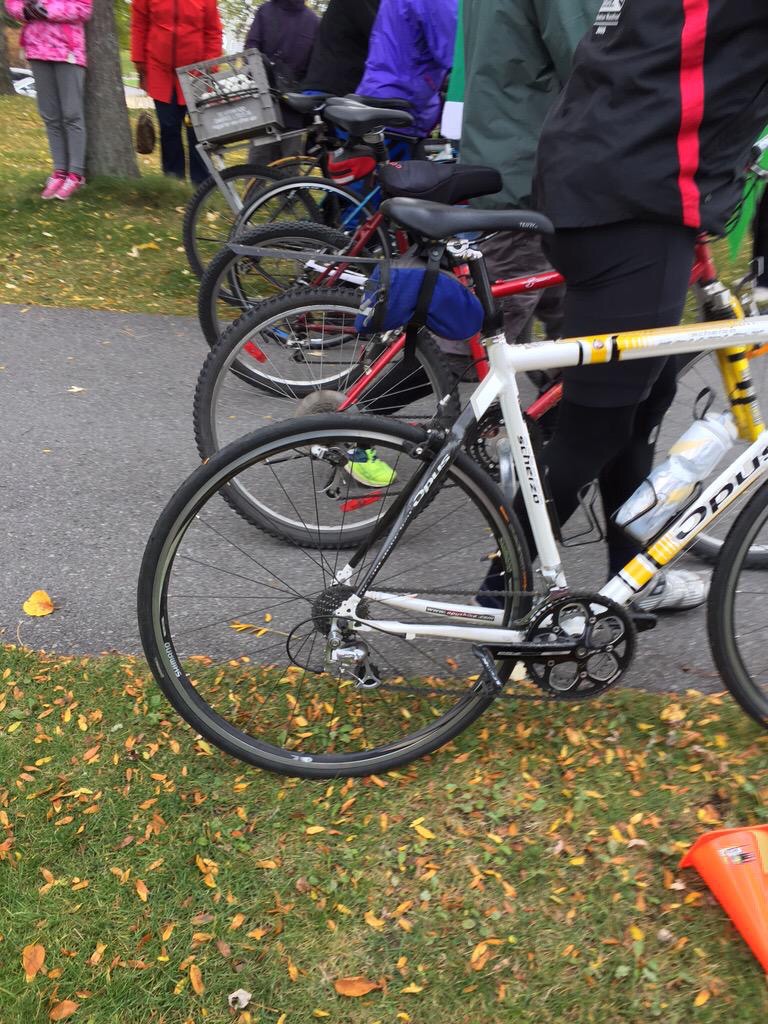
The highlight for me during the clerics cycling challenge (clericchallenge.com) was the finish line, when we all crossed together. This experience symbolized for me what the culture of Christian community ought to feel like and be like.

   
 We are part of a holy procession led by the King of Glory whose destination is sure. We have nothing to lose. If God’s grace is extended even to the generation of seekers (v.6), then we have nothing to lose. If what we are about is not a competition, then we have nothing to lose. If we don’t need to find fault in the other to prove our own self-worth, then we have nothing to lose. If it’s not about one-up-man-ship, then we can go for broke and not worry about it. If we don’t need to question who our Saviour is — who already accomplished for us our salvation — we don’t need to doubt our final destination. Then, why not share now what we have with others on this road?

All the saints on earth, despite the scars of life we bear, have gifts to share with other seekers on that journey. What gifts and blessings of God reflect in your life? In discerning this, remember: It’s not up to you alone! We don’t need to be perfect. We gain the gates not by our own merit or even hard work. Ours is the victory only because of the One for whose reason the gates are lifted in the first place.

Thanks be to God!
(1) — Michael Morgan in David L. Bartlett & Barbara Brown Taylor, eds. of “Feasting on the Word Year B, Volume 4” Fortress Press, 2009, p.228

Wise speech is a prayer

My parents, now retired pastors, have been ordained many years in the Evangelical Lutheran Church in Canada and the Polish Lutheran Church. My mother told me that not once in her long years of work did she choose to preach on the second lesson for this Sunday in Ordinary Time — the 18th Sunday after Pentecost — James 5:13-20. 

So, curious, I went back in my online archive of sermons to see if had. And to my surprise, I discovered that I now have preached two sermons in a row based on this text. The last time in the lectionary these texts appeared was three years ago in September 2012; and here we are three years later focusing on it again!

Why so? I asked myself. Many possible reasons likely. Not to mention the lectionary group here at Faith chose to reflect on James — yet again! Could it be, underlying this desire to look at James is the church’s need today for some practical advice about how to live the Christian life? Could it be, that the church today needs basic guidance about how to live as a Christian would in today’s world?

When we think of all that we say, all the airtime we populate with our words, how much of it would we consider ‘wise’? It is important to ask this, since one of the major concerns in the Book of James is our speech (Mark Douglas, Feasting on the Word Year B Vol 4, eds. Barbara Brown Taylor & David L Bartlett, WJK Press, 2009, p.112). And, it’s not so much what we say but how we say it — in the context of the relationships involved. This, indeed, requires great wisdom. So, I ask again, how much of what we say would we consider wise?

My guess is, not much. When we think of all that we say that is hypocrisy — that doesn’t really coincide with the choices we make, the lifestyles we lead. When we think of all that we say that only ends up hurting others …

When wise speech happens, it is truly a holy event. This is speech that communicates truth and honesty. This is speech that reveals vulnerability, expresses compassion, tenderness and authenticity. This is speech that is wise. And wise speech is then a prayer in God, with God, to God.

And, it is not only spoken to the ceiling. Because prayer is fundamentally a public act, not a private affair. One of the unfortunate victims of the Reformation period  — which launched the Enlightenment and Industrial and Scientific Revolutions of the modern era — was that Confession was relegated to a lower place in the value systems of religion. As a result of these modernizing developments which heightened the importance of the individual in religion, prayer was reduced and confined to words spoken to the air in our private lives.

In contrast, Confession is about speaking honestly the truth of our lives to another and with another. Confession is wise speech which brings healing and wholeness, when another ‘in the flesh’ can hear the truth and respond with guidance and in love, mercy and forgiveness.

And what we do every time we gather to worship, is pray. We pray in all the parts of the liturgy. Whether we are celebrating the sacrament of the table, whether we are listening to the sermon, whether we are singing a hymn or ‘saying’ a prayer — we are praying! Including the Confession of sins, and the pronouncement of forgiveness.

It is true — the church needs basic guidance about how to live as a Christian would in today’s world. I emphasize in today’s world because sometimes I don’t think we realize how decidedly unChristian this culture of ours is. And I don’t just mean the fact that we live in a multicultural, ethnically and religiously diverse society. But also, even in the institutional church, in our own lives, our lifestyles, our common sense assumptions about how to live our lives and the values we espouse: our attitudes towards competition, financial security, self-defence, self-righteousness, financial-material selfish gain, etc.

Perhaps it is time for the Reformation church (including Lutherans) to let go of the split we have created between grace and ‘works righteousness’. It is not all ‘cheap’ grace on the one hand; nor is it all work, on the other. In truth, it is a lot of work and practice to remain fully open to underserved and unmerited grace (Philippians 2:12-13). Because we will rush, if unawares, to make it all about our hard work. Just work harder!

At the same time, as Cynthia Bourgeault writes (in The Wisdom Way of Knowing: Reclaiming an Ancient Tradition to Awaken the Heart, Jossey Bass Publishing, 2003, p.10), “those willing to bear the wounds of intimacy, the knowledge of that underlying coherence – in which all things hold together – is possible.” To let go of the compulsions that keep us captive and stuck in patterns of life that are ungracious, untrue, unhealthy. To commit to the work and sacrifice of being true to self, true to neighbour and true to God. To practice confession and honesty with another. To accept the forgiveness, mercy and love of God and to receive it fully and know peace.

Could it be deep down we know it but are afraid to address and embrace it: the values of God in Christ Jesus are meaningful — they make for great, wordy and pious statements in church groups — yet clash with what we do and what we actually say to one another?

The Furious 7 movie which was Paul Walker’s last before he died shortly after filming the movie, ironically, in a car crash, highlighted for me this hypocrisy. In the extended version which I assume was edited after his death, there is a beautiful scene on the beach where Paul Walker’s character and family are gathered. His friends watch on as he plays with his young child and pregnant wife at the water’s edge. One of them remarks how what is truly important in life is not the thrill-seeking, high-octane, ego-satisfying selfish pursuits, but his relational world of love and family which endures forever. In contrast to the explosive, sensational content of the film up to that point, this affirmation of family living in love is rich in meaning and truth.

I commented in my slightly cynical mood after the movie that I didn’t think the Fast & the Furious franchise would have grossed the hundreds of millions it did if it made movies solely about family and love. It seems we want to acknowledge what is true and right, but only after we first can serve our own fixations and compulsions ‘for the thrill’.

Another TV example: Did you notice how the Amazing Race Canada presented the final words of the father and daughter from Africa — newly arrived immigrants, when they were eliminated before the final round? They were the victims of unfair play in that second-to-last leg of the race; other teams cheated on them by stealing their taxi not once but twice, if I remember correctly. 

And then, as the host John invited them for some closing remarks on the elimination mat, all of them spoke beautiful tear-wrenching words about the fair, generous nature of Canadians. It seems only the losers have something meaningful to say. Only when we suffer loss do we discover the truth of our lives. Now, we are getting uncomfortably closer to the whole point of our Christian faith and what it means to follow Jesus.

As I wrote three years ago, in James’ concluding chapter we encounter vivid images of prayer involving the laying on of hands and the anointing with oil. Prayer is a public act that invades the space of individuals and pulls us to be in the space of one another. Prayer is inherently relational. It gets down and dirty in the bodily reality of our lives, one with another. It is about touch and sensation as much as about the mere words we speak. Prayer is not my time, it is our time for the sake of the other.

Maybe I chose to preach on James 5 two times in a row because the Gospel associated with this text is about Jesus instructing us to cut out our eyes or chop off our hands if they caused us to sin (Mark 9:38-50). And I just didn’t want to go there! These are difficult words to ponder. Jesus concludes by using the image of salt to define the Christian life: something with an edge, that adds flavour. God forbid you lose your edge, your flavour! Jesus counsels us to have saltiness in our lives as a way to “be at peace with one another” (v.50).

Perhaps the way of Jesus will be tough and difficult building bridges of reconciliation. And yet, his last word to us today is a blessing of peace. The Book of James began with an address to those who are “dispersed” (1:1). James continues his letter to address the divisive consequences of an “unbridled tongue” (3:6ff) and considers the reasons for the “conflicts and disputes” among the people of God (3:4). James’ letter acknowledges the inherent splintering of our lives.

His letter in chapter 5, however, ends rather abruptly. Perhaps to indicate that there is no easy answer to the disconnections of our lives. Perhaps also to remind us that though wise speech is indeed a gift from God in the world so full of sin and death, we will still pray. And through prayer that is public, we will continue to engage the world in hope for a time when what has splintered can be reunited.

The life-giving gap

Does a spring pour forth from the same opening both fresh and brackish water?” (James 3:11)

The writer, James, makes a case for integrity and authenticity in the Christian life. For us moderns, living in a day and age where how we look, our reputations, our social standings and our bank accounts seem to speak louder than anything else about who we truly are and what we truly want. Is our joy at living based on these ‘worldly’ values, when we are honest about it? 

It becomes particularly challenging for us Christians, whose value system is acutely counter-cultural. It becomes a real war, actually, to embrace the true source of our lives in a world of celebrity politicians and glory-seeking suburbanites. And I think, for the most part, we live a bifurcated existence. We say one thing — I believe in the God who asks us to bear our cross and follow him (Mark 8:34) — but so easily slip into a lifestyle that is really narcissistic, self-centred and selfish. The easy way.

It’s a rhetorical question. “Does a spring pour forth both fresh and brackish water?” In James’ mind, of course not. A spring will either bring forth, on balance, mostly fresh or mostly dirty water. The meter will lean one way or the other. 

Which way do you lean? In your work? In the way you invest? In how you spend your money? In how you spend your free time? With whom? In what and how you communicate?

In the Gospel for today (Mark 8:27-38), Jesus says some difficult, counter-cultural things about what kind of way Jesus — the Lord of Lords, the King of Kings, God incarnate, Almighty and Everlasting God — will travel the journey of life. And it is this God who beckons us to follow: in order “to undergo great suffering” (Mark 8:31). Really? That doesn’t sound right for a person claiming godly power!

In an upwardly mobile culture we are suddenly and shockingly presented with a downwardly mobile God. Naturally and understandably, through the lens of worldly value, we shudder. Peter rebukes Jesus. And it is in response to Peter’s communication that Jesus accuses Peter of being Satan.

The first lesson from Isaiah, the third chapter in the Epistle James and the Gospel reading for today are a call to discipline our speech — how we talk, and for what purpose. I would broaden this to say: How we communicate. The words we use. The body language we employ. They say that 70% of communication is non-verbal. I believe this truth is what prompted Francis of Assisi to say: “Preach the Gospel; Use words only when necessary!” It’s a cliche, but it’s true: Our actions speak louder than words.

We are called to pay attention not only to the words we use — important though they are, but our actions, our tone, our presence with another. We are called to pay attention to these details in assessing the quality of our relationships. Not to do so, to ignore and dismiss our attention to these aspects of relating, is evil. Not to hold ourselves accountable to what we say and how we say it to another is a satanic time-bomb waiting to happen.

The eighth commandment reads: Do not bear false witness against your neighbour (Exodus 20, Deuteronomy 5). This means, what we say about them. Of course, first we have to look around and ask: Who is our neighbour? On Meadowlands Drive West, in Nepean, Ottawa, and in Canada. Who are our neighbours today? Do we know their names? Who are they? And then, what do we say about them, to them?

In his explanation of all the Ten Commandments, Martin Luther makes clear these are not simply about ‘not-doing’ — not gossiping, not slandering — but even more important what positive behaviour we do for the sake of the neighbour. He writes that it is imperative that Christians should do all they can to protect the good name and social standing of their neighbours — and he lifts up particularly the “sins of the tongue” in this context. (Martin Luther, “The Large Catechism,” in the Book of Concord, ed. Robert Kolb & Timothy Wengert, Minneapolis: Fortress Press, 2000, p.420)

I can’t help here to think of the millions of refugees fleeing the violence in Syria. I can’t help here but think of the many ways Muslims are disparaged in the media in the West not only in the press, but also in those malicious forwarded emails that circulate “like a hydra with multiple heads: so pernicious and so difficult to stop” (Kristin Johnston Largen, “Inter-religious Learning and Teaching” Fortress Press, 2014, p.57).

James concedes to our human predicament. In the end, no matter how hard we try to do right by this, “no one can tame the tongue” (3:8). It’s as if the narrative of Scripture accepts the impossible capability of us, on our own, to get it all right all of the time. Even though Peter is in one moment ‘Satanic’ he is, in the next, the rock upon which the church will be built against whom “the gates of Hades will not prevail” (Matthew 16:18). Martin Luther’s well-known paradox can help us frame this apparent contradiction: We are simultaneously saints AND sinners (simul justus et pecator). 

This ‘word’ today may make us feel uncomfortable. It does, me. And, probably for good reason. Yet, there is good news. God speaks into this confused darkness of our lives. God speaks the Word of creation into this murky existence (Genesis 1). A Word of forgiveness, mercy and compassion. 

And the Word that God speaks sets up the endless harmonic of sounds in the world. And as we speak, and try to speak truthfully, perhaps what we are doing is far less hanging labels around the necks of the things of the world. And instead we try to find those divine harmonics and speak and act ‘in tune’ with that Word first spoken into silence and darkness.

The image I like of creation is that God first makes a great cave. And then breathes into it. Speaks into it. A Word. And from the cave the echoes come back. Differently pitched. Differently aimed. A world of Word. And we find our place in that world listening to those harmonics, trying to speak and act in tune with them. Not to speak and act from our will or our passion for control. But to speak because we want to join in what an earlier generation would have called the ‘music of the spheres’. (Rowan Williams, “The Spirit in the Desert” Meditatio Talk Series 2015 B Apr-June CD).

Those of us preachers and public speakers, especially need to think more about this. Paul says that the Body of Christ is made up of all parts, each important in their own right (1 Corinthians 12:12-27) — you are a hand, you a leg, you the eyes, you the foot. This morning, I am the mouth! And, like James, Paul also says that greater scrutiny and possible judgement will be brought upon those who speak (2 Peter 2:3;Colossians 2:20;1 Timothy 1:2-4). A timely word, perhaps, in a season of political campaign, mindless rhetoric and questionable election promises.

How do we speak in such a way that is authentic and true? Only by looking for the harmonics that that Word of God sets up. By refusing the mass pressures of culture. By becoming in our speaking as in our living a kind of invitation into the gracious harmonics of God’s world, into the resonances and echoes that are set up by that primordial utterance of God into the cave of creation.

Simone Weil used the concept of ‘hesitation’ to describe how to communicate in a healthy way For her, part of the essence of spiritual maturity was leaving the ‘life-giving gap’ between you, the act, and the other person (quoted in Rowan Williams, ibid.). Learning not so much to project straight away our ego compulsions into the other person; learning not so much to move right away into solving a problem on our own terms. But drawing away momentarily to listen for the sake of the other. And for the sake of the truth.

At the end of the day, we are called to check the compulsion to speak. And move back into a momentary stillness into which God’s draws us, and out of which God calls us to speak and to act with integrity and authenticity.

We would make James proud.

(Hoping for) A happy ending: Why not?

“God will come and save you.” (Isaiah 35:4)

When the prophet Isaiah promises salvation to the people, people who are “weak, feeble and fearful” (Is 35:3-4) what does he mean? What does he mean when he says: “God will save you”? Does he mean, the promise of heaven? Does he mean, remission of sins?

In the news this week we have seen images of desperate people risking their lives to escape the dire situation in Syria. Refugees are literally dying for the sake of finding a better life for themselves and their loved ones.

The prophet Isaiah spoke to a people dispersed from their homes. He spoke to a people who were displaced for political reasons. Emerging empires, such as Assyria, Babylon and then the Greeks, swept through the region in the centuries before Christ leaving those without power or privilege to fend for themselves in foreign lands. Sound familiar?

The Bible gives us Christians a broader perspective on ‘Salvation’. Because when we look carefully at texts such as Isaiah 35, salvation is not about heaven and remission of sins. The people who are exiled, lost and experiencing the worst circumstances of life, will be saved from those circumstances. In real time, earth-bound, flesh and blood realities.

From the perspective of Jesus Christ, of course, we can express, in all truth, the promise of heaven and remission of sins. For sure. And yet we cannot, if we engage the bible honestly, limit the concept of salvation to these albeit abstract notions of faith. Salvation in Christ has just as much to do with our lives on earth, and the lives of others, “in the flesh”.

We may despair, watching the news. What can anyone do to make the situation right for the millions of refugees now flooding Europe? How can there be a happy ending, in this mess? We can be paralyzed in our fear, and look away, despondent.

And yet we have this fantastic story of restoration. We know how the story ends for the remnant of Judah in Babylonian exile. We know that their earthly suffering ends happily. On earth. They eventually return to Jerusalem and restore their fortunes. We can get giddy with faith at this happy ending. Surely, this is the promised outcome for all who suffer in any way!

Listen to how Professor of Old Testament, Patricia Tull, writing in workingpreacher.org, expresses the puzzling truth of this story:

“Events as deeply woven into our history as Jerusalem’s restoration take on for us an air of inevitability. Yet they cannot be taken for granted. Other nations destroyed by great empires — including Aram, Moab, and the Northern Kingdom of Israel — failed to reestablish when their crises passed. We have Judah’s story only because it transcended destruction. Every time our scriptural reading brings us to Jerusalem’s phoenix-like restoration 2500 years ago is a moment to stop for gratitude and wonder. As Isaiah 34 and 35 vividly show, reversal of fortune isn’t guaranteed. But it is possible. Judah’s success story sets a precedent for hope, showing that happy endings have occurred and can occur.”

The first prime-minister of the modern state of Israel, David Ben-Gurion, said, “Anyone who does not believe in miracles is not a realist.” To be hopeless, however grave the circumstance, is unrealistic. It works both ways: To believe that there is a happily-ever-after for each and every person in every situation imaginable is unrealistic; we know that’s not the way life works. At the same time, to dismiss altogether the possibility of happy endings and miraculous turn of events is unrealistic as well. For God, all things are possible.

Franklin D. Roosevelt once said, “Some people see things as they are and ask, ‘Why?’ Others see things as they could be and ask, ‘Why not?’

As Christians, as people of faith, aren’t we a people of a ‘Why not?’ -capability?

Why not be grateful at the start and end of each day — grateful for all things that have gone well in life?

Why not focus on the blessings and abundance rather than the scarcity?

Why not celebrate the victories of God that you see in the world in the lives of others even if those victories don’t benefit you personally?

Why not rejoice with those who rejoice and weep with those who weep?

Why not sing a song of gladness when the underdog takes it all?

Why not see the face of Jesus in the stranger, the immigrant, the Muslim neighbour, the un-churched youth and mid-lifers?

Why not envision a future for your life and the life of the church that is better than what it is now? Why not? Why not? And then, see where that leads …

We are not in the business of faith for what we make of it or get out of it. We are in the business of faith for what God has done, and continues to do all around us, and even despite us.

We can be strong and do not need to fear because God keeps promises. God keeps God’s word. As Isaiah foretold, “the eyes of the blind shall be opened, and the ears of the deaf unstopped … the lame shall leap like a deer, and the tongue of the speechless sing for joy.” (Isaiah 35:5-6). 

In the Gospel today we read about Jesus doing precisely this: Jesus brings miraculous healing to the lives of those distraught and torn apart by illness and disease (Mark 7:24-37). Jesus is the glory of God shining through the brokenness of our lives. Jesus is the majesty of God embracing the sweat and tears of our lives. Jesus is the active presence of God working in us and through our poverty and pain, amidst the blood and grit and earthy, daily activity of our lives.

The story of the Quilt Holes inspired me recently at a funeral I attended. The preacher told the story of one who faced God at the last judgement, as spoken through the first person: “I knelt before God, as did everyone else. Our lives lay before us like the squares of a quilt in many piles. An angel sat in front of each of us sewing our quilt squares together into a tapestry that is our life.

“But as my angel took each piece of cloth off the pile, I noticed how ragged and empty each of my squares was: They were filled with giant holes. Each square was labeled with a part of my life that had been difficult, the challenges and temptations I had faced in every day life. I saw hardships that I endured, which were the largest holes of all.

“I glanced around me. Nobody else had such squares. They just had a tiny hole here and there. Their tapestries were filled with rich colour and the bright hues of worldly fortune. I gazed upon my own life and was disheartened.

“Finally the time came when each life was to be displayed, held up to the light, the scrutiny of truth. My gaze dropped to the ground in shame. There had been many trials of illness. I had to start over many times. I often struggled with the temptation to give up. I spent many nights in tears and on my knees in desperate prayer, asking for help and guidance that took a long time coming.

And now, I had to face the truth: My life was what it was, and I had to accept it for what it was. I rose and slowly lifted the combined squares of my life to the light.

An awe-filled gasp filled the air. I gazed around at the others who stared at me with wide eyes. Then, I looked upon the tapestry before me: Light flooded the many holes, creating an image, the face of Christ. Then Jesus stood before me, with warmth and love in his eyes. He said, “Each point of my light shone through the holes, the rips and ragged, empty squares of your life. When you were down and out, and honest and still trusting, my light continued shining through you.”

At the end of it all, we may be threadbare and worn. It may look like a failure, a sad ending. And yet, Christ in us is the end of the story, not us.

Why not, then, just be the Body of Christ in the world today? Why not be, together, the hands and feet of Jesus? Holes and all? What do we have to lose? Why not be the answer we are waiting and hoping for — for others who have no hope, for the refugees of the world? 

I recently read the story of a woman who had walked seven hundred miles as a refugee to escape a violent war. She was finally able to cross a national boundary out of the war zone. She walked all that way and brought with her an eight-year-old girl, who walked beside her. For seven hundred miles, the child held her hand tightly. When they reached safety, the girl loosened her grip, and the woman looked at her hand: It was raw and bloody with an open wound, because the little girl had held tightly in her fearfulness. This is no casual hand-holding. This is a life-or-death grip that does not let go. (Walter Brueggemann, “Sabbath as Resistance: Saying No to the Culture of Now”, WJK Kentucky, 2014, p.88-89)

God’s hands do not let go of us, even though we may fear, even though we may be scared to take the risk and do the right things. This is the promise that God will never break.

The Evangelical Lutheran Church in Canada (ELCIC) was onto something when in convention this past summer we adopted the Reformation challenges — one of which is to sponsor, by 2017 (the 500th anniversary of Martin Luther posting the 95 theses, or arguments, on the doors of the Wittenberg Church in Germany thereby launching the Reformation), 500 refugees coming to Canada.

We are the people we are waiting and hoping for. We have a responsibility, in faith, to be grace, forgiveness, mercy and compassion to those who are unloveable, undesirable, the outcasts, the downtrodden, the refugee, the marginalized. Can you imagine what a show of grace might do in the lives of those to whom the unexpected is given?

Why not?