

Water, water, everywhere – a sermon for baptism

Photo by Ernie Dickey (British Columbia Photos, posted November 15, 2024) https://www.facebook.com/groups

Leyla is baptized today. The water in the font is not moving that much. But when we spilled it over her head, you could hear the splash and see the fall of water from her head back into the font. Water, even when it appears still, is still moving.

In baptism Water and Word come together. It is the word of promise, of hope, that amidst all the struggles and storms of life, God will never forsake Leyla. God will always, no matter what, travel with her on the life’s journey. God will always love her.

But you can’t have baptism without water. And if you think the Word part is difficult to understand, water, too, is a tricky thing, this primary conveyor of grace and meaning for us today.

On the one hand we dream and recite scripture about walking beside quiet and still waters (Psalm 23). We read about the river of life flowing through the new Jerusalem (Revelation). We consider the vital nourishment rainfall gives to the earth so desperate and dry. Water is a gift. It is necessary, required for life.

Yet, sometimes those waters can get rough. Indeed, being in the water can be dangerous business. In the Psalm today, the water mentioned is not some gentle, mountain stream or a placid pond. We’re not talking here about a dreamy Hallmark waterfall.

The pounding waves described in Psalm 93 are more akin to the weather bomb affecting the west coast of BC this past week. More like the deadly flood waters that devastated Spanish towns in a few terrifying hours, last month. The violent and deadly Noah’s flood from Genesis (chapter 7) describes this contrasting aspect of water images from the bible.

Getting into the water, we confront our fears. Getting into the water we become vulnerable. We know the dangers that lurk for humans who are not fish. We can even die, submerged under the water too long.

Waters, even baptismal waters, symbolize both peaceful religious experience as well as potential danger. Waters, even baptismal waters, take us out of our comfort zones as much as they bring comfort and joy.

Herein lies the paradox of faith, actually, between life and death. Two apparent extremes can co-exist on the same line at the same time. Both/And. Peaceful waters. Stormy waters. Same place.

The oceans on this planet represent the most mysterious and unknown region yet to be discovered. Its depths have not yet been fully plumbed. It’s a place of fear and danger, of mystery. As much as oceans determine our weather – la Nina or el Nino – and the amount of water we receive and need, they represent a vast unknowing.

What a beautiful metaphor for God. What a profound image for Jesus who invites us on the journey to follow him our whole life long. Baptism is the Christlike means to launch each of us on this journey of faith. Water and the Word combine to enrich our faith and give us hope.

Indeed, we sail over the tempestuous sea of life. Our world is in storm mode – it may be on a personal level but also on national, and definitely global levels. Danger threatens all about. No wonder we are afraid.

And yet, only when the water moves, and the more it moves, the more energy for life it gives. The powerful impact of waves gets us moving! The ocean, after all, is alive with energy: Roiling waves, crashing surf. According to CBC Radio’s The Current, scientists are now trying to harness the power behind those waves. And the impact could be staggering, providing electricity, experts believe, for up to a third of American homes (Galloway, 2024).

As we ride those turbulent seas, Christ is on the ship with us. We may be perplexed facing a great mystery. We may be afraid to move, to change. But Jesus is with us. Jesus is aware, he knows – even when from our perspective he seems to be asleep in the back of the boat (Mark 4: 35-40). With the Psalmist we can declare, “He who keeps watch will neither slumber nor sleep” (Psalm 121:3).

Today the church celebrates the reign of Christ. Christ is king. What does that mean? In the Gospel, Jesus tells Pilate that the kingdom of God is not of this world (John 18:33-37). Who and what Christ Jesus is about doesn’t look like the powers of this world.

The water images from the bible suggest the reign of Christ is not one-dimensional. Jesus is in it all – the rain that nourishes, the surf that pounds, the tsunami that terrifies, the floods that wash it all away, the waters that calm and refresh. The contrasts may befuddle and bewilder us. The journey of faith takes us right into the middle of the ambiguity. Yet, Jesus is right there, with us, giving us energy, giving us life – new life.

Jesus watches us and keeps us, no matter what storms we face, no matter how poor the prognosis is, no matter how uncertain the horizon looks, no matter how badly the waves threaten to wash us overboard. Jesus watches us because he loves us and sees us as we truly are. This is the baptismal promise.

Because even when we are submerged in water, the only way out is up. It is the first thing we do when coming out of the waters. To open our mouths and gasp for air we have no choice but to look upwards, to the hills, to the horizon, to the heavens, to the one who reaches out to us.

Christ will stay on board with us until there are no more seas to sail. Jesus will guide our days and travel with us on the journey until the storm clouds break, the sun’s rays shine through, and we can look up again.

Thanks be to God.

Reference:

Galloway, M. (Host). (2024, November 21). Harnessing the oceans waves [transcript]. In The Current. CBC Radio. https://www.cbc.ca/radio/thecurrent/thursday-november-21-2024-full-transcript-1.7390604

It matters who, and it doesn’t matter who.

For the Lord is our God,
  and we are the people of God’s pasture and the sheep of God’s hand.         (Psalm 95:7)

Unfortunately, not every one of God’s creatures has a home. In Ottawa alone, there are 12,000 families who are without safe and affordable housing. 12,000 households—not individuals—households. Newcomers to Canada are literally getting off the plane in Ottawa looking to find housing that is not available to them. The Mission downtown is where many of these refugees first end up.

By the Fall of this year, a record 74% of all new intakes at the Mission were newcomers to Canada. And, for the first time in history the shelter system in Ottawa—comprising mainly of the Salvation Army, Shepherds of Good Hope and the Mission—was at full capacity in the summer. The shelters were never before at capacity in the summer when sleeping outdoors is an option. Today, 450 families use the shelter system at a cost to the city of $3000/month for each family. A dire situation is looming this winter when already some 260 people live on the street. An alarming housing crisis is only growing.

Last Sunday on National Housing Day in Canada, as a patron of Multifaith-Housing-Initiative I attended an event hosted by MHI. Speakers, including Ottawa Mayor, Mark Sutcliffe, mentioned how important it is to work together to help those in need who don’t have a home.

I have a comfortable, safe home to live in. I suspect most of you here and watching at home do. And I ask, as followers of Christ, how do we respond to the needs around us, in light of the Gospel? Do we just focus on helping our own? Is that our mission? What is God’s mission? What does God call us to do?

On the one hand, I believe it matters whom we help.

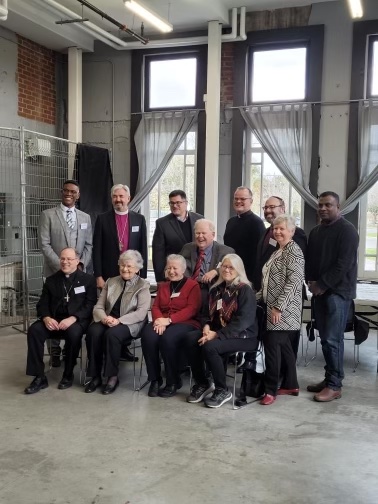
Patrons of Multifaith Housing Initiative together on National Housing Day in Canada, 19 Nov 2023

In the Gospel text for today, Jesus describes the activity of the sheep who are the good guys in this story.[1]

So, it also matters who we are, as followers of Christ.

But what I find curious is that both the sheep—the good guys—and the goats—the bad guys—share the same problem. Both of them ask the King the same question which exposes the failure of their initial perception. “When did we feed, clothe, visit, you?” and “When did we not …?” Both sheep and goats had a break-down in recognizing, being aware, being conscious of doing good, or not doing good.

In the end, it matters what we do, as followers of Christ.

While their perceptive abilities failed all of them, the good news is at least half of them got their activity right. That should indicate what the main gist of this Gospel story is about. Because it’s not ultimately about knowing who’s in and who’s out. It’s not about us making the final judgement about who’s going to heaven and who is going to hell. It’s not about making doctrinal statements about eternity and predestination.

If anything, let’s avoid these red-herring interpretations and extrapolations of the story. Because the main point is not the knowing but the doing. It is feeding the hungry, clothing the naked, visiting the sick and imprisoned regardless of who they are.

One of the attractions of Multi-Faith-Housing Initiative for me is the multi-faith part. Because where religion has been and still is used as a tool for division and war, MHI bears witness in concrete ways to how faith unites people of different religions. Faith is a way of unity rather than division.

On National Housing Day, MHI had to adjust to a last-minute change in venue. That’s because originally, we were going to have the meeting at City Hall, downtown. But because of the weekly Sunday demonstrations about the ongoing war in Palestine clogging up the downtown core, security officials deemed the City Hall area unsafe for us to meet. And so they were going to cancel the event outright.

Fortunately, through some back-room advocacy on MHI’s part, the city was able to provide us with the Horticulture Building at Lansdowne Park instead. For me this was a powerful statement showing our commitment to religious unity, where Jews and Muslims, Protestants and Catholics, Baha’i’s and Hindus, sat shoulder to shoulder in one room to witness to the power of religious unity by participating in a common divine mission to meet a growing need in our city, our province and in our nation. As one of the speakers at the MHI event said, “Never waste a crisis” for the opportunity it creates.

When we want to introduce Christianity to others, especially younger people, sometimes the language of our faith and the words we use are not good starting places. Getting cerebral with definitions of salvation and hell and judgement don’t help as much in witnessing to our faith as it is to do something good together, simply and concretely, to make a positive difference in our world.

It doesn’t matter, who. I think that is the point of the Gospel. There are differences, to be sure, between sheep and goats. But it’s difficult sometimes to tell the difference between sheep and goats, honestly. In the larger scheme of all of creation, those differences are not as great as we often make them out to be.

If we can’t know really who’s in and who’s out, if we fail in our perceptive capability, then perhaps we should leave that part of it alone. Leave the final judgement to God. Judging is not our primary job. Ours is simply to act and help no matter who it is, no matter where they come from, no matter the colour of their skin, the clothes they wear, the language they speak or the creed they follow. It doesn’t matter, who.

In conclusion, let’s turn the clock back to the 13th century. I’d like you to meet Mechthild of Magdeburg, a religious who lived her final years in a monastery of Cistercian nuns. She gradually lost her physical abilities, and this affected her faith. Not only did she go blind and not only could she not do anything for herself, but she felt God’s love had abandoned her. She came to the end of her life in a state of powerlessness which left her feeling bereft of God. A crisis of faith, you might say.

And yet in this state of powerlessness, she rediscovered God in a new way. She began to express deep gratitude for the nuns and the way they cared for her. She began to understand that the way they cared for her was the way she experienced God’s love for her, in her powerlessness.

And she talked to God, that though she had lost her pride in possession of things, “You now clothe and feed me through the goodness of others.” Though she was blind, she prayed, “You serve me through the eyes of others.” Though she had lost the strength of her hands and the strength of her heart, she prayed, “You now serve me with the hands and hearts of others”.[2]

Maybe in seasons of our lives when we experience our own powerlessness, our own weakness and are open to others with our own vulnerabilities and needs, therein lies the way to finding God’s presence, God’s love and God’s power: serving another’s needs, receiving another’s care. And whether we are the one serving, or the one receiving the help, both experience a divine connection.

In the end, it doesn’t matter who. In the end, it is the quality of the relationship that grows and endures: The relationship between people, our relationship with the world and all that is, including the tensions in between—that is what is important in living our faith.

Could it be that in relationships of trust and loving action, it can all belong? And nothing and no one is lost? Indeed,

The Lord is our God,
  and we are the people of God’s pasture and the sheep of God’s hand.        
(Psalm 95:7)


[1] Matthew 25:31-46

[2] Cited in James Finley, “Unraveled by Love” (Richard Rohr’s Daily Meditation: www.cac.org) 27 October 2023.

Reversal

September Sky/River (photo by Martin Malina, September 2022)

In the Shaun the Sheep Movie[1], a sleeping farmer accidentally rolls into a trailer and into the city. And it’s up to an adventurous lamb to bring him back, with help from the rest of the flock. It’s a humorous animation, a spin-off of the Wallace and Gromit franchise. 

Much of the humor comes from role reversal: while the farmer, suffering from amnesia, mechanically operates clippers in a hair salon, the sheep wear clothes, shop, and try to escape being captured by animal control. In the end, both the farmer and the sheep learn that they need one another. They experience the joy of depending on one another in their role reversals.[2]

But they never would have come to this satisfying and fulfilling conclusion without having experienced this reversal. They would not have deepened their relationships without having suffered through the discomfort of having their original expectations uprooted. Reversals happen when our expectations are turned upside down. And who we thought and what we thought were true are turned on its head.

In the bible we find several images for God and Jesus. In the Gospels which tell the story of Jesus, the image of God we may long have believed is turned upside down. A radical reversal.

For example, the prophet Jeremiah from the Hebrew scriptures introduces both the images of the Messiah as shepherd and king. Here is one who will “deal wisely, and execute justice and righteousness in the land.”[3] These images are later attributed to Jesus, echoed again in the New Testament (i.e. the image of shepherd in John 10).[4]

However, most references to Jesus as king occur during the Passion story, such as in today’s Gospel from Luke. The main symbol of Christ’s “kingship” is not a crown but a cross. Which ought to alert us to what happens often in the Gospel when we imagine God and what Jesus is about—a role reversal.

Diana Butler Bass writes in her book, Freeing Jesus, about this reversal of understanding who God is in Jesus Christ. Butler Bass suggests we talk more about the kin-dom of God rather than the king-dom. She writes that Jesus “used ‘kingdom of God’ to evoke . . . an alternative ‘order of things’ over and against the political context of the Roman Empire and its Caesar, the actual kingdom and king at the time.”

Moreover, Butler Bass goes on to write that “kingdom” has become a corrupted metaphor, one misused by the church throughout history to make itself into the image of an earthly kingdom. Indeed, Christians have often failed to recognize that ‘kingdom’ was an inadequate and incomplete way of speaking of God’s governance. “Kingdom” is not a call to set up our own empire. In contrast, ‘kin-dom,’ is an image of la familia, the …family of God working together for love and justice.” ‘Kin-dom’ is a metaphor closer to what Jesus intended.

The “’Kin-dom’ metaphor echoes an older understanding, one found in [for example] … the work of … Julian of Norwich. Julian wrote of ‘our kinde Lord,’ a poetic title … summoning images of a gentle Jesus. But … the word ‘kinde’ in medieval English did not mean ‘nice’ or ‘pleasant.’ Instead … in Middle English the words ‘kind’ and ‘kin’ were the same—to say that Christ is ‘our kinde Lord’ is not to say that Christ is tender and gentle, although that may be implied, but to say that he is kin—our kind …

“Jesus the Lord is our kin. The kind Lord is kin to me, you, all of us—making us one.” He is for all of us our next-of-kin. “This is a [radical reversal] of the image of kingdom and kings. ‘The Lord is kin’ … [does away with] the pretensions and politics of earthly kingdoms. [Because] Jesus calls forth a kin-dom.”[5]

I must admit, it is often out of fear and anxiety that I want Jesus to be my magical savior. So it can be frustrating when we discover a very different Jesus. Instead of one who fixes everything in an instant, Jesus is the one who walks with us through the darkest valleys. He is our kin.

Jesus is the one who calls us to lives of service—and again and again as we care for the needs of others we discover the face of Jesus himself in the lost, the last, and the least.[6] He is our kin.

On the cross, God is one who is revealed in weakness and vulnerability. God is one who comes to us in our sufferings and imperfections. The Reign of Christ Sunday this year can be of great help, in encouraging us to reframe our expectations of what it means to be the Body of Christ, the church. 

Who we are together, and anything we do together, are not validated in glory, majesty and spectacle. When we gather for worship, work together for the cause of helping others or even pray together—these activities are not validated because there are large numbers and it feels good. Rather, even where two or three are gathered, even when it doesn’t feel “like it used to”, even when the situation is anything but perfect—that is when and where God is revealed to us.

So let’s not give up on meeting together, even when numbers are small. Let’s not give up doing what little we can to fulfill the call of Christ in our lives. Let’s not give up dreaming and striving towards the future of God for us all. Because the Reign of Christ is upon us, soon and very soon. Christ Jesus comes to us in the humble moments of forgiveness, mercy, love and grace.


[1] StudioCanal, 2015

[2] “Day Resources”, 20 November 2022, Christ the King / Lectionary 34, Year C from Sundays and Seasons.com (Augsburg Fortress, 2015)

[3] Jeremiah 23:1-6

[4] John 10:1-21; Luke 23:33-43

[5] “King, kind, kin” December 12: Advent Calendar, from Freeing Jesus (Harper One, 2022) by Diana Butler Bass in The Cottage

[6] “Day Resources”, ibid.

Who’s coming to dinner?

photo: Martin Malina
“Who’s coming to dinner” – audio sermon by Martin Malina

When I was a child, a cherished Christmas Eve tradition in our family was setting an extra place at the dinner table — an extra chair, plate and cutlery. We also decorated this place setting with fresh boughs of evergreens to make it special. 

After all, Jesus was being born into the world this special night. We had to make room for him in our house since there was no room for Mary, Joseph and the Christ child in the inn at Bethlehem that first Christmas. And, my parents suggested, you never knew who might actually show up at our door. Would we find it in our hearts to let them in and serve them a Christmas Eve dinner?

There was a part of me that didn’t believe anyone would show up. After all we didn’t advertise. We didn’t put out a sign on the front lawn announcing: “One free dinner, come at 4pm, first come first serve”. No one actually knew we did this. It was merely an in-house ritual, something to stimulate our faith, to make room in our hearts for Jesus and make us think about the true meaning of Christmas, of Christ coming.

Another part of me secretly hoped someone actually would show up — an unexpected visitor, someone we didn’t invite but who came by anyway. Would they be homeless? A traveller journeying through town, looking for a place to eat a hot meal on a cold, winter’s night? Or, would it be a friend, someone in the neighbourhood just stopping by? 

And, then, how would we react? Would they like the food, or have any dietary restrictions? How would we adapt on the fly? Would they stay long? Would they come to worship later in the evening, or go home after eating? Would we become best friends for the rest of our lives? 

All those possibilities. All these thoughts swirled in my mind. This part of me actually wanted to experience the tradition, and mean something concrete beyond the personal reflections. Deep down I wanted someone in the flesh to show up. That would be cool.

Well, today is not Christmas Eve. On this last Sunday in the church year a month before Christmas, we celebrate the Reign of Christ or Christ the King Sunday. 

To celebrate the reign of Christ, nevertheless we first need to be clear about who we are actually celebrating and what kind of reign, or rule, Christ is all about. 

There seems to be some confusion among those who first encountered Jesus in the flesh, back in the day.

In pronouncing verdict over Jesus, Pilate needs clarity. In the Gospel text for the Reign of Christ Sunday this year, Pilate asks Jesus point blank: “You are a king?”[1] You don’t look like it! Your kingdom is not of this world? Well, then, who are you? 

Earlier, the disciples had been in discussion with Jesus about his identity. It is obviously unclear to the general populace. “Some say John the Baptist, Elijah or one of the prophets.”[2] Repeatedly Jesus presents as someone not easily recognized, pigeonholed, defined, nor understood. And people ask over and over again: “Who are you?”[3] From a human perspective, and even as people of faith, we may honestly struggle with this question from time to time. If it was challenging for those who met Jesus in person, then what about us, some two thousand years removed from that primary experience of the early disciples?

We have to deal with our expectations more than anything. And our expectations may not always be in line with the God of the Gospel. 

So, what kind of God is coming to you, and to me? 

If anything was clear to me about our tradition at home on Christmas Eve, it was that I was missing something. My expectations were not in line with what I actually experienced. The empty plate was not filled. The empty chair remained vacant throughout our Christmas Eve dinner. 

Ought I be disappointed? Was Jesus not coming? Was there no stranger around to knock on our door and receive our hospitality? Was the effort in vain, a wasted ritual?

There was something about my expectations that was amiss. Would the disconnect and dis-ease I felt after dinner somehow spill over into the Christmas Eve service later on, I wondered?

Maybe the problem starts with what image of the Messiah we hold in our minds and hearts. Is our image of God in Christ Jesus fuelled more by notions of earthly power and kingship? If so, that image might need some dismantling. 

For, in Jesus Christ, we meet a God “who is not armed with lightning bolts but with basin and towel, who spewed not threats [and lies] but good news for all, who rode not a warhorse but a donkey … In Christ, God is supreme, but not in the old, worldly sense: God is the supreme healer, the supreme friend, the supreme lover, the supreme life-giver who self-empties in gracious love for all. The king of kings and lord of lords is the servant of all and the friend of sinners. The so-called weakness and foolishness of God are greater than the so-called power and wisdom of human regimes.”[4]

As was often the case so many years ago, the little country church where I was confirmed was packed with Christmas Eve worshippers. When the lights went down and the candlelight was passed, the sanctuary became bright with the joyously expectant faces of worshippers reflecting the flickering light. 

As I surveyed the room around me singing “Silent Night”, my eyes stopped on the face of one person. In the far corner of the back pew, I recognized someone I didn’t expect to see there. It was Rick, my public school friend. He went to another church, but not one that normally held mid-week Christmas Eve or Christmas Day services. Just then I remembered that I had invited Rick to come to Christmas Eve service several weeks earlier, even before Advent began that year. 

After the service, my brother and I invited Rick back to our home for a short visit that we enjoyed as he waited for his ride. Later I wondered if my school friend was the surprise visitor for me, the Christ, who came to our home that Christmas Eve. Not someone I expected — not anyone who fit the figments of my imagination, neither celebrity nor unknown poor — just an ordinary friend who surprised me by his gracious presence.

Who is Jesus whom we praise this day, who comes to reign in this world, who comes to you with love, at the end?


[1] John 18:33-37

[2] Mark 8:27-30

[3] John 8:25

[4] Richard Rohr, “God’s Supremacy in Love” Daily Meditations (www.cac.org, 22 October 2021).

The Really Real

If there is one thing that stands out in my conversations with others about what people are learning from the pandemic, it is about the quality and honesty of relationships, especially with strangers. It’s like the pandemic has heightened our awareness of other people we pass on the street or in the mall, or even in our home. We have been re-introduced to what is important, what is real, in those relationships.

For example, folks have shared with me how strangers are often friendly towards them. And how they themselves feel more willing to return or initiate a kindness. Perhaps in times of social anxiety that we feel all around us, we know and behave out of a deepening awareness that we are all, indeed, in this together.

Physician Ruth Martin received the Governor General’s Award in 2015[1] for her work with incarcerated women in British Columbia. Half of the women she helped were Indigenous.  And most of these women struggled with addiction to drugs and alcohol. 

Challenging the assumption that addicted people make irresponsible choices, Ruth listened to the women’s histories—the physical and sexual abuse they endured as children, young teenagers and women. She said, “I would put my pen down and listen, and I realized that if I had been dealt the same cards, I might have been sitting in their chair. I would often place the Kleenex box close to the woman who was sharing her history, but also close enough to me that I could reach for a Kleenex for myself.”[2]

In the Gospel reading for this Reign of Christ Sunday[3], Jesus is the judge who separates the sheep from the goats – those who loved from those who cared less. For the early Christians who first heard and read this text, not only did the story call them to love “the least of these” in their midst. For they, themselves, were the persecuted and the hungry, too. 

“All the nations” gathered before the king; and the roles between those who love and those who need love are not fixed. They apply to Christians and non-Christians alike. 

This vision includes all people. And therefore, there is a call to respect the mutuality and common humanity we share with all people. As Ruth Martin experienced in her care for Indigenous women, she admitted the line separating her from the women for whom she cared was thin.

God identifies with the side of ourselves we normally don’t want to show to others: our weakness, our neediness, our vulnerability. Simone Weil said that we give not out of our strengths, but out of our weakness. What separates us, distinguishes us, are our strengths; but what unites us is our weakness.

Not only is this text about our role in giving and receiving care in mutual, loving relationships, it’s really about God. And “God is not a remote supreme being on a throne up there above the clouds or out there somewhere in the mysterious reaches of the universe.”[4]

If we are looking for God in our world, we need to look in our midst through the lives of our neighbors. “Jesus articulates in rather blunt terms that how you treat another child of God in this life is in actuality how you treat God. By seeing the infinite worth in our neighbor, we keep God as our center and focus.”[5] By seeing Christ in the face of those in need we give ourselves permission to connect with God in the brokenness of our own hearts.

But what’s the point of doing all this hard work when we are heading to heavenly kingdom in glory? Isn’t that our eternal aim anyway? Why worry about what happens on earth?

But the Reign of God is not only about eternal life, or where we go after we die. That idea is disproven by Jesus’ own prayer: “Your Kingdom come, your will be done, on earth as in heaven”.[6]

“Your Kingdom come” means very clearly that God’s realm is something that enters into this world, or, as Jesus puts it, “is close at hand”.[7] It’s futile mental energy to project it into another world. What we discover in the New Testament, especially in Matthew’s Gospel, is that the Kingdom of God is a new world order, and a promised hope begun in the teaching and ministry of Jesus—and continued in us.

I agree with Richard Rohr to think of the Kingdom of God as the Really Real (with two capital Rs). That experience of the Really Real—the “Kingdom” experience—is the heart of Jesus’ teaching. “It’s Reality with a capital R, the very bottom line, the pattern-that-connects. It’s the experience of what is.”[8]

God gives us just enough tastes of God’s realm, just enough joy and grace to feel the blessing of God and therefore to believe in it and to want it more than anything. In the parables, Jesus never says the Kingdom is totally now or totally later. It’s always now-and-not-yet. When we live inside the Really Real, we live in a “threshold space” between this world and the next. We learn how to live between heaven and earth, one foot in both worlds, holding them precious together.

The Reign of Christ begins in community – in relationships – beyond our private, self-centred preoccupations. That is where Jesus finds us. It’s when we risk reaching beyond our own concerns, to think about the needs of another who is also vulnerable, weak and suffering, that we meet the Lord – in the pattern-that-connects, in the mutual love that we experience together.

The Kleenex box is never out of reach for both of us. And when both hands reach for the Kleenex, both find healing.


[1] Status of Women Canada – government website

[2] Cited in Ken Shigematsu, Survival Guide for the Soul; How to Flourish Spiritually in a World that Pressures Us to Achieve (Michigan: Zondervan, 2018), p.153-154.

[3] Matthew 25:31-46; the Gospel for Christ the King/Reign of Christ Sunday, Revised Common Lectionary (RCL), Year A.

[4] John M. Buchanan, “Matthew 25:31-46”, in David L. Bartlett & Barbara Brown Taylor, eds., Feasting on the Word Year A Volume 4 (Kentucky: WJK Press, 2011), p.334

[5] Br. Jim Woodrum, “Center” – Brother, Give Us a Word (Society of Saint John the Evangelist, Nov 6, 2020), www.ssje.org

[6] Matthew 6:10

[7] Matthew 10:7

[8] Richard Rohr, “Jesus and the Reign of God” in Daily Meditations (Center for Action & Contemplation, Nov 15, 2020) www.cac.org