Prayer as Listening – Advent sermon series 2

Last week we met the hermit crab who needs to find a larger shell to grow into. We considered prayer as personal growth. That when we come to various crossroads on the journey of life and faith, we can either give up on a life of prayer or we find another form of prayer.

Today, we consider how important our community is to that journey. Indeed, our relationships are critical and vital to our health and well-being. In truth we cannot do without a community of faith if we want to continue maturing in faith.

After last week’s first in the sermon series on prayer, I was made aware of howthese hermit crabs will find their new, larger shell. Apparently, they find a spot on the beach and line up, together, in a little community of crabs. When a new member of that community finds them on the beach, that new crab drops its old shell at the front of the line. Shell-less, it then goes to the back of the line to wait its turn in finding a larger shell.

The crab at the top of the line – who has waited the longest – has first dibs at the new shell freshly deposited. If it fits, great! Off it goes to resume its life, wherever. If it doesn’t fit, it will keep its place at the front of the line until a shell is left there that fits. The second in line will then try it on. And, in this way, the line moves forward over time until each crab in the community has found a new, larger shell for its growth.

According to this pattern, no crab is left on its own to find its new shell. In this little community no crab is left by itself on the journey of searching, seeking and finding. The hermit crab’s growth is supported by a community of crabs on the journey they share, even as each crab occupies its unique place in line. No two crabs are the same, after all.

Often we think that what glues us together in community is talking, saying words. When we feel we must assert ourselves aggressively. We impose our opinion about who we are about and what we believe about things. We think we are doing the right thing by initiating our opinion. “Speak up!” is the mantra that captures what we believe binds us in community.

Here, we must confess that at the root of this strategy is a fear that if we don’t first assert ourselves in a dog-eat-dog world, somehow we are betraying our own beliefs. We are afraid that if we listen first, we’re not advocating for own ideas and why those ideas matter; we are afraid we’re giving up on our convictions.[1]

“Samar Minallah Khan, the feminist Pakistani anthropologist and filmmaker, was enraged. Local tribal leaders were trading little girls as compensation for their male family members’ crimes.

“These leaders, responsible for settling legal disputes in their villages, act as local judges. A long-standing practice was to address major crimes by ‘compensating’ a harmed family with a daughter of the family doing the harm. The guilty father or uncle was then considered ‘free’ and the village was told this issue was ‘resolved.’ Samar thought this tradition, called swara, was horrendous: It forever changed a young girl’s life, through no fault of her own.

“But although Samar was angry, she realized she’d never get to the outcome she wanted if she led with that anger. So, she tried something else. First, she listened more than she talked. She listened to the religious (male) leaders explain the use of swara and its benefits interpreted by the Prophet Mohammad. She listened to the fathers and uncles who allowed their crimes to be expiated this way. And, by listening, Samar learned so much that it enabled her to bridge a seemingly unbridgeable chasm of difference.

“Samar had first assumed that the fathers whose crimes were being forgiven this way were happy to let their daughters suffer for their crimes. But when she listened to them, she heard that they were not. They wanted another way.

“She [also] heard from local leaders that they placed an extremely high value on tradition. She heard from religious Muslim legal scholars that swara was a form of ‘vicarious liability’, which is not allowed in Islam. And finally, she heard that in earlier times, disputes were also resolved by sending a girl to an enemy’s family, but she didn’t stay there permanently; instead, she would be given gifts and then sent back to her parents’ home. All of this, she taped.

“She convened local communities to watch these videos and talk with one another about the tradition and its implications. One by one, local tribal leaders changed what they considered true justice. They decided that swara could be replaced by monetary compensation. Samar created change not by selling her idea, but creating a way for everyone to arrive at a new idea, together. What Samar did was to ask people to share their perspective, without trying to convince them of hers.”[2]

This process took time and a whole lot of patience. If we do this thing together, as Saint Paul advocates in his letter to the Romans, we need to be like those hermit crabs lined up together on the beach waiting for and taking turns in finding our next, larger shell.

The values of sharing, of collaborating, of operating in harmony with others – these are at the root of Saint Paul’s description of a community of faith, in Christ: May the God of steadfastness and encouragement grant you to live in harmony with one another, in accordance with Christ Jesus, so that together you may with one voice glorify God.[3]

The search for God—this is our prayer life—begins with accepting our humanity. After all it was in the stable of Bethlehem, the stable of humanity that God has come in search of us. I like this translation of verse seven in chapter fifteen of Paul’s letter to the Romans: “Accept one another, therefore, as Christ has accepted you.”[4] We accept another by learning first to listen.

So, it’s not talking that binds us into community. It’s not needing to force our way in, somehow. In truth, when you think about your closest relationships, what binds you together—what functions as the cartilage—is the confidence and trust that the other truly listens to you. And therefore accepts you. Not, “Speak up!” but rather, “Listen up!” needs to be our mantra. Prayer is not primarily talking but listening.

I read that a true friend is someone who knows everything about you and still accepts you. Isn’t that our spiritual longing, our motivation to pray and connect with God? Isn’t that the dream we share? That one day each of us meets a person with whom we can really talk, who understands us and the words we say—who can listen and even hear what is left unsaid, and then really accepts us. God is the fulfillment of this dream.[5]And so, in prayer as in all our relationships, we listen to God whom we love as God listens to us.

In making room for another in the act of listening receptively, the irony – when we first listen well—is we find that we ourselves have found a place to be heard. Deeply heard, understood, and accepted. By others in community and by God who stands beside us in line and waits for us to find that larger shell.

[1]Nilofer Merchant, Mindful Listening: Emotional Intelligence Series (Boston: Harvard Business Review, 2019), p.75.

[2]Ibid., p.69-71.

[3]Romans 15:5-6

[4]Patrick J. Howell in David L. Bartlett & Barbara Brown Taylor, eds., Feasting on the Word: Preaching the Revised Common Lectionary Year A Volume 1(Kentucky: WJK Press, 2010) p.38.

[5]Ibid., p.38-40.
Prayer as Growth – Advent sermon series 1

In the movie, “Good Boys”, three young friends explore the meaning of friendship and growth. On the journey towards maturity, Max, Lucas, and Thor discover what it means to be in a healthy relationship that can change over time.

Everything is going fine until each boy begins to pursue individual goals. At the same time, they realize that what one of them wants to do is not necessarily what the others like to do. It looks like they are going their separate ways. And the friendship group appears to dissolve.

When Lucas sits down with his parents in tears, bemoaning the breakup of his friendships, his parents offer some sage advice. They recall an old pet Lucas used to have – a hermit crab. But, when Lucas was much younger he wasn’t told how exactly his hermit crab had left them. His parents, now, tell him the truth:

The hermit crab had to find a new shell, they say. And died on its way to the beach. They explain that a hermit crab eventually outgrows its shell. And must find another shell that is larger into which it can continue to grow. If it doesn’t find a larger shell, it will die one way or another.

Lucas makes the connection that he is growing, and may need to find a larger shell to grow into – a larger social group, new friends, other activities. Leaning on this truth, Lucas is freed from the self-blame for the recent troubles with Max and Thor. It is normal and healthy to go through these growing pains in relationship. As it turns out, the boys learn to find a new way of relating with one another – a way that respects each other’s unique talents and personalities.

Throughout his letter to the Romans, Paul describes a healthy relationship to God.[1]And as we grow in this relationship, we change. And the way we relate to God changes.

In this first part of the series of sermons in Advent on prayer, I would like to underscore this theme: Prayer as growth, in our relationship with God.

There are times in our lives, events and circumstances, that give us this sense that our whole person–our deepest desires, the core of who we are–is actually waking up. At first some experiences may not feel particularly enlivening. Ironically, it is often difficult, challenging times in life that cause this re-birthing within us.

Paul writes in his letter to the Romans: “Wake from sleep, now is the moment! Shed your clothes of darkness and ignorance and be clothed with Christ.”[2]This imperative is a common theme in Paul’s writings; to the Ephesians he writes: “Sleeper, awake! Rise from the dead!”[3]

And in our Gospel text today, Matthew records Jesus’ instruction to “Keep awake!” especially at the time when you are in the darkness of not knowing, or in grief, or loss or some kind of suffering. This is the time to wake up, for God is doing a new thing for you.[4]Do you not perceive it? It is time to get up. It is time to slough off the old and make room for the new. It is time “to live into the reality of the new age about to dawn.”[5]

We hear the call at this start of a new church year and the first Sunday in Advent. We hear this call to spiritual renewal as we seek to deepen our lives of faith and wait upon the coming of the Lord into our lives. The call to renewal starts with prayer.

I started by saying there are occasions in our lives that become opportunities—divine invitation, you could say—to try a different way of praying.  Like spokes on a large wagon wheel, there are different ways to pray—intercessory praying, devotional prayer, prayers with lots of words, prayers without using any words, imaginative prayers, body prayers, sacraments, song, music, art.

A variety of prayer forms give us ways of growing and deepening our relationship with God in Christ. Because at the centre of every wheel—even one with several spokes—is the hub, which is Christ. The ever-present, living Lord, moves with us and in us down the road of life.

As we grow older, for many of us, the only real question is: Why doesn’t  God answer my prayers? Because of this conundrum alone, many of us frequently just stop praying and hope for the best. Hopefully on our life’s path, when we meet others we listen to them and discover that no two of us have exactly the same spiritual journey.[6]So, why would we believe there is only one way to pray or only one way of understanding what happens in prayer?

We are each like the hermit crab, seeking to find a larger shell to grow into.

But how can we be encouraged to find a larger shell? How can we even believe that we are growing, that our broken lives so weak and stained by life’s hardships be the place wherein Christ makes his home and through which Jesus’ light shines? How is this even possible?

I heard this week the story of someone recently walking through the woods. Without yet any snow on the ground to brighten things here in Ottawa, the landscape is shrouded in browns and darkish colours. Blah. While walking the forest path, she stopped at large, oak tree which still held its leaves.

But the leaves weren’t full and vibrant with life as you would see in late Spring. They were curled at the edges, no longer pulsing with life-sustaining chlorophyll. Like crumpled, dried paper, these leaves hung there, lifeless and dead. Just waiting for the inevitable drop to the ground.

In that instant, the clouds high above suddenly broke. And streams of sunlight immediately penetrated the darkened woods and shone upon these listless leaves. In that moment of brilliance the leaves were clothed in the light. They were animated in the sunshine and restored to an incredible vision of renewed life. They absorbed and reflected the light. Their previously deadened state was transformed.

In the darkness of predawn, it is indeed hard to believe there is anything but the night. But arise, awake! The light is coming. And when the son comes as it does every morning, we are transformed and renewed in the light. And our lives reflect again God’s grace and love.

[1]Patrick J. Howell in David L. Bartlett & Barbara Brown Taylor, eds., Feasting on the Word: Preaching the Revised Common Lectionary Year A Volume 1(Kentucky: WJK Press, 2010) p.18.

[2]Romans 13:11-14; ibid., p.16.

[3]Ephesians 5:14.

[4]Matthew 24:42; Isaiah 43:19.

[5]Howell, ibid., p.14.

[6]Ray Leonardini, Finding God Within: Contemplative Prayer for Prisoners (New York: Lantern Books, 2018), p.1,41.

God in the lowlands

These last moments of Jesus’ life stand in stark contrast to what is valued in the world.

I find it ironic that we read today a text that is normally read on Good Friday – the day Christians worldwide pause to recall and remember the brutal death of Jesus on the cross. It is the day Christians confront the God who is deeply humiliated, a man who suffers injustice to the extent of his gruesome and painful suffering and torturous, drawn-out dying.

It’s ironic because a text that is normally read on Good Friday comes just days before what North Americans call Black Friday. Despite the various reasons why that day has come to be called Black Friday – it is commonly known to be the day the malls and commercial districts are crowded, busy and congested bustling with deal seekers and shoppers. It is the day the consumer in us is stoked. Big time.

Indeed, these last moments of Jesus’ earthly, humanity all seem to be in vivid contrast to what is valued as great in our world – this world presented to us in colourful, catalogue-thick inserts and pop-up internet ads promoting incredible sales and savings.

It is not poor, but a world of glamour and glitz.

It is not selfless, but a me-first world of acquisition and accumulation.

It is not vulnerable and generous, but a miserly, defensive and self-preservationist world.

Today is also what the church calls, “Christ the King”, on the last Sunday in the church year. At the end of time, we assert in faith that Jesus is King and his reign lasts forever. But, what kind of king are we talking about here? Certainly not a kind of king the world knows.

In response to Pilate’s question “Are you the King of the Jews?”[1], Jesus answers, “My kingdom is not from this world. If my kingdom were from this world, my followers would be fighting to keep me from being handed over to the Jews. But as it is, my kingdom is not from here.”

That Jesus’ kingdom is not of this world is proved in what this ruler wants to happen and makes happen that other powerful rulers are not willing or able to do.

Let’s face it: Part of our inability to believe and trust the forgiving power of God’s grace and mercy is our inability to believe that other people deserve mercy. We want to judge whom God lets into heaven. Many of us are more comfortable not knowing what happened to the thief who scoffed at Jesus than knowing that an undeserving thief was let into paradise.

Would we not rather have had Jesus say that  God loves the people we like that God does not love the people we do not like? Would we not prefer it if God did not love the crackheads, the homeless, the refugee and Muslim immigrant? Would we not prefer it if God did not love the addicts, the adulterers, the thieves, the gays, the prostitutes, the rebellious and the disgruntled? Would we not prefer it if paradise were exclusively for the nice people, the clean people, the polite people, the well-behaved people, the right people?

How different is Jesus? There was a very strange novel published in England in the late 19th century called Flatlands. It is a story about a world that is flat, everything is two-dimensional. The chief character in the novel is Mr. Square, who is, of course, only in two dimensions.

One day, Mr. Square is visited by a Mr. Sphere who is, of necessity, in three dimensions. Square regards Sphere quite apprehensively. Sphere speaks to Square about a world of three dimensions, a world that is not flat. But Square is unconvinced. Living in a two-dimensional world, it is impossible for him to imagine another dimension. Eventually, Sphere is persecuted and driven out by the outraged flatlanders.

I propose to you that that is how different Jesus is from us. We are flatlanders. We live in a world of two dimensions, unable to grasp the possibility of a reality beyond that which we have experienced. We have been unable to believe, for instance, that love and forgiveness is a better response to evil than brute force. God’s power of love is three-dimensional to our two-dimensional thinking.

Notice with the second thief hanging beside Jesus on his cross, the thief does not ask to be saved, to be rescued. He only asks once, “Jesus, remember me when you come into your kingdom.” Perhaps his plea is meant to echo these words from the Psalm: “Do not remember the sins of my youth or my transgressions; according to your steadfast love remember me, for your goodness’ sake, O Lord!”[2]– which is to say: Do not remember me according to my faults, but remember me according to your goodness.

We have faith not because we are weak but because God is strong and God is love. There is grace for us and for the people we do not like. Our salvation is dependent on a loving, grace-filled God.

So why can we hope in this goodness when we look around us at all the evil? Because Mr. Sphere did come among all of us Squares and we did persecute him and drive him out.

But he wouldn’t and couldn’t stay away. No, his three-dimensional existence couldn’t be flattened out by us. He is alive! And he comes to us again today in this meal we are about to share.

Again, it’s so hard for us to understand because he is like three-dimensions to our two. But he comes again with a word of love and forgiveness that promises the power that will finally take care of all that’s troubling in this world. It won’t be easy. He predicted that, too. But it is the only way. He comes to us again today to lead the way. “I have seen the future,” he says to us. “The future is not some cold grave, some hard, lifeless tomb. The future is the glorious triumph of God’s love.”

This man whom we follow is the king not of the flatlands, but in the lowlands. Spheres always roll to the bottom of things. Christ is king in the lowlands because God does not want us to die and suffer in that dark and sad region. Maybe you are today in a sort of darkness. The darkness of grief, loss, physical pain or emotional pain.

But the Holy One is with you today and for you today in that darkness. And, therefore, you will be with him today, and forevermore, in paradise. Thank God! Amen.[3]

[1]John 18:36

[2]Psalm 25:7

[3]Thank you to the writers for ‘Proper 29 (Reign of Christ) Luke 23:33-43’ in David L. Bartlett & Barbara Brown Taylor, eds. Feasting on the Word: Preaching the Revised Common Lectionary Year C Volume 4(Kentucky: WJK Press, 2010) p.332-337 for many of the words and ideas expressed here.

The house built by fear

Reading from the bible can be scary. Sometimes a faithful reading of the bible will not bring calm and assurance. Just the opposite!

Today’s scripture can evoke fear.[1]When Jesus talks about Herod’s glorious temple crumbling to the ground and being betrayed by family members, our eyes widen in apprehension and we shift uncomfortably in our seats. Fearful of the future. What will it bring? Is God’s future good or something to fear. We do know, the way there won’t be easy.

From the Gospel, Jesus exposes two false ways in which people of faith try to deal with our fear. By that, I mean, strategies that we have employed for thousands of years in order to combat our fear. While these methods may be effective in allaying our fear, they also serve to block the way we connect with God.

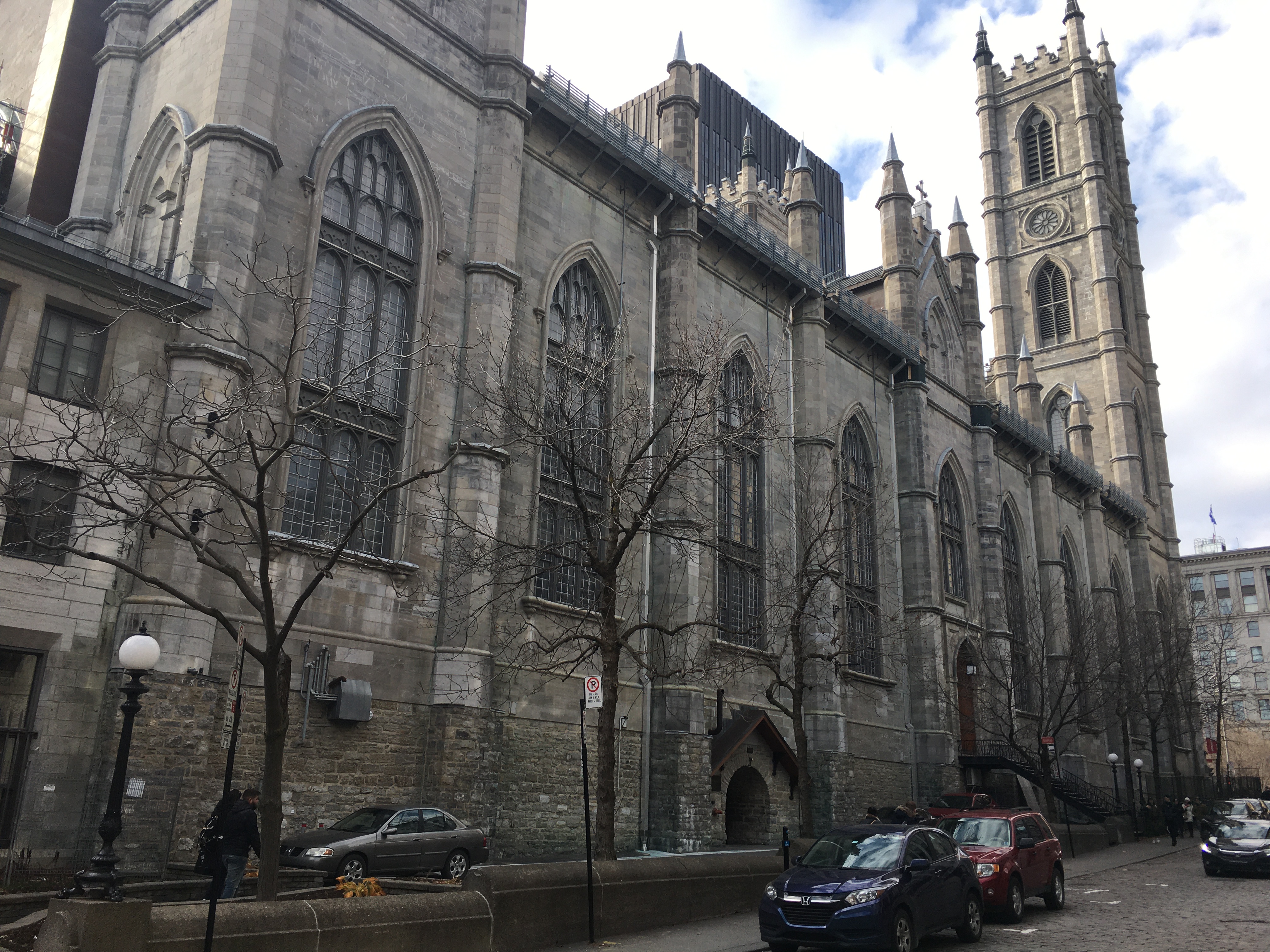
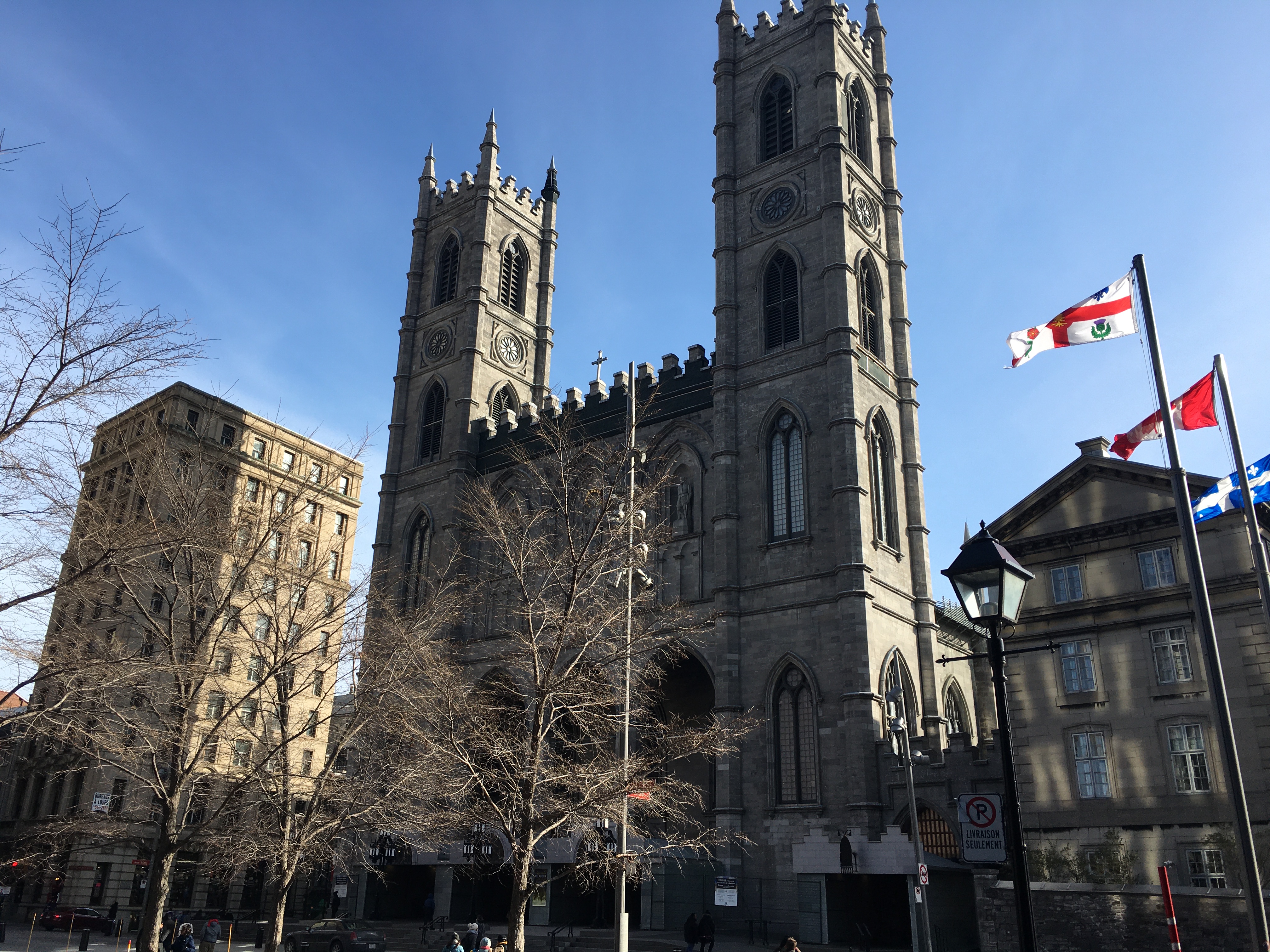
The first such strategy Jesus exposes is our attachment to, and almost exclusive dependence on, what we build. Even, as we say, to the glory of God. These buildings. Glorious, adorned with carvings, intricate stained glass, spires making confident bids to the sky, and arches perfectly rounded and balanced. Architectural master pieces. To say the least.

IMG_9192

IMG_9201

The pulpit alone, in Montreal’s Notre-Dame Basilica, is a wonder to behold. It is a sermon in itself – its spiraling, narrow staircase winding itself up into a small yet regally appointed platform high above the nave.

King Herod, for Christians reading the bible, was a paranoid despot. He killed innocent children was ruthless in defending and protecting his hold on power. Because he was afraid, afraid of losing it.

For historians and archeologists, however, he was a builder par excellence.

King Herod started building his temple in Jerusalem two decades before Jesus was born. During the time of the build he more than doubled the size of the temple mount. The temple proper was completed in eighteen months. But work on the outer courts and decorations continued throughout Jesus’ lifetime and still some thirty years after his death and resurrection. During this impressive season of building the temple, people gathered under the large colonnades and porches to hear speeches and witness healings.[2]

It was a gathering place, a central focal point for people’s identity in faith and source of authority and guidance for life. It was where you went to listen to and engage religious debate. It was where you went to deliberate truth. It was where you made animals sacrifices. Here, you found the rules and regulations and laws for a good life.

Less than a decade after everything was completed on the Herodian temple, it was pretty much destroyed by the Romans in the late first century. Jesus’ words in the Gospel text for today, calling for a day “when not one stone will be left upon another; all will be thrown down”, speak to events that were happening in the lives of Jesus’ followers during this time of the destruction of Jerusalem and its glorious, magnificent temple.

In reading this text carefully, however, I realized this is not just about buildings. Jesus isn’t just criticizing those who put all their religious stock in bricks and mortar. Jesus is exposing yet another related strategy for dealing with our fear. Not just in the glory of the buildings, but in the way we speak to one another and relate to one another. Not just in glory. But also in power.

It was, after all, the authorities who made the rules, sold the animals for sacrifice and mediated the people’s connection with God.

At root, the religious authorities persuaded the people that their relationship with God could only be mediated by the authority’s permission. If you didn’t follow the rules and authorities, you were not justified or in right relationship with God. The whole culture, the spiritual climate, surrounding the temple served to choke out freedom of a personal and direct intimacy with God.[4]

The Russian novelist Dostoevsky wrote the dismaying story with the title, “The Grand Inquisitor” in The Brothers Karamazov. The old cardinal of the church hears that the real Jesus has come suddenly to his town. The cardinal is alarmed that Jesus healed a blind man who had been coming to his church. Then, he hears that the real Jesus who has come to his town raised a young girl from the dead.

When the cardinal confronts Jesus he asks him: “Why, then, have you come to interfere with us?” He wants to rid the town of Jesus, because in his mind what Jesus did long ago is done far better by the church today. In other words, the cardinal has to admit to himself, the church does not need Jesus.[3]The cardinal really couldn’t give up the power he had. Not give it up for anyone. Even Jesus. The cardinal was afraid of losing his job — what it would mean for him and the church …

Seeking glory and defending power seem to be effective ways of dealing with our fear.  We attach ourselves to symbols and expressions of glory in our culture – the tallest buildings, the fastest cars, celebrities, newsworthy leaders and victories on the battle fields of life. This brings comfort, though momentary and fleeting. Because we can never be satisfied operating in this consumer and acquisition-fueled culture. There’s never enough, or it’s not good enough. Ever.

Jesus suggests we must learn a new language. A new way of being, with God and with one another. A way, marked not by successes in the eyes of the world—there were lots of tourists in those houses of worship we visited in Montreal. The world approves. But will we walk a different way – a way marked by love, faithfulness in suffering, and generous giving in the face of poverty, suffering and our fear?

Throughout the Gospels, the religious authorities asked Jesus for a sign of his authority. And, he never satisfied them with his answer. His answers usually appear to disturb their sense of right and wrong.

The truth, when it comes, seems to turn upside down our initial ways of thinking and doing. Here, Jesus says, “For I will give you words and a wisdom that none of your opponents will be able to withstand or contradict.”[5]

These opponents were neither stupid nor un-educated. In fact they were the most articulate and brilliant of the age. So, there is something altogether different going on here. A different way of being with God. A way not encumbered by discursive thought and debate. A way not intimidated by rules and regulations and conditional statements of belonging. A way not defined by glory-seeking persuasion nor forceful coercion.

The confirmation class the other night reflected on the meaning of the Trinity—God the Father who creates all, God the Son who is with us, God the Spirit who gives us strength. On this poster they cut out images from magazines to place in one of three designated areas on the poster. These images evoked for them the meaning and feeling of what God is up to in the world today, through the various persons of the Trinity.

IMG_9244

In reflecting on the experience of doing this exercise afterwards, we pastors admitted this was rather an abstract exercise. We weren’t just memorizing definitions of the Trinity from the Catechism, difficult enough as that is! But in engaging the confirmands on another level, we began to see more than we thought possible.

We discover that we don’t find God by building glory or defending power — ways we use to avoid confronting our fears of the future. Rather, the good news is that God has already found us. In this world. In our lives. And in a multitude of ways.

Making this link, this connection, is much simpler than all the methods we have devised to combat our fear. We don’t need the tallest and most beautiful buildings to assert God in this world. We don’t need to merit, or qualify for, our relationship with God by building skyscrapers or getting straight A’s in school.  We don’t need degrees and a long pedigree to justify ourselves in faith. We don’t need to arm ourselves with book knowledge in order to defend against some opponent whether a family member or stranger.

All we need is an open heart and a desire to love and trust. Following Jesus is about going directly to intimacy with God in our deepest selves. And God is there, right there, all along.

We can respond, then, not out of fear. But out of the love of Christ for all and in all. Forever.


[1]Luke 21:5-19

[2]Acts 3:11; 5:12

[3]Cited in Eberhard Busch, in David L. Bartlett & Barbara Brown Taylor, eds. Feasting on the Word: Preaching the Revised Common Lectionary Year C Volume 4 (Kentucky: WJK Press, 2010) p.310-312

[4]Ray Leonardini, Finding God Within (New York: Lantern Books, 2018), p.93-96

[5]Luke 21:15

“¡Presente!”

Each of the four blessings is matched with a corresponding ‘woe’[1] First, Jesus says that blessed are they who are poor, who are hungry, who weep now and whom people hate. But, unlike Matthew’s version of the beatitudes[2], Luke doesn’t stop there. Luke doesn’t let us off easily.

Lest we become too enamoured with spiritualizing virtues or escape into some pie-in-the-sky notion of faith, Luke’s version of Jesus’ sermon only sets us up for being gobsmacked upside the head. In a stunning reversal to each blessing Jesus brings a ‘woe’—to those who are rich, who are full, who laugh now and about whom people speak well.

But wait—a secure financial future, a full stomach, a light heart, and a good reputation – aren’t these all values we want and seek? Aren’t these the things around which we structure our lives to obtain? Don’t these describe to a ‘t’ our five-year, ten-year and twenty-five-year goals?

A surface reading of this scripture can leave us picking sides. Am I on the ‘blessing’ side or the ‘woe’ side of the equation. Either / Or. Will we dare go deeper?

And, at the deeper currents of our awareness — when we are honest with ourselves — don’t we already know? Don’t we already know the truth of it—that, at best, wealth, a full stomach, a light heart and a good reputation are mixed blessings? They come at a great cost to health and relational well-being. They are temporary, fleeting. They can come and they can go.

Contrary to popular belief, rather than being evidence of God’s favour, prosperity can actually endanger our relationship with God, as was the case with the rich fool and Zacchaeus—both characters unique to Luke’s Gospel.[3]

What is common to both characters? Both came to Jesus rich men with full stomachs and their reputations intact. When they came to Jesus, both the rich fool and Zacchaeus were perfectly able to take care of themselves, to say the least.

The common trait they share as prosperous men of first century Palestine, is their self-sufficiency. This state is what separates them from God. And has them trapped. they are self-sufficient.

Elsewhere in Luke’s Gospel, we read that those who lay up treasures for themselves are not—and cannot be—rich toward God[4]because when we can take perfectly good care of ourselves, it is altogether too easy for us not to trust God. So, what jeopardizes the wealthy Christian’s relationship with God is the subtle temptation to think that we can go it alone and take care of ourselves.[5]

This underlying belief applies not only to our personal lives—and what we decide to do with our wealth, our investments, our properties our material blessing— but, also to the way we do church.

Will we be a community that lives only unto ourselves, or for the sake of others? Meeting the challenges of church today, how do we move forward? What decisions will we make with the resources we have? Will we abide by the code of self-sufficiency and go it alone? Or, will we seek out effective partners, neighbours and others on the journey of faith? Will we say God is only here inside thesewalls alone? Or, will we seek God’s work out there in the world?

What with all the competing values and programs for success beating down the doors of our hearts and minds, to follow the Christ of the cross is not easy. It’s not a technique or strategy that we can simply employ. In light of the beatitudes from Luke, the way of Christ cannot be an add-on. It cannot work that way, as another activity to add to the schedule of our already busy lives.

It comes to us as a complete package. It’s a call to transformation – a whole-life make-over. I understand the hesitation. Because life in the fast lane has its perks. Maybe we don’t want to give them up. Not easily, anyway. Seeking after self-sufficiency is too much of a lucrative deal for our egos.

Therefore the message of the Gospel can really be a downer! After all, how can we ever live faithfully when immersed in our world and its values?

But, perhaps, the message of All Saints provides an antidote to the despair and the grief. And give us hope for the journey. After all, the Gospel is not just about how to get into heaven after you die, but actually more about how to live in the kingdom of heaven on earth before you die. Not just the saints of heaven. But the saints on earth.

I want to close with a brief reflection on the meaning of a couple of words. First, ‘blessing’. “Blessed” is sometimes translated as “Happy”. I prefer the translation of the first word in the Psalms[6]which incidentally is also often translated to “Happy are they …”:

The Hebrew word here is ‘ashar, which means, literally, “to find the right road.” So, in offering the beatitudes, Jesus is saying: “You are on the right road when you are poor, when you hunger, when you weep, when you let go, when you don’t hold it all to yourself.” I prefer this translation because it implies a direction rather than a moral state. It acknowledges a journey of becoming. And any path of growth and transformation will include honest struggling and striving and letting go.

It is human to struggle with these things. On one hand, we do need to learn early in life how to take care of ourselves. Learning vital skills around self-care are important. Along the journey of maturity and growth, however, we must also learn how to balance this skill towards attention to others.

The second word is ‘presence’. This word doesn’t appear in the biblical texts for today, but it is implied in our ritual of All Saints. In Spanish, you hear the word said aloud: “¡Presente!”—which literally means “here” or “present”. There is a long tradition in Latin American movements for justice of invoking the memory of those who have lost their lives in the struggle.

At political gatherings their names were read out loud, one after another, not unlike we read the names of the saints earlier. After each name the crowd says together: “¡Presente!” as if to say: “You are not gone, you are here with us. You are not forgotten, and we continue the struggle in your name.”

It is human to struggle in the mission of God on earth. But we are not alone. Not only are the saints of heaven among us in spirit and in love, God is with us each step of the way. On the journey of life …

“Blessed are you who are poor – because you are not alone!”

“Blessed are you who hunger – because you are not alone!”

“Blessed are you who weep – because you are not alone!”

“Blessed are you who are despised – because you are not alone!”

“¡Presente!” “¡Presente!” “¡Presente!”


[1]Luke 6:20-31

[2]Matthew 5:1-12

[3]Luke 12:16-21; 19:1-10; E. Elizabeth Johnson in David L. Bartlett & Barbara Brown Taylor, eds., Feasting on the Word; Preaching the Revised Common Lectionary Year C Volume 4 (Kentucky: WJK Press, 2010), p.239-241.

[4]Luke 12:21

[5]E. Elizabeth Johnson, ibid., p.241

[6]Psalm 1:1

The God who forgets

The prophet Jeremiah describes a remarkable characteristic of God. He says God will “remember no more”[1]Israel’s sins. In other words, God forgets things. Now, I’m not sure we are accustomed to perceiving God in this way. In fact, I would wager many of us will be unsettled, even disturbed, by this notion.

If God is God Almighty, all-knowing, all-everything – then how is it God will intentionally forget something about us? It’s hard to believe that God is telling the truth, here. In fact, I’m not sure we would get excited by believing in a God who isn’t all-powerful and all-knowing.

The other night was a good sports night for me. On the same night Toronto FC won their do-or-die game against New York to advance to the Eastern Conference Final in Major League Soccer. The same night, the Ottawa Senators won their second hockey game of the year! Winning is not easy for that team these days, so that win was huge. It’s a good feeling to win!

It’s invigorating and stimulating to compete, especially when you win. Indeed, we live in a world of winners and losers. And all the hype on the fields of play mirrors the values with which we live day to day.

To be better than the other. To be more beautiful than the other. To be more skilled, have more luck, be more privileged than the other. And life becomes this rat-race to establish yourself ‘over and against’ the other – to beat out your biggest competition for a position on the team, to nail that audition and get that role in the play instead of someone else.

Often climbing to the top means climbing over someone else. It’s the zero-sum game of life. We say, it’s a dog-eat-dog world out there, where it’s survival of the fittest. Whether or not we like it, we take it as normative even defensible. We shrug our shoulders and say, “that’s the way it is.”

God, however, does not compete. This is the remarkable thing about the biblical witness of God in light of the Gospel. God does not fight for space in this world. God does not need it. There is this self-withdrawing feel to God’s presence. Here, we would affirm the central paradox in Christianity: In God’s absence we find God’s presence; or, in death there is life.

God will remember their sins no more. Because if God was to remember their sins, God would still be in the game. The game of tit-for-tat, the game of revenge, retribution and punishment for sin. The game of reward for good works. The game of earning and deserving God’s favour.

But no. There is a new game in town. And it’s not really a game anymore – at least not one with winners and losers. It’s a new covenant and a new promise from God. Where everyone and everything in creation is a winner.

God will make us all winners. How? Almighty God will release a grip on the tug-of-war rope. God will let go of the imposing forces of the battle ground. God will forget. God will not compete for space in our lives. God will not compete for space in this world. God will forgive. God will ease our anxiety about all the harsh lines in our world.

The dividing walls between people, nations and teams will no longer carry weight. In God’s giving-up, they become largely irrelevant. The dividing walls in our hearts collapse into the total-immersion love of God. These dividing walls dissolve in the self-giving of a God who ‘emptied himself’ of all pretense to glory. And, taking the form of absolute humility – ‘being born in human likeness’ and ‘obedient’ even to the point of ‘death on a cross’[2]– God gives us abundant life.

In this vision, austerity is not the path because nothing is scarce. Self-denial is no longer needed. We don’t operate in a transactional reality where God is concerned. Because God is in all of life – even in the places we thought God could not be. There is so much to see. There is so much abundance everywhere!

Therefore God is in the glories of physical and mental achievement just as much as God is in the depression and defeat of Alzheimer’s disease. God is in the accomplishment and success of youthful enterprise as much as God is in the tears of failure. God in the beauty of creation as much as in the ugly storms. God is in the cyberworld of Tik Tok and Snap Chat as much as God is in the dusty pages of books long left on a shelf. God is in the nicest neighbourhoods and ivory towers as much as in the ghettos of poverty.

In the world of faith, too! God is among the Roman Catholics as much as God is among the Lutherans. God is among the Muslims and the Hindus as much as God is among Jews and Christians. Lutherans have a prayer schedule where we pray for a different Anglican congregation in the area every Sunday. Did you know that on their prayer list, today – Reformation Sunday—Anglican parishes in Ottawa are praying for Lutherans?

Will we see God everywhere in our lives? Will we rejoice and be glad because God is the God of the Cross and Empty Tomb? Will we seek to work towards a world in which all people can see the face of God in each other?

Today is Reformation Sunday. In the Lutheran tradition a big deal. One of the hallmark sayings of Reformation is that we are a church ‘ecclesia reformata, semper reformanda’ – the church reformed, always reforming. We have seen how, since 1517 when Luther nailed those 95 arguments for reform on the Wittenberg Church door, the church has changed over five hundred years. Always reforming, always growing, always deepening in the love of God for all people.

Let’s continue in that tradition. Let’s continue in God’s word!


[1]Jeremiah 31:34

[2]Philippians 2:5-11

Give God a chance

A year ago last summer we bought a potted Hibiscus plant already in full, glorious bloom. The local nursery encouraged us to plant it right away and let it take root in our garden. When winter came, we snipped the stem down to a few inches above the ground.

Last Spring, the sprig showed no signs of life. At all. And it was late June already when I was tempted to pull up the seemingly lifeless root ball from the garden to make room for something else. Visiting the same nursery at the time I complained to them about the Hibiscus plant they sold to us, that obviously did not winter-well. To say the least.

“Don’t pull it up, yet!” they entreated me. “Wait a little longer, for it has been a late Spring. Give it a chance.”

At first, I didn’t believe them. But I left the dead thing alone trying not to think about my disappointment too much. Was I in for a surprise! In early July a tiny, green shoot pushed up the earth around the base. But then, not just one, but two, three and four shoots of new life erupted out of the ground. Seven weeks later, we were enjoying a multitude of magnificent blooms. The plant had more than doubled its growth from last year!

How critical it was for me to heed the gardener at the nursery when she told me “Don’t pull it up!” and “Wait a little longer” and “Give it a chance!”

“Then Jesus told them a parable about their need to pray always and not to lose heart”[1]

In Jesus’ story, the theme is ‘not giving up.’ Not giving up is what it looks like to pray always. Elsewhere in the bible, Paul, the writer to the early church, instructed the faithful “pray without ceasing”[2]. It’s about being persistent in waiting, in not reacting, in staying the course when it starts feeling like it’s no use any longer to keep going.

“If it seems to tarry, wait for it; it will surely come, it will not delay.”[3]

The prophet was waiting for a vision from God, a word that would give new life to those who were discouraged, defeated and ready to give up on God, on themselves and on the world.

For what do you wait? After what justice do you persist? What is it you seek after that seems elusive, just beyond your grasp? Whatever that is, the scriptures describe an inner quality of the heart that will not give up, that will wait for it, that is patient and true in enduring and persisting.

That sees the present moment as holding value in and of itself.

The goal, the destination, the vision – this may seem to tarry. Perhaps in those impatient moments it’s important again to look around at what is happening. Infant baptism, for one thing, is a visible sign of this challenge and truth.

For an infant does not express knowledge of God in the way we adults do. An infant cannot give us a rational accounting of their faith. They cannot, surely, deserve blessing by pointing to a long list of their good deeds and giving an impassioned testimony.

It confounds us sophisticated grown-ups crazy, as we are influenced so much by a success-mindset culture of instant gratification. The world we live in has little patience for this kind of long-view approach. We’d sooner just give up on someone or something for which we hope. When it seems we are in futility grasping at something not yet.

Here, we are asked to commit to quite the opposite. Infant baptism invites us all to dedicate ourselves to long journey. We are challenged to persist in our waiting for it, not to give up, to have faith and stay the course.

And, in the meantime, walk with the baptized as he grows over time into the person God has created him to be. The flowering will happen, yet quite beyond our claim to control it. The green shoots poking out of the ground are occasion to rejoice. Here is evidence enough for now, for this moment. Those tiny shoots hold the fullness of the gift of faith and life in him.

Dear family and friends of the baptized, and Faith community, I hope you stick with it. This journey of faith, together. Trust in the vision, the promise. And celebrate the wondrous gift of this moment.

IMG_3355


[1]Luke 18:1-8

[2]1 Thessalonians 5:17

[3]Habakkuk 2:3, the first reading from a couple of weeks ago, Pentecost 17C (RCL)

Thanks-doing

I knew—we all knew—we had to do it. We had to go, single-file, through the turn-style and meet, individually, with the control officer. The ticket attendant would then scan the barcode on our paper copy or our smartphone before letting us in.

It started out a large crowd—a mass of people walking together across the cordoned-off streets, parking lots and plazas like a tsunami racing towards the stadium. But then it eventually, ultimately, bottle-necked to one person at a time through the gate.

IMG_8943

It was my first time at Mosaic Stadium in Regina, Saskatchewan. At game time it is probably the largest gathering of Canadians I will ever see together in one place—some thirty-thousand mostly screaming Rough Rider fans cheering their beloved football team. In all, watching that game in the stands was for me an exercise in social conformity, or fighting against it.

However, each football fan, regardless of our stripe, had to pass one-at-a-time through the entrance gate. In places where lots of people normally gather, whether it be the security line at the airport or the gate into a sporting event, each of us has to make a reckoning, an accounting.

And it can cause some anxiety, some fear. It does for me. Even though this fear is largely irrational. After all, I have my ticket. I purchased it. I have every right to be there.

And yet, that moment of passing through the gate has a kind of self-consciousness attributed to it. The spotlight now falls on me, not us as a whole. I have to put myself on the line. I can’t be anonymous any longer, melting into the perceived security of the crowd. I have to stand out, be vulnerable, if but for a moment.

Thanksgiving is about doing. It’s already a word constructed for doing something. It is ‘giving’ something, an action word: Thanks-giving. That is why we practice today. We bring food to the altar—our gifts—that will then be given to a world in need.

But doing something in our practice of faith is risky. We put ourselves on the line. We have to make a move. Declare ourselves. Make an account for ourselves. Thanksgiving has to mean something personal to each of us, individually and perhaps differently.

My mother tells the story of her home church in Poland when she was a child. Every Sunday morning during the gathering of the gifts, everyone would line up and go single-file to the altar to deposit their offering. In front of everyone to see!

For fifteen chapters in Deuteronomy (11-26), Moses gives the Lord’s instruction to the people of Israel upon arriving in the Promised Land. In the Hebrew text assigned for Thanksgiving this year, we read the first section of the concluding, last chapter (26:1-11), in this long oration.

In looking at the translated words into English we can’t see the distinction between singular and plural. In other words we can’t tell whether Moses calls the people into faithful commitment together or individually. But in the Hebrew language you would notice the distinction. So, while the early chapters in Moses’ speech are predominantly addressed to the community—as the verbs are in the plural—in chapter 26 the writer has noticeably shifted to singular verbs and personal pronouns.

In our pilgrimage of faith, there are times we have to walk by ourselves. When we can’t hide behind options any longer. When we can’t melt into the crowd. And simply observe. When we can’t be an anonymous fan any longer. When we can’t find excuses nor justifications for not doing anything about something we know needs some doing. When we can’t just be spectators any longer.

We have to go through the gate ourselves. Individually. We have to participate, and get into the arena of life and make some moves, some waves.

It’s scary to do so. To take a risk. We may not have done this kind of thing before. Because we know that in doing something for our faith, anything, we will likely make a mistake or two. It may not be pretty. In fact it may be downright messy for a while. We may at times fail, as in trying different things, things we’ve never done before—Christians have never done before—in mission with others.

The ticket we hold in our hands represents our efforts, our attempts at giving something of what we have—to show the attendant at the gate. At Thanksgiving, not every one of us may feel thankful, especially if you are going through some grief. So then, let your tears be the ‘ticket’ you bring. The ticket an also represent your financial gift, or your volunteer hours, or your gift of expertise knowledge or skills that you offer. Wherever you are at, whatever you have, you bring to the altar and lay it down.

Maybe the irrational fear we have (all fear is irrational) suggests that the ticket is not good enough, that somehow it will not register, that we will be turned away and denied the experience of what we have come to celebrate.

The ticket we bring may be for the cheapest seats high up in the nosebleeds. However we may have acquired our ticket, or whatever its value, we may suffer the anxiety of thinking it is all up to us. That our entrance fee is based on “I deserve it,” or, “I earned it”, or “I accomplished this.”

The risk of doing something brings both the pinch of vulnerability and the fulfilment of the promise. The pinch of vulnerability because in exposing our hearts we realize it’s not all perfect with us. In truth, we must acknowledge we do not do it on our own. We are limited. We are also weak. And, for a moment, this awareness—this confession—hurts.

But the ticket was already purchased. Weeks ago. Months ago. The moment we cross by the gate is after-the-fact. Our participation in the party is already guaranteed. And nothing can change that. The justification for our being there had been already long ago determined. The moment we must make an accounting of ourselves, the moment of fear and uncertainty, is also the moment we celebrate something already accomplished.

By Another. For us.

Thanks be to God!

Happy Thanksgiving!

IMG_8946

Faith alone not our faith alone

“Increase our faith,” we pray.

Isn’t that what we want? More faith to get us through the tough times. More faith to make us better people. More faith to tolerate things in life that set us off course. More faith to believe in things that are not easy to believe in. More. If only we had more.

In the BBC television series called “Broken” actor Sean Bean plays the role of Michael, a parish priest in a small, industrial town. In one of the episodes he answers a question from someone in the youth group curious as to why he chose the priesthood.

He tells the story of when he was eighteen years old he went one day with a crowd of people to visit a falconer on the side of a hill. To see such a large bird with a with a vast wingspan take flight was a treat for the villagers, many of whom had never before seen a falcon. The falconer took time describing the bird to the villagers and even had some of them feed it.

Then they all watched captivated by the sight of the majestic bird lifting off from the falconer’s outstretched arm. Michael saw the bird circle once overhead before heading out into the vast sky overlooking the valley below. The falcon became smaller and smaller—a small dot over the horizon—until it finally disappeared from view.

The afternoon wore on. People looked at the falconer and each other, wondering what to do. But the falconer did not move from his place on the side of the hill. The hours turned and the sun was setting in the western sky. What had started as a large crowd dissipated until there was only the falconer and Michael standing alone there. Michael wondered why the people had left.

He sympathized, for sure. Perhaps, as he was feeling, there was no point in hanging around anymore. The falcon was gone. How would it know to return to this very spot after ranging across a sky which was so vast and covered the whole world? Why would the falcon even care to return? It was now free to roam wherever it wanted to go. What more could it want?

To Michael’s surprise, but not it seemed to the falconer’s, as the darkness descended on the hillside he heard a flutter and rush of wings. The falcon had returned and now sat perched contentedly on the falconer’s arm. Michael could see the white of the falconer’s teeth showing from behind a smile that stretched from cheek to cheek. Michael laughed with delight.

Here was faith. And it was the falconer’s witness of faith that inspired Michael on his life journey. That the falconer had waited on that hillside for what seemed like forever. To stay there, when everyone else had gone home, even if it meant waiting alone. To have no guarantee that the falcon would return. To not have control over how long and when. And if. But only do what he was called to do: Let the falcon go. Let that bird with whom he had a relationship, to be sure, go.

“Increase our faith.”

Maybe it’s not our faith that is at stake here. These texts assigned for today can easily lead us into yet another guilt trip or glory trip—as if that’s what faith is all about! We are either not worthy enough, not good enough. Or, look – I’ve moved mountains! If only we had more, even more, faith!

“Increase our faith.”

The faith talked about in these passages are Christian, but perhaps not in the sense of the faith of the Christians. Because dwelling exclusively on our faith alone often gets us spiraling into dark holes of depression and feelings of unworthiness, defeat and failure. We hit walls of misunderstanding when we separate our faith from the faith of Christ, the One we trust. Here the central understanding is not our faith but faith in Christ, a faith that mirrors the faith of Christ.

It is like eighteen-year-old Michael watching the faith of the falconer.  What Michael ends up doing with his life is secondary. What is at stake, what is the most important thing in Michael’s experience on the side of that mountain one long afternoon, is not his own faith but someone else’s.

Timothy is charged to ‘rekindle’ the mustard seed of faith that is within him. The mustard seed is tiny, almost undetectable to the naked eye. We don’t often recognize the gift that is already there.[1]

Perhaps we too need to wait on the side of that hill, and not just give up and go home.

Timothy is encouraged that there is something good within him working long before he even became aware of it. He has to be reminded that “grace was given to us in Christ Jesus before the ages began”. And that we are called to good things, “not according to our works but according to [Christ’s] own purpose and grace.”[2]

In prayer, in our relationships and interactions, the search-light of consciousness turns off ourselves and onto the living Christ. When the attention turns away from our stuff—good and bad—and onto Jesus, I believe we may feel a needed lift. Our heart alights. The pressure for performance relaxes. The guilt dissipates. And we can start by simply being in awe about the One whose purposes and faithfulness and love reach far beyond our own self-preoccupations, weaknesses and accomplishments.

What transformed eighteen-year-old Michael was not an argument about faith, not a debate which he won or lost and convinced him either way what to do with his life. What transformed Michael was an encounter with someone who showed him the way, who practiced faith. Our call is not to win all the arguments but to forgive as we have been forgiven and to love as we have been loved.

We are called to get in touch with the Giver of the gift of faith. We are called to give thanks for the One who beckons for us to stay on the journey, calling us not worthless, but friends along the way.

Let our prayer of praise therefore shout from the rooftops: “Great is Thy Faithfulness!”[3]Amen.


[1]Luke 17:5-10

[2]2 Timothy 1:1-14

[3]Hymn 733, Evangelical Lutheran Worship (Augsburg Fortress, 2006).

The angel

I know an angel.

She’s the deli counter server who smiles when taking my order.

He’s the fourteen-year-old who dreams of winning $10 million to give to Parkinson’s research because his grandpa suffers from the disease.

They’re in the bus shelter laughing and giving hi-fives and kisses to friends who do not share the same skin colour, age, language and physical ability.

She’s the one who comes in the nursing home room to encourage with a soft and happy voice.

She challenges world leaders to pay attention to and do something about the climate crisis.

I know an angel.

Today, and every year on September 29, the church recognizes the annual festival, “Michael and all Angels”. In the bible, we acknowledge the popular ones: Gabriel, who brought news to Mary of God’s intention to give her Jesus. And, Michael the great protector whom we read about in Daniel and Revelation.

Herein lies one of those very grey areas for Lutherans who have, in our recent history, become increasingly nervous about the angels. Why is that?

In the Confirmation class which started this past week, we closed our time together by praying Martin Luther’s evening blessing: “I give thanks to you, heavenly Father, through Jesus Christ your dear Son, that you have graciously protected me today. I ask you to forgive me all my sins, where I have done wrong, and graciously to protect me tonight. Into your hands I commend myself: my body, my soul, and all that is mine. Let your holy angel be with me, so that the wicked foe may have no power over me. Amen.”[1][emphasis mine]

By the way he prayed, we can tell Martin Luther believed in angels. On the other hand, Luther didn’t care too much for those parts of the bible that suggested allegory—those so-called apocalyptic descriptions that described futuristic, other-worldly, colourful, image-rich portrayals of angels, arch-angels, cherubim and seraphim, of sword-wielding horseman, dragons and giant wheels in the sky. Luther consequently relegated these scriptures to a lower priority for the biblically literate.

“Angels cannot be our intermediaries between us and God,” we reformers insist. “There is only one mediator and that is Christ,” we claim. Christ alone, we’ve made things simple. Concrete. More about this in a minute …

And yet, at the same time, we cannot deny the reality and the truth, that just beyond the thin curtain of our awareness and perception there lies a dimension of reality in which we, too, participate—for good and for evil. Our highly trained, rational minds—thanks to the Reformation and Enlightenment eras of the last few centuries—have made us suspicious and skeptical of making such risky forays into those ambiguous, beyond-rational notions. We just don’t know what to do with that part. We just don’t know …

The Buddhist monk Thich Nhat Hanh tells a beautiful story about an experience he had following his mother’s death: “The day my mother died I wrote in my journal, ‘A serious misfortune in my life has arrived.’ I suffered for more than one year after the passing away of my mother.

‘But one night in the highlands of Vietnam, I was sleeping in the hut of my hermitage. I dreamed of my mother. I saw myself sitting with her, and we were having a wonderful talk. She looked young and beautiful, her hair flowing down. It was so pleasant to sit there and talk with her as if she had never died.

‘When I woke up it was about two in the morning, and I felt very strongly that I had never lost my mother. The impression that my mother was still with me was very clear. I understood then that the idea of having lost my mother was just an idea. It was obvious in that moment that my mother is always alive in me.”[2]

Perhaps you, too, can point to these subtle yet profound moments—especially following a loss or some great suffering or deepest love—when the cloud breaks, the sun streams through, a bird calls, an image flashes across your vision, a dream’s effect captivates you, a momentary feeling of peace and well-being engulfs you, a stranger impresses you in some unexpected, surprising way.

This is real. People talk to me about these experiences all the time. We can’t put our finger on it. We can’t rationalize our way through it. Well, we try, by talking about neural impulses and undigested fats in our bellies. But here we go again, dealing with our discomfort by reaching for yet another rational explanation. But can we explain away these experiences? Should we?

It’s easy to place religion into the esoteric realms of doctrinal outer-space. That’s our head space whose thoughts, theories and machinations serve to disconnect us from what is, right in front of us. And, sadly this state has almost exclusively defined the Reformation since the days of Martin Luther.

What about our bodies? What about our feelings? What about the natural occurrences in our daily lives? Are these not the purview of God as well?

Martin Luther insisted on the real, the tangible, as a valid and powerful expression of the divine. A faith that is characterized by the incarnation—Word becoming flesh—is a faith that cannot deny what we see, hear, taste and feel. When God became human in Jesus. When the Holy Spirit indwells in our hearts, our bodies. When we eat the body of Christ in the sacrament. God makes our reality God’s domain. Angels among us. The spiritual becomes tangible. Matter is, and has always been, the hiding place for God.

One of the clever jingles of the TSN1200 radio station in Ottawa is their oft-repeated phrase introducing whatever sport they broadcast: “The Sens play here” (NHL hockey); “The NFL plays here (football)”; “The RedBlacks play here”(CFL football); “The Fury play here” (soccer); “The 67s play here” (junior hockey).

That needs to be the church’s motto: “God plays here.” In real, tangible, visible, ways. “God plays here” among mortals, among real people in real situations. “God plays here” along with the angels and archangels.

We may not be able to figure it out completely. We may not know the mind and ways of God fully. We may not know this spiritual realm that interplays with our own. We may not even be able to rationalize it in the usual ways. And yet, we trust.

In the last line of the Evening Blessing from the Small Catechism, Martin Luther, after praying for the holy angel to be with him, he gives the following instruction:

“Then you are to go to sleep quickly and cheerfully.” And falling asleep quickly and cheerfully can only happen when, despite our inability to have all the solutions and figure out all our problems, we can feel that it will be well with my soul.

God will make God’s ways and purposes knowable to us, in the regular grind, routines and ordinary circumstances of our lives.

May you know some angels, too.

Trust.


[1]Martin Luther, “Small Catechism” in Evangelical Lutheran Worship (Augsburg Fortress, 2006), p.1162.

[2]Thich Nhat Hanh, No Death, No Fear: Comforting Wisdom for Life (Riverhead Books: 2002), p.5.