Stripping away

Photo by Martin Malina (Kalaloch Beach, WA, August 15, 2022)

At the end of the service tonight, we engage a ritual that has become a tradition in many churches on Maundy Thursday. We strip the altar.

We take away all the symbols, the candles, the silverware, the embroidery and fabric that are associated with our faith.

We do this in Holy Week – in the context of Jesus’ suffering and dying when everything he had was stripped away, not only his clothing, but his dignity as a human being. Maundy Thursday sets the stage in the grand narrative of Jesus’ Passion for Good Friday when he was nailed to the tree.

Theologian and American writer Brian McLaren writes about how one tree survives the hurricanes that seasonally batter his home state of Florida. “Many of our trees in Florida survive hurricanes by being flexible. They’re able to bend an amazing amount and spring back into shape. [But] One of my favourite trees,” he writes, “has a slightly different strategy.

“It’s called a ‘gumbo-limbo’ tree, and the way it survives a hurricane is that when the wind starts to blow, it just lets branches break off. It knows that if you can keep the trunk solid and stable, and you don’t get overturned by the wind, you can bounce back after the storm. And that’s what the gumbo-limbo tree does. It travels light through the storm. It lets go of everything that’s not essential to focus on for life” (McLaren, 2023).

If you keep the trunk solid and stable, you will find new life after the storm. What is that proverbial trunk in our lives? What was it, in Jesus’ life? What was that power that allowed him to let go of everything and be stripped of all his humanity?

The mandate to love sets the stage for this proverbial stripping. The mandate to love is the command of Jesus we hear on Maundy Thursday – the night he washed the feet of his disciples, shared the meal with them and led them to the garden to pray. This mandate to “love one another just as I have loved you” (John 13:34-35) is the fuel. It is the trunk of the tree: God’s eternal, unconditional, loving presence for all people. But it comes at a cost.

A quote I came across this past week has stuck, the wise saying of a desert mother from early Christianity. She said, “the hardest world you have leave behind is the one you carry right inside your heart” (Lane, 2024). What you carry inside your heart, it would seem to me, is precious. Whatever you hold in your heart is integral to what you perceive to be an important part of your identity. It defines who you are in the world.

This is important stuff. And it struck me that on Maundy Thursday as we strip away the paraments and silverware from the altar, we’re not talking about the knick-knacks, dusty boxes in basements and stuff we keep in storage rental units.

We’re talking about what we would consider the important, life-altering, life-defining stuff. But these are still the branches, not the trunk. You might say what the gumbo-limbo tree does in a hurricane is counter-intuitive, even unreasonable, impossible for us to do. Why would we let go of what we feel most attached to?

It’s significant that the Garden of Gethsemane was the last place to which Jesus led his disciples before he was arrested, before the dominos began to fall in the Passion narrative, a story that then escalates towards Jesus’ arrest, prosecution, persecution and execution.

Jesus led his disciples to the garden to pray. There is a form of prayer whose aim is finding inner peace and contentment in the storm.

Yet this peace cannot be experienced without a painful letting go. It’s a practice, you could say, of stripping away the non-essentials. Prayer is becoming aware of God’s grace and life of Christ with us and for us. And this prayer needs no words from us.

For the desert mothers and fathers, prayer was understood as practising a way of taming the ego’s desires for being front-row-and-centre in all things, including our conversation with God.

So, instead of doing all the talking in this relationship of prayer, we practice doing all the listening. Instead of trying to change God’s mind, prayer is about allowing God to transform the mind and heart of the one doing the praying. In this practice of letting go we allow God to change our mind about what is truly going on around us. We let God change our mind about the reality right in front of us, a reality which we usually dismiss, avoid or even distort.

In our prayer tonight and throughout these coming three holy days, may we practice letting go. In the way of Jesus, may we learn to be like the gumbo-limbo tree, especially during the storms of our lives. Because as long as the trunk remains stable and firmly planted in the ground, new life will surely find a way again.

“And now, faith, hope, and love remain … and the greatest of these is love” (1 Corinthians 13:13).

References:

Lane, B. (2024). “The Desert Tradition,” The Living School: Essentials of Engaged Contemplation. Center for Action and Contemplation. www.cac.org.

McLaren, B. (2024). 2024 Daily meditations: Radical resilience [Video]. Center for Action and Contemplation.  https://cac.org/daily-meditations/2024-daily-meditations-theme-radical-resilience/

Wagamese, R. (2021). Richard Wagamese selected: What comes from spirit.

The cost of energy

photo by Martin Malina (July 15, 2024) in Tofino, British Columbia

This year is the 80th anniversary of the death of Dietrich Bonhoeffer. After spending two years in prison, he was executed on April 9, 1945, just days before the end of the 2nd World War, for playing a key role in opposing the Nazis under Hitler.

Bonhoeffer’s life and death bear witness to the Cross. During this coming Holy Week we focus on the passion of Christ. And Bonhoeffer, like few other Lutherans in the last century, bears witness to the truth that we must first endure the cost of following Jesus to the Cross before celebrating the resurrection joy.

Bonhoeffer writes in A Testament to Freedom: “… if we would have a share in [the] glory and radiance [of Christ’s resurrection], we must first be conformed to the image of the Suffering Servant who was obedient to the death of the cross. If we would bear the image of his glory, we must first bear the image of his shame” (Barnhill, 2005, p. 107).

In other words, it costs something to be Christian in Canada. What is that cost? Perhaps the cost is our privilege, for the sake of one who is marginalized. Or maybe our pride, for the sake of respecting and dignifying another. Or our energy, for the sake of doing the right thing in the right moment. Our comfort, for the sake of exposing a harsh truth. It costs, to follow Christ.

One take away from our Sunday reflections throughout Lent about spiritual gifts and growth in faith, is that in order to develop our gifts so they can be a blessing for others, we need to cross to the other side – literally and symbolically. It’s easy to slip sideways on the pretense of growth. But for real growth to happen, we need to get out of our comfort zone and try something we’d sooner not.

The message of faith, nevertheless, is that the cost is worth it. Whatever it takes. Because the resurrection promise motivates us, inspires us, encourages us, and supports us. Because there is always grace, love, forgiveness. We believe in a God of second chances. We believe in a God who will never forsake us even in our moment of greatest need. Bonhoeffer hung on to that truth. It empowered him.

During Holy Week, we celebrate the persistence of God’s mercy despite stubborn obstacles. A major source of those obstacles resides in ourselves. Despite the self-incrimination of the convicted criminal hanging beside Jesus, Jesus’ final words to him, and the last words Jesus speaks to another human before he dies, is a word of mercy and promise (Luke 23:43): “Today you will be with me in paradise.”

God’s grace and mercy is our fuel for living. We need it. Because we will never get it right. We will miss the mark. We will stumble. But God does not give up on us. Despite all our mistakes, missteps, failures and self-doubt, God continues to nudge us forward through all the discomfort, risk-taking and vulnerability that we experience in being faithful servants of Christ. God’s grace and mercy is our energy source.

And that is why the Eucharist, the Holy Communion, is central to our Holy Week pilgrimage. It is at the table, the holy meal which we celebrate today and later this week on Maundy Thursday, when we affirm our deep and enduring connection with the living Lord Jesus.

And this connection is not just figurative or symbolic. But real, as well. This real connection gives us strength to carry on.

In 2019 a study published in Smithsonian revealed that some seeds discovered in Eastern France dated to Roman times, including the time not long after Jesus lived, in the 2nd century. It was discovered that these seeds had the same DNA as some types of contemporary wine grapes (Coman, 2024 December 10). 

In other words, some wines we drink today contain grapes with the same DNA as grapes in Jesus’ day when “on the night before he died” he took a cup and blessed it for his disciples to drink. This connection is real.

The cross, which now becomes our focal point in the days ahead, was made of wood and therefore is often referred to as ‘the tree’. In these last days we make our final leg of the Lenten pilgrimage where we will stop at the foot of the tree on Good Friday.

There is a Roman era tradition, in which to honour a special tree, wine was poured on their roots. It is no wonder then that in some legends the tree of crucifixion was a rowan tree whose berries look like droplets of blood (Mahany, 2023, pp. 45-47). The very fuel, energy source, is Christ’s blood shed for us.

We are connected, in a real sense, to Christ’s life source. We are connected through earthly elements that nourish, sustain and empower us to live and follow Jesus right to the very end. In following Christ’s mission on earth, we have what it takes.

Thanks be to God.

References:

Barnhill, C. (Ed.). (2005). A year with Dietrich Bonhoeffer: Daily meditations from his letters, writings, and sermons. Harper One.

Coman, S. (2024, December 10). Seeds of hope. Lutherans Connect. https://lcseedsofhope.blogspot.com/2024/12/day-9.html

Mahany, B. (2023). The book of nature: The astonishing beauty of God’s first sacred text. Broadleaf Books.


‘Patron’s Corner’: Multifaith Housing Initiative Ottawa

As a patron of the Multifaith Housing Initiative (MHI) in Ottawa, I was asked to respond to the following question, published in their April 2025 newsletter in the ‘Patron’s Corner’ (https://mailchi.mp/multifaithhousing/april-newsletter).

MHI: “How does your faith community emphasize the value of community and belonging?”

RASPBERRYMAN: The Canadian Lutheran Church happened because of immigration. All Lutherans are immigrants. It’s just a question of what time in history the boats and planes from Europe and beyond arrived in Canada. Because we are an immigrant church, now by and large privileged in the established sense, our call is to embrace diversity in community.

The 16th century reformer Martin Luther’s a-ha moment happened when the words of Paul struck his heart. Scriptures, for example, from Ephesians: “For by grace we have been saved” (2:8) and from Romans: “Grace to you …” (1:7) emboldened Lutherans the world over to emphasize the role of God’s grace in all our relationships. Therefore, human divisions and merit do not define our relationships. Our unity in Christ, who is gracious, does. 

20th century Lutheran pastor and theologian Dietrich Bonhoeffer, while imprisoned by Nazis at the end of the 2nd World War, wrote a book entitled “The Cost of Discipleship”. In it he emphasizes the communal aspect of following Jesus. He criticized what he called ‘cheap grace’ which happens when individuals fail to confess their sins against one another and God’s purposes, when God’s grace is reduced to an individual transaction rather than providing a path to transformation.

What Lutherans value in community is what makes grace transformative in our relationships – forgiveness, mercy, compassion and inclusion. It’s not an easy grace; it’s costly – to change and grow. Beginning in the 16th century and lasting to this day, Lutherans therefore embraced the reforming principle which became a motto for the Reformation church – in Latin, Ecclesia reformata semper reformanda – the reformed church always reforming.

Our immigrant identity in Canada, from a grace-centred approach, means that as we once came to this land centuries ago, so now, too, we are called to welcome and affirm newcomers to Canada in building communities of grace.

Surprised by new life: a funeral sermon

Earla’s commitment to the altar guild attuned her to the seasons of the church year. The paraments and colours around the altar had to be changed when the seasons changed – from Christmas white to Epiphany green to Lenten purple to Easter white to Pentecost red, etc.

So, Earla would know we are now in Lent, and what that implied as far as the communion ware, flowers and colours that did or did not appear around the altar. She followed those rules, and advocated for them, faithfully.

And I broke a big one. Not intentionally. During a worship service I spilled half a bottle of communion wine on the new carpet in the chancel right after the renovations were completed 8 years ago. Earla, despite being a stickler for doing things right, showed me much compassion and grace. There wasn’t a hint of anger or frustration as she helped me clean up the mess behind the altar.

What strikes me in this season of Lent in which she spent her last days, are what the scriptures assigned to the church at this time reveal about God. Consistently the texts depict the disciples of Jesus and others gathered around a feast, a meal, at table. God’s message of love and grace in these texts are conveyed in, around and through eating and being at table for a meal:

The story of the fig tree (Luke 13:1-9) came to us the day after Earla died: Figs are mentioned a few times in the New Testament because figs were a staple food item in the Mediterranean – like potatoes are for us today. Then, last Sunday, the story of the Prodigal Son (Luke 15:1-3,11b-32) ends with the Father throwing a great feast with the fatted calf for the son that was lost but now was found.

And tomorrow in the Gospel (John 12:1-8) Jesus is anointed by Mary but not after we find the disciples gathered with Jesus’ friends Lazarus, Mary and Martha around a meal in their Bethany home. I hope you hear the reference to a meal in each of the first two verses from the Gospel:

1 Six days before the Passover Jesus came to Bethany, the home of Lazarus, whom he had raised from the dead. 2 There they gave a dinner for him. Martha served, and Lazarus was one of those at the table with him. 

Here these friends are gathered to eat together. But surprise! The Gospel emphasizes that Lazarus was there too. This is the Lazarus who died but whom Jesus raised from the dead (John 11). To show the reality of this new life, he is described as “one of those [eating] at the table.”

Lazarus is no ghost, no figment of whimsical imagination, no other-worldly vision flicking in and out of our line of sight. No. This is real flesh and blood, consuming and digesting the food everyone else is eating. God’s promise of new life comes by way of mealtime with friends and family.

Earla loved food. She loved her fish filets from McDonalds and hot fudge sundaes. She indulged in her bacon and processed foods. She was 95 years old! Eating was not only a personal pleasure but a reason to gather with others in the church. When she was able, I don’t think she missed a church potluck.

Like the Gospel which takes pains to convey the truth, the reality, of the resurrection – in this case, Lazarus – the promise of new life for us, new life in Christ, can encourage us on our life’s journey.

Because it isn’t over. Not for Earla. Not for us. Some things have certainly changed. Your grief bears witness to the fact that you will no longer relate to Earla in the ways that gave you much joy, that created wonderful memories and supported you in many different ways.

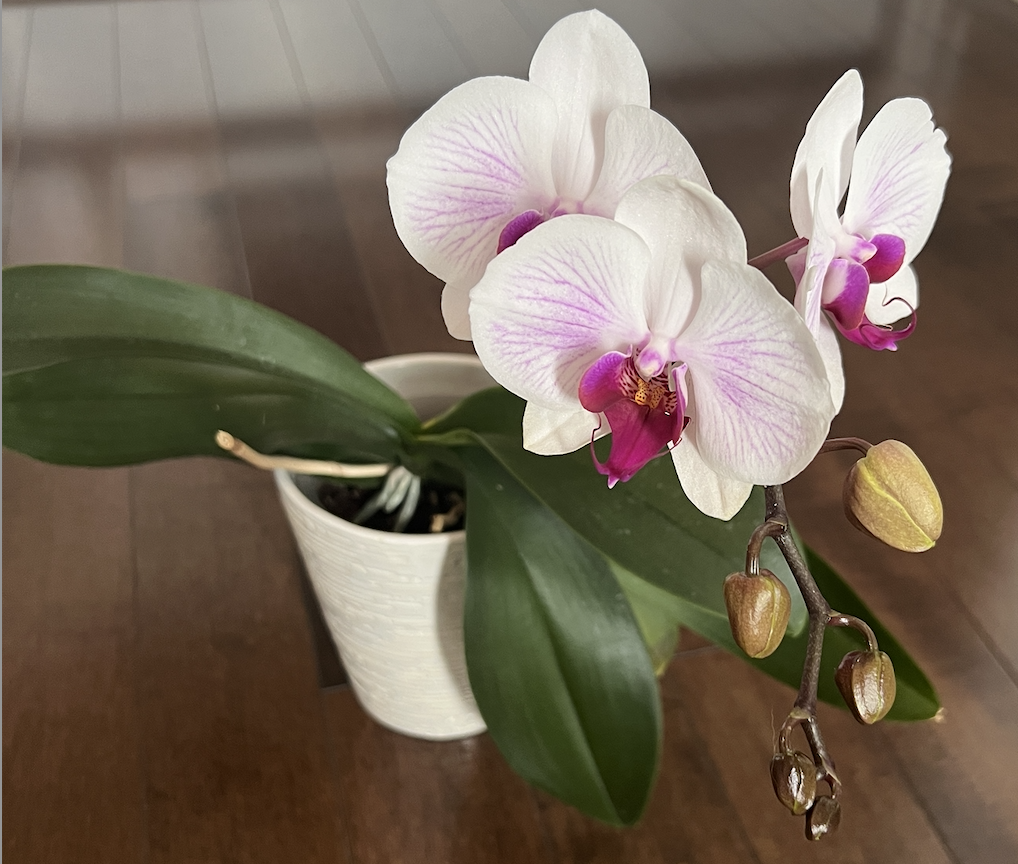
But while the relationship has now changed, it isn’t over. And there are abundant signs of this! Both the poinsettia given to Earla in hospital a year and a half ago, and the orchid plant that lay dormant for two years in Earla’s keep are reminders of the hope and promise of being surprised by the gift of new life.

After that first Christmas the poinsettia was all but destined for the compost pile. But it refused to wither and die. Contrary to anyone’s expectations, the leaves to this day have produced red leaves and remained healthy. It was one plant in Earla’s hospital room, on the windowsill, that drew our attention in amazement each time I visited.

And after two years of producing nothing, it was just this month that her tiny orchid plant decided to bring forth its majestic blooms. Who would have anticipated this?!

Their centre remains a violet/purply reminder of the journey of life on earth that will often include suffering and pain. But their frame dominates in Easter white – conveying the hopeful message of resurrection. And as you can see there are more buds to come! More surprises on the way!

Earla’s liturgical sensitivities are on display to this day as these plants from her continue to shout out that your beloved Earla sits today around the table. But now she sits at the banquet feast of heaven.

To welcome Earla at that heavenly feast, I am sure the heavenly hosts are serving it up in abundance: fish filets, bacon and hot fudge sundaes for everyone!

Gifts & Growth: Recover

An episode during the first season of The Crown on Netflix depicts the controversial televised coronation of Queen Elizabeth in 1953. The TV monitors are all switched off in the moment when the archbishop approaches the Queen with the holy oil.

The Duke of Windsor explains that this is the most sacred part of the ritual. “When someone asks why the anointing is the holiest part of the ceremony, too holy even for it to be televised, the former king explains that the anointing is the moment when the divine is infused into Elizabeth’s human form. It’s when she is no longer just Elizabeth, but Queen Elizabeth II. The holy oil marks that transformation from only human to now also divine.

“The archbishop hesitates before making the sign of the cross with the oil on her chest, and then her forehead. This is the part of the coronation that converts her from a woman into a queen” (Watterson, 2019, p. 199).

In the 16th century Martin Luther talked about the ‘joyous exchange’ in which by taking on the sin of humanity on the cross, Jesus imputed divine righteousness onto humanity. Giving and receiving. Receiving and giving.

So, we don’t speak of either human or divine, or a one-way relationship, but rather the two becoming one, going both ways. The boundary between heaven and earth is not fixed. Earth and heaven are intermingled, because of Jesus.

And Mary. Thanks to the persistent grace shown by this woman of faith.

There is this passage from the Gospel of Philip discovered in 1945 which aligns with John’s Gospel story today of Mary anointing Jesus with expensive perfume made from nard, or oil (John 12:1-8): “To be anointed with oil is higher than being immersed in water. It is when we are anointed … that we become Christians.[Because] Christ was called Messiah [which literally means ‘the anointed one’]…” (Watterson, 2019, p. 199).

Jesus receives the gift of anointing through the persistence of Mary, who perseveres in her gift-giving despite Judas’s attempt to shame her. Grace knows no bounds, no obstacles. The anointing is an extravagance. Oil gets everywhere, seeps into all places even hidden places. It covers our whole body. In the famous prayer of King David in Psalm 23, the Psalmist declares: “Thou anointest my head with oil; my cup runneth over.”

Mary knew what actions would convey heartfelt affection, honour and respect for Jesus. Mary is one biblical character who embodies the fullness of being human. She uses what she has been given. And she is the bridge connecting, in this passage, the divine love with human passion. She is the quintessential Recoverer.

copyright Martin Malina (2025)

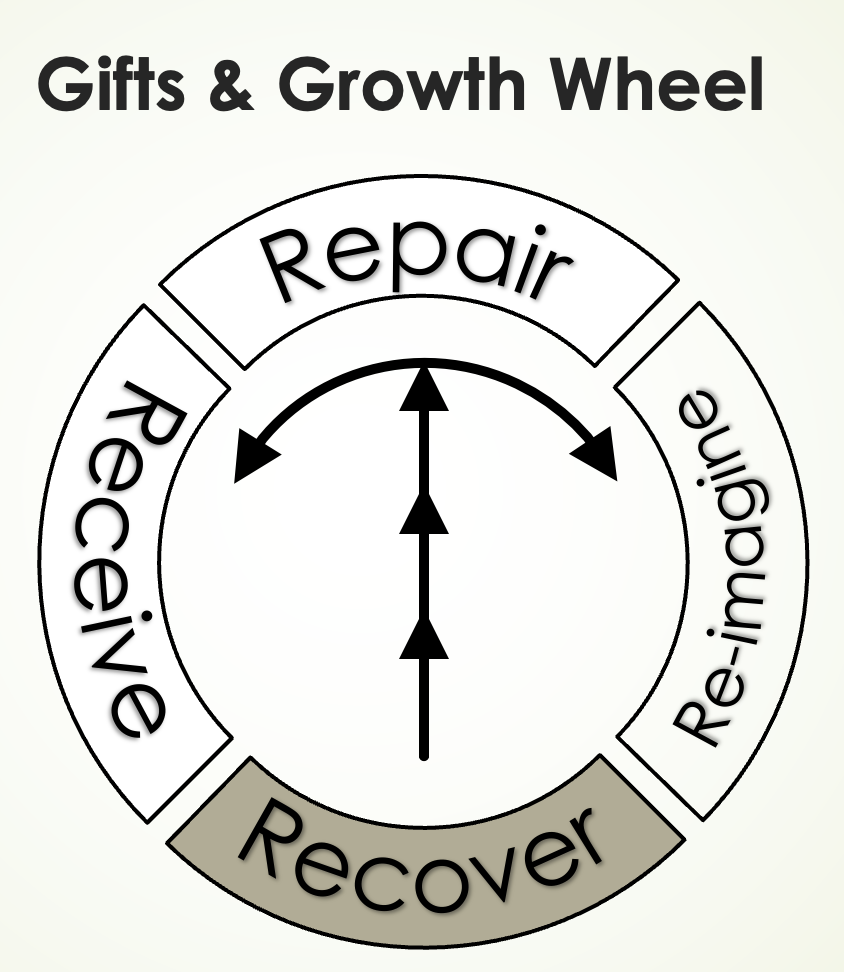
Like the Receivers, Recoverers on the Gifts and Growth Wheel are good at spotting the need, reading the room, sensing the mood. But Recoverers are especially good at giving compassion and empathy which comes from the ability to pay attention to their social surroundings. And acting on the heart’s nudge.

Paying attention. In Hebrew, the command form of “pay attention” literally means, “put forth your heart” (Mahany, 2023, p. 24).

“Putting your heart forward” means doing something that reveals your truth. By your caring actions the world sees your heart full of love. The world sees who you are, truly. Your love is expressed genuinely, and you are not hiding it nor squandering it in denial. You don’t hold yourself back because you know a genuine, self-less love motivates you.

It’s never perfect, of course. We are human. Sometimes, our desire to care is manipulative when we don’t realize our acts of care really motivated by our need to be needed. In this case we are cheating by going to the nearest quadrant on our right, the thinking/re-imaginer’s side. Caring for another, in this case, becomes a self-justifying action more than a genuine other-centred care.

“Putting your heart forward” is also not without healthy boundaries. Boundaries are crossed and blurred when the Recovers on the Wheel first move to the Receivers closest to them on their left side. This mistake is about imposing one’s care on another presuming everyone needs the same thing from you in the same way.

In this case the act of caring does not respect another’s wishes sometimes not to be cared for in the way you want to give it. Recoverers must learn that sometimes, with some people, the greatest caring act is to accept you are not the one to offer them care.

For growth to happen, Recoverers have to cross the centre of the Gifts and Growth Wheel. Healthy Recoverers reflect this commitment to action, which Repairers are especially good at. But, for Recoverers, it is an action that serves another from the heart, the source of divine love.

Caring and repairing is obviously active. If we are helpers, it’s easy for us to give help. But it’s sometimes difficult to receive help. Yet, receiving help also first requires action. You can’t receive help without acting on it: Asking for help. Accepting the help. Expressing gratitude.

In the giving and receiving of genuine love and care, there is always opposition. We witness this in the Gospel for today. Judas here represents the authorities. And authoritarian regimes try to strip everything away from people, especially their empathy and grace.

My mother and her family left Poland with nothing. The communists had taken their home, their property, all their belongings. The authoritarian government impeded their freedom and bridled their speech.

But my Mom taught me from a young age that there are some things no one can ever take away from you. In my Mom’s case, it was education. But in a broader sense, it’s what is inside you – your values, your truth, your mind, your heart, your action, your beliefs. God. No one can take those things away from you.

Recoverers teach us the importance of knowing who you are, centering on what the great American teacher and theologian Howard Thurman called “the sound of the genuine” (McLaren, 2025 March 31) within us. Recoverers are non-conformists because with wisdom and courage, they engage acts of compassion in sometimes extraordinary ways, like Mary Magdalene did, never losing sight of who they are and what they truly value never mind what others think.

On this day we give thanks for the Marys in our lives who operate from hearts full of love and caring, whose passion sometimes unbridled will get them and us in trouble with the authorities. But whose actions nevertheless demonstrate the holy bridge between the divine and the human, perfectly embodied by Jesus whose heart of love never wanes for each one of us.

Dietrich Bonhoeffer wrote, “The more we received [help], the more we were able to give; and the more meager our love for one another, the less we were living by God’s mercy and love. Thus God taught us to encounter one another as God encountered us in Christ. ‘Welcome one another, therefore, as Christ has welcomed you, for the glory of God’ (Romans 15:7)” (cited in Barnhill, 2005, p. 48).

May we learn and grow, receive and give love, listening always for the sound of God’s love ringing within us, anchoring us in Christ.

Thanks be to God.

References:

Barnhill, C (Ed.). (2005). A year with Dietrich Bonhoeffer: Daily meditations from his letters, writings, and sermons. Harper One.

Mahany, B. (2023). The book of nature: The astonishing beauty of God’s first sacred text. Broadleaf Books.

McLaren, B. (2025, March 31). Protecting our own light: Contemplative nonconformity. Richard Rohr’s Daily Meditations [Website]. https://www.cac.org

Watterson, M. (2019). Mary Magdalene revealed. The first apostle, her feminist gospel & the Christianity we haven’t tried yet. Hay House Inc.

Gifts & Growth: Repair

A verse from Saint Paul captured my attention this week. He writes to the Romans: Do not be conformed to this age, but be transformed by the renewing of the mind, so that you may discern what is the will of God—what is good and acceptable and perfect (12:2).

Life in Christ, being a Christian, being faithful means renewing your mind. During this season of Lent, we are called in the liturgy to repent and return to the Lord.

Repentance means “an action or process” (Miriam-Webster Dictionary) of changing something. It is a changed action as much as a change of mind, toward what is good and right.

What stops you from living out the best version of yourself? Because God has entrusted you with gifts. I know many of you share your gifts with others and the church. There are many! And there are different kinds of gifts. But sometimes we hold back. Sometimes we feel we don’t have what it takes. So, what keeps you from celebrating those gifts and offering them in the community?

Thankfully, the Gospel of Luke emphasizes the persistence of God’s mercy and grace despite the stubborn obstacles that keep us from experiencing the joy of life in Christ. In today’s story from Luke 15 – the famous story of the Prodigal Son – it is God’s grace in the wake of estrangement, sin, and jealousy.

The focal point in the story is, of course, the youngest son who leaves home. The reader is invited to follow his story, his perspective. We are drawn to his journey. This is the person of interest.

It’s not that God doesn’t identify with the Father’s actions. It’s not that God doesn’t care for the older son, or any other character in the story. But God is particularly interested in the Prodigal Son.

Why? Is it because this person changes? The youngest son follows through on a different course of action when he realizes that things are not working out very well for him. So, when he hits rock bottom, he changes direction. That’s the gift, the grace upon which this story hinges.

It’s not to say, “Go and make mistakes!” It’s not to say, “Go, intentionally hit rock bottom in your life!” No. Rather, it is to say, “Don’t let your mistakes keep you from continuing to act, reaching out, trying to do good.” It is to say, “Don’t let fear keep you from taking risks, changing your tack, and trying something better.”

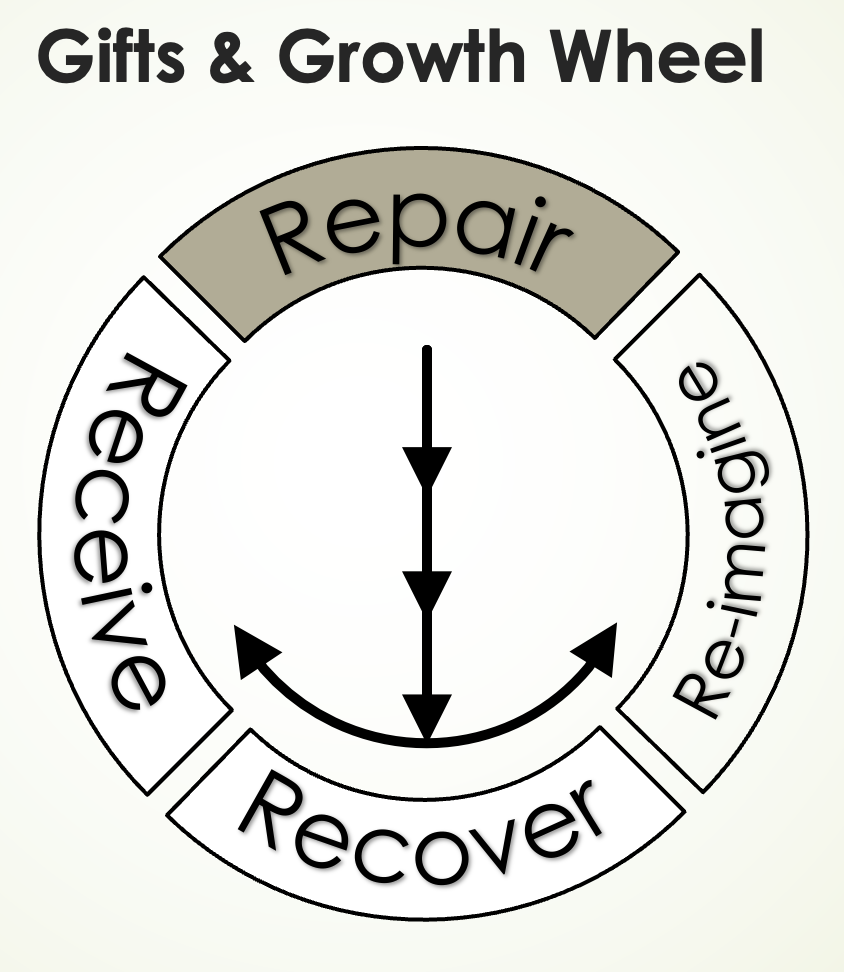
But beware! For those who value action—doing something—and want to do better to repair the problems in the world, we may be tempted to cheat and take a short cut.

copyright Martin Malina, 2025

Because to go to the thinker/Re-imaginers closest to you on the Wheel first, this might keep you trapped in justifying inaction, ironically. There’s always a reason, a rationale, not to do something, even good. We may over-think it.

Or, if you first go to the Receivers closest to you on the other side, you may trip into despair and isolation. In other words, you may just give up. It’s easy to get discouraged when your action, your work, your decisions take a downward turn.

No, for the action-oriented person to grow, they must first cross the floor and visit the Recover quadrant on the opposite side of the Wheel. To recover the heart, the feelings, the source of one’s identity. To recover the story of one’s life. To recover a sense of belonging to oneself, to others, to creation and to God. The heart-centred gifts of others will complement your own. You need them as much as they need you.

A concrete way to do this is to recover the lost traditions, rituals of one’s own faith and history. To find the anchor, again. And like a rubber band, to pull back in order to fly ahead with integrity and effectiveness.

But this means changing directions, changing one’s response to the world. What are some examples of right action?

Ask for help when you need it, seek forgiveness, embrace with open arms someone who has chosen a different path, embrace with open arms and accept the person who holds different values than you, take the initiative to reach out to others, to be with them and do good things together with them, care for creation with concrete acts of generosity and grace, vote in elections, commit to a spiritual discipline and practice of daily prayer, act and make different lifestyle choices, for the better. Etc. Etc.

In recent history, who are people you know who have experienced changes in their lives because of their faith? Who might first come to mind? In our church history it may be the likes of Martin Luther from the 16th century, and even Dietrich Bonhoeffer in the 20th century. But what about Martin Niemöller, who was a contemporary of Bonhoeffer’s? Have you heard of Martin Niemöller?

Martin Niemöller was a German Lutheran pastor. Most North Americans associate his name with the famous words inscribed on the wall of the United States Holocaust Memorial Museum in Washington:

First they came for the Communists
And I did not speak out
Because I was not a Communist
Then they came for the Socialists
And I did not speak out
Because I was not a Socialist
Then they came for the trade unionists
And I did not speak out
Because I was not a trade unionist
Then they came for the Jews
And I did not speak out
Because I was not a Jew
Then they came for me
And there was no one left
To speak out for me.

“Pastor Niemöller wasn’t just being poetic. That’s his life story. He was a German nationalist who, in the 1920s and early 1930s, supported Hitler and the Nazis. He hated Communism and socialism and workers — he believed that they had betrayed Germany in the aftermath of WWI. He worked against the Weimar Republic, thinking it to be politically weak and corrupt. Indeed, Niemöller voted for the Nazis, even in the 1933 elections which handed Germany over to Hitler.

“In short, Martin Niemöller not only did not speak out. He actively worked for a political movement to go after Communists, socialists, workers, and Jews … anyone whom he believed undermined the honor of the German nation.

“But Niemöller began to change his mind when Hitler interfered with church policies and applied racial tests to both clergy and laity, even insisting that German churches refrain from teaching or reading from the Old Testament.

“Niemöller’s resistance started when the Nazis applied their brutal and racist agenda to the church — Niemöller’s church, the community he most cared about, was vowed to serve, and led.” His changed action came about because he recovered the heart of his faith, his identity in the church, and the practices that made him Christian. And acted on it.

“Then, [Niemöller] realized that they were coming for him, too. It took him a while. It was a process. But he spoke out. He preached against Hitler and Nazism. He was one of the founders of the Confessing Church. He was detained several times between 1934 and 1937. Then, in 1937, he was arrested for treason and spent the next seven years in various prisons and concentration camps, including Dachau” (Butler Bass, 2025).

After recovering their authenticity, their true identity, action-oriented people can become Repairers. Being a Repairer as a spiritual gift is a greatly needed gift today. It is doing the right thing at the right time which will have positive effects even when those effects might not be immediately apparent. The church needs more Repairers today especially.

The last few weeks we have visited three of the four quadrants on the Gifts and Growth Wheel. Are you a Receiver – someone who reminds the rest of us of the faithfulness, the grace and the prevalence of God’s mercy? Or, are you a Re-imaginer – who thinks and reimagines a vision of God’s meaning and purpose in today’s world? Finally, are you a Repairer who will act righteously and guide others into active service in Christ’s name?

We have one more quadrant to visit next week. And no matter where you begin on this Wheel, we need everyone’s gifts to balance the wheel and help empower the church to faithfulness as we seek – like the Prodigal Son – to return to our home and be embraced by the Father at the end of all our toiling. Thanks be to God!

References:

Butler Bass, D. (2025, February 19). Forget Bonhoeffer. This is the Niemöller moment [Blog]. The Cottage/Substack. https://dianabutlerbass.substack.com/p/forget-bonhoeffer-this-is-the-niemoller?utm_campaign=email-half-post&r=66hlp&utm_source=substack&utm_medium=email

Miriam-Webster Dictionary. (2025). https://www.merriam-webster.com/dictionary/repentance

Gifts & Growth: Re-imagine

This humorous story reflects the conundrum faced by those of us who tend to over-think and stay trapped in the mind:

A celebrated holy man is on his deathbed. His students are lined up in order of seniority to pay their respects, awaiting his final words with bated breath. Eventually, and with effort, the holy man opens his eyes, then addresses his most senior student.

“Life,” he declares, “is a river.” The student turns to the next most senior, and the message gets carried down the line: “The master says life is a river.” “The master says life is a river.” Only the most junior student, the last to receive the words, is naïve enough or daring enough to venture a question: “But what does the master mean, ‘life is a river’?” The query comes back up the line, until the senior student, trembling at the audacity of questioning the master, manages to blurt it out. “My master, I’m sorry, but what do you mean, ‘life is a river’?”

The old man is moments from expiring. But for one last time, he opens his eyes and regards the student in unblinking silence. Then, he shrugs and turns up his palms.

“All right,” he says, “So it’s not a river!” (adapted from Burkeman, 2024).

Moral of the story: Real wisdom doesn’t lie in getting life figured out. It lies in grasping the sense in which you will never get it completely figured out.

This proposition can be unsettling for those of us whose starting gift is being in our head. This is the gift of analysis, of thinking through and solving problems by acquiring more knowledge.

A “head spirituality” (Ware, 2000) favours what it can see, touch, and vividly imagine. It’s a concrete spirituality often expressed in concepts. Thought and belief are central to this highlighted quadrant on the Gifts and Growth Wheel. This spirituality is often recognized by focusing on doctrines, position papers, and theological argument. This gift is so important to the church and has likely dominated in the church since the Protestant Reformation.

The temptation can be to drill down deeper and remain stuck in the world of mental constructs and abstraction. The excess of this gift; that is, if head-types don’t commit to a journey of growth, is over intellectualizing one’s faith. It is to depend exclusively on rationalism and certainty.

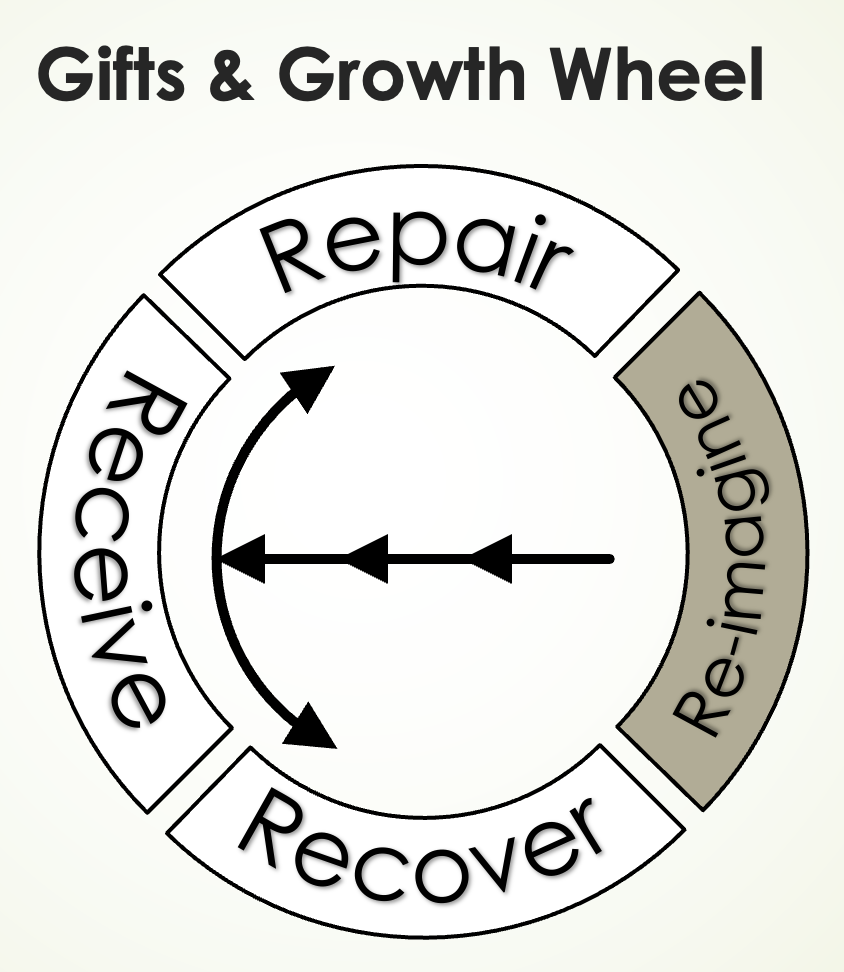
The path of growth for the head type is first toward the Receivers who know to receive reality is at is without an initial compulsion to have to rationalize it or solve an intellectual problem. The Receivers, as we learned last week, are particularly gifted in simply experiencing the presence and celebrating the grace of God without having to understand it fully.

copyright Martin Malina, 2025

When the thinker follows the path of growth their true gift can bear fruit in the community and they become the Re-imaginers (Bailey, 2021). They come with solutions, but no longer according to the exclusivist agenda of the powers that be. Without going to the opposite side first can make head spirituality exclusive – either by creating a community only of like-minded people and/ or pursuing a course of action that excludes others and paints a line in the sand between ‘them and us’.

In the world of the bible, Jerusalem represented the powers that be. Jerusalem was the seat of religious and political power in the region. Jesus knew that prophetic ministry in the face of power was a dangerous activity. Jerusalem personified the power of the world that sowed division and discord. Those that spoke the truth of God’s kingdom in Jerusalem risked their lives. Jesus knew he was in the crosshairs. But what is surprising in this Gospel text (Luke 13:31-35) is Jesus’ reaction (Reese, 2016).

In the face of threats from Herod and the religious authorities, Jesus responds with love. He responds with a longing of love for the people of Jerusalem. Jesus’ response is the compassion of a mother. His lament evokes powerful imagery of mother hen embracing her chicks in protection and love. This is the longing of God for us, expressed through Jesus’ imagination. He re-imagines what it could be like even though Jerusalem would refuse the grace of God, even though Jerusalem will crucify him.

In the last century, the Berlin Wall represented a physical manifestation of the ideological battle between communism in the east and capitalism in the west.

In the early days of the Berlin Wall during the 1960s, emotions—anxiety, fear, anger—were running high.

Hostilities flared when truckloads of stinking garbage were dumped over the wall into West Berlin by those living in the eastern sector of the city.

West Berlin Mayor Willie Brandt was flooded with demands for revenge at this offence.        

Understandable. Tit for tat. You throw garbage at us. We’ll throw it right back!

But Willie Brandt responded in a unique way.

Mayor Brandt requested that flowers—hundreds of colourful, beautiful flowers—be brought to a specific place at the wall. Then, truckloads of these flowers were poured over the wall into East Berlin (Hays, 1997).

That act in the 1960s may not have immediately felled the wall. But history bears witness to the power of non-violent solutions. Almost thirty years later, in 1989, a peaceful candlelight vigil that started in a church and gathered tens of thousands brought down the Berlin Wall.

May we re-imagine our response in the conflicts and struggles of our days and lives. May we learn to start with grace, and love – the grace that Jesus imagined for us. May the flowers reign down where division and strife pretend to define the reality that God, over time, is shaping into something good, gracious and beautiful for everyone.

This is our Lenten hope.

References:

Bailey, J. (2021). To my beloveds: Letters on faith, race, loss, and radical hope. Chalice Press.

Burkeman, O. (2024). Meditations for mortals: Four weeks to embrace your limitations and make time for what counts. Allen Lane.

Hays, E. (1997). The old hermit’s almanac: Daily meditations for the journey of life. Forest of Peace.

Reese, R. A. (2016). Commentary on Luke 13:31-35. https://www.workingpreacher.org/commentaries/revised-common-lectionary/second-sunday-in-lent-3/commentary-on-luke-1331-35-3

Ware, C. (2000). Discover your spiritual type: A guide to individual and congregational growth. Alban Institute.

Gifts & Growth: Receive

Over the past year and a half, I’ve only looked at my guitar sitting in the corner of my home office. It has sat there, lonely, untouched, collecting dust. I have not picked it up once during this time.

So, when I finally did a few days ago, and started plucking a few notes, I wondered – what’s the point? What purpose does it serve to spend valuable time messing around on a musical instrument?

I’m not being really productive playing around on it. Learning a new song won’t yield perfection (to be sure!) and only reminds me of how much my skills have deteriorated by not playing it. Even though, for Lent, I’ve committed to picking it up each day for at least a few minutes at a time, those thoughts plague me: For what purpose? Is it worth the time?

You may have heard of the so-called “Marshmallow Experiments” (Burkeman, 2024), the first of which was conducted at Stanford University by Doctor Walter Mischel in 1970.

In these experiments, Mischel and his colleagues presented children with a single marshmallow and offered them a choice: They could eat it. Or they could wait alone in the room with it for ten minutes. If they succeeded in waiting ten minutes without eating that one marshmallow, they got one more. And so on.

As these experiments unfolded over time, the scientists were able to make some evidence-based conclusions. For one thing, participants who were able to resist temptation went on to enjoy better academic performance and physical health in later childhood, and demonstrated other positive differences as adults (Burkeman, 2024).

The self-discipline not to grab the first marshmallow became an invaluable trait for what’s commonly thought of as a successful, productive life.

Self-denial is a common messaging that we impose on ourselves, often without being aware we are doing so. In other words, we remain perpetually a Lenten people because we never really enjoy the gifts we have received, have amassed, have saved over time. In this mindset, we never get to Easter because we either don’t know how to embrace and receive the treasures we have been given and/or we feel guilty for enjoying gifts from God when we do receive them.

A Canadian Benedictine, the late John Main, was known to say that the greatest sin was not succumbing over and over again to tantalizing temptations. No, the greatest sin was not fully enjoying the good gifts that we have received from God’s bounty and grace.

What gifts have you received? Are they material blessings? But gifts are more than having lots of stuff. There is the gift of music, the talent for precision and patience in woodworking and building things, the gift of listening to another, the care for animals, for growing plants, flowers and vegetables. Gifts are also the gifts of our personalities, our characters, our abilities, our passions, our interests, what we’re good at doing, what we love doing, what we enjoy in each other and in the world.

What today’s scriptures point to is the temptation to believe that we are the source of and engine behind all these gifts and good things we experience in life.

What resulted in Jesus overcoming temptation in the desert was acknowledging the true source of his power in God (Luke 4:1-13). In the accompanying text from Deuteronomy (26:1-11), the temptation is not hunger but prosperity.

When things go well and the harvest is plentiful, the Israelites will be tempted to think that they are self-made. They will be tempted to believe that they have earned their prosperity. They have worked hard for it.

To counter this temptation, God instituted the ritual of first fruits to remind the Israelites that thanksgiving always had priority over self-congratulation (Oldenburg, 2025 March 9).

On this First Sunday in Lent it is good therefore to begin with the gift of receiving. Maybe Lent can be a reminder to us that what we may be so proud to boast about is not our doing. God is the source. We are the vessels. When we recognize our primary role as receptors of God’s grace, we can then let that gift flow through us and to the world around us.

This year, the Gospel of Luke travels with us throughout Lent. And Luke’s emphasis is celebrating the persistence of God’s grace and mercy despite stubborn obstacles.

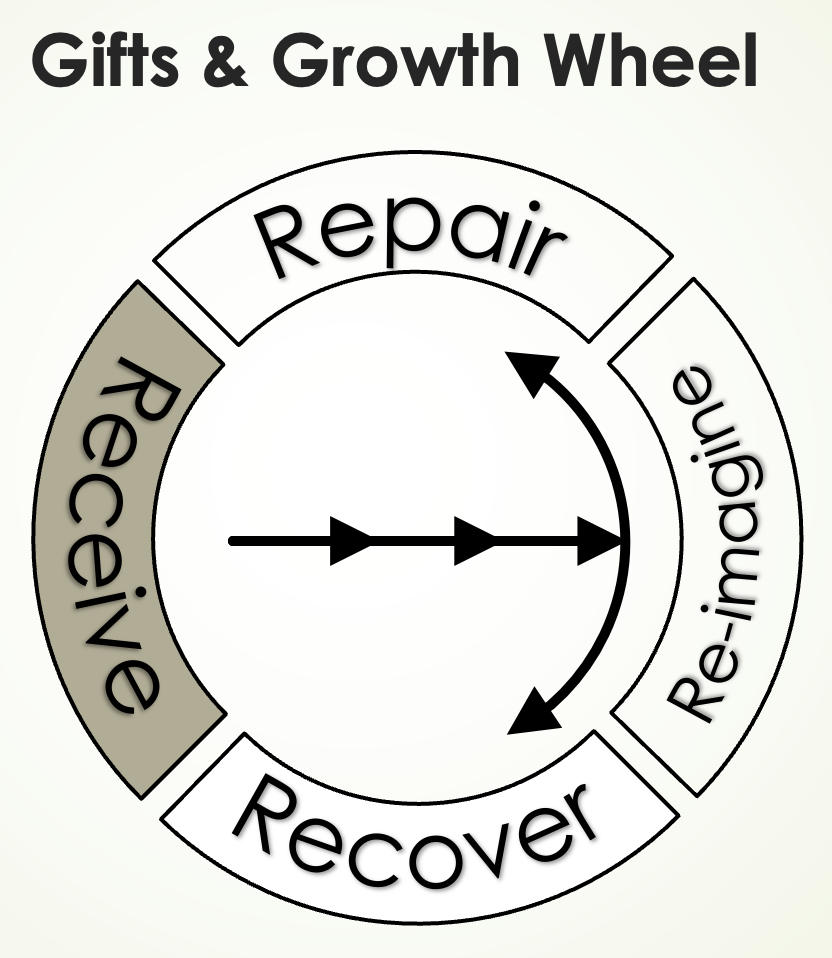
In the series of sermons this Lent, I’ll look at four ‘R’s’ of faithful practice and growth: Receiving, Re-imagining, Repairing and Recovering (Bailey, 2021). Each of these is a great and important gift for the community of faith. We need Receivers as much as we need Re-imaginers, Repairers and Recoverers.

copyright Martin Malina, 2025

Each of us, depending on our individual strengths and gifts, will start in a different quadrant. There are some who are best positioned, because of their God-given personality and character, to start at the receiving end. Others will naturally begin by re-imagining; others first will move into repairing and others still will be best suited to start in the recovering quadrant of this circle.

But for growth and wholeness, a journey of faith is necessary. We can’t remain stuck in just one of the four quadrants. For the gift to bear fruit we need the whole circle, the whole community.

So, what do the Receivers offer? The Receivers are naturally disposed to acknowledge reality as it is – the good and the bad. The receivers among us can more easily accept their lot and enjoy what they have and who they are – without judgement.

Receiving – being able to accept what is – is an incredible gift. To see God’s work in all things. To trust in God’s grace to keep us going into an unknown and uncertain future. To be, as we are.

This spiritual gift is useful in both tempering the productivity bias in our hustle culture. It is to consider that all our accomplishments are for naught, and even a temptation, if they are not placed in the broader perspective of the origin of all good things. It is God’s mercy and grace that are fundamentally operative in our lives. Our gifts bear fruit when we acknowledge the true Source of them in God and God’s mercy.

But, as I said, remaining in this quadrant without the input of the other ‘Rs’ can leave the Receivers – or “mystics”, as they are sometimes called (Ware, 1995)—stuck. They are tempted into distorted thinking that in order to experience God’s presence they need to escape or check-out from the reality of this world.

It’s ironic that the Receivers can, on the one hand, more naturally than all others receive reality as it is. But, on the other hand, the Receivers are also the ones most likely tempted to remove and displace themselves from it. To avoid all the confusion and chaos of the world, Receivers are tempted to retreat into the comforts of their self-created worlds, their private realms.

That two-sides-of-the-same-coin dynamic is characteristic of all the gifts in the circle. Indeed, our greatest gift can be our greatest blind spot.

We all start somewhere on the wheel of gifts and growth. But, for growth to happen, where do we go from there?

The next movement for the receivers is towards the opposite quadrant. For the receivers, it’s towards re-imagining. The Re-imaginers are those who start with the gift of the mind, the gift of clear and constructive thinking. This is what the Receivers need. We’ll talk about the Re-imaginers next week.

Why, you ask, do we first go to the opposite side, and not to either side of the starting point? If the Receivers would first look to the Repairers on one side, Receivers’ action might not be the best course of action in a given situation. It would be like the Receiver realizing they had to do something good in the world, but choose an activity that isn’t relevant, or particularly helpful. Likely, because the Receiver hasn’t done their homework.

On the other side, if the Receivers would first look to the Recoverers, their action might lead to boundary issues. They might over-function, burn out and feel like they needed to do everything to take on the weight of the world and care for everyone, which of course is impossible.

We first need the opposite gift to correct the distortions associated with our starting place on the circle, before moving to the last two quadrants.

This arrowed pattern in the middle of the circle looks like an anchor, intentionally. This pattern of gifts and growth keeps us anchored in our movement towards balance and healthy growth for everyone. The writer to the Hebrews affirmed: “We have this hope as an anchor for the soul, firm and secure” (Hebrews 6:19).

Today, at the start of our Lenten pilgrimage the Receivers among us will say: Thank God! Receive, enjoy and delight in the gifts of God’s doing and grace in your life. You can enjoy that marshmallow that someone gives you today. Don’t deny it. It’s Ok!

In the words of the late Indigenous author Richard Wagamese: “Sure there’s stuff that needs doing, stuff to wade through and stuff to fix but there’s also the joy of small things: a hug, a conversation, playing a song all ragged and rough on an instrument, walking on the land, listening to great music or enjoying silence and a cup of tea. Rejoice. Fill yourself again” (Wagamese, 2021).

Receive.

References:

Bailey, J. (2021). To my beloveds: Letters on faith, race, loss, and radical hope. Chalice Press.

Oldenburg, M. W. (2025, March 9). Crafting the sermon; First Sunday in Lent, Year C. Augsburg Fortress. https://members.sundaysandseasons.com

Wagamese, R. (2021). Richard Wagamese selected: What comes from spirit. Douglas & McIntyre.

Ware, C. (1995). Discover your spiritual type: A guide to individual and congregational growth. Alban Institute.

Changing lanes

photo by Martin Malina (Galetta, Ontario, 2020)

It’s all about change today. In the church year, the Transfiguration of Our Lord Sunday not only pivots us from the Christmas cycle of Advent, Christmas and Epiphany to the Resurrection cycle of Lent, Holy Week, and Easter. The Transfiguration is also an event in the life of Jesus wherein he claims his full divinity without denying his full humanity.

First, Jesus’ appearance changes on the mountaintop (Luke 9:28-43a). His face and clothes become dazzling white. And, the voice from the cloud declares Jesus God’s chosen son. Divine.

But the changes don’t stop there. The story doesn’t end with the disciples’ awe and silence atop the mountain in the cloud. There is a purpose for those mountaintop experiences. The purpose is to live on the earth.

Jesus must continue his ministry, his mission to the cross. Alongside his divinity Jesus has to continue to grapple with his humanity. He has to come down, descend to earth, so to speak, and deal with real people. And he is frustrated and angered when he encounters the people, calling them a “perverse generation”. Yes, this Gospel text about the Transfiguration of Our Lord reveals Jesus’ humanity as much as it does his divinity.

Yet, in both the divine and human Jesus, the glory, the presence and greatness of God is witnessed. “All were astounded at the greatness of the Lord,” concludes the Gospel (Luke 6:28-43a).

But the changes don’t stop there! There are others in this story that experience growth, deeper connection and maturity in faith – the healed boy to say the least, the crowds who witness the miracle, as well as the three disciples who were privileged to accompany Jesus to the mountaintop. They were all impacted in different ways. This event changed them.

This event is a key turning point in the disciples’ awareness and experience of their friend and their Lord. They are growing and changing in their faith. From simple fishermen to martyrs – many of them – there is a long narrative in between. And the transfiguration story is an important milestone in that journey towards growth and maturity.

Yes, today is all about change. The disciples in Jesus’ day represent the church today. We are the body of Christ, together. How does a community of people change, never mind individuals? In our hyper individualized society, we don’t pay enough attention to the changes we undergo as a community of faith.

After the Second World War, Sweden was the only country in continental Europe whose citizens drove on the left side of the road. This caused chaos at border crossings and many head-on collisions. So, on September 3, 1967, citizens in Sweden changed from driving on the left side of the road to the right. They called it, “turn around day”.

Because of opposition to this proposed change, a four-year education program was started four years before September 3, 1967, upon the advice of psychologists, so that at 4:50 a.m., “turn around day” began with all traffic halting for 10 minutes. After the 10 minutes were up, at 5:00 a.m. on September 3, 1967, then everyone changed lanes from driving on the left side to the right side of the roads (Watson & Watson, 2025).

To make their change, the Swedes had to first stop what they had been doing. Psychologists today call it “thought stopping” (Erford, 2020). On the road to recovery and healing, the idea is that one must begin by consciously arresting/stopping the unhelpful automatic thought before substituting an alternative thought, and behaviour.

But long before cognitive behavioural therapists started using this technique, Christian contemplatives were practising a version of thought-stopping in order to make room in their awareness of God. And what they noticed when they stopped everything, including their incessant thinking and activity trying to solve all their problems, what they discovered was that God was already working the desired change in their lives.

The practice was called Statio, the practice of stopping one thing before beginning another. I like to call it a “holy pause”. It is the acknowledgement that in the holy pause is a space of transition and threshold into a sacred dimension. And this holy pause is full of possibility. This place between is a place of stillness, where we let go of what came before and prepare ourselves to enter fully into whatever comes next (Paintner, 2018).

Statio calls us to a sense of reverence for the “fertile spaces” in between all our work and activity “where we can pause and center ourselves and listen” (Paintner, 2018, pp. 8-9). We open up a space within us to receive Christ’s invitation and Spirit to follow the way of Christ, inviting us on the path to healing.

Jesus taught the disciples the importance of a holy pause, on this path of life. The Transfiguration story began in prayer. “They went up a mountain to pray.” That is the way we travel this journey with Jesus. Prayer. In holy pausing, we begin to see God being revealed to us all the time, all around us.

The disciples, you will note, were both elated and terrified. Because those holy pauses aren’t always easy nor are they always immediately gratifying.

The turn-around-day in Sweden was not a popular move, at first. Allegedly some 80% of the population opposed the idea of changing lanes. Maybe because people knew the cost. Whole infrastructures had to be rebuilt and retooled – imagine the cost – signs, intersections, car lights – never mind getting used to driving on the other side of the road (Savage, 2018).

Was it worth it? Car accident insurance claims and more importantly fatal head-on collisions dropped sharply in the months and years following “turn around day”. So, the public effort and expense resulted in saving lives.

And that’s where this Gospel today leads us to and ends with: healing. The cross leads to the empty tomb. That’s the story of the Gospel. Transfiguration – and all those holy pause moments – eventually lead us, in the way of Christ, to resurrection and new life. That is our hope.

References:

Erford, B. T. (2020). 45 techniques every counsellor should know (3rd ed.). Pearson Merrill.

Savage, M. (2018, April 17). A thrilling mission to get the Swedish to change overnight. BBC [website]. https://www.bbc.com/worklife/article/20180417-a-thrilling-mission-to-get-the-swedish-to-change-overnight

Valters Paintner, C. (2018). The soul’s slow ripening. Sorin Books.

Watson, C., & Watson, G. (2025, January 21). Right day. Eternity for Today. Evangelical Lutheran Church in Canada. www.eft.elcic.ca

True power, true love

photo by Martin Malina, 2019

“Love your enemies” (Luke 6:27) is a teaching from Jesus that hits especially hard in today’s economic and political climate. Because loving your opposition is not how you win. Loving your enemies goes against the grain of our conditioning. 

Using a hockey analogy, we naturally want to go on the offensive when facing adversity. We want to fight back, tit-for-tat. Seeking revenge is a strong motivator, isn’t it? 

But good hockey minds know that focusing only on offense usually means losing the game. Avoiding sound defensive play is not a winning strategy. As they say, defence wins championships. 

Winning, in the end, is about nurturing love and care for the battle that goes on in your end of the ice. Loving your enemies is first loving and taking care of your neck of the woods, in your backyard, whenever challenges or personal adversity appear.

So, on the one hand, loving your enemy is NOT about being a doormat and taking abuse. On the other hand, if the aim of any relationship is to always and unquestionably have the upper hand, that is no relationship.

Indeed, the problem with a bulldog approach to the challenges we face is that it more often than not keeps you stuck, by avoiding the things in your own life which you are scared to confront. These are issues that lurk in the places you don’t want to go. Occasions of adversity are invitations and opportunities to first take stock and look in your own life for whatever needs attention there.

Imagine these issues as “gnawing rats” (Loomans cited in Burkeman, 2024). How do you deal with these rats in your life? Impulsively we may want to eradicate and stomp the bad parts out of us, eliminate them completely. With force of willpower we will confront those rats and attack them with brute force and hatred even, eh?

The problem is that this approach simply replaces one kind of hatred (“Stay away from me!”) with another (“I’m going to destroy you!”). And that’s only a recipe for more avoidance over the long term, “because who wants to spend their life fighting rats?” (Burkeman, 2024, p. 62).

“Love your enemies,” says Jesus. What about befriending the rats instead? What about turning towards them and allowing them to exist alongside? There are benefits to this approach. Following Jesus’ command isn’t merely about being mindlessly obedient and doing whatever Jesus says never mind us. Jesus truly had our wellbeing, our healing in mind when he gave us this command. Jesus wants the best for us, wants us to be healthy.

First, to befriend a rat is to defuse the anxiety we feel, because we change the kind of relationship we have with it. We turn that gnawing rat into an acceptable part of our reality. By doing this, we can begin to accept that the situation is real, no matter how fervently we might wish that it weren’t. 

But we need to do something that initially feels uncomfortable. What would it take to befriend the gnawing rats in your life? “Loving your enemy” becomes an act requiring real courage – more courage, perhaps, than the standard confrontational approach. “Loving your enemy” becomes like reconciling yourself to reality rather than getting into a bar fight with it.

This is not passivity nor, as I said, is it being a doormat. It’s a pragmatic way, Jesus teaches, to increase our capacity to do something positive while becoming ever more willing to acknowledge that things are as they are, whether we like it or not (Burkeman, 2024).

Last week walking through the thick snow in the uncharacteristically quiet Arnprior Grove, I caught sight of a quick movement at the base of a tree. But it was too quick for me to recognize what it was. Seeing the tiny creature reminded me of an Indigenous tale taught by the late Canadian writer Richard Wagamese, whose story about true power I paraphrase here:

A young man dreamed of being a great warrior. In his mind’s eye he envisioned himself displaying tremendous bravery and earning the love and admiration of his people. The young man knew that the greatest warriors were those who possessed the strongest spirit and wisdom. He longed to become the greatest defender of his people.

And so he approached the Elder of his village. He told the Old One of his dream, of the great love and respect he felt within himself for his people and of his desire to protect them.

He asked the Old One to grant him the power of the most respected animal in all of the animal kingdom. With this power, the young man would be able to become as widely respected as this animal.

The Old One smiled. Although he appreciated the young man’s earnest desire he recognized that this was the time for a great teaching. So he told the young man that he would gladly grant him this power if the youngster could accurately identify the animal who commanded the most respect from his animal brothers and sisters.

The young warrior smiled. It was obvious to him that the grizzly bear commanded the most respect in the animal world. He stated this to the Elder and sat back awaiting the granting of the bear’s power. 

The Old One smiled. He told the young man to guess again, for despite the immense courage and ferocity of the grizzly, there was one who commanded greater respect.

One by one, the young man named the animals he felt possessed the adequate amount of fierceness, courage, boldness, and fighting power to earn the awe of his four-legged brothers and sisters. He named the wolverine, the eagle, the cougar, the wolf and the bison, but each time the Old One simply smiled and told him to guess again.

Finally, in confusion the young man surrendered. The Elder told the young man he had guessed as wisely as he could. However, not many knew the most respected of animals because the most respected one is seldom seen and even more seldom mentioned. It is the tiny mole, the Old One said.

The tiny, sightless mole who lives within the earth. Because the mole is constantly in touch with Mother Earth, the mole is able to learn from her every day. Whenever some creature walked across the ground above, the mole could feel the vibration in the earth. In order for the mole to know whether or not it was in danger, the mole would always go to the surface to learn more about what created the vibration.

It is said by the Old People that the mole knows when the cougar is prowling above, just as it knows the approach of a human and the scurry of a rabbit. And that is why the tiny mole is the animal among all animals who commands the greatest amount of respect. Because though the mole might put himself at great danger, the mole always takes the time to investigate what it feels (Wagamese, 2021, pp. 47-49).

“Love your enemies,” Jesus says.

Adversity challenges us to activate the better part of ourselves. Because however you define your enemy within and without, the enemy is an opportunity to reset a relationship, to re-balance things, with ourselves, with others, with creation, and with God.

“Love your enemies,” Jesus teaches us, because in the end, it’s about relationships. We were God’s enemy because humanity killed Jesus. Because sin kept us separated from God. What God did was to break down that barrier of enmity by forgiving us, loving us. Jesus gives us a way to deepen and in the end strengthen relationships of love despite the reality, the imperfection of it all, and the adversity we will always face in this life.

“I used to pray for everything I thought I wanted,” prays Richard Wagamese, “big cars, big money, big … everything. Mostly, so I could feel [big]. That was always a struggle. These days I’ve learned to pray in gratitude for what’s already here: prosperity, health, well-being, moments of joy and to pray for the same things for others …. I’m learning to want nothing but to desire everything and to choose what appears. Life is easier that way, more graceful and I AM [big] – but from the inside out” (Wagamese, 2021).

References:

Burkeman, O. (2024). Meditations for mortals: Four weeks to embrace your limitations and make time for what counts. Penguin Random House.

Wagamese, R. (2021). Richard Wagamese selected: What comes from spirit. Douglas & McIntyre.