
Mirror mirror

Lake Kioshkokwi at Kiosk, Ontario (photo by Martin Malina, Sept 2022)

There’s always a reason not to act, not to do something. Even if that something is good, is right, is just and kind. Even if that something is God’s call on your life.

It can be dealing with something as ordinary as exercising or picking up the phone to call or text someone. Or it can be deciding on the big issues – relationships, jobs, opportunities – that can change the course of your life. There’s always a reason or reasons not to do those things.

At least we are in good company when we initially think and/or say, “no”, and justify our reasons for not acting on the nudge to pursue a good course of action. The prophet Jeremiah resisted the call of God because he believed himself not up to the task. He disqualified himself by not believing he had the abilities and the confidence to do what God asked him (1:4-10).

There’s always a reason not to do something. Fear is a powerful force. But fear is not evil per se. We have good cause to be afraid. But when our fearful avoidance and resistance overwhelms our pursuit of the good, “our overwhelming fears need to be overwhelmed by bigger and better things” (Bader-Saye, 2007, p. 60).

From where do these bigger and better things come? Contrary to what may first come to mind, these bigger and better things don’t stem from our achievements nor confidence in our abilities. These don’t qualify us in God’s eyes. Neither our resumé nor personality style justify our suitability for doing good. What does, is embracing, being and living out who we are created to be.

God saw who Jeremiah was in the goodness of his heart. God called Jeremiah back to himself, his true self. With all the conditioning of the world around him stripped bare, Jeremiah was called to embrace God’s love for and in himself.

“Mirror, Mirror, on the wall who is the fairest of them all?” The evil queen in the Snow-White fairytale is surprised not to see herself in the mirror. Instead, she sees Snow White. This revelation triggers a conflict between the queen and young Snow White and the Seven Dwarfs (Grimm & Grimm, 1812).

When we look for answers, what does the mirror reveal to us? In the face of conflict, it’s like a mirror is held up to expose the battle going on inside of us. Like the evil queen, we would rather see ourselves, have our opinions validated, have everyone else be like us, reflect who we are. The rage we direct at outsiders, others who are different, others who don’t reflect us, only reveals the conflict raging within ourselves. Being angry at the foreigner indicates a self-hatred more than anything.

Indeed, “We see in a mirror dimly,” writes Saint Paul in his treatise on love in 1 Corinthians 13. “But faith, hope and love remain. And the greatest is love.” Because we shall, one day, see face to face who we truly are in Christ. Beloved. Wipe that mirror clean! To see the goodness in others, the same goodness in you — the good we share.

When our mind’s eye clouds our vision, is it because we have forgotten who we truly are? How smudgy is our mirror? How distorted is our vision? Saint Paul says it is! So, then, look at Jesus.

When faced with the violence and acrimony of the crowd, notice Jesus neither disputes nor argues with them when they lead him to the edge of a cliff. Nor does he back down. He remembers who he is. He is solid in his identity.

And Jesus simply passes through them. He simply goes about his business of showing love to the outsider, just as Elijah was sent by God to care for the widow at Zarephath, and just as Naaman the Syrian was healed from his leprosy by the command of God (Luke 4:21-30).

Who are we? How do we keep from forgetting who we are as people of faith? Martin Luther understood Confession and Forgiveness as “a return and approach to baptism” (Luther, 2000, p. 466). Baptism is the sacrament sealing who we are – our identity in Christ. Every time we face the mirror and come true and honestly to ourselves, we recommit ourselves to baptism. In Confession and Forgiveness, we are being renewed by the love of God Paul described.

God’s love binds us together, not as isolated individuals, but into a whole community in Christ called to care for others and the world God created.

“Before I formed you in the womb I knew you, and before you were born, I consecrated you” (Jeremiah 1:5).

“I have been sustained by you ever since I was born; from my mother’s womb you have been my strength” (Psalm 71:6).

Though these words originated in the context of their lives, these two texts are not just for Jeremiah and the Psalmist. These two passages offer powerful words of hope for us as well: God knows us. God declares us, each of us, as sacred. We can lean on God. God protects us. These passages illustrate a lifelong conversation and a loving relationship between us and God.

Indeed, “today the scripture has been fulfilled in your hearing,” Jesus told the crowd in the synagogue (Luke 4:21), and Jesus tells us.

So, like to the prophets before us, God nudges us, whispering in our hearts the truth of who we are. And when we feel the tensions rise around and in us, we look for where God is in the world.

Maybe not in Nazareth. Maybe not in our own backyard, so to speak. Maybe God is active somewhere else, even in places and in people we least expect.

But that’s where God is, right now. And that’s where God is calling us to join in the Holy Spirit’s work there. Will we follow? Will we trust in the bigger and the better something that can overwhelm our fear?

Because there’s always a reason not to do something good. But what about the reasons to do something good? Remember who we are as followers of Jesus. Because divine love will never forget us.

References:

Bader-Saye, S. (2007). Following Jesus in a culture of fear. Brazos.

Grimm, J. & Grimm, W. (1812). Children’s and household tales. Germany.

Luther, M. (2000). Baptism, the large catechism. In R. Kolb & T. J. Wengert (Eds.), The book of concord (p. 466). Fortress.
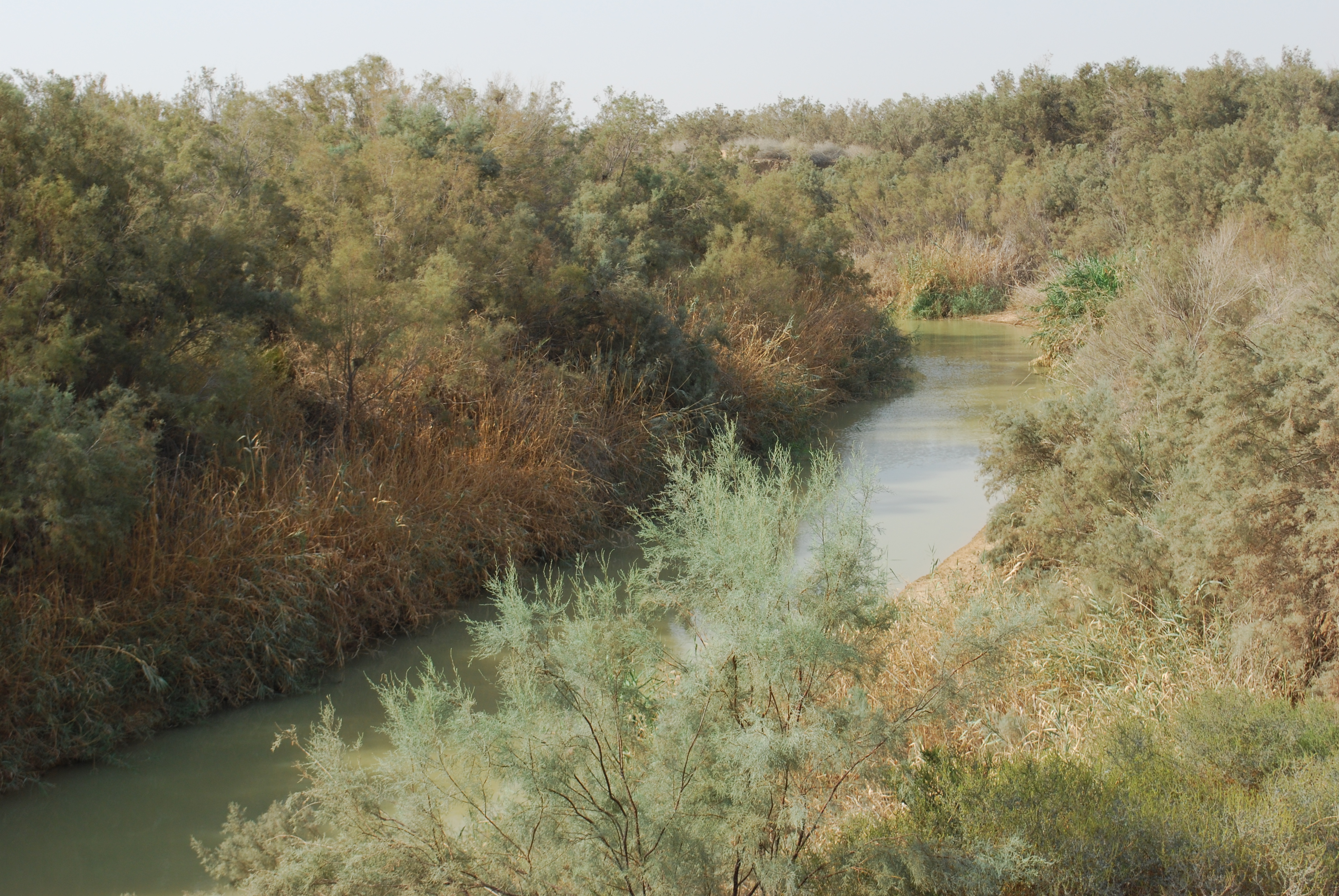

Washed in the waters of love

The Jordan River
(photo by Jean Housen, CC BY-SA 3.0 https://creativecommons.org/licenses/by-sa/3.0, via Wikimedia Commons)

There is this sense of judgement in today’s Gospel (Luke 3:15-17, 21-22). Taken alongside the imagery of gathering the wheat and burning the chaff, the announcement of a baptism with Holy Spirit and fire leaves an impression of division, exclusion and judgement (Honig, 2025).

Last weekend my brother and his wife noticed that their outdoor Christmas lights, particularly the spotlight on their nativity scene set up in the flowerbed by the front of their house was mysteriously disconnected during the night.

Examining the scene the following morning they found the bulb lying on the snow a couple feet from the extension cord. Human footprints leading from the sidewalk were evident in the snow. They also noticed what looked like a dog’s footprints in the front yard.

Who did this? Why did they do this? My brother and I came up with a list of several reasons and scenarios that might lead someone to this act of aggression. And they weren’t positive reasons. Our imaginations swirled, as I’m sure you can understand, around worst-case motivations.

If it weren’t for a chance encounter in the local grocery store the next day, I wonder how long and how deep those judgements would burrow into and affect our hearts and minds.

Thankfully, in the grocery store my brother bumped into their next-door neighbour. And immediately the neighbour apologized for their dog’s erratic behaviour the previous night.

Out for their daily late evening walk, the dog had bolted and escaped its leash, and then leapt onto my brother’s yard. The dog began digging up the cords embedded in the snow and pulled apart the outdoor lights, resulting in the displacement of the nativity spotlight. The neighbour promised to replace any damaged cords or lights.

Truth be told.

The New Testament, taken as a whole, proclaims ours is not to judge (Romans 114). In this Gospel text, there is debate about who is the Messiah – John or Jesus (Luke 3: 15-17). The people wondered if it should be John. But even John makes an error in judgement when he expresses by his false humility – “I am unworthy to untie the thong of his sandals.”

Because recall that at the Last Supper, Jesus gets down on his hands and knees to untie the shoes and wash the feet of his disciples (John 13). In his confession, John’s idea of Messiahship was mixed up because being the Messiah was not about fright, might and right – the assumption of many at the time (and today).

Rather, to be the Messiah was to be servant of all, as Jesus modelled. It was God’s choice to make, not the crowds. It was God to judge who was to be the Messiah and who wasn’t. And at Jesus’ baptism (Luke 3:21-22) what was important was the voice of God making it clear on whom God’s mission would fall.

The beloved.

Baptism is a sign and promise of God to confer the blessing of love — to gather together, to end division, to bridge difference and to welcome all into a life that is beloved (Quivik, 2025).

The reason people make great mistakes in judgement and in their behaviour, I suspect, is because they never heard what Jesus heard on the day of his baptism (Rohr, 2021). They have never heard another human voice, much less a voice from heaven bless them by saying, “You are a beloved son. You are a beloved daughter. And in you I am well pleased.”

If we’ve never had anyone believe in us, take delight in us, affirm us, call us beloved, we don’t have anywhere to begin. There’s nothing exciting and wonderful to start with, so we spend our whole lives trying to say those words to ourselves: “I’m okay, I’m wonderful, I’m great.” Which can be helpful, to a point.

But we may not really believe it until that word also comes to us from someone else, someone we adore or at least respect — a partner, a friend, a parent. And when we do hear those words directed at us, we are changed. We are empowered.

Henri Nouwen wrote, “We are the Beloved. We are intimately loved long before our parents, teachers, spouses, children and friends loved or wounded us. That’s the truth of our lives. That’s the truth I want you to claim for yourself. That’s the truth spoken by the voice that says, ‘You are my Beloved’” (Nouwen, 1992, p. 30). This is our greatest need, to hear those words spoken to us. It is the greatest need of everyone.

The banner hanging right behind me is one of my favourites in our church: Christ’s light shines in us. In us. It’s not just that Christ’s light shines. But that it shines in us. And, therefore, like Jesus, because we shine in the light, we, too, are beloved.

That new year’s fright of finding the spotlight on Jesus torn from its extension cord in the front yard of my brother’s house and then finding out the truth of what actually happened, taught me something about how quick I am to judge others.

So, I invite you to consider with me a new year’s resolution that on paper may seem rather soft. But it is more difficult, I imagine, than any new year’s resolution you can make:

Rather than judging others or evaluating them for where they fit on our scales or standards, can we, near the start of the new year and in the way of Jesus, commit to compassionately understand every person we encounter, approaching everyone with humility, with empathy, no exceptions? Can we resolve to begin every encounter with everyone we meet, in our hearts and in our words, with grace and love?

Let us be renewed in the waters, in the river, of God’s never-ending love.

References:

Honig, C. (2025, January 12). Crafting the sermon; Baptism of our Lord /lectionary 1, year C. https://members.sundaysandseasons.com

Nouwen, H. J. M. (1992). Life of the beloved: Spiritual living in a secular world. Crossroad Publishing.

Rohr, R. (2021, October 28). Beginning as beloved; Original goodness. Daily Meditations. https://cac.org/daily-meditations/beginning-as-beloved-2021-10-28/

Quivik, M. A. (2025, January 12). Crafting the sermon; Baptism of our Lord /lectionary 1, year C. https://members.sundaysandseasons.com

Water, water, everywhere – a sermon for baptism

Photo by Ernie Dickey (British Columbia Photos, posted November 15, 2024) https://www.facebook.com/groups

Leyla is baptized today. The water in the font is not moving that much. But when we spilled it over her head, you could hear the splash and see the fall of water from her head back into the font. Water, even when it appears still, is still moving.

In baptism Water and Word come together. It is the word of promise, of hope, that amidst all the struggles and storms of life, God will never forsake Leyla. God will always, no matter what, travel with her on the life’s journey. God will always love her.

But you can’t have baptism without water. And if you think the Word part is difficult to understand, water, too, is a tricky thing, this primary conveyor of grace and meaning for us today.

On the one hand we dream and recite scripture about walking beside quiet and still waters (Psalm 23). We read about the river of life flowing through the new Jerusalem (Revelation). We consider the vital nourishment rainfall gives to the earth so desperate and dry. Water is a gift. It is necessary, required for life.

Yet, sometimes those waters can get rough. Indeed, being in the water can be dangerous business. In the Psalm today, the water mentioned is not some gentle, mountain stream or a placid pond. We’re not talking here about a dreamy Hallmark waterfall.

The pounding waves described in Psalm 93 are more akin to the weather bomb affecting the west coast of BC this past week. More like the deadly flood waters that devastated Spanish towns in a few terrifying hours, last month. The violent and deadly Noah’s flood from Genesis (chapter 7) describes this contrasting aspect of water images from the bible.

Getting into the water, we confront our fears. Getting into the water we become vulnerable. We know the dangers that lurk for humans who are not fish. We can even die, submerged under the water too long.

Waters, even baptismal waters, symbolize both peaceful religious experience as well as potential danger. Waters, even baptismal waters, take us out of our comfort zones as much as they bring comfort and joy.

Herein lies the paradox of faith, actually, between life and death. Two apparent extremes can co-exist on the same line at the same time. Both/And. Peaceful waters. Stormy waters. Same place.

The oceans on this planet represent the most mysterious and unknown region yet to be discovered. Its depths have not yet been fully plumbed. It’s a place of fear and danger, of mystery. As much as oceans determine our weather – la Nina or el Nino – and the amount of water we receive and need, they represent a vast unknowing.

What a beautiful metaphor for God. What a profound image for Jesus who invites us on the journey to follow him our whole life long. Baptism is the Christlike means to launch each of us on this journey of faith. Water and the Word combine to enrich our faith and give us hope.

Indeed, we sail over the tempestuous sea of life. Our world is in storm mode – it may be on a personal level but also on national, and definitely global levels. Danger threatens all about. No wonder we are afraid.

And yet, only when the water moves, and the more it moves, the more energy for life it gives. The powerful impact of waves gets us moving! The ocean, after all, is alive with energy: Roiling waves, crashing surf. According to CBC Radio’s The Current, scientists are now trying to harness the power behind those waves. And the impact could be staggering, providing electricity, experts believe, for up to a third of American homes (Galloway, 2024).

As we ride those turbulent seas, Christ is on the ship with us. We may be perplexed facing a great mystery. We may be afraid to move, to change. But Jesus is with us. Jesus is aware, he knows – even when from our perspective he seems to be asleep in the back of the boat (Mark 4: 35-40). With the Psalmist we can declare, “He who keeps watch will neither slumber nor sleep” (Psalm 121:3).

Today the church celebrates the reign of Christ. Christ is king. What does that mean? In the Gospel, Jesus tells Pilate that the kingdom of God is not of this world (John 18:33-37). Who and what Christ Jesus is about doesn’t look like the powers of this world.

The water images from the bible suggest the reign of Christ is not one-dimensional. Jesus is in it all – the rain that nourishes, the surf that pounds, the tsunami that terrifies, the floods that wash it all away, the waters that calm and refresh. The contrasts may befuddle and bewilder us. The journey of faith takes us right into the middle of the ambiguity. Yet, Jesus is right there, with us, giving us energy, giving us life – new life.

Jesus watches us and keeps us, no matter what storms we face, no matter how poor the prognosis is, no matter how uncertain the horizon looks, no matter how badly the waves threaten to wash us overboard. Jesus watches us because he loves us and sees us as we truly are. This is the baptismal promise.

Because even when we are submerged in water, the only way out is up. It is the first thing we do when coming out of the waters. To open our mouths and gasp for air we have no choice but to look upwards, to the hills, to the horizon, to the heavens, to the one who reaches out to us.

Christ will stay on board with us until there are no more seas to sail. Jesus will guide our days and travel with us on the journey until the storm clouds break, the sun’s rays shine through, and we can look up again.

Thanks be to God.

Reference:

Galloway, M. (Host). (2024, November 21). Harnessing the oceans waves [transcript]. In The Current. CBC Radio. https://www.cbc.ca/radio/thecurrent/thursday-november-21-2024-full-transcript-1.7390604

Love – the override button (a funeral sermon)

View over the Ottawa River at CFB Petawawa, August 2023 (photo by Martin Malina)

One thing Garfield loved to do was drive. When he still lived in Ottawa, he was determined to drive to bible study every Monday even in freezing rain. And as long as he was able, he drove.

In Petawawa, it was his precious cart that he scooted around in the neighbourhood off Laurentian Drive, sometimes pushing the limits of its speed. It’s as if he had a secret override button, that when he pressed it, it would give him just a bit more torque, a little more juice. I think he loved that.

We started the service today with a thanksgiving for baptism. Water.

At a wedding reception I attended last week, I sat beside someone who worked on cruise ships for almost twenty years. I asked him about what stood out in his memory, working on a boat sailing the world over.

He said what stuck out for him were those few times “Man overboard!” was called, those horrifying instances when it was believed someone had fallen into the water.

He told me about a time when a pop music group was celebrating New Years. Its lead singer was especially exuberant and tried to dance on the railing at the back of the ship. His body was never found.

The contrast struck my reflective cruise ship manager. On the one hand going on a cruise symbolizes vacation and fun and good times. Those “man overboard” occasions, on the other hand, were tragic events. How one extreme could exist so close alongside its opposite bewildered him. And me.

Indeed, being in the water can be dangerous business. On the one hand we dream and recite scripture about walking beside quiet and still waters (Psalm 23). Yet, sometimes those waters can get rough. Noah’s flood (Genesis) was not a dreamy Hallmark waterfall. More like the deadly flood waters that devastated Spanish towns in a few terrifying hours, a couple of weeks ago.

Getting into the water, we confront our fears. Getting into the water we become vulnerable. We know the dangers that lurk for humans who are not fish. We can even die, submerged under the water too long.

Waters, even baptismal waters, symbolize both peaceful religious experience as well as potential danger. Waters, even baptismal waters, take us out of our comfort zones as much as they bring comfort and joy.

We gave thanks for baptism at the beginning of this funeral service for Garfield. I want to tell you a baptism story from his life. For the longest time Garfield expressed his desire to renew and reaffirm his baptism. And when A put in the in ground pool at their home, Garfield spent a lot of time over the last couple of summers lounging in that pool.

And so, last July we all got into the pool. I could still see Garfield’s face. He wanted to do this, but I could see a bit of fear in his eyes. And before I could say anything, he had steeled his energy and dipped under. He had just pressed that secret override button.

This was a beautiful experience for me to witness. Garfield expressed his baptismal faith amidst the growing physical challenges he faced. Garfield’s baptismal faith was the marriage between water, will, and divine promise.

Later in the summer he went into the pool again. In those same waters he had an episode that triggered his recent hospitalization. Herein lies the paradox of faith, actually, between life and death. Two apparent extremes can co-exist on the same line at the same time. Both/And. Peaceful waters. Stormy waters. Same place.

In scripture we find many such paradoxes; In First John, between fear and love: “Love casts out fear” (1 John 4:18). When love casts out fear, it is not to eliminate it. It is to put it in its proper place. As long as we live on this earth, we will have fear. But love puts our fears in perspective, in the larger perspective. As Garfield did so often, we need to press the love-override button.

While I could already see some trepidation in Garfield’s eyes on the day he reaffirmed his baptism, what carried us through that experience was an overriding love.

He knew the love of God for him. He believed in the promise of God to be with him. Tears came to his eyes every time he spoke of God’s love for him. And, of course, by that I also mean the deep and committed love he felt from his so-called angels – P & A – who lived with him these last years and watched over his days.

When you enter their pool down steps into the water, you basically face the Ottawa River direction, and just over the trees in that direction are the Laurentian Hills. I like to think that even as Garfield descended into the waters, even as he faced both the joys of faith and the fears of being human, he was also literally facing the direction of the hills. No wonder one of his favourite verses from the bible is from Psalm 121: “I look to the hills from whence is my help to come?”

Love calls us to take the long view. I think that’s why Garfield often mentioned wanting to get in a helicopter to see Petawawa from above. Did he ever do that? (Well, he is doing it today!)

Because looking to the hills means lifting our gaze upward. It is the first thing we do when coming out of the waters. To open our mouths and gasp for air we have no choice but to look upwards, to the hills, to the horizon, to the heavens.

Indeed, we sail over the tempestuous sea of life. Our world is in storm mode – it may be on a personal level but also on national, and definitely global levels.

But Christ is on the ship with us. Jesus is in command – even when he seems to be asleep (Mark 4: 35-40). With the Psalmist we can declare, “He who keeps watch will neither slumber nor sleep” (Psalm 121:3).

Jesus watches us to protect us and keep us, no matter what storms we face, no matter how poor the prognosis is, no matter how uncertain the horizon looks, no matter how badly the waves threaten to wash us overboard. Jesus watches us because he loves us and sees us as we truly are. This is the baptismal promise.

Christ will stay on board with us until there are no more seas to sail. Jesus will guide our days and travel with us on the journey until we have climbed the mountain of our lives and reached its peak.

And then, the sky will be the limit. For Garfield, today, it is so.

Thanks be to God.

To value the bruised reed

Not many today can echo the confidence of the Psalmist (29). Because confidence in God’s message does not come easily to those who struggle — struggle in faith, struggle against some great opponent within and outside themselves. And the Psalmist comes across as confident.

The Psalmist repeats the phrase, ‘the voice of the Lord’ seven times, introducing seven of the eleven verses in Psalm 29. Indeed, so the Psalmist claims, the voice of the Lord has accomplished so much, is everywhere and can do anything. The voice of the Lord can shake our world, break strong things and shock us with incredible visions!

And, therefore, his enthusiasm can either inspire some, and intimidate others. After all, how can we not notice? How can we miss what God is doing? God’s voice is loud, impressive and spectacular! You’d think there’s something terribly wrong with us if we can’t see the power and presence of God all around us. How can the Psalmist be so forthright and confident? His haughty display of faith can leave us feeling inferior or not good enough.

The church finds itself now in the season of Epiphany. The word means to ‘show’, or ‘reveal’. The season’s theme is all about our vision, being able to recognize the Christ. If only it were that easy!

The Baptism of Jesus marked the beginning of his ministry. And is slotted as the first Sunday after the Day of Epiphany.[1]In the experience of his baptism, Jesus alone saw the heavens opened and the dove descend. And it was only Jesus, in the moment of his baptism, who heard the voice of God.[2]This profound experience was meant for him.

We, too, whether at our baptism, or at the start of a new year, find ourselves at a new beginning. And we, too, may be looking for guidance and for a sign of God’s presence and power in our lives. As we seek our way, do we not yearn for the confidence that Jesus and the Psalmist in their own unique situations express in hearing and seeing the ‘voice of the Lord’—whether from the heavens or in the glory of creation itself? Especially at significant turning points in our lives? What do we see that is meant for us, personally?

At this ending of the Christmas season recall with me how some of the main characters received divine guidance and revelations. And I notice a recurring theme:

Specific guidance came to Mary and Joseph, to the wise men, to the shepherds, to Elizabeth and Mary and Zechariah – each and every one of them through dreams, visions, and stars.[3]Not exactly ways in which we normally expect to receive God’s guidance. The Christmas story teaches us how God will communicate with us. God’s revelation to you may very well come from beyond the normal sense of our day-to-day lives.

Writer-poet Kahlil Gibran wrote: “When you reach the end of what you should know, you will be at the beginning of what you should sense.”[4]In other words, when we come to the end of what we know in our heads, then we will be at the beginning of what we should experience and see in our hearts. So, maybe, those who struggle in any way — those who have come to the end of all they know — have something to show us.

We begin the new year by seeking the value in ‘bruised’ things – in us, and in the world. The prophet Isaiah writes in poetic fashion about God’s servant who will not break a bruised reed nor quench a dimly burning wick.[6]In bringing about God’s justice, the servant will honor even that which is weak, broken and imperfect within us and in the world.

In the second reading for today we must again review the story of Christ. Peter, the orator, tells the gathering at Cornelius’ house the message about the Cross and the empty tomb. And, that the character of the faithful life is forgiveness and mercy.[7] Not triumph and victory.

We begin the new year by seeking the value in bruised things – in us, and in the world. The glory of God comes only by way of the the broken things, the weak. Because only in those places and at those times do we touch the heart of forgiveness, mercy and love.

Last Spring, my wife Jessica’s special needs class travelled to Toronto to participate in the Special Olympics Invitational Youth Games. All the students in her class, each with a varying degree of developmental disability, played together on a soccer team. The team from Arnprior District Highschool played several games over the weekend against teams from all over North America. They lost every one of them.

But that wasn’t the point. Maybe the point was revealed in an incident that happened and how it was resolved:

One of the students from Jessica’s class was playing forward and was threatening to score a goal against their opponent, a special needs class from Arizona. One of their players was being inappropriately aggressive on the field with the student. It got to a point where there was a kerfuffle between the two of them.

The play was called and both teams retreated to the sidelines. Jessica’s student had held it together and did not overly react even though the other player had been provoking him the entire game by his aggressive behaviour. And the student’s maintaining composure alone was a huge accomplishment for the young lad.

But weren’t they surprised when the whole team from Arizona was soon standing in a semi-circle at centre field beckoning all our students to join them. When the circle was complete, the boy who had been aggressing took a step forward toward Jessica’s student, looked him in the eye, and said, “I’m sorry.”

Without hesitating, the student also took a step forward toward the Arizona boy and quickly added, “That’s ok, I’m ok.” The act of confession and forgiveness between the two of them was supported by their respective teammates. In a way, it was a collective effort; both sides encouraging the boys to do what was right and good. And after a big group hug at centre field, the teams resumed their play.

God is showing us all the time where truth and goodness lie. The problem is not that God isn’t doing anything. The problem is not our lack of ability to perform. 

Maybe the problem is more that we are not seeing where God is and what God is doing for the good of all in the world today. May God clear our vision to value the ‘bruised reed’ within us and in the world today. May God encourage our steps forward together.


[1]On the 6thday of January, and the 12thday of Christmas, every year.

[2]Matthew 3:13-17

[3]Luke 1-2; Matthew 1-3

[4]Kahlil Gibran, Sand and Foam

[5]Br. Curtis Almquist, “Revelation” inBrother, Give Us a Word (Society of Saint John the Evangelist, www.ssje.org, , 8 January 2020)

[6]Isaiah 42:3

[7]Acts 10:43

Give God a chance

A year ago last summer we bought a potted Hibiscus plant already in full, glorious bloom. The local nursery encouraged us to plant it right away and let it take root in our garden. When winter came, we snipped the stem down to a few inches above the ground.

Last Spring, the sprig showed no signs of life. At all. And it was late June already when I was tempted to pull up the seemingly lifeless root ball from the garden to make room for something else. Visiting the same nursery at the time I complained to them about the Hibiscus plant they sold to us, that obviously did not winter-well. To say the least.

“Don’t pull it up, yet!” they entreated me. “Wait a little longer, for it has been a late Spring. Give it a chance.”

At first, I didn’t believe them. But I left the dead thing alone trying not to think about my disappointment too much. Was I in for a surprise! In early July a tiny, green shoot pushed up the earth around the base. But then, not just one, but two, three and four shoots of new life erupted out of the ground. Seven weeks later, we were enjoying a multitude of magnificent blooms. The plant had more than doubled its growth from last year!

How critical it was for me to heed the gardener at the nursery when she told me “Don’t pull it up!” and “Wait a little longer” and “Give it a chance!”

“Then Jesus told them a parable about their need to pray always and not to lose heart”[1]

In Jesus’ story, the theme is ‘not giving up.’ Not giving up is what it looks like to pray always. Elsewhere in the bible, Paul, the writer to the early church, instructed the faithful “pray without ceasing”[2]. It’s about being persistent in waiting, in not reacting, in staying the course when it starts feeling like it’s no use any longer to keep going.

“If it seems to tarry, wait for it; it will surely come, it will not delay.”[3]

The prophet was waiting for a vision from God, a word that would give new life to those who were discouraged, defeated and ready to give up on God, on themselves and on the world.

For what do you wait? After what justice do you persist? What is it you seek after that seems elusive, just beyond your grasp? Whatever that is, the scriptures describe an inner quality of the heart that will not give up, that will wait for it, that is patient and true in enduring and persisting.

That sees the present moment as holding value in and of itself.

The goal, the destination, the vision – this may seem to tarry. Perhaps in those impatient moments it’s important again to look around at what is happening. Infant baptism, for one thing, is a visible sign of this challenge and truth.

For an infant does not express knowledge of God in the way we adults do. An infant cannot give us a rational accounting of their faith. They cannot, surely, deserve blessing by pointing to a long list of their good deeds and giving an impassioned testimony.

It confounds us sophisticated grown-ups crazy, as we are influenced so much by a success-mindset culture of instant gratification. The world we live in has little patience for this kind of long-view approach. We’d sooner just give up on someone or something for which we hope. When it seems we are in futility grasping at something not yet.

Here, we are asked to commit to quite the opposite. Infant baptism invites us all to dedicate ourselves to long journey. We are challenged to persist in our waiting for it, not to give up, to have faith and stay the course.

And, in the meantime, walk with the baptized as he grows over time into the person God has created him to be. The flowering will happen, yet quite beyond our claim to control it. The green shoots poking out of the ground are occasion to rejoice. Here is evidence enough for now, for this moment. Those tiny shoots hold the fullness of the gift of faith and life in him.

Dear family and friends of the baptized, and Faith community, I hope you stick with it. This journey of faith, together. Trust in the vision, the promise. And celebrate the wondrous gift of this moment.

IMG_3355


[1]Luke 18:1-8

[2]1 Thessalonians 5:17

[3]Habakkuk 2:3, the first reading from a couple of weeks ago, Pentecost 17C (RCL)

Life and love? Not just here

Why do you look for the living among the dead?

He is not here, but has arisen!

Where is Jesus now?

Around 13 million visitors a year flock to Notre Dame Cathedral in Paris. And that number has been growing in recent years, and will likely continue to grow now. After the fire there this past week, so many worldwide grieved at the seeming passing of this iconic and historical site.

Over a billion people in the last century alone have made a physical contact with that one particular site on the banks of the Seine River in France. Think of it. A significant portion of the world’s human population in modern history.

We are a people attached to certain places. And, then, we associate our identity, our families, our faith, our memories with those places—becoming attached to them. Losing them is akin to losing the meaning associated with that place. Losing them is losing ourselves.

Where is Jesus now? Where do we look for Christ today? In one place, only?

In the ashes of a burned-out sanctuary? At the homestead farm long ago abandoned? At the graveside tomb of a loved one? Only at the seaside, or only in gardens of splendour and glory? In the pages of the bible alone?

Can we even pin it down to one place, now? Can we experience Jesus only under certain conditions, when and where the stars are aligned in perfect order, where we feel God? And only there and then?

It was hard to believe that I would ever get the manger scene—our front-yard Christmas tableau—freed from the frozen ice last January. I joked that Jesus was snowed in with us. It felt like forever. And that it would probably be Easter by the time I would be able to free baby Jesus from the bonds of his snowy tomb.

Well, finally this past week, it was done! Baby Jesus’ resting place for the past half year now shows signs of new life in the ground even as the snow recedes.

IMG_8094

Jesus is no longer bound to a certain place and time in history. Easter has unfurled Christ to the whole world. The power of God’s love has unbound Jesus from a particular point in history and place; and, released the power of that love for all people, in every time and every place.

And, for all of creation.

Christmas and Easter are thus connected through the incarnation, the indwelling, the integration of the divine and material. While Christmas injected the divine into the DNA of humanity, announcing: “God is with us!”; Easter proclaims the universal imprint of God’s purpose through the Spirit of the living Jesus everywhere and in all things! Now, “God is for us!” Easter drives home and expands Christmas’ initial point.

Jesus isn’t in one place: 1stcentury Bethlehem, Nazareth, Galilee, Jerusalem, Golgotha.  Jesus is in every place, in all times:  2019 Canada. 1789 France. 1519 Wittenberg. 1348 Spain. 1215 England. 476 Rome. And that’s just looking backward … The future, too!

When French president Macron addressed the nation following the burning of Notre Dame, he talked about how the cathedral survived two world wars, about how the cathedral was looted and badly damaged in the French Revolution. And how it always survives. And how it will survive again, and be reconstructed.

Even through suffering, loss and death, the Spirit of hope, love and generosity prevails—throughout history! And sometimes unexpectedly. The love and life will come as a surprise. That is the nature of life.

In the winters of our lives, life will lie hidden and buried under banks of snow and ice. But under and in and within, life is literally waiting to erupt at just the right time, at just the right moment. Now it does. Because that is God’s desire for creation. Life and love.

That is God’s desire for Jacqueline who is this day baptized. That is God’s desire for each one of us. That is God’s desire, now, for everyone. The Easter message encourages each of us to release the loving Christ living in our hearts. The Easter message challenges us to act in ways that show that we aren’t saved until the whole world is saved. Because the wind of Christ’s presence now blows across the whole earth and over every creature, rock, tree and wave without inhibition, without boundary, without limitation. For all.

Today, Jesus is freed from the chains of death. Jesus is alive! Alleluia!

Amen!

Even among the lost

I hear Simon’s despair, tainted with frustration and even anger, when he reacts to Jesus’ instruction to put the nets in deep water to catch the fish in Lake Galilee.[1]

“Master, we have worked all night long but have caught nothing.” He’s trying to make a point that there is no use to doing what Jesus asks of them. After all, they did all they could do. They employed all their resources, knowledge and effort into catching fish that night. But to no avail. Understandably frustrated, Simon scoffs at the futility of doing what Jesus asks. As if he knows better. There is not point to it all.

This is not the first time we hear Jesus say or do something that mystifies us. Earlier in this season after Epiphany, we witnessed Jesus being baptized. Jesus being baptized in the Jordan River often confounds our sensibility. Why does Jesus need to be baptized? Aren’t we the ones that need to be baptized? Not God!

So often we find salvation in what we do, and the meaning we attribute to what we do. In the church, we often do exactly what the crowds at the Jordan did: We come to worship, pray the printed confessions of sin, receive Communion and hope that these liturgical acts will wash away our sins. And make life right.

Then, we also have other programs for self-improvement, such as trying a new diet, cutting down on drinking and smoking, or finding someone who will love us just right. But these things are all futile for making real change in our lives, for making our lives right.

But Jesus walks into our lives just as he waded into the Jordan to be baptized by John. If Jesus was to walk into our lives today, he could just as well arrive at our job interviews, wedding receptions, or retirement parties. He could just as well stand in the long lines with us at the Tim Horton’s or sports venues. Jesus could just as well join us in all our driving around town to this and that – and the next futile thing we are trying to do in order to make life right.

Yes, I could feel the futility behind Simon’s statement—but we fished all night and caught nothing. Would Jesus step even into that despair?

When work seems futile. When other people frustrate us. When life seems pointless. When what we do appears to have little purpose, meaning or utility. When we fail. When despair sinks in.

Or, not far removed in the face of uncertainty, we clamber and clamor for the next shiny, new thing. We distract ourselves. We fall into mindless routine or stimulating addiction, to occupy our minds or numb them. And escape reality. Even just below the surface of seeming industry, there broils a fearsome anxiety.

Yes, I hear Simon’s despair. But I also see Jesus, right there.

What is Jesus up to here? Getting baptized. Going fishing with his friends. Going to weddings. Hanging out in the streets. What is Jesus up to here, living the life we all live?

For some reason, Jesus is taking on our lost condition. Jesus participates in our lives, doing what we do, engaging our routines, our work, our lifestyles. And, as we become more aware of Jesus closeness to us in our successes and our failures, we discover the Gospel truth: that salvation comes not because of our activity, our brains, our efforts. Salvation comes through a loving Savior who finds us and takes on our lost condition.

So maybe our job is not to explain the mystery, but simply to obey the seemingly pointless, futile instruction from Jesus. And act on it, as Simon did. “Yet, if you say so, I will let down the nets.”[2]

Visit the sick. Befriend the poor, the outcast, the refugee. Accompany the vulnerable, the weak, the dying.

After selling their large house where they called home for decades, Jack and Betty moved to a smaller two-bedroom apartment in town. Once settled in, they invited Craig, a church friend, to dinner in their new home. Craig was happy to oblige.

After all, on Sunday mornings they would sit together in worship. They didn’t say a lot. Betty might say something odd, but her countenance was so bright. Jack seemed always bothered by something, like he was scowling. But the couple was always together. And they liked each other.

Craig tells the story of his experience visiting Jack and Betty. He writes,

“Once I arrived at their apartment on the appointed evening, it didn’t take me long to realize that Betty had Alzheimer’s disease. It now seemed so obvious that I felt foolish for missing it earlier. Jack never let her out of his sight. It was then that I realized that he hadn’t been scowling for the last couple of years. He was just worried.

“Before I even had my coat off, Betty took me by the hand and led me to the painting above the sofa that depicted their stately old home. She became a bit more lucid as the stories of the old place tumbled out of her soul. I felt her squeeze my hand as she talked … [as if she were trying to say], ‘There is more to me than you see now.’ … Jack stood behind us and allowed his worry to ease a bit with a tender smile.

“Dinner was interesting. Betty couldn’t be allowed near the stove, and Jack wasn’t about to learn to cook. So he had asked their housekeeper to make them an extra-large omelet before she left that afternoon. When we were ready to eat, Jack put the egg dish in the microwave, then cut it into thirds and served it on Betty’s best china. For desert he brought out Klondike bars that we ate using the good silverware, which wasn’t easy. Several times during the meal, Betty got up and wandered around the apartment a bit. I was impressed by Jack’s ability to maintain our conversation, which was always of secondary importance to him, while always watching his wife.

“Throughout the evening I kept thinking that I needed to say something useful. After all … [isn’t that what we’re supposed to do with others?] But how profound could I be with Betty, whose mind was too clouded for conversation? What would I even say to Jack…? I could try, ‘Keep up the good work’ or ‘This must be really hard,’ but that would be so inane.

“After dinner, we left the old dining-room table and made our way back to the living room sofa, where I sat next to Betty. Jack took the chair across from us. I began to talk, trying to speak of …[relevant] things, but I wasn’t doing well. [As a Christian friend, from church] I knew that I was called there to be a blessing to them and … to witness to Christ’s presence among them. But how? I felt like a pilot circling above the clouds, looking for an opening to land. Soon Betty got up and wandered off again.

“When she returned, she stood behind the chair where Jack was seated and put her trembling hand on his shoulder. And as only old lovers know how to do, he reached up to take her hand as if it were the first and millionth time he had done it. I stopped talking as they both smiled at me.

“Well, there it was – the blessed presence of Christ. Then I knew that I wasn’t there to say a thing. My calling was to behold and be amazed. It was as if their mutual smile said, ‘Don’t you dare pity us. We are blessed.’ Beneath the gentle act of holding a trembling hand lies the mystery of … [love].

“In the end, this is as good as the calling to love can be. …There is just the holding of hands …”[3]

There is neither brow-wrinkled explanation nor fear-induced despair.

There is just the smile of God in the face of another.


[1]Luke 5:4-5

[2]Luke 5:5

[3]M. Craig Barnes, The Pastor As Minor Poet: Texts and Subtexts in the Ministerial Life (Grand Rapids: Eerdmans, 2009) p.97,103-105

What is Jesus doing?

I have a small humidifier for my guitar. I combine special crystals with distilled water in a small tube that I insert between the strings. This helps prevent the hardwood casing of the guitar from cracking and splitting. I need to keep filling the small tube with water at least once a week during the dry months of winter to preserve the wood.

At this time of year in Canada, especially under the influence of a continental climate, the air is dry. Very. But we don’t even notice or think about it. The only way I know it’s really dry when it’s so cold is my skin is itchy and my hands get cracked and rough. Also, a device at home tells me the humidity levels are quite low around 20-30%. Not only does our skin pay the price in dry conditions, our organs internally need hydration. So, we have to drink more water.

It’s hard to imagine, but we can actually be dehydrated in the winter. And these conditions are not overtly noticeable, really. Unless we pay attention to our skin or check the humidistat, it’s not apparent.

When we consider faith, or spirituality, we enter into a level of awareness similar to our awareness of water around us, or lack thereof. It’s not immediately nor easily perceptible where the water is or goes.

When we approach a problem or a challenge in life with the good intention of bringing our faith to bear on it, we must first uncover our way of thinking about it. Because how we think about it influences the choices we make.

Here are a couple ways of thinking that we are usually not aware of, in the choices and decisions we make. These are ways of thinking that the Gospel for today exposes.[1]

First, underneath all our words and actions often lurks the virus of dualism. ‘Dual’ means, two: Either/Or, This or That; This belongs and That doesn’t belong. This mental strategy exists just below the level of consciousness, and is ingrained in our western thinking especially since the Enlightenment and Reformation. This way of thinking has dominated our approach to faith, even though it was not the way of thinking of those who first scribed the biblical stories.

For example, John the Baptist in the Gospel story today says that he baptizes with water but the one coming after him will baptize with Spirit and fire.[2]We may comprehend this dualistically, suggesting that Jesus was not going to use water in his baptismal ministry. We then interpret this is as: In Christian baptism, water is irrelevant, unnecessary. After all, if Jesus, Son of God, won’t baptize with water, why should we? … and so on and so on.

You see how dualism creeps into our encounter with Scripture? It doesn’t help, then, that nowhere in the New Testament do we see Jesus performing anybaptisms, let alone with water, Spirit or fire.

When we get up in-the-head with these Gospel texts, we easily can get ourselves into a twisted, confused state. We start fighting amongst ourselves over right-thinking, doctrine and the efficacy of baptism. The church divides and we see in the history, especially after the Reformation, a proliferation of denominations. And how well has dividing-over-doctrine worked for us?

But, what if the solution lies in another way of thinking? It’s interesting that in our thinking that can go astray in this Gospel text, we do get some helpful cues to help us out of the quagmire of dualism:

“Repent!” is John the Baptist’s primary message which we see clearly in the other Gospels,[3]and earlier in the Gospel of Luke.[4]The Greek word, metanoia, translated as “repent”, literally means ‘to change your mind’. Then Saint Paul comes along and instructs, “Be transformed by a renewal of your mind.”[5]So, repentance does not start by changing bad habits, or feeling guilty for bad behaviour. Repentance is not fundamentally moralistic.

First, repentance means changing our way of thinking about a problem. Repentance means looking at a challenge in a completely different way from the way you’ve always thought about it. The message of repentance is about nurturing a healthy self-critique about your thought-process, and changing it. Once the mind is changed, hopefully the heart will soon follow.

So, from this text, what if it’s not either/or but both/and? What if water, fire and Spirit were all important aspects of our experience and expression of baptism in Christ? And nothing was being excluded from the mix?

Because from the story of creation in the book of Genesis, the Spirit hovers over the water and God speaks to create. So, in Baptism the ‘word’ and ‘water’ are vehicles of God to create something new in you.[6]

We don’t often think about our need for water, especially in a country like Canada where fresh drinking water abounds. After all, over 60% of our bodies are made up of water and most of this planet is covered by water. How can we take it for granted? How can we not see it?

Water, in its various states—frozen, liquid, gas—is integral to all of creation. It is pervasive. We cannot get away from it, or remove ourselves somehow from its all-encompassing reality. We cannot divide it out, easily. It cannot exist, apart from anything else in the natural world. Water connects all things. And we can only participate in its existence within and all around us. We belong to it; it belongs to us.

Often when the Baptism of our Lord comes up in the church calendar, we immediately think this story must primarily be about our baptism. Here is another way of thinking that we don’t usually uncover: a lifestyle that places the ultimate onus on us, individually.

So, this story gives us license, we presume, to make it all about us: our faith, our work, our sin, our need to somehow earn God’s favour by seeking out baptism or proving the worthiness of our faith. The upshot of this story of Jesus’ baptism must, therefore, mean we need to imitate Jesus as best as we can.

But what about asking another question? Instead of the popular question, “What would Jesus do?”, what about asking, “What is Jesus doing?”[7]

The first question—What would Jesus do?— assumes that the Savior is on the sidelines of our lives and that the burden of life and work is on our shoulders. When we seek to imitate Jesus’ life, we presume the Savior is not really saving but is setting impossibly high standards that we attempt to imitate by doing what we assume he would do if he were in our situation.

But to be clear, we do not imitate the Savior’s life; we participate in it. In first century context, this Gospel story has less to do with the nature of Jesus and more with his purpose.[8]

“What is Jesus doing?” is built on the conviction that he is alive, reigning, and at work in our lives. In other words, he is in our situation. And that changes everything, first about our thinking then also our mission. Instead of believing that the work of Christ is done-and-over and that now it is our turn to try to imitate his life and work, we take on the identity of being witnesses who watch and testify to his continued work of salvation that is unfolding before our eyes.

Obviously, Jesus’ incarnation, ministry, cross, and resurrection make up the decisive turning point in the great drama of salvation. But the Kingdom is still coming. And it doesn’t come through ourefforts at doing Christ’s work. It comes through the ongoing ministry of the ascended and reigning Son of God, who completes his own work through the Holy Spirit so that we may participate in what Jesus is doing.[9]

Not, what would Jesus do. Rather, what is Jesus doing.

So, Baptism gives us a physical assurance that our final destiny is no longer determined by the brokenness of our world and lives and twisted ways of thinking. Baptism gives us a physical assurance that our final destiny is the realm of God already breaking in all around us. Baptism is an invisible mark initiating us into a community that anticipates the fullness of God’s kingdom.[10]Baptism calls us to pay attention to what Jesus is doing all around us, like water.

God’s voice from heaven identifies Jesus as God’s son, in whom God is well pleased. The Baptism of our Lord is not what we are about, but about what God is up to in Jesus. If anything, this text calls us to choose how we will align ourselves with the purposes of God in Christ, in the world around us today.

To that end, when we love others, when we have mercy on others, when we show compassion, and affirm all people and creation—these are worthy strategies to align ourselves with what God is doing to make everything belong.

May the grace of God, like water, wash us and surround us in hope and in thanksgiving for all that belongs to God.


[1]Luke 3:15-17,21-22; Baptism of our Lord, Year C, Revised Common Lectionary

[2]Luke 3:16

[3]For example, see Matthew 3:1-2 and Mark 1:4

[4]Luke 3:8

[5]Romans 12:2

[6]Donald W. Johnson, Praying the Catechism  (Augsburg Fortress, 2008)

[7]M.Craig Barnes, The Pastor as Minor Poet: Texts and Subtexts in the Ministerial Life (Grand Rapids Michigan: William B. Eerdmans Publishing Company, 2009), p.59.

[8]Ronald J. Allen, “Commentary on Luke 3:15-17,21-22” in workpreacher.org for January 13, 2019

[9]Barnes,ibid.

[10]Ibid.

We the Saints

Death will be no more … for the first things have passed away… ‘See, I am making all things new.’ (Revelation 21:1-6a)

Who are the saints? And, who cares?

I recall an image of running the Boston marathon described by a church leader in the context of social justice. She said that congregations and persons of faith are like marathon runners. When tens of thousands of runners line up at the start of the race, only the best runners are at the front of the pack. And when the starter’s pistol signals to begin running, it takes hours by the time everyone crosses the starting line.

The implication, I believe, is that some persons or congregations are better at this job of being the church. They belong at the front. The implication, I believe, is that there is a small group of super-stars that must lead the pack and give witness to the rest of the runners ‘how it’s done’, spurring the rest of us to be better than we are. The implication, is that not everyone is as valuable as those at the front, leading the way. The implication is that there are, to be sure, the saints; and, then, there are the SAINTS. A hierarchy.

I wondered about this. And, on one level, she is correct: The kingdom of the world needs, or wants, superstars. To survive according to the world’s rules, we want to find motivation to be better. The NBA wants the Stephen Currys and Lebron James’. The NHL wants the Conner McDavids’, Austin Matthews’ and Sidney Crosbys’. Business wants the Elon Musks, Oprah Winfreys and Bill Gates’ of the world—for better or for worse. Politics wants the Doug Fords, the Kathleen Wynnes, the Andrew Scheers and the Justin Trudeaus—for better of for worse. They set the bar—high or low, depending on your perspective.

The kingdom of the world wants superstars. The world wants to compete, to compare and to conflict. Even kill. Because, some are better. And some are worse. Some are more valuable, and some … not so much. Some set the bar while others don’t quite measure up. Yes, we like to say on All Saints Sunday that we are all saints. But, there are the saints; and then, there are the SAINTS.

We identify and glorify the heroes of faith, while overlooking the value in the sainthood of the less noticed, the less attractive, the less ‘gifted.’ The kingdom of the world—its culture of comparison and competition—has indeed infected our idea and practice of the Reign of God on earth.

We are all the children of God. We are a community. Some will say, a family, whose purpose and meaning we discover in our lives on earth. “Thy kingdom come on earthas it is in heaven,” we pray. On earth. First, we do need to accept that the church on earth is where it’s at for us. The vision of heaven on earth, of the new Jerusalem descends upon the earth. We don’t find who we are as followers of Christ—as Saints—apart from our community. To be a follower of Christ is to be discovered in community.

Not by ourselves. Not alone on the mountaintops, nor alone in the valleys. Not enlightened in the ivory towers of private illumination. Not sequestered in solitude in the libraries of ancient wisdom. Not by winning individual races. Not in individualistic endeavours that don’t need anyone else, or to which everyone else needs to conform by our powers of persuasion, force or pressures.

We don’t find who we are and what we are to do as followers of Christ—as the Saints on earth—apart from community. Even in the traditional format, the saints and conferred their title by the community. The process is, no doubt, elaborate and needs the validation of the Pope and subjected to all manner of procedure.

In Protestant theology, generally, our sainthood is conferred upon all the baptized. In baptism, we are united and joined into Christ’s death and resurrection. We are enjoined with the church on earth and the saints of heaven on a journey towards full and complete union with God when we will one day see face to face. In baptism and at the communion table, we are all placed on a level playing field.

As such, relationships matter. How we behave with one another on that journey, matters. What we say to one another, matters. How we communicate with one another, matters. The words we say, and the words we don’t say, to each other, matters. How we do church, today—not yesterday, not fifty years ago, not in the last century but today—matters. ‘Thy kingdom come on earth.’ Today.

The vision of God is meant for us to grow, to transform, to change into the likeness of Christ Jesus. The community on earth strives to reflect the divine, eternal vision. The community on earth, the church, grows into what we are meant to be, on earth. The community on earth includes and embraces all of creation, excluding no one and doing violence in word and deed to no one.

It is vital that when violence is done against any group, we stand up for the downtrodden. We stand beside those who are victimized because of their religion. As Lutherans, especially today, a week after the gun-shooting and murder of Jewish people while they prayed in their house of worship in Pittsburgh, we stand up against such hatred. As Lutherans, especially today, we must repudiate again Martin Luther’s anti-Semitic writings. Just because we are Lutheran doesn’t mean we regard Luther as infallible, without sin, as anything more than the term he used to describe us all: simul justus et peccator—we are simultaneously saints and sinners. So was he.

The Dean of the Ottawa Ministry Area of our Lutheran Church underscored the nature of this church on earth of which we are members. She said in her sermon on Reformation Sunday last week: “In Ottawa we are really one church but worship in different locations.” Ottawa Lutherans are one church. This is a change of thinking. We are becoming the new thing God is calling us to.

Together, as one, standing beside all the saints and sinners. Together, as one, standing alongside the downtrodden. Together, as one, standing with the victims of group-identity based violence. Standing against all forms and means of hatred towards ‘others’ who are different from us. The vision of John of Patmos is an inclusive one. The new earth and the new Jerusalem does not exclude anyone. The new community includes all.

Even you.

The one who just got some bad news. Even you.

The one whose marriage is on the rocks. Even you.

The one who lost their job. Even you.

The one whose health continues to fail. Even you.

The one whose anxiety and worry crushes any hope for the future. Even you.

The one whose sexual identity invites judgement from others. Even you.

The one who is new to Canada. Even you.

The one who failed the math test. Even you.

The one who was bullied at school. Even you.

The one who broke the law. Even you.


Together we will find our way. Better together.

Thanks be to God! Welcome home, saint and sinner. Welcome home. Amen!