Tonight is not just about the meal. Yes, we strip the altar at the close of the service, so our attention is naturally focused on the Last Supper.
However, the Gospel of John is not overly concentrated on details of the Last Supper when compared to the other Gospel writers. A mere four verses describe the meal itself (John 13:1-4). So, John is obviously trying to emphasize another overriding theme in the meaning of Jesus’ life, death and resurrection through the events of Holy Week.
You may have noticed that the baptismal font has lurked inconspicuously in the chancel area throughout Lent. In some churches it is completely removed. But it has stayed with us, this Lent. For a reason.
The Gospel of John which we read during Holy Week and the upcoming Easter season was originally used for baptism and preparing candidates for a life in Christ (Shaia & Gaugy, 2021). The Passion of our Lord is presented in John as a graphic picture of the baptismal movement down into the water and rising up out of it (Philippians 2:5-11).
Of course, Christian baptism uses water to express the elements of death and rebirth. “In the early church, deacons performing baptism were instructed to grasp the candidate around the chest from the back, lowering the individual under the water in such a way that a ‘startle response’ was triggered, thereby providing an experience of near death” (Shaia & Gaugy, 20221, p. 242). It was a visceral reminder of this spiritual movement.
Arising out of the water, the baptized was then blessed and announced to the community as moving forward into new life with Jesus.
It’s the dying and the rising that John is interested in keeping together — that pattern is indivisible in a life of faith. You can’t stay under the water forever; eventually you have to come up. Conversely when you are in the water you can’t keep your body above the water; eventually you immerse yourself in it.
As people who have and are travelling this journey of faith today, how do we move from the old into the new? How do we resurrect into new balance and move forward in Christ? Those are the questions John wants us to ask.
In the Gospel for tonight, Jesus demonstrates the inner posture out of which authentic service happens. Not from a place of dominance, self-righteousness or privilege. But, rather, from a servant posture of humility in the presence of another.
So, and notice the baptismal imagery employed by John, Jesus after supper “poured water into a basin …” (John 13:5). Imagine now the reversal, the paradigm shift: The divine presence strips down practically naked and presents himself to his disciples in a way that would have been appropriate only for marriage partners or a servant before their master. And Jesus washes their feet! “There could have been no more perfect exemplar of both the intimacy and selflessness of Spirit in service” (Shaia & Gaugy, 2021, p. 243).
Intimacy means vulnerability. Being exposed for all our weaknesses. And accepting them. Loving even the fact that we are fragile, insecure human beings. True service comes from that heart-place of letting go of our ego pretensions.
It strikes me that when we wonder how to love others who do not accept our efforts to love them, when we wonder how to be faithful servants of Christ in the world today with those whom we are called to reach, when we wonder how to serve others in Jesus’ name, when we wonder how to move from the old to the new, we need to start by allowing our vulnerability to show.
We receive Communion tonight. From a cup. Maybe the cup you use at home for Communion has a chip in it, or a crack or has some history. Maybe tonight is the night to use that cup with the chip or crack in it.
Listen to this poem by Rosemerry Wahtola Trommer who illustrates the divine beauty expressed in and from a broken cup. It’s called, “What’s in a Broken Cup” (Wahtola Trommer, 2022):
Not everything broken need be fixed. Even the loveliest cup, the one that seemed perfection, the one that fit just right in the hand and held the favorite wine, even that cup is only a cup, and, being fashioned out of breakable clay, it was, we could say, made to be broken. The fact it was fragile was always a part of its value. In shattered fragments, the cup is no less treasured–perhaps even more treasured now that its wholeness isn’t taken for granted. There are some who would throw the pieces away. There are some who would mend them with glue or even with gold in an effort to repair. But there are some who will cherish what is broken, hold it even more tenderly now, trusting its use– though different– is no less valuable. Trusting a fragment is sometimes more than enough. Trusting in every end is a beginning, and we might now sip our wine straight from the Source.
References:
Shaia, A. J. & Gaugy, M. L. (2021). Heart and Mind: The Four-Gospel Journey for Radical Transformation. Quadratos LLC.
Accommodating (photo by Brian Wirth, 20 March 24, Faith Lutheran Church Council pizza party)
In the next week or so families, friends and communities will be gathering for meals in the observance of Holy Week and Eastertide celebrations. Not unlike the Christmas holidays, for some, these dinners can be stressful and anxiety filled.
It gets complicated. A simple meal, and all of a sudden there’s more work to be done than you might have thought. I include here a picture of a pizza one of our members made for the council meeting last week. It’s made on gluten-free dough, half of it without dairy cheese. Like I said, enjoying a simple meal with others today is not clear cut and straight forward.
One of Holy Week’s focal points is the Passover celebrated by Jesus on the night before he died. On Maundy Thursday this week, we gather to reflect pointedly on this last night Jesus spent with his disciples.
But that first meal suffered various disruptions: One of the invited guests stormed out ready to betray Jesus and precipitate a series of events leading to Jesus’ arrest, sentencing, torture and death on the Cross. There were arguments about who’s the best among them and lamenting about thwarted expectations of the Messiah. Then, after the meal, Jesus got down on his hands and knees to wash the dirty feet of his friends.[1]
It was not a picture postcard dinner even though famous artists painted famous paintings about it. In truth it was kind of messy and unscripted.
Holy Communion which we celebrate every week is founded on that meal. As such, Communion is not a performance of perfection with perfect people. It is an honest, authentic gathering of vulnerable people. The mood around that last supper was heightened by anxious and confused disciples.
Elements of that first holy supper Jesus inaugurated are descriptive of any meal that gathers friends who want to be there, and who nevertheless know they are welcomed at the table with all their foibles and imperfections.
Meals with friends and family are real, ordinary and sometimes messy, not unlike Pastor Carolyn Lesmeister’s telling of a very special – yet messy – meal she once experienced beginning with an unanticipated horror[2]:
She recalls: “Guests were due to arrive in less than three hours when I walked into the kitchen and noticed it: the faint but unmistakable smell of decay.
“At first, I was unshaken. Produce often remained in our ‘crisper’ drawer long after its time of freshness had passed. I opened the fridge door, and—sure enough—the smell intensified. I set about tossing wilted lettuce and locating the lost apples that had gone to mush and removing cheese that wasn’t supposed to be furry. Gross, but normal—at least in our household.
“To my dismay, the stench did not go away—or even lessen—despite the newly cleaned-out refrigerator. In fact, it got worse.
“With an hour to go before people started coming over, we had the fridge pulled out of its nook and partly disassembled. Tools were strewn all over the kitchen floor. My husband was desperately trying to get the heavy-duty vacuum hose far enough up into the fridge’s mechanicals to remove the mouse carcass we had discovered to be the source of the smell.
“Any normal person would have already canceled that night’s dinner party by this point. But we were not normal people, and this was not a typical dinner party.
“So I sprayed an unhealthy amount of air freshener, lit every candle I could find, and wrestled with whether or not to warn guests that if they were sensitive to artificial scents or stories about mice they might want to sit this one out.
“The gathering we were having that night was one that had become a monthly tradition we affectionately called ‘crappy dinner’.
“As a new parent with an infant son and no family in the area, I feared becoming isolated from community and losing connections with friends.
“Then I came across a blog post by Kelley Powell called, “How to Host a Crappy Dinner (and See Your Friends More Often).” In it, she encouraged people to let go of unrealistic expectations around immaculate houses and elaborate menus, and instead embrace inviting people as they are to come to your house as it is. Low expectations and low stress …
“One of the first and most important ‘rules’ of hosting crappy dinners is that you don’t do a lot of prep work. You’re technically not even supposed to clean. At all. Because once you enter the rabbit hole of needing your house to look a certain way, you have abandoned the ‘low expectations and low stress’ ethos of the event ….
“But I didn’t worry about the fingerprints all over the windows, the dust on … every flat surface, or the fact that our house looked like it was home to an active family with children and pets. We invited people into our home — and into our lives — without trying to make any of it seem like it was nicer, fancier, or more put together than it actually was.
“In that spirit, the menu for crappy dinners is meant to be simple: Quick, easy, and generally well-liked are the top criteria.
“We chose to make it the same almost every month: gluten-free spaghetti from a box, marinara sauce from a jar (with added spices if I felt fancy), seasoned ground beef for the meat-eaters, and a giant bowl of mixed greens with various dressing options. Beverages were water, wine, milk, and maybe juice if we had some.
“That’s it. I literally invited people over and fed them pasta from a box. We served everything a la carte to easily accommodate a wide variety of dietary needs and preferences. … If it’s not something you’d ever make for a weeknight family dinner, then it shouldn’t be on the menu for crappy dinner.
“For our first crappy dinner, I was tempted to only invite ‘safe’ friends: the people who already knew my life and house were a mess and who I knew wouldn’t judge me for that.
“But, again, in a state of courage or sleep-deprivation, I decided that wouldn’t be much fun, so I invited every single person that lived in our area and was friends with me on social media. Literally everyone. Neighbors. Colleagues. Our realtor whom we adore. People who took the same fitness classes at the gym. Folks I’d met at trainings and events but not kept in touch with. If they’d had the [mis] fortune of crossing my path, they got invited. …
“We were surprised by the variety of people that turned out and the connections that were formed and deepened. Casual acquaintances of ours became real friends. Mutual friends discovered common interests and passions and became friends with one another, outside of their relationship with us. It was a beautiful thing to cultivate and witness.
“As you can tell, the point of crappy dinners is not to create Pinterest-inspired table-scapes or cook meals worthy of Instagram. Instead, it’s to foster connections between people – real, authentic, messy, vulnerable connections between real, authentic, messy, vulnerable people.
“In her speaking and writing, Brene Brown talks about how imperfections are a gift and how embracing our own imperfections eases the pressure on those around us, allowing us all to feel more deeply loved and connected.
“Lutheran theology emphasizes God’s grace: that God loves and accepts us exactly as we are — struggles, frustrations, failures, imperfections and all.
“Crappy dinners provide a tangible experience of these dynamics. By lowering the standards for hosting people, we take dinner parties from being stress-filled events that happen only on special occasions to being monthly occurrences we look forward to with joyful anticipation.
“We take the risk to invite people in and show them that we are, indeed, worthy of love and connection even if our house is a mess and our culinary skills leave something to be desired. And if WE are worthy of love and connection—even with our toy-strewn floors and dusty shelves and pasta sauce from a jar—then perhaps our guests will realize that they, too, are worthy of the same.
“As appalling as it was, there was something special about opening the door to welcome guests on The Day of the Incident with the Dead Mouse. I recall greeting people something like this: ‘Hi!! Welcome!! Come on in!! Um, sorry that the place reeks of air freshener and the windows are wide open even though it’s only … [10] degrees out. See, we had this gross little situation with a mouse, but it’s handled now and the food is ready and we’re here. No judgment if you want to leave … we know it’s disgusting…’
“Every single person stayed. We had a delightful—albeit chilly—evening full of laughter and stories and food and fun. Maybe they stayed out of politeness, but I like to think that it was one of those times that put people at ease, because when someone greets you at the door like that, you know that whatever imperfect things are happening in your life, you and your mess are truly welcome at the table.
Recipe for A Crappy Dinner Party
Generous scoops of confidence & vulnerability
Sprinkle of humor (more, to taste)
Table(s) and chairs: as many as you can find, matching sets not necessary
Food: quick, easy, cheap, adaptable
People: whomever you have contact info for
Directions:
1) Choose a location. Formal dining rooms are great, but feel free to set up a table and some folding chairs in your living room, basement, or backyard — wherever you have the most room. Borrow tables and chairs from the neighbors if necessary.
2) Invite as many people as you can. The more the merrier! Be clear about the low expectations for the gathering and that it’s about getting together, not having a fancy experience.
3) No more than 30 minutes before guests are due to arrive, start cooking. If your meal takes longer to make, then it’s probably too fancy for crappy dinner! Scale it back. Simplify.
4) Welcome people into your home. Give them whatever disclaimers you need to about the meal, the toys, the children, the pets (or don’t). Wave in the general direction of the beverages and food and tell them to help themselves.
5) Enjoy building relationships and seeing way more of your friends than you normally would.
6) Repeat as often as you like.
Let us pray. Thank you, God, for welcoming us at your table including all our imperfections, weaknesses and failures. Amen.
Calm energy in facing it all (photo by Martin Malina on March 1, 2024, Ottawa River)
The petition from the Lord’s Prayer, “Give us this day our daily bread”, is a prayer built on trust. Trust in God’s creation and God’s universe. Trust that it is all “tilted toward enough, toward abundance, and ultimately toward our flourishing.”[1]
That’s a grandiose dream, you might say. How is it that God’s universe is tilted toward enough, toward abundance, and ultimately toward our flourishing when life seems anything but? And yet, we continue to pray to God, week after week, “Give us today our daily bread.” And when we pray, “Give us today our daily bread” we expect that God will provide. “Give us this day our daily bread” is a prayer built on trust.
Today, the church commemorates Saint Patrick. “According to his Confessio, Patrick was kidnapped by Irish pirates as a youth and spent six years enslaved, tending sheep in the Irish wilderness. During this time of isolation and deprivation, Patrick writes that he often prayed hundreds of times a day, asking for God’s [provision and] protection.”[2] You don’t pray hundreds of times a day unless you expect God will somehow provide. Saint Patrick, patron saint of Ireland, trusted God in moments of desperation.
How can we build this trust that God gives us enough? How do we get from deficit to surplus? This is a question that preoccupies many of us on Annual General Meeting Day. How do we get from scarcity thinking to an abundance mentality? This is a question that preoccupies those who want to grow spiritually and deepen their faith.
First we need to acknowledge how we have been conditioned by our early life experiences. And, acknowledge the powerful influence of current day media and marketplace messaging—that we always need more, and that we don’t ever have enough. ‘More’, of course, is a relative concept.
Most of us only need to look in our closets, garages and storage pods to recognize that we are a “stuff-drunk culture”[3]. Having acquired more than we can handle, our vision, our thinking, is so much formed by these crammed spaces in our minds and our homes.
In some ways, the people of Jesus’ day were no different. What is enough and what is more are, again, relative concepts.
And Jesus taught a reshaping of those stories, the narratives, the images and memories they told. Jesus taught a reshaping of the narrative to produce a vision of abundance for all. This is what Jesus was up to when he said, over and over again: “You have heard it said … but I say to you”![4]
“Very truly, I tell you,” Jesus says in the Gospel for today, “unless a grain of wheat falls into the earth and dies, it remains just a single grain; but if it dies, it bears much fruit.”[5]
The picture Jesus paints, the narrative he is reshaping for his followers, suggests a pattern we have heard, as Christians, time and time again: Death and resurrection. Not death alone. Not resurrection alone. But, from the perspective of life on earth, both.
And by saying ‘death’, I mean little deaths and losses that you experience throughout life: divorce, job loss, migration, moving, leaving, losing, sickness, ill health, accidents, tragedy, death of loved ones, relationship break-downs – these are all little deaths.
The point is that Jesus, while not denying the pain associated with all these losses, frames them within the larger scheme of life. A life that we begin to see anew. A life that heralds new beginnings, new opportunities, and new-found hope. That’s the promise of resurrection.
In Psalm 27 (v. 13), the Psalmist expresses his faith: “I believe that I will see the goodness of the Lord in the land of the living!” Not just after we die. Not just in heaven. But here! On earth! In this world, in the regular course of our lives crappy as it sometimes goes! “Give us today our daily bread” is a bold statement of faith and belief in tasting something good from God in our lives on earth.
So, is it deficit and scarcity? Or surplus and abundance? That is a question of faith. So, where do we begin in shifting, transforming, the way we understand what is enough and what is more? Where can we start?
Well, I am looking outside more these days, letting my eyes wander over the still-sleeping trees and breathing in that promising air. And it strikes me that creation is not anxious. It is content with its own place, function and possessions. It frets not over hoarding out of fear of not having enough. Some trees rest for hundreds of years in their own sustaining power, receiving and giving over time. The scrub grass doesn’t frantically pace back and forth, catastrophizing whether enough water will soak down to its roots.
We can learn something about enough by gazing at nature. Defining enough in the way of creation means seeing contentment as fluid and flowing: “Sometimes we will have more, and sometimes we will have less. There are winters, and there are springs.” The question is how we approach both seasons.
God’s vision operates in abundance, not scarcity. Life in Christ is rooted in the belief that there is always enough of whatever we need. The picture Jesus paints and the narrative he reshapes leads us to a non-anxious posture toward the world: A calm spirit, a tender heart, open both to receive and to give whatever God has in store. “God invites us to use calm energy and unhurried effort in our lives, fueled with thoughts about a universe where pine trees and sparrows never worry about what comes next.”[6]
Let us not be fish arguing about who owns the water they are all swimming in. Let us not be birds who draw lines in the sky separating who can fly where. Let us be people who share, who are generous—in some seasons of life receiving and in other seasons of life giving what God has first given to us all.
Give us today our daily bread. Amen.
[1] Tygrett, C. (2023). The Gift of Restlessness: A Spirituality for Unsettled Seasons, p. 147. Broadleaf.
Would you count yourself among the half of all Americans—and I would presume Canadians as well—who say they are actively trying to “discover” themselves? And around 40% of adults say they are still searching for “purpose in life.”[1]
Regardless of how you may define purpose, let’s say that purpose is how you evaluate and measure your value in the world.[2] So, what is your purpose in the world?
I believe each one of us here has value and dignity, created lovingly in God’s image.[3] And perhaps our challenge today, personally and in community, is to focus our attention and centre on each other’s inherent worth, value and dignity, amidst all the challenges we face. So, why the confusion about purpose?
We may feel guilty we have this problem today because it wasn’t always like this. We often think fondly of the past. We remember when police officers and politicians apparently protected our interests. “We could rely on what the doctor told us, walk into a store and buy something without comparison shopping, and a handy person could repair their own car without an advanced degree. We feel that formerly we were more able to rely on things, on institutions, and on people in some greater or stronger way than we do today, whether or not that is actually true.”[4]
What may contribute to our confusion about our purpose today is that we are filled with apprehension and mistrust. Fear lurks beneath the lack of trust we feel today.
So, what do we fear? “Is it pain, loneliness, loss of position, loss of respect? Is it possible that underneath all of these fears, real as they are, lies one core dread: the fear of not having love? If we dig deeply enough, will we discover that our deepest fear is, What will I do if no one loves me?”[5]
“Let your kingdom come.” In this sermon series during Lent we look at various phrases from the Lord’s Prayer. Today, we reflect on the meaning of our petition to God: Let your kingdom come. Thy will be done. God’s will be done, in our lives and in the world. That is our prayer, indeed.
In his Small Catechism, Martin Luther in the 16th century offered short explanations for all the petitions in the Lord’s Prayer. He begins his explanation of this third petition by stating that God’s will is done even without our prayer, even without our specifically asking for it.[6] That’s because, for Luther, God’s will is about God’s grace, first and foremost, God’s good gift to us in the Holy Spirit.
And long before Martin Luther, Archbishop of Constantinople in the 5th century—John Chrysostom—linked the will of God in us to God’s love in us.[7] From the original Greek, Thy Kingdom Come, therefore means: “Allow love to reign fully.”[8]That is our prayer, indeed.
When Jesus gives the greatest commandment—to love God, yourself, and others with every fibre of your being[9]—we find the singular purpose of humanity: We are loved, and we are here to love.[10] Thy kingdom come, thy will be done on earth.
God is love[11]. And when we exercise love, the world on earth cannot be the same. The order of things is forced to change by virtue of a love that paints a different vision of reality.
When love reigns, we can trust others more, even those in authority never mind our closest family. When love reigns, we can find clarity of purpose for our lives. And it’s possible.
In answering the question about your purpose, did you think about what you did, or need to do? We often inquire into purpose with a task-focused mindset. But we can ask a far more probing question about purpose. What if the question of purpose isn’t at all about what we do but what we truly love? What do you truly love?
To ask the question, ‘What do I love?’ is to reconsider what matters most. When love is the driver, we think differently about money and accolades. Love shapes how we act toward our family, our friends, those we meet every day.[12] Love re-orders our priorities.
They recently renovated our local McDonalds in Arnprior. And, sure, it needed it. The restaurant is now refreshed, clean and all new and high-tech. But they still have to update the big sign outside. Because one important part of the McDonalds experience, from childhood, is no longer there: They removed the playplace.
photo by Martin Malina (March 4, 2024, Arnprior Ontario)
I remember as a kid going for birthday parties to McDonalds. And parents had birthday parties there because of the playplace. We would all dive into the ball pit which we now know as the “multi-coloured petri dish where all forms of bacteria grow and thrive.”[13]
But as children we didn’t really care. We climbed the netting, followed the yellow-tinted tubing, and with arms up down the slide we went only to ascend again.
It was a joyful space, a particular world we pursued with love. But not just for children. It was a place for early risers grabbing a coffee and off to work. It was a place for those down on their luck in need of a cheap meal. And at the centre of this world was an elaborate playground to stoke the imaginations of the gathered children with hope and innocence. We loved it. When we played, we loved it all.
When Jesus spoke of the kingdom of God, I think he was painting a picture of what the world on earth could be like, as in heaven. He was giving us a dream of a place where “everyone knows why they are there.”[14] The purpose, then, is to live out the love of being a part of a joyful space: to play, to share, to laugh, to create.
I think for young people today especially, they need to know as we all do that the kingdom of God is a place of love and purpose for a wandering people. The kingdom of God a space that gathers anyone who wants to come and give energy and focus to what they love. Will we listen? Will we learn and grow? Will we play together?
The Israelites had to lift up the image of a snake, for their healing.[15] Jesus was lifted up on a cross, for the healing of the world.[16] Healing and salvation happen only because someone is loving, caring, acting out of compassion. Healing, reconciliation, forgiveness, renewed hearts and purpose cannot happen without love. Because God so loved the world, Jesus came to us.
Allow love to reign on earth, as it is in heaven. Amen.
[1] Tygrett, (2023). The Gift of Restlessness: A Spirituality for Unsettled Seasons, p. 54. Broadleaf.
He told those who were selling the doves, “Take these things out of here! Stop making my Father’s house a marketplace!”[1]
Pastor and author, Casey Tygrett, tells the story about the difficulty he experienced with his dad.[2] He writes about the time he was driving on the freeway in the US to meet his father, to confront him with an issue that had divided them for a long time.
When Casey was driving to that meeting, he had gotten lost in his thoughts and almost missed an amazing, absurd sight: A car had pulled over, its hazard lights flashing. Even from a distance, the tilt of the car gave away the diagnosis: flat tire.
Flat tires are common. What was uncommon was that the person changing the tire was Hellboy. You know Hellboy? He was a comic book character from the 1990s. Hellboy was a large, red-skinned demon-man with a giant right hand made of stone and two horns protruding from his head, filed down into blunt circles.
And that’s what Casey witnessed that day on the side of the highway. Here was a grown man, dressed in cinema-grade costume and make-up, changing a flat tire. Hellboy was hard at work mending his world.
What struck Casey in that moment was that it felt far more believable that Hellboy would change a flat tire on the side of the highway than that he, Casey, would make peace with his dad.
The rift was so deep and had gone for so long. What chance was there of going back? What chance was there for forgiveness?
In this sermon series in Lent, we are looking at various lines from the Lord’s Prayer, and to reflect on their meaning and importance for us today. Today, we consider the line at the heart of the Our Father: “Forgive us our trespasses…”
To do the work of forgiveness, we live, as Casey realized, between our desire to see our relationships mended on the one hand, and the seemingly absurd belief that that mending is even possible.
In the Gospel for this Third Sunday in Lent, Jesus gets angry and cleanses the temple because, to put it one way, the religious leaders and money changers had sinned.[3] They had turned a holy place into a marketplace.
Jesus cries in anger, “Stop making my Father’s house a marketplace!”
Because of Jesus’ display of anger, the Gospel pushes us to imagine Jesus entering our own sanctuaries. The Gospel pushes us to imagine Jesus entering a place within our own hearts and minds. And once there, the Gospel pushes us to imagine Jesus overturning our own cherished rationalizations about the world and the people in it.
And for what purpose does Jesus overturn our world? Why does Jesus create this disruption in our own lives? To drive us out into renewed relationships.
To imagine this is not easy. That’s why we receive this Gospel during Lent.
“Stop making my Father’s house a marketplace!”
A marketplace is a place of exchange, of transaction.
And whenever religion gets into the business of buying and selling of God’s grace, requiring sacrifice to earn God’s love, we have a problem. Whenever we catch ourselves laying judgement on whether someone deserves a break, or forgiveness, or a second chance, we know we are fully immersed in the mentality of transaction.
Forgiveness is not a transaction. Forgiveness is not a mechanism you switch on or off in response to situations that you’d rather not have to deal with, because forgiveness is hard.
What kind of economy does Jesus operate in? When Jesus said, “Get these things out of here,” it’s a clue to the source of Jesus’ anger. He spoke those specific words directly to those selling the doves.
A little background on temple sacrifice: Ordinary people had to make sacrifices to be made right with the priesthood and the temple. They sacrificed oxen and sheep. But the very poor were allowed to offer doves.[4] Recall that Mary and Joseph had to give doves when they brought the infant Jesus to the temple.[5]
Jesus knows that his religion is not taking care of the poor. In fact, his religion is stealing from the poor, making money off the poor and making them give even the little they have, to feel they are right with God.
Jesus gets angry about that and overturns the economy of transaction. He overturns the mentality of exchange into the economy of grace, of forgiveness. And making that shift of thinking and of being and acting, is not easy. It’s not easy for us to receive forgiveness, nor is it to forgive. It doesn’t compute, to live in that unconditional way.
Maybe it is easier to believe you’ll run into Hellboy on the side of the road! Maybe it is easier to believe the fakest news possible, the most fantastical, absurd and improbable thing imaginable, just because someone on YouTube says it’s so. Maybe that’s easier to believe than in forgiveness, never mind with God, with one another.
And it does matter, with one another. Because in the Lord’s Prayer forgiveness is not something that’s validated just between you and Jesus. Forgive us our sins as we forgive those who sin against us. Divine forgiveness hinges on the practice and posture of forgiveness between people on earth.
To forgive someone, in Casey Tygrett’s own words, “is to abide in a land of ache, beauty, and frequent disappointment. It is a place of work and persistence, not a one-time display of obedience. It is the place in between, the restless present tense.”
And when we take a mending posture toward our world, we are in the presence of grace well beyond what we could imagine. “Grace is oxygen to all of us, should we choose to inhale.”[6] It is given already. Will we open our hearts to receive the gift?
The Psalmist, who expresses our deepest longings as well as articulates our sharpest struggles, proclaims that while God’s anger lasts but for a moment, God’s compassion lasts a lifetime.[7] God’s grace overrides all the other ways of being in relationship, even when we mess up, and stumble from time to time in the lifestyle pursuit of forgiveness.
Healthy people are not purists in the sense that they never have faults or setbacks. They just get up and go after falling. That’s the forgiveness trait. They never give up trying because they believe and trust in God’s forgiveness.
And why will we get up renewed in our commitment and faithfulness to God? Why will we be honest, vulnerable, and expressive of the love of God in our lives? Because we believe nothing we do or don’t do will jeopardize God’s steadfast, unwavering, unending, unconditional love for us.
God forgives you. Believe it. Forgive yourself. Then, forgive others.
Leslie loved good music. My wife Jessica and I bumped into Leslie and Bev at the NAC two years ago for a performance of The Messiah just before Christmas.
In the foyer before the concert began, we talked about what we liked about this famous oratory. One of the things I love about The Messiah, and baroque music in general, is the clear sense of timing, and how rhythm is employed to express various emotions and to move the story the music is telling forward.
Handel composed The Messiah in just three weeks, from August 22nd to September 14th in 1741. The timing on his brilliant composition is miraculous. How could any human being, even gifted as Handel was, complete such an epic work in just a few short weeks?
His accomplishment is an apt metaphor of the parable of the mustard seed from the Gospel today.[1] That tiny seed of a three-week period Handel needed to compose The Messiah grew exponentially to inspire the faith of countless subsequent generations and centuries.
Timing is the essence of music. Timing is the space between the notes, it is how quickly or how slowly the music is played, it is the length of the entire masterpiece. Reba McEntire wrote her song on the idea of a seven-minute time frame of meaning. Timing is critical to what God creates, and what we can do to measure the length and growth from a seed to a large tree where every bird eventually finds a home.
Leslie’s connection to worship, I sense, was grounded in the hymns we sang. Last year, we petitioned congregation members to submit their favourite hymns. And we would then include those chosen hymns in future worship services. In total, there were about sixty or so hymns the congregation submitted. Who do you think submitted by far the most, more than half of all the submissions?
Lutherans sing hymns; that’s an important part of Leslie’s Lutheran identity.
Luther’s Rose is a symbol of the Lutheran faith. Martin Luther designed each of the symbols on the Luther Rose to signify something important in Lutheran faith. Of course, Leslie loved flowers, gardening, and especially the rose. Roses were her favourite flower.
The heart is at the centre of Luther’s Rose. And the heart is associated with the love of God for us. Now the colour of the rose here is white. And white symbolizes eternal friendship and love.
In Luther’s rose the white rose petals which surround the heart also point to the realm of spirit and angels. So, the compassion of God has eternal implications. The love of Jesus points us along a journey towards the horizon, the ending of which we cannot yet see.
Along this journey of life, whether short or long, whether marked by quick, staccato notes or long, sweeping crescendos, we always hold the mustard seed in our hands and our hearts. No matter how far we are on this journey, despite the storms we encounter along the way, the smallest seed continues to hold the truth and promise of a vision of God’s eternal love, God’s never-ending compassion.
No matter what we do, or don’t do – that seed can’t get any smaller. But it can grow. In fact, it is the only thing it can do. It can only grow.
I pray Leslie’s witness of faith, during her life and to her dying moment, can encourage us not to give up on the journey. But to carry on as far as we will go. And, knowing that in the end, no matter what we have done or left undone, there is always room in the garden, at the table, in the tree—whatever metaphor works—there is a home for you and us all.
Most people love the Hallelujah Chorus in The Messiah—and I can understand why. It is beautiful. But my favourite piece is the last one—”Worthy is the Lamb, Amen.”
Jessica and I attended another concert of The Messiah several years ago at Dominion Chalmers United Church where the orchestra did something with that last piece that I had never heard before. You see, there are rest breaks in the music. Rests are beats where nothing is played—all instruments remain silent through however many rests they need to count before playing again.
Normally, just before the last series of “Amens” is sung, there is a rest, a pause, before the final crescendo is sung to the glorious climax of The Messiah.
But this time, the conductor held the rest for at least double its time. Initially, I wondered if they were finished. The music wasn’t playing at all, and we were left waiting for a long time. Was the music finished? Did the concert just end? Was it over?
But the conductor held his arms in the air during the long pause. And held them. And held them. The air was electric. The silence was charged with anticipation. We held our breaths.
Needless to say, the music wasn’t over. The extended length of silence only served to heighten the satisfying, climatic conclusion of the music.
Did the music end when Leslie died? There is definitely a long pause. It feels like the music ended and may, likely, for a long time to come. But music is about timing. And, my friends, the music is not over just because we can’t hear it right now.
The music of Leslie’s life will never end. It’s just being played in a different realm, and on a different frequency. And we will all tune in eventually. We will all find a place in that massive tree where every one of God’s creatures finds a home, for ever. To join in the never-ending song … “Amen!”
Following the Way in the Wilderness (photo by Martin Malina, July 2017, Long Beach WA)
One of the most well-known prayers in the world and among all religions, even for non-practising Christians, is the Lord’s Prayer. The “Our Father” is a go-to prayer for anyone who wants to connect with their Christian roots. And, so, it is beloved for many.
One line in the prayer has achieved notoriety, especially since the English-language “contemporary” version of the Lord’s Prayer was introduced some decades ago now: Replacing “Lead us not into temptation” are the words: “Save us from the time of trial.” As you know I prefer and have promoted the newer words. But during Sundays in Lent this year, I invite us to reconsider and re-connect with the traditional version and focus today on that particular line, “Lead us not into temptation.”
In this Lenten Sunday sermon series on the Lord’s Prayer, and on this First Sunday in Lent whose assigned Gospel is Jesus’ temptation in the wilderness, I skip ahead to start with this line about temptation. Mark’s version, of course, is the shortest of all the Gospels.[1] Immediately after Jesus’ baptism, “the Spirit drove him out into the wilderness”. In other words, Jesus was led into a time of trial.
And that’s where I’d like us to pause and reflect, on the word, “led”. In the Lord’s Prayer, “Lead us …”. Willing to be led, means to follow the leader, to trust the leader.
This version from the Gospel of Mark is first the story of Jesus’ life and journey to the cross. It is the story of his willing to be led. Right from his baptism Jesus was driven out into the wilderness.
To do so, Jesus trusted his “Father”. Trusting God meant Jesus needed to be vulnerable and open – which was the way to salvation in his moment of temptation in the wilderness. Because eventually he would experience the wilderness of the cross. For Christ, and for those who follow Jesus, wilderness experiences are the only way to resurrection and new life.
When we pray, “Lead us not into temptation,” it is also the story of our humanity. In praying those words, we are not saying we believe that God wants us to fail, that God’s purpose is malevolent and mean. When we pray, “Lead us not into temptation” we recognize our vulnerability and humanity. Our humanity naturally resists painful experience and suffering. We resist change because it will often disrupt our lives. We do not go willingly even where we know we need to go.
Life happens. And we have no choice but to endure the momentary affliction. And often those trials will reveal a momentary grace as well. Grace is often hidden. Grace often comes unbidden.
We cannot bypass suffering on the road to healing, wholeness, and new life. We cannot avoid pain in this life? And trying to avoid and resist it when it comes often causes even more suffering, usually for others. In those words–“Lead us not into temptation”–we pray a sort of confession, an honesty.
“Lead us not into temptation” is indeed a confession of faith. Because we confess our trust in God, that Jesus has been there, that Jesus is with us through our trials, that Jesus doesn’t abandon us, in our wilderness experiences and temptations where we often do fail and fall. What comfort it is to trust and know that our Divine leader is right there with us in our desert journeys.
What God would do this? In the end, we must wonder, and wonder, about this God, in Christ Jesus. What leader would do this, who empathizes and identifies with us in our suffering—whatever that suffering is?
During the first years of the German occupation of Denmark (1940-1943), Danish authorities insisted that Denmark had “no Jewish problem”. The so-called Nuremberg Laws from Nazi Germany had no hold on the Danes—those laws were not implemented in Denmark.[2] For example, there was no requirement that Jews had to wear the yellow star of David to identify themselves in public, as they were forced to do in other countries under the Nazis.
A story of the Danish King, Christian X, has achieved legendary status. German officials arriving in Denmark put pressure on the King to enact a law to have every one of the eight thousand Jews in Denmark wear a yellow star of David to identify them in public. This would be the start of the de-humanizing strategy of the Nazis in Denmark against the Jews.
The King, a Christian and a fervent supporter and ally of the Jews, was beloved by all Danes and respected internationally. But he was caught in a predicament between his moral stance and political pressure. What would he do?
The popular legend has it he appeared the next day riding his horse on the main street in Copenhagen wearing a star of David on his coat. His public defiance against Nazi discrimination caught fire. Soon all non-Jewish Danes were wearing a star of David whenever they went out, in show of support for their Jewish neighbours.
For whom among us does not deserve justice and equality? Any evil attempts to judge, segregate and punish people simply for being who they are is a temptation that undermines the freedom of all people. We cannot assert our own freedom without asserting everyone else’s freedom. Everyone else’s.
Otherwise, all we are doing is defending our privilege, which was not the choice King Christian X of Denmark made by donning the yellow star. He chose not to defend his stature and privilege as King. He chose to defend freedom for everyone, and consequently made himself vulnerable.
This legend helps me understand a little bit more about what Jesus did for us when he was led out into the wilderness. He was identifying with our broken humanity and took on our nature—in order to love us more.
What I love most about the Lord’s Prayer is that it is a force for unity and communion, in our congregation, in the church, and in the world today. It is a prayer that serves to remind Christians that we all participate in the mission of our Lord Jesus Christ. It serves to remind us that though we have differences, we don’t allow those differences to divide us. Rather, we can work together to ensure the freedom and inherent dignity of all people. In the name of Jesus.
Lead us, Lord, lead us. And may we follow, in Jesus’ name.
[2] Kernberg, O. & Goldberger, L. (1987). The Rescue of the Danish Jews: Moral Courage Under Stress (L. Goldberger, Ed.). New York University Press, pp. 187-188, 200.
There was a lot of ash in Canada last Spring and Summer. A record eighteen and a half million hectares went up in flames—an area twice the size of Portugal—shattering the previous annual record almost three times over. That’s lots of trees that went up in smoke. And lots of ash.
Beginning a wilderness journey (photo by Martin Malina 2017 in Long Beach WA)
The sheer intensity of some of those blazes means it is not clear whether the dominant fir and spruce trees in the boreal forest will come back as before.[1]
There’s lots of ashes to go around. There is no shortage. Some would argue Christians spend way too much effort, a disproportionate amount of time and energy, focusing on the ash, the sinfulness—hashtag “humanity fail”. At very least we can say that the smoke in the air last summer is a sign of humanity’s failed and failing efforts with regards to our relationship with the earth.
Putting all our energy just focusing on sin can be very heavy, weigh us down to a standstill or stand-off, when all we see through the ash is death.
Your pastor, Joel, and I were ordained in the same year, 1997. And on Ash Wednesday twenty-seven years ago our class gathered in the chapel at Martin Luther University College for worship. Our professor of systematic theology, the Rev. Bob Kelly, instructed the class to sprinkle ash—not in the sign of the cross on our foreheads, but—over the top of our heads. The ash would then land onto whatever was atop our scalp.
If you have great hair—and an abundance of hair—like Pastor Joel, then that meant real trouble: The ash would be so difficult to remove once it would get lodged down deep at the hair roots. It would be itchy and get all over the place. And if you tried to ruffle your hair you’d just get your hands all blackened and sooty.
Of course, the less hair you have the better, the easier it is. 🙂
I like the connection, in that way of doing it, with baptism. Because tonight, at the beginning of Lent, we are at the start of a holy pilgrimage. We begin a journey of self-reflection, of penitence, of contemplation, of acts of kindness and discipline. We start something tonight.
And the connection with baptism is important because baptism reminds us that all our spiritual journeys begin here, at the font, at the place of God’s grace and initiative. God starts it all, with God’s love for us, equipping us with what we need for the wilderness journey ahead.
Today’s also Valentine’s Day. At first blending those two events may feel not right, like two clashing energies. But perhaps there is value in letting each inform the other, letting Valentine’s Day bring a deeper meaning and significance to Ash Wednesday, and vice versa, at least this year.
Because Valentine’s Day is, of course, about the fire of love. And what better way to start our Lenten fast reminded of love? And fire!
Ashes, after all, are produced from fire. Often when the word fire is used in the bible, we need to recall it’s not a torturing fire, it’s a purifying fire that gets us directly to the purpose, reason and centre of all our lives – the passionate love of God for us and the world.[2] For the ancient Greeks and Egyptians, healing came from light and fire. It is the fire of God’s heart of love that brings renewal and new life to the world.[3]
Because it all starts with God’s love and grace for us, can we therefore accept those messy, painful places—in our lives, and the lives of others?
That’s why we need ritual. That’s why we need to get our hands dirty, so to speak. That’s why Martin Luther valued sacramental theology—the water, the wine, the bread—not just as representations of some abstract notion of God’s love. Our faith, our Lutheran faith, is not just some mental game. Not just theory or doctrine or adherence to words on a page our minds must grasp. Rather, consider that these earthy elements truly convey for us, experientially, the real love of God.
Jesus embraced the fullness of our humanity. The Divine embodied our humanity. His journey to the cross was real, and dirty. Jesus knows our suffering because he, too, got his hands in the muck, literally to heal people who couldn’t see.[4]
I read that even pine stumps, small and charred by ravaging fires, still excrete sap.[5] Apparently it is the way they heal themselves, the way they rescue themselves from the ash, the way they transform themselves and the forest around them, making way for the new thing. God created trees to endure and be transformed through even the worst of their suffering.
God created us to endure and be transformed through difficult, challenging times. Maybe as the ashes float down onto our heads or marked tonight on our foreheads in the sign of the cross, our Lenten journey could be one of learning to trust more. It may be uncomfortable for a while.
But maybe the ash can remind us of God’s power to make all things new. Maybe by wearing the ash we learn to appreciate what God has already given to us to usher in the new. And maybe, just maybe, the new is already happening.
Our humble efforts at cooperating in ministry, sharing our resources and experiencing worship together as Ottawa Lutherans this Lent could be sign posts leading us forward on the journey.
[2] Rohr, R. (2023, February 12). A Single Flame: Mystics on Fire with Love. Richard Rohr’s Daily Meditations. Center for Action and Contemplation. www.cac.org
[3] Richo, D. (2007). The Sacred Heart of the World: Restoring Mystical Devotion to Our Spiritual Life. Paulist Press, 86-87.
Sunlight on the beach (photo by Martin Malina 5 Aug 2022 Long Beach WA)
Before Christmas, I received a small sunlamp. I think my family knows that in that time of year when daylight is at a premium, I tend to be much grumpier. Seasonal affective disorder, a depressive condition, happens mostly in the winter months in the northern hemisphere when we don’t see much of the sun. Although that, happily, hasn’t been the case in the last week here in Ottawa!
Light therapy—exposure to a bright light for fifteen to thirty minutes each morning after I get up—has been quite effective. It helps keep the cycle of melatonin production in my body functioning well.
Melatonin is important because, among other things, it is our body’s natural way to get drowsy for a good night’s sleep. [1] The brain knows to start flooding our bloodstream with melatonin when it gets dark at night. But it needs to be replenished as well. And being exposed to too little light during the day, can disrupt the body’s natural melatonin cycles.
Maybe that’s why so many Canadians fly south during the time of the year. There are significant benefits to being exposed to sunlight.[2] The research suggests a good dose of sunrays can boost your immune system and increase lifespan. That’s looking on the bright side of things, isn’t it?
In the first book of the bible, the first thing God created was light.[3] And light allowed everything else to be created. And all of it was good![4] Let’s not forget that.
But, as we know, there’s also a downside to over-exposure to sunlight. Skin cancer is one. Ocular damage and prematurely ageing skin are other risks.
Indigenous writer, Richard Wagamese, tells a story in his novel, “A Quality of Light”, about how light first came into the world. It’s a story that presents the coming of light as good but not without its challenges and downsides as well:
He writes: “In the Long-Ago Time there was only darkness. The Animal People moved around within it casually and unafraid. They spoke to each other quietly with honor and respect, for no one saw each other’s differences and there was nothing to fear.
“One day a strange and eerie glow appeared on the horizon to the east. The Animal People gathered to see if any of them had knowledge of what this mystery might be. No one knew.
“Owl, the wise one, volunteered to investigate the nature of this mysterious glow in the sky. He flew off and the Animal People knew that if anyone could comprehend this thing, it was Owl.
“He was gone for several days. As each day passed the Animal People grew more worried for their brother, fearful that the glow to the east had captured him and that he had paid with his life for knowledge of the mystery.
“Then, suddenly, Owl landed, safe and secure, in the boughs of a great pine tree. The Animal People cheered and gathered around the tree to hear Owl’s tale of the glow in the sky.
“But there was something strange about him. Owl had possessed the vision of the eagle before he left. And now he sat in darkness, blinking and blinking as though his eyes were failing him.”
Owl told them that he “had flown directly east towards the strange glow. As he flew nearer, the glow had become brighter and brighter. Finally, he flew right into it and the illumination was so great that it very nearly blinded him. That is why, to this day, Owl feels more secure and hunts more successfully at night and why he still sits high in branches of trees blinking and blinking, trying to comprehend the mystery.
“After a great long talk, they decided that someone [else] must go and return with some of this glow.” Beaver and Raven made the attempts and returned changed in their manner but unsuccessful in bringing back some light. Finally, Spider promised to cool the heat of the sun with her tears if it should prove too hot for her. And off she went towards the Light. When Spider finally returned, the world was filled with the bright glow she carried in her web.
“The Animal People looked around themselves. Suddenly they could see each other for the first time. And they were scared. They ran off in many directions, and it was a long time before they learned how to trust each other again and to live with each other’s differences.
“The coming of the Light meant that they had more to learn of each other and their world. But they learned and they continue to pass on these teachings to each other, and especially to [the humans], the newest and strangest of the Animal People.”[5]
In the Gospel of John, Jesus is described as the light of the world.[6] Jesus is the Son and is bright like the sun! The story of the Transfiguration impresses upon us the brightness of Christ.
But the story doesn’t end with his being “dazzling white.”[7] The story describes the disciples as being afraid, terrified, not sure what was going on. This short version from Mark ends by the disciples going back down the mountain to learn more about each other the world around them.
The Light that continues to shine in our lives and world challenges us to go deeper in our relationships with one another. This journey will yield new aspects of our being we hadn’t first recognized and acknowledged. And, at first it will make us uncomfortable, for that is the function of the light.
The Light challenges us not to be afraid to ‘see’ the world and those around us anew, not without our differences, but in full sight of them. Jesus changes on the Mount of Transfiguration in order to show us that following in his way means we are changed by the light, too. So, we can appreciate the light — the inherent dignity and goodness — in another person, and accept the changes and differences in others.
The reason melatonin is so important to our health is because our bodies function according to a master clock in us, called the circadian rhythm. The technical definition of “Circadian Rhythms” is: “The physical, mental, and behavioral changes an organism experiences in a 24-hour cycle.”[8] Exposure to light literally and spiritually changes our experience of life.
After being exposed to the Light, we, like the disciples, have to go back down the mountain. In a few days we start the Lenten journey. Traditionally, Lent is the season of preparation, the season of confession, reflection, the season of being aware of our own mortality, our own finite being. Lent is traditionally where, in naked awareness of who we are, we practice trusting in the journey of Jesus to his cross, so to learn how to carry our own.
The Lenten journey isn’t easy to undertake. We can be hurt. We will stumble. We will wrestle with our demons. Following the Light through the valley of our lives presents many new challenges on the path to learning and growth.
But we journey towards the Light. We can go on this journey because we know the Light continues to change us for the better. We can go, because we now see others are on this path as well, and we are not alone. We can go, because though it requires work and discipline to follow the way, the Light always shines. And shines brightly.
In the Gospel last week Jesus healed someone with an unclean Spirit.[1] This week, Jesus heals again, not only Simon’s mother-in-law but many others with all kinds of different problems.[2] What does it mean that Jesus heals us?
The language has changed in two thousand years. What healing was to people in the first century was expressed in language that has evolved over time. Today, the language we use to describe health, wholeness and healing assumes medical advances and understandings of how our bodies and brains work—something the authors of the letters, books, poetry and sermons of the bible didn’t yet know about.
It’s not to say there is no truth in the words of scriptures. It is to confess, however, that the means of conveying that truth—the language—has changed. Because our perspective has deepened. We have learned more, over time.
Listen to these predictions made almost a century ago, about computers. In 1949, a Popular Mechanics writer predicted, “Computers in the future may weigh more than one and a half tons.” And an IBM executive in 1943 observed, “I think there is a world market for maybe five computers.”[3] Despite their erroneous predictions, computers have since the 1940s changed in size, weight, speed, memory capacity, and market value. And they are an integral part of how we must effectively engage with others and the world today.
Technology is like language. Language is a tool. And while fulfilling an important purpose, tools change with changing needs.
Today, it’s Artificial Intelligence (AI). Maybe one thing we can learn from the mistakes the IBM executive and Popular Mechanics magazine made in the 40s is not to be too certain about our predictions about AI. You never know.
There are, nevertheless, some insightful comments made by those who work closely with AI development. They point to how the technology affects people and what we value. The development of AI presents a desperate need for compassionate, loving human interaction in this world, called “soft skills”.
Although technical skills will always help someone develop an expertise, the research suggests that in the age of AI, ethics skills are more valuable than ever.[4] People who develop and work with AI need to become ethicists to preserve authenticity and trust. Interpersonal communication is another in-demand skill in this field; that is, the ability to build real relationships.
So, what does this have to do with healing? Let’s look again at the Gospel. Jesus heals. That’s what Jesus does: he seeks the healing of all people. The emphasis in this text is on healing for the sake of a good and better life-on-earth, for us and for all people. Jesus came so that we might have “life abundantly”[5] because “God so loved the world.”[6]
God so loved the world, at the time when those words were first written two thousand years ago. But God so loved the world, in the 1940s. And, God so loved the world, today, in 2024.
Jesus’ healing today has to do with reconciling people within community, overcoming barriers and whatever separates people. Healing has to do with strengthening relationship and building community.
And, to this end, God has given us the tools we need. Much of our medicine today derives from plant-life, in other words, from God’s good creation. Our healing from God is found in the gifts God has already given to us in our natural environment.
Listen to this definition of medicine from an Indigenous writer: “Medicine is in every tree, plant, rock, animal, and person. It is in the light, the soil, the water, and the wind. Medicine is something that happened ten years ago that still makes you smile when you think about it. Medicine is that old friend who calls you up out of the blue because he or she was thinking about you. There is medicine in watching a small child play. Medicine is the reassuring smile of an elder. There is medicine in every event, memory, place, person and movement. There is even medicine in empty space if you know how to use it. And there can be powerful medicine in painful or hurtful experiences as well.”[7]
Let’s remember Jesus’ healing didn’t prevent people from dying eventually from something. Healing is not some magical cure for your problems. Healing is not the total eradication of disease from life on earth.
When Jesus healed he showed us, gave us a picture, of love-in-action, healing that happened in community, not in private. Notice the healing was always in the presence of another. That’s how we know these healings happened! There was always somebody around – if not in the crowded synagogue, in a crowded house and in the streets and byways.
Healing is what happens when there is loving connection with oneself, between oneself and others, between oneself and the natural world, between oneself and the Divine. There is balance in all those parts that make us who we are.
And God loves it all. God wants us to know and feel that love. Jesus couldn’t wait to get on to the next town and village to share the message of and demonstrate God’s love-in-action!
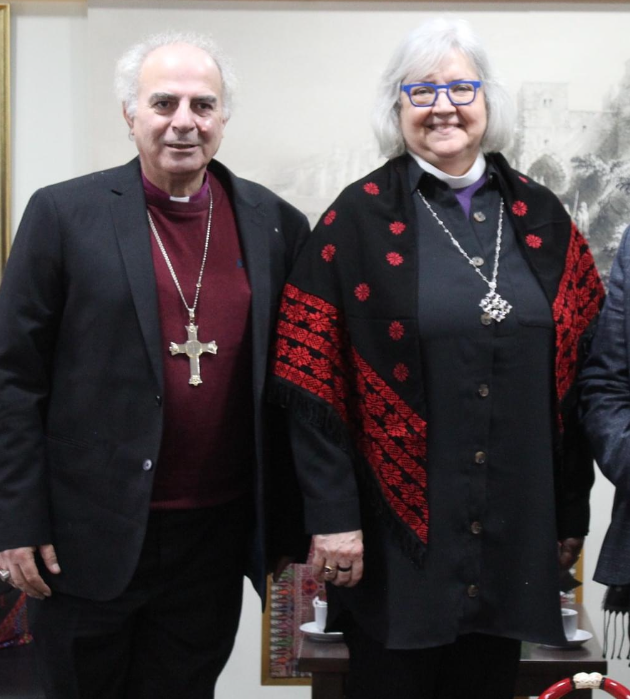
Today is Global Mission Sunday in the ELCIC. In Bishop Johnson’s sermon for today,[8] she reflects on our relationship with the Evangelical Lutheran Church in Jordan and the Holy Land (ELCJHL). In the midst of all their troubles, especially war, they continue to live in hope and faith.
Bishop Susan was actually in the Holy Lands last month, and talked with Bishop Ibrahim Azar about the very toned-down Christmas they had just experienced. She asked him how it had gone and he said to her how hard it was. “But,” Bishop Azar said, “Christ was born again in our hearts.” Christ was born again in our hearts.
If the ELCJHL can be faithful and continue ministry in their extremely difficult circumstances— keeping congregations and schools open and serving those in need, what about us?
Here’s a prediction that cannot be denied: We can certainly continue with faith and hope in the midst of the challenges we face!
Thanks be to the God, who continues to heal in Christ’s name, we pray. Amen.
[7] Garrett, M. T., Garrett, J. T., & Brotherton, D. (2001). Inner circle/outer circle: A group technique based on Native American healing circles. Journal for Specialists in Group Work, 26(1), 17-30.








 Raspberryman