Divine tears, divine love

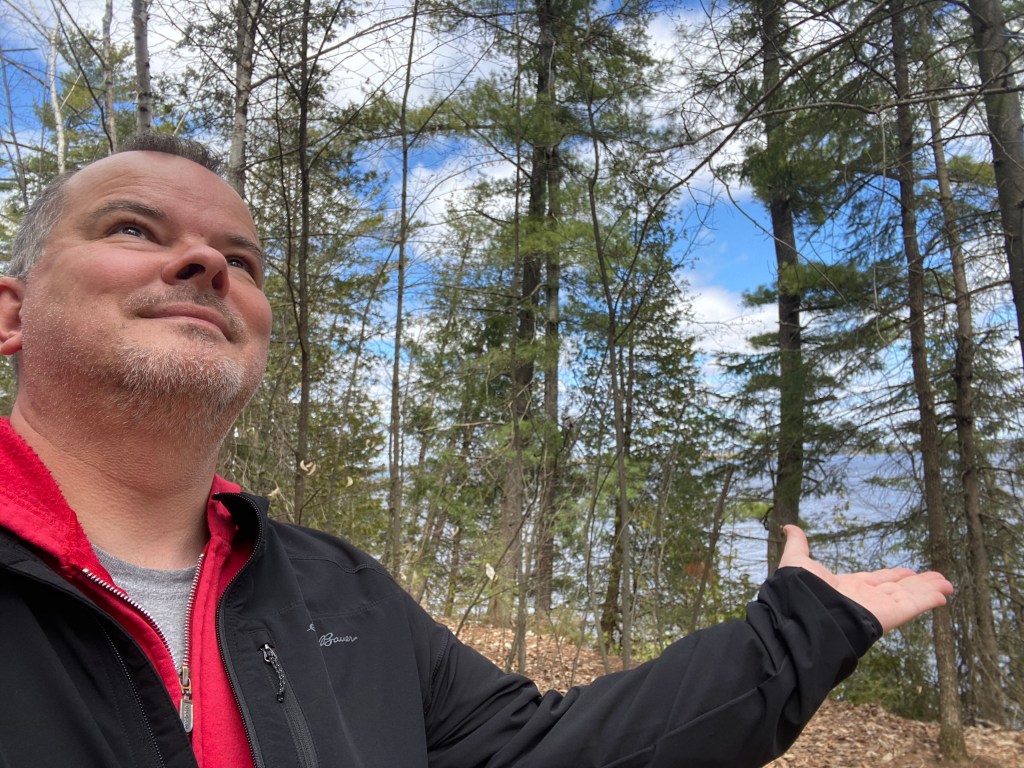
Spending more time outside these days, I’m reminded of standing in the grove, in Arnprior, with my arm outstretched, with birdseed in my open hand. I stand still, and wait.

The chickadees know that visitors to their part of the grove will sometimes bring them treats. And if they happen to be perched in the trees around you when you go with seed for them, you might have dozens of birds feeding two at a time from your hand.

This is like the posture of prayer. Which is our connection with God. Our part, is to be intentional about going into that place of prayer first of all. We have to choose to enter into it. It also a posture of being still, and being open. As with feeding the birds from your hand, prayer is about putting yourself in a position where grace can catch you. You know the saying: Faith is not so taught as it is caught.

In our relationship with God, we cannot control the outcome. We don’t know if and when what we may want will happen. The only thing we can do is return regularly to nurture that inner stance of openness to God.

Because God is free. And in our relating with God, in our prayer with God, we become free. It is in the savoring, the waiting, the creating space and time for God that over time and with practice we become free.

In a recent poll, half of respondents said their mental health has worsened over the last month, including 10 per cent who said it has worsened “a lot.” “Worried” and “anxious” were the top two answers, emotional states that experts don’t expect to dissipate any time soon.[1]

Physical distancing, for example, has taken its toll. Perhaps the most emotionally difficult aspect of this whole experience has been losing our freedom to touch, to hold, to comfort and be physically present with those we love – whether in the ICU units, gravesides or around dining room tables.

Physical distancing and self-imposed seclusion have exposed our attachments. “What do you mean I can’t visit my loved one?” we object. Our attachments correspond to what we control in our lives. Or, believe we have some control over.

Losing control over our attachments has understandably caused us increased anxiety, fear and anger. We have experienced a collective loss – a way of being community, of gathering in public places shoulder to shoulder. I wonder how long it will be, if ever, before we experience some of those things again. That is why it is so important not to delay or postpone our grief. We cannot wait until after the crisis is over to grieve.[2]

We must lament now all the things we have lost and are losing during this time – travelling, weddings, celebrations, holidays and holy days, jobs, business, dreams, friends and family members – all of it. While we can delay certain services, there is no postponing grief. Now is the time for each of us to feel it – the guilt, shame, rage, fear, frustration, denial. All of it.

I remember learning in seminary of the importance of being present to someone in ministry. We called it the ‘ministry of presence’. At the same time, we were encouraged to reflect on its counterpoint: the importance of embracing a ‘ministry of absence’.[3]That is, the healing, grace and growth that happen in times of being absent from one another. Then, I wasn’t exactly sure I understood that concept fully. But now, I am coming into a greater appreciation of its meaning.

Because during the COVID-19 crisis, we are realizing that our physical distancing – our ‘absence’ – actually saves lives. We are practising a new way of being with others. Who would have thought that creating physical distance would be an authentic and effective way to care for our loved ones and neighbours, especially the most vulnerable?

It’s hard to move in this direction, however, when we haven’t come to terms yet with our losses. The irony is that we come to affirm our healthy, life-giving connections during this crisis only by grieving what we have lost throughout all of this. Losing something or someone is letting go. Letting go is about acceptance. Acceptance is freedom.

There was a period of time shortly after I was ordained that it seemed in every funeral I did the family chose the scripture that is the Gospel for today.[4]Jesus says, “In my Father’s house there are many dwelling places …” It appears that at times of loss, Christians express their hope with a vision of coming home. A spiritual home. A place of union in the eternal love of God.

God shows this incredible, free, love to us now. God is a God who chooses to show that love in tears shed for us in our losses. In Christ, we can see those tears when Jesus wept at the death of his friend Lazarus[5], when Jesus lamented over Jerusalem for murdering its prophets[6], on the cross begging for the forgiveness of those who tormented him[7].

What the present crisis is offering us is an opportunity to approach ourselves with the love and forgiveness of Jesus. So desperately needed, now. What this crisis invites us to do is become open to the love and care that is offered to one another, imperfect though it may be. What this crisis invites us to do is practice being vulnerable – with ourselves, with others and with God.

When we give ourselves to prayer – however we do it – we practice the awareness of God’s presence. One of my favourite outdoor lawn care activities is aerating the lawn. It’s when that machine goes over the lawn leaving clumps of dirt lying all over the pocketed yard. This allows much need oxygen to enter and stimulate growth in the earth. Prayer time, meditation, contemplation, biblical reading, mindful walking – this work aerates the lawn of our minds and hearts. So the breath and the life of God can enter in.

To begin with, just notice your breathing. And not just breathing in, but especially the outbreath. We can’t hold our breath forever. We can’t control it. We’ll die if we don’t let go. So, exhaling is necessary for life. It is also an act of great trust. At that moment when you finish exhaling, there is a space, the moment of ‘death’. That’s when grace happens. Trust the outbreath, and God will breathe life into you. Again.


[1]Jonathan Forani, “Half of Canadians report worsening mental health, experts say woes just beginning” (www.CTVNews.caApril 27, 2020) 

[2]Nathan Kirkpatrick, “How to think about what’s next when the future is unclear” in Faith and Leadership (Durham N.C.: Duke Divinity, www.faithandleadership.com, 2020)

[3]I believe the writings of Henri Nouwen introduced me to the idea of ‘absence’ being just as an important part of ministry as ‘presence’.

[4]John 14:1-14

[5]John 11:35

[6]Luke 19:41; Matthew 23:37

[7]Luke 23:34

Three handles for the path – How the COVID-19 crisis reveals contemplation’s greatest gifts

We find ourselves in an extraordinary time in world history. Millions around the world have fallen ill and so many are grieving the death of a loved one or neighbour. In Canada alone millions have lost jobs, some are vulnerable and feeling unsafe because of financial or compromised health concerns, other still risk their lives daily in the essential service sector. We all experience this crisis from different perspectives and circumstances.

We are also meditators, or at least are curious about this path of prayer that practises silence and stillness and that moves us towards being present in ourselves, in this world and in Christ.

What has this crisis revealed to you? How do you respond? How does meditation and prayer increase your resiliency in times of stress?

Contemplation offers many gifts, many fruits of following the path. I want to talk about three handles that describe the landscape of the contemplative life, especially in light of the global crisis we have all experienced in various ways over the past month and a half. 

Three Handles for the Contemplative Path – How the COVID-19 crisis reveals contemplation’s greatest gifts

Handles are what we hold on to as we make our way along the path: Connection; Embracing Loss; Renewing Life. Here are three handles that reveal contemplation’s greatest gifts to us. These handles open doors of awareness on the path of contemplation.

1.   Connection

As the national coordinator for the Canadian Christian Meditation Community, I look for the connections. I try to see the network of relationships that comprise the landscape of meditation groups, events and organization across the country. How Christian Meditators connect is a question that energizes my work for the community.

The COVID-19 pandemic crisis, as a shared human experience, first reveals to me how intrinsically connected we all are for better or for worse. The virus itself could not have travelled so quickly and so far without the advances of technology. Our contemporary fascination and obsession with travel can get us around the globe at speeds never before in history possible. Our hyper-active culture was the efficient delivery system for this virus.

There’s a socio-economic aspect that cannot be overlooked. The viral transmission was facilitated by those of us – predominantly the privileged, monied and ‘successful’ – who for either business or pleasure make it an important part of our lifestyle to jet-set. The economy of privilege and wealth made this virus so potent in its rapid spread across the globe. 

You might recall the segment of the population first targeted were those who had travelled and were returning home. They were the first to self-quarantine for 14 days beforelocal, community transmission became a concern. 

Our identity in the World Community for Christian Meditation has been for decades now animated by our ability to meet anywhere in the world. The pandemic has exposed our vulnerability in maintaining and growing those beloved connections, in person. The global crisis raises questions about our capacity for bringing people from around the world together under one roof in one place and time, for retreats and seminars.

How do we see ourselves as a community? Where do you locate yourself within the Christian Meditation community (group, region, national, world)? How will we sustain and build those relationships, moving forward?

These are some of the questions that first emerge for me during this time of seclusion, physical distancing and suffering for many. But there are deeper questions to ask.

I currently work in the large, urban setting of Ottawa. The city lies on the banks of the Ottawa river, which flows south and east towards Montreal, the St Lawrence River and finally spills into the Atlantic Ocean. From Ottawa, if you follow upriver north and west, you move into smaller, rural towns in the Upper Ottawa Valley.

Earlier in my life I served a parish in Pembroke about 150 kilometres northwest of Ottawa. When speaking to an old friend from Pembroke last week, I was again reminded of how this virus knows no boundaries. There have been, to date, more recorded infections of COVID-19 in the Upper Valley than in the small town in which I live, closer to the city limits. 

Normally, rural-living people don’t associate much with the ‘problems’ of the larger urban centres. They see themselves apart from, and take pride in, being disconnected, unburdened and somewhat free from the concerns of the large city ‘far away’. But my friend in Pembroke talked to me of how people in her parish were practising social distancing, disciplining themselves by limiting their worship recording session to five people standing at least two metres apart. 

Regardless of where you live, rural or urban, you cannot isolate yourself from the danger. Deep in this crisis now we cannot deny the truth that it is our collective problem, and not just someone else’s living on the other side of the globe or only in the big cities. 

All of us participate both in the transmission of the problem and in its resolution. We are asymptomatic transmitters of the disease, or symptomatic sufferers, or symptomatic transmitters, or one of the growing number of recovered and hopefully immune, or as the fortunately unaffected and un-infected. Each of us is a participant in the crisis.

Of course, we didn’t need COVID-19 to introduce us to the idea of our common humanity. Especially as Christians we have always affirmed our inherent connection, our ‘unity in Christ’. Whether we say we participate in the invisible, spiritual unity, or hopefully sometimes even participate in some wonderful visibleexpressions of unity, we are united.

Christian Meditation brings together people from various religious or non-religious backgrounds. We are united in the silence, the stillness in the presence of Christ regardless of creed or doctrinal affiliation. We don’t speak words out loud in our prayer. Language, after all, tends to divide and differentiate, which is not a bad thing. As Father Laurence Freeman expressed in his Holy Saturday talk from Bonnevaux this year, we need language.[1]

But underneath the language is the silent breath of God that flows through and holds us all in love. In Christian Meditation we affirm our ‘boundary-less’ solidarity in the love of Christ. We affirm our common humanity. We can be present to and share in the living consciousness of Jesus, whoever we are and wherever we live, all the time, in the prayer of the heart.

How we ‘see’ this is vital. If it is raining outside, we have a choice. We can see the rain and conclude that our lives are a waste and a wreck, and wallow in self-despair. Another way of seeing has us simply accept the rain. “Yup, it’s raining.” 

Here we may want to recall the apophatic roots of the mystical prayer tradition: Seeing is not thinking. The sight, here, is not physical. It is neither tied to our thinking process nor our capacities for doing, imagining, or saying anything. In truth, as 19thcentury American essayist Henry David Thoreau noted, “I begin to see an object when I cease to understand it.”[2]

Here is an inner vision that sees the self and the world within the web of human inter-connectedness. It is a web that is given not constructed. It is an inter-connectedness that we affirm despite all that separates us. We experience loving union, despite ourselves. We simply step into it, are present to it, whenever we meditate.

God dwells in all our hearts. God chooses to make home within us all. This is the promise of scripture. This is the reality of God with us.

Given the traditional ways we have self-identified (language, urban/rural, elderly/youth, binary/non-binary, financially independent/poor, upper class/middle class/lower class, Catholic/Protestant/a-religionist, etc.) how has the COVID-19 crisis affected your vision of our unity—our connection as human beings? Do you ‘see’ a change within you, if any? How so?

2.   Embracing loss

As many people enter a seventh week of self-isolation, the COVID-19 pandemic is unifying us in our anxiety.

In a recent poll, half of respondents said their mental health has worsened, including 10 per cent who said it has worsened “a lot.” “Worried” and “anxious” were the top two answers, emotional states that experts don’t expect to dissipate any time soon.[3]

The global pandemic placed unprecedented restrictions on us. Not only has time slowed down. But in that slowing-down we have noticed the smaller things around us and in us, the ‘smaller’ things that normally have gone unnoticed, unrecognized: underlying beliefs, attitudes, dispositions. If ever we had been borderline depressive, or borderline obsessive compulsive, or borderline anything, the COVID crisis may have just tipped us over the edge.

Physical distancing, for example, has exposed our attachments and severed the links. “What do you mean I can’t visit my loved one?” Anxiety, understandably, follows. The irony is that we come to affirm our healthy, life-giving connections during this crisis only by coming to terms with our losses. Losing something or someone is letting go. Letting go is about acceptance.

Perhaps the most emotionally difficult aspect of this whole experience has been losing our freedom to touch, to hold, to comfort and be physically present with those we love – whether in the ICU units, gravesides or around dining room tables. We have experienced a collective loss – a way of being community, of gathering in public places shoulder to shoulder. I wonder how long it will be, if ever, before we experience some of those things again.

As is natural for us human beings under stress and anxiety, we have formulated coping strategies in the grief process: denial and anger to begin with. Anger comes probably in the guise of blame – blaming the government or some nation; blaming local authorities for mis-managing, mis-communicating, mis-analyzing. 

Of course we know that blame is a poisonous, destructive way of processing our grief because we do so by hurting others when really anger is the invitation to do some much-needed inner work. The blame game, we know, says more about the person playing it, than it does about the object of the blame.

Along with our social attachments, we have lost a sense of safety, security, certainty and control. This has been a season of loss, if anything. And we’ve devised many ways of managing and coping with these losses. Addictive behaviour keeps us from fully feeling, embracing and accepting the limits of our very humanity in this present moment.

For me, it is thinking compulsively about ‘what’s next’ that keeps me locked in my head – everything from the next item on the agenda or schedule of my work day to how I approach my hobbies and past times, to pondering what I need to get done tomorrow and the day after tomorrow. I fixate on those things. Thinking, again, keeps me from my heart, and from experiencing, accepting and being loved in the present moment.

If you do have time and willingness to read some books during this stay-at-home time, let me recommend four: First, Jim Green’s “Giving Up Without Giving Up: Meditation and Depressions”; Beldon C. Lane’s “The Solace of Fierce Landscapes; Exploring Desert and Mountain Spirituality”; Gregory Mayers’ “Listen to the Desert; Secrets of Spiritual Maturity from the Desert Fathers and Mothers”; and Ernest Kurtz and Katherine Ketcham’s “The Spirituality of Imperfection: Storytelling and the Search for Meaning.”

When we have the courage to look into our hearts, perhaps more than anything we are afraid at what we may find there. So, we avoid this more courageous path of going there by getting trapped in our heads. We will more easily find blame or worry about some abstract future scenario. We will more easily distract ourselves into addictive, compulsive behaviour. 

Yet, what the present crisis is offering us is an opportunity to confront the fearful side of ourselves with love and forgiveness. So desperately needed, now.

The practice of Christian meditation allows us to traverse the inner terrain, this landscape of desert, aridity and loss. The unproductive and detached manner of Christian Meditation leads us there, and probes into that silence underneath the cacophony of emotions, compulsions and images that collide and broil to the surface of our consciousness. 

“The only way we can contemplate is recognizing and relativizing our own compulsive mental grids—our practiced ways of judging, critiquing, blocking, and computing everything.”[4]

It is to let it be. When we return to the mantra during our meditation we don’t do violence against the woundedness of our soul. We don’t avoid, deny and repress the thoughts, the turmoil of emotions and darkness of our depths. In truth, we do the opposite. We let them rise to the surface of our awareness. We let them be. And when they pique, we look elsewhere. We shift our gaze, our attention, to the word. 

In praying, then, we participate in the widening of spaciousness both in time and consciousness. It is aerating the lawn of our minds and hearts. We venture into an expanding divine space, the in between space where God’s grace and love exist. It is by probing this awareness within us that eventually those thoughts, emotions and images let go of us. 

Meditation is the ability to tolerate and then to be in relationship with what is.[5]The mantra, then, is the word in whose interior rhythm we experience a deeper listening, in love, to our true self in God.

Richard Rohr writes, “Contemplative prayer always requires hospitality to your deep self, to the deep parts of yourself. It demands the openness to receive whatever might arise in you and then gently release it into God’s hands … You do so in a relationship that provides a safety and support in holding whatever emerges. Whatever emerges in silence and stillness before God emerges in the place within you in which you are held within God.”[6]

What do we learn in this space?

First, in the practice of prayer we discover that our discipline does not constrict the time of our day. It’s not that we don’t have time to meditate. Paradoxically those who meditate twice daily experience a broadening of time so that they, in fact, have more time to do what they need to do. More time than they ever had, COVID notwithstanding.

Second, when we remain in the space of our limitations, even for a short time, we begin to learn what it feels like to ‘die before you die’: when the bottom falls out of all our spent resources. Dying before dying is embracing the consequences of our resistance to being un-attached, un-productive, and un-successful. The effect of our ego-impulse to be attached, to be busy and find self-worth in comparing and competing can harm others and ourselves. Recognizing and confessing this in brutal honesty, hurts.

So, we must “trust the down”, in Richard Rohr’s words. Trust the down and God will take care of the “up”. Trust the falling, the letting go, the releasing of control. Trust that our limits, our failure, our suffering, our imperfection is integral to the journey, the pilgrimage towards transformation. Trust the down, the out-breath. Because the “unloading of the unconscious … [contemplation] is the visible face of the invisible process of reworking your unconscious, a process that is going on as you sit in stillness before God and yourself.” 

Trust the down, the outbreath. We can’t hold our breath forever. We’ll die if we don’t let go. So, exhaling is an act of great trust. At that moment in breathing when you finish exhaling, there is a space, the moment of ‘death’. That’s when grace happens. Trust the down, and God will breathe life into you. Again.

During this time of expanded time that feels both slow and goes by so quickly, the discipline of prayer allows “the deep hidden work of healing and transformation that God is doing in your soul” in the midst of all our losses.

What within you resists the present moment which this crisis has open for you? What keeps you stuck in the cycles of denial or blame?

How will you allow the fear, the self-incriminations, the anger and guilt to co-exist in your life and within your practice of prayer?

3. Renewing Life

Spring is in the air! In more ways than one, we are beginning again. In our collective consciousness, our hearts and minds are turning towards a new beginning: With hope and anticipation we look forward to the time we can meet in person together, and when we can experience the freedom to eat-out and meet in public spaces again. 

The posture in our hearts of ‘starting over’ is an Easter hope. New beginnings. New life. Like the proverbial phoenix rising again out of dust. Jesus’ resurrection announces this truth. And if it’s true with Christ, it is true everywhere and for all.

We are all beginners, rookies on the field of life. We say this about our prayer practice. In a sense, no matter how experienced we are. Whether we have been meditating all our lives or just a few days, each time we sit down in silence and stillness, we begin again. When we see ourselves perpetually as beginners on the journey, we become ready for anything, and are open to all possibilities.

How do we start over? Remember the basic pattern of liturgy: Someone must start it all. Someone initiates the conversation and says, for example, “The Lord be with you”. Those of us practiced in this way of worship will know that the conversation may start there but doesn’t end there. We need to respond, “And also with you.”

There is this back-and-forth flow dynamic between God’s word, God speaking and how we hear that and what we do with that. There is this back-and-forth flow between what God says to us and our response to God’s life and love in all and for all.

How do we begin again? How do we begin each time to strengthen this relationship? We can consider Jesus’ words: “I have come to give you life and life abundantly”; that is, we nurture our own lives as a responsiveness to God’s own life. Our lives thus share in the abundant vitality of God.

If anything, we may have been shocked by the COVID-19 crisis to consider how to live well. What we’ve had to stop, what we’ve had to pause, what we’ve had to close – and not just for a week or two as I suspect many of us initially expected, but for months. All these restrictions are causing us to reflect on the meaning of our lives and what might emerge from it.

I also suspect more and more of us are coming around to accepting that what does emerge will not be “back to normal” to the way it was right before we had to lock things down. What does emerge will likely, over time, be some kind of integration, blending, hybrid of what we have been doing in the last several weeks in physical distancing with social gathering.

The words of Jesus about abundant life come to us in this season of Easter – the season of resurrection and new life. These new words are a language of recovery, where we tell stories about the way we were and what it used to be like living; and how we are living now. I said earlier when reflecting on the handle of loss, that we have a choice: Self-love, forgiveness, embracing the imperfection within us. This was the first choice. But not the last one.

The liturgy calls forth our response. The Lord be with you. And also with you. The second choice is to live out from that pivot, that handle, of loss. To truly live, to be awake and alive to this gift of the present moment, we live out of the forgiveness and self-love, confident in our connection with all of creation. We live out of this awareness towards the transformation of the world. Meditation leads us from the center point within, to embrace a divine vision for all. 

Being in liminal space leads us to the new thing. Remember the visions we have seen over the past month: the foxes trapesing across the Golden Gate bridge, the clear, smog-free blue skies over Los Angeles and Himalayan peaks never before seen!, the new species being discovered because of human economic restraint, the clearer waters in Venice. 

We’ve also witnessed a dramatic and unified political will – a clear choice we have – to give financial aid to the most vulnerable in the economic crisis and recently increase the hourly wage by $4/hour to essential health care providers.[7]

If we can do it now, why can’t we do it again, in some way? When the devastating effects of the pandemic continue to wreak havoc in vulnerable places of the world. Famines will expose unjust systems of wealth and food distribution. When the effects of the economic slow-down continue to devastate families in poverty, the homeless, the poor, Indigenous peoples, vulnerable communities. In the aftermath, why can’t we continue to enact the vision and exercise willingness to make things better for all people?

Eco-theologian Thomas Berry expresses this notion in writing that we need, in our age, is to dream the new world into existence. We must dream the way forward. “We must summon, from the unconscious, ways of seeing that we know nothing of yet, visions that emerge from deeper within us than our conscious rational minds.”[8]

The new life post-COVID is not “now all my problems are solved”. This new life is not “going back to the way things were.” The new life is not problem free nor tripping into some sentimental, perfect past. 

It is a new thing. It is a new way of seeing the world as it is, whatever it is. The Prophet Isaiah captured this divine work in Hebrew poetry: “Do not remember the former things, or consider the things of old. I am about to do a new thing; now it springs forth, do you not perceive it? I will make a way in the wilderness and rivers in the desert.”[9]

Christian Meditation anchors us in a daily practice that expands our consciousness to transcend who we are and include what we have seen. Christian Meditation anchors us in a daily practice of connecting ourselves to the source of love and life in all and with all. 

God has chosen to dwell among us. God has made us the temple of God’s presence. Christ lives in us as we live in Christ. And so, we are confident in who we are, beloved of God in whom we live, breathe and have our being.

What new practice, discipline, routine, habit, project have you tried during seclusion that has given you hope? What will you continue to do and what new thing will you bring to your life post-COVID? Who has accompanied you on this journey of discovery and growth?


[1]www.acontemplativepath-wccm.org

[2]Cited in Ernest Kurtz and Katherine Ketcham, The Spirituality of Imperfection: Storytelling and the Search for Meaning (New York: Bantam Books, 2002), p.69

[3]Jonathan Forani, “Half of Canadians report worsening mental health, experts say woes just beginning” (www.CTVNews.ca April 27, 2020) 

[4]Richard Rohr, “Liminality” (Daily Meditation, 16 February 2020, www.cac.org

[5]Jim Green, “Giving Up Without Giving Up” (New York: Bloomsbury, 2019), p.100

[6]Rohr, ibid.

[7] in Ontario

[8]Richard Rohr, “Liminal Space” (Daily Meditation, 30 April 2020, www.cac.org

[9]Isaiah 43:18-19

Going through

Spring is in the air! In more ways than one we are beginning soon again. In our hearts and minds we are turning towards a new start.

With hope and anticipation we look forward to the time we can meet in person together again. We look forward to the time when we can experience the freedom to eat out, and meet in public spaces again. 

The posture in our hearts of ‘starting over’ is an Easter theme. New beginnings. New life. Like the proverbial phoenix rising again out of dust. Jesus’ resurrection announces this truth. And if it’s true with Christ, it is true everywhere and for all.

We are all beginners, rookies on the field of life. In a sense, no matter how experienced we are. Whether we have been Christian all our lives or just a few days, each time we do anything in the awareness of God-with-us, we begin again. With this attitude of always a beginner, we are then ready for anything, and open to all possibilities.

How do we start over? Remember the basic pattern of liturgy: Someone must start it all. Someone initiates the conversation and says, for example, “the Lord be with you”. Those of us practiced in this way of worship will know that the conversation may start there but doesn’t end there. We respond, “And also with you.”

There is this back-and-forth flow dynamic between God’s word, God speaking and how we hear that and what we do with that. There is this back-and-forth flow between what God says to us and our response to God’s life and love in all and for all.

How do we begin again? How do we begin each time to strengthen this relationship? We can consider Jesus’ words in the Gospel for today: “I have come to give you life and life abundantly”[1]; that is, we nurture our own lives as a responsiveness to God’s own life. Our lives share in the abundant vitality of God.

If anything, we may have been shocked by this crisis to consider how to live well. What we’ve had to stop, what we’ve had to pause, what we’ve had to close – and not just for a week or two as I suspect many of us initially expected but for months – all these restrictions are causing us to reflect on the meaning of it all and what might emerge from it.

I also suspect more and more of us are coming around to accepting that what does emerge will not be “back to normal” to the way it was right before we had to lock things down. What does emerge will likely, over time, be some kind of integration, blending, hybrid of what we have been doing in the last several weeks in physical distancing with social gathering.

During the Easter season we celebrate Good Shepherd Sunday. Images of Jesus tending flocks of sheep and holding the lost sheep over his shoulders populate our imaginations. Yet in the Gospel text today, specifically, Jesus self-identifies as the gate. This is one of many “I am” statements Jesus says in John’s gospel. He’ll go on later in the chapter to say “I am the good shepherd.” But here we dwell momentarily on the image of Jesus as the gate. The care, the love, the compassion of Jesus come to us through the gate.

A gate is a way through. A gate is a place of transition. A gate marks a boundary between what is and was to what can be, beyond. Jesus is that gate that beckons us forward.

We have found ourselves these days in seclusion and isolation. It is an in-between space in time, of being in that ‘already but not yet’ place. It is not a comfortable place to be in. It can be very disruptive to those especially who have lost jobs or have become sick, who have lost loved ones and who suffer fear and anxiety as a result. 

And yet, rejecting, repressing and avoiding that in-between and uncertain place keeps us from entering and going through the gate. The gateway threshold, in Christ, is in truth a graced time, but often does not feel ‘graced’ in any way. Because moving through the gate, as slow and as long as this feels like, keeps us struggling with uncertainty, and calling so-called normalcy into creative question.

In such space, we are not in control. That is why Jesus must be the gate. 

The gift of being in this place in the love of Christ is that Jesus guides and leads. Moving through this space, we do not do so on our own terms or strength. It is the love and faith of Christ that is the engine, the propulsion and momentum to new life beyond the gate.

The gate leads us to a new way of seeing and being in the world. It is the place, too, where we can begin to think and act in new ways. While we are betwixt and between now, having left one room or stage of life but not yet entered the next, the very vulnerability and openness of this space allows room for something genuinely new to happen.[2]

It’s hard now to know for sure what that ‘new thing’ exactly will be. At the same time, we can foster within us an approach to abundant life in Christ in such a way that gives life and energy to possibilities. Theologian Charles Eisenstein wrote about leaning into “a more beautiful world our hearts imagine can be possible.”[3]

The new life post-COVID, even new life in Christ, is not “now all my problems are solved”. This new life is not “going back to the way things were.” The new life is not problem free nor tripping into some sentimental, perfect past. 

It is a new thing. It is a new way of seeing the world as it is, whatever it is. The Prophet Isaiah captured this divine work in Hebrew poetry: “Do not remember the former things, or consider the things of old. I am about to do a new thing; now it springs forth, do you not perceive it? I will make a way in the wilderness and rivers in the desert.”[4]

An opportunity lies before us all. We may witness a global reset of priorities. Individually, too. What are those priorities? And let’s live into them, in the weeks and months to come. Remember the life-giving visions we have seen in the last month: the foxes trapesing across the Golden Gate bridge, the clear, smog-free blue skies over Los Angeles and Himalayan peaks never before seen, the new species being discovered because of human economic restraint, the clearer waters in Venice, the political will to give financial aid to the most vulnerable in the economic crisis and recently increase the hourly wage by $4/hour to essential health care providers.[5]

Let these visions inspire us to enter the gate. Let these visions empower us to become what Jesus is calling us to be. Let new and abundant life fill you as you follow Jesus through.


[1]John 10:10

[2]Richard Rohr, ‘Liminal Space’, Daily Meditation, 26 April 2020, www.cac.org

[3]www.charleseisenstein.org

[4]Isaiah 43:18-19

[5]In Ontario

Love finds us

This past week across Canada we’ve seen more and more indication that we are starting to ‘flatten the curve’. That is to say, new cases of coronavirus infection today do not greatly exceed the new cases recorded yesterday. Day over day, we aren’t seeing anymore spikes in new cases.

This is good news. But people are still getting sick, and dying. And our officials are telling us not to waver in our disciplines around physical distancing. We are not out of the woods yet. We can’t relax isolation practice. We must still stay at home and go out only when absolutely necessary.

A glimmer of hope that our hard work is starting to pay off. But we’ve been at this over a month already, and just now we are starting to get some good news. This process is taking a long time. As someone told me, we are in a marathon.

I’m not a marathon runner. But I did walk part of the Camino in Spain a few years ago. And I remember those days when I accomplished thirty to thirty-five kilometres were days that I bided my time and pace. I had to conserve energy, especially at the beginning of the day when I had energy and drive. I held back from going ‘all out’ early because I knew I would be walking late into the afternoon and still have hills to climb and descend at the end of the day.

Despite my good efforts and intentions, however, it didn’t always work out. I didn’t walk thirty kilometres every day. Occasionally unexpected obstacles prevented from moving on – Half way through what was turning out to be a good day on the trail, my knee locked. Sometimes finding food or bad weather delayed or cut days short. Sometimes it felt like I wasn’t making any progress at all. I wondered if I’d ever make it to my destination.

Two disciples are on half a day’s walk to Emmaus, and away from the holy city and the dramatic events surrounding the death of Jesus, their friend and their Lord. This resurrection story from the Gospel of Luke[1]reflects all that is good on a pilgrimage: the vulnerable sharing in intimate, trusting conversation; the encounter with strangers who become friends; the sitting at table and sharing in breaking of bread. And, in all of these very human experiences we recognize, sometimes in a moment of surprise, the risen, living and loving God in Christ Jesus who accompanies us in all these ventures.

The disciples are surprised with joy when they finally recognize Jesus. The full realization doesn’t happen until after the fact: “Weren’t our hearts burning when we talked on the road?” This surprise factor – a blessed goodness – is given, not earned. Indeed we are not in control of the love and grace that comes our way. Love finds us in the journey. Even if we don’t see it right away.

On Easter Sunday I spoke of the life that finds us. The life of God in Christ is animated, is conveyed and energized by love. In Easter, life and love come together as one. The life of Jesus comes about through death and resurrection. And it is all made possible by love. On our pilgrimage in life, love finds us. God seeks our good. Even when we can’t recognize and fully appreciate it right away.

My driven self feels sorry for those disciples for having to make that long walk back to Jerusalem. They went all that way to Emmaus only to head back to Jerusalem – the place of their fear and anxiety. What a wasted journey! How unproductive and inefficient a process! Why couldn’t Jesus just appear to them where they were to begin with, without having had to walk all that distance?

And yet, God’s love comes to us. God’s love comes to us even when we are not necessarily fully aware of God’s presence. God’s love comes to us despite our inefficiencies, mistakes and heroic interventions. God’s love finds us in doing things imperfectly, within our human limitations, when things don’t quite work out in the way we had envisioned. 

“There is no direct path to goodness,” Theologian David Ford so describes the paradox of being found by love amidst the confusion and messiness of life. We don’t construct a good life. Rather, he talks about an “active passivity”.[2]Especially when we don’t know exactly how things will work out in the end – this is when we experience Christ sustaining us, being present to us. And it’s while we are on this uncertain journey when we are surprised by grace and love.

I learned an expression walking part of the Camino de Santiago a few years ago: “Attaquer le chemin!”. Perhaps because for a few early days I walked with a couple of French speakers, the attitude expressed in that phrase (to attack the road) revealed a rather compulsive driven-ness to succeed and accomplish something.

My negative reactions when things didn’t work out for me on the Camino exposed my pretense and delusion of being in control of the outcome of my good efforts and intentions. My rather masculine and heroic attempts to attaquer le chemin kept me from being receptive to God. My anxious determination to take control, to be in charge of my destiny obstructed my view of God where God was.

My egoic need to possess ‘my own’ Camino experience blinded me to the good and the grace that was, in truth, coming my way and offered to me over and over again, each day: Despite the exhaustion, frustration and discomfort of the pilgrimage, I was given safe and comfortable shelter each night. I did find enough nourishing food and companions along the way to share with. I was only able to fully appreciate these gifts in hindsight.

This grace – the love of God – is born again in your heart this Eastertide. Christ is risen! Not once the marathon of physical distancing, seclusion and what may feel like imprisonment is over. But Christ is risen right in the midst of the efforts, the fits, the starts, the backtracks, the failures and the mundane. Right now. Right here. Can we therefore not step into the love, hope and grace of God that is always there? And live out of that love?

I pray you know this love and hope. Amen.


[1]Luke 24:13-35, for the Third Sunday of Easter, Year A (Revised Common Lectionary).

[2]Australian Anglican priest, theologian and writer, Sarah Bachelard, cites David Ford in her webinar on ‘A Living Hope: The Shape of Christian Virtue’, 21 April 2020, www.wccm.org

An earth-quaking resurrection

An earthquake makes sense on Good Friday. With the passion of grief, the sorrow of injustice and the horror of torture and painful death. An earthquake makes sense there, in those situations. We normally associate dying, losing and suffering with disruptive forces, earth destroying events.

Indeed, the earth itself is involved and participates in the dramatic telling of Jesus’ death. When Jesus breathes his last on the cross, there is an earthquake and the rocks split according to Matthew.[1]

Do we notice, nevertheless, that the resurrection of our Lord also includes an earthquake? In Matthew’s gospel, there is a great earthquake at the dawn of the first Easter when the women come to the tomb. In fact, this earthquake precipitates the telling of the resurrection, when the angel of the Lord comes and rolls the stone away. Then, sits on it.[2]

The story of resurrection is not without its own earth-quaking truth. The words ‘fear’ and ‘afraid’ dot the landscape of the telling not only in Matthew’s version but John’s as well. As the angel in Matthew tells the women: Do not be afraid,[3]so Jesus tells the disciples hiding for fear behind locked doors in the upper room.[4]The context of the resurrection reflects tectonic degrees of disruption, anxiety and fear among those closest to the power of Jesus’ resurrection life.

And, the power of resurrection is not limited to Jesus. Matthew is very clear that “after Jesus’ resurrection, they [the bodies of the saints who had died and were raised] came out of the tombs [after the Good Friday earthquake] and entered the holy city and appeared to many.”[5]

Resurrection also happens unto us, and in us! The living Christ renews us – not only for the life to come. But starting in this life! We are continually being reborn and renewed towards the good that awaits us.

Resurrection, therefore, is not regression. When Thomas the disciple finally arrives at his beautiful confession of belief in the risen Lord, it comes at the expense of his old self. He is not at the end the person he was a week earlier, when he had expressed his disbelief.[6]The story-telling compresses the time and process of his transformation. In truth, for most of us, that process of change takes much longer.

And yet, the dynamic is the same. Resurrection is not regression. Once Easter happens, there’s no going back. Think about a loved one who died some time ago, or when you lost something or someone, when you lost a certain way of doing things that you once cherished … 

We know that we can never again experience that which we lost, in the same way. There’s no bringing back ‘the way it was’. Even though at some point we will be able to interact again, socialize and worship together in one room, it will be different. Our hearts will be moved in a new way. The process of change introduces a new reality for ourselves and for the world.

In a short video-meeting with the confirmation class earlier this week, the question we asked of each other was: “What’s one thing you believe will be different for you and in the world, when all this is over?” The confirmand’s responses were varied: Everyone will wash their hands better and more often; the stores won’t remove the plexiglass and physical distancing signs; many more social gatherings, appointments, education and meetings will take place online. The truth is, we will not come through this experience unchanged. The world will be different. It won’t be ‘going back to normal’ but rather growing into a ‘new normal’.

This is resurrection. New life. It doesn’t come easy. In truth, getting there almost always requires an earthquake, a ground-shifting and -splitting experience. At the same time, it means we are headed in a life-transforming, a life-enhancing, a life-renewing direction. To a conclusion that is good, for all.


[1]Matthew 27:50-53

[2]Matthew 28:2

[3]Matthew 28: 5,8,10

[4]John 20:19

[5]Matthew 27:52-53

[6]John 20:24-29

Life finds us

This is an Easter we will never forget. Not just because most of us are confined to our homes this year rather than crowded together in one large room. But because of what is happening in the world around us. In our lifetime, in our generation, we are part of an unprecedented global event.

Due to the coronavirus pandemic …

This is the first Easter in 700 years, since the Black Plague tore through Jerusalem in 1349 that the Holy Sepulchre— housing the traditional sites of Jesus’ crucifixion and tomb—is closed to the public. Not since the Great Depression in the 1930s will our nation experience its highest levels of unemployment in the months ahead. Not since the great wars of the last century will we collectively hold our breath as the number of deaths increase into the tens of thousands and infections continue to soar into the millions worldwide.

This is an Easter we will never forget.

But if this is an Easter we will never forget, what is it about Easter we need to remember?

We need to remember that the risen Christ first met a couple of women outside an empty tomb in a quiet garden early that first Easter morning.[1]

We need to remember that the risen Christ met a couple of friends out walking away from the city to a small town called Emmaus.[2]That the risen Christ appeared to Saul, and only him, on the road to Damascus.[3]

We need to remember that the risen Christ came to a handful of his friends in a small upper room where he first breathed on them the Spirit of God,[4]and on a secluded beach for breakfast.[5]

We need to remember that is wasn’t in a large, packed room where Easter was first experienced. It wasn’t to an audience of hundreds and thousands crammed into a noisy sanctuary with trumpets sounding and voices shouting “Christ is risen!” where the resurrection first happened. We need to remember that Christianity grew not through mass media campaigns and slick marketing strategies to reach a multitude.

We need to remember that the story of Christ risen was told from one person to another, from generation to generation, until these stories were finally written down late in the first century. We need to remember that these verbal accounts and the faith that sustained them endured the plagues, world wars and social and economic upheavals of the ages.

We need to remember the resiliency and power of the message of Easter that life finds a way, through it all. And that life will find us.

The grace of Easter, the blessing of Easter, the good news of Easter is that despite our resolve, our efforts, our capacities, our ingenuity, our resources … God is resolved to find us. God’s life in Christ finds us. 

Even when we come up against the limits of all our own private resources, the limits of our strength, our knowledge … life finds us.

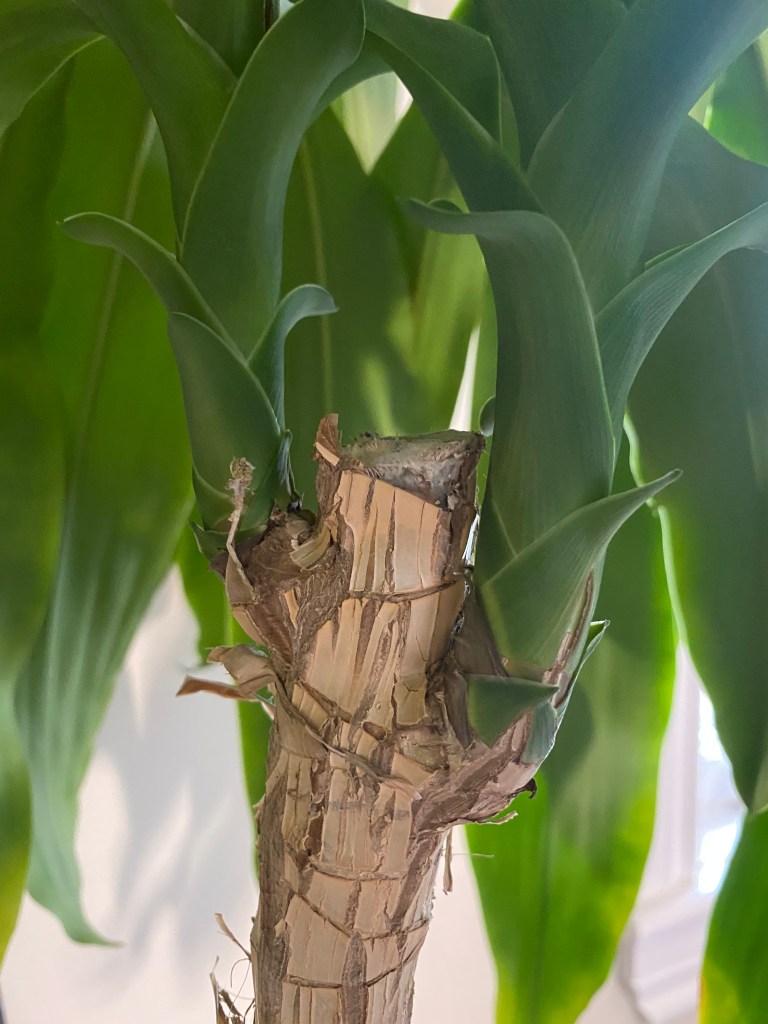
The palm tree-like plant in my office is a miracle of new life. Over the years it was growing too tall for any room in my house. There was no more room to contain its growth. I was all out of options. And it wasn’t an outdoor plant. It would surely have died.

In my ignorance, perhaps, in my impatience and frustration, I cut it down. There was only a couple feet of trunk left in the large pot. The day of the deed, I decided to just leave the protruding stick sitting in the pot for a few days before I had time later to dump it and rip out the root ball.

To my utter surprise and shock, however, a couple of days later I noticed a green bud emerge from the side of the stem. I couldn’t believe it! So, I started watering the plant again. And, wouldn’t you believe it, another small sprig had emerged on the other side of the plant’s stem.

Life finds a way. And life finds us. When we are at the end of our resources. When we feel we can do no more.

Life finds us. In the small things. Life finds us, personally. Christ comes to us where we are, in few numbers, in small places.

This Easter, one we will never forget, we need to remember that what started small ended as big. That what starts at home ends up changing the world forever.

Christ is risen! Christ is risen indeed! Alleluia!


[1]Matthew 28:1-10

[2]Luke 24:13-35

[3]Acts 9:1-9

[4]John 20:19-23

[5]John 21

Our ‘passion’ story

Looking at this tree-like plant (behind me) reminds me of one of the major symbols of Palm Sunday – recalling the story of Jesus’ triumphal entry into Jerusalem; and, how the crowd sang “Hosanna!” to Jesus by waving palm branches and making a roadway strewn with leaves from trees.[1]

Indeed at this time of year in Ottawa we start to see more green outside. The snow has just melted and the earth covered by ice is exposed to rain and sun for the first time in months. Thoughts of earth renewed and life restored tease me out of the doldrums of despair, as I struggle to keep my spirit afloat during the coronavirus crisis we are all enduring.

Maybe then it is appropriate to call today by its other name: “Passion Sunday”. Passion Sunday launches us into Holy Week which culminates in Good Friday, the day Jesus died. Throughout this coming week Christians recall the stories surrounding Jesus’ path to the cross.

In fact a large part of the total content in all four Gospels – Matthew, Mark, Luke and John – make up the Passion stories. If we consider each Gospel as made up of major parts, or Acts, as in plays of live theatre or opera (e.g. Act 1, Act II, Act III), the longest ‘Act’ of each Gospel situates Jesus in Jerusalem during his last few days. 

And yet, in our practice of faith, we conveniently steer clear of this significant though uncomfortable and disruptive part of Jesus’ life. In doing so we learn to devalue our own path of suffering as integral to faith in Jesus. We Protestants, especially, in our worship life normally leap from Palm Sunday (not even calling it Passion Sunday) to Easter Sunday avoiding everything in between.

These days during the pandemic, we don’t have the luxury of choice. We are being forced into our own Passion story. We are being asked to self-isolate. We are being asked to place restraints on our normal, social activity. And some of us are sick, and will still get sick. As social beings, we protest. 

Relationship dynamics are pushed to the limit – dating relationships, marriages, faith communities, extended families, households. And the normal fractures within relationships, usually glossed over by the activities, novelties and loud noise of regular life, are exposed now as cavernous fissures separating us during this time of ‘physical distancing’.

At this time we need to take another look at Jesus’ Passion. The word used in the context of Jesus’ suffering is not ‘passive’. It is not ‘giving up’ in a fatalistic hands-in-the-air way. It is not rejecting, or running away from, avoiding or denying what is happening to us now.

It is not giving up. But it is giving it up. Jesus in his passion did not run away. Instead he faced head-on what was being done unto him. We, too, can choose to accept our current situation and ask God, Jesus, who knows this path well, to be with us in it. Precisely because we don’t have control over this circumstance, our lives, then, are about allowing life to be done unto us, which Jesus prayed in the Garden on the night before he died.[2]So, we embrace our time of passion.

Passion time is like ‘fallowing’ time. In agrarian cultures, in farming communities, people become in tune to the seasonal changes. During long winter seasons, the land is not being productive, crops are not being sold and money is not being earned. But it is valuable time, in fallow, to refurbish and repair tools, equipment, and buildings. Down time, though seemingly ‘quiet’, is in truth generative time to press reset on the fundamentals of our community and personal relationships.

Passion time, though not easy to endure, is time nevertheless to both help and allow bodies and ecosystems to renew themselves. It is time to refresh and expand our awareness of what is, to reflect on successes and failures and decide what needs to be done differently once we are back to normal.

These fallow-time activities are not a waste of time, or time off. But, rather, this time can be seen as investment in personal, family and community well-being.[3]

The fallow season is the bridge between suffering and joy. Keeping fallow means trying another remedy for the malaise, boredom and despair we all feel:

Stillness rather than incessant activity.

Simplicity rather than always doing too much and over-functioning.

Silence rather than raising the volume.

Being with whomever makes up your household rather than being distracted by a noisy crowd.

Take this time during Holy Week not only to read the entire Passion story in any of the Gospels. But take the time, also, to rediscover your relationship with your spouse, partner, children, grandchildren, parent, grandparent, yourself. Even if you live by yourself, your pet and even your plants.

I’ll be watering this palm tree and caring for it a bit more this coming week. The meaning of Holy Week is the Passion of Christ. Walk with Jesus as Jesus walks with you. The waiting, the watching, the patience of remaining in this suffering. The ground is still fallow. The earth is fallow. This is our season, now. Waiting for the life that will surely come. 


[1]Matthew 21:6-9

[2]Matthew26:36-39

[3]From Richard Rohr’s Daily Meditation, “The Path of Descent”/”Reality Initiating Us”, 28 March/1 April, 2020 (www.cac.org

A larger life

Two neighbours that attended the same local church looked at each other over their shared, backyard fence. Respecting the two-metre physical distance rule, they waved to each other. And then one spoke up.

“So, what did you give up for Lent this year?”

The answer was tinged with desperation: “Everything!”

This morning I want to speak to those who are self-isolating at home but who otherwise are feeling ok. By this point may be going a bit stir-crazy. I want to speak to those who are feeling a growing anxiety for our world, our communities and who worry increasingly for loved ones on the front lines, stuck in countries far away and for the poor, homeless and vulnerable in this pandemic. I want to speak to those who need to remind ourselves why it is important to be restricting our social practice.

In doing so, it indeed feels like we’ve given up everything. Not just chocolates. Not just those symbolic gestures of religious observance. It feels like Lent this year is truly a journey – and an extra-long one – of exposing all our dearest attachments, our dependencies, our entrenched patterns of behaviour. It’s hard to give all that up.

Someone on my social media posted an old wisdom saying: “When you silence all the busyness and noise around you, then in that silence the noise within will rise …” When our external world shuts down so much as it has during this lockdown, we must face our own selves like never before. We are forced to confront and reassess our most dearly and tightly held social behaviours.

Including how we do church. It seems increasingly so, that the Lenten journey this year is going to last long past the calendar date for Easter. We won’t be seeing each other face-to-face for a while. The end of the crisis will come, but we first have to get there. 

Another post I’ve shared on my social media this week is a good one: “Churches are not being closed. Buildings are being closed. You are the church. You are to remain open.” How do we do that? How do we remain open?

We record these short worship services in the sanctuary and wear familiar attire with all the usual trappings. We do this for comfort in the midst of trying times. The comfort of familiarity. We also do this to stimulate the imagination and encourage hope. Imagine the day, and it will come, when we can gather again together in places of worship! I hope that vision encourages us and lifts our spirits.

At the same time and in the midst of this extended Lenten journey, we can’t escape to la-la land, to some disembodied realm of our imagination alone. We can’t pretend that life can only happen when there is no more coronavirus. We can’t delude ourselves into the desperation of believing that we can have life only when there is a vaccine for COVID-19. Life doesn’t happen only once all this is over.

We need to exercise our faith where and when we are. Even in the midst of crisis. We need to discover the life of God—not now in some sanctuary or regular place of worship, but wherever we are: At home, in the grocery story, outside on our walks, helping with food delivery to those most vulnerable; Practising safe, social distancing; Yes, even by facing and acknowledging the anxious, fearful demons within our own hearts.

The point of the raising of Lazarus gospel story is to tell us something true about God. The raising of Lazarus probes the point of Jesus’ resurrection. “I am the resurrection and the life …” Jesus says.[1]

The meaning of the Lenten journey is more than just ‘God for us’. The cross of Jesus is profoundly a sign that “God is with us.” God is in our suffering, alongside us in this difficult journey of fear and anxiety. After all, God in Christ promised to come to make home with us, and dwell with us.[2]

So when, as the old wisdom saying concludes, when we confront the noise within: “… Hold your heart in love. As a mother holds a crying child. Until your heart curls up in the silent love of God.” The pain is one we all share. And so, too, must be our response—a shared response out of love for the neighbour.

In showing compassion and love to our neighbours, we are church. In recognizing the gift of our life despite all of the challenges face, we are church. In recognizing others’ sacrifice for the good of those affected, we are church. In doing our part to create new connections, new ways of being together, new ways to care for others, we are church. 

And we continue to be church in the larger life of God in Christ. 


[1]John 11:25-26

[2]John 14:23; Revelation 21:3

Global solidarity in a global pandemic

The gift of physical sight is a two-edged sword: We can see many things at once in our field of vision. But we can also be very easily distracted by what we see in front of us. It’s hard to focus.

When we use only our ears, however, our hearing brings us more quickly into focus – on what is important and what needs to be done. When we listen, we have to right away clear out all the other noise and chatter into a singularity of mind.

Yes, the blind beggar in the Gospel story receives his sight[1]. That is the obvious miracle. But just as great a ‘miracle’ is that the blind man first had to hear Jesus. He had to focus on Jesus’ voice that told him what to do. 

He had to listen to Jesus’ instruction to go to the Pool of Siloam and wash. The Pool of Siloam – a relatively recent archeological find in Jerusalem – was located in a public space. It was not someone’s private swimming pool. It didn’t belong for the exclusive use of a wealthy and privileged individual. 

It was a place everyone could access, a place people went in that part of the city for fresh drinking water, a place also recognized for ritual bathing. The Pool of Siloam was designed for everyone to use, including the blind beggars of the city.

For his healing, the blind man had to go outside the sphere of his own private world. He had to go beyond himself, so to speak, into a public place.

Besides the obvious physical threat, the greatest danger during this global pandemic is to become completely turned in on oneself. Perhaps you, too, in your social isolation practices have started to feel a bit of ‘cabin fever’ by now. It’s been a few days. The initial novelty is starting to wear off. Our restlessness is fed by fear and despair. How long will this last? We may feel within our hearts a growing and relentless sense of foreboding. And this will undo us if not checked. 

The solution to this inner dis-ease is not to violate the protocols of social distancing and the instructions of the authorities. But it is to find ways, creative ways, to focus on another, and their needs.

I was moved by the heartfelt image from Italy, of an eighty-year-old woman on her birthday standing in her tiny apartment kitchen. Her window was wide open. Tears were streaming down her face as she listened to her neighbours sing to her in unison, “Happy Birthday”. The chorus of voices echoed in the narrow open spaces between the multileveled rowhouse neighborhood. 

As always but even more today, people are still starving. Not just starving for food and for certain paper products. But starving for love, starving to belong, starving for shelter, starving for justice.

May God grant us the courage to focus mind and heart, and first listen. Listen to and focus on the voice calling us to let ourselves be loved. Listen to and focus on the voice calling us to go beyond ourselves to the other, in loving deeds.

Indeed, we are experiencing a global solidarity in the midst of this public health crisis. Even in the suffering of this experience, may God grant us courage to find new ways of affirming our solidarity in the life, the love and being of Christ.


[1]John 9:1-11

Keeping watch on our moral compass in a pandemic

Our very human responses are varied and exposed in this public health crisis. Whatever the case may be, we must also be vigilant about the moral disease exposed in a pandemic.

In our normally extraverted and active society we are now becoming practiced in what it looks and what it feels like to be ‘distant’ from each other. Not just at sports stadiums and convention venues, but religious gatherings as well. 

In our social distancing exercise we are properly encouraged to inform ourselves of the risks and take the necessary precautions. Yes. We are encouraged to heed the health and official authorities. Yes. Best practices in worship and community life together are emphasized. Yes. We show thereby our responsibility to the sanctity of life, not just our own. 

But for the sake of the most vulnerable.

For the time being we will refrain from physically sharing the Peace. We will leave the offering plate on the table into which we offer our gifts. We will cough into our sleeves. We will encourage donating online if you choose to self-isolate; and, we will explore using the internet more for helping people of Faith to connect. We will encourage vigorous hand-washing practices and dis-infect surfaces and door handles in our public spaces.

But there is something more going on beneath the surface of our vigilance.

When social distancing becomes a virtue. And dread overwhelms the normal, healthy bonds of human affection. 

“In his book on the 1665 London epidemic, A Journal of the Plague Year, Daniel Defoe reports, ‘This was a time when every one’s private safety lay so near them they had no room to pity the distresses of others. … The danger of immediate death to ourselves, took away all bonds of love, all concern for one another.’

“Fear drives people in these moments, but so does shame, caused by the brutal things that have to be done to slow the spread of the disease. In all pandemics people are forced to make the decisions that doctors in Italy are now forced to make — withholding care from some of those who are suffering and leaving them to their fate.

“In 17th-century Venice, health workers searched the city, identified plague victims and shipped them off to isolated ‘hospitals,’ where two-thirds of them died. In many cities over the centuries, municipal authorities locked whole families in their homes, sealed the premises and blocked any delivery of provisions or medical care.”

While some disasters like hurricanes and earthquakes can bring people together, history shows that pandemics can tear people apart.

“The Spanish flu pandemic that battered America in 1918 produced similar reactions. John M. Barry, author of The Great Influenza, reports that as conditions worsened, health workers in city after city pleaded for volunteers to care for the sick. Few stepped forward.

“In Philadelphia, the head of emergency aid pleaded for help in taking care of sick children. Nobody answered. The organization’s director turned scornful: ‘… There are families in which every member is ill, in which the children are actually starving because there is no one to give them food. The death rate is so high, and they still hold back.’

“This explains one of the puzzling features of the 1918 pandemic. When it was over, people didn’t talk about it. There were very few books or plays written about it. Roughly 675,000 Americans lost their lives to the flu, compared with 53,000 in battle in World War I, and yet it left almost no conscious cultural mark.

“Perhaps it’s because people didn’t like who they had become. It was a shameful memory and therefore suppressed. In her 1976 dissertation, ‘A Cruel Wind,’ Dorothy Ann Pettit argues that the 1918 flu pandemic contributed to a kind of spiritual [apathy] afterward. People emerged from it physically and spiritually fatigued. The flu, Pettit writes, had a sobering and disillusioning effect on the national spirit.

“There is one exception to this sad litany: health care workers. In every pandemic there are doctors and nurses who respond with unbelievable heroism and compassion. That’s happening today.

“[At] … EvergreenHealth hospital in Kirkland, Washington State … the staff [is] showing the kind of effective compassion that has been evident in all pandemics down the centuries. ‘We have not had issues with staff not wanting to come in,’ an Evergreen executive said. ‘We’ve had staff calling and say, ‘If you need me, I’m available.’

“Maybe this time we’ll learn from their example. It also wouldn’t be a bad idea to take steps to fight the moral disease that accompanies the physical one.

“Frank Snowden, the Yale historian who wrote Epidemics and Society, argues that pandemics hold up a mirror to society and force us to ask basic questions: … Where is God in all this? What’s our responsibility to one another?”[1]

History also shows that pandemics tend to hit the poor hardest and enflame social divisions. Today, we cannot forget those who are most vulnerable: the elderly, for one, who must stay in these days. A simple note phone call or email to ask if they need any groceries or medication pick-up. These calls will remind them they are not alone through this crisis. That there are those who care. And are willing to help.

In our efforts to maintain concrete connections, even in this time of social distancing, we continue to build the community of love that is the Body of Christ.

Even in crisis, we are not meant to be alone. In crisis, we are not meant to retreat into self-preoccupation. This pandemic cannot kill compassion, too. Even if only where two or three are gathered, virtually or face-to-face, we resist allowing our fear to overwhelm us. We trust in “God with us” and in the revelation of God in Christ who speaks often in the Gospels the words of promise: “Do not be afraid.” We are called always but especially at this time, to reassure others in the same promise.

In this time of social distancing, I pray in the love of Christ Jesus who overcame the boundaries of fear and social stigma. The Samaritan woman at the well was not so much in need of a physical healing as she was an emotional, social healing.[2]Our faith in Christ acknowledges those areas in our individual and public lives where we need emotional and moral healing as much as physical.

By temporarily limiting our gatherings, we are being responsible in not contributing to the problem – the transmission of disease. But at this time especially let’s be just as vigilant in not abdicating our moral call to be responsible for others’ care.

I pray in the love of Christ who reached out to touch and heal the blind man, the leper, the diseased, and who placed himself, even to death on a cross, all in the public sphere. I pray in the love of Christ whose life and love extends to our times and public places, into our hearts and into our very own relationships and communities. 

At the end of the pandemic which will surely come, my hope is that as human beings will have overcome the physical danger, Christians will also have stayed true to our moral compass.

The Peace of Christ be with you all.


[1]David Brooks, “Pandemics Kill Compassion, Too.” New York Times, March 12, 2020.

[2]John 4:5-30