The stars shining in your night sky

audio for sermon “The stars shining in your night sky” by Martin Malina

The sermon today comes with thanksgiving to Diana Butler Bass in her blog posted on the last day of Christmas, just before the Day of Epiphany 2023, entitled “Active Epiphany”[1]:

Following the light to the edge(photo by M Malina August 2023 at Kalaloch Beach WA)

On January 6 [every year], the Christian calendar turn[s] to a new season: Epiphany. 

The origins of Epiphany as a church festival are somewhat vague, as is the very definition of the word. “Epiphany” can mean manifestation, revelation, appearance, insight, enlightenment, or a shining forth. 

Epiphany begins with the story of the Magi, three astrologers, who follow a brilliant star to the place of Jesus’ birth and honor the child with gifts.[2] Upon seeing the baby, they were “overwhelmed with joy,” and fell on their knees. 

The wise men awaited a sign in the sky — a star — to guide them on this journey. Revelations break in, light shines forth, and glory appears. Such things are from the realms of mystery, awe, and wonder. They surprise and disrupt the normal course of existence. Epiphanies are not of our making. 

But it would be a mistake to believe that we are only passive recipients of epiphanies. We need to be alert for their appearance and search out the trailings of their presence. Revelations can be missed if one isn’t attentive or attuned to the possibilities of sacred surprise. 

The Magi, of course, were looking for a sign. They were professional spiritual seekers! But they weren’t content just gazing upon the star. They didn’t remain in some distant locale and admire its glory from afar. They got up and followed it to its source. And their journey even involved danger — as a treacherous king attempted to use them to manipulate this manifestation for his own evil purposes. They kept going.

[In the Gospel for today[3] the disciples follow Jesus from a distance and then respond positively to his invitation: “Come and see!” Their watching from a distance turns into active engagement.]

We may not create epiphanies, but we respond to them. Epiphanies grab a hold of us; we can’t shake them. Epiphanies ask something of us. The star is an invitation, a calling to do something — to act. 

These verses from Isaiah, traditionally read at Epiphany, underscore this:

Arise, shine; for your light has come,
and the glory of the Lord has risen upon you.[4]

We arise; we shine — glory entices us, woos us, into the light. We don’t just observe. Epiphany embraces and vivifies us. 

Epiphany is a manifestation, the mystery revealed, and an invitation to discover grace, goodness, and God. It is neither a magic fix nor a moment when utopia arrives. The birth, the star, and heavenly glory don’t eliminate the darkness. Rather, such revelations cast the light that we need to see the way. 

Epiphany beckons us to pay attention and participate in widening the circle of light in the world — to push back against all brittle injustice and brutality. Whether a babe in Bethlehem or a burning bush, epiphanies are guide stars on a longer journey toward healing, liberation, and peace. 

[Did you notice with all the extra snow on the ground recently, how much brighter it is? Even during this darkest time of the year when we in the northern hemisphere are farthest removed from the sun—the source of all light in our solar system—the snow reflects what little light there is and magnifies it. That is why your optician will suggest you wear sunglasses at this time of year, to protect your eyes from the excessive brightness. Can you imagine? In a way, it’s just as bright in the darkest time of year as in it is in the summer when we are closest to the sun! We have enough light that we need, even when we are in the shadows. What sign are you looking for?]

Even when we are lost in the shadows of life’s difficulties, where is the light? Wherever the good peeks through the clouds, follow the good. Wherever you notice a grace, a gifting, a loving presence, a merciful act, follow the grace. Wherever a voice calls for justice, peace, goodwill to all, follow that.

Perhaps these words, a seasonal benediction of sorts, from Madeleine L’Engle capture the fullest sense of Epiphany:

This is my charge to you.
You are to be a light bearer.
You are to choose the light.

Arise. Shine.


[1] Diana Butler Bass, “Active Epiphany” The Cottage (dianabutlerbass.substack.com, 5 January 2023)

[2] Matthew 2

[3] From John 1:29-42, the 2nd Sunday after Epiphany

[4] Isaiah 60:1

Taking down the tree — a funeral sermon

Along our post-Christmas street” (photo by Martin Malina Jan 2023)

Taking down the Christmas tree sometimes leaves me feeling saddened, especially for those joyous moments during the holidays when precious memories were made.

For others, taking down the Christmas tree at the end of the season represents the suffering and loss that overshadowed everything else during these last few weeks. Or, maybe you didn’t even put up a tree in the first place.

When suffering and death coincide with superficial Christmas cheer we cannot explain away the grief. Our tears are exposed; they come quickly and often. It doesn’t take much to trigger our sorrow. We cannot deny nor avoid the pain, no matter what time of year.

Surrounded by love for the fallen” (photo by M Malina 6 Jan 2023 in the Arnprior Grove)

What is also exposed by our tears is love. And we cannot explain away love, either. Alongside the unfathomable and often unbearable weight of grief is the mystery of love. How on earth can love co-exist and persist in the valley of the shadow of death?

Many of us will normally take down Christmas decorations in the first week of January. For those who wish to recognize the discipline of the Twelve Days of Christmas they will wait until January 6th—the Day of Epiphany. And for the long haulers, they will wait until the Festival of Candlemas on February 2nd before they take down their Christmas Tree.

The benefit of observing the seasons of the church year is recognizing the natural rhythms and cycles that repeat every year. We can look forward to what the next season offers in terms of meaning and divine promise. 

There’s this joyous anticipation which feeds our innate longing for the good, for the better, even for adventure. Maybe that’s why some people are not in a rush to take down their tree. Because they know, and can rest in, the promise and faith that soon enough the change will happen again next time around.

Wayne gave me the impression that he lived with a strong sense of hope and promise. In my view he was practised in the art of anticipating the good and resting in the promise of the better. 

Maybe it was cultivated by his Bingo-calling days. Yes, Bingo in Pembroke!

I’ve only ever played Bingo but never called it. I imagine the caller has a great job. Because, on the one hand, there is structure in the game: Five columns of letters spelling B-I-N-G-O and under each column are numbers ordered in groups of five (1-5, 6-10, 11-15, 16-20, 21-25).

So, the hope of which I speak is not a flight of fancy, ungrounded, nor some unhinged pursuit. Perhaps this hope-in-form comes with maturity, experience and age. We must all make mistakes on this journey of growth, to be sure.

But eventually this hope brings joy, the joy that comes from calling the BINGO game. Because as the caller you don’t know when someone will get five-in-a-row. It could be early in the game; it could be late in the game; it could be anywhere in between. Also, as the caller, you don’t know who will win; it could be anyone in the room.

The game carries itself. The caller serves something beyond their control of the outcome. You only know someone will get five-in-a-row at some point. Anticipating this is all the fun for the caller. And so, as the caller, you don’t need to rush. Just let the good thing happen when it will. This is hope.

This hope and anticipation help place the present moment in perspective. For one thing, it allows us to nurture patience, slow things down when necessary, appreciate and even enjoy every moment we have.

During the pandemic when everything ground to a halt even services of worship were suspended for a time, including the sacrament of Holy Communion. No one knew what or how to do things. The church couldn’t meet on Sundays onsite here, in person. Nor could we share in the breaking and eating of bread and drinking the wine from a common cup.

Yet, Wayne and Elsie helped break new ground. 

You see, the Holy Meal conveys the meaning of love in unity—communion—with one another and with God who is merciful and forgiving always. In this Holy Meal, essential to it, is the promise of God to be with us and for us always.

Despite the roadblocks and restrictions and all that may block the flow of God’s love. Despite everything that changes. Somehow, God always finds a way to us. “You did not choose me, I chose you,” Jesus said indicating God’s primary move of love towards us.[1]

And so, upon Wayne’s and Elsie’s request, we forged ahead anyway. We met a couple of times in the parking lot outside this church building. We remained in our cars, parked side to side with windows open even in the freezing cold wintertime. We used makeshift trays to hold the cups and plates on our laps. We brought our own bread and wine from home. And three of us had Communion in the Word of Christ.

It impressed me how much Wayne’s vision was promise-filled, how much his faith allowed him to live in the present with hope, even willing to risk something new—just because it might work. And if not the first time, maybe the next time.

And it did work! Why? Because Wayne didn’t do it alone. Wayne and Elsie did it together. In love.

You see, we can only live in faith when we are in relationships of love. Faith only happens in love. “Faith, hope and love remain, but the greatest of these is love.”[2]

In faith, hope and love, we can do many things for the good. In faith, hope and love we can even take down the Christmas Tree this year. We can take it down because we do not do it alone. We don’t do faith by ourselves. Wayne got that.

And at the end, the last time we must take down the tree for the season of our life, we can do it. We can cross that boundary of death in the hope that the seasons are about to turn yet again. Our relationships don’t end, they just change. We are still in communion. Wayne got that.

Thanks be to God.


[1] John 15:12-17

[2] 1 Corinthians 13:13

Word-less ordinary

audio for sermon “Word-less ordinary” by Martin Malina
The trees say it all” (photo by Martin Malina, Gillies Grove Arnprior, December 2022)

I know a retired pastor who, for most of the funeral sermons he gave over the course of his ministry, he entitled his sermon: “Chapters of So-and-So’s Life”. And he would proceed, simply, to tell the story of the deceased’s life from beginning to end.

In remembering a loved one who has died, families will often recount in their minds and conversations with one another their story. Not just the last years before they died. But their whole life, including life-changing events, youthful adventures, closest friends, their accomplishments and failures, where they travelled, interesting experiences—from every chapter of their life.

You would think the Gospels in the Bible would do the same for Jesus. But they don’t. Except for the first two chapters in only two of the four Gospels telling the Christmas story[1], we only have the last three years of Jesus’ life. I used to think that’s because that’s all we needed. But there’s more to that.

20th century educator, author and management consultant, Peter Drucker, once said, “The most important thing in communication is hearing what isn’t said.” The art of ‘reading in between the lines’ is what is sometimes called for if we are to understand the whole truth of the matter. Can we as people of faith become non-verbally smarter? Can we hear for and learn to pay attention as much to what isn’t written than what is? Because the words we don’t have have just as much to ‘say’—perhaps even more.

When it comes to what is presented in the Gospels about Jesus’ life, we need to come to terms with the fact that Jesus remained anonymous and largely invisible for the first thirty years of his life—most of his years on earth. What do we make of that? What is the significance of most of Jesus’ life being absent from the biblical narrative?

Some authors have written fictional accounts, piecing together and extrapolating from what we do know about Jesus and his relationships and places where he lived. Christopher Moore[2] and Sue Monk Kidd[3] are two contemporary authors who have attempted to describe what may have happened in those invisible years of Jesus’ life after his birth. Because we don’t really know, for sure. We can only imagine.

I appreciate this effort nonetheless because in Jesus, “God became part of our small, homely world.” In Jesus, God “entered into human limits and ordinariness.” Throughout those thirty years, Jesus spent little time becoming noticed. For most of his life, he was no celebrity. Far from it. He climbed no ladder of success. In the words of Saint Paul, he didn’t consider his divinity as something to be grasped and flaunted for all to see.

Rather, Jesus spent most of his life embracing his common humanity. He spent a lot of time descending, “emptying himself and becoming as all humans are” (Philippians 2:7), “tempted in every way that we are” (Hebrews 4:15) and “living in the limitations of weakness” (Hebrews 5:2). Jesus walked, enjoyed, and suffered the entire human journey.[4] He was ordinary, like us.

When Jesus is baptized in the River Jordan by John the Baptist,[5] we see the heavens opened, the dove descends, and we hear the voice of God: “This is my son, the Beloved, with whom I am well pleased.” 

Traditionally we hear these words as a launching point for Jesus’ public ministry. We consider God’s words as a stamp of approval on the missional purpose of what Jesus will do—as divine Son of God. We perceive this event in light of the goal—what Christ will achieve on the cross and by the empty tomb at the end of his three-year ministry.

As we stand on the banks of the Jordan River witnessing this divine event of Jesus’ baptism, I wonder if we’re not getting ahead of ourselves. Let’s take a step back for a moment.

Because what we perceive in Jesus is not an individual, autonomous God. We need to remember Jesus is in constant relationship within the Triune God: three persons in one. We know Jesus often related in prayer to God whom he called “Abba”[6]—Father. We know Jesus often reminded his listeners that if they have ‘seen’ him, they have ‘seen’ the Father. The “Father and I are one” Jesus prayed. And, in the bond of the Holy Spirit, Christians appreciate God as fundamentally relational.

When it comes to Christ Jesus, he has been “from the beginning”[7] in union with God. They have been talking with each other from the beginning of time. God the Father, God the Son, God the Holy Spirit—they are dancing together in relationship since the creation of the world.

It strikes me that if there is any stamp of approval at Jesus’ baptism, it has more to do with recognizing the life Jesus has already lived to that point—his first thirty years. God calls Jesus “beloved” for making it this far as a human being. For the divine Christ has embraced his ordinariness, in journeying the path we all take. “Good job! We’ve done well!” I can hear God say at Jesus’ baptism.

I wonder if there isn’t a call here for us to embrace our own humanity. As St Irenaeus is known to have advised in the 2nd century: “The glory of God is a human being fully alive.”[8] If God’s glory is humanity fully alive, our lives must mean something important to God. 

In other words, there is something holy about the ordinary. Each ordinary moment. Every unnoticed action. What isn’t said about us. Every ordinary conversation. Each word we use and don’t use. Every ordinary decision we make in the routines of living. Our whole lives have brought us to these moments of time that are pregnant with God’s loving presence, in Christ Jesus. Even the painful, sorrowful ones.

Let us live our ordinary lives to the fullest—as God intends—so that we, with Jesus, can also hear God’s words spoken to each one of us: “You are my beloved and in you I am well pleased.”


[1] Matthew and Luke

[2] Christopher Moore, Lamb: The Gospel According to Biff, Christ’s Childhood Pal (William Morrow Paperbacks, 2004).

[3] Sue Monk Kidd, The Book of Longings (Penguin Books, 2021).

[4] Richard Rohr, “Incarnation” in Daily Meditations (www.cac.org, 19 December 2022).

[5] Matthew 3:13-17

[6] John 17

[7] John 1

[8] Attributed to St. Irenaeus, bishop of Lyons in what is now France in the last quarter of the 2nd century.

Light-infused

audio for “Light-infused” by Martin Malina

“In the beginning was the Word, and the Word was with God, and the Word was God …what came into being in him was life, and the life was the light of all people … The true light, which enlightens everyone was coming into the world.”[1]

These are the first words from John’s Gospel, for this first day of firsts (the first day and Sunday of a new month, the first day and Sunday of a new year, and the First Sunday after Christmas).

Looking back over the past year, I realize I’ve discovered, or re-covered a renewed appreciation for receiving mail. Especially at Christmas. 

And I don’t mean e-mail. I mean opening old-fashioned, real paper, mailbox-visiting cards in the mail.

Thank you to all who gave me Christmas cards this year! I enjoyed opening each one. 

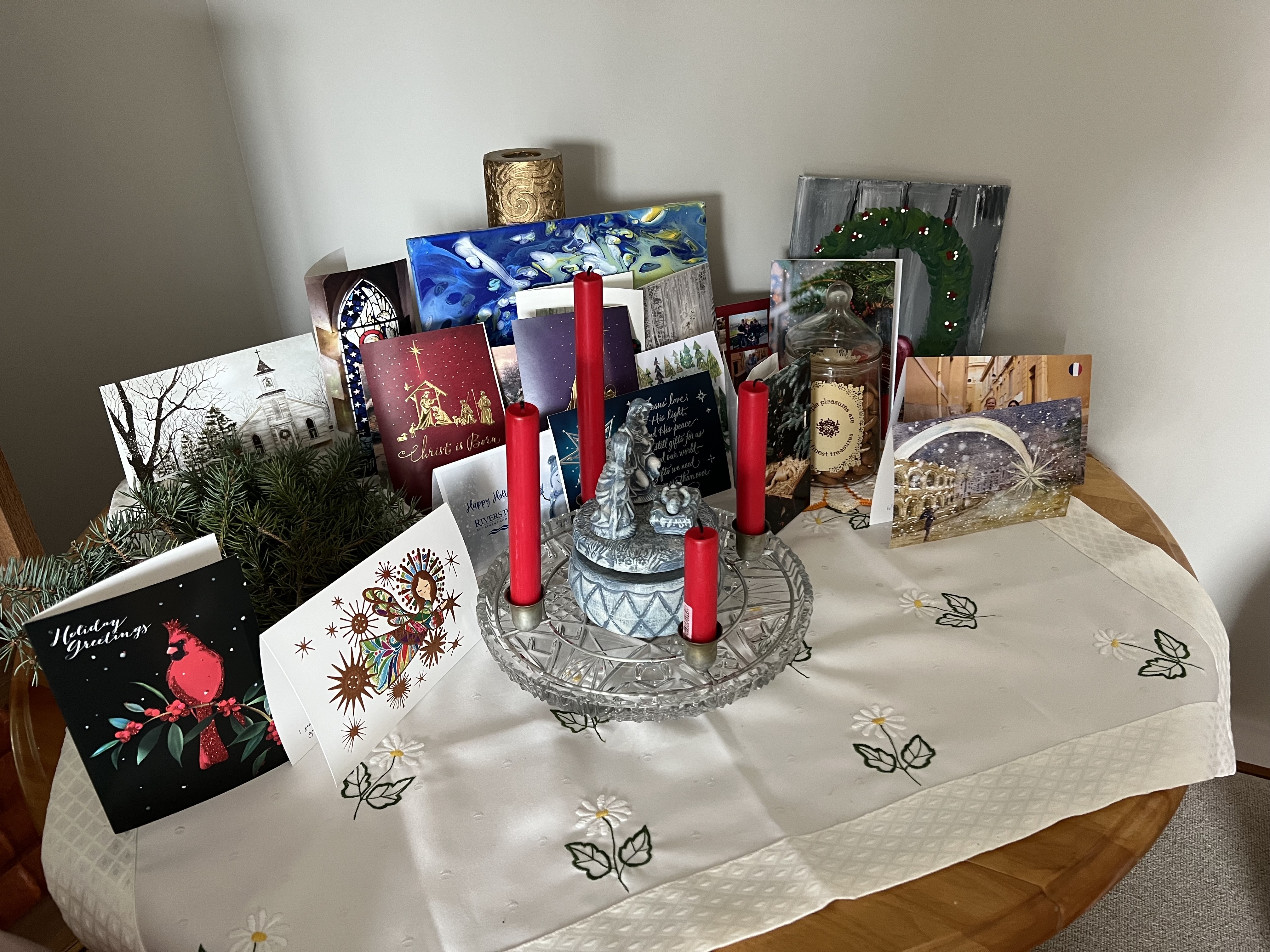
When I visited my mom’s apartment at Christmas, we spent time looking at her decorations and commenting on the Christmas cards she received and displayed on a table beside her advent wreath. Several of these cards came from far-away and overseas. 

One caught my attention. It was a photograph whose centrepiece was baby Jesus lying in a manger, surrounded by spruce trees decorated with real candles. I immediately responded favourably to the real spruce trees—it reminded me of the beauty of creation common in Canada. 

But it was baby Jesus, something about the way he was lying in his makeshift crib—the feeding trough—that, frankly, disturbed me. And it took me a moment to understand why. It was the way his little arms were spread out and feet were crossed that reminded me of the end of Jesus’ life on earth. 

Published by Evangelical Sisterhood of Mary, photo from print by Vineyard Publishing Co. Seoul, Korea

As I contemplated this depiction of baby Jesus, I realized I wasn’t just looking at a baby boy born in a Bethlehem barn during the reign of King Herod in first century Palestine. In that moment, time expanded to include both the trajectory of Jesus’ life on earth—the future, and the past—long before Jesus was born.

Let’s start in the past. The Incarnation was in the works since the beginning. The opening verses from the Gospel of John echo the first days of creation described in the first book of the bible, Genesis. 

What did God create on the first day? Light. Light is the subject of the first day of creation.[2] Light is the first action of God on earth. The light first shone when the world was created, “when God joined in unity with the physical universe and became the light inside of everything.”[3]

The true light was already shining in the shadowed places. The light was already shining in the darkness before Jesus, the human person, was born that first Christmas. That is why John writes that the light was coming into the world; it’s an ongoing work of God.

So instead of saying that God came into the world through Jesus, maybe it is more accurate at Christmas to assert that Jesus came out of an already light-infused world.[4]

With J. Philip Newell, I would assert that salvation in Jesus is not the bringing of light to a creation that doesn’t have it, but rather “the liberating of light”[5] from within, a light that is already there.

This realization brings me to my knees in confession. Because today, the problem we deal with is our resistance to the light. The problem is how we refuse God’s love and presence in our already light-infused world. Pray with me for God first to open the eyes of our minds and hearts to see in the shadowed places what God is doing. 

We see in the original Gospel stories of Jesus’ birth that there’s really nothing pretty about the first Christmas.[6] All the ways human beings end up resisting the light within us and the earth is personified by the ruthless King Herod.

Right from the start of Jesus’ life, Herod is threatened politically by Jesus. Right from the start, Jesus is the target of the authorities and political powers. The slaughter of the innocent children[7] highlights the gross injustices of our world whose selfish, power-hungry ends will justify the means at all costs—even killing children. Jesus, already at his birth, lies in the fore-shadow of the cross, and his eventual death at the hands of the powers-that-be.

The way baby Jesus’ feet and arms were positioned on that Christmas card was, in my mind, like Jesus in scenes depicting his death on the cross. I wonder if that connection—between Jesus’ birth and death—was intended by the artist of that Christmas card.

One lesson we can take away here is that the birth of Jesus does not remove the presence of evil in the world. It was true in the first days of creation. It was true at the birth of Jesus. And it is true today.

Another lesson along the way, which is the Gospel—good news, is the light still shines. It is still there, sometimes burning brightly for us to see. And sometimes, we don’t perceive it at all. And we may need to re-focus on where God is revealed and how God frees the light shining within our hearts and in this world. 

On the journey now with Jesus, here is some good advice from Marilyn Chandler McEntyre, on how to journey with Jesus when we find ourselves in the darkness of night and in the shadows of life:

Go slowly; Consent to it; But don’t wallow in it; Know it as a place of germination; And growth; Remember the light; Take an outstretched hand if you find one; Exercise unused senses; Find the path by walking in it; Practice trust; Watch for the dawn.[8]

On the first day of this new year, 2023, may you know moments of light, moments of grace, moments of love, as the dawn breaks anew.


[1] John 1:1-4,9

[2] Genesis 1:3-5

[3] Richard Rohr, “The First Incarnation” in Daily Meditations (www.cac.org, 18 December 2022)

[4] Ibid., 19 December 2022

[5] J. Philip Newell, The Book of Creation: An Introduction to Celtic Spirituality (Mahwah NJ: Paulist Press, 1999), p.11-13.

[6] Richard Rohr, ibid., 21 December 2022

[7] Matthew 2

[8] Marilyn Chandler McEntyre, “What to do in the darkness”, in Holly W. Whitcom, Seven Spiritual Gifts of Waiting (Minneapolis: Augsburg Books, 2005), p.38.

A baby’s cry

Being held in the light (photo by Martin Malina December 2022)

This Christmas when we sang “Away in a Manger”, I stopped at the part in the carol where it read: “…no crying he made”. Really!? We know Jesus cried as an adult when his friend Lazarus died: “Jesus wept” (John 11:35). If he could cry as an adult, surely he would cry as a baby. He was, after all, human.

And if the baby Jesus cried, did the shepherds hear him cry?

In that region there were shepherds living in the fields, keeping watch over their flock by night.[1]

The shepherds were outside. And not temporarily. They were “living in the fields”. In Canada at this time, we would be winter camping. But most of us may have experienced camping in the summertime. Outdoors. In nature. When it’s a little warmer. Listening to all the natural sounds of creatures great and small.

Would we hear the baby cry?

The first of four nights we spent on the shores of the Salish Sea last summer, on the Olympic Peninsula in Washington State right across the Straits from Vancouver Island. Arriving midweek, we were pleased that there were hardly any people in the small campground right on the water. Below us, where there was room for a tent or two, the sites were not occupied, thankfully! Assured of some days of rest and quiet, I enjoyed the view from our small cabin located on a ridge overlooking the water.

It was peaceful. Quiet. Only the sound of the gentle breeze through the Sitka Spruce trees and Western Hemlocks that guarded the shoreline. Only the chirp of jays and sparrows, and even a couple of ospreys. Occasionally I heard the distant and meditative throb of engines from an ocean tanker going to and coming from the ports at Vancouver and Seattle. It was a pleasure to be outside.

The weekend arrived, bringing more people to the campground including some families with young children to the tent sites below us. The noise levels increased. 

On the last morning, I sat down in my favourite spot in front of our cabin on the ridge beholding another glorious morning. I usually got up early as the sun was rising over the water and most people were still in bed. And it was quiet.

Except the baby crying. Right below us in a tent a family had pitched the night before, the sounds of a wailing infant sliced through the morning reverie. It wasn’t a consistent cry, either. The baby would scream – a desperate plea. Then, stop. And moments later, it would start over again.

My reaction was one of anger and frustration. How dare this baby interrupt my prayer time! I didn’t want to hear the baby’s cry. I wanted to hear the birds, the water, the wind!

But just then I started writing my Christmas Day sermon! Because in a moment of grace, I let go of the need to control my circumstances. In a moment of grace, I let go of my preconceived notions of where God was being revealed to me.

Not always in those uninterrupted, peaceful, and undisturbed moments. Not just in places and circumstances that I can control and manage. But in the spaces and places in between. When I loosened the tight grip on my world, something beautiful happened.

Would the shepherds hear the baby cry? Well, my guess is that they did. Why? Because they were “keeping watch over their flocks by night”. In the nighttime, a dangerous time—in more ways than one considering the violent politics in 1st century Palestine. In the night when fears mount and dangers lurk in the shadows of our imaginations, they keep watch. They were awake, paying attention.

So, as the baby cried that early morning last August on the Salish Sea, rather than give up, I allowed the noise of the baby’s cry to become part of my prayer. I kept paying attention, listening even more carefully, going with the flow. And, when I did that, I noticed two things:

First, something I hadn’t heard on our trip until that morning when the baby cried, was a loon’s mournful song in the distance. I love loons. To me, the loon’s call is a sign of God’s call. In between the baby’s cries, a loon announced its presence in the cacophony.

And then the baby emerged from the tent, being held by a loving parent who rocked the baby and walked along the shore carrying their bundle of love. The baby didn’t stop crying right away when the parent held them. But I learned an important lesson of faith:

When I let go, when I can’t hold myself any longer—so to speak—God holds me. In love.

When the shepherds heard the baby cry, they moved into action. They didn’t wait till morning. They went right away—running even—to Bethlehem to “see this thing that has taken place”. And visit the Christ child they did, because they were already practised in the art of “keeping watch by night”. They were attuned to the sounds of God reverberating throughout all of creation, all of the time.

Christ is born! Jesus is with us, Immanuel. Will we hear the baby’s cry today?


[1] Luke 2:1-20

Before Santa, God’s Agent – A Christmas Children’s Chat

Before Santa Claus became “Santa”, he was Saint Nicholas. Saint Nicholas was a real person, and a bishop a long time ago.[1] A bishop is like a pastor, but instead of relating only to one congregation as a pastor does, a bishop relates to many congregations—and many people covering a large area.

Saint Nicholas indeed cared for many people in the part of the world known today as the country of Turkey. As a Christian he was very active in his faith by helping people who were poor, giving gifts and money to those who needed food, and rescued people who were in prison. In short, he helped people who were in trouble. All his life Saint Nicholas showed people how to love God and care for each other.

You could say he was “God’s Agent”. Yes, many of the things he did to help people he did them in secret. He didn’t want to draw attention to himself, because it was the kindness that he showed that was the important thing.

But he wasn’t God’s agent in the sense of being like a spy from the movies. Spies will sometimes deceive and trick people on purpose. No, Saint Nicholas was God’s Agent in the sense of doing things out of faithfulness to God, being active to do God’s will and show God’s love to all people. Even if he had to take some risks.

And that’s what we are all called to do as well. Like Saint Nicholas, we too are God’s Agents of love for other people. This Christmas I pray we can all find little ways, and maybe some big ways, to be God’s Agents, and like Saint Nicholas show God’s love for all people.

There are many stories about Saint Nicholas. I would like to read you one of them about a special animal—the Pine Marten—who was Saint Nicholas’ good friend; and, who helped him on a very special mission as “God’s Agent” …

Invite the children to sit with you gathered around the Christmas Tree.

Read Terri Reinhart, illustrated by Patrick Reinhart, “The Fiercest Little Animal in The Forest” (Colorado: St Patrick’s Press, 2nd Printing, 2019).

Let us pray:

God of joy and cheer,
    we thank you for your servant,
    the good bishop Nicholas.
In loving the poor,
    he showed us your kindness;
in caring for your children,
    he revealed your love.
Make us thoughtful
    without need of reward
    so that we, too, may be good followers of Jesus.[2] Amen.

At the end, hand out a Saint Nicholas treat to each child …


[1] traditionally 15 March 270 – 6 December 343 A.D.

[2] B. Batchelder, illustrated by Barbara Knutson, All Through the Day, All Through the Year: Family Prayers and Celebrations (Minneapolis: Augsburg Fortress, 2000).

One light

In the Christmas Eve candlelight service we all light our individual candles to symbolize the light of Christ coming into the world.

In this ritual, there’s another symbol for these candles I’d like us to consider: These candles represent each one of us. The light of Christ shines in our very own lives.

I took a photo of one of the advent wreaths we constructed in our home this past month; you can see it below. To begin with we had four, good-sized pillar candles we set in a bed of stones. But the glass holder had a relatively small diameter. The only way they would all fit in the container was to place the four candles right beside each other so they were touching. 

As the four candles burned down, pretty soon we realized our mistake. They were too close to each other. The flames from the candles conspired to melt the wax in an accelerated, agitated fashion. The melted wax pooled quickly and often snuffed out the drowning wicks. We managed the candles as best as we could. But by the end all that was left was one amorphous blob of wax at the bottom of the bowl.

The candles burn much better when there is more space between each of them.

One of my favourite rituals of Christmas is shining all manner of lights. There are various and different kinds of lights—LED, flashing electrical lights for outdoor use, fairy white lights on boughs of spruce and pine, candlelight, and the list goes on. Yet all of them still do one thing: they provide light. It’s all about the light. These candles we light tonight belong to the one light of God. All light comes from God.

At a deeper level, we are all united, and share, in the light of Christ. All of it belongs to the One. At a deeper level, God overcomes whatever separates and divides us. In our common humanity, like all the wax pooling together at the bottom of the bowl, therein we find the one light in us all.

At Christmas, we often discover and experience our failings, weaknesses, and limitations in our relations. Amidst the intensity of those relationships, may we be reminded again of the good news of Christmas: That our individual lives–where necessary space is important–we still belong to a larger, brighter and ever-burning light. This is the life and love of God coming into the world at Christmas, and whose life and love is for the whole world.

Love action

Irresistible Flow (photo by Martin Malina, December 2022, Ottawa River at Arnprior)
audio for sermon “Love Action” by Martin Malina

Did Mary and Joseph love each other? I mean, we say that they both loved God. But did they love each other? And what was this love? What kind of love?

The Christmas story from Matthew doesn’t explicitly describe the dimension of love in their relationship.[1]

Eileen O’Hea relates an example from her life about what the New Testament describes as—from the Greek— “agape” love. And this love was expressed by her dying mother. O’Hea writes:

“An example of agape love happened to me as I sat beside my mother’s bed a day before she died. An ambulance siren rang through the city streets close to our home. It somehow penetrated the thick coma-like sleep that enveloped my mother. Her eyes opened and dreamily met mine for the first time in many hours. She then looked at me and asked, “Is daddy alright?” “Yes,” I replied, “he’s fine; he’s in the living room.” My mother, assured that the one she loved was safe from harm, slipped back into the sleep she would not awaken from again.”[2]

The kind of love that propels someone into a deeper, more fulfilling life with another is what I think the angel reminds Joseph of in the dream he has.

Notice the angel’s first words to Joseph. The angel says his name. Before anything else is said, saying someone’s name when you address them is already an act of love for the person. Saying their name calls them to pay attention in return, grounding them in the moment of grace and opening their hearts to listen to and receive the other. The angel’s words to Joseph communicate love. 

Joseph had to be called back to his love for Mary. We say it was Joseph’s love of God that made him obedient. Let’s assume Mary told Joseph about the angel Gabriel’s news that she will bear the Son of God. So, when the angel then confirms this news in Joseph’s dream, Joseph is called to obey out of his love of God, the God who Mary now carries in her body. Joseph’s love for Mary, herself, is the way he chooses to love God in that moment of decision. For Joseph, love of God indeed means loving Mary.

This truth is echoed later in the New Testament, specifically the commandment to love one another. “The commandment we have from [God] is this: those who love God must love their brothers and sisters also.”[3] In other words, you cannot love God without loving someone on earth. 

But there’s so much that blocks us from practising this true, “agape” love in life, isn’t there? What blocks this love?

Joseph’s plan to dismiss Mary was an act of fear. After saying his name, the angel’s very next words to Joseph are, “Do not be afraid” – the most repeated instruction in the whole bible. “Do not be afraid to take Mary as your wife.” The bible has something to say about being afraid, and how fear relates to love. In scripture, fear and love are at opposite ends of a spectrum:

There is no fear in love, but perfect love casts out fear; for fear has to do with punishment, and whoever fears has not reached perfection in love. We love because [God] first loved us.[4]

When talking about love, that’s where we need to begin. With God’s love for us. And how God loves us. And we are given a gift in the Holy Meal. The sacrament of the table is first and foremost God’s gift of grace, God’s gift of love for us and the world.

Holy Communion is a meal we share with others. This is an important realization. Because while the Communion is “given for you”, personally, it is also given for everyone else. Communion is not just ‘ours’, individually. It connects us to the whole of creation. As national bishop Susan Johnson writes:

“The bread and wine are symbols of all life joining in praise of God … The earth, the sea, and all their creatures join in this praise. The meal is universal … [and] includes all our relations … [The Communion] connects us to angels, and to the saints who have gone before us. The meal makes no distinction between people. God invites all to come and share in this mystery. All receive the same bread and wine. All are equals … before the grace of God.”[5]

Love opens our hearts. In Communion, each of us is called by name to receive the grace of God. In forgiveness we accept love despite our failures and weaknesses. 

We cannot do it alone. We cannot love perfectly. Even though we are called to love others as God would love—infinitely, graciously, extravagantly—it’s not easy to do this especially when we are suffering, grieving, and hurting.

Joseph and Mary had each other. Their love for each other and God helped them take risks of faith together, trusting in God’s love always. We are not alone on this journey. Love is not a solitary act. We don’t love others on our own accord. It’s not our love to keep for ourselves alone or dispense by ourselves alone. 

Rather, we love with God.[6] Loving with God means the love we give is an expression of the heart of God, who is Emmanuel—God with us. The love God gives is not based on the merit of the beloved, nor the correctness of the beloved’s beliefs. But rather the love we share is part of the flow of God’s ongoing love for us and all of creation.

We join God’s love and participate in God’s loving. Like stepping into a river which flows continually. We may start at the river’s edge, gingerly testing the waters. Our first move into the river may be tentative. We may only go in a little way, and quickly jump out. We may even feel at times that we are not making any progress at all going deeper. 

But regardless of how we may feel, and in whatever hurting circumstance we may find ourselves, there is something else going on that is deeper, and bigger, than what we may first perceive—as Joseph and Mary both learned in their experience. The story wasn’t just about them.

The Greek philosopher Heraclitus once said that “you cannot step into the same river twice,” meaning every act, however small, however tentative, bears an essential newness. Divine love is not a river of stagnant water but a fountain fullness of overflowing love, love that is forever awakening to new life.[7] Whether we are aware of it or not each time we dip into the river, the love of God-with-us strengthens a deeper, more lasting flow and truth within us and the world around us.

In the shadows of our lives this Christmas, may our loving shine forth brightly, in Jesus’ name.


[1] Matthew 1:18-25

[2] Eileen O’Hea, “Contemplation and Love” Rain for the Sea (London: The World Community for Christian Meditation, Meditatio Talk Series A, 2009)

[3] 1 John 4:20-21; Matthew 7:12

[4] 1 John 4:18-19 

[5] Donald W. Johnson & Susan C. Johnson, Praying the Catechism: Revised and Expanded Edition (Minneapolis: Augsburg Fortress Press, 2021), p.174.

[6] Brian D. McLaren, Faith After Doubt: Why Your Beliefs Stopped Working and What to do About It (New York: St. Martin’s Essentials, 2021), 116–117.

[7] Ilia Delio, The Unbearable Wholeness of Being: God, Evolution, and the Power of Love (Maryknoll, NY: Orbis Books, 2013), 74, 76–77, 83-84.

Gateways of doubt

A Path Through It (photo by Martin Malina October 2022)
sermon audio for “Gateways of Doubt” (by Martin Malina

You could tell it was his first time on the diving board. Even though the edge of the spring board was only about ten feet above the surface of the water, he was not sure.

The little boy paces back and forth along the full length of the board, his index finger lifting his chin, his eyes squinting in concentration. Then he crosses his arms across his chest. Back and forth. Back and forth. Will he jump?

All the while his instructor calls for him from the water below. Her arms are outstretched, ready to catch him. The boy’s friends encourage him with: “Come on!” “You can do it!” “It’s fun!” The splashing, the playing, the shouts of joy are all evidence of the promise of what is to come.

But for the longest time, the little boy is not sure. Then on one of his return paces back to the edge, and for inexplicable reason, he unexpectedly jumps. He holds his legs tucked underneath him so tightly.

After he emerges out of the water, his face is beaming with joy. He clambers out onto the pool deck and runs happily into the waiting arms of his parents.

Today is called Gaudete Sunday, meaning Rejoice! The liturgy wants to capture the joy of anticipating the birth of Jesus. Soon and very soon! We’re over halfway in the season of Advent. 

We light the candle of joy today on this Third Sunday of Advent, although we may not feel particularly joyful these days. For so many reasons.

This Advent theme has its roots in the pregnancy narrative from the Gospels. It is the joy experienced by Mary after she receives the news that her life will birth the Savior. Mary then sings her famous Magnificat which we just read together.[1]

But the joy of the Gospel can be misunderstood. 

When the angel Gabriel appears to Mary to tell her what’s in store for her, I notice Mary’s initial confusion: “But she was much perplexed”[2] by the angel’s words. Initially she wasn’t sure about what was asked of her.

I suspect we think that a holy encounter would initially inspire certitude and confidence in our faith. And therefore, this certainty would lead us to joyful praise and discipleship. I suspect we presume that faith is borne from understanding it fully and knowing everything and being sure about it, first. Then, be joyful. 

But the joy of the Gospel does not come from being certain. The joy of the Gospel does not come from eliminating all doubt and ambiguity in life. 

In this case with Mary, the words of the angel Gabriel don’t lead her out of doubt and into faith. It’s the other way around: Her encounter with the angel leads her out of whatever preconceived notions gave her a sense of security, and into a “holy bewilderment.”[3] God’s message disrupts her certainty and turned her world upside down. “She was much perplexed.” Or, as she says to Gabriel: “How can this be?” In faithful response, Mary moves out of familiar spiritual territory and into a lifetime of pondering, wondering, questioning, and wrestling.

Doubt is the gateway to joy.

The journey to expressing true, authentic joy cannot exclude the experiences of our lives that disrupt our certitudes. Being faithful moves us into realms of unhinging, unknowing, unlearning even what has kept us secure and comfortable in our beliefs our whole life long. And moving forward anyway. And doing it. Jumping off the diving board.

In the Gospel reading for today, John the Baptist is in prison, and he knows he is near the end of his life.[5] In the uncertainty and fear, it is natural for him to seek assurances from Jesus. “Are you the one who is to come, or are we to wait for another?” You could say, when he sends his disciples to ask Jesus if he is the One, the Messiah, John is expressing doubt. 

Jesus’ response suggests at least a couple of cues for our own journeys of faith:

First, doubt is not the opposite of faith. In truth, doubt is very much an important, a vital, aspect of faith in God and Jesus. Jesus does not scold John for questioning Jesus’ identity as the Son of God. Jesus does not say, “Shame on you John, you should know better!” Rather, just the opposite.

Jesus lifts John up. Jesus praises John for being like no other in the reign of God. John may be at a difficult part of his journey. But it’s not over. There’s more, and better to come!

It’s important in the church, even among those who have been faithful for years, decades, that we give each other permission, even admiration, for expressing honesty in doubting our beliefs. It is part of, and belongs to, a life and journey of faith whose end is life in the “kingdom of heaven’’. 

Even when we feel our own lives are nearing their end, it’s ok to question God. In truth, doing so is a mark of great faith. This authenticity provides a safe, truly loving place for having real conversations about suffering, death, life, and God. 

One of the great proponents of doubt as a way to find deeper truth was René Descartes, seventeenth century philosopher, mathematician, scientist, and Christian. He expressed the value of doubt this way: “If you would be a real seeker after truth, it is necessary that at least once in your life you doubt, as far as possible, all things.”[6]

In Jesus’ response to John’s question, Jesus doesn’t come out and say: “I am the Messiah, the one for whom you have been waiting.” Jesus doesn’t give John a simple, clear-cut, plain-truth answer to John’s question. Jesus does not satisfy John’s clinging to certainty and long-held beliefs. Even nearing the end of his life, John is faced with bewilderment, in the sense that he still needs to be on that journey of wrestling, questioning and working through it himself.

In her faithful response, Mary consents to evolve. To wonder. To expand her vision. And continue jumping. Her gateway of doubt through which she moves turns into a path she must continue to follow and discern as she makes her way forward. She has to learn that faith and doubt are not opposites—that beyond all the easy platitudes and pieties of religion, we serve a God who dwells in mystery.

In Holy Communion, bread and wine become the body and blood of Christ. We speak of a mystery here. Shall we say the mystery of incarnation. As we will celebrate in the coming Christmas season, God is not hostile to creation, the stuff of earth. God becomes human, part of the stuff of earth. God enters our frail, human reality. And we celebrate this mystery every week at Communion when simple gifts of bread and wine are transformed.[7]

Along with wine and bread, we offer ourselves at the table, that we might be transformed. Martin Luther claimed that “Even as bread and wine become the body and blood of Christ, so the people are transformed into the body of Christ.”[8]  For we are a community, a people, sent to care for others and the world, to encourage, support and serve them.

On one level, we perceive only bread and the wine. But from the heart we perceive what God does at the table and are reminded again that God’s work of transformation continues in us and in the world around us.

If we agree to embark on a journey with this God, if we jump as Mary did, we will face periods of bewilderment and true joy. Through gateways of doubt. If we agree to embark — jump! — on a journey with God, and receive the nourishment God provides on the journey, we will be transformed. And the world around us.

Because Christ has died. Christ has risen. And Christ will come again.


[1] Luke 1:46-55

[2] Luke 1:29

[3] Debie Thomas, Into the Mess and Other Jesus Stories: Reflections on the Life of Christ (Eugene, OR: Cascade Books, 2022), p. 5-6. 

[5] Matthew 11:2-11

[6] Descartes, Principles of Philosophy.

[7] Donald W. Johnson and Susan C. Johnson, “Holy Communion” in Praying the Catechism: Revised and Expanded Edition (Minneapolis: Augsburg Fortress Press, 2021), p.170.

[8] Martin Luther, tr. Jeremiah J. Schindel, rev. E. Theodore Bachman, “The Blessed Sacrament of the Holy and True Body of Christ and the Brotherhoods, 1519,” Luther’s Works (Philadelphia: Muhlenberg Press, 1960), 35:59-60.

Wreath on fire

“…may the righteous flourish;
  and let there be an abundance of peace” (Psalm 72:7)

audio for sermon ‘Wreath on fire” by Martin Malina

The season of Advent was always a big deal at our home when I was a child. I remember looking forward every year to Advent—the season of candles, wreaths, waiting and anticipating Christmas coming.

Fire transparent, Fire contained, Fire reflected (photo by Martin Malina, 2022)

On our wooden coffee table in the middle of the living room we would place a large wreath with real pine boughs intertwining four, tall candles. Of course, these candles were a lot shorter by the time the fourth week of Advent rolled around having lighted them every day. And the pine boughs had gotten quite dry. The needles were falling off.

It was during the last week of Advent one year when, after lighting all four candles, my mother, brother and I had to go into another room for a short time. When the fire alarm went off, at first I couldn’t think of what it could be. But then the awareness struck all of us and we dashed back into the living room.

The whole wreath was consumed in a gigantic plume of fire and smoke reaching up to the ceiling. Thank God for the water nearby that saved us.

John the Baptist warns the religious leaders of the day, in today’s Gospel reading, that the one who is coming will burn the chaff “with unquenchable fire”.[1] The advent wreath on fire appeared unquenchable, believe you me! 

Today we light the candle of Peace on the wreath. The biblical word for peace is ‘shalom’. What does ‘shalom’—the peace of God—mean?

The advent wreath on fire wasn’t a calming vision of peace, one that we normally seek at this time of year. We may not expect and may not want to read a passage from the bible these days that paints disturbing images about the coming Christ. 

I am drawn, rather, to focus on the “… intimate comforts of mangers, fireplaces and hot chocolates.”[2] I would rather my advent wreath not explode in a plume of unquenchable fire. I want to see the soft, flickering light, snuggled up with a blanket and a good book on the couch. I don’t think I’m alone in seeking a reality closer to Hallmark images of chestnuts roasting on an open fire. 

Yet, a world already awash in the soft glow of Christmas, this Sunday’s gospel jarringly redirects our focus. The Gospel presents a dirty and smelly John the Baptist wearing camel’s hair, eating locusts and wild honey, and screaming threats at the religious leaders visiting him in the wilderness. Where is the good news in this?

Before we skip over John the Baptist in our rush to get all cushy with Christmas, let’s pause for a moment. And consider this: While only two of the four gospels talk about Jesus’ birth, all four tell about John the Baptist. So, there’s something here we need to pay attention to. We need to ponder why his story is vital to our Advent journey.

Ancient wisdom for people of faith warned against what was called a “pernicious peace.” One of self-indulgence, self-absorption and self-preoccupation with being comfortable. A peace that ultimately does not satisfy. In fact, too much of this spelled a dangerous escape from reality—a pernicious peace.

What do you notice first about John the Baptist? What detail about his persona first draws you in? I’m drawn to the wild honey image. I love honey. But I must confess I associate the pleasure and benefit of honey with an early childhood image that has stayed with me—Winnie the Pooh. But this childhood warm-fuzzy image must be revised. Because it doesn’t square with the reality of the honeybee and its grittier, larger truth.

In her Advent devotional, Gayle Boss describes how bees survive winter. They cluster together and shiver their wing muscles in a carefully arranged dance to keep the queen and the honey at the center of the hive warm. 

Some bees are even born to know only this long, cold season of life: “They will know only the dark hive,” Gayle Boss writes, “the press of their sisters’ bodies …They give their lives to shivering together in the dark, the tiny repetitive gestures of each, added together, a music beyond our hearing, sustaining a future for the community.”[3]

There’s a constant movement, not easily perceptible to us humans in the formation of honey and the beehive. There’s movement, a community that endures difficulty and toil during the dark winter. Yet in the toil, there is hope for the future. And this is the ongoing work we give during Advent.

The pastor says: “The Peace of the Lord be with you all.” And the people respond: “And also with you.” Where is this said in the liturgy every week? Those words mark the beginning of the Communion part of the service. Those words and gestures launch us into Holy Communion.

We share the Peace. Sharing the Peace is an action towards and with one another. Then, in our tradition, we come forward. We move our bodies on the way to the altar to receive the gift.

Peace is not a state of being, but a movement. Like the bees shivering their wings to keep the queen and honey warm. Peace is a movement, ongoing. A path. A way of peace. This is the shalom of the bible. 

The Hebrew concept of peace was described as peace between God, the people, and the environment. When we share the peace of Christ at the beginning of the Holy Communion, “we are calling for this shalom to be present in our lives, in the lives of others, and in the world. Shalom [therefore] means hospitality and welcoming the stranger in our midst.” And after the Eucharist—the Holy Communion— “we go forth as agents of reconciliation, carrying the peace of Christ with us.”[4] Even and especially when we find ourselves in the wilderness of our lives.

So, what is your “wilderness”? Is it a physical suffering? Is it dealing with mental illness, an emotional pain, an addiction, sadness, anxiety, fear, anger, shame? Is your wilderness the loneliness of the season, the feeling of abandonment, isolation? What is your wilderness?

We all likely have a few advent wreaths on fire, figuratively speaking, somewhere in our lives. And we may feel like all we are doing is trying to put out all those out-of-control fires. But John the Baptist warns the religious leaders, even suggesting that the “wrath to come” is not something from which to “flee”. Repentance is not escaping into a Hallmark world of denial and avoidance. True repentance happens when we face the wrath, the wilderness, the suffering in faith and hope. 

God takes the lead. God comes to be with us in our wilderness wandering. Jesus is the Living Water[5]that saves us. Jesus chose to go to where John the Baptist was—into the wilderness of his life, to be baptized. God chooses to go there—into the wilderness of our lives—to bring healing and wholeness.

This is wonderful news! God doesn’t flee from the wilderness. It is the place where God’s presence is experienced. This is the path of peace. It’s a journey. May we find our nourishment and strength moving toward the goal on this winding path.


[1] Matthew 3:1-12

[2] Donna Lynn Gartshore, “Where did you go?” Eternity for Today (Winnipeg: ELCIC, 29 November 2022)

[3] Gayle Boss, All Creation Waits: The Advent Mystery of New Beginning (Brewster, MA: Paraclete Press, 2016), p.15–16.

[4] Donald W. Johnson and Susan C. Johnson, Praying the Catechism: Revised and Expanded Edition (Minneapolis: Augsburg Fortress, 2021), p.160.

[5] John 4:13