The third mountain: Feed the need; eat something good.

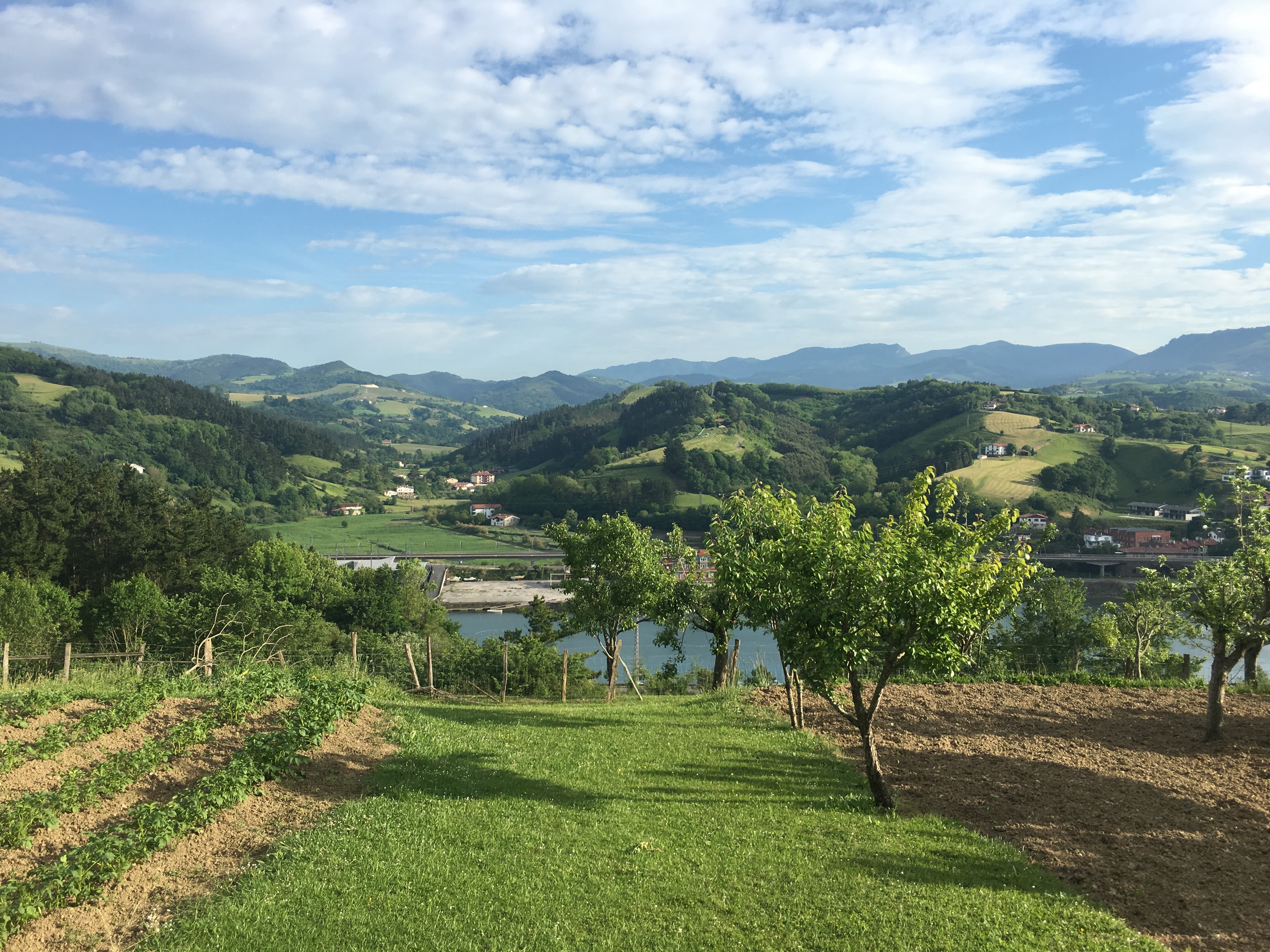
On the Mount of Feeding in Basque-land (photo by Martin Malina, in Orio, Spain 2017)

“What is that?” I wanted to blurt out when the server placed a bowl in front of me. I was famished. I had just walked the first leg of the Camino del Norte in the scorching heat under the Spanish sun. 

It was almost 25 kilometres on foot. Not that far on paper, you might think. But in order to complete this first day of my pilgrimage, I had to scramble up a six hundred metre elevation to gain the top of the ridge overlooking the Bay of Biscay on the north coast of the Basque land. And I had to descend those hills on knees that were starting to buckle under the weight of my pack. It was a brutally challenging start to the journey. And I was tired, thirsty and hungry.

I didn’t want to complain. Out loud, anyway. “What is this?” I slurped the salty broth soup with chunks of cod floating irreverently in the stew-like dish. The food didn’t look appealing, at least from a North American culinary perspective. But I downed it like it was nectar from heaven. The cod fish soup hit the spot and gave me the energy I needed to half-crawl to my bunk for the night.

Climbing (photo by Martin Malina, Irun, Spain, May 2017)

The third mountain in Matthew’s Gospel is the Mountain of the Feeding—where on a side of a hill on the shores of Lake Galilee Jesus provided food for a multitude who had come to listen to Jesus’ teaching.[1] Jesus fed them with the simple gifts of bread and fish. Everyone ate their fill. A basic need was filled. There were even baskets left over. An abundance of simple things, for everyone.

In our world, it goes without saying that we have an abundance of food for ourselves. We complain about food prices going through the roof. And yet, I wonder if any of us have eaten less and lost weight, in response. Most of us could do well to lose some pounds. Maybe some of you have. I suspect most of us, however, still consume the same amount of food. And not of simple, basic things. We confuse needs with wants.

Between 1984 and 1991, in three covert military operations—called Moses, Joshua, and Solomon—over twenty thousand Ethiopian Jews were airlifted to Israel to escape famine and civil war. In an Israeli-made movie based on the first, Operation Moses, the story is told of a Christian child who is helped by the Ethiopian Jewish community to adapt to living in Israel as a Jew.[2]

The first thing that happens after the plane from Africa lands in Israel is that the whole planeload of people is sent to the showers. When copious amounts of water are used to scrub them clean, the boy has a panic attack, crying: “they will punish me, they will punish me. I am wasting so much water.”  Talk about basic needs.

Even though the person who told me about this movie saw it many, many years ago, that scene stays with her to this day. It leaves an impression because many of us take water for granted. Especially in Canada, where fresh water is naturally in abundance. Safe, clean drinking water is fundamental to human life. It is a basic need, even more so than fish and bread.

Yet, one main theme in this film, suitably titled “Live and Become”, is people from different faiths helping each other. Recognizing the need to find a new home in a faraway land, Ethiopian Jews helped a young Christian boy whose mother was left behind. 

When basic needs are shared—like having access to fresh drinking water and safe homes—some of the religious and social divisions that normally separate and often cause conflict among us, evaporate in expressions of love. 

When Jesus pays attention to the woman at the well in today’s Gospel reading[3] by attending to her need, Jesus crosses social and religious fault lines. In Jesus’ day, Jewish people did not mingle with Samaritans—outsiders, foreigners. Neither did male, Jewish leaders speak with women.

And yet Jesus, moved in ways of love for all God’s creatures, reached out and touched her heart. First, he acknowledged our human tendency to feed ourselves with things that will only keep us wanting more; eating this food will never fully satisfy us. The gifts of God’s grace, Spirit and love, however, satisfy us forever. Then, Jesus showed her mercy and offered her eternal love. Jesus addressed a basic need, not a want.

On the woman’s part, she receives the love Jesus offers. She is moved that Jesus knew everything about her and still loved her. Responding to this love doesn’t necessarily make things easier for her. That’s why the love God has for us is about meeting a need not a want. 

Sometimes what we need, in love, is to be challenged to confront our fear. The woman had every right to be afraid. She could have kept quiet given her troubled, personal history. She could have kept God’s love for herself.

But she opens her heart to Jesus and responds by sharing her experience of being loved with others. The evidence of this is her courage to then go to the city and tell everyone of her encounter with Jesus. She leaves her water jar behind—a symbolic gesture—and goes into the city to start her new life. 

She overcomes her fear and becomes an effective evangelist for Jesus. Her life bears witness, through the ages, to the power of God’s love overcoming all sorts of social and religious divisions.

I still remember the sight of that large bowl of the fish soup. The chunks of the cod floating in the watery stew of vegetables. I was thirsty and I was hungry. And I was grateful for the sustenance that simple meal had given to me.

“What is that?” (photo by Martin Malina, May 2017 in Spain)

I recall our son’s good advice for trying something new to eat, something you’d not normally ‘go to’. He said, “Someone, somewhere in the world today considers this food a gourmet, a delicacy.” When we open our hearts in love for others and for the whole world, we recognize our shared, common needs, our shared, common humanity. Practising love for another will help us overcome our fears and inhibitions.

There is a food that I love eating at home here in Canada that tasted even better in Spain: the fruit. I have never eaten more delicious oranges and peaches as I did when walking the Camino. I remember almost drinking the sweet juices of a peach I savoured during a rest break on the trail in the Basque hills. I remember how good that one peach tasted.

I wonder about what a difference it makes when we become aware of what we choose to focus on. On this third leg of our Lenten journey, we are called to feed the need (not the want); eat something good. When relating to people from other cultures and other parts of the world, we can choose to focus on the good or the bad.

There is always a bad apple in the basket. But so is there in our basket, so to speak. We can choose to fixate on that bad apple, or two, or three. But there is a whole bushel-full of apples that are pretty good. Maybe not perfect, but certainly not bad.

As we make our way down the mountain of the feeding, Jesus leads the way, breaking boundaries that divide us, and challenging our fears so that we can perceive reality in a new way. And, Jesus provides for us through the grace and mercy and love of others sharing what they have with us. Our needs are being met. Before we even lift a finger to eat. Can we do likewise, for another?

A sermon for the Third Sunday in Lent, Year A (RCL), by Rev. Martin Malina

[1] Matthew 14:13-21

[2] Live and Become, 2005

[3] John 4:5-42

The second mountain: Trust someone

Sermon on the Mount (2nd Sunday in Lent, 5 March 2023, by Rev. Martin Malina)

You can’t do this journey without trusting someone. Or, at least, trusting life—that something good lies beyond the next ridge on our Lenten journey. It’s a disposition of the heart, to nurture a trust in someone else who travels with you.

After Jesus is tempted on the mount of temptation, he begins his ministry, his calling. This part of his life is not recognized in the traditional creeds of the church. Which is unfortunate because we miss a significant aspect in the message God wants to bring to us in how to live a life of faith on earth. How to journey well.

On the Mount of Whistler (overlooking Whistler BC, photo by M Malina August 2019)

After descending the mount of temptation in the first week of Lent, we now climb the mount of beatitudes. From this mountain top[1] Jesus delivers his famous ‘sermon on the mount’. Well-known passages from Jesus’ speech include the beatitudes, the golden rule and instructions on how to pray. It is here Jesus gains the reputation of being a teacher and is therefore granted the title “Rabbi” in the Jewish faith.

It is how Nicodemus, a leader of Israel, first addresses Jesus when he encounters him in our Gospel reading for today[2]. He calls Jesus, “Rabbi”. A teacher.

But Jesus challenges Nicodemus by turning the tables on him. He says to Nicodemus, “You are a teacher yourself, and yet you do not understand this?” Does Nicodemus try to resist the implication that those have lived long can still be ‘born again’, and change? Good teachers will always challenge us to grow. 

Who are your teachers? And how do you respond? Will you trust them?

Nicodemus approaches Jesus with a little bit of uncertainty. He is learning to trust Jesus. But he is not a spy trying to test Jesus like the other Pharisees were wanting to do; otherwise, he would not need to find Jesus at night to talk to him. And, rather than ask whether Jesus was a teacher, he declares up front that Jesus was a teacher sent from God. Nicodemus’ manner and words indicate he was an honest seeker of Jesus, still trying to figure it out for himself.

And eventually he does! Later in the Gospel of John we discover that Nicodemus did in fact become a follower of Jesus. Nicodemus did learn to trust him. First, by defending Jesus publicly in front of other Pharisees,[3] and then showing up in the garden to anoint Jesus’ body for burial.[4] Nicodemus had a change in heart which allowed him to trust Jesus. He was, you could say, born again!

The life and leadership of former bishop of San Salvador, Oscar Romero (1917-1980), illustrates how our hearts are changed by who we consider our teachers.

When the name Oscar Romero is mentioned, I first think of his dramatic assassination right at the altar where he was giving mass. His name is associated first with the horror of his violent death. Similar to the Creed’s exclusive focus on Jesus’ death and resurrection, by focusing only on Romero’s death we miss what had changed in his life when he sought another teacher.

At first, in his role as priest, then bishop, Oscar Romero assumed that the ways of God were in fairly close alignment with the priorities of the Roman Catholic magisterium and the Salvadoran government. For him, at this time, Romero saw in Jesus someone who could be used to defend his country’s status quo. You could say the Catholic Church in accordance with the government were his ‘teachers’.

But when he opened his heart to the love of God, his vision changed. He saw the love of God expressed by the common people. And that is when he found the courage to align himself with love. He decided to live in solidarity with the poor and learn from them the ways of God. Poor people, rather than priests, professors, and politicians, would now be his teachers.[5]

During the funeral service last week of the late Paul Bosch, a former professor of mine at Martin Luther University College in Waterloo, the preacher, Bishop Michael Pryse, recalled a teaching Paul Bosch had offered to him.

A group of ordained pastors were visiting a religious retreat centre north of Toronto early in Bishop Pryse’s ministry when he was still a pastor. Upon entering the chapel there, Paul Bosch translated from an inscription above the altar which said, in Latin: “sic Deus delexit mundum”. The standard translation of that phrase—sic Deus delexit mundum—was the well-known verse from John 3:16 in our Gospel reading today: “For God so loved the world …” 

However, Paul Bosch went on to say that the Latin verb ‘delexit’ is also the root of our English phrase, “to take delight”. In other words, not only does God love the world, but God also takes delight in what God created. God takes delight in us. God enjoys creation, takes delight in all that is.

And, if God so loved the world and takes delight in us and in everyone God created, God must also trust us. When you love someone, you trust them.

When God gave Abraham the mission to leave his hometown and journey to far away Canaan,[6] God entrusted this mission to him, because God loved him. When Jesus called his disciples to follow him, Jesus trusted his companions on the journey, because he loved them. When Jesus preaches that blessed are the poor, the meek, those who are persecuted for my sake, when Jesus teaches us to love others the way we want to be loved, God is placing an incredible, almost unbelievable, amount of trust in us. 

Martin Luther taught that the favored, preferred, definition of faith was not belief so much as trust. To have faith, is not to believe something but to trust someone. And so, on this second leg of our Lenten pilgrimage to the five mountains in Matthew’s Gospel, as we make our way down the mount of beatitudes today, the second tip for our journey is: Trust someone on the way.

And we can trust that God won’t disappoint. We can trust that despite our failure and shortcomings in trusting others, God will always trust us, will always be faithful to us in life and in death.


[1] In the Gospel of Matthew, read chapters 5-7

[2] John 3:1-17

[3] John 7:50-51

[4] John 19:39

[5] Richard Rohr, “A Deeper Way of Love” Week Eight: The Way of Jesus (Daily Meditations, www.cac.org, 21 Feb 2023)

[6] Genesis 12:1-4a

The first mountain: Remember who you are

The first mountain: Remember who you are

While the Gospel of Mark is about the desert, Matthew is the Gospel of mountains.[1] There are five mountains in the Gospel. And during five Sundays in Lent, we will visit each of the mountains Jesus visits on his journey to the cross:

The Mount of Temptation, The Mount of the Beatitudes/Sermon on the Mount, the Mount of the Feeding, the Mount of Transfiguration, and the Mount of Olives. And from each visit to a mountain, and based on the Gospel reading for the day, we will conclude with a guiding principle—a tip for the journey ahead.

On the mountain (photo by M. Malina on Hurricane Ridge looking at Mount Olympus, WA, 12 August 2022)

The first mountain we visit in Lent is the Mount of Temptation. And the biggest temptations Jesus faced were to believe lies about who he was. 

The Gospel reading for today[1] describes Jesus’ forty days in his wilderness journey. And in the desert Jesus encountered the father of all lies, the devil, who tempted him. The devil tempted Jesus not to believe in what God told him at his baptism, which happened right before he went off into the desert. At Jesus’ baptism, God said: “This is my Son, the beloved, with whom I am well-pleased.”[2]

In three different ways, Jesus was tempted by the devil to believe lies that undermined the truth of his identity—who he was. What are these lies? First, Jesus is tempted to prove his identity only if he changes a stone to bread. In other words, he is defined by what he does. The first lie.

Second, Jesus must verify what was said about him in the scriptures; he is defined by what others say about him. The second lie.

And third, the devil takes him to the highest mountain—the mount of temptation—to show him all the kingdoms of the world to tempt Jesus into believing he is who he is only by having it all! The third lie.[3]

Three lies. And three holy responses:

The truth Jesus needed to affirm in his life to thwart the devil’s temptations was that: First, Jesus belonged to God already, before doing anything. God’s love for Jesus happened before his ministry and purpose on earth was achieved. Second, God’s love for Jesus needed no verification by others; it requires no test. And third, God’s pleasure and favour did not depend on how much power or riches he had.

These temptations are also aimed at each one of us. In our day and age, we are tempted by these lies: First, we are what we do; we have value only by our achievements, success, and accomplishments. Our value stems from our action, a belief which results in always running from pillar-to-post, over-working, active all the time. Lie number one. 

Second, we succumb to believing we are what others say about us. In the early part of our lives, it’s important to listen to and imitate even those whom we admire and love. It’s how we start developing our personalities. But eventually, we must also strike our own course and be who we are without always responding in order to please others. We make decisions according to our own conscience and not according to what others would have us do. In the end we are not what others say about us. Lie number two. 

Finally, we are told the lie that are what we have. And it’s not just how much stuff we have, or what neighbourhood we live in as a sign of who we are. It’s also how much we know. Knowledge. Information. I can only be me if I have all the right ideas, or enough information. Lie number three.

Each of these lies if we pursue them without reflection and self-awareness can take us far off course; they can distract us and negatively affect our relationships to the point of not knowing who we are, with disastrous results.

And so, on this First Sunday in Lent, the first ‘tip’ for the journey is: Remember who you are.

The story is told of how little, first-born Joshua reacted to having a new baby sister. 

“Be careful,” was Mom’s advice to Joshua, “she’s just a few days old and we can’t be rough with her.” She repeated this instruction often those first days.

Late one night Mom and Dad heard footsteps down the hallway and into the nursery. Dad was on duty, so he quickly got out of bed and followed Joshua into his sister’s room. When he poked his head to see what Joshua was up to, Dad was a little startled:

Joshua was practically inside the crib with little baby sister, his body hanging over the railing and his legs dangling over the top.

“Joshua! What are you doing?!” whispered Dad as loudly as a whisper can be. “Don’t wake up your sister!”

“Shhhh!” Joshua replied, “I am listening to what my baby sister remembers about God.”

This story about children is about remembering. Remembering God. Remembering that we come from God. Maybe we need to be like children our whole life long when it comes to having confidence in our identity and remembering to whom we belong.

Remember who you are. In Christ.

You are not what you do. You are not what others say about you. You are not what you have. If you’re not these three things, who are you? 

You are a beloved child of God. You have worth and value before you do anything. You need not prove your worth by what you do or don’t do. Just as you are, you are loved. You, like everyone else, are a human being not a human doing. You can stop, rest. It’s ok. Leo Tolstoy gave some great advice for the action-oriented among us: “In the name of God, stop a moment, close your work, look around you.”[4]

Moreover, you are a beloved child of God, not the product of someone else’s wishes for you. You are beloved in your own right, on your own two feet, in your own good mind and heart. You are uniquely created, fashioned in God’s eye before you were born. You are like no other on this planet since the beginning of time and forever more. You make a unique contribution by who you are. Don’t take to heart what others say about you, good or bad. Because what they say is not the whole truth about you. Be yourself.

And finally, you are a beloved child of God, not because of the size of your financial portfolio and not because you have all the right ideas. But because your heart beats and you breathe the air that everyone else breathes on earth. You have value even without anything anyone may acquire in life.

On this first leg in our Lenten journey, remember who you are. Because when we know that we are unconditionally loved, we can love others in kind, without placing false expectations on them:

We make our love not dependent on what they do or don’t do for us. We make our love not conditional on what they have. And we love others not based on their reputation, pedigree or good word in the gossip circles.

Imagine a world where all of us remembered who we truly are in the unconditional love of God!


[1] Belden C. Lane, Desert Spirituality and Cultural Resistance; From Ancient Monks to Mountain Refugees (Canadian Mennonite University Press, 2011), p.22.

[2] First Sunday in Lent, Matthew 4:1-11, Year A (Revised Common Lectionary).

[3] Matthew 3:17

[4] Christopher L. Heuertz, The Sacred Enneagram: Finding Your Unique Path to Spiritual Growth (Michigan: Zondervan, 2017), p.185-190.

[5] Cited in Daily Prayer for All Seasons (New York: Church Publishing, 2014), p.49.

Be Real

Read Matthew 6:1-6,16-21

Burning the palms for Ash Wednesday (photo by Martin Malina 20 February 2023)

A year ago, my niece introduced a new social media app called BeReal to our teenaged daughter. How it works: BeReal sends a notification to you only once a day with a three-minute deadline to photograph whatever you’re doing in that moment. And then you need to post it to your online community. The thing is, you don’t know when that notification will arrive. The initial appeal was to show to the world only an ordinary, real—not staged—part of yourself and your life.

But, after being on the market almost a couple of years now, BeReal has declined sharply. Usage is down a whopping 95% from its peak last summer. Other apps have tried a similar approach and have also failed.[1]

The appeal of BeReal was its authenticity. It tried to counter what other apps such as Facebook, Instagram and SnapChat tend to create in the social media world: users showing only the best version of themselves. What BeReal wanted to do was address an unfortunate consequence of social media usage in general, a condition known as FOMO: the fear of missing out, because viewers only see the best in other people’s lives. And because they aren’t experiencing the same, many believe their lives aren’t as satisfying or as good.

The source of the problem is that people want to showcase only snapshots of their lives of which they are proud: places they visit on vacation, highlights of their day, venues they attend with others at restaurants and sporting events, selfies with celebrities, sayings and rants they want to publicize to ‘get a response’. These are the parts of ourselves we wish to show to the world. We want others to see how impressive we can be. Basically, bragging, showing off. 

We say we like authentic people but want only to show ‘the best’ of ourselves to the world. That is the deeper issue here.

Faithfulness to the Lenten journey counteracts this tendency in us. And it has a staying power unlike BeReal. The church has observed Lent for almost two thousand years. It is a healthy spiritual observance to temper these natural human tendencies in us all. 

Not to feel bad about ourselves. Not to believe we are unworthy. I’m not advocating putting oneself down, nor am I promoting self-renunciation. What I’m driving at is genuine humility, self-discipline, and unbounded love.

Lent starts on Ash Wednesday. We wear ashes on our foreheads. The ashes represent our mortality, our humanness. Wearing ashes does not symbolize the impressive part of ourselves. Do we have the nerve to resist wiping off the ash from our foreheads the moment we leave the church building? And keep it on as we stop at the grocery store or grab a bite to eat at a local restaurant on our way home from church?

Authenticity is finding the balance between the joy we have in believing that there is a glorious destination for our faith, on the one hand. And on the other hand, engaging the reality of the cross in our lives.

There is no spiritual bypass to get to that joy, that hope, that destination we seek. There is only the way through the wilderness, as Jesus led the way for us. Staying true to the path in the wilderness requires from us an active engagement with the world as it is, not as we want it to be. As is.

Lent invites us to engage the truth of our humanity. And this difficult journey—within ourselves and with others—calls us to be intentional, proactive and disciplined on this journey. No bypass. As Jesus went, so we must follow.

If you object, saying you don’t venture onto social media nor use it at all, I have observed a similar dynamic in the tradition of wearing your “Sunday best” to weekly worship. While there may be some benefit, spiritually, to ‘cleaning up’ once a week, this strategy fails as soon as we lay judgement on others who don’t dress up for church. Thankfully we’re past that time when it was a big deal.

Perhaps at the start of this journey, each of us can take stock in areas of our own lives where we tend to present only the best version of ourselves. And it’s hard, especially in the church, to show our real selves—to be real—which includes being open about our own vulnerabilities. But when we are, we receive a great gift from others – the grace, acceptance, and love of Christ. And it may even come as a surprise! And when we least expect it!

Lent invites us to spend the next forty days to explore this tension between the hope we have, and the real journey through the cross of Christ.


[1] @SashaKaletsky (twitter), February 8, 2023.

Little deaths

Stepping through? (photo by Martin Malina, Arnprior Grove 12 Feb 2023)

“Yea, though I walk through the valley of the shadow of death, I shall fear no evil, for Thou art with me…”[1]

9As they were coming down the mountain, Jesus ordered them, “Tell no one about the vision until after the Son of Man has been raised from the dead.”[2]

Today we stand on the mountaintop with Jesus and his disciples. We scan the horizon and see other mountains in the distance. There, on another mountain far away, lies our destination. And we realize that the journey to get there will be long and hard.

It begins the moment we step off this mountain. It begins as all holy journeys do, by a path of descent.

We begin Lent in a few days. Lent is the season of ‘descending’ because it is not easy going down the mountain. It’s harder on your body going down than it is going up. And Lent traditionally is the season of learning the faith. But the journey we take necessarily involves an unlearning of sorts, before the real learning takes place. It’s a bit of a paradox: That in order to find life, you first have to deconstruct something that has been entrenched, lose it. Jesus himself says, “Those who lose their life for my sake will find it.”[3]

Physical death is the ultimate low point in that paradox. But throughout our earthly lives, we experience ‘little deaths’ – losses, changes, ego-humbling events. Life is ‘done unto us’ through suffering that invites us to unlearn something we’ve held on to deeply for a long time. In those deaths, we are invited to respond and move towards new life. Because the low point is also the turning point, when the path begins to ascend.

But we’re not there yet! Today we stand on the mountaintop. Before Lent starts, before the journey through the valley of the shadow of death begins, the disciples experience glory on the mount of transfiguration. They see Jesus in a way no other human beings have. This is the stuff of legend. You’d think they should run down that mountain and shout what they have witnessed from the roof tops!

But Jesus calls them not to tell anyone just yet. He tells them not to respond impulsively, according to their human inclination. Jesus is asking them to hold themselves back, keep it to themselves, not to tell your friends, not to publicize the spectacle of glory they had just witnessed.

We’ve devised all sorts of interpretations around this strange instruction: The time was not right, Jesus still had to accomplish a few more things before letting the cat out of the bag, so to speak. For Lutherans, it’s the cross. Jesus had not yet made that final journey to death, and resurrection.

But have we given enough thought to what effect this instruction had on the disciples themselves in that moment. The disciples, like all human beings, are not robots. We can’t just blindly obey without feeling anything. Faith and discipleship are not a switch we turn off and on heartlessly, coldly. It would have been painful to obey this instruction to keep a lid on it. You experience something great and wonderful, and you want to tell everyone about it! Right away!

What would a child do in a playroom with all sorts of intriguing, colorful toys and things to do? And you tell them: You can play with all the toys in this room for however long you want to play with them. But, there is one thing you are not allowed to do: You cannot for any reason look behind that small cupboard door. Well, what do you think that child will do when the adult is not looking?

A child might be a slave to compulsion. But maturing people of faith who have gone through many a valley and who are practised at letting go will grow from that childish way. Maybe never fully, but that is the trajectory of growth. We will learn to manage those impulses, however imperfectly. And we will obey, not blindly and not just because “I was told”. We will obey because we trust the promise and the experience that something good and healthy comes out of not always caving into compulsion.

That is the journey of Lent, of learning. Of first doing without in order to receive the better. First comes the path of descent, the letting go. But truly let go. Then the wilderness of the in-between time, the valley. Then, finally, the blessing, the resurrection, the promise fulfilled.

There are stories from the bible we normally read during the season after Epiphany which concludes today. But this year, because we are in a different lectionary year, we did not hear the story of Jesus turning water into wine at Cana during a wedding.[4] So I’d like to briefly comment on this today before we launch down the mountain into Lent.

At the end of this story, the Gospel writer concludes that “in Cana of Galilee [Jesus] revealed his glory.” And I suspect most of us interpret ‘glory’ here to mean that something spectacular and miraculous happened. Yes, it did. I’m not denying the miracle of changing water into wine. But before we run away with some theology of glory removed from the reality of life, we need to recall the context of the telling of this story—the reason Jesus stepped in, in the first place.

“When the wine gave out” and “They had no wine”, the wedding party had a problem. They were left bereft, lacking something they had considered essential to their party. They faced the abyss of panic and desperation of loss. What will they do now that they had none? That’s when Jesus acts.

Before we can talk about the glory of God, we need to understand that the promise fulfilled, the blessing given, the grace of God comes only after the loss, the letting go, admitting the mistake, embracing the suffering of doing without. 

The limitation and ‘little death’ happen first. The Winter comes before the Spring. The dark night of the soul yields the beauty and grace of dawn. You can’t talk about God’s glory without also mentioning in the same breath what was lost. You can’t find unless you lose. God’s glory is revealed in human weakness[5], emphasis on ‘in’.

There is no bypass on this journey. We are not superman who can jump from one mountaintop to the next. You see what I’m getting at? The glory of God only makes sense in the light of the Cross of Christ. 

“Jesus is a person and, at the same time, a process. Jesus is the Son of God, but at the same time he is the way. Jesus is the goal, but he’s also the means, and the means is always the way of the cross …. The cross is the pattern of life and a path for our own liberation.”[6]

This is the journey of Lent ahead. We stand on precipice now, looking down into the valley, seeing the winding road we must travel to get to the next hilltop. The journey is long and arduous. But Christ goes with us. We won’t get lost because the One who goes with us knows the way. And he will help us.


[1] Psalm 23, KJV

[2] Gospel reading for the Transfiguration of our Lord, Year A, RCL; Matthew 17:9

[3] Matthew 10:39

[4] John 2:1-11

[5] 1 Corinthians 1:17-31

[6] Richard Rohr, “Following Jesus’ Way” The Way of Jesus (Daily Meditations, www.cac.org, 19 Feb 2023).

Stone-picking and Pineapple Love

A Labour of Love (photo of our pineapple plant by Martin Malina 8 Feb 2023)

6I planted, Apollos watered, but God gave the growth. 7So neither the one who plants nor the one who waters is anything, but only God who gives the growth. 8The one who plants and the one who waters have a common purpose, and each will receive wages according to the labor of each. 9For we are God’s servants, working together; you are God’s field …”[1]

Tuesday is Valentine’s Day. So let me begin by talking about what Jessica loves. I believe she loves me, yes. But she also loves pineapples.

Yes, pineapples. Almost ten years ago, for a classroom experiment (but also because she loves pineapples), Jessica cut off the head of a pineapple—the part with the green stalk coming out from the top. For a week or so she left the top part sitting in a bowl of water until some tiny roots emerged. Then she planted it in a pot of earth. And left it.

At the start of the pandemic almost three years ago, she brought the plant home from the classroom. I was shocked to see that a woody stem had grown about two feet tall. But it needed to be supported by a stick to which it was tied. Otherwise, it would fall over. On top of the stem was a tuft of green leaves. And there were some leaves grouped together at the bottom near the earth. Kind of ugly.

Over the summer months we kept it inside, watered it and cared for it the best way we could. But nothing happened. It didn’t die. But it also did absolutely nothing. It didn’t grow more leaves or taller. 

So, without doing any research whatsoever I acted on my green thumb intuition. Big risk! I pruned it. I cut it off down to that bottom growth. And then continued watering it, keeping it by a sunny window and watching it grow over the past few years.

Then, I did the research, a little bit anyway. I learned that pineapples don’t actually grow on trees. They’re grown from the center of a leafy plant. The conditions for growing pineapples must be ‘just right’. Growing pineapples is a complex process and therefore most of it is done by hand. It is labour intensive, since there needs to be a high percentage of sunny days with temperatures between 18 and 35 degrees Celsius. If it’s too cool the taste will be sour. If it’s too hot, they’ll be extra sweet. They grow best in sandy, loamy soil. 

And those conditions are not perfectly met in our home. It’s now been at least a decade since Jessica started her experiment. And, while there is sign of life and growth in this journey, we still haven’t harvested our first pineapple from this plant.

Saint Paul writes in today’s Epistle reading that “God gives the growth”, and uses an organic, natural analogy to make the point that spiritual maturity and growth in Christ take time. Just like it takes a long time to grow anything—a tree, a plant—so, too, growing in faith is a process. It requires the long view.

Even if all the rules are followed, growing ‘by the law’ does not guarantee fulfillment in faith. Loving something cannot be done ‘by the book’, because it will be by nature an imperfect effort. In fact, I don’t believe we will ever harvest a single pineapple from our plant. But we continue labouring anyway, and we stick to it because love comes from the heart. And, you never know …

Paul concludes his sermon by telling the church in Corinth that “you are God’s field.” In the bible, we are called many things: sheep, Christ’s body, children of God. But here we find an interesting analogy: God’s field. We are the ground in which God’s plants are watered and nourished, and out of which grow the fruit of God’s purpose.

We are the field. In my first parish which was in the middle of southern Ontario farmland near Stratford, Jessica and I once visited friends on their farm in the Springtime. On a relatively dry day, we spent an afternoon walking on the fields which would be planted soon with soybean seeds. 

We picked stones. The frost of the winter brought to the surface rocks and stones. Farmers will sometimes go through their fields in Spring and remove the stones which they then pile along fence lines and corners of their properties.

Stone-picking is an arduous and painstaking task. You basically wander across the expanse of the field picking up the rocks into pails which when filled you need to dump along the side of fence. And go back and fill another pail. Talk about commitment to your land! It’s a work of love.

This is God’s work. God wanders through the wasteland of our lives, painstakingly picking up the rocks, pulling them from our “hearts of stone”. We are the field. God is the stone-picker. God is faithful, combing through the nether regions of our lives, working the field, year after year. Year after year.

It’s a process. Growth takes time, maybe even a lifetime. But God’s love and faithfulness never fail. God never fails at doing His part: forgiving us when we make mistakes—when we judge others, when we fail in our relationships, when we can’t love for whatever reasons.

God continues His work, turning the soil of our lives, showing mercy, being faithful, envisioning, and growing us to, the life we can have and will one day have, bearing abundant fruit.


[1] 1 Corinthians 3:6-9

Practising mercy

audio for sermon ‘Practising mercy’ by Martin Malina
Candlemas (photo by Martin Malina 2 Feb 2023)

If you offer your food to the hungry
  and satisfy the needs of the afflicted …[1]

I stopped at the pronoun “your”. Your food. Not someone else’s. The food you had set aside for yourself. That is the food you give to the hungry. Feeding the hungry is about recognizing and acknowledging what we have first received.

I know a couple of households on our street—families with children. The moms got to know each other and have had a friendship defined by their helping each other out.

For example, just as breakfast plans were underway early in the morning one of these moms would run out of milk or eggs, essential items in anyone’s fridge. But they would simply run across the street to ‘borrow’ a couple of eggs or half a carton of milk. 

I wonder how much of that happens anymore. Not just to those two, but in general. Relying on a neighbour for help. Feeling confident in crossing the street, knocking on the door, and asking: “Can I borrow a couple eggs?” 

The pandemic certainly magnified this cultural trend underscoring a belief in self-reliance. Hoarding toilet paper. Doing it on my own time and whenever I want to do it. Using my own resources to make it through life. Survival of the fittest—the smartest, the opportunist, looking out for one’s own.

We’ve truly become a society in which relying on a neighbour’s help is not in vogue. It makes us vulnerable. It puts us in someone else’s debt, and we don’t like that. It shows weakness. Lack of personal organization. Not the qualities we seek in a me-first, success-oriented culture.

In the Psalm for today,[2] we read that the righteous are merciful and full of compassion. Merciful. What does it mean to be merciful?

One meaning of mercy is to “provide relief”[3].  When you provide relief for someone, you’re not necessarily solving the bigger problem for them. You are not counting the cost nor expecting to change the world. You are just in the moment with them. You are simply being merciful, cultivating compassion, relieving the suffering a bit.

This year we left our Christmas Tree up until February 2nd. For a couple of reasons. For one, my brother, his wife and daughter visited us last week for dinner so we could finally celebrate Christmas together! But we also wanted to observe an old tradition in the church.

February 2nd is one of the most ancient Christian holy days — the Feast of the Presentation of Jesus — also called Candlemas.It commemorates the events in the Gospel of Luke when Joseph and Mary brought their newborn son to the Temple in Jerusalem. The purpose of the temple visit was Mary’s purification, a cleansing ritual forty days after the birth of a son. Upon arriving at the Temple, they encountered Simeon, an elderly blind prophet awaiting the Messiah. He took the child from them and proclaimed:

My eyes have seen your salvation,
which you have prepared in the presence of all peoples,
                                              a light for revelation to the Gentiles
and for glory to your people Israel.[4]

This event marks the final festival in the cycle of light. Weeks ago, Advent began with lighting candles in anticipation of Jesus’ birth. Christmas, then was accompanied by angelic beams on the family in a manger. Epiphany celebrated the star directing seekers to his birthplace. 

And, as the season following Epiphany unfolds, the light expands, inviting the first disciples to “come and see.”[5] The final movement in the arc of light is Candlemas, where the entire world is set ablaze with God’s manifestation of love. 

Christian feast days are, of course, theological. But they are laden with cultural meanings as well. In the Roman world, and in Europe where Christianity would flourish, early February was an important time in the cycle of seasons, as it is here in Canada. Candlemas falls halfway between the winter solstice and the spring equinox and is the time when many of Europe’s ancient tribal people believed the earth woke up to new life. It marked the season of lengthening days — and was associated with fertility, the lambing season, and the returning of light. 

The tradition of Candlemas came out of this intersection of the Jewish story of Mary’s purification and Jesus the Light with the primal seasonal celebrations of Mother Earth and brighter days ahead. Thus, on February 2nd, it became a practice that many Christians would bring candles to the church to be blessed — and then walk through towns or villages in candlelit processions.

The long weeks of winter candle festivals — from Advent to Christmas through Epiphany — end with us bearing light into the world. In a way, it all began so passively. Waiting for God to act, to birth peace and justice in the world. God did something for us, gave us a gift of life and light. 

And the cycle concludes with a remarkable challenge — words that millions of Christians today hear from the Gospel: You are the light of the world.[6]

Yes, God created the light. Jesus is light in the darkness. And yet we — fragile and flawed human beings — are the light of the world. Jesus says, “No one after lighting a lamp puts it under the bushel basket, but on the lampstand, and it gives light to all in the house. In the same way, let your light shine before others.”[7] Just like your food, it’s your light.

We are the light. [8]

How do we be the light and show mercy? What is the quality of faith that starts this journey for us? One place is right here, at the Communion table.

We come to this point of the liturgy every Sunday with this posture and maybe these words in our hearts and minds: “Here is my offering. Take it. Use it. Transform it. Make it beautiful.”

And so, we gather together and bring the stuff of our lives. We bring to the table our gifts and place them in the offering plate. We also bring all those things that may remain unnamed: our fears, worries, mortality, even sickness. We bring our dreams and our wounds. We place all of that on the altar and ask Christ to take it. To change it and make it useable. To transform it into something that can reflect the life of Christ—his wholeness, his hope.

Then, once the prayers are said over the bread and wine, bread and wine that symbolize all our named and unnamed offerings, we receive it back again, transformed. We receive it as something that can infuse us with his very life. So, what’s broken in us can be restored. What’s not enough can become enough. Our wounds and fears can be transformed into gifts—gifts we can offer the world so those who are hungry can be fed. So those who are suffering can find relief.[9] Find mercy.

We are defined, then, not so much by what we do in our self-sufficiency culture. We are defined by what we first receive. 

I want to close with a prayer, which is a poem by Wendell Berry:

I know that I have life
only insofar as I have love.

I have no love
except it come from Thee.

Help me please to carry 
this candle against the wind.[10]


[1] Isaiah 58:10

[2] Psalm 112:4

[3] Kathie Goertz Thompson, “Faithful High Priest” in Eternity for Today (Winnipeg: ELCIC, 31 January 2023).

[4] Luke 2:30-32

[5] John 1:46

[6] Matthew 5:14

[7] Matthew 5:15-16

[8] Diana Butler Bass, “Candlelit Faith: An Ancient Tradition, Full of Meaning” in The Cottage (dianabutlerbass@substack.com, 1 February 2023)

[9] Adam Bucko, Let Your Heartbreak Be Your Guide: Lessons in Engaged Contemplation (New York: Orbis Books, 2022), p.114-115.

[10] Cited in Diana Butler Bass, ibid.

Agitated faith

audio for sermon ‘Agitated faith’ by Martin Malina
Impact (photo by Martin Malina at Cape Disappointment WA, August 2022)

At the end of the Week of Prayer for Christian Unity my mind turns again to that word, ‘religion’. You might say that is the reason you are reading this blog. You want some ‘religion’. The root meaning of the word, religion, is to reconnect, re-align, hold together again. Like a ligament, religion connects all the pieces. 

You could say the purpose of religion is to unite all the parts. What has been separated, is brought back together again. To do religion is to work towards mending what is been torn apart.

We pray regularly for Christian unity, and for religious unity in families, among loved ones, in communities and churches. Our Lutheran[1] church supports ecumenical initiatives. Especially locally as Faith Lutheran Church we have realized this effort in our relationship with Julian of Norwich Anglican Church and City View United Church in Ottawa, sharing worship services in the past few years.

So why do we do that? Why do we actively pursue visible, religious unity? In his sermon on the mount, Jesus says that “Blessed are the peacemakers.”[2] God’s favour rests on those who work towards building relationships of trust, love, and compassion. 

But we know the divisions persist. History shows Christians have not often represented well the meaning of religion. Our egos get in the way. Defensive, reactive postures result in sometimes violent conflict. It is not a history of which we are proud:

The antisemitism in Martin Luther’s thought and writing, Nazi Germany, the Holocaust; going back further—the European Catholic-Protestant wars, the witch-hunts, the Crusades of earlier centuries – all justified by Christians.

Even today, considering the troubled history between Canadian settlers and the Indigenous, any good-intentioned efforts towards reconciliation with First Nations, Métis and Inuit people are met with all kinds of resistance. Any call for Christian Unity, therefore, often drowns unfortunately in the sound of crickets. We, at best, hear this call with slightly jaded, skeptical and cynical hearts.

I remember in public school, vividly, a science experiment that left an impression on me. We mixed sodium bicarbonate with vinegar. Of course, the resulting agitation created a volcano of fizz. Later in my university days while enjoying some pretzels and beer with friends I learned that adding salt—lots of it—into beer encouraged carbon dioxide bubbles to cluster together and foam up. And I basically redid that third-grade science-project. 

But the erupting volcano eventually loses its fizz and settles down. The chemical reaction has run its course. In nature the elements that connect may initially become agitated in order to be true to their separate identities. But the reaction doesn’t last. And something new comes out of it.

Perhaps, our expectations and understanding of the word “Peace”—the peace of God—needs re-evaluation.

Because “God’s love is not just about playing nice and his peace is not without tensions. The Hebrew word, shalom, or ‘peace’, is not the absence of tension…”[3] Shalom introduces the need for a right relationship to be established between different parts. And that process, like a chemical reaction, often begins in an agitated state, to say the least.

M. Scott Peck used the term “pseudo-unity” or “pseudo-community” to describe a group of people who want to be loving but withhold some of the truth about themselves and their feelings in order to avoid conflict.[4] In a pseudo-community, members’ differences and grievances are minimized, even unacknowledged. On the surface they may appear to be functioning smoothly, but it is shallow. There is no real love and no real justice. Because avoidance of conflict is not a recipe for creating a healthy community in the long run.

During the season after Epiphany, Christians are called to look for signs like the Magi searched the skies of their world for a sign to lead them to the Messiah. What are the signs of God’s presence that can help point us in a direction of greater unity among different people? 

In 1989, Spanish born Jesuit priest, Fr. Ignacio Ellacuría was assassinated in El Salvador. A martyr of the Christian faith, he preached that the sign to guide us is “the one … present in every age, in whose light all the others must be discarded and interpreted. That sign is always the historically crucified people.”[5]

The sign is the Cross of Jesus. 

As much as Martin Luther had some harmful things to say, he also had much to say that was good. According to Luther, God was, and is, being revealed to us in suffering. In the vulnerability and pain of death on the cross, Jesus revealed the God who suffers alongside us wherever there is pain and suffering in the world.

The Cross was theologically vital not just to Luther but to the Apostle Paul before him. Paul, of course, is the central figure of the Acts of the Apostles and author of some of the earliest Christian writings and Epistles whose central theme is: “God’s power is shown in human weakness.”[6]

In other words, we can know God when we first identify with our own suffering and weakness and when we own up to our fault in the matter. When we embrace our vulnerability and mortality as humans, we are ushered into the divine presence made known to us in Jesus Christ.

Moreover, when we perceive the suffering in the world, when we go to places of human tragedy, pain and dying, we again are ushered into the divine presence and enabled through ‘Grace Alone’[7]. The grace comes in the trust we have in God who “by the power at work within us is able to accomplish abundantly far more than all we can ask or imagine,”[8] and whose gift of peace “surpasses all understanding.”[9]

Peace from the bible is not warm fuzzies. Peace from the bible is more like salt-and-vinegar fizzies. Peace means right relationships. And striving for right relationships will cause tension. But the result of any chemical reaction is a changed reality. Growth brings change.

That is why, in my experience, Christian unity is best expressed when we get together to work in mission for justice. When we engage together in refugee sponsorship. When we work together to bring food we have prepared for those who have very little. When we pool our resources to provide affordable and safe housing for the homeless. When we invite neighbours to care for our garden so the food it produces can be shared in the Carlington Community. This list goes on. 

Peacemaking finds success in mission and justice work. Religious unity is realized in these efforts, reflecting the God of the cross, in Jesus and his love.

Some Christians worry that they’re getting their theology wrong if they engage with others who are different from them. I’m old enough now, to say, first, that it is impossible to know the mind of God. We will always have holes in our theology, no matter your background or denomination or history. But God will have mercy and forgiveness when we get it wrong.

What concerns us in this world of religion is if we get the whole showing compassion, mercy, forgiveness, and love -thing wrong. Thankfully God never gives up on us. The experiment will happen again, and again. May we be true to our identities and bold in relating to others with open hearts, minds and loving spirits. And may we grow through the initial agitation that sometimes will happen, to see through it and into the kingdom of God.

God is faithful and God brings us together in bonds of love that can never be broken. Thanks be to God.


[1] Evangelical Lutheran Church in Canada (ELCIC) www.elcic.ca

[2] Matthew 5:9

[3] Adam Bucko, Let Your Heartbreak Be Your Guide: Lessons in Engaged Contemplation (New York: Orbis Boos, 2022), p.121-122.

[4] Ibid.

[5] Cited in Bucko, ibid., p.123.

[6] 1 Corinthians 1:18-31

[7] One of the call-signs of the Reformation, and Luther’s theology, based on Saint Paul.

[8] Ephesians 3:20

[9] Philippians 4:7

In light of eternity

Both moon and sun in sight” (photo by M Malina July 2018 Long Beach WA)
audio for sermon “In light of eternity” by Martin Malina

During the pandemic I found myself waiting for the right time. The right time, for everything: I waited for the right time to make easy decisions about whether to wear a mask, whether to go to that concert, large indoor public setting, or sports event. I waited for the right time for experiencing life as ‘back to normal.’

It’s natural to want that, especially after any disruptive, traumatic experience. I was reading the firsthand account from Adam Bucko in New York city who lived through the trauma and aftermath of the September 11 attacks in 2001. He writes in his recent book:

“The horror and devastation are still very present with me, even now. I also remember that in the days following the tragedy, here in New York, glimmers of hope and resilience began to emerge. People spontaneously began gathering in public places, like Union Square in Manhattan, to commence impromptu public grieving ceremonies … 

“All of a sudden there seemed to be enough money to care for the poor. If you looked unwell, strangers would come up to you on the NYC subway and make sure that you were all right. Grief softened our hearts, and pain made us aware of other people’s suffering. There was a certain holiness in the air during those days. We were seeing with new eyes and hearing with new ears.

“But then, about two weeks after the tragedy, we were told that everything needed to go back to normal. Memorials were cleared out of public spaces. Public prayers were discouraged. To be normal, we were told, was to go shopping because that was good for our country. To be normal, we were told, was to cease congregating in public places. We were told to go back to normal and that we did.”[1]

Over twenty years later and at the tail end of another traumatic, public event of this century, there are voices calling us to go back to normal. Big business, of course, wants us to believe that everything is back to normal. Watching the ads on TV or blockbuster movies filmed in the last couple of years you’d think there never was a pandemic. Even some churches operate as if the pandemic didn’t happen.

And, maybe, deep down inside of us all, including me, I want to believe it is back to normal and the time is right for responding to life and to God the way it used to be.

But the scriptures appointed for this season after Epiphany suggest that it is never a good time to respond in faith. There is no normal. No ‘right’ time from our perspective.

In the Gospel text for today[2] Jesus calls the disciples to follow him. What is he calling them to do? To follow God’s call through the Holy Spirit. And this is a Holy Spirit who is described in scripture as blowing where it chooses, and no one knows where it’s coming from or where it’s going to.[3]

Jesus is calling them to make a course-change in their lives which will significantly impact their personal and community relationships, to say the least, leaving behind family even.

Finally, Jesus is calling them to do something good for others in the mission of God. “Follow me and I will make you fish for people.”

One of the beliefs that gets in the way of following Jesus is that we do so on our own — by our own strength, using our own resources, depending on our individual minds alone. 

We are conditioned to believe in ourselves, conditioned by our culture, our upbringing, our schooling. Yes, we have to trust, believe in and love ourselves. God speaks and moves through us. But not alone! Love your neighbour is mentioned in the bible more often than love of self.

One of the mistakes I made in planning my pilgrimage on the Camino de Santiago when I took a sabbatical six years ago was that I intended on travelling by myself. If I ever walk on that path again, I know now I need to do it with others alongside. Because we are not soloists in God’s choir.  We are not independent operators doing our own thing. We are not private contractors on this journey of faith. 

Following God calls us to step out of our private cocoons and work with others who are different from us. It is hard to trust in others and in God—and not just in ourselves. It’s never a good time when it isn’t easy.

I’m using the example of the pandemic to illustrate the idea that it’s never a good time. But we can apply that idea to other areas of life: That the call — the deep, resonant, voice of God may very well come to you at a bad time in your life.

The prophet Isaiah asserts that it is on those who have walked in great darkness that the light has shined; for those who have been in anguish there will be no gloom.[4] It’s never a good time for epiphanies when they come in the midst of anguish and sorrow and letting go. But it starts there. In the grit and grind of living. And that’s where hope lies.

Like Isaiah, John the Baptist was a prophet announcing God’s reign. His area of work was confined to the Jordan River where he baptized anyone who showed up there.[5] When Jesus heard John the prophet was imprisoned, Jesus continued the work that John started, but left the Jordan area and expanded the ministry to Galilee. The missional, centrifugal force of the work of Christ was beginning its ever-expanding circle of inclusion.

The very first words of Jesus when he begins his mission are: “Repent, for the Kingdom of God has come near.”[6] Notice the sequence: Repent because the reign of God is already here. In contrast to John, Jesus announces a new strategy and ordering of things. 

First comes the presence of God. First comes the grace. First comes Jesus and his love. First comes healing, mercy, forgiveness.

The equation with Jesus has been turned on its head. The converting, the confessing, the personal growth come after love not before it. The converting comes after not before grace is first given. The Reign of God has come near.

The Reign of God puts things in perspective, a larger perspective. The Reign of God is not just about me-questions. The Reign of God has broad, societal implications. 

One translation of the Kingdom of God from the Latin, reads, “in light of eternity.”[7] To consider things in light of eternity is a great clarifier. Seeing all things in light of eternity snaps us out of our distractions, delusions and narrow thinking. The perspective in the light of eternity pulls us out of a private religion, pulls us out of our comfort zones and our relentless pursuits of self-indulgence. 

It calls us to start with love for and grace with others rather than fear and judgement. Instead of retreating into our fortresses and behind barricades of mistrust and hate, the light of eternity calls us to trust life and trust others. And the signs are there, when we begin with love.

As difficult as it was during those first days, weeks and months of the pandemic, the signs were there. As they were in those first couple of weeks after 9-11 on the streets of Manhattan. Signs of love, compassion and community. During the early stages of the pandemic, neighbours gathered outside, over backyard fences. Do you remember? Climate scientists observed that the air in places like Los Angeles became almost crystal clear like never before. Do you remember? We slowed down our hectic pace. Do you remember?

These are the stars, the signs of Epiphany, guiding us to where Christ is born anew in this world. Are we listening? Are we watching?

It’s only ever the right time in retrospect. After all is said and done. At the end of the day, we can look back and recognize the signposts. At the end of the day, we can look back and recognize God’s hand in it all. At the end, we can affirm that all along, it was the right time. 


[1] Adam Bucko, Let Your Heartbreak Be Your Guide: Lessons in Engaged Contemplation (New York: Orbis Books, 2022), p.93-94.

[2] Matthew 4:12-23

[3] John 3:8

[4] Isaiah 9:1-2

[5] Matthew 3:5-7

[6] Matthew 4:17

[7] sub specie aeternitatis = in light of eternity; Richard Rohr, “Big Picture Thinkers; Prophetic Truth” Daily Meditations (www.cac.org 16 January 2023).

A funeral sermon —Participation by All

Arising & flying together” (photo by M Malina, August 2022, Kalaloch Beach WA)

Bruce’s death leaves a very big hole in our hearts, and in our church. It is a kind of loss we cannot easily understand. It happened over a relatively short time. And we ask: Why? Why now? Why him? Answers don’t come easily.

In the prayers we will shortly say—standard Lutheran prayers at funerals—we ask God “to help us, in the midst of things we cannot understand.” Martin Luther himself stated: “I believe that I cannot by my own reason or strength believe in Jesus Christ.”[1] Indeed, we pray for God to help us in the midst of things we cannot understand. Belief doesn’t come easily in the midst of sorrow.

Being faithful at a time of loss calls us to confess that we don’t have all the answers to life’s toughest questions. We must recognize at a time of death that having faith now doesn’t qualify us to understand why, perfectly.

And I don’t think Bruce pretended that he did. He knew well enough that having the right answers to difficult questions and circumstances in life was not the point of being faithful to the call of Christ.

Bruce knew that the purpose of religion, of faith, at difficult times especially, is not to understand it so much as to participate in it. The purpose of faith for Bruce was not to have everything figured out, to understand everything completely, before acting on it or doing something about it with others. Just do it!

This belief in participation is what motivated him to try getting the men’s breakfast started up again during the pandemic. This belief in participation is what motivated Bruce to gather some chalk and invite school children to draw and sketch on the church parking lot when they walked by after getting off the bus on Meadowlands.

It didn’t matter who you were, whether you were a church goer or not. But just get involved together. 

Bruce also knew Jesus gave some tough instructions and said some challenging things in his sermon on the mount. Bruce had his questions. It’s sometimes difficult to get your mind around what Jesus said, like: “The last shall be first, and the first shall be last” and “Love your enemies” and “Blessed are the poor.”

When Bruce was recreational coordinator, a special arrangement was made when the Fisher Park high school was built. The arrangement was between the school board and the local community: that anyone living in that neighbourhood could use the recreational facilities in the school.

As head of the Fisher Park Community Recreational Council, Bruce was careful and firm in spelling out its philosophy: the emphasis of the program was “participation rather than competition.”

Bruce was quoted in the newspaper article written up about him as saying: “Recreation should first and foremost be fun; if the kids learn something, well that’s great too. They’re not here for learning for learning’s sake.”

Though he still asked deep questions of faith right to the end, ultimately for Bruce his faith was how best to bring together diverse people. It was about participating and having fun with others.

Bruce told me recently that the best sermon he remembers my Dad preaching at Faith was when my Dad talked about how each snowflake is unique; God created no two snowflakes exactly alike. Bruce would gaze across mounds and mounds of the white stuff outside and say: “You see all that snow is made up of trillions and trillions of snowflakes each different. But they’re all together.”

Sometimes we can get stuck in the snow. Sometimes participating together is not fun—and Bruce knew this, too. The disappointments, even hurts from different people trying to work together; The pain of conflict, of failure, of good intentions gone awry.

Bruce, in his last days, shared with me a memory I think he cherished about his mother when he was a child. He was playing as many children will do, running around outside and having fun when a dog bit him on the leg. He went crying to his Mom, more out of shock than anything else—it wasn’t a deep wound.

He recalls this moment vividly, when his mother bent down and kissed the owie on his leg. And, just like that, the tears were gone, and he immediately scooted off to continue playing, running around and having fun.

He needed his mother to assure him, to soothe him, to love him when it hurt. When participating in community is challenging, when understanding a situation does not come easily, when tough questions of faith arise, those are times we need each other. We need assurance. We need the divine kiss on our metaphorical boo-boo, so we can continue playing, having fun, participating in and enjoying the life we share in Christ Jesus.

I think that’s what Bruce would want for us today. To keep playing. God doesn’t take away the owie. God doesn’t immune Christians from suffering and even death. God doesn’t insulate us from hardship, just because we say, “I believe”. 

I remember Bruce got excited the time I told the congregation that we need to consider revising some words to that the popular song: Jesus Loves Me—“This I know for the Bible Tells Me So”. Because, in truth, we know Jesus loves us because we are shown love. We have mothers, fathers, sisters, brothers, friends who will hopefully kiss our boo-boo’s and send us off to continue living. We should sing: “Jesus Loves Me This I Know for My Mother/Father/Sister/Brother/Friend shows me so.”

I think Bruce would want each one of us to know this love of God. I think Bruce would be so happy to see us all together in this place today.

Amen.


[1] In his explanation of the 3rd article of the Apostles Creed, Small Catechism