Following the water-way: a sermon at baptism

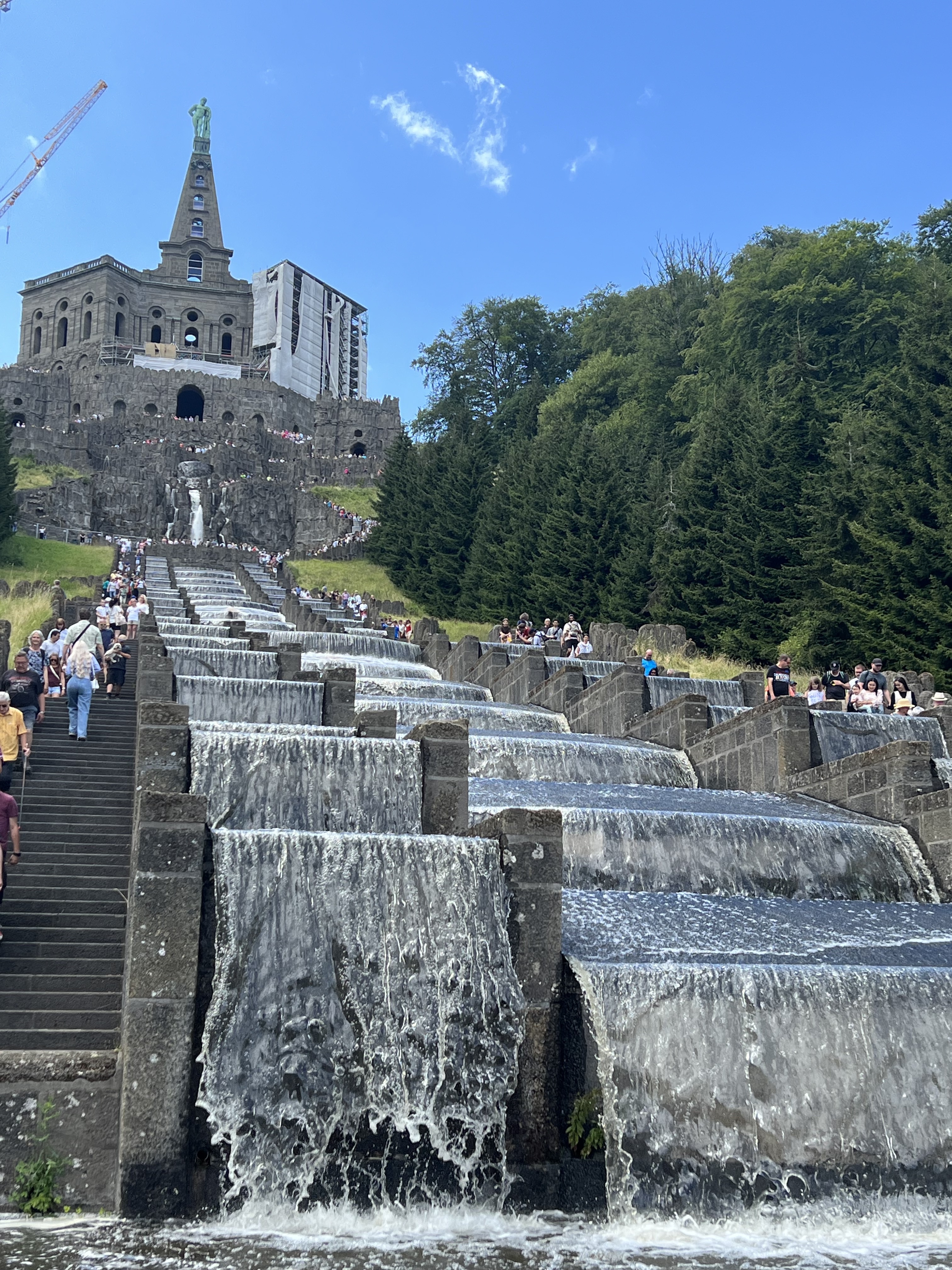
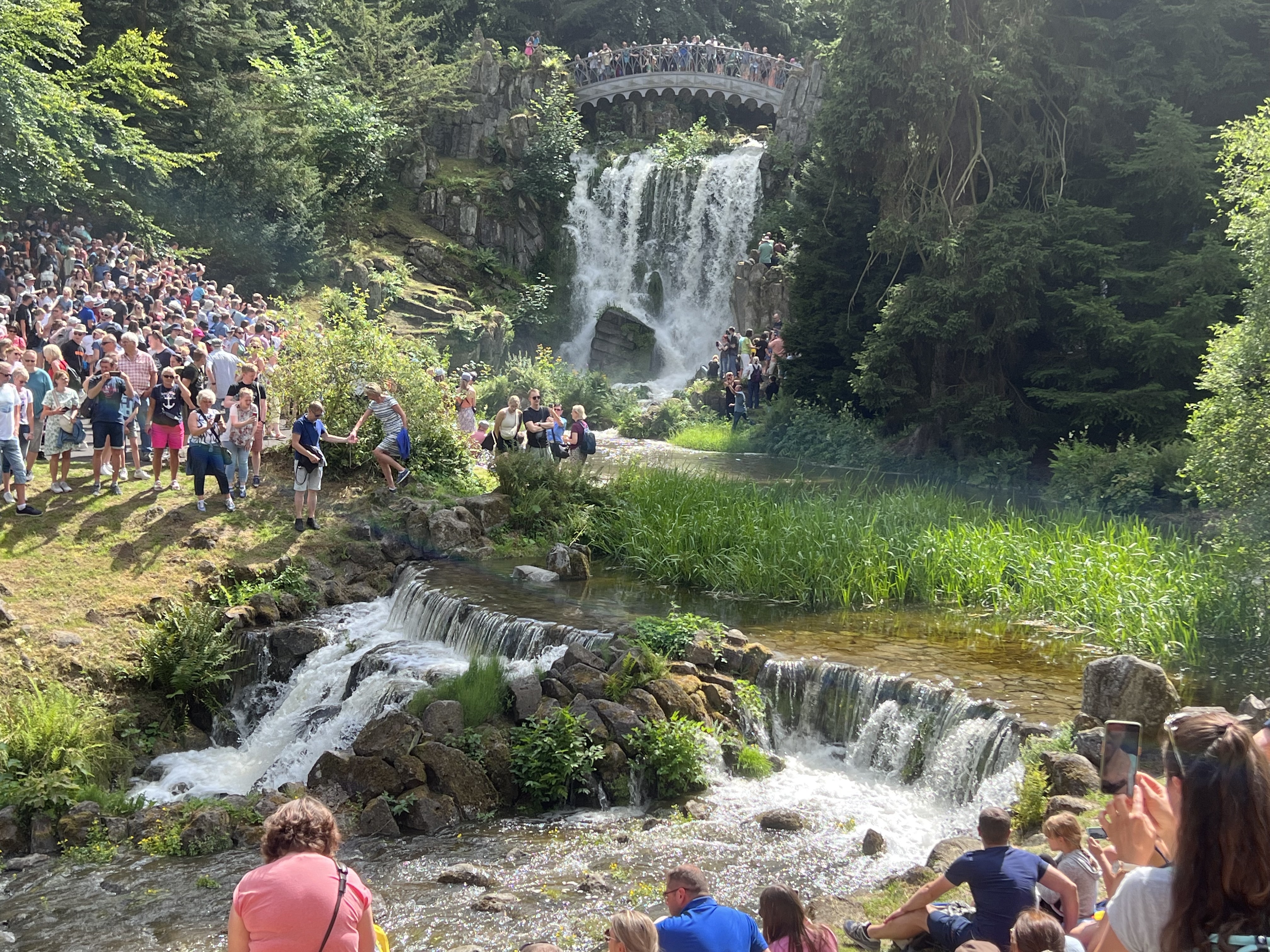
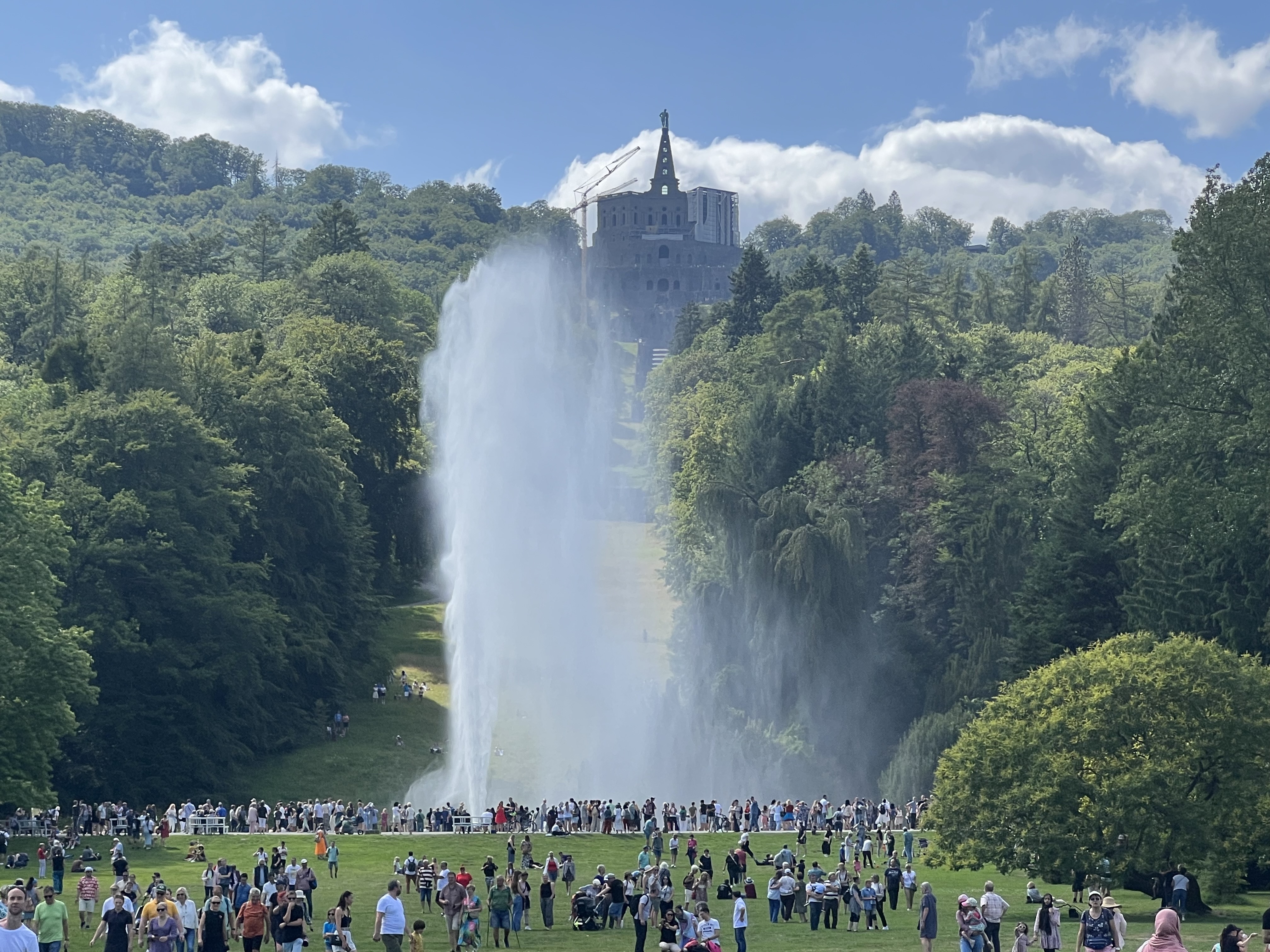
Images in this post depict the waterfall at Wilhelmshöhe Bergpark in Kassel Germany (photos by M. Malina on 16 July 2023)

I had to experience it for my own.

And that meant a rather long, not unenjoyable but challenging, hike up and down a tall mountain and tower in Kassel, Germany, on a sunny, hot day last month. This mountain park called “Wilhelmshöhe” covers an area of over 560 hectares. As such it is the largest of its kind in Europe.[1]

At first, up. We had to get to the top before the water started flowing so we could witness its spectacle. Years ago, I had visited the mountain, saw it from a distance, but for various reasons didn’t ‘experience’ the wonder of its water works.

You see, behind the Hercules monument atop the mountain lies a vast matrix of reservoirs and channels which supply water to mostly underground cataracts and chutes.

Only twice a week during the summer at a specified time of day, a loud horn signals the start. And then water begins to flow all the way down the mountain finishing its trek by fueling a spectacular 50-metre high fountain in a small lake at the bottom.

Visitors can follow the waterway all the way down just ahead of the rush of water, stopping at various viewing platforms to see the water as it first appears flowing over cliff faces, or rapids or over ancient aqueducts. You can time it just right on your march down the mountain to witness this incredible flow of water.

I couldn’t help but relate my experience to the imagery surrounding baptism. Baptism, for many of us, happens near the beginning of our lives. It involves water, the pouring of water over us. Water and baptism are inseparable.

Of course, water flows down the hill. Its trajectory is downward. The life of faith, flowing from our baptism has a similar trajectory. Following Jesus means going down into the valley of our lives. The meaning of faith really hits home when we respond to Jesus’ invitation to “come” and “follow” him, just like Peter did in our Gospel text today when he got out of the boat and into the storm to meet Jesus.[2]

And more often than not, the baptismal life leads to a place where we will be open to Christ’s invitation to follow the water-way and come off the mountain top of our securities and out of our comfort zones.

That is where baptism leads. Follow the water way. Downward mobility is the direction of growing our faith, paradoxically. That is what following Jesus means. This journey down the mountain is the way of love, grace, and acceptance.

In the Baptism liturgy we heard the water references from the bible: when God’s Spirit moved over the waters at creation, when God delivered Noah from the flood, when God led Israel through the sea, when Jesus was baptized by John in the river Jordan.[3] And, at the end of the Gospels when Jesus died on the cross, water flowed from his side.[4] Water dominates the stories of salvation throughout the Bible.

When he encounters people on his earthly journey, and us today, Jesus offers the “living water” that he says he is, an eternal spring that will flow from the hearts of all the faithful.[5]

In the Gospel text for today Jesus encounters his disciples during a storm on Lake Galilee. You get the impression that Peter doesn’t really know what he is getting himself into, when he wants to go to the Lord.

Well, he knows, intellectually. He is a fisherman, after all. He knows the lake. From inside the boat, he sees the waves growing, the winds intensifying. The storm is already unleashing its fury when Peter makes what amounts to his cerebral expression of faith: “If it is you, Lord, command me to come to you on the water.”[6]

But soon Peter will know what he’s getting himself into. “Come,” says Jesus.[7] The difference is that when he leaves the boat, Peter is investing more than just his mind. He is all-in, now.

Peter, in order to know the truth of Jesus, had to follow the way of the water. He had to immerse his entire self—mind, body and spirit. He had to get out of his head and experience a relationship with Jesus. He had to put his whole self on the line, not just what he thinks about Jesus. It’s when he first really notices the waves and is afraid that he knows for himself God’s saving act.

Truth is not an idea. It is a relationship.

Christ Jesus calls us to follow the waterway. Our baptism is neither a private affair occasioned in isolation, nor is it a debate. It is an experience of a relationship. It is conducted among the church—the people of God. We move en masse, together ‘down’ the proverbial mountain and into experiencing God in our daily lives which includes all the challenges of living.

Jesus doesn’t call us to escape the storms. Jesus doesn’t call us to get back into the harbour where it is safe. He calls us to meet the challenges of the world head on, out on the open water. And he calls us to trust in Christ who is present, there, when the storms come. And come they will.

Because especially amid the turbulent storms of life – and that is the message of the Gospel – we experience the love and intimacy of God who created us, lives in us, and invites us into adventures of faith. “Come” says Jesus to you and to me. “Come”, follow the water of life and love that flows on forever.

And Christ Jesus will be right there beside you.


[1] Bergpark Wilhelmshohe

[2] Matthew 14:22-33

[3] Evangelical Lutheran Worship, Pew Edition, Holy Baptism (Evangelical Lutheran Church in America: Augsburg Fortress Press, 2006), p.230

[4] John 19:34

[5] John 4:1-42; 7:38

[6] Matthew 14:28

[7] Matthew 14:29

“I am here, now” – a funeral sermon

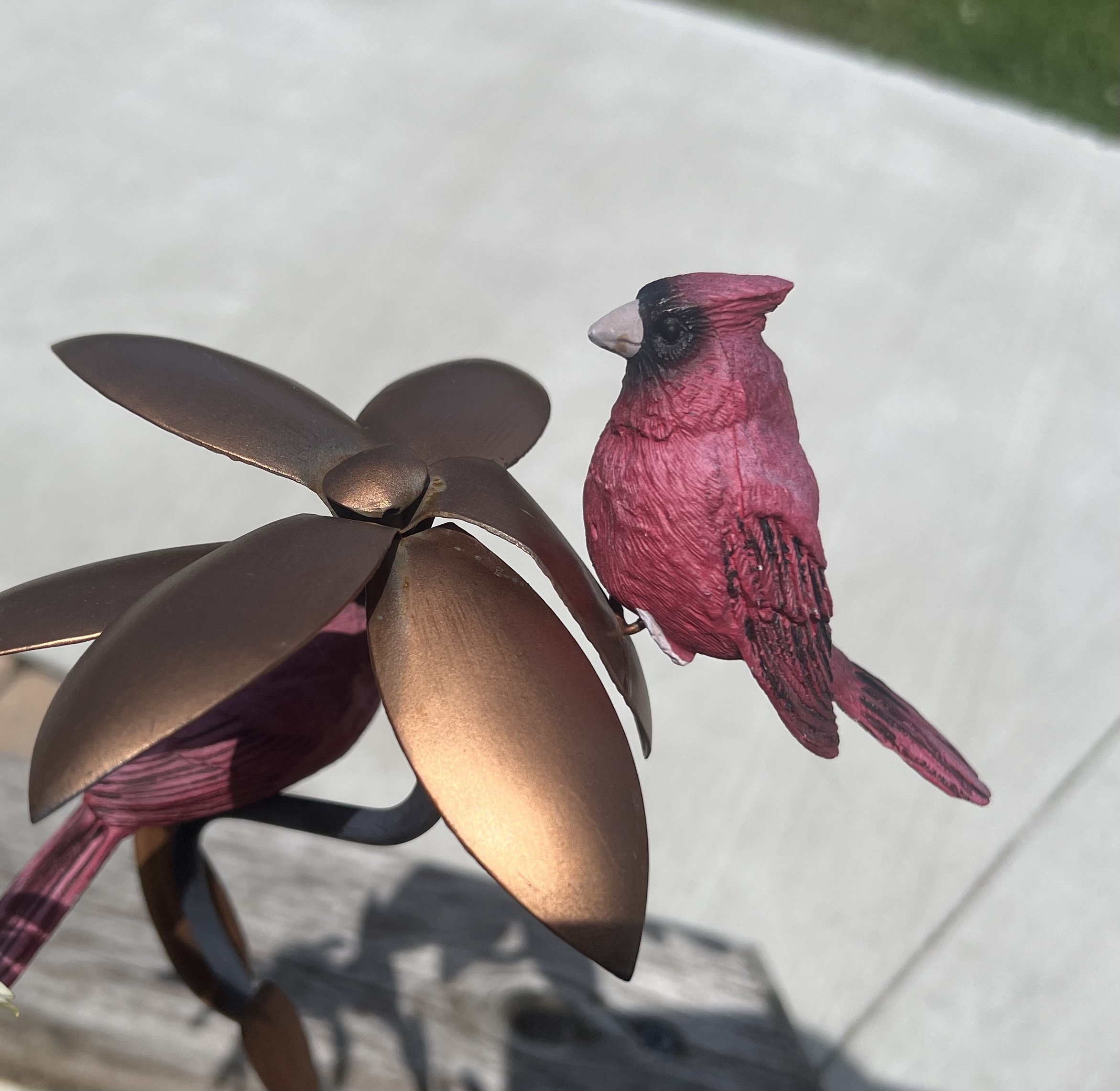
cardinal in garden (photo by Martin Malina 6 August 2023)

It has been a year this month when we first heard of Marie’s diagnosis. It goes without saying this news came as a devastating shock.

This past year has been a journey to say the least, a journey of ups and downs, of hope and despair. And not just Marie’s suffering but ours as well especially you, Wayne and dear family.

The time seems to have gone by both quickly, and at the same time feels like a long haul. It’s as if time itself expanded in each moment of living: This year was only one, short year in the large scheme of things. But it contained billions of seconds that filled each day and place where Marie spent time – various rooms in the General Hospital, the apartment in Sarsfield, and the hospice in Kanata.

The meaning of this time played out in each ordinary moment. And each of those moments was a gift to us, each interaction with Marie and one another a blessing.

I have two Tim Horton’s mugs in front of me. Wayne told me the funny story of when Marie was selling mugs at the Tim Horton’s counter in the Canada Post building. Typical of Marie’s sense of humour, and trying to increase sales, she turned some of the mugs on display half-way around, so the handles were pointing the opposite way vis-à-vis all the other mugs.

And when potential customers came to take a closer look, she would, with a smile on her face and mischievous twinkle in her eye, announce that these were very special mugs because some of them were left-handed, and others were right-handed.

Her sense of humour caused and causes us to laugh. And laughter always gets us out of our heads and brings us into the present moment. Laughter is the key to an understanding of faith that Marie’s life exemplified.

Her jokes and humour not only brought people of the same mind together, but also people who are different in their beliefs, backgrounds and life experiences. That was her gift. Her presence brought us together into a moment in time that all of us shared, a moment in time that was quite common and ordinary for us all.

Indeed, Marie expressed her extraordinary faith in very ordinary situations and ways. Her faith was not sophisticated. Her faith was not born from a lot of book knowledge, education degrees nor ivory-tower language. Her faith was not so much about ideas and theories about which you could be ‘right or wrong’. It was more concrete and specific, formed in love.

We gather to celebrate Marie’s life today during Ordinary Time, in the church year. It is the ‘green’ season of church colour, signifying the simple life and growth of all creation.

Jesus told stories about ordinary life – planting seeds, harvest time, growing vines, losing coins and sheep, money and wages, the birds of the air, the flowers of the field; and ordinary people in the middle of it all. Jesus even laughed with others at a party.[1] Humour and laughter are the key to understanding something very important about God:

God comes to us “disguised as our life.”[2] Folks who get this are deeply spiritual people. Because they know God is revealed not in church services inside church buildings on Sunday mornings alone.

Rather, more importantly, God is revealed in every moment of ordinary living. God is revealed if we pay attention—and that is the work of our lives—in those moments of grace and beauty in the midst of it all, good and bad. That is where God is.

So, in the last year I’ve been on a birding kick. I’ve even gotten myself a fancy app to identify bird calls. It’s hard sighting a bird from the back deck or even in the woods walking. I hear the bird first, and then go looking wondering if I can spot it in the trees or bushes. Not easy.

But there is one bird that catches my attention time and time again without much effort on my part. Marie’s favourite. It’s almost as if the cardinal wants to be spotted. You don’t have to be a life-long birder whose memorized every page of some comprehensive archive of all North American birds. Because grace comes uninvited and often unexpected.

There it is, right before my eyes, whether I’m ready for it or not. There it is, contrasted against the green foliage of the maple, oak or spruce tree at this time of year. I can see it, the brilliant red covering its entire body, popping out at me. As if it wants to say to me— and probably is in its sweet song—the very words of a God who now embraces Marie under loving, caring, protective wings:

“I am here. I am with you, always. I will never leave you, no matter what.” Thanks be to God!


[1] Read through Matthew, Mark, Luke, John – the four Gospels in the Bible.

[2] Richard Rohr, Things Hidden; Scripture as Spirituality (Cincinnati, Ohio: St Anthony Messenger Press, 2008), p.17.

You do it

The Feeding of the Eight (CCMC meditation group Calgary, 28 June 2023, at Lake Minnewanka)

The parable of the feeding of the five thousand is very well known among Christians.[1] And I must admit to you, as the years go by, I find it increasingly challenging to preach on well-known texts. To find a new angle. But this story can be looked at in a variety of different ways.

You can look at it as a math problem: Twelve disciples, with five loaves and two fish. Five thousand people to feed, multiplied by a miracle we will call ‘x’. Divided and eaten in the amount of ‘y’ equals twelve baskets of leftovers. I hated doing problems like that in school.

Last month when I hiked with other Christians near Banff, our mountain and lake-side journey concluded with a picnic near the beach. Since I was the only out-of-province hiker who arrived late the night before I did not have time to put together a lunch. However, my hosts who put me up the night before had provided a hearty breakfast for me so I wasn’t really all that hungry. And, given the time change, I would be fine until we arrived back in Calgary later that afternoon.

When everyone sat down at the picnic table, out came the lunch packs: Individuals brought sushi, fruit, hummus, wraps and then began eating what they packed for themselves. I had my water bottle and during our lunch break was totally content simply to visit and behold the pristine mountain vista before our eyes.

But to my pleasant surprise, someone handed me a bun, then some sliced meat, with cut-up lettuce and mayo. Then someone else slid over some sliced apple and a container of cherries. Totally unexpected, I realized how hungry I actually was after the morning hike. And I appreciated the kindness and generosity of my friends to share their food with me.

The Feeding of the Five Thousand story emphasizes the compassion of Jesus, his heart for the crowd. It underscores, as well and once again, the reluctance and disbelief of the disciples. And of course, it’s a miracle story.

I think perhaps my favourite interpretation of this text is that the sharing of the five loaves and the two fish is the miracle. The sharing of the five loaves and two fish is the miracle.

I think the crowd is moved by seeing the disciples scrounging for their meagre supplies. And I think they get motivated and realize they have gifts to offer as well. So, someone finds they have a piece of cheese, and someone has some olives, and someone else has some dried meat and someone else has some wine. And one by one people bring forward what they have been hoarding and it becomes a giant potluck with twelve baskets left over. It’s like the hearts of the crowd are opened.

And maybe that is the miracle: that Jesus is able to bring out the best in those present. The generous, giving, selfless best. But there’s more.

I think perhaps the most important part of the text is when the disciples say, “This is a deserted place, and the hour is now late; send the crowds away so that they may go into the villages and buy food for themselves.”[2] They want to be let off the hook.

Don’t we all? They see trouble coming: an hangry crowd of five thousand, and they want to avoid it. But Jesus turns around and says, “You give them something to eat.”[3] You give them something to eat. You do it. It reminds me of the story of the raising of Lazarus. After Lazarus comes out of the tomb, Jesus tells his disciples, “You unbind him.”[4] You do it.

It was all fine and good to depend on Jesus to do everything when he was with them. But Jesus was preparing his disciples for the time when he would not be there. Not that he ever abandons them. We know his promise to be with them and us until the end of time.

But as Jesus called the disciples, they were being trained to carry on Jesus’ ministry after his time on earth.

We are Jesus’ called disciples. And now Jesus calls and asks us the same thing. Delegates to the Special Convention of the ELCIC earlier this summer in Calgary received that message: “You” do it. You address climate change. You feed the hungry. You take a stand on what it means to be in healthy relationships with all people, and not just with those who are like us.

It’s not someone else’s job. As Christians who worship Jesus Christ today, we are responsible, as Christ-bearers, for using the resources we have been given to do the mission of God in the world today. In whatever way we have been equipped and gifted to do it.

It won’t be easy. We will be vulnerable to others. We will make some mistakes. We have to be ready for that. But when the value, the measure and the goal is the love of God in Christ Jesus for all people, and for all God’s creation, then we can trust this God to see us through. Because Jesus will also bring out the best in us—the generous, giving, selfless best.

We may not recognize the gifts we have. We may at first be reluctant to use them. We may be blocked by some reason to release our gifts to the world. But when we try, take the first small step, in our vulnerability but out of a heart of love for others, Jesus will bring out the best in us. And then we, too, like the disciples of old shall behold the wonder of God.


[1] Matthew 14:13-21; This sermon was inspired by the words of national bishop Susan Johnson who preached on this story at the closing service of the special convention of the ELCIC meeting in Calgary (June 28-July 2, 2023).

[2] Matthew 14:15

[3] Matthew 14:16

[4] John 11:44

“You do it” sermon by Rev. Martin Malina, Pentecost 10A, 6 Aug 2023

Somewhere, someone is

photo by Martin Malina (Ottawa Rideau Ramble, Burritts Rapids, 20 June 2023)

They say Canadians are peace-loving people. I count myself among many Canadians whose personality style wants to avoid conflict. We would rather ‘go along to get along’ than engage in conflict.

That is why this Gospel text is troubling, to say the least.[1] It is rife with conflict, and not just in the public arena. Jesus suggests that conflict is a normal part of a faithful life, even within a family. That part, especially, I don’t like.

How do we receive this message which, I would like to presume, promises something healthy, hopeful and positive for the journey of faith?

Jesus says, “What I say to you in the dark, tell in the light; what you hear whispered, proclaim from the housetops.”[2]

Perhaps there is something that we don’t see amidst all the froth and flotsam of human conflict. Perhaps we may not appreciate it right away— something deeper, a connection between us all that runs true despite the surface turbulence of human interaction.

Maybe amidst the strife, the divisions and disagreements there lies a hidden reality that is very much worth “proclaiming from the housetops.” And we need to tap in on that bond, become aware of it, draw deeply from its power, especially when we disagree.

What is this bond?

When infants are baptized, we say that even though the individual baby cannot express cognition in the way adults do and therefore can’t say with words, “I believe”, it is the prayers of the faithful, the community, that validate the affirmation of faith at baptism. And their faith stands in for the infant. When the baby can’t, the grown-ups will.

During the early stages of the pandemic debate swirled around Eucharistic practice—whether it can be conveyed online or only in person. I was struck by the comment of a faithful pastor now retired, who said that while he individually didn’t attend in person to receive the sacrament, his faith was nonetheless encouraged simply to know that somewhere, in some place, the Holy Communion was happening “where two or three are gathered”. Somewhere, someone was.

Over the last couple of months I’ve helped start up noon hour meditation groups for staff at the Bruyère hospitals here in Ottawa. Last week some of the organizers and chaplains debriefed how it was going so far. During the meeting over zoom much was said about who was not attending. We reflected on the meaning of relationships and community.

And the conversation became more open-ended. One chaplain, a Christian, remarked that while she hadn’t worshiped on Sundays in a local church for a long time, her faith was encouraged nevertheless to know that somewhere, someone, was going to church every Sunday. It was important to her, never mind that she wasn’t attending, that it was happening somewhere.

Those of you who are here in person need to hear this: That knowledge alone has kept her faith going. A faith that is alive.

The prayers continue despite what individuals do or don’t do at any given time. Especially in grief, when God may feel distant; or, dealing with a personal tragedy; or, reeling from an accident or circumstance beyond your control that has disrupted your life– when you don’t feel like or can’t pray … perhaps it’s at those moments you need to know that someone, somewhere, is praying for you.

“This is my prayer to you, at the time you have set, O Lord.”[3]

The discipline of regular prayers, whether it be every Sunday morning in worship, or any other set pattern that people know, is a gift amidst the turmoil of life. And even if an individual in a unique situation cannot or does not participate in person, their physical absence doesn’t invalidate the prayer. In truth, the prayers of the community can encourage those very people.

In the Psalm for today (69:13), the Psalmist acknowledges “the time set” for prayers. For Christians, as for people of other religions, times set for prayer function as an anchor point in the day, the week, and the year.

When I took a world religion’s class in high school, I recall asking why Muslims prayed at five set times every day? The answer I received inspired me and expanded my understanding of the power of prayer. They followed that regimen of prayer so that people of the Islamic faith would know that prayers were always happening, given the various time zones, around the globe. That awareness can be very encouraging for faith. Even though individually I may not be saying any prayers right now, someone, somewhere, is.

When Luke describes the lifestyle of early Christians in the Acts of the Apostles, the early disciples made “the prayers”[4] part of each day. He doesn’t imply, “they prayed whenever and whatever.” He refers to “the” prayers–a definite article, and order of prayer implied. They observed common prayers at the times set aside. It was a discipline.

Whether it be Muslims praying five times a day or Christians following the Daily Office, called the “Hours” (for example: matins, vespers, compline, etc.) or meditating twice daily in the morning and in the evening, people of faith in their practice of prayer attest to the unceasing[5] nature of prayer, collectively. Prayer continues, around the globe at all times. Even if individuals aren’t praying unceasingly, the community is.

What we can’t do by ourselves, someone, somewhere, is. American writer Helen Keller wrote, “Alone we can do so little; together we can do so much.” And that goes for prayer—how we connect with God, with ourselves and with one another.

And I wonder, amidst all the turbulence of life in community, is it this awareness of what unites us, what gives us power from deep within, that releases us to do so much for God. And even though our faithful actions might result in ruffling some feathers? So be it.

I heard the story from the son of the late Art Sugden, who fought in the First World War as part of the 31st Alberta Battalion in the Canadian Corps. Ted told me of his father’s dramatic survival of the battle at Vimy Ridge.[6]

A bullet from tracer fire took out both his eyes, rendering him blind for the rest of his life.

Eventually Art returned to his hometown Calgary in 1929. He also returned to his favourite hobby: gardening. Though he was physically blind and couldn’t see the beauty of the flowers he tended, he kept on working in his garden. Though I suspect his other senses could enjoy the flowers’ gift, he couldn’t see for himself their blooms. Yet he continued during the Springtime, Summertime and Fall time of the year, caring for the earth and flowers that grew there. He did this work faithfully even though he couldn’t witness with his own eyes the fruit of his labour.

But he kept on, trusting that the flowers he tended would give the world a beautiful gift of vibrant colour and joy. And he was right. Others saw, saw the gift he nurtured and brought to life, saw the beauty that in turn gave the world joy and hope for tomorrow.

Somewhere, someone is.


[1] Matthew 10:24-39

[2] Matthew 10:27

[3] Psalm 69:13

[4] Acts 2:42

[5] 1 Thessalonians 5:17

[6] Edward Sugden, “A tribute to my father” in Esprit de Corps (Volume 16, Issue 10, November 2009), p.36-38.

“Somewhere, someone is” a sermon for Pentecost 4A by Rev. Martin Malina

Talkoot

“The harvest is plentiful, but the laborers are few; therefore ask the Lord of the harvest to send out laborers into his harvest.”[1]

Receiving lots of water (photo by Martin Malina 15 June 2023 at Faith Lutheran Ottawa)

Jesus gives instructions to his followers in today’s Gospel. And each of their names is listed: “Simon, also known as Peter, and his brother Andrew; James son of Zebedee, and his brother John; Philip and Bartholomew; Thomas and Matthew the tax collector; James son of Alphaeus, and Thaddaeus; Simon the Cananaean, and Judas Iscariot, the one who betrayed him.”[2] We must be careful, here …

Receiving instructions from the Lord can be hazardous to our spirituality when we mistake Jesus’s words to be meant for individuals. When we interpret the message of Christ only through the autonomy and separateness of individuals, we miss so much.

Whenever we read from the bible about sin and salvation especially, we may easily be tempted to make it all about me and Jesus; it’s up to me to make it right, to do the job. We read these sacred texts, admittedly, from our individual point of view.

A month or so ago, the confirmation class planted gladiolus bulbs in the ‘Faith Garden’, as we call it. On that day when the young teenagers put the flower bulbs into the ground and covered it with earth, we prayed, gave thanks for the gift of the earth, and blessed our act.

It also poured rain that day. So, we were pretty hopeful that those bulbs would take and grow.

But until a couple days ago it has not rained a drop. In fact, wildfires across Canada have burned to date an area larger than the entire land mass of Costa Rica. It has been dry, to say the least. If anything in our garden was to grow, let alone survive, someone would have to water it regularly.

I live a 45-minute drive from the church property and when I am in the city I normally don’t think of watering a garden as part of my work schedule. It struck me just recently that those bulbs may not have received a drop of water since the day we planted them.

And I despaired. I was catastrophizing: What a failure! What a poor showing if the confirmation class of kids from Ottawa would see that their flowers, dedicated to their faithful growth, not only didn’t grow but died in the ground.

When I took a walk to the garden the other day, however, I was shocked to see several of the bulbs bursting out of the ground. How did that happen? I learned that over the past month, other members of the church regularly went to the garden to water it.

If it were up to me alone, faith wouldn’t happen. If it were up to us, individually, to make it right, to grow in trust and faith and joy in the Lord, it can’t happen. The truth is we are connected one to each other in the bond of love, grace, and presence of God.

We often approach our life of faith, our daily practice of faith, however that looks like, as a solitary act, something we do by ourselves, alone. From the outside, that’s what one may see: I’m praying. I’m visiting others. I’m donating money. I’m doing this by myself. And it’s on me to make any good from it.

But Jesus addresses his disciples as a group. It’s the second person, plural, that is implied: “You”. And, Paul writes to churches, not to individual members of that church. Whether he is writing to the Thessalonians, the Galatians, the Ephesians, Corinthians or Romans, Paul addresses the community as a whole. And he writes in his letter to the Corinthians that we are the “Body of Christ”[3] with many parts serving a larger purpose.

It is the body that is the focus, and all that we do is for the “common good”.[4] Collectively we take responsibility for our faith.

Notice in the Epistle reading for today from Romans, Paul doesn’t use one singular pronoun. All the pronouns are plural: “us”, “we”, “our”.[5] We are in it together.

The gift of God’s grace and the love of God poured into our hearts is much greater than all our sins combined. The gift of God’s grace places us all on a level playing field. There are no superheroes – some better than others – in the land of God’s love, mercy and grace for all people. We are truly in it together.

For six years in a row, including the pandemic years, Finland has ranked No. 1 as the happiest country in the world.[6] There’s a beautiful concept expressed in the Finnish language. Talkoot is an old Finnish word that doesn’t have a one-word equivalent in English. Talkoot basically means: “working together to do something that one would not be able to do alone.”[7]

In agricultural times when someone had a big project at their farm, such as building a barn roof, they’d hold a talkoot. Here in Canada we’ve perhaps witnessed the Old Order Mennonites do a similar thing with a ‘barn-raising’. Neighbours gather voluntarily and put in a day’s work to help, then celebrate with a festive meal.

This kind of culture extends to why, for example, Finnish people often feel positive about their civic duties and helping the wider society by sacrificing their private comforts and desires of the moment. “They see it as essential for the good of the whole.”[8] Our faith is not about ‘what’s in it for me’ culture but rather, ‘how can I be part of the solution for the greater good’?

Paul uses the image of ‘pouring’[9] to describe how much we have to give. Not a trickle. Not a drop. When we’re in it together, we experience I believe the depth of grace. Just like the Faith garden receives an abundance of water from members who water it regularly and an abundance of rain, like it did just a few days ago when it poured, the grace and love of God has been poured into our hearts. Therein lies a deep reservoir of grace and love for the good of all.


[1] Matthew 9:37-38

[2] Matthew 10:2-4

[3] 1 Corinthians 12

[4] 1 Corinthians 12:7

[5] Romans 5:1-8

[6] http://worldhappiness.report

[7] From the world’s happiest country

[8] Ibid.

[9] Romans 5:5

Talkoot – a sermon for Pentecost 3A by Rev. Martin Malina

Following her heart – a funeral sermon

It was her life she lived. When I reviewed again Ida’s life story that you, dear family, wrote, I had the strong impression of a unique journey that only she could have lived. Though similar in scope to the general narrative of many people fleeing war-torn and post-war Europe in the last century, and though similar to the narrative of many immigrants to Canada from northern Europe, her story had its own flavour. For example, just recall with me all the places she called home after emigrating from Germany and landing in Quebec City:

Regina and Weyburn in Saskatchewan, Montreal in Quebec, back to Prince Albert in Saskatchewan, Kelowna in British Columbia, then to Vancouver and finally to Ottawa in Ontario—and that’s just her time in Canada! Who else would have covered so much ground in the second largest nation by land mass on the planet? Her life was her own. Not someone else’s.

She never just stayed in one place. She moved on. Even though many circumstances surrounding her emigration and personal life events were beyond her control, you don’t get the impression that she just followed along. Whether something good or bad happened, she saw an opportunity and took it—took the initiative, took a risk filled with hope. She didn’t follow a script. She followed her heart.

So it is, I think, with our grief. Today we express our sorrow at losing Ida. In many ways it is a sad day, like the day she died. We must acknowledge our own way of grieving. Each of us does it differently. We no longer live in a cookie-cutter world where everything is done the same way for everyone, and everyone must conform to a standard method.

The pandemic has only accentuated this truth, especially when it comes to how families process their grief and how they ritualize their memorials of loved ones. It isn’t done the ‘same way’ for everyone. Some will do everything they need to do in a week. Some will take years before they are ready to have a burial.

It has been over two years since Ida died at Granite Ridge Long Term Care Home in Stittsville Ottawa, on February 3, 2021. You took the time you needed before you were ready to take this next step. And that is good. We must learn to respect our diversity. But we’ve travelled this road together, not alone. I think Ida would approve.

If there is anything that summarizes for me the adventurous and Canadian-geography-encompassing breadth of Ida’s life journey is that she didn’t do it alone. At different times, and in different places, various people, including close family members, accompanied her. Though ‘home’ meant several different street addresses over time, she rarely if ever was all by herself at those pivot points.

Whether with one son or the other, or her husband at the time, close friends, her brothers in Germany, or churches or health care institutions where she worked, she was part of a community wherever she went. Relationships and relating were important to her no matter where she lived.

And, in fact, that is my last and enduring image of her: where she lived the last chapters of her life at Granite Ridge. Rarely, if ever, did I find Ida alone in her room when I went to visit her. She was always in the activity room surrounded by her floor mates watching the TV, or waiting with her table mates in the dining room for the next meal, or in the hallway by the nurses’ station where she could monitor the high-traffic crossroads on the busy “Lake House” floor.

And though her death ended something important for you, and though we cannot see her any longer in the flesh, we can be confident that those relational bonds endure to this day. With the gift of faith, we can affirm that while your relationship with her has changed it has not ended. Nor, ever will. She continues today to live, move and have her being in the God of all hope and the source of all life.

Jesus says that he goes to prepare room for you (John 14:1-3). He makes a promise not just to everyone, but to you, personally. There is a place not just for Ida, but for you, too. In the divine realm, the holy house, the family of God—however you want to define it—you belong.

The message of the Gospel is intensely personal. It is not some general comment for the collective human race—though it is that, too. But today, as we continue to mourn the death of your beloved Ida, everyone in this room and watching online needs to hear a personal word of comfort spoken just for you: You belong, forever.

This personal word also goes beyond the promise of making room for you. God takes pleasure in spending time with us. The prophet Zephaniah describes how God “will rejoice over you with gladness, he will renew you in his love; he will exult over you with loud singing as on a day of festival” (3:17–18). 

These verses provide us with a profound word picture in which we see the almighty God of the universe taking delight in each of us. 

It’s like never getting sick of chocolate and enjoying it forever. Can you imagine ever getting sick of eating chocolate? Though Ida got tired of the taste and smell of chocolate after working in a chocolate factory in Berlin before coming to Canada, maybe she will be surprised in heaven. Because the party never ends!

Mercy and sacrifice

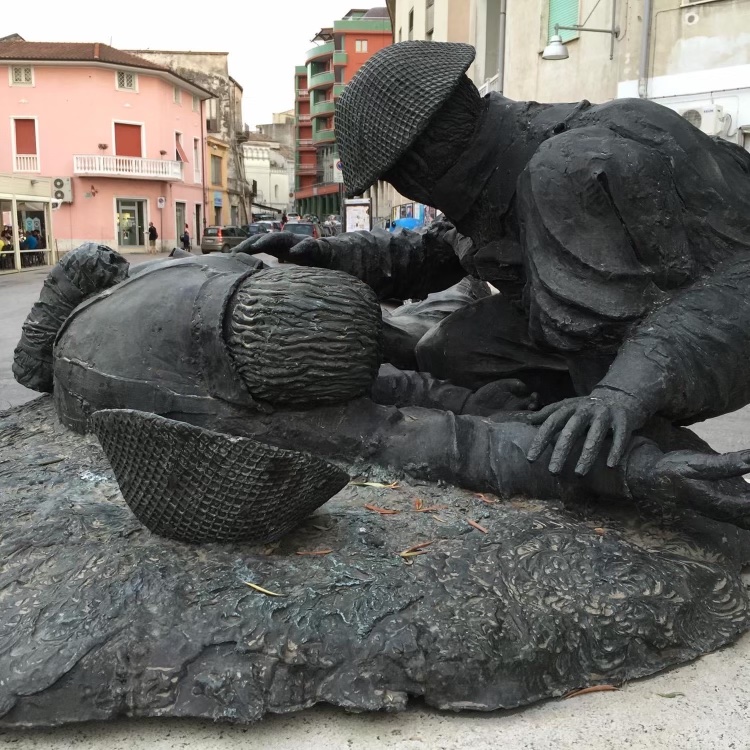
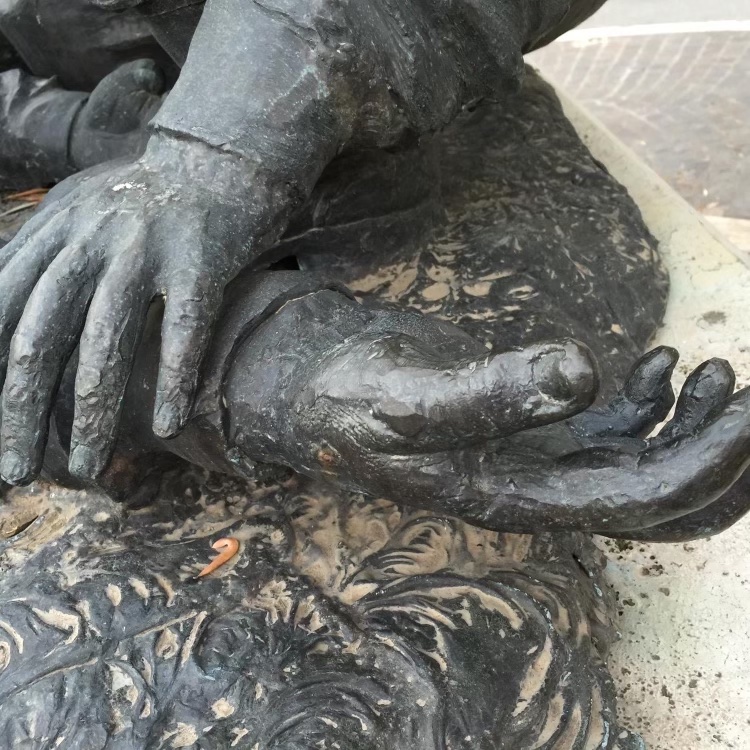
“The Price of Peace”, a gift to the people of Ortona, Italy, by Canada in 1999 (photos by J. Hawley Malina, July 2016)

“I desire mercy, not sacrifice.”[1]

Let’s say the word “sacrifice” here represents our good efforts to help others. Let’s say “sacrifice” reflects our giving money for good causes, offering ourselves in service even when it is inconvenient or uncomfortable for us. Let’s say “sacrifice” shows our discipline to pray and worship. By placing mercy and sacrifice in contrast, does Jesus exclude sacrifice from a life of faith?

If sacrifice means self-sacrifice in the sense of constant self-abnegation or denying your needs altogether in the helping relationship, then I would say, yes. Doing too much good can sometimes just reflect our compulsiveness. We end up satisfying more our needs than effectively meeting others’ needs and thus enable dysfunction in the relationship more than anything. Sacrificing can burn you out. God doesn’t want that.

But is there something redemptive about ‘taking one for the team’? And in what situations?

I think about emergency room staff and first responders—doctors, paramedics, and nurses—who will see all manner of people coming through their ward. They will be performing life-saving surgeries, procedures, and therapies in intense, stressful situations.

But they’ll be doing all this not for their family members, not for friends and people they know, not for those who belong to their social circle. No.

Most people served by the health care system are unknown, completely unknown, to the caregivers. Health care providers spend their days helping complete strangers, some of them undeserving we might say. Still, they show mercy.

Edith Cavell was a nurse during the First World War in the last century.[2]

By late 1914, Brussels was occupied by the Germans. The nursing school there became a Red Cross hospital, treating casualties from both sides, as well as continuing to treat civilians. Initially, Edith was asked to help two wounded British soldiers trapped behind German lines. She treated the men in her hospital and then arranged to have them smuggled out of Belgium into the neutral Netherlands.

Eventually, Edith became part of a network of people who sheltered Allied soldiers and Belgians eligible for military service, arranging their escape. Over the course of the year, she helped around 200 British, French and Belgian soldiers, sheltering them in the hospital and arranging for guides to take them to the border. On August 5, 1915, she was arrested for this activity and placed in solitary confinement.

Edith was tried and court-martialed along with 34 other people involved in or connected to the network. She was found guilty and sentenced to death. On October 12, 1915, nurse Edith was shot by a firing squad.

Edith Cavell’s undying service and sacrifice bled from a heart of love for the stranger, and all for a higher good. Her giving did not focus on sin or punishment. She didn’t discriminate nor judge others, whether they were the good guys or bad guys, whether they were deserving of her help or not. Her love reflected the heart of God, first and foremost, in leading with mercy and grace.

Why does God show mercy? With God, mercy is often expressed by forgiveness. So why does God forgive us? We know the act of forgiveness itself doesn’t take away the sin and its consequences. We know from experience that forgiveness doesn’t nullify or eliminate offensive actions. So, why does God continue to forgive us, and others?

Because “every time God forgives … God is showing a preference …for sustaining relationship over being right, distant, superior, and separate.”[3] God’s love for you and for me is about God’s absolute ability to keep a relationship going with everyone and everything.

For Jesus, it’s about maintaining the relationship. Jesus didn’t just tolerate, or put up with, sinners and keep them at arms’ length. He ate with them. And that’s what drew the ire of the Pharisees.

Not only was Jesus breaking the rules by eating with sinners, but his action also exposed the Pharisee’s desire, deep within, to separate themselves, cut themselves off from people they didn’t like. Jesus exposed the Pharisees false claims to righteousness, a false righteousness which only justified their hate.

In the past I’ve mentioned to you a children’s story entitled “Six-Dinner Sid”[4] about a cat named Sid. He was the cat that ate six dinners a day in six different, neighbourhood homes on Aristotle Street. But there’s more to the adventures of Sid the cat.

You see, for the longest time he was able to get away with it because the people on Aristotle Street didn’t know each other, didn’t talk to each other actually. They had no clue what Sid was up to. Each household believed the cat they fed was theirs, and theirs alone.

All Sid had to do was work hard remembering which name he would go by in each house, and the six different ways to behave at each. But his luck soon ran out. His scheme worked perfectly until Sid got a nasty cough.

The next thing he knew, he was taken to the vet not once, but six times, by six different families. By the sixth time the vet realized she was meeting the same cat with the same cough but coming with six different people and responding to six different names. Sid was found out and expelled from Aristotle Street. Sid’s owners said he had no business eating so many dinners.

Sid went to another street, called Pythagoras Place. And, like before, he started going to six different homes on this street. But on Pythagoras Place, the neighbours talked to each other all the time. So, right from the start, everyone knew about Sid’s six dinners.

By the end of the story, the six neighbours that provided the meals for Sid didn’t mind feeding him, didn’t mind that he was getting six meals a day, and didn’t mind giving grace upon grace to Sid. They all loved Sid, who was by nature a six-dinner-a-day cat.

“I desire mercy, not sacrifice” means the starting point must always be mercy and love. Not judgement and rejection. Start with love in relationship.

It’s the heart of love that also loves the self, and sometimes puts down limits and recognizes healthy boundaries. In all the good we do, all our disciplines, all our offerings, the service we give, we must start with love. It’s the heart of love that generates the authentic and truly helpful sacrifice. It’s the heart of love that reaches out to the neighbour and grows relationships defined by grace and mercy for the other.


[1] Matthew 9:9-13. In verse 13 Jesus quotes Hosea 6:6: “For I desire steadfast love and not sacrifice, the knowledge of God rather than burnt-offerings.”

[2] Imperial War Museum write-up on Edith Cavell ; https://www.youtube.com/watch?v=aar8_iLtIcA

[3] Richard Rohr, “One Stream of Love” Evil is a Social Reality (Daily Meditations, www.cac.org, 19 May 2023).

[4] Inga Moore, Six-Dinner Sid (New York: Simon & Schuster, Aladdin Paperbacks, 1991). See my post “A Timely Meal” from www.raspberryman.ca posted on July 22, 2021.

“Mercy and Sacrifice” a sermon for Pentecost 2A by Rev. Martin Malina

East wind

Wind-pressed
(photo by Martin Malina at Cape Flattery WA, 14 August 2022)

What does being faithful, being spiritual, mean in the face of unhappy, difficult, circumstances in life?

I must admit that for me during the past Easter season sometimes the messages and metaphors of pure light and new life clashed with the losses, disappointments and bad news that came up during the Easter season. It seemed the joy of resurrection felt incompatible with what is happening in the world today and in our lives personally. There was this disconnect, and it didn’t always feel right to shout out at the beginning of every Easter service: “Christ is risen! Christ is risen indeed! Alleluia!”

Maybe, then, this Pentecost season is a gift to us, and a help, as it shifts our attention away from the images of new life and pure light – God knows we have lots of daylight these days! We’re ready for another image to guide our imagination and encourage our spirit and faith.

What about, wind? Wind is central to the Pentecost and Creation stories from the bible.

A northeast wind, quite blustery in the last couple of days, brought wild-fire smoke into the Ottawa area. The wild-fire smoke created poor air quality. I had many-a sneezing fits when I went outside yesterday.

In the scriptures, we find that the Spirit of God can blow through in ways we may not always expect, nor even prefer. What does the wind do to us? First, the wind jars us out of our comfort zones. It makes us uncomfortable. It causes a reaction in us.

First, the Spirit of God must “bear witness” with our own spirit, as Saint Paul puts it[1]. Our own lives are exposed, in all truth. Some call the Spirit of God the “objective inner witness”[2] that looks back at us with utter honesty. We might call it, simply, a wake-up call. And that is why we begin the liturgy using ancient words of confession: Lord, have mercy.

It wasn’t an easy beginning for the first disciples of Jesus:

“When the day of Pentecost had come, [the apostles] were all together in one place. And suddenly from heaven there came a sound like the rush of a violent wind, and it filled the entire house…”[3]

You can’t get away from the unsettling, inertia-disrupting character of God’s creative Spirit. In Genesis, when God created the world, when the earth was “a formless void, and darkness covered the face of the deep,” God’s Spirit, “a mighty wind from God” swept over the face of the waters.[4] Notice the descriptive words: mighty, sweeping …

Then in the book of Exodus when the Hebrews escaped slavery in Egypt, they were going East towards the Promised Land when they came up against the Red Sea in front of them.

And “The Lord drove the sea back by a strong east wind all night … and the waters were divided.” [5]

In order to walk that path on dry ground toward the other side, toward freedom, the Hebrews needed to push into that headwind blowing into them at full throttle. They needed to lean into the counterforce of that harsh, persistent headwind blowing against them, likely slowing them down and making their passage more frustrating and uncomfortable, for sure.

But that unfavourable, uncomfortable wind, was at the same time the way towards their freedom and deliverance, a saving gift all along.

These scriptures remind us that God’s Spirit may not always arrive as a pleasing, warm summer night breeze or a still, small voice, a faint stirring of the heart, or a subtle and polite whisper.

Divine Spirit can also arrive with difficult, unsettling effects.

My mother tells me of a time when she was a young girl growing up in southern Poland towards the end of the Second World War, in a town not far from Auschwitz, the notorious Nazi death camp.

As a six-year-old, my mom one afternoon was playing in her backyard, and a gentle east wind was blowing in from the direction of Auschwitz. And she recalls a strange, acrid odour wafting in with that wind, coupled with what she thought were ashes floating around everywhere.

It was only much later as an adult, my mom recalled this disturbing childhood memory, with the foul smell and ashes floating in with the wind. And she realized the horrible truth of what that wind revealed that day.

How over a million Jews at Auschwitz were gassed to death in specially-built chambers, and then their bodies burned in crematoriums with smokestacks pointing to the sky, the wind carrying and revealing the gruesome truths of this systematic, mass-murderous activity of the Nazi regime.

What did the wind blow-in on that day?

The Spirit of God—of truth however hard it might be—may not always be easy to take. The Spirit of God opens to us the difficult and challenging realities before us. The Spirit of God does not allow us to avoid nor deny the truth any longer.

So how do we align ourselves with the Divine Spirit, so that we might be witnesses to, messengers of, mouthpieces for that Spirit? Going where the Spirit sends us? Catching the wind and sailing along with that mighty wind of Divine Spirit? And in so doing, spreading more truth, justice and love in a world that so needs it?

God’s Spirit bearing witness to ours shows us whom we need to love. A sign in a church classroom read: “You cannot treat people like garbage and worship God at the same time.”

And so, we must unveil the hard truths of past and present suffering of others at the hands of the church: Jews, blacks, indigenous, our 2SLGBTQIA+ siblings, and people of colour. We must confess and dispel the implicit racism that creeps constantly into our daily discourse, a racism that swims almost unconsciously in our institutions, organizations and in our own hearts.

Holy Trinity Sunday is about celebrating a relational God. However we define trinity or seek to intellectualize about it, the bottom line is God’s identity is wrapped up in the relationship between God the Father, the Son and the Holy Spirit. The story of Pentecost and the early growth of the church was about building relationships based on the values of the Gospel of Jesus Christ.

The season after Pentecost calls the church to build and rebuild relationships of faith. That is our mission to the ends of the earth and to all nations. And doing so, we are called to pay attention to the values which determine the words we say and our behaviour with others.

At a time when the church faces critical decisions it’s important to affirm this fundamental characteristic of the church since the beginning; indeed, the beginning of time: Relationships characterized by love.

Some of you know I like to write and aspire to finish some novels that are in my head waiting to be written down. I was looking recently at the website of the Ottawa Writers’ Circle where they identify not merely a code of conduct but a code of values.

The rationale they provide for doing so is that “… it’s important that we all understand what is expected of members at events, offline and online.… A Code of Values outlines what [we] stand for and what we expect our members to believe in …”[6]

Even though this particular group is primarily about writing, they are clear and upfront about how and why they treat each other the way they do. They are expressly an open, safe, and welcoming community, who prioritizes respect and diversity. This means, and they publicize this:

Treating people like we would like to be treated; Never saying anything about anyone you wouldn’t say to them directly; Listening with the intent to understand, and acknowledging it is important to the speaker; Learning when a behaviour is welcome and unwelcome; Not using poor social grace as an excuse to consistently make people uncomfortable; Being understanding when someone is new or shy without being forceful.

To become aware of the pitfalls is part of the learning to be in community, and to be in healthy relationship.

But the learning and the journey ultimately brings us to compassion, even with ourselves. Because the Divine Spirit is a life-giving Spirit, bringing much needed oxygen to efforts which stir up joy and love, affirmation and encouragement in any and all places and people.

Just as that mighty Wind of Pentecost filled the entire house and the apostles’ hearts, carrying and scattering them to the ends of the earth in the name of Jesus, may that same Spirit fill, carry and send us out, to breathe new life, grace and love where we can.


[1] Romans 8:16

[2] Richard Rohr, Things Hidden: Scripture as Spirituality (Cincinnati Ohio: St. Anthony Messenger Press, 2008), p.74.

[3] Acts 2:1-2

[4] Genesis 1:2

[5] Exodus 14:21

[6] Ottawa Writers Circle Code of Values

“East Wind” sermon for Holy Trinity Sunday by Rev. Martin Malina

And so it begins

The chancel on Pentecost-Confirmation Sunday (Faith Ottawa, photo by M.Malina, 2023)

Dear Confirmands,

Confession: Over the past two years of meeting and Confirmation programs, we’ve barely skimmed the surface of what we can know about the Christian faith from a Lutheran perspective:

We’ve just scratched the surface of the biblical story and sacraments. We’ve only dipped our toes into the shallows of the otherwise deep waters.  We’ve said the Lord’s Prayer together and read through the Creed. We’ve talked about the Commandments and affirmed Article Four of the Augsburg Confession—that we are saved by grace alone and nothing we can do or know will ultimately save us.

And maybe that’s the point. Because here we are confirming you today! Despite what from one perspective can be seen as a rather lean program. And yet our action today underscores this fundamental Lutheran belief: We cannot by our own strength and efforts earn God’s favour.

Many of our senior members will be eager to tell your stories of large confirmation classes where they had to sit for hours memorizing scriptures, learning by heart the entire catechism and singing the Reformation hymns like “A Mighty Fortress is Our God”. And that’s not even describing the anxiety surrounding the final exam before their confirmation.

Another confession: I think we have long passed the day of doing confirmation that way.

And still you are today being confirmed in the faith. Besides affirming we are saved by grace alone, our action today underscores another very important understanding of our faith: Confirmation merely emphasizes you are at the start of a journey today, not the end of it.

Over the last several months groups of Lutheran youth leaders from around the world—specifically from Africa, Europe and the Americas—gathered to set priorities for the church today. These priorities will be part of the deliberations at the Lutheran World Federation Assembly in Poland which I will attend in September later this year.

Some of these priorities agreed by Lutheran youth leaders, ages 18-30, were: eco-theology, justice in community, inclusive and accessible churches, youth leadership and mental health.[1] Clearly there is a future for the church because there is so much to be done by you and others your age. And you’ve already started on this journey:

Even though you didn’t memorize anything, or read through every word or explanation in Martin Luther’s catechism, you did feed the hungry and provide clothing to the poor. You did plant a garden. You did, by handing out coffee and slices of pie, put a smile on the faces of homeless people in downtown Ottawa. You ate together, shared laughs and silly stories. You engaged in service projects around the city. You worshipped and prayed together.

But it’s not over. Those activities can and will happen again. The one word we should eradicate from the lexicon and culture of Confirmation Sunday is ‘graduation’. You are not graduating today. You haven’t completed anything, really.

Today is not a graduation. It’s really the start. It’s a journey you are on—we are all on—to grow in faith. That’s why each of you is receiving the gift of a small tree–a white spruce. Because like anything that grows, it will need regular care and nurturing. And it will grow over time.

You may doubt everything we do today. And that’s ok. It’s a journey. You may not be sure of God today and what God promises you. And that’s ok.

It’s ok because what we did accomplish these past couple of years was community. Not perfectly. But we related with one another, and spent time together doing meaningful things. We got to know each other a bit. And when one of us was missing from class, we asked about them—where they were and how they were doing.

And that’s what the church today needs: Forming relationships in faith. And maybe for some of us older ones, re-forming relationships of faith.

Confirmation is an affirmation of faith—a saying yes to everything good. To our baptism. To God’s grace. Saying, even though we may not be 100% sure and even though we don’t know everything, we do know this:

God loves you and God will be with you forever. God loves everyone else and will be with us forever.


[1] Scan recent posts in the Lutheran World Federation Youth Instagram account @lwfyouth https://www.instagram.com/lwfyouth/

And so it begins”; a sermon for Pentecost-Confirmation Sunday, by Rev. Martin Malina, May 2023

Statio

Moving holding still (photo by J Hawley Malina 18 May 2023)

You can miss something Jesus says in the Gospel if you read it too quickly or skim over it. But because the instruction is repeated almost verbatim in the other reading assigned for the 7th Sunday of Easter I bring it to your attention.

How would you react to being told to wait? It’s hard enough to wait your turn in a crowded supermarket line, or getting snarled in stop-and-go traffic, or waiting for needed surgery or treatment. What would you do when someone asks you to wait? Wait for a sign before going through with a course of action your heart has settled on, or doing something you really want to do?

Jesus tells his disciples to wait in Jerusalem until they receive the promised Holy Spirit. They are to wait there before going out in God’s mission to the ends of the earth, to all nations.[1] Why are they waiting, to stay in place, before doing the Lord’s good work? What value is there in doing that?

On the other hand, if we use Jesus’ words to justify inaction, I think we are missing the point. Jesus isn’t saying: Don’t do anything until everything else is figured out and we have clear-cut answers. Jesus isn’t saying: Don’t do anything until all our problems are solved, until conditions are right or everything is perfect or until there is no doubt as to what to do.

To have peace in one’s heart and confidence to move forward in life means fear and doubt will still be part of our journey. To have peace and conviction about a course of action means there will always be reasons not to do something.

How does this Gospel help us today?

The disciples had experienced a significant transition in their lives. It had only been three years on the road with Jesus. They had experienced the wonder and the joy as well as the challenges, the disruptions, the dangers, and the threats of being with the Lord in person. All of this, after being—in some cases, suddenly—called away from their previous lives as fishers and tax collectors. That’s a lot of change in a short time.

And now, after the intense and tumultuous last days in Jerusalem witnessing Jesus’ arrest, torture and violent death on a cross, after witnessing his resurrection and encountering Jesus in the upper room, on the road to Emmaus and by the lakeshore, did they even have time to process all of this, to grieve?

Perhaps that’s one piece of wisdom in Jesus’ instruction: Wait in Jerusalem. Give yourself some time. Slow things down, take a breath, re-group. Pressing the reset button on their lives, the disciples spent valuable time in prayer, blessing God in the temple.

We may do well in our lives to pay attention to times of transition. Not ignore nor devalue those moments in-between. From a broader perspective, we are emerging from three years of pandemic disruptions. We cannot deny nor minimize its impact—positive and negative—on our lives. We need to give space for grief, for re-grouping, resetting.

It is time to again affirm what wisdom traditions through the ages have often claimed: What we most deeply seek and desire — healing, fulfillment, an answer to a question — must ultimately reveal itself to us. French philosopher Simone Weil once noted: “We do not obtain the most precious gifts by going in search of them but by waiting for them.”[2]

I want to conclude by giving us a practical exercise. Here is a spiritual discipline we can practice on a regular basis, even every week at worship:

Statio, from the contemplative Christian tradition, is the practice of stopping one thing before beginning another. Another way of expressing Statio is “holy pausing”. It is the acknowledgement that in the space of transition and threshold is a sacred dimension, a holy pause full of possibility. This place between is a place of stillness, where we let go of what came before and prepare ourselves to enter fully into what comes next.”[3]

When we pause between activities, we open ourselves to the possibility of discovering a new kind of presence of in-between times. Statio calls us to a sense of reverence for the “fertile spaces between our goals where we can pause and center ourselves and listen.”[4] We can open up a space within for God to work.

Because when we rush from one thing to another, we skim over the surface of life. When we rush from one thing to another, we lose the sacred attentiveness that brings forth revelations in the most ordinary of moments. We can become fully conscious of what we are to do rather than mindlessly completing another task. We can pay attention to what is actually happening rather than compulsively finding something else to talk about in order to erase the discomfort of a quiet moment between words.

In little yet significant ways, we can practice Statio in the liturgy. Our weekly worship is designed to honour times of transition. And we have to be intentional about our movement through the various stages of the worship service.

The prelude and postlude, for example, are transitional elements. The instrumental music first brings us into and then takes us out of the time for prayer. Here we can practice being still and silent within ourselves. We can collect our thoughts and affirm our relationship with ourselves and with God. We can just listen.

During the prelude and postlude, as we enter and leave this space of worship and prayer, we can give ourselves and each other the honour and respect of practising transitional time.

We do this, so that when the Spirit calls, and our hearts are nudged in faith, we will go. The seed of faith has been planted. And the seed of new life will now grow.


[1] Acts 1:4; Luke 24:49

[2] cited in Richard Rohr, “Waiting for Things to Unfold” Expanding our Vision (Daily Meditations, http://www.cac.org, 1 June 2022)

[3] “Holy Pausing” in Christine Valters Paintner, The Soul’s Slow Ripening (Notre Dame, IN: Sorin Books, 2018), p.8-9.

[4] Ibid.

Practise ‘Statio’ – a sermon for Easter 7 by Rev. Martin Malina