Learning to let go

Normally at this time of year, there is already a thin layer of snow covering the ground, in these parts.

When I was walking in the Arnprior Grove last week – a protected conversation area which boasts Ontario’s tallest Eastern White Pine tree – it dawned on me that by now I should be hearing the crunch of snow underfoot. I also would not be scrambling down the steep ravine to the banks of the Ottawa River. The snow and ice on the hill would prohibit such a daring descent.

So, I counted my blessings at being able still to enjoy where my feet were taking me, stepping directly on the ground. With this awareness I noticed the thick layer of fallen leaves blanketing the trail in spots—usually not far from the base of a bare, skeletal frame of a maple, walnut or oak tree.

I reflected again on how these trees must have felt, doing what they do. They are alive, after all, even without leaves on branches. They are alive, after all, creatures like you and me designed by the Creator’s imagination and love.

Something very normal was happening again in the cyclical rhythms of the seasons. Once again, they had to let go of their leaves—the leaves which had been such an important part of their identity, their purpose and function. Their leaves had provided other creatures around them with pleasure to behold their colourful beauty and offer protection and comfort.

The trees had to let go of them. And not just once in a lifetime, but every year.

Letting go of something important is part of the normal rhythm of life on earth. Similarly, it is something important for people of faith, as Christ-followers especially, to learn how to let go as we grow and mature over the years.

What must we learn to let go of, as we age? For each of us, it will be different, as unique as each leaf is to each tree: Certain ideas, attitudes and beliefs that once made sense but no longer help, now; certain goals, dreams, aspirations, desires; certain relationships, social status, privilege; material wealth, employment, security; physical health; etc. Not bad things in and of themselves, even good.

Good news and bad news. Good news is that today we receive the last parable of Jesus from Matthew this church year! (It’s good news because these parables from Matthew are tough! They are hard work). The bad news is that we still have to wrestle with this one, today.

The good news is that again, like last week, there really is some good news in this parable, but not from what appears on the surface. The bad news is that in order to uncover the good news we need to let go of some familiar and easy explanations associated with this parable of the talents.[1] We have to practice letting go, even in our reading of the bible.

To begin, the parables of Jesus, in general, are not easy-to-read policy manuals or employee handbooks on ‘how to live your life of faith’. They are not instructions for good living. It’s easy, admittedly, from a policy-instruction-manual-approach to take-away from this parable that we are to invest aggressively in the markets of our lives to yield a maximum return. Just like the two servants did with their talents.

Those who risk it all and participate fully in the economy of competition and profit-making will be rewarded. And that’s our three-step stewardship program for the year!

But would you be shocked to learn that the parable of the talents is not a lesson in stewardship?[2] So, you ask: If parables aren’t meant to be dissected and decoded for a moral lesson, what is their purpose?

Any interpretation falls short when it overlooks the context of this Gospel, and its Christ-centred meaning. I’m taking my cue from 16th century reformer Martin Luther who advocated an approach that first seeks Christ in the reading of any scripture.

And I found that this parable of the talents happens to be the last parable Jesus tells, in Matthew’s Gospel, before being arrested and put on trial. The largest section of each of the Gospels for that matter—Mathew, Mark, Luke and John—is the passion narrative. The suffering of Jesus is the longest and most developed plotline in the entire Gospel. Christ’s passion demands our attention in reading the Gospels.

We need to read this parable from the perspective of Jesus’ passion.

In telling this parable, Jesus is first naming the truth that salvation is not about a transaction that takes place in the market economy of our lives. Just hours before the crowds will turn on him, just before Jesus will be arrested, tried and executed, Jesus tells his disciples that faith is not about proving our value to God by our efforts alone, our own good works.

Let’s admit it, money is a powerful symbol of our efforts, our deserving, our reward, our work. Money is a powerful symbol for defining our self-worth, our value.

And Jesus turns this symbol on its head.

Faith isn’t about material accumulation and earning your way to heaven. Faith isn’t about a prosperity gospel that says the measure of our faith is how much money you have. The quality of your faith is not equated with the size of your nest egg.

Faith is about the trees. Living a faithful life is learning, season after season, how to let go of what is important, a letting go whose natural outcome is experiencing the grace and mercy and forgiveness of God. It is God who gives freely, who is abundant in generosity and grace. Before a beautiful, new thing can happen in our lives, we need to let go of that ‘something’ that once gave us much joy and meaning.

So, the second thing Jesus is doing here was preparing his disciples, and us, for letting go. It was the passion and death of Jesus where he let go of all the security and defenses, where he became fully vulnerable to the pain of the human condition which was his. Here, on the cross, Jesus introduced his disciples to embrace a life of what it means to let go[3]—a life of practising forgiveness, a life of sacrifice. Jesus was preparing his disciples, and us, to embrace a God of mercy and faithfulness instead of a God of wrath.

Looking at the world can lead us every easily to embrace a false image and perception of God. The master in this parable is not God. The master demonstrates what the world values and how the world operates. So, who does the master represent, specifically?

This parable was written to the Messianic Jews after the destruction of the Jerusalem temple in 70AD. The Christian minority was being persecuted by the Roman Emperor Vespasian. They were violently forced to let go of all the symbols of their religion and literally the building blocks of their identity.

This parable displays for its original listeners in the first century how destructive and wrathful the “master” of the Roman Empire was, where there was indeed “weeping and gnashing of teeth.”

And in Matthew’s Gospel this wrathful image is set alongside the image of a suffering Christ. Early Christians had to make difficult decisions. Who were they going to trust? Who were they going to follow? The master of the world, or the suffering servant? They were encouraged to embrace the new reality with hope, trusting that as Christ suffered loss and found new life, so too their loss would lead to a joyful new beginning.

Which is it, for you? Which image and perception of God dominates your imagination? Because how you perceive God is very likely how you respond in your life of faith.

If God is vengeful and retributive in judgement, then we will, like the servant, “be afraid”. If, on the other hand, we know God to be a God of compassion who is faithful to the end even through all the letting go, how will our actions demonstrate this quality?

In the Epistle for today from First Thessalonians, we read “For God has destined us not for wrath but for obtaining salvation through our Lord Jesus Christ, who died for us, so that whether we are awake or asleep we may live with him. Therefore, encourage one another and build up each other, as indeed you are doing!”[4]

Jesus showed us to let go, and trust God to do the work of salvation for us. Our job, in every season of life, is to learn and practise letting go as painful and difficult as it is. Because on the other side, there is a great promise. On the other side, there is joy indescribable. Even during our lives on earth, as it is in heaven.


[1] Matthew 25:14-30

[2] Erik Parker, The Millennial Pastor blog (2017)

[3] See Philippians 2:6-11; and, Joyce Rupp, Praying our Goodbyes; A Spiritual Companion through Life’s Losses and Sorrows (Notre Dame, Indiana: Ave Maria Press, 2009), p.34-35.

[4] 1 Thessalonians 5:9-11

Blessed be what we need

September evening in Krakow (photo by Martin Malina, 12 Sept 2023)

For me, the parable of the “foolish bridesmaids” sounds almost like an anxiety dream I’d wake up from in a panic.[1]

It feels like Jesus is saying the Kingdom of God is like a bad dream where I’m supposed to go pick up someone famous at the airport, like … Keanu Reeves.

But, in this nightmare, I forget to fill my gas tank and then I’m idling in the cell phone parking lot for so long I doze off and then when Keanu Reeves finally texts that he’s arrived, my car starts beeping that it’s nearly out of gas.

But then I realize the guy beside me has a gas tank strapped in the back of his monster truck and I ask if he can help me out but he just points to the overpriced gas station outside the airport. And in a panic I use the fumes to get there.

But then when I’m filling up my Volkswagen I see Keanu Reeves drive off in the passenger side of that guy’s F150 and he doesn’t even return my wave—like he doesn’t even know me.

So, stay alert! The kingdom of God is like that. So, where is the good news in this parable?

We receive this story nearing the end of the church year. We are also approaching the end of 2023. I don’t think I’m alone in saying 2023 was a tough year, to say the least. For many, personally, dealing with losses; and, in the world—all the wildfires, floods, droughts, the wars in Ukraine, Sudan and Gaza with millions fleeing and dying from brutal violence.

We are like those bridesmaids waiting for the groom to come. Perhaps we can feel their desperation. Waiting is hard and is often tinged with uncertainty and anxiety.[2] We all have to do it.

We may even be praying for the Lord to come. And come now. We may feel that there isn’t enough oil in the world can keep our lamps lighted in this long, dark night. No matter how hard we try, we may not feel we have enough proverbial gas in the tank to endure it all.

We need some good news.

The usual interpretation is not good news. The “wise” bridesmaids, though I’m not sure “wise” is the word, refuse to help those without enough oil. Are we to conclude that we should not rely on others? That we should not give to those who ask of us?

I mean, that would be strange wouldn’t it, if Jesus just suddenly took back everything he said about generosity and self-giving and instead gave us a parable about how we should be stingy and self-reliant?

This parable doesn’t sound like most of the other stuff Jesus said. Here is a smattering of three other sayings of Jesus from Matthew’s Gospel:

“Give to everyone who begs from you, and do not refuse anyone who wants to borrow from you.” (Matthew 5:42)

“If you wish to be perfect, go, sell your possessions and give to the poor.” (Matthew 19:21)

“Woe to you, teachers of the law and Pharisees, you hypocrites! You shut the kingdom of heaven in people’s faces!” (Matthew 23:13)

No, the good news in this parable isn’t about reiterating a Boy Scout sentiment of always being prepared. Because I think if we peel off another layer of meaning, there is some really good news hidden underneath all the surface drama going on in this parable, good news that actually helps us claim who we truly are in relationship with God.

So, what is the good news that Jesus has hidden for us in this parable?

Sometimes in approaching a difficult biblical text, we need other stories from scripture to release for us the good news.

Three, I want to relate to this parable: First, the snake in the Garden of Eden; Second, the Light in Book of Revelation; Third, The Feeding of the 5000.

First, remember that wily snake—the devil—in the Garden of Eden, from Genesis? The snake tempted Adam and Eve to eat the forbidden fruit from the tree of life. Consequently, Adam and Eve became self-consciously ashamed.

Filled with shame, they tried to hide from God. When God finds them, they say they are naked and afraid. And God says, “Wait, who told you that you were naked?”

My money is on the snake.[3] Adam and Eve listened to the false voice of the snake. They believed that voice more than they believed God’s voice.

Which brings us back to the bridesmaids. The foolish bridesmaids weren’t foolish because they didn’t bring extra oil. Or because they fell asleep. I think they were foolish for listening to the other bridesmaids tell them what to do.

And they were certainly foolish for doing it. I think they were foolish in the exact same way we are foolish. They were foolish because they listened when voices other than God’s tried to tell them who they were. They listened to those whispering voices telling them that they can only approach the groom if they have already met all their own needs first.

Because in the last book of the bible, Revelation, we read: “In the city of God, they will not need the light of a lamp, for the Lord God will give them light.”[4]

Think about it. If at midnight the guy who was on watch said, “Hey, wake up, the groom is coming!” the groom must have had a lamp or torch of some kind, right? How else could the groom have been seen coming from a distance at midnight?

The foolish bridesmaids weren’t foolish because they didn’t bring back-up oil. They were foolish because instead of trusting that the light of Christ was enough to shine the way, they wasted all that time and energy and money trying to get their own. Someone shamed them into thinking they could never approach the Lord with what they lacked.

Rather than just trusting that the light of those around them and the light of the groom was enough, they assumed they had to provide their own—and then they were so consumed by the shame of not having and being enough, they busied themselves trying to fix it—so much so that they missed the wedding banquet, altogether!

They missed everything.

Of course, the bridegroom said, “I don’t know you” because they hadn’t come to him in their need and lack and want. But Jesus knows us not by our independence from him, Jesus knows us not by showing our resourcefulness. No. Jesus knows us by our need of him, for which we should never be ashamed.

They, perhaps not unlike us, mistakenly assumed that all God is interested in is our strength, our preparedness, our exceptionality. When what God really asks of us is to know our need for him.

When Jesus asks the disciples on the remote mountainside what they have with them to feed the crowd—do you remember? He asked, “What do you have?” and they said, “Nothing – nothing but a couple loaves and a few fish.” They said it like it was a problem.[5]

But do we not have a God who created the universe out of ‘nothing’?[6] Do we not have a God who can put flesh on dry bones ‘nothing’?[7] Do we not have a God who can put life in a dusty womb ‘nothing’?[8]

‘Nothing’ is God’s favourite raw material to work with! God looks upon that which we dismiss as ‘nothing’, ‘insignificant’, ‘worthless’, and says, “Ha! Now that I can do something with.”

So, all that is to say, the Kingdom of God is not like an existential anxiety dream.

Maybe you are sitting here today having listened to a voice other than God’s: That we have to be better than others. Our church has to be bigger and more entertaining and attractive. Maybe you are thinking, “I have to bring my best to the Lord for God to take notice, etc., etc.” And maybe the story that voice says is so familiar that you think it’s the truth.

But consider that maybe you’ve been listening to the wrong voices all along. Listen and maybe you can hear God saying, “Wait, who told you that you were naked? Who told you that you have to lie to be loved? Who told you your body is not beautiful? Who told you that your only value is in your excellence, and how much you have accomplished in life? Who told you that what you have done (good or bad) is actually who you are? Who told you that you don’t have enough? Who told you all that?

My money is on the snake. And he’s a damned liar. Always has been.

So, when snakes and well-prepared bridesmaids start talking blasphemy, don’t listen. You don’t have to show up with everything you need. The light of Christ is bright enough. Always has been.

And always will.


[1] Thank you, to Nadia Bolz-Weber, for her brilliant take on this Gospel. It’s her sermon I basically preach here. Read it in its original:  “Listening to Snakes and Bridesmaids: A Sermon on How Self-Reliance is Overrated” (Substack: The Corners, 26 February 2023). Read also Matthew 25:1-13.

[2] David Lose, “Pentecost 22A: Hope and Help for Foolish Bridesmaids” in Dear Partner (www.davidlose.net) 3 November 2014.

[3] Genesis 3.

[4] Revelation 22:5.

[5] Matthew 14:13-21; Mark 6:31-44; Luke 9:12-17; John 6:1-14.

[6] Genesis 1:1-2.

[7] Ezekiel 37.

[8] Genesis 15-17, Luke 1:7-24

10,001 smiles: a sermon for All Saints

The war continues in the middle east, in lands long considered ‘holy’. The violence there today has confounded us, saddened us, grieved us to the core. Even though many here may not have close connections to the region, we nevertheless feel a great and unresolvable human travesty continues to happen in a place that feels anything but holy.

Even pithy old sayings don’t seem to make sense anymore. Have you ever used this one: “Those who cannot remember the past are condemned to repeat it.”?[1] As if the problem can be solved merely by knowing more facts about history.

We are coming to realize, however, that the solution is not just knowing more. Rather, we need to learn how to know. What version of history? Whose history are we listening to? There is more that needs to happen than defending a certain point of view, right or wrong, if this conflict will ever end.

This is probably why Albert Einstein, the greatest mind of the 20th century, said decades before the current conflicts in the Middle East first erupted: “Imagination is more important than knowledge. Knowledge is limited. Imagination encircles the world.”[2]

Jesus’ preaching doesn’t satisfy the analytical, rational mind. The Beatitudes are not easy to understand from a rational perspective.[3] How can the poor be blessed? How can the reviled have their reward? How can the peacemakers lead the way to the kingdom of God? Our rational world is at complete odds with the meaning of blessing and saintliness.

If you asked someone today to describe people who are saintly, they probably wouldn’t respond by quoting the Beatitudes. More to the point, we have a pretty good idea of what makes a blessed life: Blessed are the rich … Blessed are the sexy and glamorous … Blessed are the powerful … Blessed are those who get everything they want … Blessed are those who are famous …[4]

The paradoxical style of Jesus’ teaching instead activates another part of our minds and hearts— the intuitive, imaginative mind. It’s a knowing that the heart knows full well even if the left brain can’t contain it. You have to experience the love of God yourself. The solution is having a change of heart.

Today is the festival of All Saints. The Protestant reformation made the bold claim that we are all saints. Martin Luther said this is possible because at the same time we are all sinners.[5] Maybe it’s not easy to understand this. But at the heart level, it is because all the saints in history were also all human beings living a very human life. They made mistakes. They weren’t always faithful. They were afraid, anxious and angry at times. They had their passions and desires.

Yet the truth is, despite their sin, even because of their sin, these saints were beloved by God. It is a simple truth when before we engage our minds, we open our hearts to it.

Saint Bonaventure taught that we are each “loved by God in a particular and incomparable manner …”[6] Other saints of old, such as Francis of Assisi, taught that the love of God for each soul is unique and made to order. And that is why any “saved” person feels beloved, chosen, and even ‘God’s favourite’. God’s love is always and precisely particular, and thus intimate.

Many people in the bible also knew and experienced this specialness. Yes, ‘secret’, or even ‘hidden secret’ is what King David[7] and other saints of old—such as Saint Paul—called this special, particular love of God for them. The love of God is not something you can explain. It must be personally experienced: Because God seeks and desires intimacy with each human being.

And once we experience such intimacy, we forgive ourselves. We know our sin, our shortcomings. We have failed. Yet, at the same time, we are unconditionally loved. Once we experience such intimacy, we recognize it in the other. It is not a selfish love, not a what’s-in-it-for-me mentality; that’s the calculating left-brain, analytical side, again.

Rather, it’s a generous, giving kind of love based on the vision, the expansive imagination, of God’s love for all people regardless their skin colour, their religion, their political ideology, etc.

Today we not only name the new saints, baptized in the last year, we also remember our beloved saints of old. An important part of marking All Saints is recalling to our imagination those who have made a difference in our lives, people who took the time to teach us and show us—maybe even from childhood—that we are deeply loved by God.[8]

How do we remember someone? What is their legacy? More importantly, how does their legacy affect your behaviour, your being, in life today? So, I ask you to bring to your mind a vision of your loved one. What do you see?

The late American writer Brian Doyle wrote a poem about his sister. And her smile is what he remembers about her—seen in his mind’s eye. He writes a poem entitled, “Ten Thousand Smiles”:

“I was just calculating that my sister, whom I have known for 700 months, which is nearly three thousand weeks, which is nearly twenty thousand days (which is a remarkable number of days when you think about it; I mean, that’s a stunning heap of pain and laughter), has smiled at me roughly 10,000 times, give or take a few thousand. Now, did she also occasionally snarl and shriek? O yes she did.

But ten thousand smiles, that’s a remarkable number of smiles, and I want to stay with the smiles here. Q: what are the cumulative effects of so many smiles? Can you get smile burns? Can your interior warmth go up a point after so many smiles? Does each smile register somehow permanently in you, like a scar? Can you get smiling scars?

We can see the effect of smiles on faces, the cheerful lines that smiles cut in skin after years of use; do smiles also get cut into people who have been smiled upon? If everything we know about everything is hardly anything, could smiles be food?”[9]

God smiles at each of us. That’s the vision of God we must hold on to. God’s face turns to us in Christ and we are welcomed with arms outstretched. When our hearts find their home in the love of God for each of us, we are indeed, all of us, saints in Christ.

Pastor Ted told me of an “accident” that happened during the worship service one All Saint’s Sunday service in a former parish of his years ago. The white pillar candles were all lighted in a row on the altar—remembering each one of the saints.

As the candles burned down during the service, he realized with growing concern the problem: There was a draft coming across the altar. And the candles were too close to each other. It had been a busy year. The flames from the candles, therefore, conspired to melt the wax in an accelerated, agitated fashion. By the end of the service the melted wax pooled quickly into one amorphous blob covering most of the altar.

All of it belongs to the One. It may be hard to believe. But God’s love overcomes whatever is between us, whatever separates and divides us. In our common humanity, like all the wax pooling together on the altar, we find our unity in the Creator who lovingly made us all in God’s image.


[1] The quote is attributed to writer and philosopher George Santayana.

[2] “What Life Means to Einstein: An Interview by George Sylvester Viereck,” The Saturday Evening Post, October 26, 1929: 117.

[3] Matthew 5:1-12; the Gospel for All Saints Sunday, Year A (Revised Common Lectionary).

[4] Diana Butler Bass, “Unexpected Saintliness” Sunday Musings (Substack: The Cottage /Diana Butler Bass), 5 November 2023.

[5] simul justus et peccator; simultaneously saint and sinner.

[6] Cited in Richard Rohr, “God’s Passionate Love” (Daily Meditation: http://www.cac.org, 22 October 2023).

[7] Psalm 25:14

[8] Lindsey Jorgensen-Skakum, “Blessed Saints” Eternity for Today (Winnipeg: ELCIC, 1 November 2023).

[9] Brian Doyle, “Ten Thousand Smiles” The Kind of Brave You Want To Be (Minnesota: Liturgical Press, 2016), p.52.

Hold the middle, hold the tension

A Pentecostal minister, an Orthodox priest, an Anglican reverend, a Methodist pastor, a Mennonite leader, a Roman Catholic Cardinal and a Lutheran walked into a … sounds like the beginning of a bad joke. Or a good one!

No joke. They all walked together into an auditorium in front of hundreds of Lutherans at the 13th Assembly of the Lutheran World Federation last month in Krakow Poland. I was there. And I listened carefully as each leader from their respective church reflected on the meaning of grace – a bedrock theme for Lutherans, especially.

Today is Reformation Sunday. Traditionally this day has been celebrated by Lutherans as a victory day for the triumph of Lutheranism, the history of Martin Luther and the reformers, against the abuses of the Roman Catholic Church in 16th century.

In my youth especially this celebration heightened for me the divisions between Christian denominations, especially vis-à-vis the Roman Catholics. We were the winners. We were right. They were wrong. We had the truth. They did not.

In this culture of divisiveness, often leading to violence, the Protestant Reformation unfortunately fanned the flames of hatred even among Christians, to this day. We only have the historical record in Europe to prove that, as well as local Ottawa Valley stories to expose the depth of the division between Protestants and Catholics.[1]

But we’ve come a long way in over five hundred years, including vis-à-vis Roman Catholics. Are there still differences? Yes, to be sure. But theologically, the doctrine of justification by grace is something most Christians agree on today. The Lutheran Church has matured greatly over the centuries—and I would argue for the better. We are no longer a 16th century church.

All the ecumenical guests at the LWF Assembly last month—the Mennonite, Methodist, Anglican, Orthodox, Roman Catholic, and Pentecostal—spoke passionately about grace, and God’s relationship with us. What did the General Secretary[2] of the Lutheran World Federation—a PhD scholar herself—say?

She began by citing one of Martin Luther’s famous paradoxes. It is found in On the Freedom of a Christian (1520. Luther wrote, “A Christian is utterly free, lord of all, subject to none. A Christian is utterly dutiful, servant of all, subject to all.” This paradox holds the tension, and joins “lord” and “servant” in one person.

In other words, it’s not just one side of it. It’s not just being “utterly free, lord of all, subject to none” – which is the popular understanding of freedom in this land today, is it not? Freedom in Christ, and in a life of faith, involves holding the tension between “utterly free” on the one hand and “servant of all” on the other. The paradox asks us to consider both/and. And not just slip into an easy either/or fix.

How can we live out this paradox, this tension, in a life of faith today? Recently, Lutheran bishops and leaders made public statements on the war in the Middle East.

In her letter, presiding Bishop Elizabeth Eaton of the Evangelical Lutheran Church in America wrote,

“Dear church, As Lutherans, we are accustomed to holding tension between two truths. Thus the ELCA denounces the egregious acts of Hamas, acts that have led to unspeakable loss of life and hope. At the same time the ELCA denounces the indiscriminate retaliation of Israel against the Palestinian people, both Christian and Muslim.”[3]

A few days ago, our Canadian Lutheran bishops also issued a statement on the Israel-Hamas war. Again, listen to the language of both/and: “We are concerned about the rise in antisemitic and anti-Islamic words and actions in our communities and across the world. We pray that all people of faith may embody peace rather than incite hate. 

They continue, “Please join us in prayer and concern for the region. For those who mourn their dead on both sides of the conflict. For the hostages and their families, afraid for their lives. For those who have been maimed and injured. For those who have lost their homes. For those who have not been able to move to safety. For the opening of a humanitarian corridor into Gaza. For a peaceful solution to this war. That the war may not escalate into neighbouring countries.”[4]

In Matthew’s Gospel, Jesus says, “I have come to call not the righteous but sinners.”[5] St Paul later taught that “Everyone has sinned.”[6] No one is 100% right in any dispute. And no one is 100% wrong in any dispute. The way forward is learning to hold the tension inside of us, in the world outside of us. And finding a middle ground. Both/And.

Another theme emphasized throughout the LWF Assembly in Poland last month was the Cross of Christ—a central image in Luther’s theology. The cross has two beams, holds the middle between two directions.

Being human and living by faith is neither perfectly consistent—something many of us sitting here likely want—nor is living by faith total chaos—a stance describing much of post-modernism and even atheism.[7] To be a Christian today is to hold the contradictions with God, with Jesus, who held the tension on the cross and thereby showed us the way to new life.

The cross is holding the middle. The cross holds the tension. The world, reality, is neither perfectly consistent nor totally chaotic. We can therefore forgive reality in the world, in humanity, for being what it is. And work for what is right and loving.

There is a cost for holding the contradictions within yourself, to be sure. Things are not always, easily, nor quickly resolved. But the gift, the grace is that nothing is lost. No one is left behind. Nothing is wasted. You belong. They all belong. It all belongs, in the arms of God’s mercy.

In this short Gospel text for Reformation, Jesus says, “continue in my word”. [8]  Other translations—the New King James, among others—have it: “abide in my word”. I like that, too.

“Word” and “Truth”. What are we to make of these loaded statements by Jesus? Elsewhere in John’s Gospel, Jesus says, “I am the truth.”[9] Then, in the first chapter of John’s Gospel—one we will hear in full at Christmas: “The Word became flesh and lived among us … full of grace and truth.”[10] Therefore, as Martin Luther himself emphasized, the “Word” is Jesus. And he is also the “Truth”. Now, read the Gospel for today again substituting “Jesus” wherever the words “truth” and “word” appear.

It’s good to compare translations of the bible. I referred to the New King James Version earlier in comparison to the New Revised Standard Version. Sometimes inspiring insights emerge when you do this. In a recent Indigenous translation of the New Testament, verse 35 is truly illuminating for me: “A slave is not a member of the family and will not always live with the family. But a son of the family always has a home.”[11]

Even when you leave, for whatever reason. Even, on many levels, when life takes you away from home. Even when the journey of faith means going away, far away. You belong.

In Christ, you always have a home. There is always a place for you at the table. No matter your denomination, your religious background, or lack thereof, no matter your starting point—you can always come back and find your home, in Christ Jesus.


[1] In Eganville, Ontario, most Protestants lived on one side of the Bonnechere River and Catholics on the other side. Curiously, and tragically, both Grace Lutheran Church and St James Catholic Church buildings burned down in the 1990s.

[2] The Rev. Dr. Anne Burghardt

[3] Bishop Eaton issues statement on Israel-Hamas war , emphasis mine.

[4] ELCIC bishops issue statement on Israel-Hamas war , emphases mine.

[5] Matthew 9:13

[6] Romans 5:12

[7] Richard Rohr, Things Hidden: Scripture as Spirituality (Cincinnati Ohio: St Anthony Messenger Press, 2008), p.204.

[8] John 8:31-36, NRSV

[9] John 14:6

[10] John 1:14

[11] John 8:35, First Nations Version: An Indigenous Translation of the New Testament (Illinois: InterVarsity Press, 2021), p.183

Hold the middle, hold the tension — a sermon for Reformation Sunday 2023 (Rev. Martin Malina)

Church in the trees

Into relationship (photo by Judith Kierschke, 22 October 2023)

Gathering Song: For the Beauty of the Earth 1                                                                     

  1. For the beauty of the earth, for the beauty of the skies, for the love which from our birth, over and around us lies: Christ our God, to thee we raise, this our sacrifice of praise.
  2. For the beauty of each hour, of the day and of the night, hill and vale and tree and flower, sun and moon and stars of light: Christ, our God, to thee we raise, This our sacrifice of praise.

Welcome & Instruction

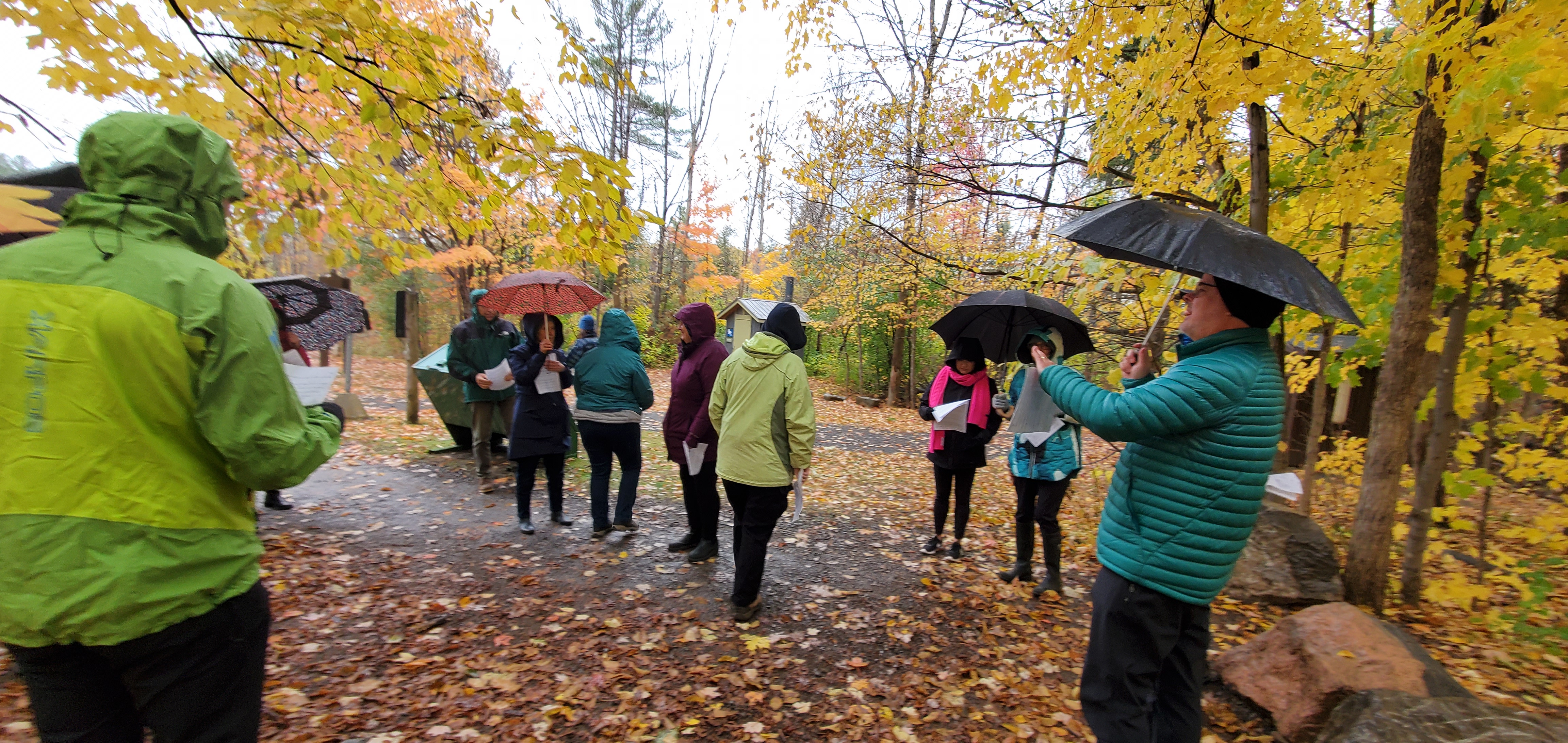
As we begin this morning, I welcome you into a moment of silence …. Listen to your breath as you breathe in, And breathe out …. Listen to the wind …. We are connected through the breath of God. Slowly allow yourself to relax into this welcoming place. You belong here with the birches, aspens, pines, spruces, maples, oaks.

When you walk, also listen for the water that nourishes the trees and all that grows in this place. Even though the water is still, it moves mirroring the arteries of blood flowing through your own body.

The trees and the water welcome us because they have not forgotten that we are related, that we come from the same dust and return to the same dust. Take another deep breath of gratitude to acknowledge that our lives are fully dependent on the healthy functioning of these trees, these waters.

We aren’t just meeting in nature; we are entering into relationship with nature. We are already very much part of nature. We are creatures of (not simply in) the natural world.

We are here today to re-member ourselves back where we belong. We are here as an expression of “religion”, which means re (again) and ligio (connection).2

Scriptures about Trees:

“Out of the ground the Lord God made to grow every tree that is pleasant to the sight and good for food, the tree of life also in the midst of the garden, and the tree of knowledge of good and evil.” (Genesis 2:9)

“The righteous flourish like the palm tree and grow like the cedar in Lebanon. They are planted in the courts of our God. In old age they still produce fruit; they are always green and full of sap, showing that the Lord is upright …” (Psalm 92:12-15)

“Sing, O heavens, for the Lord has done it; shout, O depths of the earth; break forth into singing, O mountains, O forest, and every tree in it! …” (Isaiah 44:23)

“On either side of the river is the tree of life with its twelve kinds of fruit, producing its fruit each month; and the leaves of the tree are for the healing of the nations.” (Revelation 22:2)

Song: All Things Bright and Beautiful3                                                                         

Refrain:           All things bright and beautiful, all creatures great and small. All things wise and wonderful, the Lord God made them all.

  1. Each little flower that opens, each little bird that sings, God made their glowing colors, God made their tiny wings.        Refrain
  2. The purple-headed mountains, the river running by, the sunset and the morning that brightens up the sky.                                    Refrain
  3. The cold wind in the winter, the pleasant summer sun, the ripe fruits in the garden, God made them every one.               Refrain
  4. God gave us eyes to see them, and lips that we might tell, how great is God Almighty, who has made all things well.     Refrain

Prayer for the journey:

Forgive our arrogance, Creator God, when we place ourselves at the center of your universe. Forgive us when we forget our place in creation. Renew your creation, O God. Sustain the earth and seas, the trees and all that lives in them. Kindle in us a reverent awe for all creatures great and small, so we may, in your mercy, love your creatures and care for life in all its forms. Amen.

Questions for the journey:

  1. What other stories or poems from the bible mention trees? What message do the trees convey from God? In the teaching of Jesus?
  2. Are the trees singing? What song are they singing – Praise? Lament? What do the trees tell you, today, as you walk in this wetland forest?
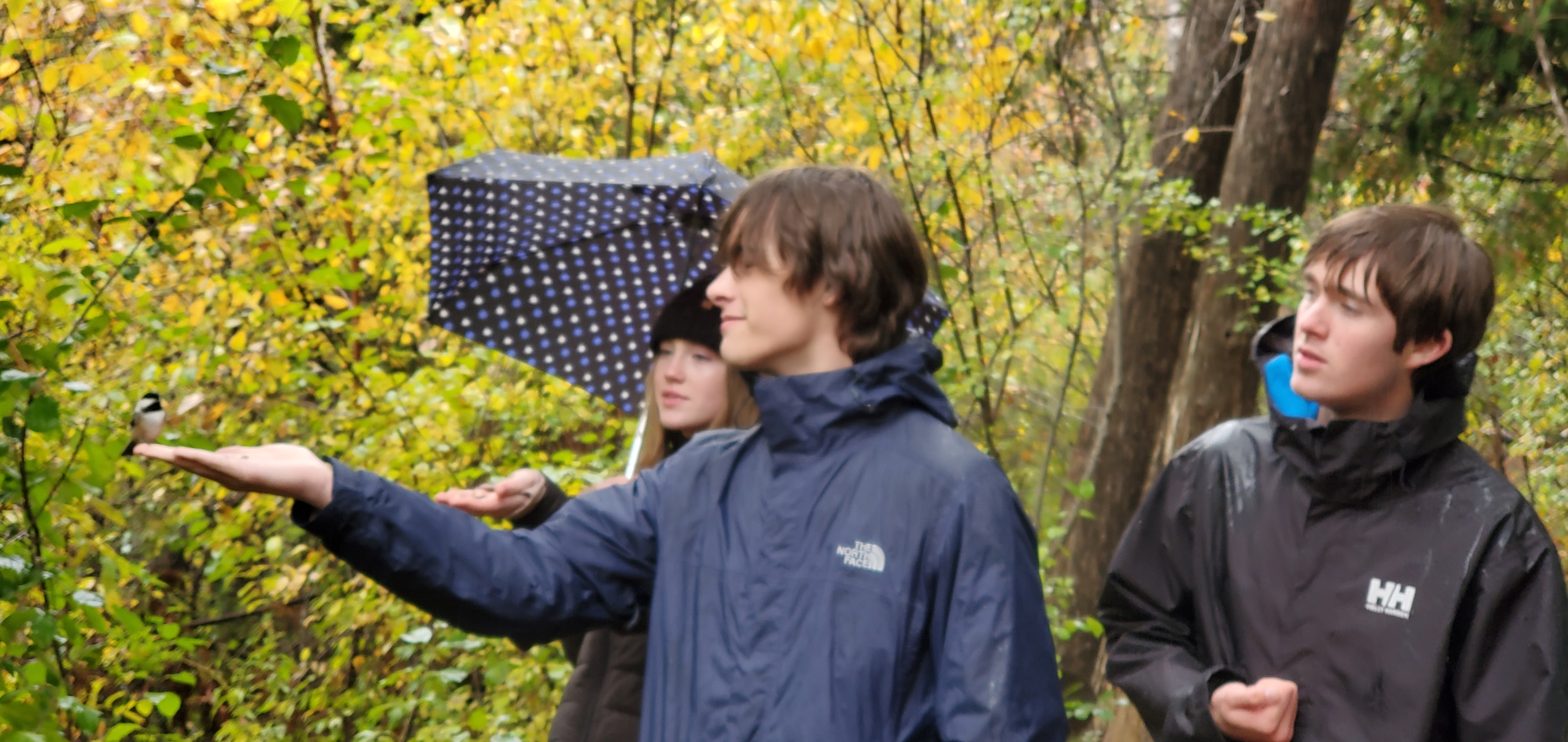
  3. Who makes home among the branches of the trees? How do the trees provide for the needs of other living creatures?
  4. What word do you hear in your own life as you pray and walk among the trees today: An invitation to begin a journey of faith? A word that challenges your beliefs? A call to confession? A word of encouragement along life’s journey?
  5. How does the bad weather today represent or reflect the way you sometimes respond to the storms in your life? Do you ‘weather the storm’, embrace it, go into it? To what degree do you seek to avoid and hide from the storms? What is better?

Rules for the path:

  1. You might be walking near someone you do not know. We are meeting friends from another congregation on this walk. If appropriate, introduce your name and remember to look in their eyes.
  2. Respect another’s physical space and need for silence. Our journey of faith is ours to make. We aren’t walking someone else’s path. Other’s may be on a similar journey but walking at their own pace and in their own way. Pay attention to the physical cues others give for what they need on this walk.
  3. Follow the leaders and listen to instructions they give.

Closing Prayer: (Our Father ….) In the words Jesus taught us, and in the many languages of our hearts, let us pray ….

On the Jack Pine Trail, Ottawa (photos by Judith Kierschke, 22 October 2023)
  1. Evangelical Lutheran Worship, Pew Edition (Minneapolis: Augsburg Fortress, 2006) Hymn #879 ↩︎
  2. Victoria Loorz, Church of the Wild: How Nature Invites Us into the Sacred (Minneapolis: Broadleaf Books, 2021), p.206 ↩︎
  3. With One Voice: A Lutheran Resource for Worship (Minneapolis: Augsburg Fortress, 1995) Hymn #767 ↩︎

Is grace too much?

A feast of grace (photo by Martin Malina 23 September 2023, Mikołow, Poland)

A couple invited some people to dinner. At the table, the wife turned to their six-year old daughter and said, “Would you like to say the blessing?”

“I wouldn’t know what to say,” the girl replied.

“Just say what you hear Mommy say,”, the wife answered.

The daughter bowed her head and said, “Lord, why on earth did I invite all these people to dinner?”

In Matthew’s version of the Gospel story about the wedding banquet, the invited guests don’t come.[1] Why not? Who wouldn’t want to go to a wedding reception that includes a five-star dining experience? The King even sends out his staff to cajole those invited to show up. But to no avail.

They make excuses not to come. In our terms, they’re about being married, being busy, having a job or occupation. You can fill in the blanks. These are not bad things, but just “busyness with many things.”[2] Things we can control, direct and of which we can manage outcomes. Things we might prefer, actually, compared to the ambiguous uncertainties in the realm of grace.

Could it be the invited guests know deep down that when they respond to the King’s invitation, they will have to change? Could it be that when we enter the realm of grace, we also enter the realm of risk-taking, vulnerability? Could it be that grace is too much? Too hard?

The Gospel story of the wedding banquet throws all kinds of theological conundrums onto our path. Even when the King shifts gears and invites everybody and anybody, “good and bad”, we encounter an unwelcomed plot twist: One unfortunate guest who accepts the invitation, makes a mistake. He doesn’t put on the appropriate coat for the occasion and suffers the dire consequence.

Can grace, freely given, be too much for us to handle? And, so, it’s easier to say ‘no’.

The marvelous short story, “Babette’s Feast”, was made into an award-winning foreign film. It is set in a tiny village on the coast of Denmark. The people there are good people, but they’re living inside an isolated and lonely town, a sort of “sparse and sour” place.[3]

It’s a little world of laws and pettiness and religious rigor where the main characters—two elderly, spinster daughters of a deceased Lutheran minister—live a pretty Spartan lifestyle. They eat the same food every day, the same bowl of soup and the same codfish. They dutifully share their food with the disadvantaged, carrying on a ministry of their father. In fact, ‘joyless duty’ might be the key theme in their lives.

The movie version depicts a dark and cloudy, not-so-inviting environment. The place is bland, the food is bland, and it’s all in service of some sense of obligation. They’re not bad people. It’s just that you get the sense that deep down there is something important missing. They live a not-so-desirable life, not referring to material things so much as their spirit, their attitude.

Into this village comes Babette, a French woman, a cook, it turns out, who has lost her family in the revolutionary war in France. She runs away from France to save her own life and is sent by a friend to these sisters. She offers to be the sisters’ cook, in return for room and board. For fourteen years she dutifully cooks ale-bread soup and codfish, every day, just as the sisters wish. Because that’s what they like.

Then, Babette wins the lottery, ten thousand francs! After some negotiation, she talks the sisters into allowing her to prepare a fine banquet to celebrate their deceased father’s one hundredth anniversary. First, the sisters ask what kind of food she would serve. Babette replies that she wants to give them a French dinner, the way they eat in France.

They have a major meeting, among the remnants of their father’s Puritanical flock, to see whether they even want a French dinner. There’s also a lot of talk about whether or not they can allow alcohol, and the sisters, to humour their faithful Babette, go along with it. But they resolve to themselves only to fake their enjoyment of it. “It will be as if we did not taste it,” they promise.

Course after course, Babette lays on the table an enormous, beautiful, sumptuous feast. The guests’ eyes just widen, but as they drink a little bit more and more of the wine, they loosen up.

One of the guests, a general, is visiting his aunt, a member of the congregation. The general, who had eaten at the finest tables, knows better than anyone present the quality of the feast that he is experiencing.

The general is a man who has seen the larger world. He has been hurt, has gone through success and failure. He had obtained everything that he had striven for in life at this point. He was admired and envied by everyone. The general was a moral person, a good person, loyal to the king, loyal to his wife and friends. He was a good example to everyone in the village.

But as the conversations open up, he confesses that he was not altogether happy. Something was wrong somewhere. During his stay in the village, he is carefully feeling his mental self all over as one feels a finger to determine the place of a deep-seated, invisible thorn. And still, he had not yet put his proverbial finger on it.

Now, after the sixth course all the guests are starting to forgive one another, for in the years since the pastor’s death they have degraded into petty rivalries. Into the fourth glass of wine, they actually start enjoying it all, laughing and relaxing even into the unsolvable mysteries of life. They take pleasure in the gift of the feast despite all that has troubled them. They learn, finally, to enjoy this banquet that they never thought they could possibly enjoy. It was a world into which no one had ever before invited them.

“Babette’s Feast” first describes religion without grace. Of course, Lutherans are supposed to be the very ones who championed grace – but even those pious, Norwegian Lutherans could forget. Just prior to Babette’s feast, their Christianity had been a resented banquet, where as Christians “they were more afraid of the Risen Christ than even the crucified one.”

Grace is always too much.

At the end of Babette’s feast, the general stands up to give a speech. He begins by quoting the Psalms, “Mercy and truth have met, righteousness and bliss have kissed.”[4] Notice that often we would consider mercy and truth as opposites. Righteousness and bliss are supposed to be opposites, too, no?

What the general is getting at is acknowledging something beautiful that happened during the feast—great opposites overcoming their opposition and kissing one another, embracing one another. By love and grace, the world full of contradiction, tension and opposites is made one.

Grace is a free gift from God, yes. Yet, the gift places upon us a choice, a choice to respond and live through that gift. We will not resolve anything, ever. In the end, it is the King in the Gospel story who makes the final judgements.

In the end, it is God’s mercy and God’s truth that come together, in Christ’s love for us all. God invites each of us into a life of grace, abundance and joy. And no matter how we respond—since responding somehow, we will—God will continue to send, won’t stop sending, us invitations to attend a gracious meal, praying us to accept.


[1] Matthew 22:1-14

[2] Richard Rohr, Things Hidden: Scripture as Spirituality (Ohio: St Anthony Messenger Press, 2008), p.175.

[3] Rohr, ibid., p.180-183.

[4] Psalm 85:10 King James Version

Is Grace Too Much? (A sermon for Pentecost 20A by Rev. Martin Malina

Baptismal Thanksgiving

9You visit the earth and water it abundantly; you make it very plenteous; the river of God is full of water. (Psalm 65)

Last month, there was unprecedented flooding in eastern Libya from cyclone Daniel which roared across the Mediterranean. In Libya alone, thousands are missing and feared dead.

Where in some places the earth is arid and in desperate need of water, so many regions are being inundated with deadly amounts of too much water.

Water is like thanksgiving. It’s not just about one weekend in October to call to mind all those things for which we ought to be thankful for. It’s not even about being thankful only when we feel like it, or when conditions in our lives warrant it, or when we pretend to be.

Psalm 65 comes from a section in this book of the bible that are mostly laments, or prayers of anguish and petition for help in the midst of untold suffering. Nearly a third of all the Psalms are laments. And we sing Psalm 65 in the midst of all these laments.

The challenge before us is to consider thanksgiving in the midst of all that life brings. Our practice of thanksgiving may be a genuine response to the good in our lives, yes. But, as Diana Butler Bass suggests in her book on gratitude, thanksgiving is an ethic.[1] And therefore, must be a discipline. Something we work at despite the circumstances of our lives.

Thanksgiving is about practising gratitude in the moment. So, the practice of thanksgiving is not about some over-arching, theoretical conclusion about one’s life—whether it’s good or bad, or whether things have gone your way, or not. It’s not a one-time public observance as much as it is a quiet, continuous attitude towards life in general.

It’s more about learning to recognize each moment, good and bad, as holding the promise and potential of God’s loving presence. Thanksgiving is about paying attention to the grace of God now. And leaving everything else—thoughts, biases, prejudices, pre-conceived notions—leaving all that behind to embrace what is, without judgement.

There’s nothing better than being submerged in cold water to bring you into the present moment. What is the first thing you recognize when someone emerges out of the water after a surprisingly refreshing and perhaps unexpected dip: Their eyes are wide open. There’s no other place your mind, body, and spirit can be when the impact of water wakes you up to the moment.

Baptism is about water. Our tradition has been these tiny fonts. But Martin Luther—the great reformer of the 16th century—preferred full immersion. That was his bias, and for good reason: The whole body is involved, not just the head. Water brings us into the present moment.

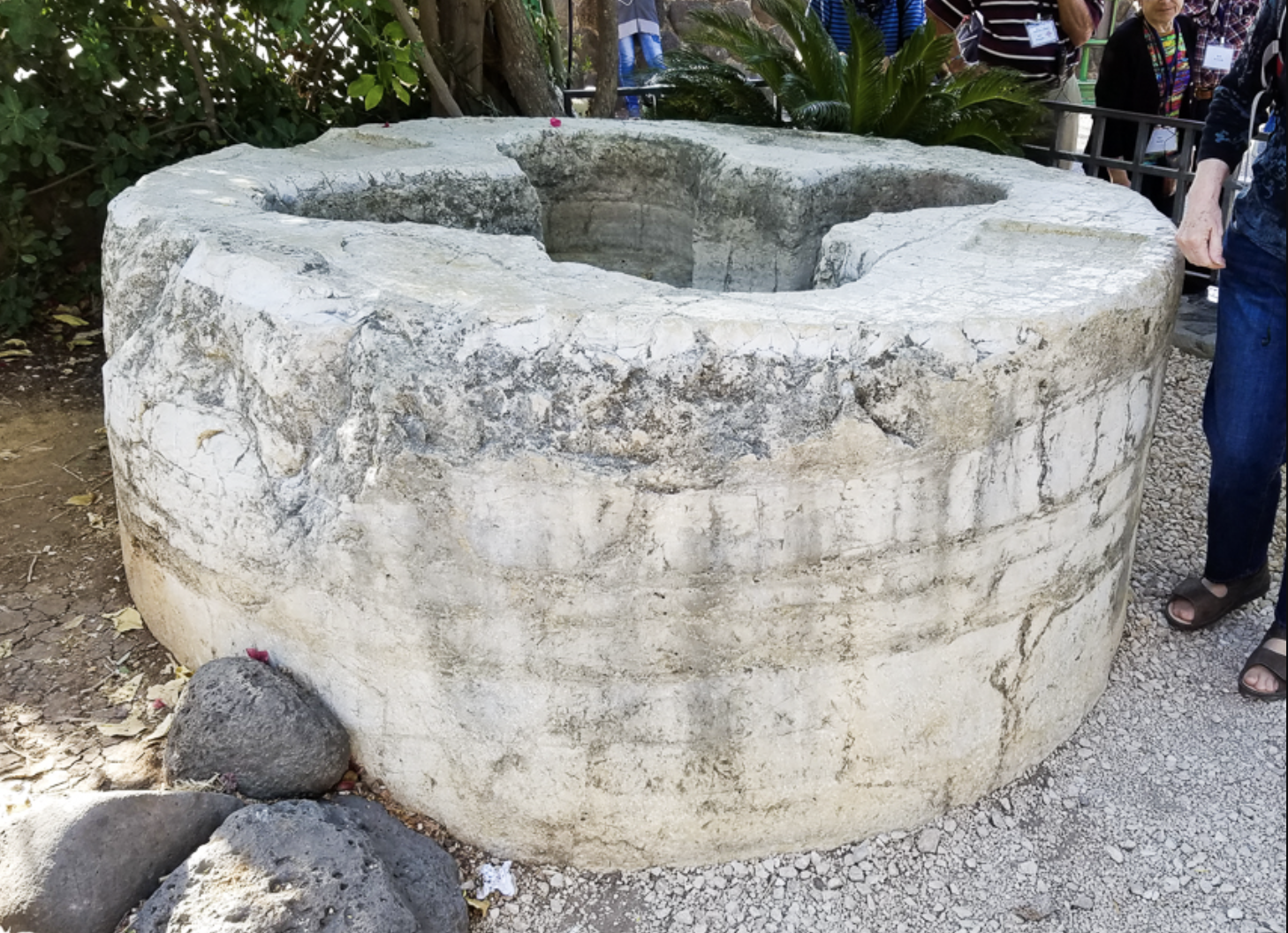
There’s a stone baptismal font on the northwestern shore of Lake Galilee that I visited years ago. It dates to around the 5th century. What I like about this font is that the opening is shaped in a cross. This font is also deep enough for someone to be fully immersed in the water.

The baptized would have to sit down in one of the four sections and make the confession of faith before being submerged in the water. The font was in a church right beside seven springs whose water flows strongly, gushing to the surface.[2]

Baptism is one of the two sacraments in the Lutheran Church. The other one is the Holy Communion whose Greek word, “Eucharist”, means the “Great Thanksgiving”. Both sacraments are thanksgivings. We engage God and reality with hearts trained in thanksgiving, facing whatever direction our life has taken us.

The four directions of Indigenous spirituality support this wholistic approach to our work of thanksgiving. For example, in the smudging / sweetgrass ceremony, you pray turning to face all the compass directions: east, south, west, north. And facing each direction one offers a prayer of thanksgiving[3]:

When you face east, you are thankful for all good things that come from the east, typically the gift of the sun and its light and warmth that keeps life going.

When you face south, you give thanks for times of healing and restoration in your life, signified by the warm winds which blow from the south.

When you face west, you give thanks for our ancestors, those who have gone before us, those who have passed beyond the horizon into eternal life; we are all headed west towards the setting sun of our own life.

And finally, when we face north, we give thanks for the gift of wisdom because the north wind is always angry; hard things come from the north, and therefore we are encouraged in the path of discernment and wisdom.

Thanksgiving underlies all the directions of our lives, not just one or the other.

In a life of thanksgiving, we embrace all experiences. We meet all challenges with grace. We are present to each moment, realizing it is all grace. That is thanksgiving. It is a giving it up, a releasing of the heart into the ocean of love and life that holds us all.

American Indigenous theologian Randy Woodley expresses it best. He describes the sacred power of giving oneself over to nature. I can relate, when I’ve gone camping and slept in a tent on the ground, sleeping by the waterside or a river running over rapids nearby:

“Sleeping in the bosom of nature is not the same as sleeping in the safety of one’s own home. Not at all. As you lay your body down to become one with the Earth, reality shifts. In that state, you can sense that God, Creator, is listening to the intentions of your heart. Whatever the mysterious power is behind creation, it softens one’s mind. Great Mystery unscrews the tight lids of the jars of certainty that you hold too tightly, too fiercely. You realize, sometimes even trembling, that something greater than yourself is meeting you.

“There, in the restful unknown world between sleep and wakefulness, you give yourself to those elements, to Spirit, in the kind of vulnerability a newborn to the world must experience.

“As I dozed off into the realm of sacred beauty next to that stream, I listened to how the water responded to each rock, to every branch protruding from the creek bank, and to the swirl of every curve as it “meandered past me and into some other creature’s nap. With each contact, the water had a particular note and registry of sound.

Over the rocks, around the curve, and down the path of its sacred water journey. Sacred sleep. Sacred water. Sacred life.”[4]

It’s okay if you don’t feel thankful this weekend, for whatever reasons and burdens you carry with you. It’s okay, because while you don’t feel it now, you will someday. Religion is never a one-time, one-off, experience. It is something that grows, organically, in your heart through the good and the bad. And there will be times when the gift emerges with joy.

For Thanksgiving is a process, an attitude and a practice. It is a river that continues to flow deep within giving life and love.


[1] Diana Butler Bass, Grateful: The Transformative Power of Giving Thanks (New York: Harper One, 2018)

[2] In a Byzantine church at the Seven Springs of Tabgha. On the four directions in a Christian context, read Alexander John Shaia, Heart and Mind: The Four-Gospel Journey for Radical Transformation, Third Edition (New Mexico: Quadratos, 2021), p.183: “This form of the cross … was the shape that was venerated during the years these gospels were composed and it served–with rare exception–as the shape of the baptistry into the seventh century.”

[3] Raymond Aldred & Matthew Anderson, Our Home and Treaty Land: Walking our Creation Story (Kelowna BC: Wood Lake Publishing, 2022), p.28-29.

[4] Randy Woodley, Becoming Rooted: One Hundred Days of Reconnecting with Sacred Earth (Minneapolis: Broadleaf Books, 2022), p.16.

Baptismal thanksgiving — a sermon for Thanksgiving Day Canada by Rev. Martin Malina

The end of the line, on authority?

photo by Martin Malina (15 September 2023, Auschwitz-Birkenau, Poland)

“By what authority are you doing these things ….?”

The chief priests and elders question Jesus’ authority.[1] They ask Jesus a question in order to trap him. Jesus answers not in the way they anticipated or desired, by asking a question himself.

In the Gospels, Jesus asks many more questions than he answers. Answering a question with a question was the norm. In the four Gospels of the New Testament Jesus is asked 183 questions of which he only directly answers three. How can they believe what Jesus says, especially if he doesn’t answer their questions directly? On what is his authority based? What is the nature of Jesus’ authority?

While I was attending the Lutheran World Federation (LWF) assembly meeting in Krakow Poland last month, I met Lutherans from all over the world. The LWF is a global community consisting of 150 member churches.

And I enjoyed informal conversations with other pastors, advisors and bishops from countries who will soon hold elections. For example, Poland, Argentina and India will be electing governments in the coming months with all of them teetering towards hard-line approaches.

Governments are not our only authorities in life. Parents, doctors, police officers, school teachers, by-law officers, pastors–these are other authorities in our lives. A couple of months ago when Pastor Jennifer Hoover facilitated conversations with the council and other members of our congregation about the church today, we reflected on our attitude towards authority, in general. Our response to anyone in authority is one factor that has changed since the 1960s.

On the one hand, there is this sense today of not listening nor considering any voice of authority. Earlier this year I read a contemporary young adult fiction book similar to the Harry Potter series, in which young students attended a special, magical school.[2]

But there were no teachers in this school, at least not in the traditional sense. Contrary to what we might expect, teachers were not embodied persons interacting with the students. Instead, the magical building itself was the teacher, thus removing people from the role of having authority. This novel reflected a current-day attitude toward authority — that we don’t easily accept the authority of others as we did a century ago.

On the other extreme, and especially under stress and anxiety, some yearn for an iron-fist rule. With the high cost of living these days and inflation rates soaring worldwide, people naturally knee-jerk towards seeking a strong voice of authority that will enforce strict rules, as if forcing everyone to follow the same rules and being of the same mind will make things better.

These varied approaches suggest to me that authority needs to be redefined for our time. And while a total disregard for any authority on the one hand and those strong voices in politics on the other may be tempting, what the world needs today is the strong voice of the Gospel of Jesus Christ.

On one of the days during the Lutheran World Federation Assembly in Poland, the entire delegation visited Auschwitz and Birkenau—the death camps of the Nazis. The experience of seeing the remains of the gas chambers and shooting walls was deeply impactful. Hearing the stories of survivors and seeing pictures of a few of the one million people who violently died in these death factories was humbling, to say the least.

One story has stayed with me, of Father Maximilian Kolbe. He was a Catholic priest, himself a prisoner at Auschwitz who sacrificed his life in place of another person chosen to die. Eventually succumbing to the brutal horrors of Auschwitz and Birkenau, Kolbe maintained his belief that even in the midst of hell, God is present in the smallest act of love for another. “Don’t ever forget to love” was his undying testimony of faith.[3]

Facing his own prosecutor, Jesus told Pilate in no uncertain terms that the reign of God does not reflect the world’s definition of authority and power. “My power is not of this world,” Jesus said.[4] So, on what is Jesus’ ‘kingdom’ grounded?

After we returned from Auschwitz, we received a special guest who addressed the Lutheran World Federation Assembly. One of the few living survivors of Auschwitz, Polish historian and journalist Marian Turski, urged the LWF Assembly “to combat hate speech and turn fear of strangers into empathy for the other.”[5]

His presence and words challenged and moved me. After all, he was speaking to a large group of Lutherans and a church which was complicit and identified with the German church of the 1930s and 40s aligned with Hitler.

But what really touched my heart was why he decided to come to speak to us at all on that day — September 16. A Jew, Turski confessed that he debated whether he should join us on the first day of the Jewish new year, Rosh Hashanah. Normally he would have considered going to the synagogue to participate in the prayers and celebration there among his own.

And who were we to him – the other, the representatives of those who were his enemy eighty years ago? But, after speaking with his wife that morning, he decided to break the rules of his religion in order to meet with us. It was more important for him to follow the rule of love. “God is love,” our scriptures claim.[6] And God is our authority.

The Gospel reading today includes Jesus’ teaching on authority—the second part of the reading when he talks about two brothers who do opposite things; one doesn’t do what he says he’ll do, and the other does what he says he won’t do.

In the end, the action is more important. The critical measure is not what you say, but what you do. Any expressed belief, intention or doctrine means little if it is not paired with a behaviour and action that communicates a heart of love.

Compassion is the unique characteristic of true spiritual authority.[7] A compassion modelled by Jesus, by Maximilian Kolbe and Marian Turski. Compassion for others who are different from us. Compassion that results in loving action.

Celebrating Rosh Hashanah, Jews dip apples in honey to symbolize the hope for a sweet year to come. Turski invited the Lutheran Assembly to do the same later that day. It was to be a sign of the hope we all share that despite all the hellish, fearful, violent, divisive things going on all around us in the world today, God is present in acts of love for others outside our circles. Wherever love is practised between people, there God is. That is our sweet hope.

At lunch following Turski’s speech, we found plates of sliced apples with honey on all the tables in the dining hall. It was one of many cherished meals shared with others who were different from me, during my time abroad. God comes to us in the stranger who shows us love.


[1] Matthew 21:23-32

[2] Naomi Novik. A Deadly Education: A Novel (The Scholomance Book 1). New York: Del Rey, 2020.

[3] “Love in the Midst of Hate” Theology of the Heart – Life of the Saints

[4] John 18:36

[5] Marian Turski addresses LWF Assembly 2023

[6] 1 John 4:7-21

[7] Richard Rohr, “With Compassion We Change Sides” Compassion (Daily Meditations: www.cac.org, 22 September 2023)

sermon for Pentecost 18A (Rev Martin Malina)

How do you start a fire when the chips are down?

Fatwood (photo by Martin Malina 24 August 2023)

You want to start a fire. It’s cold. It’s wet. You’re outside. You need to eat. You need to stay warm. You need to start a fire.

But this fire is in your heart. It may only be a shimmering ember right now, or a small flame at risk of being snuffed out by the winds of despair, depression, disappointment, anxiety, fear or grief. You may feel you never even had that spark in your heart to begin with.

But you want to start. You are willing to try. You want to start up that fire again. But you don’t know how. What are you going to do?

How do we start over? What is our first move on the journey of transformation?

On a backcountry canoe camping trip, my fellow campers and I needed to get and keep a fire going—to cook our meals, to keep warm and to provide the ambiance we all cherish around a campfire. But we did not haul enough wood in our canoes for five days. We needed to start a fire with what we could find on our island site smack dab in the middle of the large Cedar Lake in Algonquin Park.

When campers go looking for firewood, we normally look for hardwood branches, twigs, dry bark. We look on the ground near the campsite for fallen trees and branches. Some campers will even bring saws to cut down trees and chop the wood themselves.

But that strategy was not going to work this time. August, as you may recall, was a wet month—lots of soaking rain. So, most of the wood and trees around us were water-logged, literally. Moreover, it was a very popular spot with the beach—we were fortunate to get it. But that also meant there were precious little scraps of firewood leftover in the immediate area around the site.

We did find something — a kind of combustible material that was plentiful. It’s called fatwood. Stumps from fallen trees covered the island. And some of these had roots still drawing water from the ground up towards the top of the stump. The build-up of sap in fatwood creates chunks of resin. This resin burns like turpentine.

When you burn fatwood, the fire crackles and pops and you don’t get a whole lot of smoke. But best of all, a small piece of fatwood burns for hours, longer than any other kind of firewood! It’s perfect!

Normally we wouldn’t look for dead stumps littering the forest floor to find the combustion we need. The fat wood does not look on the surface like good, burning wood. It is ugly, dirty-looking, wood. Campers usually ignore it, discard it, don’t even see it.

But it was the best thing ever to start and keep a fire going.

To start solving the problem of how to start a fire, we first needed to realize the limits of our usual strategy. We first needed to confess that the way we have normally done things will not work in the present circumstances. They may have worked well in the past and in other contexts. But no longer. The first step towards positive change is to admit we need to approach things differently at the start.

Where are we going to look for a way forward, when we confess the old ways of doing things in our personal lives and in the church no longer work today? Where are we going to look?

The Gospel of Matthew can help. It was written to Jewish Christians who also had to start over. This Gospel was written at the end of the first century right after Roman Emperor Vespasian completely destroyed the temple in Jerusalem. Those Jews who survived the brutal purge were demoralized and uncertain about how to move forward. “There is no known equivalent to what Rome did that day,” one scholar claims.[1]

The Jewish remnant escaped to Antioch in the north. Among them were the Messianic Jews who believed that the Messiah had already come in the person of Jesus, himself a Jew. What help does Matthew’s Gospel offer in a time of upheaval and dramatic change?

First, notice the tone of Jesus’ teaching in the Gospel. Several times in the Gospel of Matthew we hear this paradox from the mouth of Jesus—this tension between apparent opposites of “loosening” and “binding”, of “losing and finding”. It’s not just in our Gospel reading for today, but in at least three other places where we dance on fulcrum of both/and.[2]

Jesus says opposite kinds of things all the time—both comforting AND challenging: “Come to me all ye that are weary and carrying heavy burdens and I will give you rest”[3]; and then: “I have come not to bring peace but a sword.”[4] This Gospel like no other is full of paradox and seeming opposites. Why? To acknowledge the time of transition among first century Messianic Jews: from the pain of loss to the challenge of new beginnings.

Jesus seems to describe a life of faith as one in which we are always leaving something behind and starting something new, letting go of past strategies and learning new ones. It’s admitting that there are times when I have to look elsewhere and not necessarily where I’ve looked before in order to face a challenge.

Then we see Jesus in action as he encounters people on his travels. He meets, for example, the Canaanite woman. She persists and is relentless against Jesus who is rude to her and quite insulting. Because of the woman’s courage to challenge a rabbi, Jesus grants her what she asked—the healing of her daughter.[5]

The old strategy of reaching out only to Jews with the message of Christ needed to change. Our Lord Jesus himself models for us inner transformation, which is the starting point for our journey of faith towards healing and wholeness.

The biggest help Matthew offers, however, is the framing of the Gospel—how it begins, and how it ends:

Matthew begins with the story of Jesus’ birth. And Matthew is the only Gospel of the four that includes the visit of the Magi.[6] These wisdom-seekers from the far East were not Jews. They were Gentiles—using the language of the New Testament.

And, the Gospel concludes with the famous words of Jesus, the great commission to his disciples to go “to all nations” with the news of God’s love and saving promise.[7] “All nations” refers to the Gentiles. The term Gentile refers to people who were outside the pure, Jewish religion.

In the midst of a devastating loss, the Jewish Christians in Antioch were encouraged to engage and be with people outside their tradition. They were called to a journey that Saint Paul would later pick up and emphasize, a journey to include Gentiles in God’s loving embrace, making an ever-widening circle.[8]

Where do we look on the start of our journey of transformation, when we admit old strategies no longer serve us well? The Gospel of Matthew suggests we look beyond the bounds of our own perception which will often blind us to what is right in front of us. The Gospel of Matthew, in modelling for us this shift, suggests we confess our bias, and embrace a new path as yet untrodden.

There’s also a holy part to this journey that yields the warmth, radiance and beauty of a good-burning campfire. And we will discover that, too, along the Way.

The fatwood ain’t pretty. Yet God calls us to this journey of transformation not in spite of but because of the unattractive, broken parts of our lives. There’s something immeasurably valuable about fatwood. The journey will include all of it.

Thanks be to God.

With Us (photo by Martin Malina 25 August 2023)

[1] John Alexander Shaia, Heart and Mind: The Four-Gospel Journey for Radical Transformation (Sante Fe New Mexico: Quadratos LLC, 2021), p.74-75

[2] Matthew 10:39; 16:19, 21-28; 18:15-21

[3] Matthew 11:28

[4] Matthew 10:34

[5] Matthew 15:21-28

[6] Matthew 2:1-12

[7] Matthew 28:18-20

[8] Read Paul’s letter to the Galatians, for example. See, also, Matthew R. Anderson’s “The Purists: Laphroaig Single Malt Islay & The Gospel of Matthew” in Pairings: The Bible and Booze (Toronto: Novalis Publishing, 2021), p.89-98

a sermon for changing times, by Rev. Martin Malina

Beach presence

Beach front in Algonquin (photo by Martin Malina 26 August 2023)

27“For the Son of Man is to come with his angels in the glory of his Father, and then he will repay everyone for what has been done. 28Truly I tell you, there are some standing here who will not taste death before they see the Son of Man coming in his kingdom.” (Matthew 16:27-28)

The early church expected and hoped that Christ would return to earth in their lifetime. Christians have called this expectation: ‘the second coming’.

After the complete destruction of the Jerusalem temple by Roman armies in the late first century, the early followers of Christ found comfort in the promise of the glorious return of Jesus to earth. The last two verses of today’s Gospel reflect their belief and hope.

But what about us? How do we respond to these verses, two thousand years later?

I wonder if the passage of time and history has affected our understanding of God. I wonder, therefore, if we hear the Gospel for today[1] as threatening or punitive, as if Jesus is saying, “I’m coming back so you’d better watch out! You’d better do it right, or I’m going to get you.” Such a reaction reflects a God of vengeance, of punishment, does it not? Is that our dominant image of God—as someone who is ready to pounce on our every misdeed and mistake?

Peter, in the verses just preceding this Gospel for today, made a bold statement of belief in Jesus as the Messiah. And he got it right. But then he gets it wrong. Over and over again. Jesus even calls Peter “Satan” at one point.

If Jesus was all about judgement and punishment, Peter would not have been given the privilege and great responsibility of being the rock upon which Jesus would build the church.[2]  Would we entrust the fortunes of a new enterprise, company, or business to someone who demonstrates Peter’s kind of immaturity, impulsiveness, and lack of consistent mental clarity?

But Jesus is not talking about judgment. He’s not threatening us or talking about coming to punish us because we’ve been bad and our faith is weak; or, not coming to us because our faith is weak. He is not pointing a condemning finger at those who make big mistakes and who fail in life, time and time again.

Of course, two thousand years of history has proven those early Christians wrong, in the sense of a bodily return of Jesus as Messiah who would liberate them from Roman oppression. Jesus didn’t come back ‘immanently’ in the way they and Christians since the first century expected him. But that doesn’t mean Jesus was not true to his word.

Like reward and judgement, our perception and our image of God needs to change. Our understanding of God’s presence and return to us needs to deepen and grow. Rather than a dominant image of a vengeful God, what about a God who is about forgiveness, mercy, compassion, patience and love? How would we experience the presence of such a God?

At the beginning of this summer I was worried that I would miss out on one thing I love to experience every summer: Being on a sandy beach under the warm summer sun by the lapping waves. Despite all the wonderful travelling I’m doing, a beach was not in the plans.

You wouldn’t think that a backcountry canoe camping trip into the northern reaches of Algonquin Park would render a sandy beach experience. Most of this area is Canadian shield rock and pine. Along the portage routes and shoreline put-ins you’d be lucky to find a narrow space at any campsite to dock your canoe and disembark.

But to my happy surprise the camp site I found with my friends on Cedar Lake had a beach—and a big one—including a gently sloping sandy bottom into the refreshing water. Uncommon and incredible by Algonquin Park standards. And all for us!

So, on one afternoon when the sun was shining its brilliant warmth I lied down on the soft, white sand by the water, covered my face with my Tilley and just rested. I imagined being on a tropical island or resort in the Caribbean or some exotic place we Canadians like to escape during winter.

But something was wrong with that vision. It didn’t coincide with my experience of that moment. On that beach by Cedar Lake, I did not hear any human-generated sounds: no jet skis, no people laughing, talking, no highway traffic in the distance, no airplanes roaring overhead, no jack hammers or construction noise nearby, no background music. Just absolute, natural silence. I experienced reality in a much different way than I routinely do.

Even though at some level that moment was disquieting for me, I felt profoundly grateful for my summer beach experience. I felt thankful for the simple things in my life. I felt the joy of a divine gift and presence. God is in my life always. Even in unexpected places and different experiences.

Sunset over Cedar Lake, Algonquin Park (photo by Nick Forte, 23 August 2023)

In the Gospel, Jesus is not talking about a one-time, judgement-motivated coming of God out of the thunder clouds. He’s talking about the forever coming of Christ, the eternal coming of Christ … now … and now … and now.

Christ is always coming; God is always present. It’s we who are not! Jesus tells us to be awake, to be fully conscious and present to every moment we experience. It’s the key to all spirituality, because we usually are not.  

Most of us just repeat the same routines every day, and we’re upset if there are any interruptions to our patterns. Yet, “For those who want to save their life will lose it, and those who do, will find it.”[3] It’s ironic that to save our lives we need to stop our usual patterns and pay attention to those moments and places and people that take us off our routine and out of our comfort zone. This grace of God often comes to us unexpectedly.

Because God is found in the interruptions, the exceptions, the surprises, the space in-between the noise of our life. God has to catch us literally “off guard”![4]

When we are present, we will know the Presence. It is that simple and that hard. In the Garden of Gethsemane, the last words Jesus spoke to his apostles were, “Stay awake.” In fact, he says it twice.[5] We need to practice staying awake to recognize Jesus with us.

A word of caution: We need to practice being present to Presence, yes. But staying awake does not come from willpower but from a wholehearted surrender to the moment as it is. It’s largely a matter of letting go. We let go of our resistance to what the moment offers. We quit clinging to a past moment. It is an acceptance of the full reality of what is right here and now. Practising this is the task of a lifetime.  

We cannot get there by any willful method or any technical fixes whatsoever. We can only be there. The purest form of spirituality is to find God in what is right in front of us—the ability to accept what the 17th century French Jesuit Jean Pierre de Caussade called the “sacrament of the present moment.”[6]  

Let’s practice, shall we? Let’s practice the presence of Christ here, among the church, and especially now as we receive the sacrament of Christ’s presence at the holy meal.

Christ is with us. Because God is love. Thanks be to God!


[1] Matthew 16:21-28

[2] Matthew 16:18

[3] Matthew 16:25

[4] Richard Rohr, “Be Awake” A Contemplative Heart (Daily Meditations: www.cac.org) 29 August 2023

[5] Matthew 26:38-41

[6] Cited in Rohr, ibid.

“Beach Presence” sermon by Rev. Martin Malina