The glory: Worth the sacrifice?

I commend to you the reflection entitled “Storied Stones” (Nov 2015) written by Karoline Lewis, Associate Professor of Biblical Preaching at Luther Seminary in Saint Paul, Minnesota, found at workingpreacher.org. What follows here is basically her wording with some addition and adaptation —

“What large stones and what large buildings?” If you have ever been to the Holy Land, you know just how big those stones really are. If you haven’t been, you can find online a picture of the western wall — the Wailing Wall — a remnant of Herod’s temple; these blocks of stone are far taller than most people.
Massive. Impressive. No wonder the disciples were agog and amazed. I certainly was. And suddenly, this Gospel story (Mark 13:1-8) made sense. Suddenly, I completely understood the astonishment of the disciples. The impetus for awe is typically justified — and on many levels.
“What large stones?” We love bold. We love big. We love better. That’s the human motto, in every form, it seems. The bigger, the better. The disciples are no different than we are and we are no different than the disciples back then. While we tend to trust in our two-thousand-plus-years insightfulness or insist that the disciples are less than insightful, Jesus calls out the truth of our humanity — both for his past and for present disciples: 
It is true: Like the first disciples we are attracted to splendour and grandeur. We are drawn to the biggest and the best. The most influential. The most powerful. The most anything. We love superlatives. Lest we think we are any more knowledgeable than Jesus’ first disciples, we are not. We only know different attractions, manifestations, and incarnations of magnificence, especially when it comes to what it means to be a Christian today.
Membership numbers, programs, innovation. Stewardship campaigns, “transformative” preaching, Christmas pageants. Christian education, moving worship, building projects — there is no end to what large stones we seek to erect. Our large stones are meant to draw the attention and wonder of onlookers. Our large stones are put in place to attract potential members. Our large stones are even constructed so as to secure the dedication and continued wonder of our own flock. Our faith, our religious life, our churches are not free from the want for prestige, for desire of greatness and grandness, for a yearning for a majesty beyond comparison. 
Why is that? Is it fear? Is it insecurity? Is it a belief that church is really just one big competition?
On the brink of his own arrest and death, Jesus’ lesson to his disciples — to us — is critical. As Jesus’ ministry comes to a close in Mark, it will be all too easy to fall back into a kind of mode of expectation that seeks to compare Jesus’ kingdom with those of this world. As we look toward to the end of the church year and Reign of Christ Sunday, it is easy to be convinced that bigger and better are marks of God’s church. As we get settled into Sunday morning routines, it is easy to disregard that God’s criteria for success is not bigger and better, but faithfulness. That what God cares about is not the “blank-est,” but our best — and there’s a difference between those two.
“What large stones?” is something we are quick to notice but we are not as quick to ask what stands behind the perceived greatness. There is always a backstory of which we are not privy. We cannot tell from the outside the story the lies on the inside. We cannot see in first impressions what has made possible the result or the efforts to get there. We cannot know what it took to make our amazement possible.
In part, Jesus is asking us to ask what’s been overlooked in the past for the sake of what is viewed in the present. And, usually such large stones do not come without a significant price. That those whom we prop up, admire, wish to be, or envy, have particular reasons and rationales for being what and who they are. 
How would we feel if we knew the truth about how the large stones came to be? Well, we may not like what we hear. We may start to realize that such greatness is not worth the overhead. And we may begin to understand that another’s striving for greatness has come at the expense of others, and perhaps the cost of one’s very self.
“What large stones” is a phrase never without sacrifice, either the sacrifice of others or the sacrifice of who you intended to be, wanted to be, and thought you could be. Sometimes this sacrifice is positive. But we can never think that the greatness of another is achievable on our terms. Our tendency is to see this greatness and think we could have done better, rather than inquire about how the greatness came to be. Sometimes this sacrifice is negative, because the allure of grandeur then throws all others under the proverbial bus or the grandeur itself takes over the soul.
In the end, “what larges stones” is itself a statement of faith. And it’s a statement of faith that Jesus asks us to reconsider.
What large stones in your life reveal sacrifices you have made, or are making, that are positive and/or negative? Is it time to reconsider your striving for the ‘large stones’ in your life? Is it time to reconsider your yearning and desires for grandeur and splendour and glory? is it time to reconsider the purpose of your life, and address those decisions you are making to maintain a false, unhealthy striving based on the world’s values? Is it time to meet Jesus, again, at the foot of the cross? Will you bring your concerns to God, and lay them at the altar today? And start anew?
I love the NRSV translation of the closing verse in this text: The trials Jesus describes that will characterize difficult times of transition are “but the beginning of the birth pangs” (v.8). Birth pangs. Jesus uses imagery from the natural course of life, which begins in considerable pain. Birth pangs normally announce the start of something wondrously new, unimaginably joyous and indescribably loving — the birth of a new relationship, the gift of new life.
The large stones will not last. Life, love and hope will endure forever. Have heart. Never give up.

The home of God

Every year in mid to late November since the turn of the millenium Canada has observed a National Housing Day. This Sunday, November 15, I will participate in an interfaith Prayer Service at Centrepointe Studio in Nepean (Ottawa) to mark this day and remind us of our calling as Christians as well as members of other faiths to work together in providing affordable and safe housing for all people. Please visit http://www.multifaithhousing.ca for more details on our observance of National Housing Day. Below is a draft of my words, representing a Protestant Christian viewpoint focusing on the Gospel of Jesus Christ. We will also hear voices from the Roman Catholic, Muslim, Hindu, Unitarian and Jewish perspectives.

Community singing is an important tradition among Christians. We love to sing. And the music conveys well the passion and the truth of what we are all about, as followers of Jesus.
Here is a verse, and the refrain, from a hymn that is quickly growing in my affection at this time of year:

Christ, be our light! Shine in our hearts. Shine through the darkness. Christ, be our light! Shine in your church gathered today.

Longing for shelter, many are homeless. Longing for warmth, many are cold. Make us your building, sheltering others, walls made of living stone.

Christ, be our light! Shine in our hearts. Shine through the darkness. Christ, be our light! Shine in your church gathered today. (1)

Many times in the Gospels (in the Greek Testament of the Bible), Jesus describes the “kingdom of God”. One of my favourite images is from Mark (4:32), where Jesus compares God’s reign to a small seed that ” … becomes the greatest of all shrubs, and puts forth large branches, so that the birds of the air can make nests in its shade.”

This image gives an all-encompassing, expansive vision of what God intends: a home for all creatures great and small.

Of course, the problem is, that so many people don’t have this shelter, this safety, this home. And it’s not just a spiritual reality. It’s also a material, earth-bound reality.

After all, Jesus himself was a refugee. After his birth, Jesus’ parents Joseph and Mary had to flee the threat of persecution in their home country. In Matthew (2:13) we read: “… an angel of the Lord appeared to Joseph in a dream and said, ‘Get up, take the child and his mother, and flee to Egypt, and remain there until I tell you; for Herod is about to search for the child, to destroy him.” Jesus, Christians believe, is the Son of God. And this God we worship experienced, on earth, what it means to be a refugee and to be homeless.

Elsewhere in Matthew (8:20) as Jesus exercises his ministry of compassion, healing and grace to the downtrodden, he reminds those who listen: “Foxes have holes and birds of air have nests, but the Son of Man has nowhere to lay his head.”

We are called, therefore, to care precisely for those who are homeless, who are refugees today as if we are loving God. The righteous will ask God: “Lord, when was it that we saw you hungry and gave you food, or thirsty and gave you something to drink? And when was it that we saw you a stranger and welcomed you, or naked and gave you clothing? And when was it that we saw you sick or in prison and visited you?” And Jesus answers, “Truly I tell you, just as you did it to least of these … you did it to me.” (Matthew 25:37-40)

I quote thirteenth century Saint Francis of Assisi, who said: “Preach the Gospel; use words only when necessary.” Through concrete actions of care to the homeless, Christians have a clear and unequivocal mandate that bears witness to our faith most effectively: Not through words so much as by our actions, we make a physical haven for those without. And, in so doing, we reveal the truth that the author of the last book of the Bible expressed: “See, the home of God is among mortals!” (Revelation 21:3)

(1) “Christ Be Our Light” text by Bernadette Farrell OCP Publications in Evangelical Lutheran Worship Hymn #715 Pew Edition, Augsburg Fortress, 2006

Not a passive remembrance

I catch myself whenever I pin my poppy on my lapel wondering: How is it that I am living out this symbol of remembrance? In my own life, and in the community of faith, how are we demonstrating the values of freedom and protecting the dignity of all people? For example, it is estimated that some 140 war veterans are homeless on the streets of Ottawa. Men and women who gave their lives to service of this great country are now destitute. What are we doing about that?
Because in the Gospel text today (Mark 12:38-44) Jesus condemns those whose mere formal, ritual observance characterizes their faith. When ‘saying prayers’ is the only thing we do as Christians. There may be times in our lives when that is all we can do. Yet if the practice of faith is enacted solely as a “pro forma ceremony”, it only reveals a questionable faith and a “fallow, craven piety” (1).
What problem does Jesus identify here? Well, the religious leaders “devour widows’ houses and for the sake of appearance say their prayers” (v.40). Their heart is not in their religion, we may say. They typify the delusion of sacrifice — believing they give more than they should but less than they can. In the end, whatever they perform to impress others does not really change their lives. Their worship does not call forth from them any measure of risk and trust. It does not involve their whole being.
Are you, like me, feeling increasingly uncomfortable? As is the case with difficult Gospel texts, we may perform an impressive, interpretive slalom course around the issue. We may focus on the money, for example: “Shouldn’t the temple treasury be happy for the large amounts of money given by the rich? What is Jesus doing offending the rich? Not very smart!” 
Or, our self-justification may target the poor. We idealize the sacrifice they make. But to what extent? To justifying a social-economic system that maintains benefits to the rich and demands even greater sacrifice from the poor? But, in the end, Jesus’ words suggest that what is important here is not the amount of money, per se. Why? Yes, both the rich and the poor give varying amounts. 
But both give to the temple treasury that will soon be utterly destroyed. This gospel story in Mark is positioned right at the end of Jesus’ public ministry, and right before his temple speech and passion story — Jesus’ suffering and death on the Cross. In the verses that immediately follow this text, Jesus foretells the destruction of the temple — “not one stone will be left upon the other” (13:1ff). 
When you compare the amount of pages that the passion stories in all of the gospels occupy, that material is proportionally greater than everything else in the gospels including Jesus’ teaching and healing ministry. The story of the “widow’s mite” abuts right up against the beginning of Mark’s telling of Jesus’ journey to the Cross. This literary structure must therefore influence our reading of it. 
Jesus not only condemns the heartless, faithless pretence of giving, he shows that unjust, self-serving religious enterprise won’t last. You could say anyone giving anything to the temple was ‘throwing their money away’ to a worthless cause. At best, we could say that the widow gives everything she has to an institution that does not deserve it. 
The only true mark of religion is how the institutional community engages the poor. Our Sunday morning worship services mean absolutely nothing if what we do here does not translate into practical life-giving, grace-abounding giving of who we are and what we have to the world out there.
This passage gives us the opportunity to explore what it means to put in everything we have on the line, and all that we are to live on as people of faith. The giving of ourselves will have power when we put our heart, and our full trust, in God who will not abandon us in this giving.
An apple tree never tastes its own fruit. The fruit is meant to be tasted by others. Martin Luther would plant an apple tree even if he knew the world would end tomorrow. The point is the gift of grace is meant to be given. Our responsibility is not the preoccupation with the final result. The temple was going to be destroyed anyway. But did that mean no one should bother giving to it?
It is worth it! We are that apple tree, producing fruit to be enjoyed by all. If we stop producing fruit, then we stop being who we are as Christians. It is the free act of giving where value and meaning is experienced.
The test of a Christian community is this: If we asked the poor for a letter of reference, would they give it to us? How welcome do all people feel here? Do all people, regardless of their station in life, feel safe to be themselves in this place? Someone once said that a church without the poor is a place God has obviously left.
Who is our neighbour? As we look to our neighbours who are vulnerable, marginal and even despised — the homeless, Aboriginals, the physically disabled, newcomers to Canada, refugees, seniors, Muslims, gays and lesbians, rich and poor: these are our neighbours. They live among us, beside us, even in the church. If we say we are welcoming, does our congregation have a letter of reference from these people?
We shall not despair! Regardless of how we interpret the widow’s offering, this bible story ultimately is not about how much we should give.
It’s about how much Jesus will soon give for a people who do not deserve it.
The story of the widow’s mite, in the end, points towards the greater sacrifice Jesus will make — Jesus, who will give his life and his all for us, a people not deserving of God’s grace yet recipients of it nonetheless.
Where does that leave us?
To be changed, to change. We read in the Bible about people who are changed in Jesus’ presence: Peter, John, Paul, just to name a few. On the road to Damascus, on the beaches of Lake Galilee, in the synagogue and temple — When people encountered Jesus, their lives changed. How can we presume, then, that we ought not be changed ourselves in the presence of a God who pays attention to every detail of our life.
As we shift our gaze outward and reach outward to pay attention to who is around us, we discover that Jesus is paying attention to us. As he sat in the temple, across from the treasury watching people come to make their offerings, so Jesus notices us — not in a ‘ready-to-pounce’ judging way. Jesus is not the cosmic policeman watching to catch us in the act. But only to bring loving light to the truth of our lives.
In the end, Jesus pays attention to the details of our lives and beckons us to journey with him to the Cross. Because no matter how good we are, or how bad, Jesus gives himself for us out of love and grace. Though we may be unworthy of God’s love, Jesus still makes the ultimate sacrifice. We, and everyone else, are still worth it — still worth God’s incredible sacrifice and love.
(1) Emilie M. Townes in Bartlett & Taylor, eds. “Feasting on the Word: Year B Volume 4” WJK Press, 2009, p.286

Lift, and open the gates!

I reacted with sadness and sympathy looking at the photo of my friend’s dog whose entire face, chest and front legs were pierced with dozens — maybe even hundreds — of the sharp quills of a porcupine.
The photo was taken of the dog in the back of the car on the way to the vet, and she seemed stable enough — like the look of someone who knows they’ve been stung and know they just need to hold it together for a bit longer.

I felt sorry for that dog because it was simply being true to its nature — maybe motivated by a natural impulse to be friendly and play with another creature. Unfortunately, good intentions don’t always yield the desired results in relationships. Often, expressions of love and care are misunderstood. And the response can sting — just like this poor dog! I wonder if this dog will ever approach another porcupine again with such exuberance. 

On All Saints Sunday, Christians remember not only those who have gone before us who now taste and see the glory of God in eternity. We also reflect on the “communion of saints” on earth. And, like we did last Sunday during the celebration of the Reformation, we ask the good question: Who are we? Who are the saints? What qualifies a Christian for sainthood, beginning in this life?

Psalm 24 may suggest that no one living can belong to this glorious, virtuous group of people. Only those with clean hands and pure hearts who do not swear deceitfully (v.4) can qualify. A sharp tone of exclusivity rings throughout our tradition. Since I am not good enough, and will never be good enough, I have nothing good to offer. And so I will grovel in the dirt, turned in on myself and my sins.

Such negativity dominates our way of life. We don’t see abundance, we see scarcity. We don’t see forgiveness of sins as much as we love to talk about and dwell on our sinfulness. We don’t see the good, we see the bad. It’s a dangerous world out there, after all, and so we need to build closed, protective fortresses around us. And therefore, we get stuck in a self-centred, self-inhibiting style of life. Who am I to be able to offer anything of value? Let alone be counted among the saints?!

The bible’s poetry, today from the Psalms, offers insight into this problem. The Scriptures reveal a way of emphasizing what is important. Really important. We see this method most in the Hebrew scriptures — the Old Testament Psalms and prophets: Repetition.

Repetition of words and phrases underscores a sense of urgency or jubilation. In the Psalm for today — 24 — certain phrases are repeated. The context is a massive procession coming up the road to Jerusalem; God is returning to the temple being restored in the city of God. 

And as the people ascend to the walls, the cry goes out not once (v.7-10), but several times: “Lift up your heads, O gates! and be lifted up, O ancient doors! that the King of glory may come in.” (x2) The general image of ‘lifting up’, in fact appears almost half a dozen times in this short Psalm. What emphasis is being sought by the Psalmist, here?

The insistence of lifting up the gates mounts beyond the request to raise the gate just high enough, or the doors just wide enough, for the King of glory to enter and then to be slammed shut in the face of the others in the procession. Rather, the intent is for the gates to be raised so high above the walls that they will never need to be shut again. The intent is for the doors to be flung off their hinges, in order that the seekers and followers of the Lamb may follow him, redeemed and welcomed, into the courts of God. (1)

“The barriers to paradise, like the stone rolled away from the empty tomb in the garden, have been pushed aside to give us unfettered access to behold the smiling face of a gracious and accepting God, whose mercy, rather than our own merits, enables us to pass through the open door.”

We need to remember and appreciate who our King of glory is: A man, named Jesus, who encountered in his short life on earth all that we must endure and suffer. Our God is a God who became one of us in order to fully appreciate our own station in life. God understands our human weaknesses, suffers and endures with us on the road up to Jerusalem, and longs to welcome us into the divine presence. 

Ours is a God who bears the scars and wounds of crucifixion, even in his resurrected form. God is one who identifies with us seekers and wanderers who bear the scars of life, the woundedness of sin — and yet who long for something more: a deeper communion with God and the saintly procession going to Jerusalem together.

If we want to know God, we must know and accept ourselves; if we want to accept ourselves, we must know and accept God. Who are we? Well, perhaps we first need to ask: Who is God? Clean hands, a pure heart, a humble spirit, integrity and honesty — these are infinitely more difficult and subtle a list of characteristics suggested by this Psalm than the mandates against theft and adultery and the taking of another life (as in the Ten Commandments).

The qualifiers for sainthood are not a cut and dry check list easily accomplished like completing a shopping list. Rather, the qualifiers for sainthood are worked out in a life-long journey and sometimes seesaw struggle with the One who despite bearing the scars of suffering is the only One with clean hands and a pure heart.

Who are we? Well, then, Who is God? In Jesus, God is the One who welcomes us all into the holy city, whose cry goes out to lift up those gates — I mean, really lift up those gates — forever — in order to let in that whole procession of rag-tag, diverse, wounded, broken followers!

Knowing who we are, appreciating fully the grace and acceptance of us by a God who knows us, what do we have to lose? We can offer what little and what much we have to help others. We can use the gifts we have been given for the sake of the other, and with others, on this journey. We don’t have to be afraid. We can take the risk to reach out — not worried about the results but only convinced of the value of what we do.

Whether we have been stung by the quills of disappointment; whether we have been hurt by the failures of our lives; whether we have been weighted down by the pressures of performance in work and play; whether we endure the pain of physical, mental, emotional illness; whether we grieve through the losses of life — we are still on the way! And will always be!

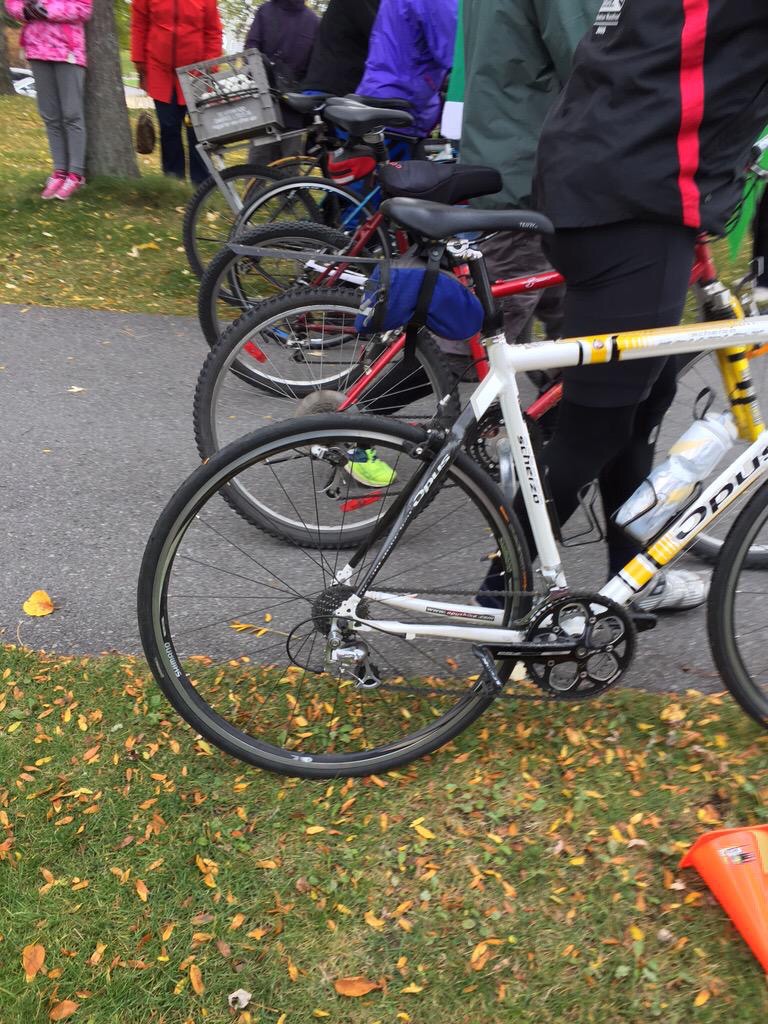
The highlight for me during the clerics cycling challenge (clericchallenge.com) was the finish line, when we all crossed together. This experience symbolized for me what the culture of Christian community ought to feel like and be like.

   
 We are part of a holy procession led by the King of Glory whose destination is sure. We have nothing to lose. If God’s grace is extended even to the generation of seekers (v.6), then we have nothing to lose. If what we are about is not a competition, then we have nothing to lose. If we don’t need to find fault in the other to prove our own self-worth, then we have nothing to lose. If it’s not about one-up-man-ship, then we can go for broke and not worry about it. If we don’t need to question who our Saviour is — who already accomplished for us our salvation — we don’t need to doubt our final destination. Then, why not share now what we have with others on this road?

All the saints on earth, despite the scars of life we bear, have gifts to share with other seekers on that journey. What gifts and blessings of God reflect in your life? In discerning this, remember: It’s not up to you alone! We don’t need to be perfect. We gain the gates not by our own merit or even hard work. Ours is the victory only because of the One for whose reason the gates are lifted in the first place.

Thanks be to God!
(1) — Michael Morgan in David L. Bartlett & Barbara Brown Taylor, eds. of “Feasting on the Word Year B, Volume 4” Fortress Press, 2009, p.228

Prayer for Reformation Sunday

We give you thanks, loving God, for  your unconditional love and grace to us and all people. Help us be moved to your heart, Christ Jesus, as our motivation, our desire, our passion for the decisions we make in our congregations. By your Holy Spirit, keep us steadfast in your Word, and continue to bless us in mission for and with others, so all may have dignity and all may live in hope. Amen

Reformation Themes 2017

The Day of Reformation (October 31) for Protestants, and especially Lutherans, calls us back to basic questions about who we are, as people of faith. Celebrating this day gives us the opportunity to ask again, “Who are we in the variety of religious expression on a diverse, social landscape?” And what do we have to offer?

For Protestants, the word itself may give us a clue. Protestants have often identified themselves as protesting against something. Many of us know the history: In 1517 Martin Luther nailed those 95 arguments on the doors of the Wittenberg Church. “Theses”, we’ve called them, were statements against certain religious practices and beliefs in the 16 century church. “Here I stand” has become a popular Martin Luther quote as he stood his ground and accounted for his beliefs before the Pope and Emperor at the famous meeting in Worms, Germany, shortly thereafter.
Many of us remember the Lutheran legacy as substantially a theological assertion: that you cannot ‘buy’ your way into heaven (by purchasing indulgences); rather, we are justified by grace through faith. Faith and salvation are fundamentally gifts from God.
And this is why the Lutheran World Federation (LWF) — a worldwide communion of 144 national churches — has come up with the theme of “Liberated by God’s Grace” for the 500th anniversary in 2017, commemorating Luther’s first protestant act in Wittenberg. Its sub-themes resonate with the indulgence debate: “Salvation not for sale; Humans not for sale; Creation not for sale.” 
In the pronouncement of these themes Lutherans worldwide and in Canada are claiming that we are not only celebrating something that happened in history. We are also asserting that we are a continually reforming church; that century-old themes can be relevant even today.
“Salvation – not for sale; Humans – not for sale; Creation – not for sale”. When something is not for sale, it is not on the market. We can not procure it by our means — any material means for that matter. When something is not for sale, it is a gift. We cannot possess it, in the same way we can never really possess God, salvation, anyone else, nor can we possess the earth.
The world today wants us to think and believe we can. We therefore delude ourselves into thinking and believing that we can buy salvation, that by our own hands, efforts and hard work we can earn God’s favour, God’s forgiveness. Do we go to church because we feel we need to manage our spirituality more as an insurance policy against hell, even though we are not sure about living out the mission of Jesus today? But God’s love in Jesus is unconditional. It is free. We have nothing to lose in positively living out our faith. Really! “Salvation — not for sale!”
Second, humans: It’s incredible that in the 21st century, there is still slavery practiced in the world; according to a 2013 study, there are still some 30 million slaves in the world today. Even in Canada, young people are gone missing and forced into the sex trade. Many Aboriginal women have disappeared, some murdered and some no doubt exploited in some despicable way. But, we claim: “Humans — not for sale!” What are we doing about this?
Finally, creation: As I said, our culture wants us to believe we can buy it. In fact, a recent survey measuring happiness revealed that our happiness is often dependent on ‘owning’ property. While the exchange of goods is in many ways an important building block of our economy, how differently would we look on our lives if creation (the environment, the land, the water and the resources therein) was not only something we must buy, possess and exploit for profit — but simply given as a gift from God that we share with all people? “Creation — not for sale!” Is finding meaning and purpose in life not the real sources of happiness? (“Money Really Can Buy Happiness, Study Shows”, thecanadianencylopedia.ca, 2013)
The confirmation class last week planted a tree in our church yard. Not only did we do this to respond to one of the Reformation challenges of our church (Evangelical Lutheran Church in Canada) to plant 500,000 trees by 2017, we performed a loving and caring act towards God’s beautiful creation which we share with all living creatures.
  
When it comes down to it, and we are honest, we must confess that it is often very difficult to be loving. It is challenging, even though we say we believe in a God who loves us unconditionally, loves the world unconditionally, loves creation unconditionally. 

So, how can we learn to love better?

How to love a porcupine

The following story was shared at a Faith Lutheran Women’s meeting recently, and I am relating it to the themes generated by the Lutheran World Federation (LWF) and adopted in convention by the Evangelical Lutheran Church in Canada (ELCIC) this past summer, to celebrate the 500th anniversary of the Reformation in 2017: “Liberated by God’s Grace: Salvation-not for sale; Humans-not for sale; Creation-not for sale!”

I was walking through the woods one day, happy to be outside in the wild. I was thinking about Jesus’ command to love our neighbour (Matthew 22:39; Mark 12:31; Luke 10:27). How is this possible? How could I love people who are not like me, who are different than me, whose beliefs are ‘a stranger’ to me.

When I rounded a bend in the path through the forest, I suddenly came across a porcupine trundling across the way in front of me. Its prickling spine and shell were covered with a dense coat of sharp quills pointing outward towards me. I stopped short and wondered what to do.
I think the porcupine, startled by my sudden appearance in its world, did as well.

In the silence that separated me and the porcupine on that path, I grinned at the thought that God must also love the porcupine. As ugly and as funny a creature it is, the porcupine too is created and therefore beloved by God. But how could I love that porcupine?

The porcupine is a rodent that can be hunted in Ontario, open year round and no limit by the law. Moreover, the porcupine’s meat is apparently safe to eat — a low risk, uncontaminated option in the protein department. Help yourself!

Perhaps to love a porcupine could mean different things. Sometimes if I assume loving a porcupine could only mean one course of action, I may be pricked by the needles!

If you were in that forest, confronted by that porcupine, what would you do? Or not do? 
In whatever you do, are you aware of why the porcupine might be afraid of you? The porcupine, like many creatures in the wild, is not for sale; that is, you aren’t there to buy or sell the things you see in the forest. So, why are you in that forest in the first place? What are you doing there? What are some words you could use to describe your relationship with everything else that makes the forest their home — including the trees, the water, the birds, and creatures that inhabit the place? (For example, are you their ‘owner’, or do you ‘share’ the gifts of creation with other creatures? What do you make of the fact that you are stronger and smarter — probably, and hopefully! — than most other creatures? What do you make of this gift you have?)

How is the forest, the path, and the porcupine analogous to human community and how we relate in our society to one another? How can we love the stranger who is also our neighbour? And just because we may not understand fully other creatures — including other people who are different — how can we show love to them (For example, by listening to them? By being curious to learn more about them? By helping them with something they need in our shared humanity? etc.)

You shall see the light

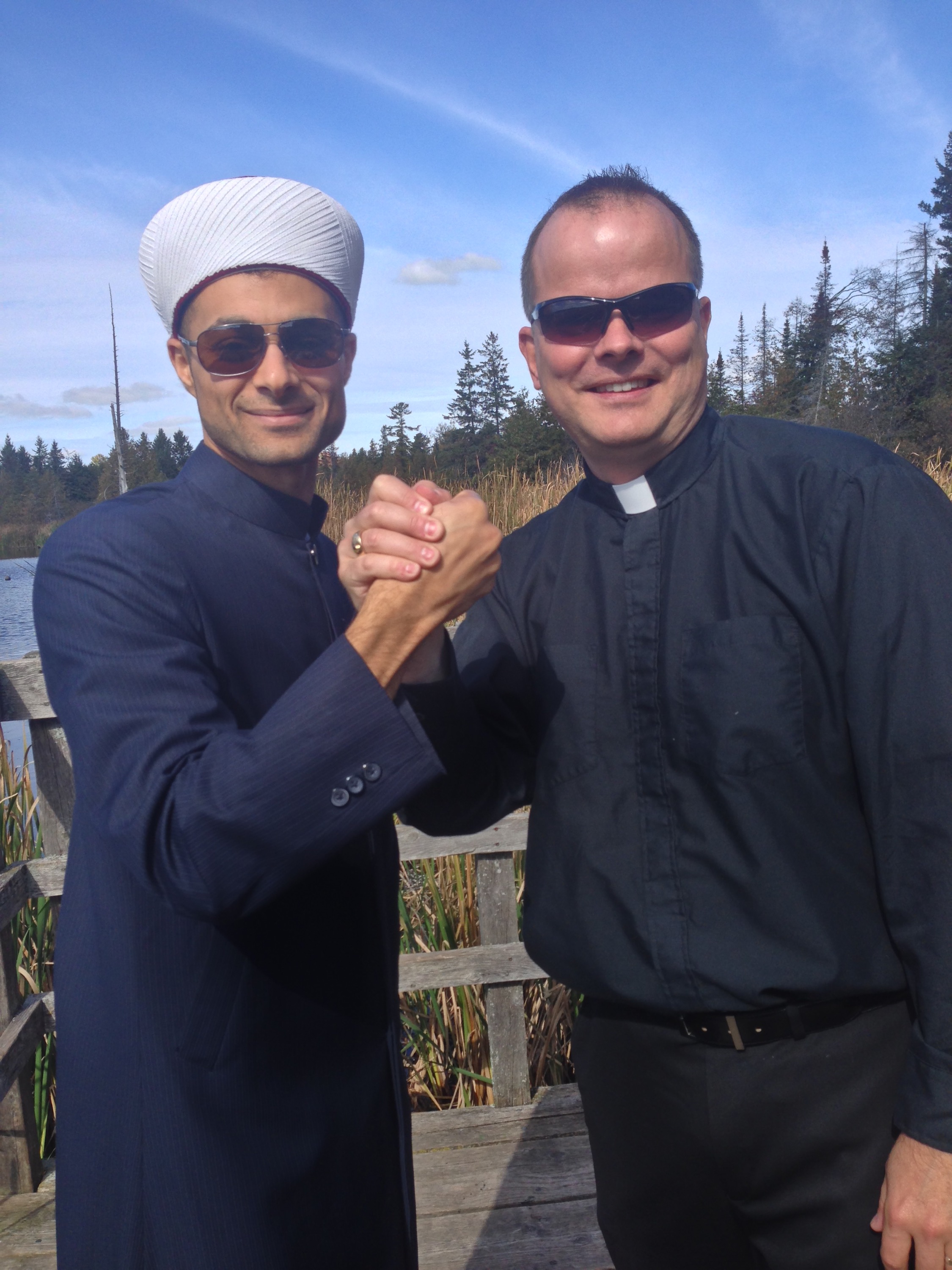
Jesus commanded that we shall love our neighbour as ourselves (Matthew 22:36-40). This commandment motivates me to participate this afternoon in the clerics’ cycling challenge (www.clericchallenge.com), initiated by Imam Mohamad Jebara.

  
Practically, then, what Jesus’ commandment means is that if you love someone, you want to know something about her or him. You want to know who she is, what he values, and how they orient their life. If you love someone, you take the time to talk to him, get to know her, and in so doing, you share yourself as well. 

  
Love shows itself in attention to another, in accepting another on their own terms — yes, and in a willingness to learn something new, to think about things in a new way, and to grow together in friendship and harmony. 

  
When I say Christians are called to love their Jewish or Muslim neighbours, for example, I mean we are called to develop relationships of mutual affection, understanding, and appreciation (Kristin Johnston Largen, “Interreligious Learning and Teaching” Fortress Press, 2014, p.59). Then, we love our neighbour as ourselves, thus fulfilling Jesus’ commandment.

  
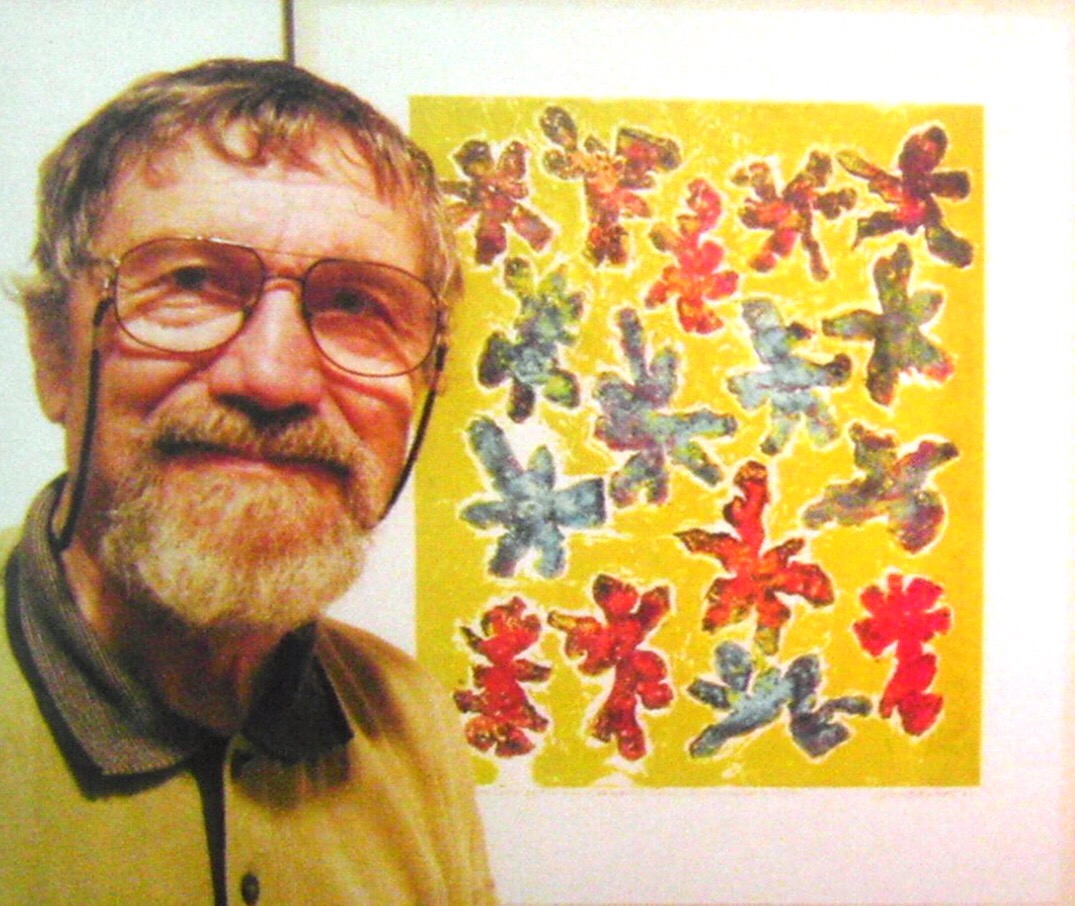
I had the pleasure of viewing some artwork this past week at the Rothwell Gallery on Montreal Road in Ottawa. The Gallery is presenting until October 24th the work of the late Leonard Gerbrandt (1942-2010) who travelled the world and created beautiful impressionistic watercolours and prints especially about the structures of various land and waterscapes. I was given a personal tour by Ute, his spouse, of the hundred pieces or so displayed in the gallery.

  
When we began the tour, she asked me to guess what colour appears and is prevalent in the vast majority of his art. With a twinkle in her eye, she confessed that this particular colour also happened to be his favourite. And so I went to work. At first, I suggested it was the earth tone greens, even maybe the rust, terracotta and orange/reds. No. No. And no.

As we reflected on one specific piece of art I marvelled how Leonard mixed the blues to distinguish sky and sea. Ute smiled, then said, it was blue indeed. I quickly travelled through the gallery looking anew at the paintings. And you know what? It was true! Now, I could see it — blue indeed found its way into almost all his paintings. Why didn’t I see that at first?

Blue, after all, is my favourite colour too (No political association, though!). And then I pondered further why I couldn’t see what had always been my favourite colour. Had I been distracted by the flashiness of other ‘colours’? Did I take ‘my colour’ for granted? What were ‘the blocks’ inside of me preventing me from seeing what was most important to me? Pride? Anger? Fear? Shame? Greed? Why couldn’t I appreciate fully the beauty that was staring me in the face, for me?

Of course, colours would not exist without the presence of light. In fact, it is how the light is represented in a work of art that brings out the textures and hues created by the paint brush. I also believe that art, like music, serves to reflect back to us an inner state — and that is why art and music can be so powerful conveyors of meaning and truth about ourselves and the world at any given moment in time.

The living Jesus is with us, and in our hearts through the Holy Spirit. The love of God propels the Spirit to move us in the the way of Jesus. And yet, we block our sight. We can’t see the light. What are those blocks that keep us from living out of our nature that is being renewed day by day? What keeps us from loving our neighbour? Is it fear of the unknown? Is it a shame that is deeply imbedded? Is it the fire of anger, the pain of regret, the poison of hatred, the paralysis of mistrust?

“Out of his anguish he shall see light” (Isaiah 53:11)

This phrase comes from a larger so-called suffering servant poem from the prophet Isaiah. Christians have read Jesus Christ into the role of the servant even though the text was originally heard among the people of Israel hundreds of years before Christ. The ‘servant’ could refer to the people as a whole suffering in Babylonian exile, or to a specific individual (i.e. Persian King Cyrus /Isaiah 45) who liberated the Israelites and led them home to Jerusalem.

This exegesis is important and we need to tread carefully in working with sacred texts that we share with our Jewish neighbours. We Christians know the sacrifice of Jesus on the Cross for our liberation, indeed for the whole world. Jesus fits the suffering servant-narrative from Isaiah. Let’s work with this.

The anguish Jesus experiences in his suffering and death reflects a God who is fundamentally relational. And God the Father, the Son and the Holy Spirit relates to us in our very own humanity. Thanks to Jesus who showed us the way not just in his divinity but especially in his very own humanity. ‘Anguish’ after all, is a human emotion grounded in love. That is, “to anguish over the loss of a loved one” (online dictionary definition).

Not only does Jesus know our suffering in a shared humanity, he feels for us because of God’s intense love for us. The author of Hebrews is therefore able to describe Jesus as the ultimate high priest, who “is able to deal gently with the ignorant and wayward, since he himself is subject to [this] weakness” (5:2). In short, Jesus helps us “see the light” because of God’s deep anguish-filled love for us. God grieves losing us to our sin, and will not stop short in going the distance — even sacrificing his own life — so that we too will see things as they truly are, in the brilliance of God.

In prayer, 14th century Christian mystic Julian of Norwich reflected the divine stance: “I am light and grace which is all blessed love.” May our words and deeds reflect the light of Christ to our neighbours, in all grace and love.


The happiness trap

In our traditional celebration of Thanksgiving this weekend (in Canada), you may be wondering how to feel thankful when things aren’t going well. When unpaid bills start piling up, when a health diagnosis pulls the rug from under your feet, you are in an accident, or a relationship sours, freezes and breaks off. How can I be thankful?

Not dissimilar from the social expectations of Christmastime, the season of Thanksgiving can bring stress to even those of us whose lives are going reasonably well. Because we presume, do we not, that to be thankful we need to be happy? And to be happy, we need to be living ‘the good life’ when all works out the way I want it. And when it doesn’t….

For example, “if I don’t get that job promotion, I’ll be depressed”; or, “if the house does not sell for the price I want, I won’t be happy”; or, “if I don’t get away to that sun destination this winter I’ll be in the dumps”. We find ourselves in a perpetual state of dissatisfaction.

We are caught in the happiness trap. The striving for which basically guarantees us discontentment and frustration. 

Now, if all we want is to be happy, we won’t grow because we will only attend to those things that we already appreciate and understand. If all we want is to be happy, we assume that we are already where we are supposed to be. If all we want is to be happy, we will stay stuck; we have left no room for growth and development that only comes from some intentional work that might in fact be meant to change us for the better.

If we only pursue happiness, we are constraining the movement of the Spirit of God. That Spirit may want to call us to, and discipline us for, some greater purpose. That greater purpose will not be achieved by just wanting to be happy all the time.

In contrast, I suggest a healthier, more realistic approach: to work toward faithfulness rather than happiness. (Gil Rendle, “The Illusion of Congregational Happiness” Congregational Resource Guide, http://www.congregationalresources.org, 2010, p.4)

Writer Lisa Bendall (lisabendall.com) uncovered a recent Florida State University study which advised not to confuse a happy life with a meaningful one. That is, “happiness is lower in people who have more stress and anxiety, but meaning is higher in these same people.” Which suggests something important about a healthy degree of anxiety and stress in one’s life. Through the lens of Christianity, we can say that ‘picking up our cross’ and following Jesus may not yield a happy lifestyle all the time. But it will result in transformative change in our life that will make a positive difference in the world. Bottom line: It won’t be easy.

The narrow search for happiness focuses only on making things easy. And that is why pursuing mere happiness is a sure-fire way of living a self-centred, narcissistic and meaningless life bereft of making a difference in the world for the better. Show me otherwise in the lives of people who have made an incredible contribution to their communities, nations, society and the world. Were they always happy? Did being unhappy at times deter them from pursuing their values and rich meaning for their life?

“Seek ye first the kingdom of God” (Matthew 6:33) suggests the same. Jesus is not promising us a distress-free lifestyle. Pursue the higher ideals. Take the high road. Don’t give up. If I only wanted to be happy, I’m not sure I’d want to follow Jesus on this earthly journey which must surely go through the Cross. Staying true to oneself, to others and to God means a bumpy ride from time to time.

Here are some tips for this life that is given to us — not just for the placid, calm waters of life. Our baptism means that from time to time the water will get rough. And we need to know how to navigate those waters and stay afloat!

Shortly after Bishop Michael Pryse (Eastern Synod – ELCIC) was elected some fifteen years ago, he made a trip up to the Ottawa Valley, and went white-water rafting on the Ottawa River. Here is what he learned, eight rules; and applied it to life, faith and church:

1. Don’t be surprised if the boat doesn’t go where you want it to go.

2. Rest in the calm places. There will be more white water soon.

3. Never stop paddling. Even when it seems hopeless.

4. If you get into trouble… DON’T panic.

5. If you go under, let go of everything. Eventually you will come back up.
6. Someone needs to call out the orders. It works better that way.
7. White water is what you came for. Enjoy it.

8. Everyone paddles furiously to get somewhere, but ultimately it’s the current that takes you downstream.

Ultimately, trusting in the grace of God will get us there. Which means, does it not, that even if we are limited in whatever way, even when life is not perfect and things don’t work out for us, we can still fulfill our purpose and find meaning in our faith? Keep paddling! Do what you can, because we really don’t have anything to lose.

Last week when I attended the meeting of Deans in our Synod, Bishop Pryse shared in his closing comments a word of inspiration from Thomas Merton — a quote he has displayed in his office:

You may have to face the fact that your work will apparently be worthless and achieve no results at all, if not perhaps results opposite to what you expect. As you get used to this idea you start more and more to concentrate, not on the results, but on the value, the rightness, the truth of the work itself.

And this, I believe, brings something more than mere happiness: enduring contentment, meaning and peace in one’s heart.

May your Thanksgiving celebrations encourage you in the value and meaning of the gift of  your life.

Coming clean

Recently a member of my parish shared with me this joke:

An elderly woman walked into the church. The friendly usher greeted her at the door and helped her up the flight of steps.
“Where would you like to sit?” he asked politely.

“The front row, please,” she answered. 
“You really don’t want to do that,” the usher said. “The pastor is really boring.” 

“Do you happen to know who I am?” the woman inquired. 

“No,” he said. 

“I’m the pastor’s mother,” she replied indignantly. 

“Do you know who I am?” he asked. 

“No,” she said. 

“Good,” he answered.

I think we laugh because we can relate to our innate resistance to being vulnerable, to admitting fault, and being honest about who we truly are. We work so hard to deny and protect a semblance of strength and infallibility. 

This is not the community of Christ. Rather, the church is a community of the broken, of the vulnerable, of those at risk. It’s a community, in other words, of those who know their need and seek to be in relationship with each other. It’s a community who has learned that by being in honest and open relationship with each other they are in relationship with God, the very one who created them for each other in the first place.

See “Community of the broken and blessed” below …