Colouring the world with love

After receiving the visit from the angel Gabriel announcing to her that she would bear the Christ child, Mary came in haste to meet with her cousin and friend, Elizabeth. In the midst of conversations between people – the angel and Mary, then Elizabeth and Mary (Luke 1:39-55) — the word of God comes. The Word doesn’t come outside of a conversation.

I read recently a definition for the Word made flesh as Conversation (Loorz, 2021). Yes, conversation. God speaks existence into being (Genesis 1-2). God creates by issuing forth a word.

But then that Word needs to be received. That word needs a response in order to take root and grow. The Word of God, Jesus Christ, as the Great Conversation, is given and received. The first Christmas didn’t happen without conversation, lovingly given and lovingly received. God spoke Christmas into being.

As they say, the world is black and white until you fall in love. Then you see the world in colour. In her book entitled Love in Colour cataloguing love stories and myths from around the world, Bolu Babalola (2021) wrote, “Love is the prism through which I see the world.”

If we will keep Christ in Christmas then we need to start with love, because “God so loved the world that He gave his only Son” (John 3:16).

Speaking of colours, then, what is your favourite Christmas colour? Red and green likely top the list. Others like white with gold. The classic debate in households is whether to go with multi-coloured lights on the tree or stick with pin-prick white to mimic the stars in the sky. Or, mix them all together? Which do you prefer?

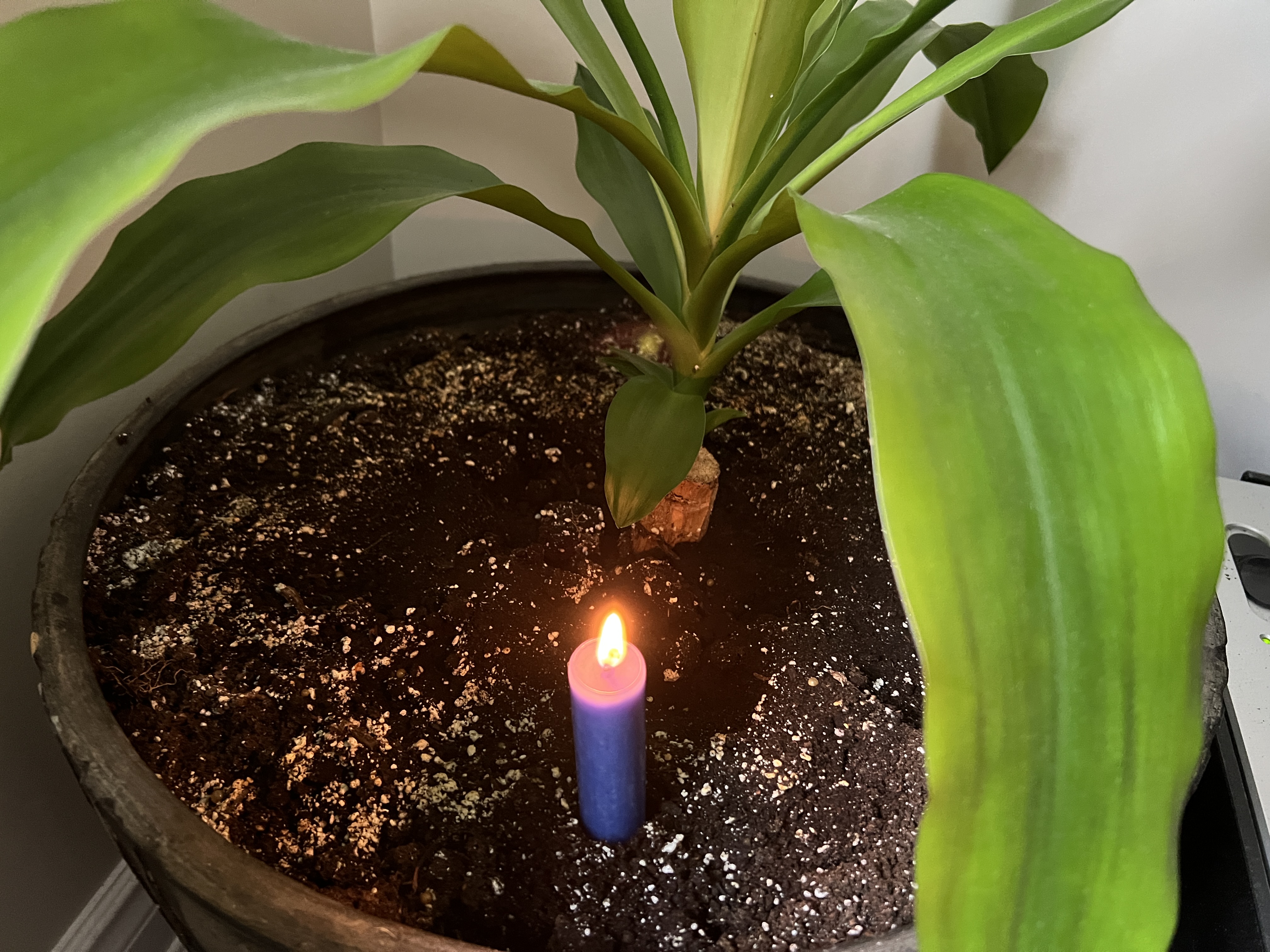
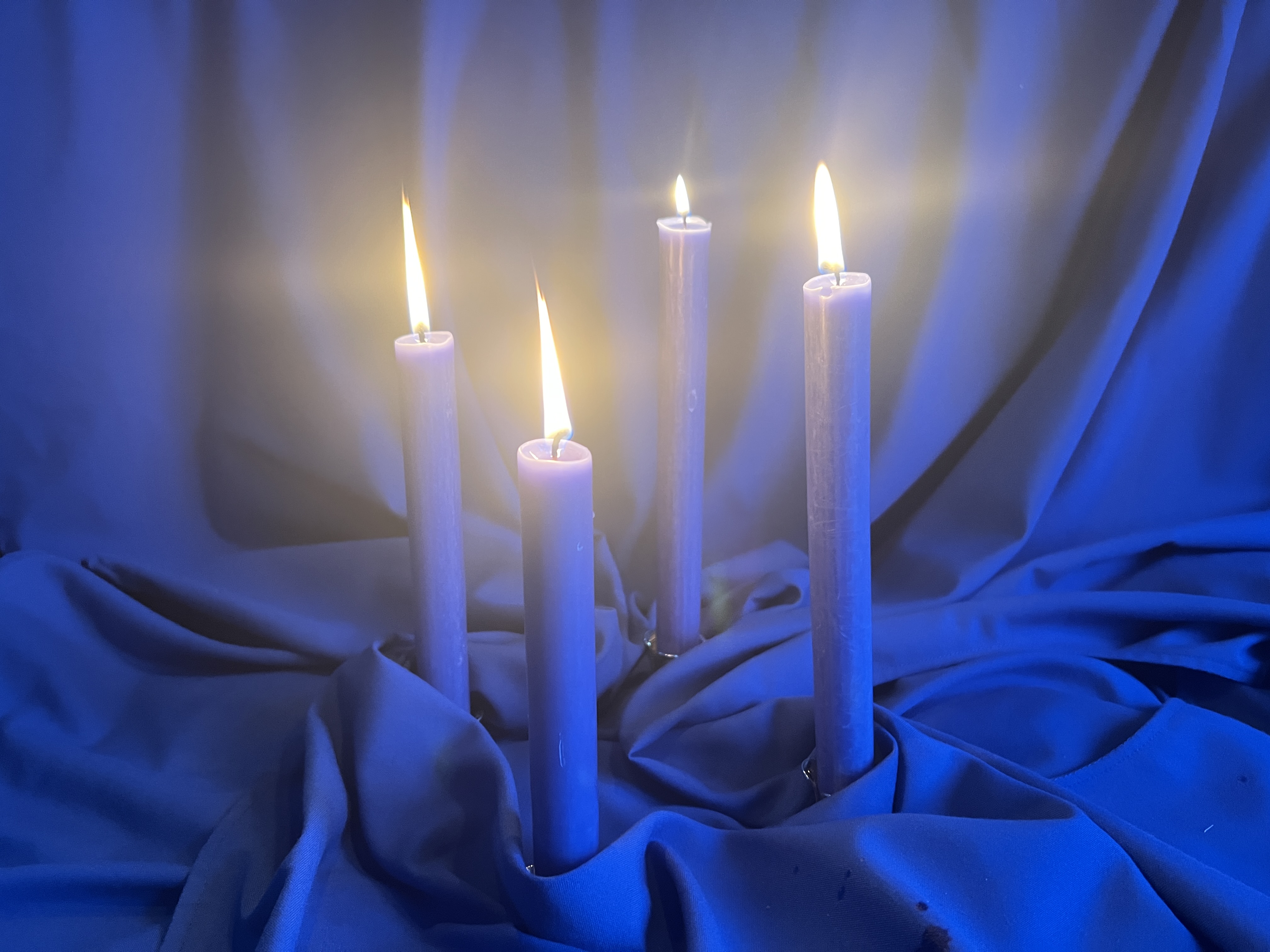
Blue is the colour now used in churches during the season before Christmas, the season called Advent. The colour blue is an interesting choice. Why, blue? At this time of year when the days are short, we hear the colour blue perhaps associated more with our mood – the winter blues.

Some believe blue is the colour of Advent because it represents the colour of the sky at the time of Jesus’ birth (Coman, 2024). The 13th century Italian artist, Giotto, tried to replicate blue in his depiction of the nativity:

https://www.worldhistory.org/image/12682/the-nativity-by-giotto/

We see blue whenever we look up and far into the distance towards the horizon where sea and sky meet. Looking into the distance likely means we are, from the perspective of feet on the ground, looking at a whole lot of blue, pointing us to the limitless expanse of the universe. And so, blue is the colour of hope, yearning and longing.

Yet, here on earth the colour blue is extremely rare in nature. Less than 10% of all plant species are blue and even so, most of the time their blue is an optical illusion.

It’s an optical illusion created by the refraction of light against what is actually red pigment. The only plant with genuinely blue leaves lives on the floor of the rainforest in South America.

But what really stands out is that while all other plant material changes colour when it dies, blue flowers are the only flowers that retain their colour in death. They retain their colour in death – maybe to remind the world that they haven’t gone away, that they have made their mark, that they, in some way we can’t explain or see with our eyes, live on. Blue is then also the colour of steadfastness. From everlasting to everlasting.

In the end, as we still walk by faith on this planet, it really doesn’t matter what colour you prefer. It doesn’t matter whether the Advent candles are all red or all blue, or all purple or some purple and one pink, or all blue and one white or all white.

The important thing is that you know why you are using the colours you are using. What is the story behind the colours you use? And how do those colours reflect a part of the Christmas story surrounding the arrival of God and God’s love to this earth?

Today we lit the fourth and final candle on the wreath. This fourth candle is called the Love candle. When we know why we do certain things, we can then appreciate why others do it differently. We practice love. What are the reasons they have for the choices and decisions they make – regarding their traditions, their background stories?

We don’t love because others start behaving as we do. Love isn’t about making others conform to our way of doing things. Instead, love is appreciating and being genuinely curious about where the other person is coming from, and letting them know it!

And that’s how we respond in love. That’s how we keep the conversation going. Loving others is behaving in ways and saying things in order to keep the conversation going. The goal at Christmas is to love. The Christmas story lives in us when we keep the conversation going, when we don’t shut it down.

Mary said yes to the angel’s Word from God. Her heart opened even though her mind must have had many questions. Her heart expanded to include the Word of God into her life. She kept the great conversation of God’s love going in her. And her responses in love got the whole ball rolling. And Christmas happened. Thanks be to God!

References:

Babalola, B. (2021). Love in colour: Mythical tales from around the world, retold. William Morrow.

Coman, S. (2024). Seeds of hope: Day 5. Lutherans Connect. https://lcseedsofhope.blogspot.com/2024/12/day-5.html

Loorz, V. (2021). Church of the wild: How nature invites us into the sacred. Broadleaf.
Expected yet unexpected

The gift of Christmas is not what we first expect it to be.

Time seemed to accelerate beginning with Canadian Thanksgiving in October. Then before we knew it was Remembrance Day, then Black Friday, Cyber Monday, Giving Tuesday in November, then the planning for the Christmas holidays, decorating, making New Year’s reservations, attending the social office parties, family gatherings, choral concerts, organizing shopping days and finalizing all our lists in December. My head starts to spin just thinking about everything we associate with those markers on the calendar.

We wrap up our expectations of Christmas around these activities. Indeed, participating in all of it creates expectations about the destination, intended or not. What do you expect when Christmas Day finally arrives? What do you want Christmas to be for you?

Part of the challenge at this time of year is trying to match what we want with what we actually end up doing.

The Gospel today describes the people in first century Palestine as filled with expectation (Luke 3:15). What were they expecting? They were looking for someone to come and save them, a Messiah. They were a people who walked in darkness (John 1), in a troubled time in history. They yearned for a saviour to liberate them from oppression.

And they suspected that maybe this saviour was John the Baptist – a charismatic speaker with a magnetic personality that could captivate the crowds with shock-and-awe oration never-mind his poor taste in fashion.

The gift of Christmas is not what we first expect it to be.

When I think deeply about my favourite Christmas memories, they were moments that happened despite the planning and to-do lists. What sticks, what made the greatest impression on me from Christmas times past, they were all moments that were unexpected.

These precious memories came more as a surprise: a serendipitous encounter with a friend, an unexpected moment outside on a winter’s night under starlit skies, walking on snow-packed streets, delivering gifts, listening or singing to a certain piece of Christmas music, a smile and healing tears in the midst of sorrow and terrible loss.

The gift of Christmas is not what we first expect it to be. John the Baptist redirects the attention of his followers to the one who is the expected Messiah, but not in the way they expected. Jesus is the gift of Christmas who still surprises in the way he comes to us.

We’ve been taught to consider Jesus today not as a political leader to free people from military oppression. But we’ve also been taught that Jesus comes to us mainly as a ‘caring’ God, a God who is gentle, who cares, coddles, protects and watches over us.

But Jesus was also someone to reckon with. There was this no-nonsense, straight-from-the-shoulder truthfulness about the way Jesus related not just to his opponents, the Pharisees, but to his very own disciples as well.

And he was not always necessarily nice. Jesus called Peter, “Satan” in one sizzling exchange (Matthew 16:23). Jesus never said, “Blessed are the nice”. He publicly expressed his anger, causing a social ruckus on temple grounds. There he physically disrupted the unjust practices of the money changers (John 2).

The Christmas narrative is not just about coddling and comforting the privileged. John the Baptist, if no other character from the Christmas story does it better, calls us out of our comfort zone, and challenges us in our image of the Christ, the gift at Christmas. Jesus, both the expected and the unexpected one.

The true gift at Christmas makes us think twice about what we are receiving. In the One who comes to us at Christmas in ten short days, we may not expect what we actually receive. The gift may surprise us, catch us off guard. This may make us feel uncomfortable at first. That part of Christmas is unsung.

Yet, one other truth of Christmas gleaned from the biblical narrative: The gift came at the right time. God gave the people what they needed, when they needed it most.

The baby born in Bethlehem had a forerunner to get the people ready for the gift. Even though they were warned, they were still surprised and bewildered when the gift arrived: The messy stable. The crying infant. The bloody cross. The empty tomb.

Because what they got in Jesus was not a Messiah riding a chariot at the head of tens of thousands of warriors thundering up the Kidron Valley to Jerusalem. What they got was a vulnerable human who showed us the very face of God.

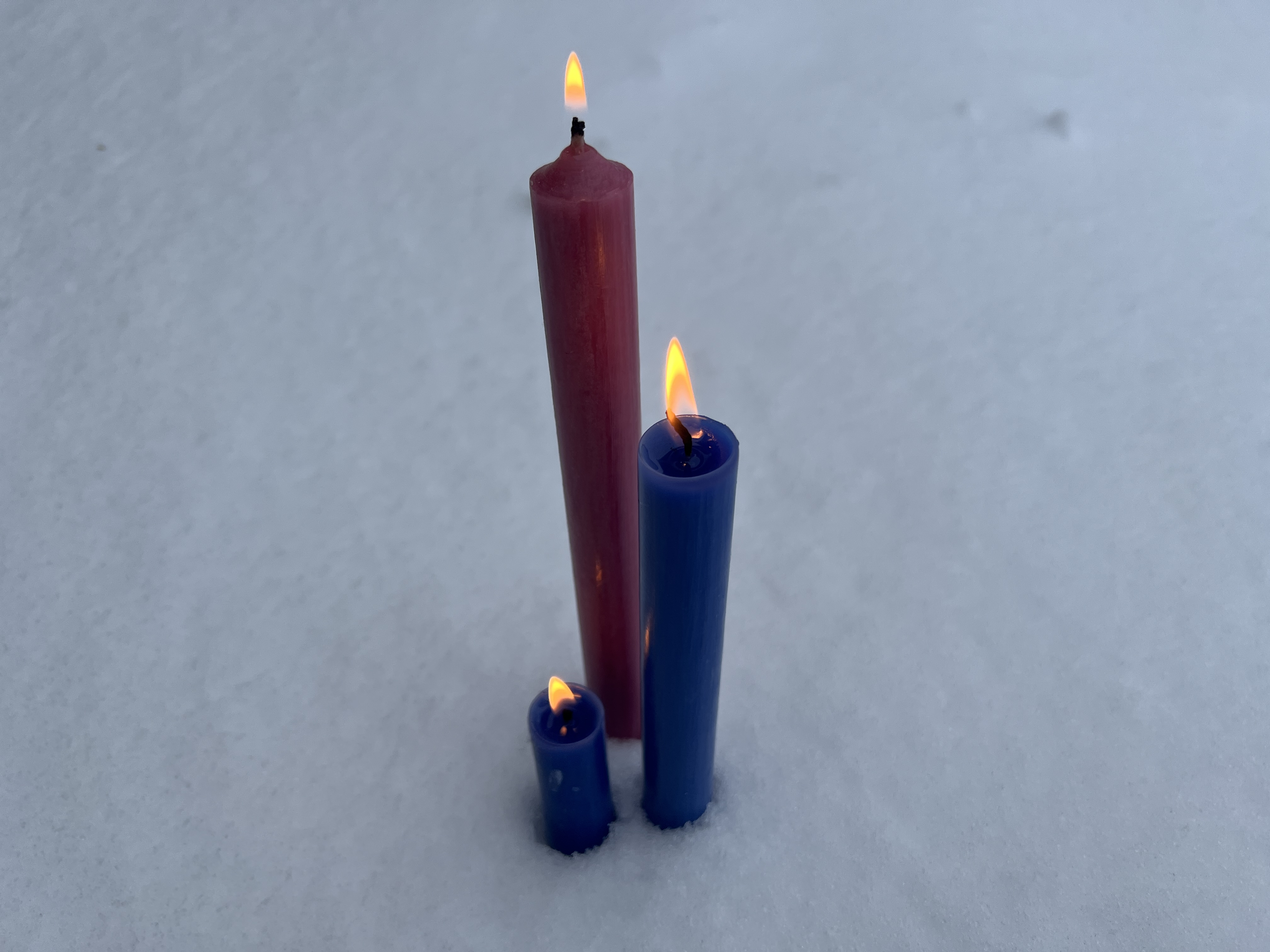
Today we lighted the ‘joy’ candle on the wreath. This third Sunday of Advent is traditionally called ‘Gaudete’, and it is rose coloured. ‘Gaudete’ is from Latin which means, “rejoice”, from Philippians (3:1/4:4) – “Rejoice, rejoice in the Lord always! Again I say rejoice!” Gaudete Sunday gives us permission to praise God and give God thanks for the gift, expected yet unexpected, that soon arrives.

Do you expect to be surprised? When you are, that experience brings the joy of Christmas.

Stoppage time: the waiting game

“Prepare the way of the Lord!” shouts John the Baptist in the wilderness (Luke 3:1-6).

There was a child who was asked to read a part in a Christmas pageant at church. She had the part of John the Baptist. She was perfect for the role, a firecracker of a personality, a born leader. She had many friends who listened to her and followed her on the playground.

But she was worried that she would make a mistake or forget her lines. She told her parents that she didn’t want to go in front of so many people. It made her stomach upset and she felt scared.

Her parents told her stage fright was normal and that the best way to deal with her fear was to be prepared. Being prepared meant going over her lines 10,000 times in the weeks leading up to the play until she could fall asleep reciting her lines perfectly.

She protested. What if her mind would blank out when getting on stage? What if all that practice would mean nothing if she froze under the lights? Why should she even bother trying?

Preparation is the virtue we hail in Advent, when we are called to watch and wait – and prepare! – for the coming of the Lord at Christmas.

But what happens when we don’t have time to prepare everything just right? What happens when we are not prepared, when it comes down to it?

The notion that during Advent we are to wait, at first seems ludicrous. There is no time. How can we wait when there is so much to do (to prepare!)?

But what if the key to being prepared is learning and practising the art of waiting?

Because the truth is, no amount of preparation can prevent a tragedy from happening just as no amount of preparation can have you ready for the birth of a child when it happens. When it happens, at some profound level, we know we can never be fully prepared. When it happens, we know that we could never have anticipated and controlled for every contingency. So, what if being prepared means we know how to wait for it? Could it be, maybe we need first to learn how to wait?

From the Gospel, waiting first means we need to slow down. When shopping malls, parking lots and highways in December indicate everything but, slowing down is vital to receiving the Word of God this season. To practice, notice how you read scripture. So, in the Gospel reading today resist the temptation to skip through the first couple of verses (Luke 3:1-2) – it’s a list of names we have difficulty pronouncing.

Yet, there is purpose here. Luke, the Gospel writer, is intentional about naming all the political and religious rulers of the day and the time they presided. Luke firmly plants the message in a particular place and time in history. We can’t rush through this. Read those words intentionally as if they were a prerequisite for what comes after. And this takes practise. Read slowly.

Every valley shall be lifted and every mountain made low. Not just one valley. Not just one mountain. Not just the valleys associated with Friday night. Not just the mountains confronted Monday morning. Not just the valleys and mountains experienced during worship. In every valley of our lives. On every mountain encountered in daily living.

God’s message needs to land in time and place. We need to slow it down in order to notice it everywhere.

Luke is also quite clear, and intentional, about placing John the Baptist in the wilderness. Not in the crowded confines of a stuffy boardroom or lecture hall. Not in the opulent chancels and temple sanctuaries. Not in the public square in the middle of the city. Not even around the kitchen table or comfy living rooms of our private homes.

In the wilderness, there is lots of space, open areas yielding infinite horizons and unexplored terrain. There is this expansiveness associated with receiving God’s word. We rarely give thought to these conditions when the message is delivered. But there is always context. Waiting is preparing the ground, turning the proverbial soil of our hearts in order to receive the gift. God works from the inside out as much as God works from the outside in. Those expansive contexts of our lives, inner and outer, must be nurtured and practised.

Here is something you can do this Advent to illustrate this practice of slowing it down. For example, I know exchanging and mailing Christmas cards is not as popular today as it was a few decades ago. But maybe some of you can relate.

So, when you receive a hand-delivered Christmas card or in the mail after the postal strike is over, don’t open it right away. If you live with someone else, wait until you can sit down with them for a meal or coffee later that day to open it together, read it and give thanks for the person sending it. Or, if you live alone, wait until your next devotional time, or quiet time to open it, read it and give thanks for whomever sent it.

Advent is about slowing down, opening up time and space, and marking time.

Finally, waiting is becoming aware that the message is for you. Not for someone else. Not for the wayward children or grandchildren. Not for those who disagree with you. Not for those from other parts of the world. Not for those who behave differently from you. Not some part of the culture you do not participate in.

When John the Baptist spoke of a baptism of forgiveness, his opponents – the Pharisees – didn’t at first think this baptism referred to them. They, after all, had already participated in the mikvah, the Jewish ritual of immersing into the purity bath.

The rug was pulled from underneath the Pharisee’s feet when the message that John the Baptist brought was meant for them. And not just for the Gentiles, but for Jewish people as well – everyone who does not receive the message of repentance and forgiveness for themselves.

Waiting opens up regions of the soul to admit the call of repentance and promise of forgiveness into each and every one of us. Waiting allows us to contemplate what that changed life means for us. It’s very personal.

But what if we are like the little girl preparing for the Christmas pageant? What if we can’t or don’t prepare? What if we insist, “It’s not for me.”

When we are not ready for what happens in life, when there is no amount of work that can adequately prepare us for whatever comes our way, God still puts extra time on the clock. Just like at the end of a 90-minute soccer match, there’s always stoppage time to account for injuries that delayed the play of the game during the first 90 minutes. There’s extra time added. Always.

God’s patience is infinite. God waits for us. Even when we get injured, are delayed, or for whatever reason can’t seem to get our ducks in a row. God’s pacing and timing operate on a different level which we cannot fully understand, except that God makes time and space for us. And God’s message is to each one of us, personally. That message is conveyed in love and mercy.

“I am confident of this,” writes Saint Paul to the Philippians, “that the one who began a good work among you will bring it to completion by the day of Jesus Christ” (1:6).

The second candle we light today is called the Peace Candle. When we wait for the Lord by slowing down, creating space, and we receive the message for us personally, we prepare in a way that brings peace into our lives. Because of God’s grace and love, peace reigns.

Zechariah, the father of John the Baptist, sings God’s praise in the temple at the news of John’s birth:

78 In the tender compassion of our God
  the dawn from on high shall break upon us,
79 to shine on those who dwell in darkness and in the shadow of death,
  and to guide our feet into the way of peace. (Luke 1)

Having peace is about living daily with ourselves and others in the mercy, forgiveness and love modelled by the one for whom we wait, Jesus Christ the Lord.

Finding green shoots of hope – everywhere

Hope is the theme of the first Sunday of Advent. It is the hope candle, the first one, we light on the Advent wreath today.

But I must admit after reading the scripture assigned for the start of thie new year in the church calendar (Luke 21:25-36), the Gospel from Luke did not initially feel like an Advent-themed scripture. For one thing, Jesus points to fresh leaves on a fig tree, a sign of coming summer. Summer? When winter in the northern hemisphere is bearing down upon us?

After all, shouldn’t we be reading Christmas stories and singing Christmas carols already, like they are doing in the malls? We’re getting our shovels out and snow blowers primed, not looking at green leaves. Admittedly, many of us might rather skip over Advent, its call to spiritual discipline, slower pacing, prayer and perspective, and rush headlong into the frenzy of the season.

The word, Advent, from Latin, means “coming” and refers to the comings of the Lord: the coming of Jesus at the first Christmas two thousand years ago; the second coming of Christ at the end of all time; and the coming of Jesus into our lives every day and in moments we perceive as grace-filled.

When we work at it a bit and unpeel the layers of this Lukan scripture we nevertheless find clues that plant it firmly in this season of preparation, anticipation and longing called Advent. In short, hope undergirds this Gospel.

“Then he told them a parable: ‘Look at the fig tree and all the trees; as soon as they sprout leaves you can see for yourselves and know that summer is already near’” (v.29-30).

One quick Google search reveals that figs are mentioned in the bible 50 times (Bolen, n.d.), because they were so common in that time and place, being a part of their economy and a staple of their diet.

A recent fig excavation in Ireland found 2,000-year-old remains of a fig, preserved because it had been burned (RTE Media, 2024). Among other things, this archeological discovery points to a lifestyle adopted so far north and so far away from Rome. Considered an exotic fruit, figs were enjoyed not just in regions governed by the Roman empire nearer the equator, but in areas of Europe not controlled by Rome. Figs found in the least expected places: Ireland.

Jesus often used fig trees as symbols and metaphors in his teaching. He used common, relatable images of people’s lives to make a point about living in God’s kingdom. But God’s kingdom on earth, not in heaven. “Your will be done on earth,” the Lord’s Prayer points us to focus here, on the ground.

Annie Dillard said, “The Gospel is less about how to get into the Kingdom of Heaven after you die, and more about how to live in the Kingdom of Heaven before you die.” If it were the other way around, why would Jesus spend so much time talking about coins, treasures buried in the earth, fig leaves and trees, lost sheep, seeds and mustard trees? The point of the Gospel is to point us to this life and finding hope and ways of relating to each other and the world that reflect kingdom values.

Admittedly, this perspective on faith requires some hard work. And maybe that’s why we shy away from that ‘kingdom on earth’ perspective. To nurture hope as a Christian is not to remain passive in facing seemingly hopeless situations. It is to be active in faith.

Perhaps the most striking reason for observing an intentional Advent season prior to the festivities of Christmas is the reality common to us all, the reality of death and grief. Approaching Christmas can be the most difficult for those especially experiencing this season for the first time without their loved one, or for those preparing for their last one.

In no other circumstance of life can Advent be such a gift. To slow things down. To temper expectations. To practice contemplation, value simplicity, and give permission to those who suffer, give them space, room to just be and do whatever – without the stringent expectations of the hustle culture and anxious disposition to doing what is expected. Here is an opportunity to say, ‘stop’. Breathe. And reset.

In dealing with grief, it is important to do something to acknowledge the holidays (Morris, 2018). Because grief is unique to each one of us, for some it might mean doing the same thing you’ve always done, or it may mean doing things a little bit differently this year.

The key is to do something, however simple and small – even if at first you might not feel like it. Being hopeful is not a feeling. It is doing the right thing for you.

So, on the one hand, don’t do what is expected. Don’t do what the world thinks you should do. Don’t pretend to be all joyful and happy. Don’t join the consumer frenzy and hustle or put pressure on yourself to be a certain way.

Lower your expectations. Tell yourself it’s okay to do less this year. Give yourself permission to be sad and cry during the holidays. On the other hand, do something. Don’t do nothing. Don’t wait for feelings to be your signal to act.

Many faith communities will offer a Blue Christmas service. A very valuable ministry, to introduce sacred text, Advent hymns, comforting social support, and to hold contemplative, accepting space to an otherwise loud and intense season. Perhaps you’ve once attended a Blue Christmas service. If you would like to attend one put on by Ottawa churches this month, I can give you a couple options where I know they are happening.

What are personal things people who struggle with loss and grief can do in the weeks leading to Christmas?

Lighting a candle in honour and memory of a loved one. Making or buying a special tree ornament or stocking you can hang on the tree. Asking everyone at a family gathering to write down a fond memory they have of a loved one and place those written memories in a special vase or keepsake box that you can read together later in the season. Making a donation to a charity in a loved one’s memory. Volunteering in a hospital, food bank or serving food at an Out of the Cold program. These are all meaningful activities to engage.

The point is, Advent is such an important season to observe, before launching mindlessly into the Christmas festivities and frenzy which, let’s be honest, are by and large self-serving and self-indulging. Especially in a time that feels hopeless, there are things you can do to shift that focus – meaningful things – to discover hope again.

Find green shoots of hope wherever you can. Look for the proverbial fig leaf, even if in places you might never have expected. And do something. And if, this year, you cannot …

Some people and communities are doing great things. Celebrate them. Others are doing small but important things. Thank them. Others are doing courageous things. Appreciate them. Keep hope strong. Keep hope alive (Reich, 2024).

References:

Bolen, T. (n.d.). Fig Trees. Retrieved from https://www.bibleplaces.com/fig-trees/

Morris, S. (2018). Overcoming grief (2nd ed.). Robinson.

Reich, R. (2024, November 19). How to hope in a hope-less time [blog]. https://robertreich.substack.com/p/how-to-hope-in-a-near-hopeless-time?

RTE Media. (2024, November 14). On a roll: Fig from 2,000 years ago found at Dublin archaeological site [website]. https://www.rte.ie/news/dublin/2024/1113/1480725-fig-excavation-dublin/

Building for Christ – Part 4

The Centre-One-Piece’, photo by Martin Malina
audio sermon, “Building for Christ – Part 4” by Martin Malina

The story of Mary visiting Elizabeth vibrates with energy. There is this back-and-forth, cause and effect, initiative and response. If Newton’s Third Law of physics – that every action has a reaction—were applied to people, here would be a good, positive example. 

Mary’s visit causes notable reaction. Her cousin Elizabeth is affected by Mary. And not only Elizabeth. Twice in the description of the visit the Gospel notes that “the child leaped in her womb”.[1] The greeting causes a responsive, palpable joy that we can feel in the text. 

The meeting between the yet unborn Jesus and John the Baptist and their mothers is pregnant with meaning – which prompts Mary, then, to sing her famous Magnificat: “My soul magnifies the Lord!” You can’t help but envision this scene which is about relationships between individuals.

Today, I put the final piece in place in the house we have been building for Christ over these past Sundays of Advent. We started with the foundation of love—fences and a frame that made room for everyone including the animals and all creatures great and small. Last week we added the star shining brightly its joyous guidance to those journeying to meet the Lord. Today, we finally see the centrepiece, the Holy Family.

What stands out for me in this particular manger scene is how Mary, Joseph and the baby Jesus in the manger are not separate pieces. They are one piece. Of course, they are one family. They form one unit, connected in their relationships with each other. The emphasis here is their connection rather than their individualities. And I think this is important when we reflect on all things Christian.

The story of Christmas, indeed the story of the bible, is not about autonomous individuals living out their private lives. The emphasis is not as much about individuals as it is about relationship in community: Their relationship with God, and with one another.

Christmas is about people, a cast of characters. If you’d miss anyone in the story it would be incomplete. Missing from this particular manger scene are the Magi and the Shepherds. Perhaps your manger scene at home has these important characters. You can’t tell the Christmas story without the angels, the shepherds, the wise visitors from the East, the animals, the guiding star, Herod, Joseph, Mary and Elizabeth, John the Baptist, Zechariah and of course—at the centre—baby Jesus.

Christmas is about people, and so is Christianity. Christian faith would mean nothing without the cast of characters that make up God’s grand story of faithfulness to the people of God of all time and in every place. Everyone in this story is important, critical, to its telling. 

You are a part of God’s story. While faith is personal, faith is not individualistic. When you were baptized, you were not alone baptizing yourself. When you eat the holy meal, you are not doing it all on your own—whether online or onsite here. It’s about the relationships between the individual parts—that’s where the meaning is for faith.

Even our advent wreaths. Whether we have it hanging from the ceiling, or whether it sits on a side table, or shelf, or on a stand in the middle of the floor, the advent wreath is not suspended in a vacuum. Here at Faith, the red ribbons stream upward from the circular frame, four of them, where they are tied securely together at the ceiling. The ribbons hold it all together in place. They are the ‘glue’ keeping the wreath from falling down.

So I have to imagine the shepherds and Magi here as well. They connect prominently to the Christmas story. And what do the shepherds and wise men do when they come to the manger? What comes to my mind is that they kneel, bow, stoop low to get close to see the baby Jesus. Their posture strikes me. 

Do your shepherds stand? Do the three Magi remain on their feet or their camels? Or, as they come near to the manger, do they put down their staffs on the ground, and kneel?

Here we probe some depth in the character of God’s relationship with humanity. It’s the posture that’s important, the nature of the relationship. Mary and Elizabeths’ greeting and meeting was one of joy, celebration and praise. What does the manger scene reveal about the nature of our relationship with God, and God’s relationship with us—the glue that holds it all together? What words would you use to describe God’s posture towards us?

It’s the Fourth Sunday of Advent – the last stop on our journey to Bethlehem.

It may be tempting these last days to make it about us, and about our abilities to accomplish everything before the special day arrives. It may be tempting to make Christ’s arrival dependent or conditional on us getting it right. Christmas will happen—we may be tempted to think—only if it happens a certain way (when all the decorations are put out, when the meal is prepared, when all the family arrives, when all the gifts are bought and wrapped, when we can pack a church with robust singing of the favourite carols, etc., etc.).

Martin Luther cautioned people of faith not to depend on our righteousness, our ability, even our humility to make things right with God. So, we can kneel or sit, yes, in all humility. Or, we can stand, if that’s how it is for us. God sees it, and God knows.

But time and time again, what is really important, is that the God of the bible, the God in Christ Jesus, stoops to our level. God initiates the relationship. The first Christmas didn’t happen because people had it all right and organized. God stoops to wherever we are—in our thoughts, our feelings, our actions our beliefs. It doesn’t matter, at the start and at the end, what we believe or don’t believe, what we do or don’t do, what we feel or don’t feel. 

God still comes to us. God stoops down to where we are. Christ will come into our world and our lives this COVID Christmas.

And as I’ve said just before the start of the Advent journey this year, I’ll say again at the end: 

For, in Jesus Christ, we will meet a God who will not be armed with lightning bolts but will stoop to us with basin and towel. 

We will meet a God who will not spew threats and lies but will stoop to the poor with good news for all. 

We will meet a God who will not ride a warhorse but stoop on a donkey’s back[2].

We will meet a God not part of the Jerusalem religious establishment, but a God who will stoop to live in backwater Nazareth. 

We will meet a God not born in a palace somewhere atop a hill, but a God who will stoop, a helpless, vulnerable baby born to two, poor teenagers in a barn. 

Now that our house is built, we can both contemplate the nature of our connections and relationships and pay attention in our words and our deeds to the witness we make to this God who will always stoop, to come to us.


[1] Luke 1:41,44

[2] See “Who’s Coming to Dinner?”, sermon for the Reign of Christ Sunday, November 21, 2021 at http://www.raspberryman.ca 

Building for Christ – Part 3

Harbour Breton, South coast of Newfoundland 2021, photo by Simon Lieschke
“Building for Christ – Part 3” audio sermon by Martin Malina

They had a vision. But perhaps it wasn’t quite the way they had expected it to turn out. But was it worth the risk? Now that is the question.

They wanted fireworks for the wedding reception. When we arrived a couple days before the wedding at our friends’ home, the father of the groom opened his shirt at the table. And with jaws dropped, we saw a large, purple bruise circling most of his chest area. What happened?

The groom wanted fireworks in the backyard where the wedding was going to take place the next day. In setting it up the night before, the groom, brother-in-law and father were careful to follow the instructions. Except they must have missed something. 

Beause when they tested the fireworks, the riggings exploded and the fireworks shot out in every direction but upwards. The groom and brother-in-law dove for safety to avoid the flaming projectiles. But one hit the father in the chest with force and knocked him over. He was fortunate not to have sustained greater damage to his body!

Was it worth the risk? That is the question.

On some Advent wreaths, the third candle is pink because rose is a liturgical color for joy. This third Sunday of Advent is called “Gaudete” Sunday, from the Latin, and is meant to remind us both of the joy that the world experienced at the birth of Jesus, as well as the joy that the faithful have reached the midpoint of the Advent journey.

Today, we place a star over the open frame of the house built on love, for Christ. The star of Bethlehem gives light, a shining beacon in the dark night. And so the candles are lighted, now three of them on the Advent wreath. We begin to notice the light that is given off. After all, an Advent wreath isn’t really doing its job unless the candles are lighted, showing their albeit tiny flames.

It is the Sunday of celebration, not unlike the fourth Sunday in Lent called “Laetare”. In all our preparing, keeping on track, and our work we now anticipate and expect the end of the journey which is near! So, what do we do now that we are almost there? Waiting, after all, is so difficult.

The crowds asked John the Baptist, “What should we do?” now that the Messiah was very near, closer than they thought! With all the upheaval, fear and anxiety about the future, what to do, whom to trust? Is John the Messiah? When the big picture seems uncertain, and society as a whole feels like it’s on the brink, what do we do? “As the people asking John the Baptist were filled with expectation”[1], so are our hearts. What should we do in this short time before Christmas?

Gaudete and Laetare both mean “Rejoice!”. But some suggest a subtle difference.[2]  First, this work happens on the inside of our lives. This is the work of Gaudete. This work is self-reflective. We examine our own expectations. We consider our own desires and acknowedge our own restlessness. What are we waiting for? What are your desires this Advent? How is that you expect Jesus to arrive in your life this Christmas? How are you watching and waiting? These are important Advent questions to ask yourself.

But what is the outside work—Laetare—from which we pause to celebrate? What is it that keeps our noses to the ground, so to speak, and hands in the dirt, to get ready, spiritually?

John the Baptist gives practical advice if not delivered with much fire and brimstone. John tells them: Give what you have to someone who doesn’t have. Share what little we have with others. Be fair and just in your daily transactions. Don’t threaten anyone. And be content with what you have.[3] Small acts of kindness. Paying loving attention to the little things. Sounds like a good prescription for unsettling times, and for good mental health. Just focus, one day at a time, one small act of kindness at a time.

And sometimes doing these small things for God is a bit of a risk. Whenever we move out of our comfort zones, consider another point of view, whenever we refrain from reacting out of anger, fear or anxiety—we know the risk because things are changing. Yes. But we do so primarily responding to something moving in our hearts. Something powerful and good drawing us forward.

The season of waiting expectantly gives permission for us to acknowledge our restlessness and our desires despite the tensions and suffering those desires and expectations can create for us. This is part of our humanity, a humanity not denied by the journey of faith, especially the journey to Bethlehem. 

The Magi and the Shepherds took great risks to pursue their longings—dealing with Herod, for example.[4] Despite this adversity, they nevertheless responded to the movement of their restless and adventurous hearts to follow the light in the sky.

Christian hope is not really the belief that tomorrow is necessarily going to be better, or that the future will turn out the way we expect it to or even desire it to. Christian hope is not the belief that as Christians we won’t ever meet with adversity.

All that Jesus seems to be saying is that even if one mustard seed is sprouting, or one coin found, or one sheep recovered[5] that is reason enough for a big party. “Even a small indicator of God is still an indicator of God—and therefore an indicator of final reason, meaning, and joy. A little bit of God goes a long way.”[6] A tiny flame on a simple candle.

At the outdoor wedding feast when we danced the night away, what joy it was to see those firecrackers going off at midnight, once they got it right. I thanked God for the risks my friends took to have firecrackers at this wedding. Those risks gave us the gifts of light and joy in the night. It was worth the risk.

Unless we let go of the familiar, the safe, the secure—and this is what the pandemic has forced upon us to an extent; unless we take the risk of becoming vulnerable, we cannot grow. 

So much of the bible, and from other writings that stand the test of time, underscore this important theme. From the story of Abraham in Genesis, to the great epic stories of the Odyssey, the Iliad, the Lord of the Rings.[7] They all require leaving everything and going on a journey that will lead to a new life, a new identity, and newfound joy.

They all took risks. And they all experienced joy. Let it be for us as well. Amen.


[1] Luke 3:10,15

[2] https://gezemiah.wordpress.com/2018/12/15/gaudete-v-laetare/

[3] Luke 3:10-14

[4] Matthew 2:1-12

[5] See Luke 15

[6] Richard Rohr, “The Gift of Confidence” Mystical Hope (Daily Meditation, www.cac.org, 6 December 2021)

[7] Br. Geoffrey Tristam, Society of Saint John the Evangelist, “Risk” in Brother Give Us A Word (www.ssje.org, 10 December 2021)

Building for Christ – Part 2

Lake of Bays, Dwight Beach, Ontario, photo by Martin Malina
“Building for Christ – Part 2” audio sermon by Martin Malina

“… and all flesh shall see the salvation of the Lord” concludes the Gospel for this Second Sunday of Advent.[1]

All flesh.

We continue today to construct the home for the coming of Jesus. Last week we started with the foundation of love, which defines all that we do to build for Christ.

This week, our house takes form by creating space. This space is not just on a one- or two-dimemsional plane, but in three dimensions. The house grows upward from the ground. Our building creates space in height, depth and breadth. Our building leaves a footprint on the earth. It claims a part of the ground upon which we live, breathe and have our being.

As soon as we place candles on the circular, evergreen form, the Advent wreath takes shape. The candles give it height and form. You have to make space for it wherever you place it. Because when those candles burn, there needs to be enough room above the wreath as well.

And the candles are what really give your wreath character. Because there are thin, tapered candles, there are round, bulb-shaped candles, there are stalwart, pillar candles of varying height and thickness. Some wreaths have purple candles, others have red candles, more are now blue candles. And with any of the above options, some will have one pink candle thrown in, and even others, add a white one in the centre. There are no two advent wreaths alike. And every one has an important meaning to convey, an important truth to demonstrate, a part of the story of Advent to share.

As we build for Christ coming, then, who will occupy this space? Only those who are alike? Only those who will express their faith in the same way?

When I look at the frame of this house we are building, I notice that it is not just for people. It is a barn. A stable, where animals feed and find shelter. It is their home. Some of my favourite children’s Christmas books are told from the perspective of the animals in whose barn Jesus was born.[2] Those who witness the holy birth are not just people. But all creatures great and small. 

Who will occupy this space? All flesh shall see the salvation of the Lord.

Which means, different perspectives. Different life experiences from which to receive the good news of Christ coming. Different needs, different takes, a multitude of ways of appreciating the glory of God in simple, ordinary lives.

And not just for one. Not just for the elite, and the privileged. The house we build for Christ includes all flesh, all creation is welcome to witness the glory of God.

Because animals are an important part of the story of Jesus’ birth in Bethlehem—the sheep, the camel, the cows and other barnyard creatures, I’d like to tell you now about a duck who can teach us something about living in stormy times—not unlike the treacherous times under “Emperor Tiberius, when Pontius Pilate was governor of Judea, and Herod was ruler of Galilee”[3]

Here’s a poem called “The Little Duck”, written by poet and professor at the University of New Hampshire, Donald C. Babcock:

“Now we are ready to look at something pretty special. 

It is a duck riding the ocean a hundred feet beyond the surf,

And he cuddles in the swells.

There is a big heaving in the Atlantic.

And he is part of it.

He can rest while the Atlantic heaves, because he rests in the Atlantic.

Probably he doesn’t know how large the ocean is.

And neither do you.

But he realises it.

And what does he do, I ask you.

He sits down in it.

He reposes in the immediate as if it were infinity – which it is.

That is religion, and the duck has it.

I like the little duck.

He doesn’t know much.

But he has religion.”[4]

The duck’s way of being way out there beyond the surf reveals to us how to live faithfully in a time of watching and waiting, in a time of disruption and upheaval, amidst the storms and waves that threaten to upturn and drown us.

The little duck must be dwarfed in the face of the vastness rising and falling around it. But not only does the duck seem unconcerned; the duck “cuddles in the swells”. It is as if the duck embraces where it is, tender in the midst of it all, a part of it. The duck belongs and can rest while the Atlantic heaves. Here we witness the “wondrous juxtaposition”[5] of the restlessness of the ocean and the peace that remains possible for the duck.

In the scriptural imagination of Jewish and Christian traditions, the ocean signifies chaos—the forces of disorder that threaten to overwhelm the bounds within which our lives are secured.[6] The ocean can also signify the vastness of God’s being which we cannot know nor see the limits of.

In the face of this oceanic, boundless bigness of both God and chaos, what is our puny existence? Like the duck’s, our lives are towered over by forces we have no capacity to contain, by storms we cannot master. What is our response?

Our inclination, when we realize our situation, is to panic or struggle. Yet, the duck does neither of these things. For there it is, far out from shore, cuddling in the swells, and at rest. The duck is not fighting it, the duck is in communion, at one, with the whole.

Knowing is not the point. Our strength to fight it is not the point. Trusting is, and being in the present moment with all that is, is.

Because all of it belongs. We are all—all creation—held in God. Every perspective. Every experience we and others have. Every place and time. The ocean is vast and all flesh belongs. And the Psalmist reaches time and time again for this truth, to comfort us, to deepen trust as “deep calls to deep”: There is no place on earth, nowhere I can go, no one removed, “no where to flee from your presence”, O God.[7]

“If I take the wings of the morning and settle at the farthest limits of the sea, even there your hand shall lead me and your right hand shall hold me fast.”

When I travelled through the Judean wilderness on the road from Jericho up to Jerusalem years ago, we stopped along the way as groups of nomads made their way across the desert. And the interesting thing was the way their tents were constructed. 

These tents had walls like any tent. But every wall was also a doorway—you could roll up the canvas to make it look like an open patio canopy. Among other reasons, I learned that semitic people consider eating together as a sign of reconciliation and forgiveness.

The more you could have in your tent at mealtime, the better it was for the whole community wandering through the desert: A house with no walls, and many ways in.As we build a house for Christ to come this Christmas, we build by creating space for everyone. The space we occupy, therefore, has room—room for all who find their way here. This is also room that beckons us not to circle the wagons but to widen the circle. And we do so trusting that God is in it all, even in the waves, that God is present in love for all.


[1] Luke 3:1-6

[2] Eve Bunting, We Were There: A Nativity Story (New York: Clarion Books, 2001); Jean Little, Listen, Said the Donkey (Toronto: North Winds Press, 2006); Jean Little, Pippin the Christmas Pig (Toronto: North Winds Press, 2003); Martin Waddell, Room for a Little One: A Christmas Tale (Toronto: Margaret K. McElderry Books, 2004); Karma Wilson, Mortimer’s Christmas Manger (Toronto: Margaret K. McElderry Books, 2005)

[3] Luke 3:1

[4] Donald C. Babcock cited in Sarah Bachelard, Poetica Divina: Poems to Redeem a Prose World (Singapore: Meditatio, 2021), p.57

[5] Sarah Bachelard, ibid., p.60-61

[6] Ibid.

[7] Psalm 42:7; 139:7-10

Building for Christ

Building for Christ – audio sermon by Martin Malina

I hold in my hands two pieces of fencing to begin building a home for Christ to come this Christmas. Many of you might know what this project will eventually look like, come the Fourth Sunday of Advent. For those who are not sure, I encourage you to check in every Sunday right here to witness the building emerge before your very eyes, piece by piece.

These fences suggest both something necessary, and something of the downside in human behaviour. It is in our nature to build fences after all—whether in our neighbourhoods between homes, between nations and tribes, between individuals and families.

Boundaries are good and important. They define who we are as individuals and people. They clarify and bring focus to relationships, roles and functions. Boundaries are especially important for young people as they discover who they are and explore the limits of possibility for their lives.

Boundaries are not meant to be divisive. Yet, division is often a consequence of drawing a line in the sand. Fences can divide and keep people apart, at war, in acrimonious conflict. Fences can entrench people in opposition to each other. Building fences can hurt and damage relationships for the long term.

Despite the ambiguous image of a fence, we start anyway. We begin to build something from scratch. And maybe that is a grace. I wonder if that isn’t a recurring theme of the pandemic: rebuilding and restarting from the ground up considering everything we may have taken for granted before the pandemic. Whether in our friendships, our hobbies, our leisure acitivity, our work and even our church. We seem to be pressing the reset button: From our practice of Communion, to the way we do meetings, to our outreach activities, music and mission in the community—everthing requires all the assumptions to be laid out on the table again, to be re-examined and re-purposed.

And that can be unsettling–to start over, to start from scratch.

Not only do we begin Advent today, today is the start of a new church year, a new cycle, a new round: Advent, Christmas, Epiphany, Lent, Easter, Pentecost with Ordinary Times mixed in throughout the cycle of the church year. And then it all begins again, next year. We symbolize today the start of a new cycle by lighting candles, progressively—four of them for the four weeks leading to Christmas—on an Advent wreath.

As we build for Christ-coming each week with a new part of his home, I’d like to look carefully at different parts of the Advent wreath to describe something important about how we begin again.

And the first thing we notice with most Advent wreaths is the foundational part—the circular form of the Advent wreath. Fences tend to be square, or rectangular, coming together at right angles. But the wreath is round. And around the circular form of the Advent wreath we place boughs of spruce or pine from trees that we will notice outside especially during the cold and grey winter months when nothing else appears to be alive.

In the Psalm today, the refrain is a prayer to God: “Remember, O Lord, your compassion and love, for they are from everlasting.”[1] And, in the Gospel today, Jesus says, “Heaven and earth will pass away, but my words will not pass away.”[2] [emphasis mine]

The good news–gospel– that threads throughout both of these scriptures appointed for the First Sunday of Advent is the lasting and indestructible nature of God’s compassion and love. Nothing in all of history, all of creation nor anything in the future can shuck the love of God. Nothing. No division, no enmity, no strife, no walls that divide. The loving presence of God is eternal, timeless, unending—just like evergreens wrapped in a circle on a wreath. A circle has no beginning and no end. It goes on, forever.

Perhaps you remember when you were a child and an adult said something like, ‘OK, kids, gather around, it’s circle time’. Circles are natural to us. And sacred.

When we gather in a circle, the praying has already begun. When we gather in a circle, we communicate with each other and with God, even without a word being spoken. That’s what I love most about this building in which some of gather in person this morning: The building here at Faith Lutheran is round, circular.

The circle has no beginning and no end, so one can enter at any place or stage. The circle can explain stages of life, cycles of maturity, values, and different groups of people. The symbolism of the circle is one of the oldest in Canada, having been found in various parts of the country in ancient petroglyphs. It is included in various Indigenous traditions. Many of the ceremonies and dances are fashioned intentionally in a circle. 

Circles are found in nature. Circles can explain the seasons, how they all continue on to create harmony and balance. In observing the outdoors, the circle is a common and natural shape. Trees, rocks, whirlpools, tornadoes, and flowers all bear a common resemblance to circular objects more than triangles, rectangles or squares do.[3]

We may need to establish those fences. We may need to enforce personal boundaries and sometimes even assert where the line must be drawn. Sometimes we do have to close a door. We are human, after all.

But God is beyond any boundary, even one drawn by the circle. God is not bound by any material or mental boundary we may devise for God. What we construct may or may not be helpful. But these boundaries are not ultimate. Thirteenth century Italian theologian, Saint Bonaventure, spoke of God as one “whose center is everywhere and whose circumference is nowhere.”[4]

What is ultimately important is to know that it was out of great love that God chose to take on human form and flesh[5]—take on the boundaries defined by our humanity, good and bad. Here we make a house for Christ to dwell, for this word is true and will not pass away: “The home of God is among mortals. God will dwell with them, and they will be God’s people.”[6] Because of compassion, a love that is everlasting.[7]

This is the first and necessary part, the foundation, for building a home for Christ. When we press the re-start button on anything we do, this is where to begin.


[1] Psalm 25:6 NRSV

[2] Luke 21:33 NRSV

[3] The last few paragraphs starting with “Perhaps you remember …” are adapted from Richard Rohr, “Sacred Circles” in Daily Meditations (www.cac.org, 13 October 2021).

[4] Bonaventure, Bonaventure: The Soul’s Journey to God, 1,14, trans. Ewert Cousins (Paulist Press, 1975) p.5,8,100

[5] Philippians 2:5-8

[6] Revelation 21:3

[7] See also Psalm 103:8-14