True power, true love

photo by Martin Malina, 2019

“Love your enemies” (Luke 6:27) is a teaching from Jesus that hits especially hard in today’s economic and political climate. Because loving your opposition is not how you win. Loving your enemies goes against the grain of our conditioning. 

Using a hockey analogy, we naturally want to go on the offensive when facing adversity. We want to fight back, tit-for-tat. Seeking revenge is a strong motivator, isn’t it? 

But good hockey minds know that focusing only on offense usually means losing the game. Avoiding sound defensive play is not a winning strategy. As they say, defence wins championships. 

Winning, in the end, is about nurturing love and care for the battle that goes on in your end of the ice. Loving your enemies is first loving and taking care of your neck of the woods, in your backyard, whenever challenges or personal adversity appear.

So, on the one hand, loving your enemy is NOT about being a doormat and taking abuse. On the other hand, if the aim of any relationship is to always and unquestionably have the upper hand, that is no relationship.

Indeed, the problem with a bulldog approach to the challenges we face is that it more often than not keeps you stuck, by avoiding the things in your own life which you are scared to confront. These are issues that lurk in the places you don’t want to go. Occasions of adversity are invitations and opportunities to first take stock and look in your own life for whatever needs attention there.

Imagine these issues as “gnawing rats” (Loomans cited in Burkeman, 2024). How do you deal with these rats in your life? Impulsively we may want to eradicate and stomp the bad parts out of us, eliminate them completely. With force of willpower we will confront those rats and attack them with brute force and hatred even, eh?

The problem is that this approach simply replaces one kind of hatred (“Stay away from me!”) with another (“I’m going to destroy you!”). And that’s only a recipe for more avoidance over the long term, “because who wants to spend their life fighting rats?” (Burkeman, 2024, p. 62).

“Love your enemies,” says Jesus. What about befriending the rats instead? What about turning towards them and allowing them to exist alongside? There are benefits to this approach. Following Jesus’ command isn’t merely about being mindlessly obedient and doing whatever Jesus says never mind us. Jesus truly had our wellbeing, our healing in mind when he gave us this command. Jesus wants the best for us, wants us to be healthy.

First, to befriend a rat is to defuse the anxiety we feel, because we change the kind of relationship we have with it. We turn that gnawing rat into an acceptable part of our reality. By doing this, we can begin to accept that the situation is real, no matter how fervently we might wish that it weren’t. 

But we need to do something that initially feels uncomfortable. What would it take to befriend the gnawing rats in your life? “Loving your enemy” becomes an act requiring real courage – more courage, perhaps, than the standard confrontational approach. “Loving your enemy” becomes like reconciling yourself to reality rather than getting into a bar fight with it.

This is not passivity nor, as I said, is it being a doormat. It’s a pragmatic way, Jesus teaches, to increase our capacity to do something positive while becoming ever more willing to acknowledge that things are as they are, whether we like it or not (Burkeman, 2024).

Last week walking through the thick snow in the uncharacteristically quiet Arnprior Grove, I caught sight of a quick movement at the base of a tree. But it was too quick for me to recognize what it was. Seeing the tiny creature reminded me of an Indigenous tale taught by the late Canadian writer Richard Wagamese, whose story about true power I paraphrase here:

A young man dreamed of being a great warrior. In his mind’s eye he envisioned himself displaying tremendous bravery and earning the love and admiration of his people. The young man knew that the greatest warriors were those who possessed the strongest spirit and wisdom. He longed to become the greatest defender of his people.

And so he approached the Elder of his village. He told the Old One of his dream, of the great love and respect he felt within himself for his people and of his desire to protect them.

He asked the Old One to grant him the power of the most respected animal in all of the animal kingdom. With this power, the young man would be able to become as widely respected as this animal.

The Old One smiled. Although he appreciated the young man’s earnest desire he recognized that this was the time for a great teaching. So he told the young man that he would gladly grant him this power if the youngster could accurately identify the animal who commanded the most respect from his animal brothers and sisters.

The young warrior smiled. It was obvious to him that the grizzly bear commanded the most respect in the animal world. He stated this to the Elder and sat back awaiting the granting of the bear’s power. 

The Old One smiled. He told the young man to guess again, for despite the immense courage and ferocity of the grizzly, there was one who commanded greater respect.

One by one, the young man named the animals he felt possessed the adequate amount of fierceness, courage, boldness, and fighting power to earn the awe of his four-legged brothers and sisters. He named the wolverine, the eagle, the cougar, the wolf and the bison, but each time the Old One simply smiled and told him to guess again.

Finally, in confusion the young man surrendered. The Elder told the young man he had guessed as wisely as he could. However, not many knew the most respected of animals because the most respected one is seldom seen and even more seldom mentioned. It is the tiny mole, the Old One said.

The tiny, sightless mole who lives within the earth. Because the mole is constantly in touch with Mother Earth, the mole is able to learn from her every day. Whenever some creature walked across the ground above, the mole could feel the vibration in the earth. In order for the mole to know whether or not it was in danger, the mole would always go to the surface to learn more about what created the vibration.

It is said by the Old People that the mole knows when the cougar is prowling above, just as it knows the approach of a human and the scurry of a rabbit. And that is why the tiny mole is the animal among all animals who commands the greatest amount of respect. Because though the mole might put himself at great danger, the mole always takes the time to investigate what it feels (Wagamese, 2021, pp. 47-49).

“Love your enemies,” Jesus says.

Adversity challenges us to activate the better part of ourselves. Because however you define your enemy within and without, the enemy is an opportunity to reset a relationship, to re-balance things, with ourselves, with others, with creation, and with God.

“Love your enemies,” Jesus teaches us, because in the end, it’s about relationships. We were God’s enemy because humanity killed Jesus. Because sin kept us separated from God. What God did was to break down that barrier of enmity by forgiving us, loving us. Jesus gives us a way to deepen and in the end strengthen relationships of love despite the reality, the imperfection of it all, and the adversity we will always face in this life.

“I used to pray for everything I thought I wanted,” prays Richard Wagamese, “big cars, big money, big … everything. Mostly, so I could feel [big]. That was always a struggle. These days I’ve learned to pray in gratitude for what’s already here: prosperity, health, well-being, moments of joy and to pray for the same things for others …. I’m learning to want nothing but to desire everything and to choose what appears. Life is easier that way, more graceful and I AM [big] – but from the inside out” (Wagamese, 2021).

References:

Burkeman, O. (2024). Meditations for mortals: Four weeks to embrace your limitations and make time for what counts. Penguin Random House.

Wagamese, R. (2021). Richard Wagamese selected: What comes from spirit. Douglas & McIntyre.

It all evens out

What happens when your best friend starts saying things and doing things that offend and hurt? Our responses are varied. But it is our best friend who has suddenly created this division. And we don’t know what to do.

A Manitoba family took to heart a playful suggestion made by a journalist to deploy hockey sticks in a row in snowbanks on the border. They pasted on the blades of these hockey sticks googly-eyes to provide 24/7 surveillance (Proudfoot, 2025 February 5).

In the Gospel today (Luke 6:17-26), we observe both Jesus’ actions and words. But if just look at the words of the Beatitudes alone, taking them out of the setting of the narrative, this is tricky. At best it leaves us analyzing paradox and struggling with ambiguity. At worst, the words confuse us, and we dismiss them in frustration.

Because Jesus pulls the rug out from underneath our presumption of who is blessed, and who is cursed. It’s the opposite of what we believe:

We believe you are blessed if you are not poor. You are blessed when everyone adores you. You are blessed when you have material wealth, social status, and your reputation is intact. You are blessed when you are tough and negotiate to win in a world of winners and losers. You are blessed when you win, in any relationship – even with your best friend.

Taken alone, Jesus’ words may support this winner/loser mentality. Because there are the blessed and there are the ‘woe-ed’, those who are cursed. And where do we fit in that either/or framework? Are you one of the cursed, or the blessed?

“It was said of Rabbi Simcha Bunim that he carried two slips of paper, one in each pocket. On one he wrote: … ‘For my sake the world was created.’ On the other he wrote: … I am but dust and ashes.’ He would take out each slip of paper as necessary, as a reminder to himself” (Spitzer, as cited in Burkeman, 2024).

Thank God we also witness Jesus’ actions before he said a word. Before uttering those perplexing and sometimes confusing Beatitudes, we see him in action. His action sets the context. And what is he doing?

In Luke’s version of the Beatitudes (the Gospel of Matthew also records Jesus’ Sermon on the Mount in Matthew 5:1-12) Jesus “comes down … and stood on a level place” with all the people. In Luke’s version, it all evens out.

Not only do the divine and human come together on one plane of existence, so do all the diverse peoples gathering to watch and hear Jesus – “a great crowd of his disciples and a great multitude of people from all Judea, Jerusalem, and the coast of Tyre and Sidon” (v. 17).

And Jesus healed “all in the crowd” – the blessed and the cursed (v. 19), even before Jesus began to preach those divisive, perplexing words. Before any words, his actions demonstrated what all of us share – our common humanity.

So, what does it mean that he “healed” everyone? Let’s look at the meaning of the word, healing. In the original Greek, the word for healing means more than a mere cure. Healing, in the New Testament, is the same word as salvation, to restore, to make whole (Thayer’s Greek Lexicon, 2011). Healing is about re-establishing right relationship between humanity and God, between people. Healing is about reconciling the opposites, breaking down the polarization within us and around us (Kenny, 2025, January 28).

Amidst the division, the polarization in our lives and in the world, Jesus “healed all in the crowd”. Jesus introduced an ethical dimension for being in relationship, being a friend. Jesus was about reconciling relationships that appeared, on the surface, destined for damnation.

So, now the words of Jesus may make better sense when taken in the context of Jesus’ action, which demonstrated no enduring separation, no eternal division, but rather wholeness. Rabbi Bunim held awareness of both the good in him, and the bad. He held a high view and a low view of his humanity. Perhaps, therein lies the key. Both within us, and all around us in everyone, everything.

The writer, Anne Lamott suggests: “Everyone is screwed up, broken, clingy, and scared, even the people who seem to have it more or less together. They are much more like you than you would believe. So, try not to compare your insides to their outsides” (Lamott, cited in Burkeman, 2024).

Lamott’s dust and ashes’ low view, on the one hand suggests something important and humbling about God, about reality and our place within it. God came down to our level. God became human. And died a very human death, condemned and persecuted.

But if we have overly identified for so long with our sins, our fears, our judgements, our afflictions, our limits and weakness, and all the sins in the world today, if we stay at the cross, we get stuck in despair. That’s not where the story ended. That not what Jesus wants from us. He came down to our level, in order that we may be lifted up.

We need a high view that also recognizes our limitations and mortality. Because it does not follow, that who we are and our actions don’t matter.

They don’t matter if we feel pressured to be winners in every interaction, especially against those who are different from us. They don’t matter if we feel pressured to achieve an extraordinary standard of merit that feels like victory on the battlefield, or in a way that’s applauded by a multitude of people. They don’t matter if our winning means someone else must be the loser. That we are blessed and those on the other side of the border line are cursed.

What does matter is realizing our individual being is inseparable from everything and everyone else. Each of us is impossible to be and do without countless people we might normally think of as separate from us. After all, Jesus made no distinction in his actions. “He healed all in the crowd.”

Our actions do matter when, despite our limitations, our simple un-extraordinary actions make a positive difference to the person we encounter in each moment.

So, what we do for God as saints and sinners, blessed and cursed, we do for no other reason than nothing could be as enlivening and truer to God in this momentary situation we find ourselves. Jesus came down to our level and made God accessible to all people in every situation. Jesus loves and has hope for everyone.

There’s lots to be done. Take heart. The good thing about everything being messed up is that no matter where you look, there is great work, important work, to be done.

God has given us the opportunity, being born into the messy state of life on earth in this time in history, to do one small thing at a time. We may not matter that much, from one perspective, but we matter as much as anyone ever did.

References:

Burkeman, O. (2024). Meditations for mortals: Four weeks to embrace your limitations and make time for what counts. Penguin.

Kenny, A. (2025, January 28). Healing beyond the cure: Jesus’ healing ministry. Center for Action and Contemplation: Daily Meditations. https://www. https://cac.org/daily-meditations/healing-beyond-the-cure/

Proudfoot, S. (2025, February 2025). A Manitoba family deployed googly-eyed hockey sticks [YouTube]. The National, CBC News. https://youtu.be/Q2yg7tkglQA?si=tKA_R0dMAGeHf-kB

Thayer’s Greek Lexicon. (2011). Biblesoft Inc. https://www.biblehub.com/Greek/2390.htm

Freed to be, freed to act

(Photo by Martin Malina, Sandbanks Provincial Park Ontario, 2020)

After witnessing the miracle of Jesus providing the overabundance of fish Simon Peter says, “Go away from me Lord, for I am a sinful man” (Luke 5:1-11). In the presence of a great gift, Simon feels weak.

In the Epistle reading for today (1 Corinthians 15:1-11), Paul confesses, “I am the least of the apostles, unfit to be called an apostle …” In the presence of the divine, Paul realizes his weakness.

When Isaiah sees a vision of the glory of God, he beats his breast and cries, “Woe is me! I am lost, for I am a man of unclean lips, and I live among a people of unclean lips …” (Isaiah 6:1-8). Not only does he confess himself, but he also implicates his own people for failing and falling far short of the glory of God.

Simon Peter, Saint Paul and the prophet Isaiah, were all quick to announce their limits, faults, sins, and weaknesses in the presence of the divine. These are giants of faith and central biblical characters of God’s choosing to bear witness to the message and purpose of God.

When we experience God’s presence, when we experience a miracle, when we bear witness to something of God, we are faced first with our own failing, fault and weakness, which is not easy. It hurts. But we are not left with our broken selves alone. We are given a choice, to embrace who we are, and follow Jesus.

We are free to be, and freed to act.

We are freed to act because we accept what is truly most important. We are freed to act because we can live out of our true selves in Christ. This movement towards freedom from being ruled by our fears, however, is tough.

I remember as a kid freezing my hands outside on a cold winter’s day. They’d get so cold, not quite frostbitten. But when I came into the warm inside, they felt numb and got all red and puffy. My fingers stung for many minutes as the blood slowly returned to the tips of my fingers.

I remember complaining to my parents why they said it was good that my fingers hurt. For one thing, my fingers stinging was a sign that my blood was still flowing there and therefore were still alive! If I didn’t feel anything, that would be really bad.

This turn towards healing begins with honesty and vulnerability. The movement to our healing and transformation begins, like it did with Isaiah, Paul and Simon Peter, by entering on the ground floor with ourselves and others. And so, it begins by stinging.

Coming alive is scary. It hurts. When we realize we are seen in the glory of God’s all-pervasive light means we are changing. Jesus’ statement to Simon, “Do not be afraid” suggests that Simon was afraid bearing witness to the miracle. Because now, his life, should he choose to continue following and listening to Jesus, will change.

What is most important? To what are we making this shift? From what are turning away? What is the treasure we seek?

Fish were a valuable part of the economy in ancient Rome. But fishing was not an entrepreneurial, free enterprise. Fishing was controlled by Rome and profited only the elite. Since Caesar functionally owned Lake Galilee and all the creatures in it, the best of the catch belonged literally to him.

For fishers, like Simon Peter and his cohort, fishing was a subsistence work. Their work was not their own. After Rome got the biggest and best fish, that haul of fish would be heavily taxed in a system of tariffs, duties, and tributes. Those who caught the fish would see little from their sale, just enough to feed their families (Butler-Bass, 2025, February 9).

In that moment, it finally came to a head. In that moment, in the face of a miracle, Simon Peter is faced with the decision whether or not he will continue working for an oppressive regime, whether he will continue to follow Caesar and his unjust policies that benefited only the powerful and rich. Or, whether he will free himself from that.

Simon is not sure he can handle that shift of thinking, of understanding. Just a moment’s hesitation, perhaps. But he and his cohorts, in the end, “leave everything behind” and follow Jesus to treasure people not possessions. Because the treasure of God is not material wealth for the rich. The treasure of God is having compassion for all people.

“In the year 258 the Roman Empire, during one of its many persecutions of the church, ordered that the church turn over its treasure. The task fell to a young deacon named Lawrence who was given three days to complete it.

Immediately Lawrence sold all the liquid assets and gave that to the sick and the widows. He liquidated also all of the property and divided that up amongst the poor. On the third day, he appeared before the emperor who demanded to see the treasures of the church.

Lawrence just turned to behind him and there were the poor, the sick, the hungry, the naked, the stranger in the land, and the most vulnerable. And Lawrence said, ‘These are the treasurers of the church’.” (Eaton, 2025 February 3).

It hurts to let go. But, when it hurts, stay with it. The blood is flowing. God might just be revealing something important about who you are and who you are becoming in Christ, a beloved child of God freed to be, and freed to act.

References: 

Butler Bass, D. (2025, February 9). Sunday musings: Fishing trip … or something else? [blog]. The Cottage. https://dianabutlerbass.substack.com/p/sunday-musings-a12?utm_source=substack&utm_medium=email&utm_content=share

Eaton, E. (2025, February 3). The Evangelical Lutheran church in America. https://www.instagram.com/elca

Mirror mirror

Lake Kioshkokwi at Kiosk, Ontario (photo by Martin Malina, Sept 2022)

There’s always a reason not to act, not to do something. Even if that something is good, is right, is just and kind. Even if that something is God’s call on your life.

It can be dealing with something as ordinary as exercising or picking up the phone to call or text someone. Or it can be deciding on the big issues – relationships, jobs, opportunities – that can change the course of your life. There’s always a reason or reasons not to do those things.

At least we are in good company when we initially think and/or say, “no”, and justify our reasons for not acting on the nudge to pursue a good course of action. The prophet Jeremiah resisted the call of God because he believed himself not up to the task. He disqualified himself by not believing he had the abilities and the confidence to do what God asked him (1:4-10).

There’s always a reason not to do something. Fear is a powerful force. But fear is not evil per se. We have good cause to be afraid. But when our fearful avoidance and resistance overwhelms our pursuit of the good, “our overwhelming fears need to be overwhelmed by bigger and better things” (Bader-Saye, 2007, p. 60).

From where do these bigger and better things come? Contrary to what may first come to mind, these bigger and better things don’t stem from our achievements nor confidence in our abilities. These don’t qualify us in God’s eyes. Neither our resumé nor personality style justify our suitability for doing good. What does, is embracing, being and living out who we are created to be.

God saw who Jeremiah was in the goodness of his heart. God called Jeremiah back to himself, his true self. With all the conditioning of the world around him stripped bare, Jeremiah was called to embrace God’s love for and in himself.

“Mirror, Mirror, on the wall who is the fairest of them all?” The evil queen in the Snow-White fairytale is surprised not to see herself in the mirror. Instead, she sees Snow White. This revelation triggers a conflict between the queen and young Snow White and the Seven Dwarfs (Grimm & Grimm, 1812).

When we look for answers, what does the mirror reveal to us? In the face of conflict, it’s like a mirror is held up to expose the battle going on inside of us. Like the evil queen, we would rather see ourselves, have our opinions validated, have everyone else be like us, reflect who we are. The rage we direct at outsiders, others who are different, others who don’t reflect us, only reveals the conflict raging within ourselves. Being angry at the foreigner indicates a self-hatred more than anything.

Indeed, “We see in a mirror dimly,” writes Saint Paul in his treatise on love in 1 Corinthians 13. “But faith, hope and love remain. And the greatest is love.” Because we shall, one day, see face to face who we truly are in Christ. Beloved. Wipe that mirror clean! To see the goodness in others, the same goodness in you — the good we share.

When our mind’s eye clouds our vision, is it because we have forgotten who we truly are? How smudgy is our mirror? How distorted is our vision? Saint Paul says it is! So, then, look at Jesus.

When faced with the violence and acrimony of the crowd, notice Jesus neither disputes nor argues with them when they lead him to the edge of a cliff. Nor does he back down. He remembers who he is. He is solid in his identity.

And Jesus simply passes through them. He simply goes about his business of showing love to the outsider, just as Elijah was sent by God to care for the widow at Zarephath, and just as Naaman the Syrian was healed from his leprosy by the command of God (Luke 4:21-30).

Who are we? How do we keep from forgetting who we are as people of faith? Martin Luther understood Confession and Forgiveness as “a return and approach to baptism” (Luther, 2000, p. 466). Baptism is the sacrament sealing who we are – our identity in Christ. Every time we face the mirror and come true and honestly to ourselves, we recommit ourselves to baptism. In Confession and Forgiveness, we are being renewed by the love of God Paul described.

God’s love binds us together, not as isolated individuals, but into a whole community in Christ called to care for others and the world God created.

“Before I formed you in the womb I knew you, and before you were born, I consecrated you” (Jeremiah 1:5).

“I have been sustained by you ever since I was born; from my mother’s womb you have been my strength” (Psalm 71:6).

Though these words originated in the context of their lives, these two texts are not just for Jeremiah and the Psalmist. These two passages offer powerful words of hope for us as well: God knows us. God declares us, each of us, as sacred. We can lean on God. God protects us. These passages illustrate a lifelong conversation and a loving relationship between us and God.

Indeed, “today the scripture has been fulfilled in your hearing,” Jesus told the crowd in the synagogue (Luke 4:21), and Jesus tells us.

So, like to the prophets before us, God nudges us, whispering in our hearts the truth of who we are. And when we feel the tensions rise around and in us, we look for where God is in the world.

Maybe not in Nazareth. Maybe not in our own backyard, so to speak. Maybe God is active somewhere else, even in places and in people we least expect.

But that’s where God is, right now. And that’s where God is calling us to join in the Holy Spirit’s work there. Will we follow? Will we trust in the bigger and the better something that can overwhelm our fear?

Because there’s always a reason not to do something good. But what about the reasons to do something good? Remember who we are as followers of Jesus. Because divine love will never forget us.

References:

Bader-Saye, S. (2007). Following Jesus in a culture of fear. Brazos.

Grimm, J. & Grimm, W. (1812). Children’s and household tales. Germany.

Luther, M. (2000). Baptism, the large catechism. In R. Kolb & T. J. Wengert (Eds.), The book of concord (p. 466). Fortress.

Which pieces are missing?

(photo by Martin Malina)

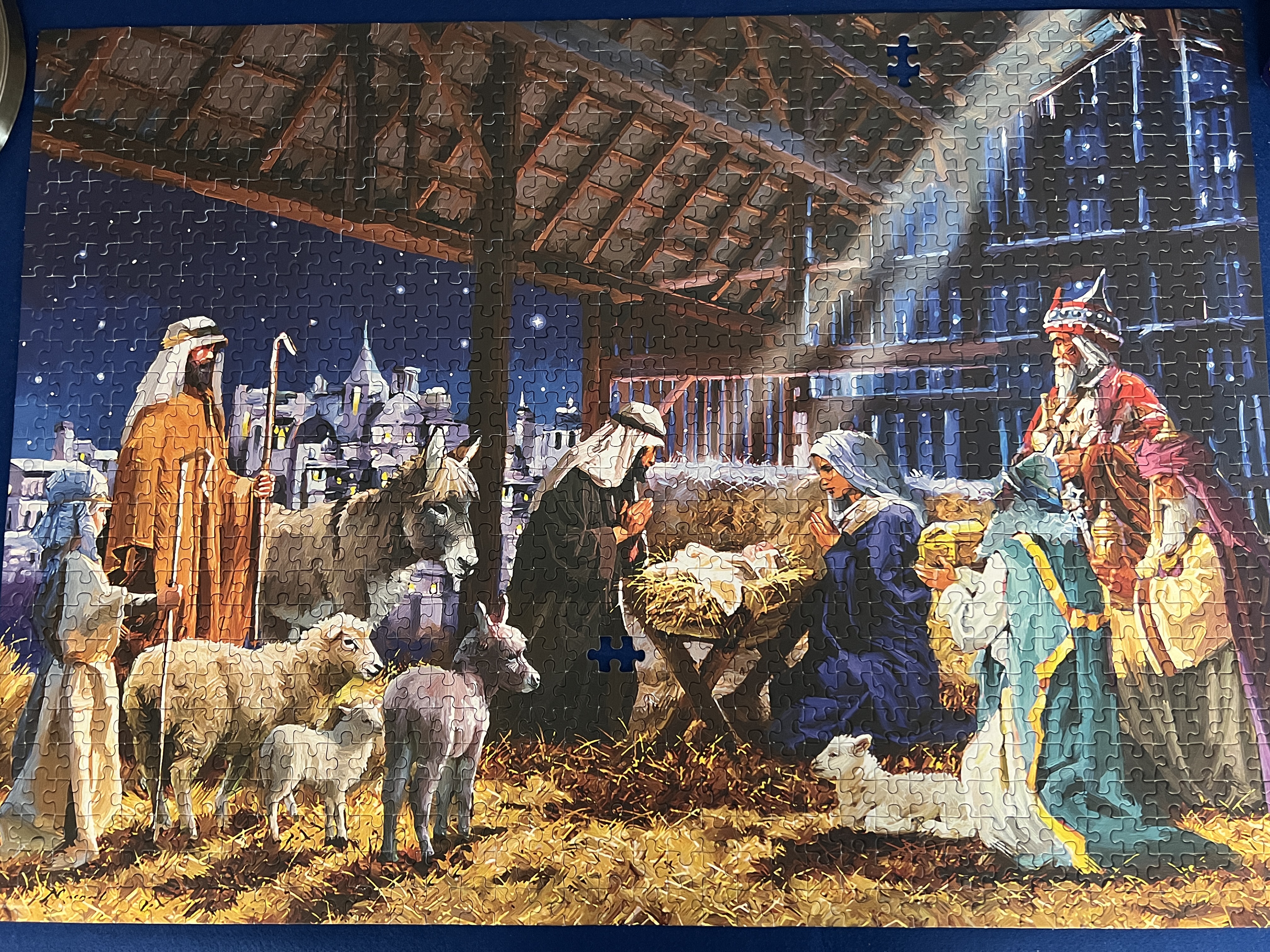
It is finished! The 1000-piece nativity puzzle is now done. Thank you to all who contributed – whether you fitted only one piece or sat for hours in the narthex over the past month and a half, putting it all together. It is complete.

Or is it?

Upon closer observation of the photo above you might notice there are two pieces missing. Just two, out of a 1000. But two, nonetheless. Sucked up in the vacuum cleaner, stuck on the bottom of someone’s boots, or dropped inadvertently in someone’s pant pocket. Who knows? How does that make you feel?

You might think, like me, of parables in the bible where Jesus leaves the 99 sheep to go searching for the one lost sheep (Luke 15:1-7), or the parable in which a woman searches her whole house to find that one, lost coin (Luke 15:8-10).

Whatever you may want to say about Paul’s writing in his letter to the Corinthian church, it has a clear meaning: Every piece matters. Every part is important for the whole (1 Corinthians 12:12-31a) to function well. All the gifts perform vital roles for the overall health and wellbeing of the body.

Paul even goes as far to say, “those members of the body that we think less honorable we clothe with greater honor, and our less respectable members are treated with greater respect, whereas our more respectable members do not need this” (v. 23-24).

In her book Fierce Love, the Rev. Dr. Jacqui Lewis refers to the Zulu concept of ubuntu which means, “I am who I am because we are who we are.” This phrase resonates with Paul’s words in 1 Corinthians. We, the body of Christ, are deeply interrelated, united by one Spirit. Perhaps we could say, “I am Christ in the world because we are Christ in the world” (Lewis, 2021, p. 11).

If each of us is worthy because together we are, this leads us to ask a very relevant question for all our families, communities, teams, groups, neighbourhoods, and nations: What parts are missing? Whose voices are not being heard? What members of the body have been ignored, overlooked, even marginalized, treated as unimportant?

In preparation for the annual meeting later this winter, the council is now searching, as we normally do at the end of terms, for a couple new members to serve. In choosing leaders on council, we can ask the same question: Whose voices in the congregation are not yet represented, nor being heard? Who is not at the table?

I love the children’s book I’ve used for Communion instruction. It’s called, “A Place for You.” The theme is inclusion. That is why in the invitation to the Communion table I will often say, “You are invited without exception.” Because Jesus loves everyone and welcomes all to the table of God’s grace.

The missing pieces challenge us to support and lift up everyone.

In the Gospel for today (Luke 4:14-21) Jesus returns to his hometown Nazareth, the place he grew up, the place where everyone knew who he was as a child. The scroll is given to him – the scroll of the prophet Isaiah – to read publicly. He has no choice which scroll to use. But, from everything Isaiah has to say, Jesus chooses this one particular text.

He could have read anything. The prophet’s words fill a big book, some 66 chapters long. Yet, Jesus focuses on this part. He makes it a point to remind the good people of Nazareth whose marginalized voices God has heard, and whom now God’s people are called to lift up.

What captivates the crowd, as all the eyes of those in the synagogue were fixed on him, was that Jesus distinguished himself, his new role, his mission now as the voice of God to declare what people of faith were called to do with Jesus: to bring good news to the poor, to release the captive, to recover the sight of those who are blind and let the oppressed go free – the economically poor, the incarcerated, the disabled, and the migrant. They belong at the table, too.

This is now the job of the body of Christ to proclaim, in our words and actions. How do we proclaim the words of Jesus in our daily lives? How do we follow Jesus?

In the science fiction dystopian television series Silo (Yost, 2023), 10,000 people have lived for decades in an underground bunker in the shape of a cylinder over a hundred floors deep. They’ve lived in the silo because the air outside is poisoned. At least that’s what they’ve been told.

A mechanic, Juliette Nichols, uses a modified hazmat-type suit to leave the silo and survive outside. But all the people inside don’t know where she has gone or whether she’s still alive. People start to question the truth. A rebellion grows.

A group of mechanics living at the bottom of the silo claim those privileged living closer to the top have not been telling the truth about what is really going on outside the silo. The rebels rally around a spray-painted symbol “JL” and chant “Juliette Lives!” to galvanize their faith.

In Jesus’ day, we have to remember they didn’t have microphones. The Nazarenes would pack the synagogue to listen to the speaker. To make sure everyone got the gist of the speaker’s message especially those at the back of the room, those closest to the speaker would repeat in a loud voice together a phrase the speaker just said. This method of getting the word out is called “the people’s microphone,” the practice of amplifying voices without a sound system (Augsburg Fortress, 2025).

This method requires attentive ears—those nearest must hear and respond to the call of the speaker—and it requires the community’s unified work, lifting up the speaker’s voice together.

Yes, “JL” is our call, too. But for us it is “Jesus Lives!” “Jesus Lives!” is a sign of hope for the fulfillment of what is being called upon the living body of Christ today

But if bringing good news to the poor and releasing the captive was Jesus’ purpose and mission, all evidence today points to the contrary. Had Jesus failed? Has the church failed? Many today, I know, feel that it has on many levels. Because so many people still suffer. And will suffer.

Perhaps a vision of a perfect world free from all suffering is not what Jesus meant. Because if we follow in his steps: From that early synagogue worship service to the hills of Galilee, on the road to Jerusalem, and the way of the cross, we discover that suffering is not God’s will.

Rather, what is God’s will is life in the face of suffering. What is God’s will is courage in the face of fear. What is God’s will is faith in the face of doubt and love in the face of hatred and prejudice. God’s will is to call these things out of the hurt and brokenness that we are and that we find around us. “With Christ, the prophecy is fulfilled, in you and in me” (Evenson, 2025). Because “JL!” Jesus lives. Thanks be to God!

References:

Evenson, B. (2025, January 26). Comments from the cloud of witnesses; Third Sunday after Epiphany /lectionary 3, year C. Augsburg Fortress. https://members.sundaysandseasons.com

Lewis, J. (2021). Fierce love: A bold path to ferocious courage and rule-breaking kindness that can heal the world. Harmony Books.

Yost, G. (Creator). (2023-present). Silo [TV series]. Apple TV+.

Present to Presence

photo by Martin Malina

About once a month I have lunch at Denny’s on Merivale with a dear friend of mine. His name is Jack Murta. He is a retired politician. He was a Member of Parliament from Manitoba in the late 1980s. A member of the Progressive Conservative Party, Jack served as the Minister of Tourism in the Brian Mulroney government.

Today, he sits on the Board of the Mission in downtown Ottawa and leads Christian Meditation groups there for people who are homeless. Jack and I spend a lot of our time talking about politicians and how they related with one another back in the day. Indeed, much of our conversation recalls the past.

In the Gospel reading for today (John 2:1-11), guests to a wedding party in Cana, Galilee, meet most likely in a garden setting, to celebrate a joyous occasion.

Certain clues in the story attract our attention. I’d like to point out, first, the empty jars normally filled with water used for the Jewish rite of purification. People engaging this rite did not drink the water. It stayed on the outside of their bodies when they immersed themselves in the bath.

The jars in this story direct peoples’ attention to their past, their Jewish tradition and ritual. The garden also was the usual setting where Jewish weddings took place, a reference to the Garden of Eden in the first book of the bible – Genesis (Shaia, 2021). The jars and garden are indicative of tradition, the past, the way things had always been done.

And not only does the Gospel look to the past, it points us to the future as well. “My hour has not yet come.” Jesus hints to Mary about his future path, when Jesus’ purpose will be fulfilled on the cross and by the empty tomb.

But it’s the present moment where the miracle—the sign—happens. It’s into the present moment that the Gospel ultimately draws us. “You have kept the good wine until now.” The steward recognizes Jesus’ act of bringing an unexpected gift for the guests.

And Jesus’ action in the present does more than merely get the bridegroom out of an embarrassing social faux pas. The unexpected gift is good wine, not normally offered late in the party. It’s in the present moment, even in an unpleasant situation, when people enjoy themselves.

Brain studies have examined where most of our time is spent thinking. They show that we spend most of our time thinking either about the past or the future; and, between these two, most of it is about the past. In other words, being fully present in the moment is not where we spend most of our time. And this is true even among young adults (Bellana et al., 2017).

Our thinking, entrenched in the past or fantasizing about the future, is also closely related to speech. Thoughts and words go hand in hand. Talking a lot is related to thinking a lot (about the past).

But in the Gospel, it’s more about what is not said that draws my attention. Mary does not tell Jesus what to do. She merely points to the problem. And leaves it up to her son.

The head steward didn’t know where the wine came from, but the servants knew because they drew the water for the jars as per Jesus’ instruction. How did they know it had turned to wine? Did they taste it, before and after? If it were left up to the dialogue alone, what was said out loud, we would be missing important pieces. There would be gaps in the story filled in only by observing behaviour.

As much as 80% of what is communicated takes place on the nonverbal level: our tone of voice, our body position and movement, our facial expressions, the direction of our eyes (Mehrabian, 1972).

What is more, if you want to be friendly, or hostile, your body language is over 12 times stronger in getting the message across than anything you might say (Argyle et al., 1971). What we do and how we do it speaks volumes. Words are important but have power only when anchored in the present reality. Simply pointing to the reality without judgement nor instruction, without any hint of direction nor evaluation, Mary said to Jesus: “They have no wine.” Fact.

Events and situations that bring us into the present reality are often not initially pleasant. We resist the present moment because we may be afraid of what we encounter there.

From the garden to the hospital. There aren’t other settings that bring us, force us, to the present moment more as in the hospital. When we are sick or visiting someone who is ill, or working in the hospital setting as a nurse, PSW, doctor – being there makes us grapple with the sometimes-harsh realities of the present moment.

And in that present moment, very few words are necessary when it comes down to it. The past, the future, these are all important and good. But when it comes down to it, presence is all we need in the present moment.

My friend, the retired Member of Parliament, Jack Murta, was also good friends with one of Speakers of the House of Commons at the time. And when you think about it – a politician Member of Parliament and a Speaker of the House – you can imagine the jokes about them entering a bar: There would be a lot of words spoken to say the least! Even the name – “Speaker” of the House – evokes images of a whole lot of verbiage. Words. Words. Words!

And yet, at the end of his long life, when this Speaker of House was dying in the hospital, he indicated he wanted to see Jack one last time. So, Jack drove to the hospital. And at this point the Speaker was no longer saying much of anything. But when Jack sat down beside him, the Speaker reached out and Jack took his hand in his own. And for many minutes they just sat there without saying a word. The touch of his hand was all the Speaker wanted and needed in that moment.

What mattered, what really mattered, was not the past on earth nor the future on earth. What mattered, what really mattered, was not saying a whole lot of words anymore. Because the joy of living even in that desperate moment, the true joy was found in the simple touch of another in the present moment.

I mentioned the water for the purification rite. It stayed on the outside of the human body. We don’t normally drink our bath water. Jesus performed a miracle of transformation: from water to wine.

When we celebrate Holy Communion, wine is offered. Jesus transformed an understanding of religion from external ritual to internal reality. We don’t wash our bodies with wine. We drink it. We bring it inside of us. We consume it. We digest it. It becomes part of us.

Holy Communion invites us to be present in the moment. To touch. To feel. To drink. To taste. To eat. Let this sacrament in which we participate weekly give us an occasion to practice being present to the holy Presence of God in Christ Jesus. So, with Christ’s presence in us now, we can be God’s loving presence in the world by what we say and what we do.

Behold, now is a very acceptable time; Behold, now is the day of salvation (2 Corinthians 6:2).

References:

Argyle, M., Akema, F., & Gilmour, R. (1971). The communication of friendly or hostile attitudes by verbal and nonverbal signals. European Journal of Social Psychology, 1, 385–402.

Bellana, B., Liu, Z. X., Diamond, N. B., Grady, C. L., & Moscovitch, M. (2017). Similarities and differences in the default mode network across rest, retrieval, and future imagining. Human Brain Mapping, 38, 1155-1171. https://doi.org/10.1002/hbm.23445

Mehrabian, A. (1972). Nonverbal communication. Aldine.

Shaia, A. J. (2021). Heart and mind: The four-gospel journey for radical transformation. Quadratos.

The Gospel that hurts

sermon audio “The Gospel that hurts” by Martin Malina

The Epiphany won’t let us go without challenging us. This Gospel text should come with a warning label attached to it: Read at your own risk! It offers little by way of the warm fuzzies. There is confrontation. Baiting dialogue. There is even violence. Jesus is rejected by his hometown.[1]

But there is a nugget, or two, almost hidden from view. It is deep inside this text if we are willing to work for it. Dig it out. And that work is just like any good physical work-out will leave you feeling, with achy muscles. It is the Gospel that hurts.

The story is told about Michelangelo, the famous artist, painter and sculpter. He’d go to these huge quarries where he instructed the masons to cut out a gigantic piece of marble and roll it back to his workshop. There he’d spend a couple of years chipping away at it. He’d cut all kinds of things from those stones: People, horses, kings.

He’d bang away with a huge hammer and chisel, taking off large chunks. Then he’d come back with a smaller hammer, smaller chisel, maybe a file, then some sandpaper, and finally a damp, velvet cloth.

Admirers used to ask him, “How did you create that out of a chunk of rock?” He’d shake his head and say, “I didn’t. It was there all along. I just let it out.”

Inside of us is good just waiting to jump out, to be released. The hammer and chisel will hurt. It does. It’s painful to grow. We wish life didn’t have to work that way. But remember, the velvet cloth isn’t far behind.[2]

Jesus mentions the story of Naaman. [3] Here is the nugget in the text I found. It’s worth re-reading the orginal story in full, from 2 Kings 5. Naaman, like the Nazarenes reacting to Jesus, was incensed at what was asked of him and proposed to him, in terms of his salvation, his healing. 

Naaman was ready to reject the prophet’s instruction for his healing. But thank God for Naaman’s servants. His servants speak truth: “If you were commanded to do something difficult would you not have done it for your healing?”And all that was asked of him was to wash in the Jordan River.[4]Naaman’s expectations had to be pealed away from him to accept the truth, accept the simple truth. Not easy, but simple. And he was healed.

We are nearing the end days of the pandemic. Yet it doesn’t feel like the end is in sight. We may feel very guarded in our hope. Planning ahead, and anticipating how this pandemic will pan-out seems daunting, confounding and overwhelming. It’s hard to look forward to anything. To have hope. The only thing we have, right now and in the end, is the present moment. With ourselves.

And that relationship is harder than we think to navigate. Simple is not easy. And that journey, in truth, hurts sometimes. We would rather avoid that journey and place all our proverbial eggs in the external baskets of life. What’s out there. But only doing that and we miss something precious. And central to the Gospel:

Inside of us is a light. Inside each one of us is something good, of God—yes—something worth releasing to the world. To believe that right now, in the midst of everything, means everything and makes all the difference. 

2022 sunrise over the town of Arnprior (photo by Martin Malina)

Wherever you are, the light inside you—it may be small, it may be barely flickering, it may be gasping for oxygen—that light never burns out. The light inside is just rising, in fact, gaining strength. And the pathway forward is this simple awareness and acceptance. You are loved.

In the end, the Gospel that hurts is an invitation for us to grow into who we are, to embrace who we are from the inside out, and deepen our faith in the communion of all the saints in Christ. May this Epiphany season be for us a time to respond positively to that invitation.


[1] Luke 4:21-30

[2] The story is told by Charles Martin, Chasing Fireflies: A Novel of Discovery (Nashville: Thomas Nelson, 2007) p.234-235

[3] 2 Kings 5:1-19

[4] Ibid. verse 13

Gorillas of grace

sermon audio for “Gorillas of grace” by Martin Malina
Madawaska River at the Stewartville bridge, Ottawa Valley (photo by Martin Malina 2022)

Jesus concludes in the Gospel reading, “Today the scripture has been fulfilled in your hearing.”[1]

In your hearing. An important part of how successfully the gospel is communicated depends on you, the listener—how you receive it.

From the text he reads in the synagogue, Jesus asks his listeners in Nazareth to broaden their vision, beyond the original situation Isaiah addressed hundreds of years earlier. 

Because it’s a different narrative Jesus tells the Nazarenes, even if it grows out of the biblical tradition. He asks them to consider what the text means to them in their current situation. 

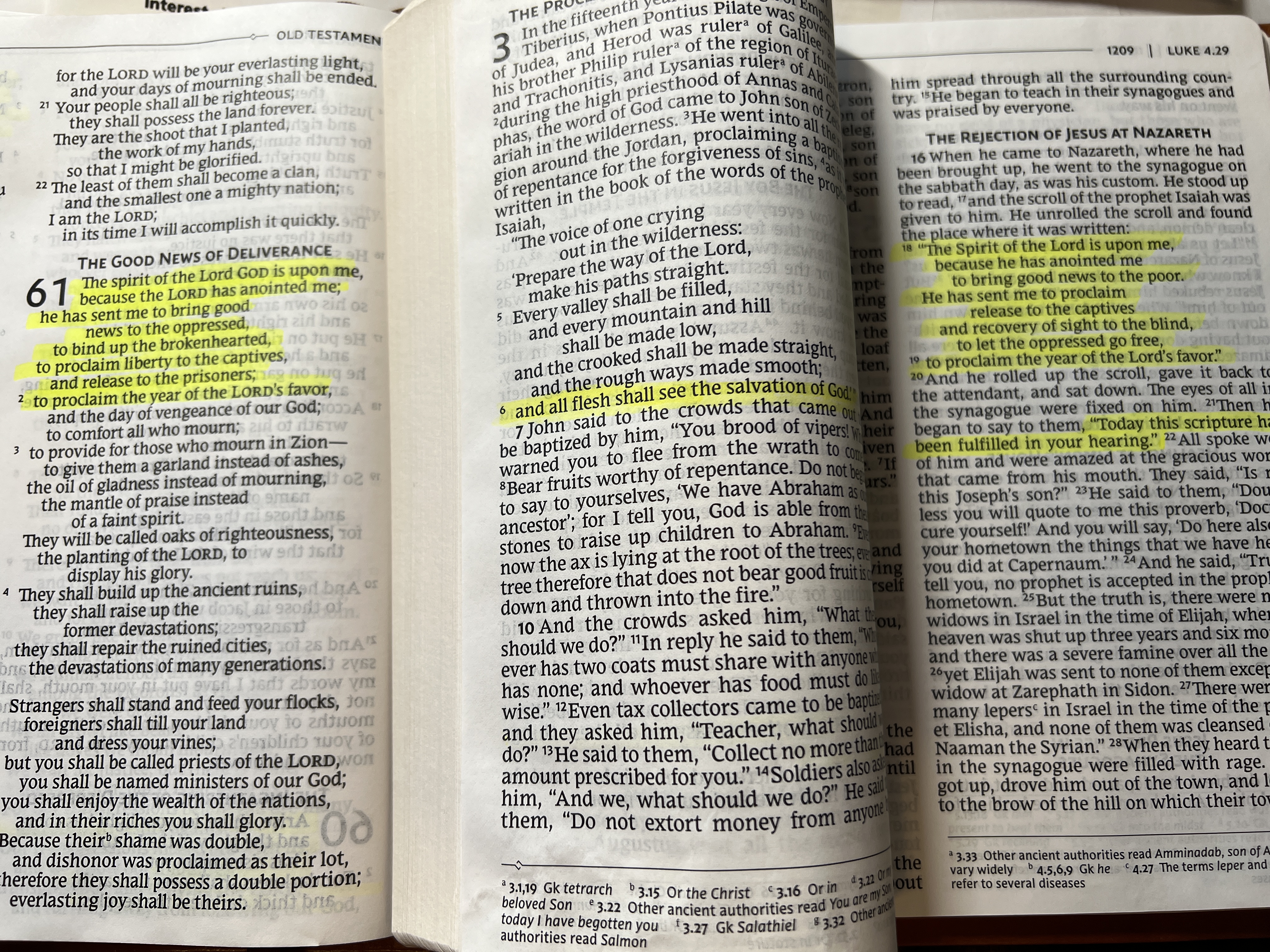
What is startling, especially to his hometown family friends who knew him from youth, is that Jesus refers to himself as the fufillment of Isaiah’s prophecy. “The Spirit of the Lord is upon me …”[2] In other words, Jesus identifies himself with what originally was the voice of one called Isaiah. 

Jesus self-identifies with Isaiah’s words (reading from the NRSV photo by Martin Malina 2022)

The beginning of Jesus’ ministry, according the Luke’s gospel, comes therefore with a challenge. And not an easy one for the listeners in that 1st century Nazarene synagogue. 

To broaden their vision would be quite the challenge. To consider this Jesus as someone so much more than the hometown boy who returned for a visit, the boy whom they scolded, taught, disciplined and with whom they played, hung out, pushed the boundaries of adolescence. To consider this Jesus as someone so much more. How about the Son of God?

But there is so much more to this passage. Jesus reads a text from the prophet Isaiah which serves a kind of mission statement for Jesus. Talk about a purpose-driven life! To bring good news to the poor. To proclaim release to the captives. To recover the sight of the blind. To let the oppressed go free. To proclaim the Lord’s favour. How many churches have this mission statement posted over their doors?

How do we begin to see more to the story, something we may be missing because we are fixated on only the historical perspective, for example? Or, we may be focused only on one way of interpreting this text—what we learned in Sunday School decades ago? How do we notice what is beyond the limits of our own perspective? Maybe something significant?

I invite you to participate in an experiment with me: I call it the Gorillas of Grace experiment. 

“Imagine you are watching a group of people, some wearing white shirts and some with black shirts. They are all weaving in and out of each other in a group and throwing basketballs. You have been instructed to count the number of bounce passes from someone wearing a white shirt to another person wearing a white shirt. Since there are several balls, and several types of passes being thrown within and between the groups, you are so focused on the counting you completely miss a gorilla walking through the middle of the group, pounding on his chest and continuing on! 

“This phenomenon is called ‘selective attention’, and is true for at least 75% of the people who have actually done the experiment. When we are hyper-focused on one thing, we literally miss what is right in front of our faces. We perceive only those objects that receive our focused attention.

“And neuroscience tells us that what we pay attention to wires us to see more of the same. We not only miss seeing the wonderful things right in front of our face, quite often we miss the opportunity to cultivate more of their presence. Paying attention to the gorillas in our midst—the daily graces we tend to overlook, or not see at all, can profoundly change the way we see the world.”[3]

Many of us long to feel the relief of a post-pandemic world – where we can at long last go back to doing things the way we always have done them. We want again to exercise the freedom we have to go anywhere we want any time we want and with whomever we so please. What a life! 

We don’t want anymore to feel the constriction, restriction and paranoia of going into public settings. We don’t want to live our days besieged by the prospect of severe illness. We don’t want to live our daily lives as if it were some huge risk everytime we go out our door. A worthy vision, and hope.

But there is more we can learn from this time and experience of our lives with COVID. Our awareness is being broadened. And Jesus might just be calling us to stretch our horizon, vision, perspective. Just like he did in Nazareth.

Because during this season of restrictions, we taste just a little bit of what so many people in the world feel all of the time, never mind COVID. People who are poor, or disabled, or in some way marginalized – who, in short, are not privileged as we are. We are given a small taste of what it must be like for a disabled person who cannot, physcially, enter our church buildings under their own power, COVID or no COVID. We now know a little bit of what it must feel like to live under constant threat of danger – how racialized people are harrassed and bullied, all of the time, wherever they go.

Jesus’ mission statement calls not just the people in Isaiah’s world to whom these words were first spoken, not just to the Nazarenes in Jesus’ world. But to ours as well.

Today, what the world needs are people of faith who can see beyond their own conditioned perspectives. Especially in families, relationships and any human organization that has felt the distress of division—divided over opinions, entrenched in unyielding positions. What the world needs today are people of faith who can follow where Jesus calls, even if it challenges us, even if it makes us feel uncomfortable for a while. 

Jesus calls us to practice a vision that perceives all sides of a story.[4] Not just the original context in scripture. But its adaptation to the present day. Not just my way of looking at things. But another person’s perspective as well: someone who is different than me, someone who is poor, captive, delusioned, oppressed – and to them proclaim the Lord’s favour. 

When we perceive the world through God’s eyes, we see not with scientific coldness nor mere objectivity as if studying something with scholarly detachment. But we see with love, with compassion, with mercy and forgiveness. With a heart that seeks to understand and connect with another. That is the difference people of faith can make. People who incorporate a multitude of perspectives in loving relationship. And to ‘see’ that Christ is present to all people of every time and every place.


[1] Luke 4:21

[2] Luke 4:18-19; Isaiah 61:1-2

[3] Alane Daugherty, From Mindfulness to Heartfulness (Bloomington IN: Balboa Press, 2014), p.30-31.

[4] Laurence Freeman calls it a ‘panoptic’ vision, see www.wccm.org “Daily Wisdom” (9 December 2021)

The best for the last

sermon audio for “The best for the last” by Martin Malina
Looking Northwest over the frozen Ottawa River at Arnprior, photo by Martin Malina January 2021

“… you have kept the good wine until now.” (John 2:10) 

Last Spring, I noticed we had bottles of wine stored in the altar care room cabinet. The bottles of wine had sat there unopened since the beginning of the pandemic. I recall mentioning this to the council at the time, wondering with them if the gathered community will ever drink communion wine together again during a service in the building. And would the wine we had stored even still be good whenever that will happen? Questions I thought I’d never ask.

I’m sure I’m not the only one asking these kinds of questions, and not just about sacramental practices. What will the church be when all is said and done with COVID? What will our gatherings look like? Will it even feel anywhere near the same it did before the pandemic struck almost two years ago now? Will people even want to gather again inside a building to worship and pray?

In the first of his signs, Jesus, attends a wedding at Cana.[1] And the good wine runs out near the beginning of the party. Normally the best wine is served at the beginning of the party when guests can still discriminate between the good stuff and the “inferior”, watered-down fare served later on.

In the first miracle that launches Jesus’ earthly ministry—when he turns water into wine—there is no turning back. What he does here sets the tone and direction for what he and God are all about. What Jesus does at Cana of Galilee introduces the way of God that extends through all his earthly ministry right up to the cross of Calvary and the empty tomb. 

In the first of his signs Jesus does the opposite of what is expected: He undermines social convention. The best wine for the party Jesus gives not at the beginning when guests are still in their right minds. He doesn’t give them the really good wine when they can still be impressed. 

It’s precisely when the guests are not at their best, when they are already drunk and their mental faculties are comprised, that the perfect gift is given. Jesus, right at the beginning of his earthly mission to bring the kingdom of God on earth, does exactly the opposite of what everyone would expect. 

Perhaps we expect that we would recognize what God is doing in this pandemic only if we can be at our best. Perhaps we expect that there should be no ambiguity with God, no ambivalence in God’s ways and in God’s truth, from our perspective. Perhaps in times of disruption and uncertainty we expect God to show us the way with conviction and clarity.

“Everyone serves the good wine first, and then the inferior wine after the guests have become drunk. But you have kept the good wine until now.”

Now, as we set our hearts on hope that we will come to the end of the pandemic this year. Now, some two years into it when many of us our not at our best. Now when we feel near the end of a party that really hasn’t felt like a party in the least. 

Now, when many of us are exhausted and discouraged, fearful and anxious. Now, when so many are ill and frightened for the future. Now, when we live on the threshold between the losses of the past and prospects of an uncertain future.

“But you have kept the good wine until now.”

A beautiful gift lies before us now. Even though in our fatigue we might not at first be able to discern it, Jesus saves the best till last. Even though in our clouded COVID brains, we might not perceive it right before us, Jesus offers us something precious. 

As we slowly but surely near the end of a marathon season, we lean and live into the new normal. We acknowledge the awkwardness and discomforts of doing things a new way, a different way. Perhaps with all of that we feel like the weather outside—frozen, inert, lifeless. 

But perhaps there lies under all of that the seeds of renewal for us. Jesus doesn’t show us a clear answer to the problem so much as he is resetting our perspective on reality, and a new way of living that moves us, in the end, toward a more loving and more generous life than ever it was before.

Because God doesn’t wait until we are at our best to give us the gift of grace. In truth, perhaps it’s when we are not at our best when we are most receptive to receiving, to being open to, God’s forgiveness and love. Perhaps the Spirit of God can best enter in through the cracks of our broken, needy and longing hearts. And that’s when the Epiphany happens for us.


[1] John 2:1-11