
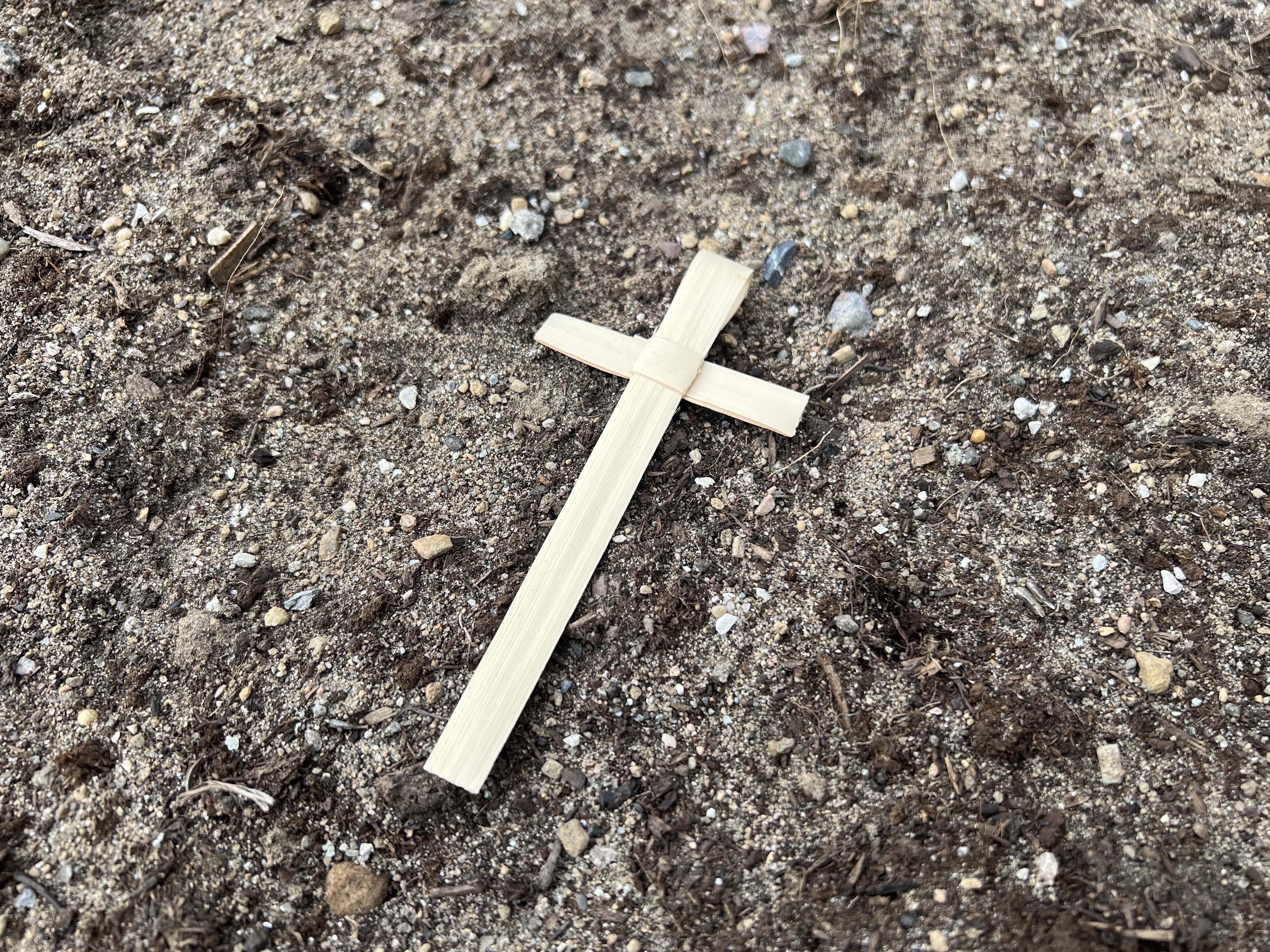
Today, we stand with the women and disciples at the foot of the cross. We have arrived at the end of our Lenten pilgrimage. Or so we may feel.
We have come now to the base of the hilltop of Golgotha. We have come to the edge. We’ve made it.
We may have been carrying a heavy burden—our own cross. What do you bring? What have you carried? Maybe at this point you realize you can carry it no longer? Because the weight of it is just too much. Because, while at the start of this journey you thought perhaps you could carry it all, you now realize your own limits, your own complicity, your own misguided perceptions, your own sin.
“We come to the edge, when what we hold cannot be contained” (Mahany, 2023, p. 52), when we have to finally lay it down.
Golgotha stood at the edge of the city of Jerusalem. In order to leave the city, or enter it, you had to pass through the place crucifixion, of death. There is no bypass where truth is concerned. Pilate sought refuge in argument and exercising power — that was his bypass. “What is truth?” (John 18:38) he quipped, retreating into abstraction and perceived safety of his privilege and power.
“What is truth?” Jesus’ answer to Pilate? Watch me. Watch what I do. Watch the power of God’s love in the actions of Simon who will carry my cross (Luke 23:26), in the centurion’s cross-side confession (Matthew 27:54). Watch the power of God’s love in those who wait at the edge of the hilltop and witness the day turn to night (Mark 15:33), the curtain in the temple being torn in two (Luke 23:45). Watch the power of God’s love in the grace shown by Joseph to provide a tomb for my body (Luke 23:50-53). Watch what God does, then …
Jesus knew his path. Jesus’ path led through the challenge, the suffering, the cost – not around it. Dietrich Bonhoeffer, the famous Lutheran pastor who was executed by the Nazis 80 years ago this year for opposing Hitler, noted in one of his books, how Jesus fulfilled his call on earth.
But in this short reading, Bonhoeffer extended the example of Jesus into our own lives, as his followers, should we seek peace for our souls at edge of our journeys.
He writes, “Our hearts make sure that we only keep the company of friends, of the righteous and the respectable. But Jesus was to be found right in the midst of his enemies. That is precisely where he wanted to be. We should be there too. It is that which distinguishes us from all other … religions. In them, the pious want to be with one another. But Christ wants us to be in the midst of our enemies, as he was; it was in the midst of his enemies that he dies the death of God’s love and prayed: Father, forgive them for they know not what they do. Christ wants to win his victory among his enemies. Therefore, do not withdraw, do not seclude yourselves; rather seek to do good unto all. Make peace, as far as it depends on you, with all” (Bonhoeffer cited in Barnhill, 2005, p. 31).
This was Jesus’ path, to be in the middle of the tension, the conflict among his enemies. This had always been his way.
For example, Jesus could have avoided Samaria on his way to Galilee. Samarians were in tension and at odds with Jews. Jesus could have gone around. But instead, he travelled through the region, some 150 kilometres on foot. No wonder the Gospel writer reports Jesus as “weary” (John 4:6) when he stops at the well to talk with the Samarian woman. Many others would have gone around. But for Jesus, it is always important to go through even though it cost him. The path is hard.
We have a famous path in Canada. And it isn’t easy to follow. The Path of the Paddle is a series of portages between lakes and rivers from the western edge of Lake Superior into the bush of Northwestern Ontario. The path is part of the Trans Canada Trail. In one of its hardest sections, where in order to travel when the water is not frozen, the trail must be negotiated at the height of bug season, soon upon us. Portaging is not for the faint of heart: each portage means traveling twice – once to carry the canoe, and the other time to carry the gear from one lake’s edge to the next.
This path was first charted by Indigenous people as the Anishinaabe Trail, before it became a major route for Europeans interested in the fur trade. Today, this path is being restored in the hope of re-establishing the original route as it once was.
The 1200-kilometre journey was made by Carrie and John Nolan ten years ago. It involved 120 portages, and it took them 58 days. It was certainly a test of their fitness, endurance and physical and mental stamina (Coman, 2025, April 11).
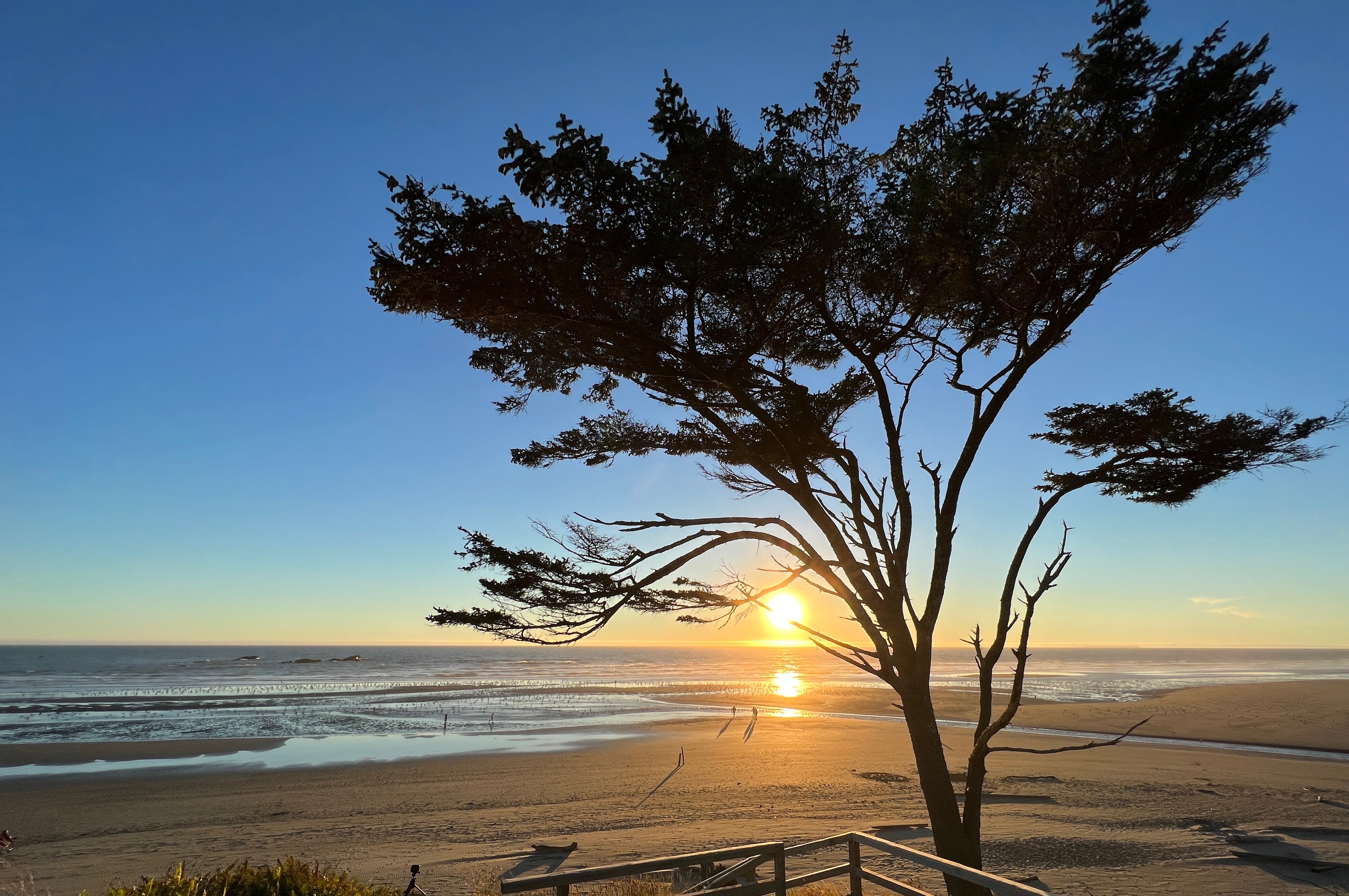
When we come to the edge, when what we hold can no longer be contained, tears will often fall. Is it any wonder that God turned to water when making our tears? We can go to the water’s edge, when what we hold can no longer be contained. The water’s edge, like at the foot of the cross, is the place to let it all out, to lay it all down, to let it go. The baptismal waters, our place of identity forming in Christ, is sacred, this holy edge. Where we can be honest, vulnerable, and let the tears roll.
I walked only a small portion of the Camino de Santiago in Spain – some 800 kilometres long. It is one of the oldest trails on the planet, dating back over a thousand years to the 9th century. Last year, in 2024, the Camino attracted almost half a million pilgrims.
If you are walking, it could take months to cross the Iberian Peninsula in northern Spain towards the destination. The destination? Pilgrims will say, it is the city of Santiago de Compostella, in the shrine of Saint James.
But increasingly over the years, more and more pilgrims go through Santiago and travel an extra 100 kilometres to a town called Fisterra, whose name literally means, “the end of the world.” This town lies on the coast along the Atlantic Ocean which at one point in history was deemed to be situated literally at the edge of the known world.
Santiago becomes a way point on a journey to a more significant edge where the horizon is limitless and points our vision upward. This extended journey does not end at the Cross but continues beyond the original destination to a more expansive vision beyond the hardship of the trail.
The Cross is not really the end point. That is why Good Friday is good. Because the Cross, while necessary to go through, is merely a gateway to the edge of a new world coming.
References:
Barnhill, C. (Ed.). (2005). A year with Dietrich Bonhoeffer: Daily meditations from his letters, writings, and sermons. Harper One.
Coman, S. (2025, April 11). Streams of living justice [Blog]. Lutherans Connect. https://streamsoflivingjustice.blogspot.com/2025/04/day-33.html
Mahany, B. (2023). The book of nature: The astonishing beauty of God’s first sacred text. Broadleaf Books.

 Raspberryman