Mixing it up: a funeral sermon at Christmas

My first impression of Maurine, when I met her over ten years ago, was that she was a grumpy person. She was 88 at the time. Honestly, I was afraid of her because of the way she looked at me. She had that piercing look that bore deeply into my soul.

But that impression did a full 360-degree turn-around. How? After I got to know her a bit more, she seemed to be having way too much fun to be a grumpy old person. Ten years have passed, and I have grown in my admiration of Maurine to have fun and look at the bright side of things, despite the challenges we have all faced especially during the pandemic.

I had resolved to figure it out: What made someone so resilient and live so long? What gave Maurine this incredible determination to live? And I suspected that most if not all folks living into their late 90s share a similar characteristic.

A long, long time ago, Maurine volunteered at the Ottawa Jazz festival, so she liked jazz. She may have even heard the story of the jazz musician who kept playing on. Even though the show he was playing in had ended, he kept playing well into the night after the doors had been locked, because he was still in search of ‘the note’. That it was out there somewhere, and he kept going to reach it. [1]

And perhaps that story gives us a clue as to why Maurine kept going. Was it in the hopes that she’d one day experience something that would satisfy her deepest desire? That she was still looking for ‘the note’? And she wouldn’t give up until she found it.

One of the last times I visited Maurine she pointed on the wall in her bedroom where prominently hanging right by the door to her room was a painting. The painting depicted the profile of a horse’s head. The horse’s name was Brett. Brett was a beloved horse belonging to the friend who had pulled Maurine’s name out of the hat during a Christmas gift exchange when the Evangelical Lutheran Women still met monthly—a long time ago.

I could tell Maurine had cherished that gift. It was homemade. It was from the heart. It was deeply personal. It probably reminded her of the two Clydesdale horses that lived in her backyard growing up on Flora Street when the family owned a city snow removal company—when horses were still used for that sort of thing. That’s a long, long time ago.

Maurine welcomed this gift, and I suspect many other gifts throughout her long life. She never turned down a kind deed offered her. She never refused help; she welcomed it.

For me, she modelled how to receive the blessings of others, which isn’t any easy practice for many of us who are more into offering help, doing the kind deed, being in charge. But Maurine expressed no quibbles at receiving and enjoying the gifts of others. She prized them, in fact.

We gather during the season of Advent—a time when we prepare to give and receive gifts as a reflection of the greatest gift of divine birth and presence in our lives.

Christmas isn’t just about giving, important as that is. It’s also about receiving and being good about that. We gather during Advent, waiting to receive Christ’s presence. It is therefore the season of hope.

But we gather as people who mourn. We use the term, a “Blue” Christmas, to acknowledge our experience of loss during a time of year when the world wants to party. When we grieve, when we are sad, it is especially hard to join with others in singing a heartfelt “Joy to the World!”.

No words, no upbeat songs, no cheery hellos can lift our moods tangled in the thickets of grief and loss. It’s hard to receive kindness and grace when we are down.

Blue, at the same time, is the colour of hope, the colour of the pre-dawn sky just before the sun rises at the start of a new day. Blue is the colour of water reflecting the light and giving life to all that lives.

I think when we can hold both sadness and hope, we live a balanced life and therefore a healthy life. Giving and receiving. Feeling grief deeply as well as truly enjoying the gifts and pleasures of life.

Maurine was able to embrace both. She held the suffering in her life—and tragedies she did experience. Yet she was also open to feel moments of joy without excuse, self-denial, or a false sense of humility. I believe this contributed to the longevity and resilience of her spirit, if not physically as well.

After she pointed at the painting of Brett the horse on the wall, I could still see the twinkle in her eye. The conversation turned to what she’d like to drink. And for some reason we joked about drinking something with a little bit more panache to it. We veered completely away from straight up drinks—that wasn’t even in the cards. No, we talked about cocktails, and mixing drinks.

While we agreed that a gin and tonic was the drink of choice for both of us, what she wanted was another mixed drink that I had never, ever heard of. And it sounded disgusting to me. Ready for it? Beer mixed with … clamato juice! Really?!!! Yuck.

But the nurse attending to her while I was there and who was part of that conversation agreed that mixing beer and clamato juice was really good. Ok. Maybe it’s a thing. And then we laughed.

Now, I don’t want you to remember Maurine primarily with this picture in mind. But that conversation did remind me of something important that we are doing here today.

If we expect perfection or purity—from us, from our celebration of life, our experience of life—if we expect perfection in how we go about our traditions and important events in life—how we celebrate Christmas, for example, and live through this holiday time of year …

If we expect these occasions to be perfect (“If it’s not done a certain way, then it can’t be Christmas!”—if that’s our attitude), then we won’t be in a position of heart to receive the gifts of God which are always, always being offered to us, even in our grief. We’d be resentful, closed up, and feeling sorry for ourselves. The problem is not God. It is us.

When Jesus tells his disciples, “Be awake. Be alert. You do not know when the Lord is coming”[2], we may hear such a passage as if it were threatening or punitive, as if Jesus is saying, “You’d better do it right, or I’m going to get you.”

But Jesus is not talking about a judgement. He’s not threatening us or talking about death. No. Instead, he’s talking about the forever coming of Christ, the eternal coming of Christ … now … and now … and now.[3]

Christ is always coming; God is always present. Even into the messy, mixed up and miserable times of our lives. That is the promise of Christmas, in truth.

Maurine was present to this truth, even in the last days of her life. In the hospital when it was really bad for Maurine and she wasn’t really saying much of anything, we still knew she could hear every word spoken from the scriptures, prayers and our conversations. Her eyelids would flutter, and before I left, she managed a word—a word of hope that sounded the right ‘note’ which I believe she had finally found.

“I am not alone,” she declared. “I am not alone.” She repeated it a few times, barely but perceptibly audible over shallow breath. “I am not alone.”

If there ever were a ‘note’ for which to strive, to find, and to capture the essence of hope—even at death’s door—it would be those words: “I am not alone.”

The witness that Maurine gave to her faith, her resilience to keep going despite the setbacks, her longing to find that ‘note’ encourages me, and I hope you, too, to keep going, to keep striving for an experience of God who comes to you, in love. Even this Christmas.


[1] Neil Gaiman, The View From the Cheap Seats: Selected Nonfiction (New York: HarperCollins Publishers, 2017), p.293.

[2] Mark 13:33-35

[3] Richard Rohr, Just This: Prompts and Practices for Contemplation (New Mexico: CAC Publishing, 2017), p.37-38.

“I am here, now” – a funeral sermon

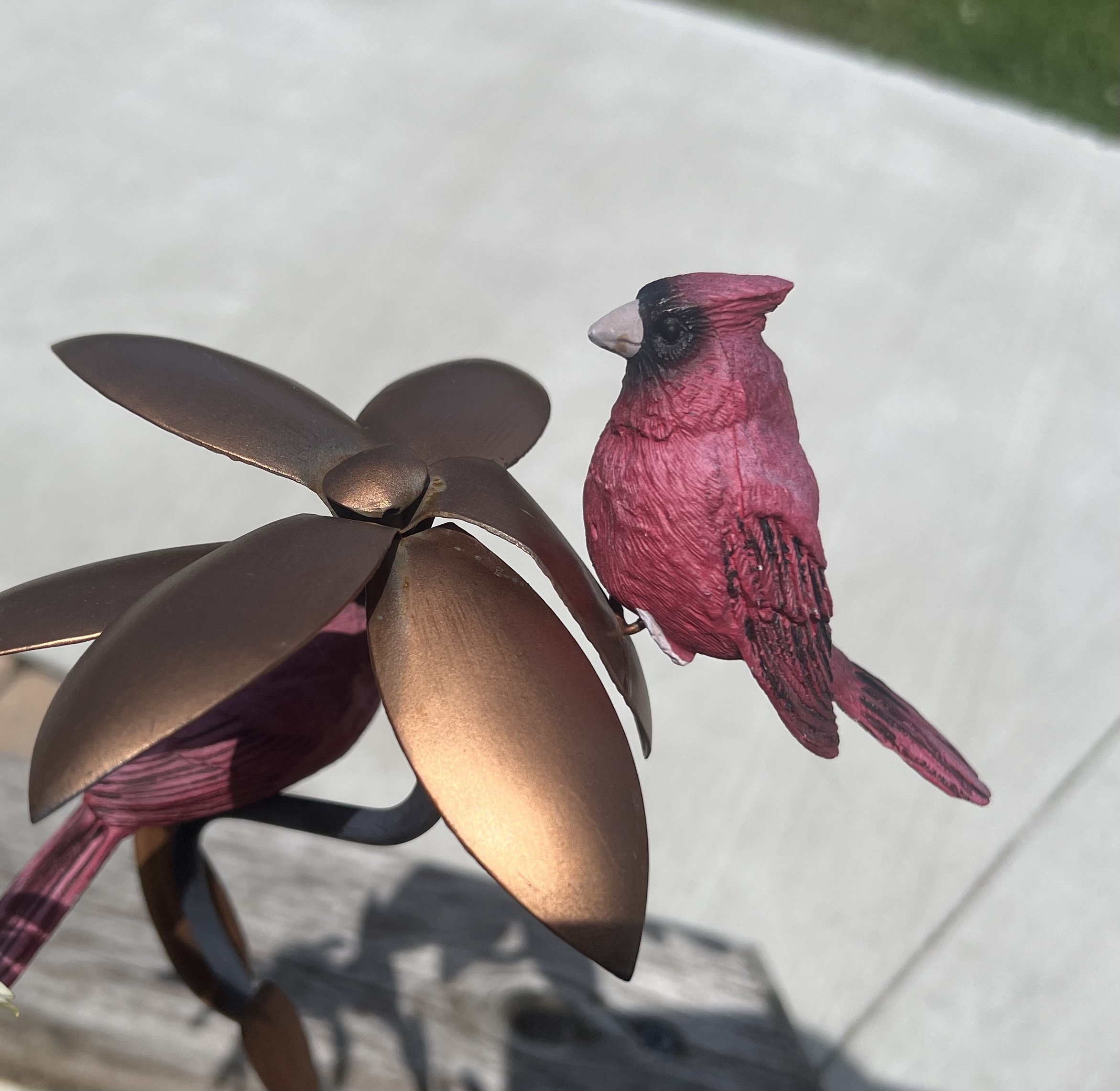
cardinal in garden (photo by Martin Malina 6 August 2023)

It has been a year this month when we first heard of Marie’s diagnosis. It goes without saying this news came as a devastating shock.

This past year has been a journey to say the least, a journey of ups and downs, of hope and despair. And not just Marie’s suffering but ours as well especially you, Wayne and dear family.

The time seems to have gone by both quickly, and at the same time feels like a long haul. It’s as if time itself expanded in each moment of living: This year was only one, short year in the large scheme of things. But it contained billions of seconds that filled each day and place where Marie spent time – various rooms in the General Hospital, the apartment in Sarsfield, and the hospice in Kanata.

The meaning of this time played out in each ordinary moment. And each of those moments was a gift to us, each interaction with Marie and one another a blessing.

I have two Tim Horton’s mugs in front of me. Wayne told me the funny story of when Marie was selling mugs at the Tim Horton’s counter in the Canada Post building. Typical of Marie’s sense of humour, and trying to increase sales, she turned some of the mugs on display half-way around, so the handles were pointing the opposite way vis-à-vis all the other mugs.

And when potential customers came to take a closer look, she would, with a smile on her face and mischievous twinkle in her eye, announce that these were very special mugs because some of them were left-handed, and others were right-handed.

Her sense of humour caused and causes us to laugh. And laughter always gets us out of our heads and brings us into the present moment. Laughter is the key to an understanding of faith that Marie’s life exemplified.

Her jokes and humour not only brought people of the same mind together, but also people who are different in their beliefs, backgrounds and life experiences. That was her gift. Her presence brought us together into a moment in time that all of us shared, a moment in time that was quite common and ordinary for us all.

Indeed, Marie expressed her extraordinary faith in very ordinary situations and ways. Her faith was not sophisticated. Her faith was not born from a lot of book knowledge, education degrees nor ivory-tower language. Her faith was not so much about ideas and theories about which you could be ‘right or wrong’. It was more concrete and specific, formed in love.

We gather to celebrate Marie’s life today during Ordinary Time, in the church year. It is the ‘green’ season of church colour, signifying the simple life and growth of all creation.

Jesus told stories about ordinary life – planting seeds, harvest time, growing vines, losing coins and sheep, money and wages, the birds of the air, the flowers of the field; and ordinary people in the middle of it all. Jesus even laughed with others at a party.[1] Humour and laughter are the key to understanding something very important about God:

God comes to us “disguised as our life.”[2] Folks who get this are deeply spiritual people. Because they know God is revealed not in church services inside church buildings on Sunday mornings alone.

Rather, more importantly, God is revealed in every moment of ordinary living. God is revealed if we pay attention—and that is the work of our lives—in those moments of grace and beauty in the midst of it all, good and bad. That is where God is.

So, in the last year I’ve been on a birding kick. I’ve even gotten myself a fancy app to identify bird calls. It’s hard sighting a bird from the back deck or even in the woods walking. I hear the bird first, and then go looking wondering if I can spot it in the trees or bushes. Not easy.

But there is one bird that catches my attention time and time again without much effort on my part. Marie’s favourite. It’s almost as if the cardinal wants to be spotted. You don’t have to be a life-long birder whose memorized every page of some comprehensive archive of all North American birds. Because grace comes uninvited and often unexpected.

There it is, right before my eyes, whether I’m ready for it or not. There it is, contrasted against the green foliage of the maple, oak or spruce tree at this time of year. I can see it, the brilliant red covering its entire body, popping out at me. As if it wants to say to me— and probably is in its sweet song—the very words of a God who now embraces Marie under loving, caring, protective wings:

“I am here. I am with you, always. I will never leave you, no matter what.” Thanks be to God!


[1] Read through Matthew, Mark, Luke, John – the four Gospels in the Bible.

[2] Richard Rohr, Things Hidden; Scripture as Spirituality (Cincinnati, Ohio: St Anthony Messenger Press, 2008), p.17.

Following her heart – a funeral sermon

It was her life she lived. When I reviewed again Ida’s life story that you, dear family, wrote, I had the strong impression of a unique journey that only she could have lived. Though similar in scope to the general narrative of many people fleeing war-torn and post-war Europe in the last century, and though similar to the narrative of many immigrants to Canada from northern Europe, her story had its own flavour. For example, just recall with me all the places she called home after emigrating from Germany and landing in Quebec City:

Regina and Weyburn in Saskatchewan, Montreal in Quebec, back to Prince Albert in Saskatchewan, Kelowna in British Columbia, then to Vancouver and finally to Ottawa in Ontario—and that’s just her time in Canada! Who else would have covered so much ground in the second largest nation by land mass on the planet? Her life was her own. Not someone else’s.

She never just stayed in one place. She moved on. Even though many circumstances surrounding her emigration and personal life events were beyond her control, you don’t get the impression that she just followed along. Whether something good or bad happened, she saw an opportunity and took it—took the initiative, took a risk filled with hope. She didn’t follow a script. She followed her heart.

So it is, I think, with our grief. Today we express our sorrow at losing Ida. In many ways it is a sad day, like the day she died. We must acknowledge our own way of grieving. Each of us does it differently. We no longer live in a cookie-cutter world where everything is done the same way for everyone, and everyone must conform to a standard method.

The pandemic has only accentuated this truth, especially when it comes to how families process their grief and how they ritualize their memorials of loved ones. It isn’t done the ‘same way’ for everyone. Some will do everything they need to do in a week. Some will take years before they are ready to have a burial.

It has been over two years since Ida died at Granite Ridge Long Term Care Home in Stittsville Ottawa, on February 3, 2021. You took the time you needed before you were ready to take this next step. And that is good. We must learn to respect our diversity. But we’ve travelled this road together, not alone. I think Ida would approve.

If there is anything that summarizes for me the adventurous and Canadian-geography-encompassing breadth of Ida’s life journey is that she didn’t do it alone. At different times, and in different places, various people, including close family members, accompanied her. Though ‘home’ meant several different street addresses over time, she rarely if ever was all by herself at those pivot points.

Whether with one son or the other, or her husband at the time, close friends, her brothers in Germany, or churches or health care institutions where she worked, she was part of a community wherever she went. Relationships and relating were important to her no matter where she lived.

And, in fact, that is my last and enduring image of her: where she lived the last chapters of her life at Granite Ridge. Rarely, if ever, did I find Ida alone in her room when I went to visit her. She was always in the activity room surrounded by her floor mates watching the TV, or waiting with her table mates in the dining room for the next meal, or in the hallway by the nurses’ station where she could monitor the high-traffic crossroads on the busy “Lake House” floor.

And though her death ended something important for you, and though we cannot see her any longer in the flesh, we can be confident that those relational bonds endure to this day. With the gift of faith, we can affirm that while your relationship with her has changed it has not ended. Nor, ever will. She continues today to live, move and have her being in the God of all hope and the source of all life.

Jesus says that he goes to prepare room for you (John 14:1-3). He makes a promise not just to everyone, but to you, personally. There is a place not just for Ida, but for you, too. In the divine realm, the holy house, the family of God—however you want to define it—you belong.

The message of the Gospel is intensely personal. It is not some general comment for the collective human race—though it is that, too. But today, as we continue to mourn the death of your beloved Ida, everyone in this room and watching online needs to hear a personal word of comfort spoken just for you: You belong, forever.

This personal word also goes beyond the promise of making room for you. God takes pleasure in spending time with us. The prophet Zephaniah describes how God “will rejoice over you with gladness, he will renew you in his love; he will exult over you with loud singing as on a day of festival” (3:17–18). 

These verses provide us with a profound word picture in which we see the almighty God of the universe taking delight in each of us. 

It’s like never getting sick of chocolate and enjoying it forever. Can you imagine ever getting sick of eating chocolate? Though Ida got tired of the taste and smell of chocolate after working in a chocolate factory in Berlin before coming to Canada, maybe she will be surprised in heaven. Because the party never ends!

A funeral sermon —Participation by All

Arising & flying together” (photo by M Malina, August 2022, Kalaloch Beach WA)

Bruce’s death leaves a very big hole in our hearts, and in our church. It is a kind of loss we cannot easily understand. It happened over a relatively short time. And we ask: Why? Why now? Why him? Answers don’t come easily.

In the prayers we will shortly say—standard Lutheran prayers at funerals—we ask God “to help us, in the midst of things we cannot understand.” Martin Luther himself stated: “I believe that I cannot by my own reason or strength believe in Jesus Christ.”[1] Indeed, we pray for God to help us in the midst of things we cannot understand. Belief doesn’t come easily in the midst of sorrow.

Being faithful at a time of loss calls us to confess that we don’t have all the answers to life’s toughest questions. We must recognize at a time of death that having faith now doesn’t qualify us to understand why, perfectly.

And I don’t think Bruce pretended that he did. He knew well enough that having the right answers to difficult questions and circumstances in life was not the point of being faithful to the call of Christ.

Bruce knew that the purpose of religion, of faith, at difficult times especially, is not to understand it so much as to participate in it. The purpose of faith for Bruce was not to have everything figured out, to understand everything completely, before acting on it or doing something about it with others. Just do it!

This belief in participation is what motivated him to try getting the men’s breakfast started up again during the pandemic. This belief in participation is what motivated Bruce to gather some chalk and invite school children to draw and sketch on the church parking lot when they walked by after getting off the bus on Meadowlands.

It didn’t matter who you were, whether you were a church goer or not. But just get involved together. 

Bruce also knew Jesus gave some tough instructions and said some challenging things in his sermon on the mount. Bruce had his questions. It’s sometimes difficult to get your mind around what Jesus said, like: “The last shall be first, and the first shall be last” and “Love your enemies” and “Blessed are the poor.”

When Bruce was recreational coordinator, a special arrangement was made when the Fisher Park high school was built. The arrangement was between the school board and the local community: that anyone living in that neighbourhood could use the recreational facilities in the school.

As head of the Fisher Park Community Recreational Council, Bruce was careful and firm in spelling out its philosophy: the emphasis of the program was “participation rather than competition.”

Bruce was quoted in the newspaper article written up about him as saying: “Recreation should first and foremost be fun; if the kids learn something, well that’s great too. They’re not here for learning for learning’s sake.”

Though he still asked deep questions of faith right to the end, ultimately for Bruce his faith was how best to bring together diverse people. It was about participating and having fun with others.

Bruce told me recently that the best sermon he remembers my Dad preaching at Faith was when my Dad talked about how each snowflake is unique; God created no two snowflakes exactly alike. Bruce would gaze across mounds and mounds of the white stuff outside and say: “You see all that snow is made up of trillions and trillions of snowflakes each different. But they’re all together.”

Sometimes we can get stuck in the snow. Sometimes participating together is not fun—and Bruce knew this, too. The disappointments, even hurts from different people trying to work together; The pain of conflict, of failure, of good intentions gone awry.

Bruce, in his last days, shared with me a memory I think he cherished about his mother when he was a child. He was playing as many children will do, running around outside and having fun when a dog bit him on the leg. He went crying to his Mom, more out of shock than anything else—it wasn’t a deep wound.

He recalls this moment vividly, when his mother bent down and kissed the owie on his leg. And, just like that, the tears were gone, and he immediately scooted off to continue playing, running around and having fun.

He needed his mother to assure him, to soothe him, to love him when it hurt. When participating in community is challenging, when understanding a situation does not come easily, when tough questions of faith arise, those are times we need each other. We need assurance. We need the divine kiss on our metaphorical boo-boo, so we can continue playing, having fun, participating in and enjoying the life we share in Christ Jesus.

I think that’s what Bruce would want for us today. To keep playing. God doesn’t take away the owie. God doesn’t immune Christians from suffering and even death. God doesn’t insulate us from hardship, just because we say, “I believe”. 

I remember Bruce got excited the time I told the congregation that we need to consider revising some words to that the popular song: Jesus Loves Me—“This I know for the Bible Tells Me So”. Because, in truth, we know Jesus loves us because we are shown love. We have mothers, fathers, sisters, brothers, friends who will hopefully kiss our boo-boo’s and send us off to continue living. We should sing: “Jesus Loves Me This I Know for My Mother/Father/Sister/Brother/Friend shows me so.”

I think Bruce would want each one of us to know this love of God. I think Bruce would be so happy to see us all together in this place today.

Amen.


[1] In his explanation of the 3rd article of the Apostles Creed, Small Catechism

Taking down the tree — a funeral sermon

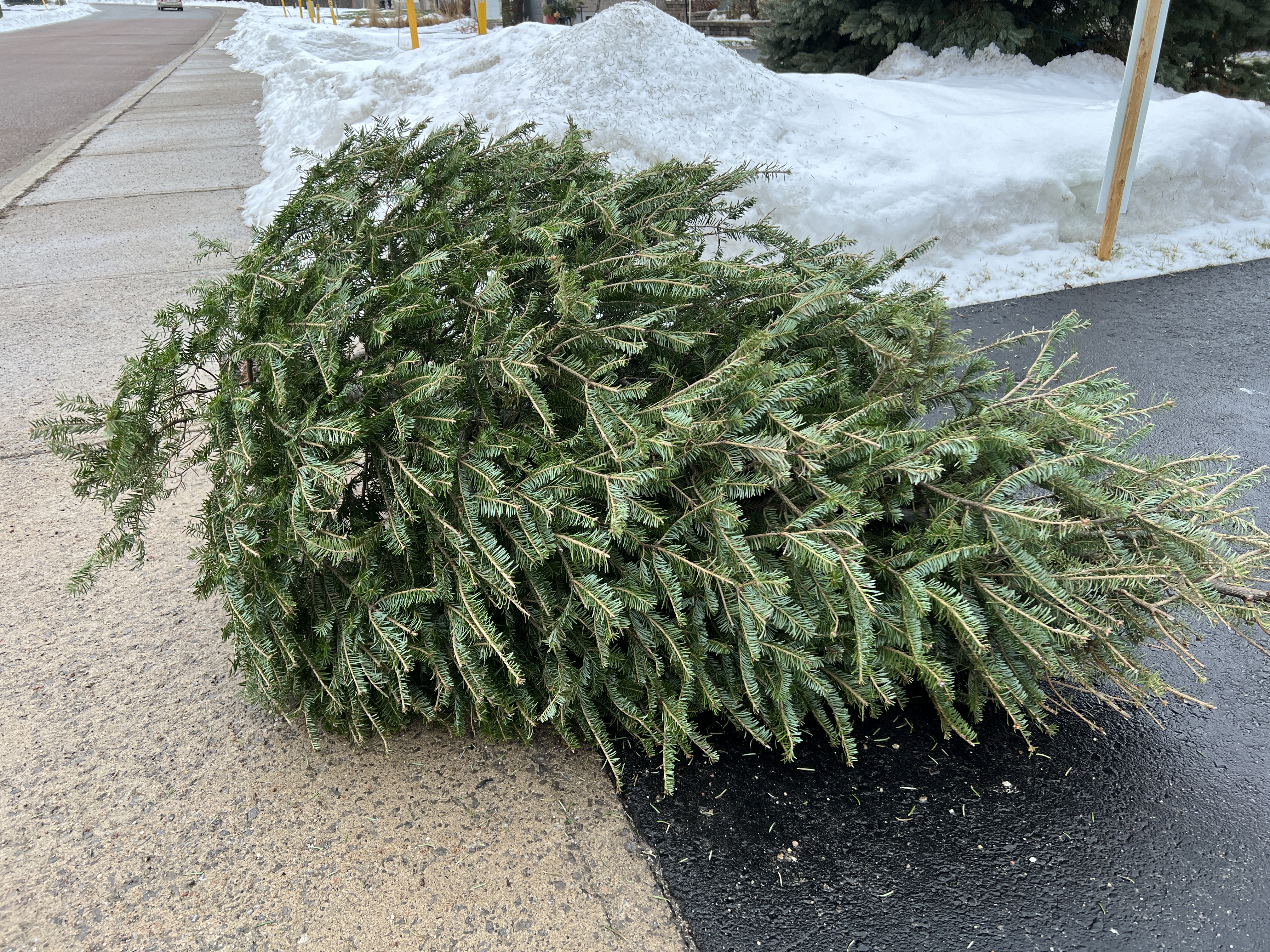
Along our post-Christmas street” (photo by Martin Malina Jan 2023)

Taking down the Christmas tree sometimes leaves me feeling saddened, especially for those joyous moments during the holidays when precious memories were made.

For others, taking down the Christmas tree at the end of the season represents the suffering and loss that overshadowed everything else during these last few weeks. Or, maybe you didn’t even put up a tree in the first place.

When suffering and death coincide with superficial Christmas cheer we cannot explain away the grief. Our tears are exposed; they come quickly and often. It doesn’t take much to trigger our sorrow. We cannot deny nor avoid the pain, no matter what time of year.

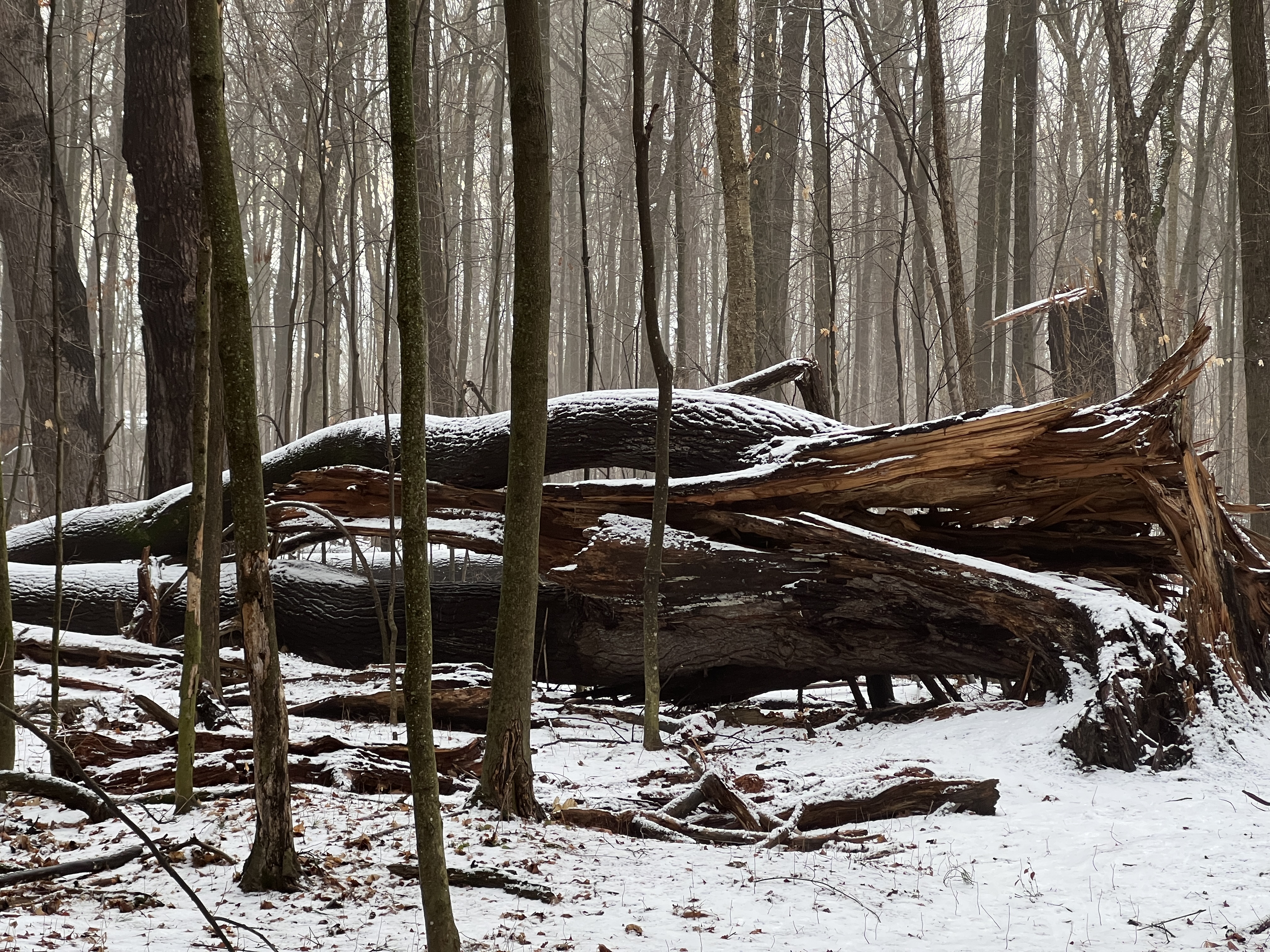
Surrounded by love for the fallen” (photo by M Malina 6 Jan 2023 in the Arnprior Grove)

What is also exposed by our tears is love. And we cannot explain away love, either. Alongside the unfathomable and often unbearable weight of grief is the mystery of love. How on earth can love co-exist and persist in the valley of the shadow of death?

Many of us will normally take down Christmas decorations in the first week of January. For those who wish to recognize the discipline of the Twelve Days of Christmas they will wait until January 6th—the Day of Epiphany. And for the long haulers, they will wait until the Festival of Candlemas on February 2nd before they take down their Christmas Tree.

The benefit of observing the seasons of the church year is recognizing the natural rhythms and cycles that repeat every year. We can look forward to what the next season offers in terms of meaning and divine promise. 

There’s this joyous anticipation which feeds our innate longing for the good, for the better, even for adventure. Maybe that’s why some people are not in a rush to take down their tree. Because they know, and can rest in, the promise and faith that soon enough the change will happen again next time around.

Wayne gave me the impression that he lived with a strong sense of hope and promise. In my view he was practised in the art of anticipating the good and resting in the promise of the better. 

Maybe it was cultivated by his Bingo-calling days. Yes, Bingo in Pembroke!

I’ve only ever played Bingo but never called it. I imagine the caller has a great job. Because, on the one hand, there is structure in the game: Five columns of letters spelling B-I-N-G-O and under each column are numbers ordered in groups of five (1-5, 6-10, 11-15, 16-20, 21-25).

So, the hope of which I speak is not a flight of fancy, ungrounded, nor some unhinged pursuit. Perhaps this hope-in-form comes with maturity, experience and age. We must all make mistakes on this journey of growth, to be sure.

But eventually this hope brings joy, the joy that comes from calling the BINGO game. Because as the caller you don’t know when someone will get five-in-a-row. It could be early in the game; it could be late in the game; it could be anywhere in between. Also, as the caller, you don’t know who will win; it could be anyone in the room.

The game carries itself. The caller serves something beyond their control of the outcome. You only know someone will get five-in-a-row at some point. Anticipating this is all the fun for the caller. And so, as the caller, you don’t need to rush. Just let the good thing happen when it will. This is hope.

This hope and anticipation help place the present moment in perspective. For one thing, it allows us to nurture patience, slow things down when necessary, appreciate and even enjoy every moment we have.

During the pandemic when everything ground to a halt even services of worship were suspended for a time, including the sacrament of Holy Communion. No one knew what or how to do things. The church couldn’t meet on Sundays onsite here, in person. Nor could we share in the breaking and eating of bread and drinking the wine from a common cup.

Yet, Wayne and Elsie helped break new ground. 

You see, the Holy Meal conveys the meaning of love in unity—communion—with one another and with God who is merciful and forgiving always. In this Holy Meal, essential to it, is the promise of God to be with us and for us always.

Despite the roadblocks and restrictions and all that may block the flow of God’s love. Despite everything that changes. Somehow, God always finds a way to us. “You did not choose me, I chose you,” Jesus said indicating God’s primary move of love towards us.[1]

And so, upon Wayne’s and Elsie’s request, we forged ahead anyway. We met a couple of times in the parking lot outside this church building. We remained in our cars, parked side to side with windows open even in the freezing cold wintertime. We used makeshift trays to hold the cups and plates on our laps. We brought our own bread and wine from home. And three of us had Communion in the Word of Christ.

It impressed me how much Wayne’s vision was promise-filled, how much his faith allowed him to live in the present with hope, even willing to risk something new—just because it might work. And if not the first time, maybe the next time.

And it did work! Why? Because Wayne didn’t do it alone. Wayne and Elsie did it together. In love.

You see, we can only live in faith when we are in relationships of love. Faith only happens in love. “Faith, hope and love remain, but the greatest of these is love.”[2]

In faith, hope and love, we can do many things for the good. In faith, hope and love we can even take down the Christmas Tree this year. We can take it down because we do not do it alone. We don’t do faith by ourselves. Wayne got that.

And at the end, the last time we must take down the tree for the season of our life, we can do it. We can cross that boundary of death in the hope that the seasons are about to turn yet again. Our relationships don’t end, they just change. We are still in communion. Wayne got that.

Thanks be to God.


[1] John 15:12-17

[2] 1 Corinthians 13:13

Tales of three trees – a funeral sermon for a mother who loved gardening

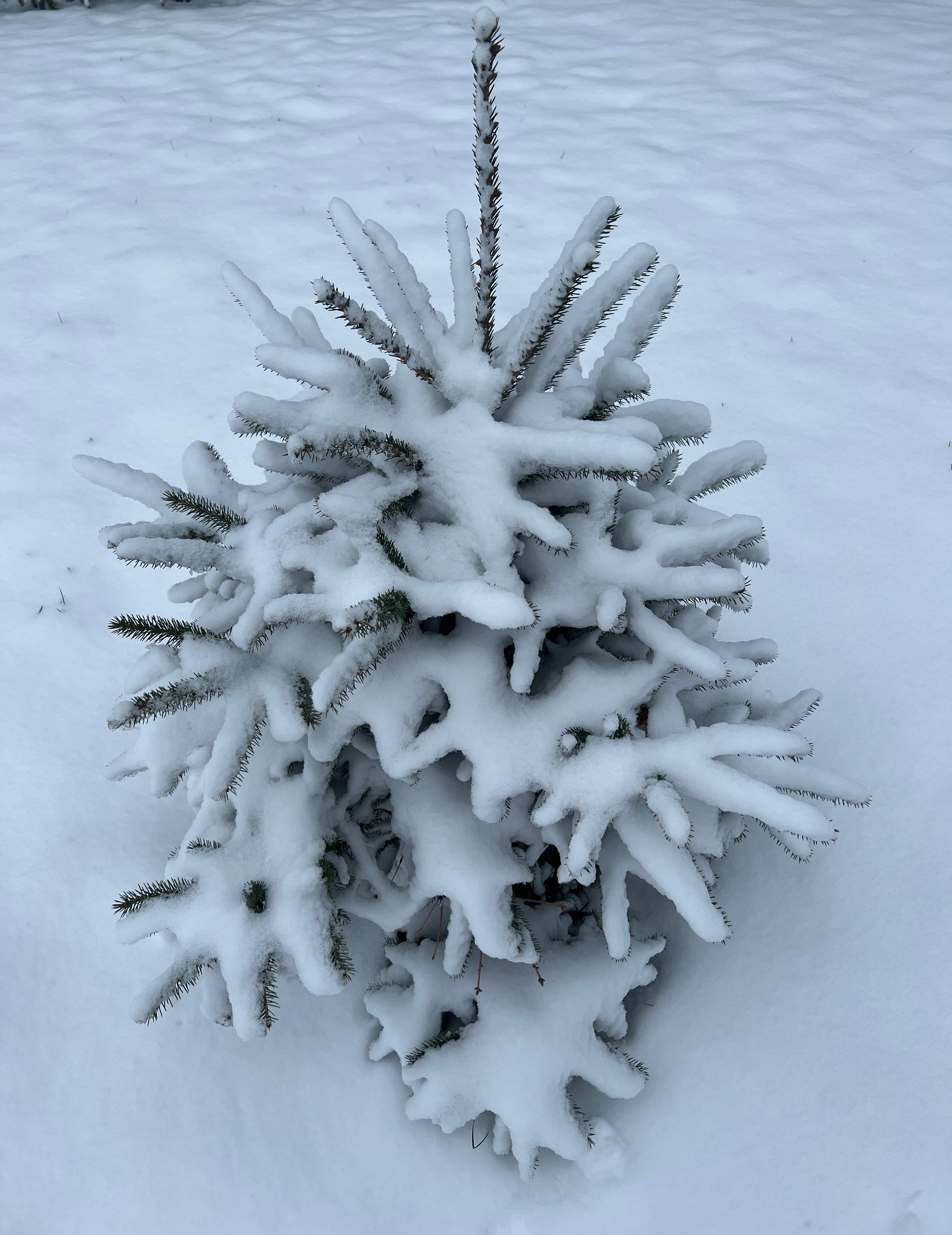
Still growing (photo by Martin Malina 16 November 2022)

Jesus said, “Indeed, the water I give them will become in them a spring of water welling up to eternal life”[1]

Up until last month, Emilie provided fresh cut flowers from her garden to adorn the altar here at Faith every week. Not only did Emilie gift flowers, but she also gave trees. I want to mention three trees she gave.

The first tree, she gave to me. It was barely 10 inches tall. I think it is a green spruce. It was October around Thanksgiving when it showed up at the church in a flowerpot. So, late one evening when I came home, I got out the shovel and put it in the ground. I didn’t want to leave it too long before the frost would freeze the ground and snow would pile high.

I also learned that especially after transplanting anything alive, it was important to soak the tree with water. I must have dumped a dozen large pailfuls over the tree those first few days. The lawn around the tree was saturated. And I repeated this process for the weeks leading to the first snow, and also the following Spring. This tree had water.

And it responded positively. It grew quickly. A couple years later, and it’s now pushing four feet. Its lead is long—a robust, strait javelin pointing up to the sky.

The second tree Emilie gave to the church. When we took down a dead poplar at the street behind the church building, she replaced it by gifting another birch. If I recall correctly, it was late in the Springtime a few years ago—that year when there was hardly any rain. That was the year the grass was brown by the end of June. 

I remember Andrew coming to church on a Sunday in June holding a bucket and saying we needed to water that thing—which we did when we could. But it didn’t get enough. And by the end of the season that year, it was dead.

The third tree Emilie gave to the church was during the 500th anniversary year for Lutherans, back in 2017. That year, the national church encouraged congregations to plant a tree commemorating Martin Luther nailing his 95 theses on the door of the Wittenberg Church in Germany, thus inaugurating the 16th century Reformation.

It’s also a green spruce, I think, and you can see it on the east side of the church above the community mailboxes. In 2017 the confirmation class planted that tree when it was also barely a foot high. Our neighbours generously placed a chicken-wire fencing around it for protection since pedestrians like to cut across the lawn there, coming to and from the bus stops along Meadowlands Drive.

I’m not sure how it has survived. It hasn’t taken off like the one I have at home. But it’s filling out and I have confidence it will survive. And maybe even some day, thrive, surrounded by its mature neighbouring trees. 

Three trees. Three tales. The first received an almost constant nourishing and abundance of water. The second received not enough water. And the third benefitted from its surroundings for protection and just enough nourishment over time. I like to think that these three different tales reflect different aspects of Emilie’s life and character. And they point to ways in which we live ours.

The first tree.

It appears Emilie, despite humble beginnings, found life and even life abundant. She was uprooted in her youth and transplanted into a new world. Mobility and change were fundamental to the dynamic of her life. Maybe she was even energized and stimulated by what these changes brought to her and the possibilities before her. Metaphorically speaking, she found lots of water, saturated with the fullness of what life could be for her. Emilie employed all the resources at her disposal and took risks to make it happen. She lived life to its fullest always reaching for what was within her grasp. 

The second tree.

But as we all do at times in life, Emilie also experienced seasons of drought. These were times when her world turned upside down. And sometimes for reasons beyond her control. Relationships ended or changed. A re-ordering of life happened, but not without first suffering the pain of enduring and then of losing. Of doing without. 

Disappointment. Tragedy. Failure. Like something that used to be secure and stable is no longer. When we face the gaping chasm and fall into it. It feels like dying.  Certainly, these last few months she lived under the threat of her growing illness and of this day that we gather to mourn her death.

Finally, the third tree. This tree is the most curious. A little bit mysterious in the sense that it somehow finds a way to live without our constant and full engagement all the time. There’s uncertainty about it.

But, perhaps by the help of neighbouring humans and trees, it finds a way. Perhaps its environment protects it, to some degree. We don’t often see it but it’s there. We might not notice it; it doesn’t stand out. But beneath the snow and behind our conscious awareness of it, this little tree continues to live, and grow. 

Emilie understood the mystery of growing things. She understood that we do our part. But flowers bloom and trees reach for the sky according to forces beyond our constant, active involvement and even awareness. I think this respect for growing things gave her such an amazing ‘green thumb’.

Though in winter and early Spring months the circumstances on the ground do not always show evidence of the final product, what motivated her to continue going and gardening year after year was the vision of what that flower or tree could eventually become. Regardless of the actual outcome. That’s the secret. That’s faith. It’s the hoped-for vision: Going for it, a vision of what can be—tall, solid and majestic trees; flowers exploding in brilliant colour under summer sun.

A vision of what can be, in our lives, is what motivates us and to which people of faith aspire and around which we order our days.

The vision from the book of Revelation, the last book in the Bible, contains the images of water and trees.[2] Here we find the divine promise that despite suffering, and during seasons of drought and despair, God will offer the river of life to nourish the tree of life. And what is more, the purpose of the tree of life is “for the healing”[3] of us all! Including you and me.

It’s about life, and even living beyond the days of our lives on earth. Deep within our lives, not always visible, perceptible nor noticeable, lives the Spirit of God in Christ. And this gift of grace will nourish us and grow us, forever.


[1] John 4:14

[2] Revelation 22:1-5

[3] Revelation 22:2

All in nature – a funeral sermon

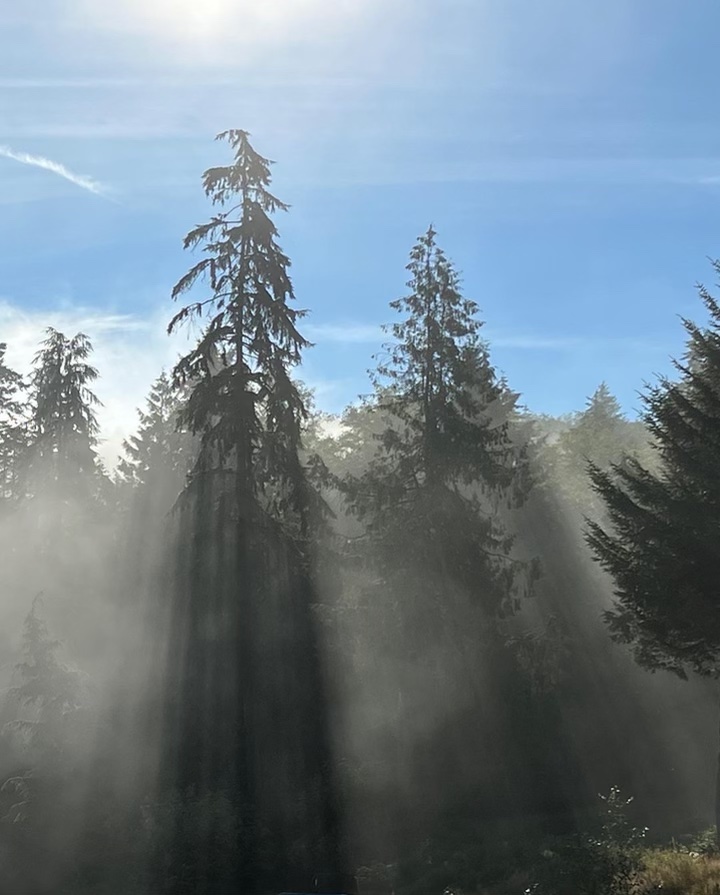
Sun and Shadow (photo by Martin Malina, Joyce WA, August 2022)

In the memories you shared moments ago, at least a couple of you mentioned the ‘chaos’ that ensued during your family gatherings of grandchildren and great-grandchildren descending en masse. I like the term you used with me just before the start of this service: “My home was jungle!” Jungle. The image of intertwining vines and large limbs of trees pressed in close together. I love it!

During one of the last times that I met with Vladimir, I interrupted his outdoor yard work. He was caring for his impeccable lawn, the garden, and the trees around your home. His work to care for creation extended naturally from his work to care for the human body. His scientific mind and his drive to excel were energies that defined his life. And these gifts were put to good use in the simple yet dedicated yard work near the end.

Living in the world of trees, air and light, we must confess our innate connection with the natural world. Human and nature are interconnected, entwined. This past summer I travelled with my family to the Pacific Northwest and visited coastal regions in Oregon and Washington State specifically. These regions are really all about the trees. The trees—the Sitka Spruces, Douglas Firs and Western Hemlocks— more than anything captivated my senses and thoughts.

Like the tree, we yearn “…for a place where earth and sky are joined. Trees invite us to a height that’s grounded in roots … In climbing we’re also reaching down.”[1]

Climbing, as a metaphor for life, we understand:

The tree and the human share the compulsion to climb—to reach higher and go farther. Vladimir’s life suggests that movement, physical and mental, of going higher and farther. From humble roots in Prague to world travel, taking risks, willing to make major transitions in life, emigrating to a new country during wartime, learning a new language. Not just surviving but thriving in the new world.

In feeding themselves, trees support human life, producing up to thirty percent of the oxygen in our atmosphere. Trees absorb our carbon dioxide even as we inhale their oxygen. There’s nothing mystical about the fact that trees and humans breathe each other. We help each other grow, reach higher!

Indeed, in our climbing we confess our love affair with light. If photosynthesis uses light to produce oxygen, heliotropism is a tree’s capacity to get more light. Trees extend their branches in every direction to reach the greatest possible sunlight. Plants and trees bend toward the sun as they grow.

But in climbing we are also reaching down. What is meant by reaching down? Here we explore the paradox of life and death.

The roots—what’s beneath the surface, not at first visible. In some hardwood trees especially, like the cottonwood, the roots can expand beneath the surface of the earth in every direction, making its root system twice as wide as the tree is tall. It’s what happens underneath the surface that is truly fascinating.

Scientists are finding that trees communicate with each other through an underground fungal network. This network allows them to share food and water with adjacent trees, nursing their sick neighbours as may be needed. It even functions as an Internet cable, warning other trees of danger—for example, the coming of bark beetles or leaf rust—by sending electrical signals across this fungal grid. Trees are social beings.

When we, as humans, take root of our life: When we grow in self-awareness, affirm what we value and live out of the truth of who we are—this is the process of ‘going down’. Which isn’t an easy process all the time. We experience the pain of loss, of change. But, learning from the trees, going down to take root is but another way of going up. The paradox: Taking root of our lives is the spiritual way of growing up, reaching out, and leaning towards the light, the sun.

The bible is full of tree metaphors and images. The fig tree in the story Jesus tells[2] describes a reality we all must face: the death of a tree represents our own death. What use is there in death? Our impulse, quite understandable, is like the man who petitioned the gardener: Cut it down. Get rid of it. Because it hasn’t produced anything. And it isn’t producing anything anymore. What value is in that?

But God pulls the rug from underneath our initial expectations. God is a God of second chances. God never gives up on us. Even if it has the appearance of death, you never know. What’s under the surface may still yield more than we can ever imagine. What is not visible can still bring forth abundance.

Vladimir’s body has returned to earth. Earth to earth, ashes to ashes, dust to dust—we will say shortly at the inurnment. But his body, his life still has meaning, still offers nature the rudimentary building blocks for life on earth, nourishing the growth of new things all around us, nourishing growth in our souls. In our memories. In our hearts. In the legacy he leaves. 

We pray that what was good in his life will continue to be good in ours; what he valued and sacrificed and made good for others we would value, sacrifice, and make good for others.

For life never gives up. God’s life and love never end. At the end of the bible, we find another tree.[3] It grows right on the shores of the River of Life. Continually being fed by a water source that never ends, the tree lives forever.


[1] Belden C. Lane. “Trees” in The Great Conversation: Nature and the Care of the Soul (New York: Oxford University Press, kindle edition, 2019), p.82-97

[2] Luke 13:6-9

[3] Revelation 22:1-5

A funeral sermon for one who loved music

The music hasn’t ended; the key has changed[1]

I’m going to ask you to do something that may seem a bit odd, a little unusual. I hope you’ll bear with me for a moment because I think as we continue, you’ll understand why I am asking you to do this.

 I want you to take a moment and just sit in the silence. Be present and open to the silence, and just listen. But before you do that, I want to tell you something. 

Many believe that silence is the opposite of sound and that there is nothing to hear. Inge knew otherwise. As a singer and one who loved to participate in the church choir at Faith Lutheran and the Community choir in Nepean, Inge knew that’s just not true. Every good singer knows that silence is the necessary space between the notes. 

That space, what most of us might call or experience as emptiness, absence, or a void, is the birthplace of the music. That space of silence is as much a part of the music as is each note. That space sets a rhythm, holds energy, and gives music its life, power, and beauty. Silence is never just emptiness, an absence, or a void; not in music, not in life, not in death, and not on this day. 

So take a moment now and listen to the silence. (pause) What did you hear? 

My guess is that we hear the music of Inge’s life; we hear her song of love, her song of friendship, her song of serving, her song of presence in your life. 

And I wonder what song she gave you. How did she touch your life and invite you to join your voice to hers in the great song of life? How did she conduct you into the original music of your own life? Hang on to those songs, Inge’s, and yours. Let them fill you and carry you. They are holy hymns.

I’m also guessing that you heard your song of grief and sorrow, your song of loss, and your song of love for or friendship with Inge. It probably had a verse or two about loneliness, sadness, and wondering how you can know the way. That’s the space between the notes. That’s the opening to a new song for Inge, for you, and for all those you love but no longer see. 

I want you to know this. The music of Inge’s life did not end at her death. Today we stand in that space between the notes, a space that makes room for presence in a new way, a space from which God is making all things new. “Sing to the Lord a new song” the Psalmist sings.[2]

The music of Inge’s life now plays in a different key.

Isn’t that what we mean when we say at these times, “Life has changed, not ended?” Isn’t that what Jesus is telling Thomas in today’s gospel[3] when he says, “That where I am, there you may be also?” Death is not the coda, the conclusion, to the song of life. 

Though we might be able to name the day and maybe even the hour of Inge’s death, she never knew that moment. She simply moved from this life to a new life. The music hasn’t ended, the key has changed. And that means we must learn to listen in a new way. We must listen with the ears of our hearts. 

So when we get to the parts of life that call us to slow down, pay attention and listen with the ears of your heart. Listen for the voice of Inge. Listen for the voices of all those you love but no longer see. Feel her and their presence. The music is always playing. 

“Do not let your hearts be troubled,” for we are singing the never-ending song of life. That’s why we’ve gathered here today. And that’s why on this day, even as we soon go to the graveside, we make our song, “Hallelujah, Hallelujah, Hallelujah.” 


[1] Largely borrowed and adapted from Fr Michael Marsh, “The Music Hasn’t Ended, The Key Has Changed—A Funeral Sermon” in Interrupting the Silence (https://www.interruptingthesilence.com). Thank you Fr Michael!

[2] Psalm 96:1-2,12

[3] John 14:1-6

Strawberry story – a funeral sermon

audio for ‘Strawberry story – a funeral sermon’ by Martin Malina

Well here we are, finally, at the end of June. It’s strawberry season in these parts. So I want to start with a strawberry story. But it starts out pretty bad:

A holy man is being chased by a tiger. He runs as fast as he can, but the tiger is hot on his heels. Ahead of him is a cliff, with a vine hanging down over the edge. He grasps the vine and begins to clamber down the face of the mountain, when down below …

He spots another tiger prowling on a ledge beneath him. A tiger above and a tiger below, he hangs there, clinging to the vine. Then, he notices …

Two little mice have scampered up and begun gnawing at the vine that is supporting him. He can’t seem to catch a break! It’s just getting worse! The writing is on the wall.

At that desperate moment, he sees right before him …

A ripe, red, wild strawberry, growing on the side of the mountain. He plucks and sinks his teeth into it—how sweet it tastes! (1)

In times of loss and grief, it often feels like all is lost. It feels like the disappointments only mount, and despair hounds relentlessly at the edges of our existence. It’s not just one tiger chasing you, there’s another one waiting for you ahead. And then the one thing you are hanging on to begins to disintegrate before your very eyes!

Planning for this funeral service has felt a little like this story, too. Shortly after Bill died several months ago now, we planned to have his celebration of life just after Easter, appropriately, when we hoped the pandemic wouldn’t be a factor keeping us from gathering. But it was! So, we postponed it to this day, months later, hoping this time of year would give others the opportunity to join us.

There are nuggets of wisdom and truth embedded in the strawberry story. And in the story of the raising of Lazarus, which you chose to accompany our reflection on this day when we celebrate the gift of life in your beloved Bill.

The story of Lazarus starts out pretty badly. It is a story mired in death and grief and failed expectations. Did you notice the extent to which the Gospel writer includes details about death and grief: Lazarus’ dear friend Jesus being “deeply disturbed in spirit and deeply moved” to the point of weeping. The smell of death, the “stench because [Lazarus] had been dead four days.” And Martha’s disappointment that it took so long for Jesus to get there. And, finally, the dead man coming out of the tomb, “his hands and feet bound with strips of cloth and his face wrapped in a cloth.” (2)

Death, and loss, and its sordid details feature prominently in a story about new life. Will someone notice the sweet, ripe, red, wild strawberry hanging on the side of a cliff? We don’t know what happened to the holy man eating that strawberry. We can guess, very likely he met his end. Just like with Lazarus. Even though Jesus raised him to live a few more years on earth, he still eventually died. Death comes to all of us. 

What is more the question, especially for people of faith, is how we live and how we respond to the gifts of life given to us, however small, however unexpected and contrary to anyone’s expectations. 

Indeed, we go where we are looking. We go in our hearts and minds and souls, where we set our sights. We veer in the direction of where we choose, intentionally, to look. 

We can focus on the death part incessantly and all that’s disappointing and wrong in the world, and live the emotional consequences of that strategy for life. Or, without denying the challenges—the holy man still tried to get away from the tigers chasing him; he didn’t just give up—we can choose to see the life, the good, the gift, amidst all the turmoil. And that strategy will set us free from all that binds us.

One of Bill’s occupations was as a surveyor for the Ministry of Transportation in Ontario. Bill laid out most of the main highways on Manitoulin Island and also major highways in Timmins and Sudbury.

Now, to do this job especially on major highways you have to develop a certain kind of vision so that the turns can be navigated safely by drivers and the bends are not too sharp.

When I drive on major highways I need to keep my eyes far down the road in order to make the turns smoothly and stay in my lane. But I will sometimes get distracted. Something will catch my eye on the side of the road, or in the fields by the highway. And I will catch myself, thankfully, in time to avoid an accident. I will have noticed with alarm how the car started veering perilously in the direction of my gaze. I have to work at keeping my attention on the road.

It takes work, intention and yes discipline to see with the heart what is often right in front of us—a grace and gift from God that is good. And maybe that is what we are all called to practice in these challenging days.(3)

Jesus orders those attending by Lazarus’ grave side to “unbind him, and let him go.” In life as in death, we are called to “unbind, and let go.” This takes work and sometimes we catch ourselves running in every direction. 

I sense, nevertheless, without having known Bill personally before his stroke, that he was one who didn’t give up when obstacles arose. In raising a family, in choosing his career, he saw the sweet, ripe, red, wild strawberry right before him. In choosing you […] to be his wife for over fifty years of marriage, he chose life and love.

And today God has chosen for Bill, life. Life eternal. God is the source of life, and all things good. We call this funeral service a celebration of life!

For us who as yet walk by faith, let us notice the moments of life right here and now: The beautiful weather that greeted us this day, the music and the singing, and the food which we will enjoy together following the service.

Let us acknowledge the joy and gratitude of those who are present with us to support you, dear family. These relationships are precious.

Even though obstacles creep up all the time, and it feels like all may be lost, there is always the surprise of finding a sweet, ripe, red, wild strawberry growing on the edge of the cliff. Would we see it? And enjoy the gift?


(1) Adapted from Ram Dass, “Conscious Living, Conscious Dying” in Polishing the Mirror: How to Live From your Spiritual Heart (Boulder Colorado: Sounds True Inc., 2014), p.91

(2) John 11:33-44

(3) Psalm 121

A funeral sermon

audio of funeral sermon for Hertha, by Martin Malina

Such knowledge is too wonderful for me; It is so high that I cannot attain it. Where can I go from your spirit, O Lord? Or where can I flee from your presence? If I ascend to heaven, you are there; If I make my bed in Sheol, you are there. If I take the wings of the morning and settle at the farthest limits of the sea, even there your hand shall lead me, and your right hand shall hold me fast. (Psalm 139:6-10)

Hertha’s confirmation verse was from Philippians 4:13 – “I can do all things in Christ who strengthens me.” All things are possible. 

Perhaps this confirmation verse, given to Hertha at a young age, would become a calling of sorts, a gift to her especially in the last couple of decades of her life as she faced serious illness, setbacks and several medical crises. Perhaps this confirmation verse would alight over her like some metaphysical banner whenever it was tough going: “I can do all things, even this.”

Like Saint Paul who wrote these words in the 1st century from prison, Hertha would take this words to mean: “I can do all things in Christ—even when I’m at my lowest, even when my needs are their greatest, even when I don’t bring my A-game. I will endure the physical, mental and emotional anguish in my life. I will tough it out.”

Indeed, her mental toughness was exceptional, on many levels. Her faith as well. This was her simple yet solid faith in Christ who emerged from his suffering and death to new life. Indeed here was a vision in her mind that guided her through the difficult times. It was a holy pattern of getting back up after falling down: suffering-death-resurrection; and repeat: suffering-death-resurrection. She could indeed do it all, meet every challenge head on, literally. All things were possible.

Yes, Hertha had such a strong brain, a quick mind. Even into her 90th year she could still recall and tell stories from her childhood in vivid, blow-by-blow detail. Her memory was like a concrete vault.

She could provide comprehensive explanations to all, and I mean all, her medical conditions to such an extent that impressed even her surgeons and specialists. She knew more about her body’s ailments than anyone else. Her brain was firing on all cylinders her whole life long.

Iain McGilchrist argues in his seminal work The Master and His Emissary[1] that contrary to popular myths about the brain, the left side and the right side of the brain actually both function in every decision and activity we engage. And, again contrary to what had been earlier assumed, McGilchrist shows that the left side—prone to focusing on the particular, concentrating and rational explanation—is in truth subservient to the right side—which adopts the big picture view and accepts nuance, metaphor and ambiguity. It’s the right side that is the Master; and the left side the dutiful Emissary not the other way around.

We may presume that Hertha’s capacity for acquiring knowledge, applying analysis and logical explanations to situations in her life was the exceptional thing. But there is more to it, I suspect.

A better place to meet today would be the shores of the Bonnechere River near Kilaloe at the family cottage. Of course for various reasons we can’t. But perhaps each of you present today, whether watching online or here in person can conjure up in your mind an image of that place that is special for you.

And that is why Hertha chose the hymn we will listen to shortly: Shall We Gather At the River. She knew that spot to be a connecting-ground for the generations spanning her family line: From the humble yet intriguing beginning of how Joe acquired the land, to the grandchildren and great-grandchildren who would decades later also develop a deep connection with that same spot on the river. 

Perhaps as the weather improves moving into Spring and Summer later this year, you can pause to remember and give thanks for Hertha when you next gather together there.

What impressed me was why she chose this hymn, especially because it is a common, beloved hymn often chosen at funeral services. She made a connection within herself—between the strong baptismal imagery in the hymn and the integration of the Christian faith with her personal experience. Left brain connecting to the right brain.

For sure, Hertha could left-brain it with the best of us. But Hertha’s master, so to speak, was her right brain function. Despite her precise and comprehensive capacity for rational thinking and acquiring knowledge, she ultimately could submit to the realm of faith, trust, acceptance and love. That’s why she picked that hymn, because she loved you. She loved you dearly.

She knew and often admitted to me that so much of life cannot, and need not, be merely explained away. She knew that there was no place on earth, indeed no place in her mind, that she could go apart from the loving and steadfast presence of a God she couldn’t fully comprehend.[2] She knew, that often all we need to do when facing the mysteries of life, love, death, suffering, and God, is just to gather at the river. And sing.


[1] Iain McGilchrist, The Master and His Emissary: The Divided Brain and the Making of the Western World (New Haven: Yale University Press, 2019)

[2] Psalm 139:6-10