Let the ash rain down

There was a lot of ash in Canada last Spring and Summer. A record eighteen and a half million hectares went up in flames—an area twice the size of Portugal—shattering the previous annual record almost three times over. That’s lots of trees that went up in smoke. And lots of ash.

The sheer intensity of some of those blazes means it is not clear whether the dominant fir and spruce trees in the boreal forest will come back as before.[1]

There’s lots of ashes to go around. There is no shortage. Some would argue Christians spend way too much effort, a disproportionate amount of time and energy, focusing on the ash, the sinfulness—hashtag “humanity fail”. At very least we can say that the smoke in the air last summer is a sign of humanity’s failed and failing efforts with regards to our relationship with the earth.

Putting all our energy just focusing on sin can be very heavy, weigh us down to a standstill or stand-off, when all we see through the ash is death.

Your pastor, Joel, and I were ordained in the same year, 1997. And on Ash Wednesday twenty-seven years ago our class gathered in the chapel at Martin Luther University College for worship. Our professor of systematic theology, the Rev. Bob Kelly, instructed the class to sprinkle ash—not in the sign of the cross on our foreheads, but—over the top of our heads. The ash would then land onto whatever was atop our scalp.

If you have great hair—and an abundance of hair—like Pastor Joel, then that meant real trouble: The ash would be so difficult to remove once it would get lodged down deep at the hair roots. It would be itchy and get all over the place. And if you tried to ruffle your hair you’d just get your hands all blackened and sooty.

Of course, the less hair you have the better, the easier it is. 🙂

I like the connection, in that way of doing it, with baptism. Because tonight, at the beginning of Lent, we are at the start of a holy pilgrimage. We begin a journey of self-reflection, of penitence, of contemplation, of acts of kindness and discipline. We start something tonight.

And the connection with baptism is important because baptism reminds us that all our spiritual journeys begin here, at the font, at the place of God’s grace and initiative. God starts it all, with God’s love for us, equipping us with what we need for the wilderness journey ahead.

Today’s also Valentine’s Day. At first blending those two events may feel not right, like two clashing energies. But perhaps there is value in letting each inform the other, letting Valentine’s Day bring a deeper meaning and significance to Ash Wednesday, and vice versa, at least this year.

Because Valentine’s Day is, of course, about the fire of love. And what better way to start our Lenten fast reminded of love? And fire!

Ashes, after all, are produced from fire. Often when the word fire is used in the bible, we need to recall it’s not a torturing fire, it’s a purifying fire that gets us directly to the purpose, reason and centre of all our lives – the passionate love of God for us and the world.[2] For the ancient Greeks and Egyptians, healing came from light and fire. It is the fire of God’s heart of love that brings renewal and new life to the world.[3]

Because it all starts with God’s love and grace for us, can we therefore accept those messy, painful places—in our lives, and the lives of others?

That’s why we need ritual. That’s why we need to get our hands dirty, so to speak. That’s why Martin Luther valued sacramental theology—the water, the wine, the bread—not just as representations of some abstract notion of God’s love. Our faith, our Lutheran faith, is not just some mental game. Not just theory or doctrine or adherence to words on a page our minds must grasp. Rather, consider that these earthy elements truly convey for us, experientially, the real love of God.

Jesus embraced the fullness of our humanity. The Divine embodied our humanity. His journey to the cross was real, and dirty. Jesus knows our suffering because he, too, got his hands in the muck, literally to heal people who couldn’t see.[4]

I read that even pine stumps, small and charred by ravaging fires, still excrete sap.[5] Apparently it is the way they heal themselves, the way they rescue themselves from the ash, the way they transform themselves and the forest around them, making way for the new thing. God created trees to endure and be transformed through even the worst of their suffering.

God created us to endure and be transformed through difficult, challenging times. Maybe as the ashes float down onto our heads or marked tonight on our foreheads in the sign of the cross, our Lenten journey could be one of learning to trust more. It may be uncomfortable for a while.

But maybe the ash can remind us of God’s power to make all things new. Maybe by wearing the ash we learn to appreciate what God has already given to us to usher in the new. And maybe, just maybe, the new is already happening.

Our humble efforts at cooperating in ministry, sharing our resources and experiencing worship together as Ottawa Lutherans this Lent could be sign posts leading us forward on the journey.


[1] Milman, O. (2023, November 9) After a record year of wildfires, will Canada ever be the same again? The Guardian. https://www.theguardian.com/world/2023/nov/09/canada-wildfire-record-climate-crisis – :~:text=Fire ravaged Canada in 2023,record nearly three times over

[2] Rohr, R. (2023, February 12). A Single Flame: Mystics on Fire with Love. Richard Rohr’s Daily Meditations. Center for Action and Contemplation. www.cac.org

[3] Richo, D. (2007). The Sacred Heart of the World: Restoring Mystical Devotion to Our Spiritual Life. Paulist Press, 86-87.

[4] John 9

[5] Tygrett, C. (2023) The Gift of Restlessness: A Spirituality for Unsettled Seasons. Broadleaf Books.  p. 120

Be Real

Read Matthew 6:1-6,16-21

Burning the palms for Ash Wednesday (photo by Martin Malina 20 February 2023)

A year ago, my niece introduced a new social media app called BeReal to our teenaged daughter. How it works: BeReal sends a notification to you only once a day with a three-minute deadline to photograph whatever you’re doing in that moment. And then you need to post it to your online community. The thing is, you don’t know when that notification will arrive. The initial appeal was to show to the world only an ordinary, real—not staged—part of yourself and your life.

But, after being on the market almost a couple of years now, BeReal has declined sharply. Usage is down a whopping 95% from its peak last summer. Other apps have tried a similar approach and have also failed.[1]

The appeal of BeReal was its authenticity. It tried to counter what other apps such as Facebook, Instagram and SnapChat tend to create in the social media world: users showing only the best version of themselves. What BeReal wanted to do was address an unfortunate consequence of social media usage in general, a condition known as FOMO: the fear of missing out, because viewers only see the best in other people’s lives. And because they aren’t experiencing the same, many believe their lives aren’t as satisfying or as good.

The source of the problem is that people want to showcase only snapshots of their lives of which they are proud: places they visit on vacation, highlights of their day, venues they attend with others at restaurants and sporting events, selfies with celebrities, sayings and rants they want to publicize to ‘get a response’. These are the parts of ourselves we wish to show to the world. We want others to see how impressive we can be. Basically, bragging, showing off. 

We say we like authentic people but want only to show ‘the best’ of ourselves to the world. That is the deeper issue here.

Faithfulness to the Lenten journey counteracts this tendency in us. And it has a staying power unlike BeReal. The church has observed Lent for almost two thousand years. It is a healthy spiritual observance to temper these natural human tendencies in us all. 

Not to feel bad about ourselves. Not to believe we are unworthy. I’m not advocating putting oneself down, nor am I promoting self-renunciation. What I’m driving at is genuine humility, self-discipline, and unbounded love.

Lent starts on Ash Wednesday. We wear ashes on our foreheads. The ashes represent our mortality, our humanness. Wearing ashes does not symbolize the impressive part of ourselves. Do we have the nerve to resist wiping off the ash from our foreheads the moment we leave the church building? And keep it on as we stop at the grocery store or grab a bite to eat at a local restaurant on our way home from church?

Authenticity is finding the balance between the joy we have in believing that there is a glorious destination for our faith, on the one hand. And on the other hand, engaging the reality of the cross in our lives.

There is no spiritual bypass to get to that joy, that hope, that destination we seek. There is only the way through the wilderness, as Jesus led the way for us. Staying true to the path in the wilderness requires from us an active engagement with the world as it is, not as we want it to be. As is.

Lent invites us to engage the truth of our humanity. And this difficult journey—within ourselves and with others—calls us to be intentional, proactive and disciplined on this journey. No bypass. As Jesus went, so we must follow.

If you object, saying you don’t venture onto social media nor use it at all, I have observed a similar dynamic in the tradition of wearing your “Sunday best” to weekly worship. While there may be some benefit, spiritually, to ‘cleaning up’ once a week, this strategy fails as soon as we lay judgement on others who don’t dress up for church. Thankfully we’re past that time when it was a big deal.

Perhaps at the start of this journey, each of us can take stock in areas of our own lives where we tend to present only the best version of ourselves. And it’s hard, especially in the church, to show our real selves—to be real—which includes being open about our own vulnerabilities. But when we are, we receive a great gift from others – the grace, acceptance, and love of Christ. And it may even come as a surprise! And when we least expect it!

Lent invites us to spend the next forty days to explore this tension between the hope we have, and the real journey through the cross of Christ.


[1] @SashaKaletsky (twitter), February 8, 2023.

Devotion for Ash Wednesday and Lent

Read Psalm 51

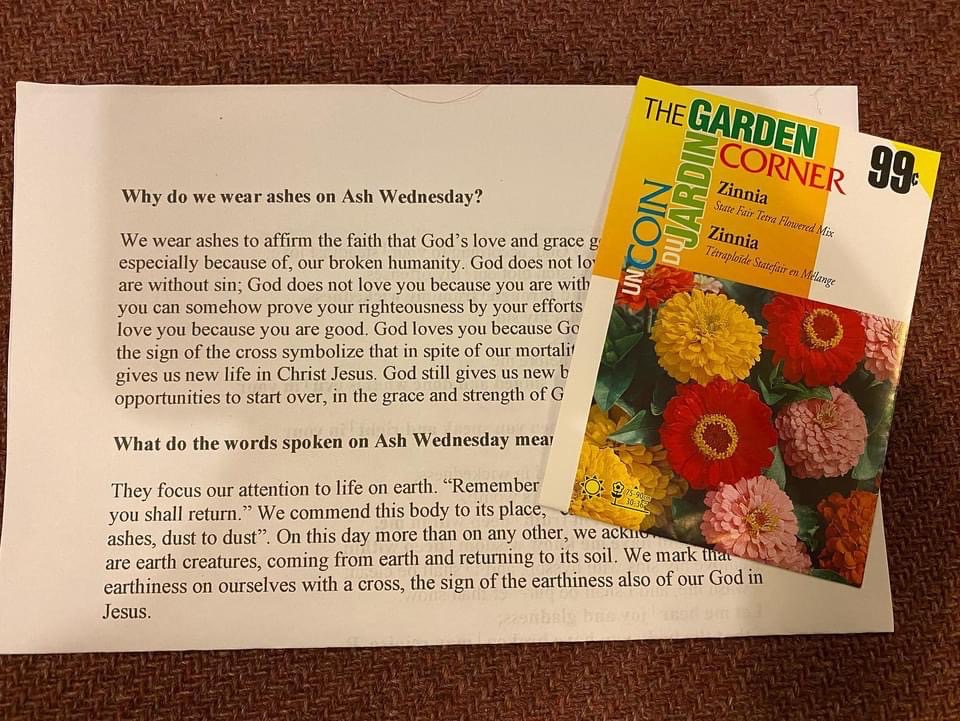
Why do we wear ashes on Ash Wednesday?

We wear ashes to affirm the faith that God’s love and grace go with us despite, and especially because of, our broken humanity. God does not love you because you are without sin; God does not love you because you are without blemish or because you can somehow prove your righteousness by your efforts alone. God doesn’t love you because you are good. God loves you because God is good.[1] The ashes in the sign of the cross symbolize that in spite of our mortality God still loves us and gives us new life in Christ Jesus. God still gives us new beginnings, new opportunities to start over, in the grace and strength of God in and with us.

What do the words spoken on Ash Wednesday mean?

They focus our attention to life on earth. “Remember that you are dust, and to dust you shall return.” We commend this body to its place, “earth to earth, ashes to ashes, dust to dust”. On this day more than on any other, we acknowledge that we are earth creatures, coming from earth and returning to its soil. We mark that earthiness on ourselves with a cross, the sign of the earthiness also of our God in Jesus.

A Prayer for Ash Wednesday

Gracious God, out of your love and mercy you breathed into dust the breath of life, creating _______ to serve you and our neighbours. Call forth _____’s prayers and acts of kindness, and strengthen ____ to face their mortality with confidence in the mercy of your Son, Jesus Christ, our Savior and Lord, who lives and reigns with you and the Holy Spirit, one God, now and forever.

Amen.[2]

Gospel Acclamation

Return to the Lord, your God, who is gracious and merciful, slow to anger, and abounding in steadfast love. (Joel 2:13)

An activity for home during the 40 days of Lent

Plant a packet of seeds in a pot full of soil. Care for the seedlings by watering and providing light. And watch them grow into new life and beauty. Take a photo, if possible, when the flowers are blooming and email to prmartinmalina@gmail.com


[1] Thank you Richard Rohr

[2] Adapted from the Prayer of the Day for Ash Wednesday, 2 March 2022 (Sundays and Seasons online, Augsburg Fortress)

The dust of life

I remember when confetti was no longer allowed during weddings. The church cleaners would otherwise be logging in long hours trying to vacuum those little pieces of coloured paper out from the carpets in the sanctuary.

Those who grieved the passing of the confetti era have a point. Because confetti symbolizes something more than just a mess. When it is a mess with intention, it is a celebration of life.[1]

We may not at first associate the ordinary, simple, mundane aspects of life as worthy of notice. Perhaps it is more a question of focus. Like with confetti – do we see the unbound joy of love in throwing bits of paper over the bride and groom; or, do we see in the confetti an egregious mess waiting to be cleaned up?

On Ash Wednesday, we have to deal with a bit of mess when getting some ash on our foreheads. Of course, this symbol draws our attention to our own mortality. Dust we are and to dust we shall return. We turn our attention thereby to the frailty and finitude of life. And this isn’t a bad thing in and of itself. Because death is the one inevitable of life.

But we must learn how to live with it. How can we think about death when may not know how to live?

In the same chapter from which we read the Ash Wednesday Gospel, Matthew records what Jesus says in the face of the mess of life and an uncertain future.  He draws our attention to common, ordinary things. He turns our gaze towards flowers and fowl. Consider the lilies, they don’t sew or spin but are clothed magnificently. Consider the birds, they don’t plant or harvest, but are fed and cared for.[2]

We might add: consider the confetti at a party. Or, consider the ash placed on your forehead. Frivolous, we might think. Unnecessary. We can do without. 

And yet, we know that the measure of our days is rarely determined in the mind-boggling adventures some are fortunate enough to embark on. Rather, when we remember the lives of those we love it is often the small, simple ways they went about the world that live on in our memories.

The focus our God calls us to is life. The purpose of Lent is life, and our journey towards life abundant which will necessarily involve some loss, some pain. But then, what is the focus? What will our God have us see?

Mangrove trees are normally fresh-water plants, I read. But they are now found living in a tidal river flowing into the Coral Sea in North Queensland in Australia, a body of water which is salt water. How have they survived? How have they lived?

“In the service of survival, they have developed an elaborate root system that filters out much of the salt contained in the river water before it can kill the tree. When excessive salt still threatened the life of these trees, they somehow devised a means to guide the salt to particular leaves, which then turned orange and fell off the branches. These came to be called the ‘sacrificial leaves.’ They died that the tree might live.”[3]

Jesus announced his purpose and mission on earth when he told his disciples that he came so that we might “have life, and have it abundantly.”[4]A momentary affliction of loss has not the final word. “Death has been swallowed up in victory. Where, O death, is your victory? Where, O death, is your sting?”[5]

The message of Ash Wednesday is inherently a positive message of hope, a call to persevere, and a challenge to risk losing in the sure promise of finding something better on the other side. We cannot bypass the way of the cross. But we go on this journey now assured that life, and life abundant, for us await. That is the focus and the aim. It is about life.

In the small, ordinary, sometimes frivolous acts, in the common, daily experiences of living. “How do we live?” ought to be the focus question during Lent.

Be intentional and pay attention enough to ask the cashier how they are doing, when the lines in the grocery store are long.

To relish in deep breaths when the air is finally warm enough outside it no longer freezes our lungs on the way in.

To say ‘yes’ to more snuggles and one more hug when our children request them.

To say ‘yes’ to resting and taking space when our bodies tell us that’s what we need.

In full view of death, we walk a path on which we show up to life. Trusting that the small things matter, or at least that their frivolity is not completely in vain. And we shall live, living in ways that will attract life and give life to the world.


[1]Thank you to Megan Westra for her thoughtful and moving blog for Ash Wedesday (“Confetti Wednesday” at https://mailchi.mp/d6a0d42b1af8/confetti-wednesday?e=8e6a7196da)

[2]Matthew 6:25-34

[3]John Shelby Spong, Unbelievable: Why Neither Ancient Creeds Nor the Reformation Can Produce a Living Faith Today (New York: HarperCollins Publishers, 2018), p.87

[4]John 10:10

[5]1 Corinthians 15:54-55