Unknown's avatar

About raspberryman

I am a pastor in the Evangelical Lutheran Church in Canada, serving a parish in Ottawa Ontario. I am a husband, father, and admirer of the Ottawa Valley. I enjoy beaches, sunsets and waterways. I like to write, reflect theologically and meditate in the Christian tradition.

Can you believe it?

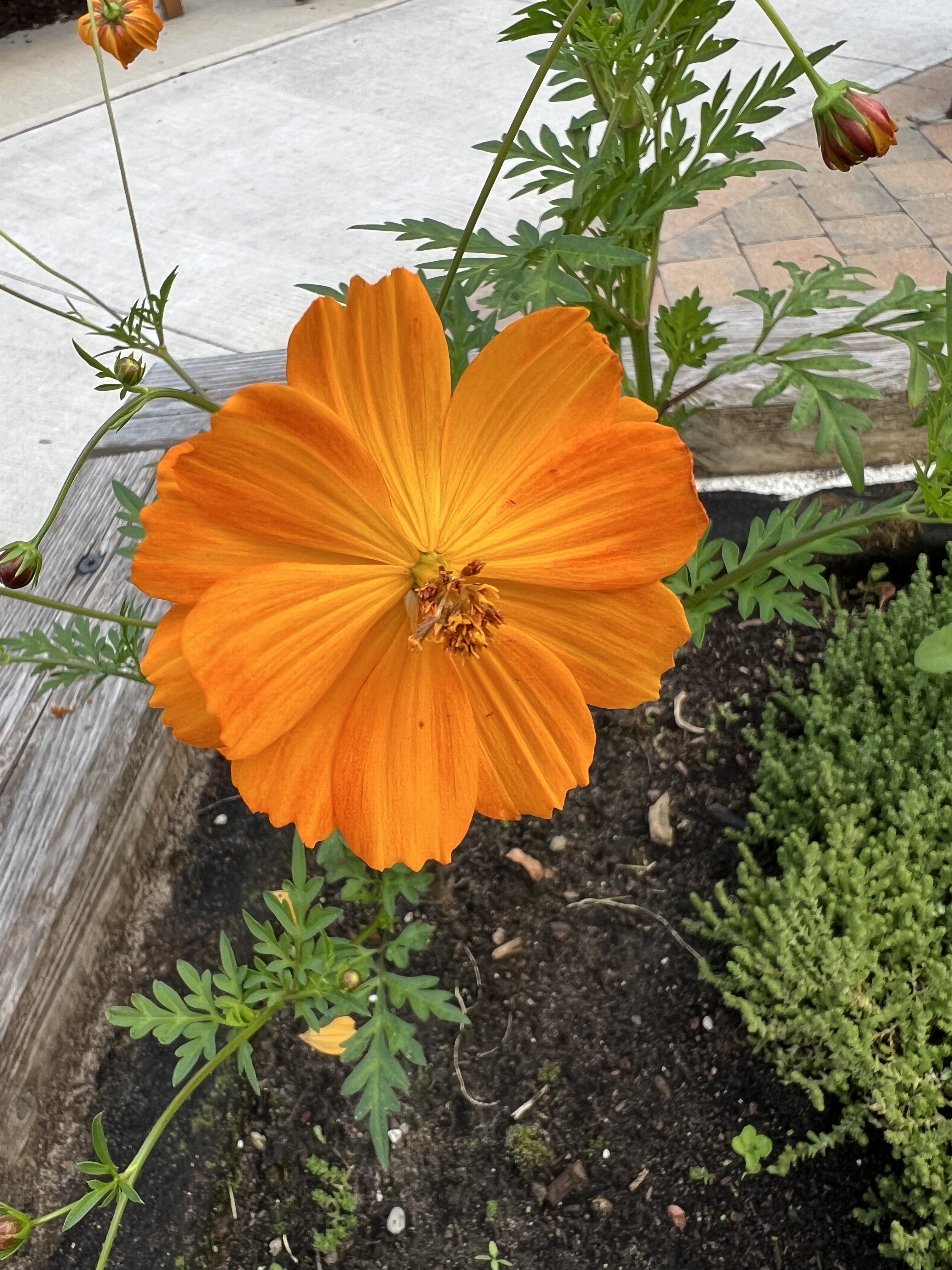
Around Mother’s Day, this past Spring, Jessica gifted my mom a small sleeve of cosmos seeds. Mom then planted them in the community garden in the backyard of her retirement residence.

Residents there take great pride in the flower garden that each year yields a spectacle of colour and shows off their gardening skills.

Before leaving for our West Coast vacation last month, my mom was delighted to report that the first flowering buds were appearing on her cosmos plants.

Two and a half weeks later, when I returned to observe the progress of the cosmos, I had to blink and pinch myself. Was I looking in the right place in the sprawling garden? Because those cosmos flowers were not where I thought they had been.

My mom then told me the drama that had ensued at the retirement home in the time I was away. Someone in the building had ripped out her cosmos. And they were found discarded in the garden shed atop the compost heap. After my mom reported what happened to the front desk, to staff and her friends there, everyone at the home soon knew of the offence. But no one came forward. Who dun it?

As the Sherlock Holmes investigation went into high gear, my mom’s friends quickly retrieved the limp stems from the garden shed, put them in a bucket of water, and a few days later replanted them in another spot in the garden, and soaked the ground with water.

Hoping against hope, they nevertheless warned my mom the ripped out flowers probably didn’t have a chance as it had been over 24 hours they had lain in the hot shed.

One evening the following week, a resident a few doors down from my mom’s room quietly took. my mom aside after dinner and whispered into her ear that she had seen something from her fifth floor balcony the day of the incident.

The culprit was identified, someone who when gently confronted confessed they thought the cosmos looked too much like a weed; and, besides, it didn’t fit in the otherwise manicured looking part of the garden where the flowers had been originally planted. The deed was quickly forgiven, as miracle of miracles, the transplanted cosmos flowers not only lived but thrived in their new location. What drama! What a miracle!

Despite a mistaken floral identity, despite misguided intentions and conflicting visions for the garden, despite the almost certain prognosis of death for the ripped-out cosmos, grace happened.

The Gospel for today from John (6:35,41-51) presents a far more troubling reality for Christians. This troubling reality is a stain and a blemish on Christian history since the time of Jesus. The Gospel writer John specifically mentions “the Jews” (John 6: 41) as complaining and debating against Jesus. Here we glimpse into what John does a few times in his Gospel: portraying Jews, as a whole, rejecting Jesus.

Perhaps this portrayal was understandable from John’s perspective, if it was a response to the persecution of his community by Jewish neighbours in the latter part of the 1st century (Oldenburg, 2024) when this Gospel was first written.

But in the centuries since, it has been Christians who have persecuted their Jewish neighbours, in both subtle and violent ways, and often using John’s gospel as an excuse. Particularly after the Holocaust in the last century, today’s reading, like Good Friday’s, cannot be proclaimed without acknowledging how this gospel has been used to justify not only hate crimes against Jews but by extrapolation any race, culture or religion distinct from ours including Arabs, Muslims and Palestinians.

Retribution is a blight on humanity. From disputes in the garden to geo-political conflict, it seems humanity is destined, if anything, to continue the senseless escalations of a tit-for-tat mentality. Can it ever end? Like the ripped-out cosmos, reconciliation and peace really appear hopeless, causes destined to die on the growing pile of dashed dreams and unattainable aspirations.

I sympathize with the prophet Elijah’s impulse to just escape and hide. Jezebel threatens and warns violent retribution against Elijah. In a way you could say Jezebel’s intent is justifiable after Elijah himself killed the prophets of Baal (1 Kings 18-19). Elijah therefore gets out of dodge, feeling defeated, vulnerable and depressed. He will give up and disappear into the wilderness. What was the point of his prophetic role anyway if he was just going to be killed at the hand of the enemy?

At his lowest point, ready to die under the broom tree, Elijah experiences grace by the miraculous appearance of life-sustaining bread. Even though he was mistaken to leave his followers and run away from his prophetic duties, Elijah is looked after. Even though he was mistaken, Elijah is nevertheless sustained. Even though his thinking on the matter was flawed, it doesn’t stop God.

God has not given up on him. God’s love and favour are not dependent upon Elijah’s morality, wisdom, or consistency, but upon God’s reliability. God’s grace is not dependent on how many mistakes we make, whether or not we make the right decisions all of the time. Judgement is not God’s first response.

God is faithful. And the life God has given to creation will therefore ultimately find a way. The angels attended to Elijah on his escape path in the wilderness. Just like the angels attended to Jesus when he was tempted in the wilderness (Mark 1:12-14). We are never completely separated from God’s gracious, loving presence no matter how deep and far our wilderness wanderings, no matter how deep and far our grief, our depression, our never-satisfied longings.

We all get stuck in killer cycles – be it retribution, anger, fear, despair, anxiety. God will not be phased by any of it. When Elijah is fed and makes his forty-day journey to the holy Mount Horeb, God meets him there and says, “Why are you here?” (1 Kings 19:8).

Get up and get going! God will be with you and give you what you need for the journey ahead. And God will continue being ever-faithful, ever-gracious, ever-loving.

Reference:

Oldenburg, M. W. (2024). Crafting the sermon; Looking at sunday, august 11 lectionary 19, year B 12th sunday after pentecost. Sundays and Seasons. Augsburg Fortress. https://www.sundaysandseasons.com

Into the night

Sunset over Clayoquot Sound, Tofino BC, July 12, 2024 (photo by Martin Malina)

I find it bemusing that the crowd in this week’s Gospel reading (John 6:24-35) is still asking for signs. How many do they need? In the first verse of John 6 from last week’s Gospel, “they saw the signs that [Jesus] was doing for the sick.” And then, after the Feeding of the Five Thousand, the Gospel concludes by validating the faith of the crowd: “When the people saw the sign that he had done, they began to say, ‘This is indeed the prophet who is to come into the world’” (v. 14).

The crowd’s appetite for signs, for proof, is insatiable. It’s like we are never satisfied. Nothing is ever good enough. There is always something wrong that needs improvement. You hear this from, ironically, players on winning sports teams never mind losing ones, when they say: “We can always get better.” Yes, but, what do they expect? That they can play a perfect game? Really?

The religious craving for signs feels a little bit like what is defined today as “spiritual materialism”. Spiritual materialism feeds off ‘signs’. It just leaves us wanting for more but with the expectation that we have to earn it by our accomplishments, and by possessing greater truth for ourselves. It’s tied in with the world’s values and that prosperity gospel notion – a way of doing religion in which we are never permitted to be content with imperfection. We can therefore never allow ourselves to be at peace.

If something I perceive is wrong I need to figure it out. I need to be better and work harder. Fix it. I must hone my skills of discernment, so that in the end I can own or discard the proposition based on my own interpretation thereof never mind what someone else thinks. On this path, everything I perceive is bad must be purged and eliminated. I therefore live in a constant state of vigilance, unrest, and discontentment.

You ask: Do we not want a deeper communion with God? And, can we not learn to tell the difference between right and wrong, good and bad? Absolutely, we can.

But Jesus suggests a way of life that does not deny the two are inextricably entwined. The weeds and wheat must grow together (Matthew 13:34-40), according to a teaching of Jesus. If we are going to grow in faith, we need to learn to live with and accept both realities.

Jesus talked about the mustard seed, which is both good and bad. Pliny the Elder, a contemporary of Jesus, wrote that the mustard seed was medicinal, so it did have some value. But Pliny the Elder advised against planting it because it tended to take over the entire garden. It was a weed that could not be stopped (Rohr, 2024).

Sometimes what we need is found only by embracing those difficult times in our lives as doorways to experiencing God in a whole new and wonderful way.

Because what we need is not validated by proof. What we need is not immediately perceived by observation alone. Let me give you an example. Today, many of us observe all that is not well in the world. And, there is definitely evidence that will support that proposition. These days are like nighttime when the world is blanketed by shadow and ash.

Ironically it is only at nighttime when we can see the stars shine brightly. When we look up at night our spirits rise to the brilliance of the pinpricks of light against the night sky. Ironically it only when we engage, accept and not avoid nor deny our doubts, our pain and the difficulties of life, that we discover a grace of God, a gift or a help coming from a place we never expected.

People of faith through the centuries have used this metaphor of the nighttime for how they still kept faith through their suffering. How did they do that? Did they know something we don’t? Or are they aware of a reality that exists beyond evidence of what we observe on the surface?

You see, those very stars that shone so brightly for us during the nighttime, are they gone during the daytime? Have they magically disappeared? Well, no. Those same stars are shining just as brightly in the daytime. We just don’t see them. But they are still there.

The brighter our surroundings, the more difficult it is to see the stars. And yet, during the daytime of our lives, those are the good times we say. During the day when our sun/star is shining brightly everything is going accordingly, to plan. During the day when our sun/star shines, all is well, and everything is just so.

We cherish those memories of the way things were – so right, so beautiful – in the past. When we could see it all. And everything was as it should be forever more. And so, as I said, we grieve today, that it will never be the same again.

It is significant that Jesus provides a way forward, albeit somewhat cryptically, in his response to the crowd seeking a sign. He says, in today’s Gospel, “… you are looking for me, not because you saw signs, but because you ate your fill of the loaves” (v. 26).

In other words, you connect with God not because you ‘see signs’ but because you experience something that moves you to act. Manna has a purpose. You connect with God not because you’ve figured it out beforehand in your head, but because you receive God’s grace in the wilderness of your life to move on and do what needs doing.

Remember, when all you had was the simple manna that nevertheless sustained you through that difficult time (Exodus 16:2-4, 9-15). It was during the tough times that God’s presence was made manifest, that God was made real to you in the breaking of the bread. And so it is, today.

At the beginning of my vacation Jessica and I attended a Christian Meditation retreat whose theme was “From anxiety to peace”. Our theme speakers reflected on anxiety not as something to deny or try to get rid of on the journey of faith. Healing doesn’t come by denying the reality of what is, including all our thoughts, feelings and behaviours good and bad.

Rather, we were challenged to consider anxiety as the invitation towards peace, the doorway through which we discover deeper understanding and clarity of thought, teaching us to be ok. The wilderness night times offer a way to experience hope by accepting and seeing with the mind’s eye the small wonders of God’s love made real to us. And therefore we don’t need to let fear be our guide.

What are the stars shining in the night for you? The little things that you might miss in the daytime? Those things we easily take for granted? People and situations we overlook in all our hurry?

God, give us peace. God, give us courage.

Reference:

Rohr, R. (2024, July 30). A gracious weed: The reign of God. Daily Meditations, Center for Action and Contemplation. https://cac.org/daily-meditations/a-gracious-weed/

Long spoons

Today I’d like us to consider the story of the feeding of the five thousand (John 6: 1-21) from the perspective of how our needs are met.

It’s a story that often gets repeated in the lectionary so I am sure you will hear this Gospel story again soon. Sometimes the sermon applies the story to feeding the hungry, literally. That’s an important point.

But today I want to ask the question: How are we fed? For what do we hunger in our lives and how are those needs met? Because the main point of the Gospel is that God feeds the hungry, that God meets our needs in ways that surprise us.

On the one hand, each of us will present unique needs. What you ask for, what you offer to God in prayer will not be the same as what the person sitting next to you this morning would express. We are living different lives, experiencing different things at this point in time. So, in part what we need is unique to everyone. We must own that, individually.

On the other hand, everyone in the feeding of the five thousand shared a common, basic need for food. Everyone has needs. No one is self-sufficient in our common humanity. We are all needy. We all need grace, help, forgiveness, mercy, compassion, support. If there is one thing we share is our unique place in a larger, shared web of relationships on which we depend.

Yes, it’s hard to believe it. It’s a miracle everyone is fed. At first, the disciples don’t believe they have enough resources to feed everyone. They don’t even believe Jesus can feed the crowd. And yet, it happens. Surprise! But, how?

Since the miraculous event happened two thousand years ago, humanity has devised all sorts of ways to meet our needs on earth. History has proven that our lives on earth can be a living hell or heaven, depending on how we choose to treat each other.

The story of the Long Spoons, attributed to Rabbi Haim, is told by a teacher, James Overholser (2022). He writes,

“A few years ago, I took two old brooms and sawed off the bristle ends so they could be replaced with two large serving spoons. I brought the long spoons to class, and held one firmly in each hand as I told this story:

“A man is soon to die, but he is given an opportunity to tour the afterlife before his death. During the first stop on the tour, he enters a large dining room and sees many people seated around the table. In the middle of a large round table is a huge pot of delicious hot stew.

“However, the people seated around the table have spoons attached to the end of a long stick permanently attached to their hands. They can aim their spoon for the pot of stew, but because of the long spoon, they cannot bend it toward their mouth. Instead, the stew falls into their lap, causing painful burns. They are sad, angry, frustrated, and starving.

“The man requests an end to the tour, so they leave and go on to the other destination for afterlife. They enter a second large dining room and see many people seated around the table. There is a large pot of stew at the center of the table, and the people all have long spoons permanently attached to their hands.

“However, they are all chatting, smiling, and eating a delicious meal. But they are taking the time to feed each other. [After scooping their spoon into the stew, each of them feeds someone sitting across the table from them using their long spoons]” (p. 74-75).

In teaching this class, Overholser instructs that once each day for a week, students initiate some act that is not simply focused on their own plans, struggles, or interests. But they are to engage in some act that is kind, thoughtful or helpful for another person. In addition, Overholser suggests that it is good if they do not know the person. It is better if they do not like the person. And it is best if the act of kindness is done in an anonymous manner.

How are our needs met, indeed? How are the needs of others around us met?

Five thousand people is not literally five thousand. Other Gospel stories vary the number. Precisely how many, therefore, is not the point. The point is there were a lot of people on that mountainside. And not everyone knew everyone else. Most of them were strangers to each other, or at best, acquaintances besides family members or neighbours who came along.

It’s noteworthy that the act of faith in the story came not from the disciples or appointed few who followed Jesus but from a nameless, anonymous child who alone was willing to share what little they had.

Maybe the child’s generous act caught on.

The miracle of the feeding – I’ve said this before – is not that everyone was fed. Jesus can do anything. He is God, after all. No, in the end could the miracle be that some were willing to share their food to meet the needs of others?

A life of faith, a life of living in the Spirit, is a life lived in relationship, in community. A life of faith is expressed by people doing good things together to feed the need.

We meet our needs in opening ourselves to others. This action accurately describes Christian faith. Richard Rohr summarizes it well. He writes, “We don’t truly comprehend any spiritual thing until we give it away. Spiritual gifts increase only by ‘using’ them” (Rohr, 2024).

When that happens, Jesus is present to us. God becomes visible and recognized not in private pursuits, even religious ones, doing it by ourselves for ourselves. But rather in acts of grace, mercy and generosity.

What are the places in your life where there is room for you to practice feeding the need of another soul? And just as important a question: Who else is sitting at the table next to you who can share both in the giving and in the receiving?


References:

Overholser, J. C. (2022). Respecting the ideas and ideals proposed by Alfred Adler: A personal and professional journey. The Journal of Individual Psychology, 78

Rohr, R. (2024, July 26). Not for ourselves alone. Richard Rohr’s Daily Meditation. https://cac.org/daily-meditations/not-for-ourselves-alone/

Christian Meditation is pro-social

from wccm-canada.ca

Meditation is pro-social, pro-growth, pro-empathic

If you want to dig into the truth about Christian Meditation, you first have to look beyond the superficial, and sweep away certain misunderstandings swirling in the popular mindset. Meditation practice, in general, attracts much negative attention because it is often associated with the following three false assumptions:

Misunderstanding #1: Meditation makes you anti-social

Visions of religious elites cloistered behind fortress walls in remote, out-of-the-way hermitages capture the popular imagination. While introverted personalities are more easily drawn to the ascetic life of silence, stillness and solitude, meditation in fact fosters extraversion. Scientific studies have recently correlated meditation practice with pro-social behaviour. For example, experiments have documented interpersonal benefits arising from meditation interventions in therapy. Meditation doesn’t make you anti-social. Meditation is not an escape from social reality. It is not meant to entice you to avoid difficult social encounters and conversations. Instead, its regular practice improves your capacity to pay attention to others and deepen the quality of your relationships. Meditation practice provides the basis, the grounding, for an authentic and healthy engagement with social reality. Meditation is fundamentally pro-social.

Misunderstanding #2: Meditation keeps you stuck in your ways

Being still during prayer conjures the false perception that meditation abets physiological, emotional, and spiritual stasis. While meditation practice slows down our physical, mental and emotional activity, it doesn’t stop those natural processes. Meditation practice does not lead to inertia. In fact, because we are conditioned for hyper-activity in our culture, it’s more difficult for us to slow down. In meditation, we discover a more natural, simpler cadence for living. Again, scientific studies have recently linked meditation practice with physiological change in regulating heart rate. New neural pathways are forged in our brains. With ongoing meditation practice, the body changes in ways that promote mature growth in relationship with ourselves, to our world and those around us. Our basic physical, emotional and spiritual motivations adapt and change. Meditation practice ultimately promotes continual personal development and growth.

Misunderstanding #3: Meditation makes you selfish and self-centred

In my Lutheran tradition the words of Martin Luther first come to mind. He defined sin as being “turned in on oneself”. Navel-gazing is a popular criticism leveled at meditation. It is therefore rejected as a true prayer practice, especially in Protestant circles. It is easy to categorize meditation with ‘new age’, narcissism and self-preoccupation. In light of scientific findings, blanket assertions that meditation keeps you turned-in on yourself are no longer defensible. In fact, researchers have shown that meditation promotes an other-centred frame of mind. This frame of mind is accomplished by building our capacity for empathy. One study, referenced below, correlated meditation with increased motivation to care for those who suffer. Meditation, if anything, promotes loving concern for others.

John Main famously said that meditation creates a community of love. If anyone wants to belong to such a community in whatever context and grow in compassionate care for others, it is sound advice to start with a meditation practice.

For more information about the practice of Christian Meditation in Canada, please visit www.wccm-canada.ca

References

King, B. G., Zanesco, A. P., Skwara, A. C., & Saron, C. D. (2023). Cultivating concern for others: meditation training and motivated engagement with human suffering. Journal of Experimental Psychology, 152(10), 2897-2924. https://doi.org/10.1037/xge0001431

Lee, M. Y., Eads, R., & Hoffman, J. (2022). “I felt it and I let it go”: Perspectives on meditation and emotional regulation among female survivors of interpersonal trauma with co-occurring disorders. Journal of Family Violence, 37(4), 629-641.https://doi.org/10.1007/s10896-021-00329-7

Growing into the promise

The Gospel doesn’t describe the healing that happens in an individual, one-on-one therapy session between counsellor and client. The Gospel doesn’t describe healing in the context of some individual pilgrimage to a far-off, remote location to find the answer. It doesn’t happen in private. Not in the Gospel, anyway.

Healing, in the Gospel, is a profoundly social experience. In the Gospel text for today (Mark 5:21-43), Jesus finds himself in the middle of a crowd pressing in from all sides. Both the bleeding woman and dying daughter are surrounded by crowds of people with Jesus in the middle of it all. They are touching him, bumping into him.

As I sat down to watch one of the home games of the Stanley Cup Finals from Edmonton, I was impressed by the tradition there of singing the Canadian national anthem. For a couple of reasons.

The traditional way is for someone, usually with a pedigree for singing – a celebrity musician – to stand alone on the ice with the spotlight on them. It’s really a performance, and they are the only one singing the anthem.

But for those Edmonton games, with nearly 20,000 fans surrounding him, Opera singer, Robert Clark, stayed in the stands, in the middle of the crowd, pressing close in.

(from Sergei Belski USA TODAY Sports)

Then not even halfway through singing the anthem, he stopped, turned the microphone out, and let the crowd finish singing the Canadian anthem. It was spine tingling to hear the national anthem sung with gusto not by the performer but by the whole crowd.

Their singing together wasn’t a refined performance ever rehearsed. It was in the moment, and for me inspirational, not so much what they were singing but that they were singing it together – 20,000 voices strong.

It is for me a wonderful picture of what the church is about. Jesus hands it over to us. The healing and the growth involve each of us, pressed together, in community.

A whole new slate of leaders of the Eastern Synod of our church were elected last week. Many new Synod council members were elected. New officers were elected – Treasurer Fred Mertz, and Secretary Chris Hulan. A new vice chair – the first ever from Atlantic Canada, Sara Whynot – was elected. And a new bishop – the first ever female bishop in the Eastern Synod, Carla Blakley – was elected. The turnover was significant, offering, in her words, “the promise of a new tomorrow”.

And yet, the church at this time, seeks healing and wholeness in a season of budget restrictions. Benevolence giving – that is, income received to the Synod from congregations – has been on a steady decline since 1992. Over recent years Synod budgets have relied more on investment income to fund its mission goals, four of them, which are: 1. Providing support to the Synodical community; 2. Developing capable leaders; 3. Connecting to the wider church through effective partnerships; and, 4. Living as a healthy Synod.

Amidst these goals, and in this time, how do we embrace the promise of a new tomorrow? In his last sermon to the Synod as bishop on the closing day of the Assembly, Rev. Michael Pryse talked about our baptism.

“Think of baptism,” Bishop Pryse said, “… as a garment. Only it’s kind of like the sweaters that your mother would buy for you when you were a kid. Remember … arms down to the knees? She always bought them a few sizes too big so that you “had room to grow into them.” Baptism is kind of like that. Galatians talks about baptism as “putting on Christ.” But baptism is a garment that we’re always growing into…always in the process of filling out.

“Luther called baptism a ‘once and for all event which takes your whole life to complete.’ I really like that! Baptism happens but once, but it is a beginning point in a never-ending process of renewal. We’re always growing into it … always in the process of reclaiming its promises and benefits. Baptism gives us an identity … but it also gives us a purpose and a task that we carry with us throughout our earthly lives.”

At the Synod Assembly last week, we were all together, in person, for the first time since a couple of years before the pandemic – so it’s been six years. During worship, at the banquet, in sessions, around committee tables we were pressed in close, closer than I was used to, shoulder to shoulder. We were building community, realizing how it felt to be together again in a bigger way.

“You have often heard it said that the church is like a family,” Bishop Michael went on to say. “And certainly, the most important thing a family does for us is to tell us who we are. The family gives us identity … gives us place … gives us, hopefully, a true sense of self.

“That is one of the church family’s essential tasks…to tell us who we are…to nurture and sustain the baptized in their God-given identity. That’s part of what we do every week in our worship services. “Rise and go, your sins are forgiven.” The body of Christ given for you.” “Go in peace, serve the Lord.” We’re practising the virtues of the kingdom. We’re affirming and building up our essential and fundamental identity as baptized children of God…an identity that we’re always growing into…always experiencing in a fuller way.”

For many Canada Day is also about reaffirming our national identity. It is a collective identity that is growing in rich diversity, multi-cultural beauty as well as a growing awareness of our troubled history and acceptance of the challenges that face a growing population. The church has a place in all of this, to model and bear witness to the virtues of the kingdom, our fundamental baptismal identity in Christ.

And even though that identity may sometimes feel like it’s too big for us – too challenging, too scary – we will grow into the promise. After all, growing into Christ is a lifelong journey of growth.

And as we grow we will sing! We will sing our identity out loud. We will sing it out, imperfectly and unpolished, but with the whole people of God together sounding out God’s love for all. Sounding out that each person has dignity and has been created by God out of love. Sounding out the call to care for one another, and to work towards peace and justice for all. So, in the coming season, let us sing!

Heaven and earth – a funeral sermon

Strive first for the kingdom of heaven (Matthew 6:33)

Not long before she died, Bev shared with me a childhood memory: On her way to Sunday School with her brother, they ran across the yard and down the street. But alas! Dressed in her Sunday best, she tripped right into a puddle of mud, splattering her pretty dress. She didn’t end up going to Sunday School that morning, but the reason I think she remembered this incident was because of what happened next …. (I’ll tell you at the conclusion of the sermon!)

In her mind Bev strived for the higher ideal. In that sense, her vision was skyward, upward. Bev’s standard was golden. Her thinking, sharp. Her ideals cut to the chase. And there was no arguing.

Striving is about looking up. Almost every time Bev came to worship recently, she would take my arm at the door on the way out, and look me in the eye and say, “Psalm 121”. This is the Psalm she wanted read at her funeral, I think to represent her ideals. There’s this energy about looking up for help, far and away, to that high, transcendent point just beyond reach.

This section from the Psalms in which we find Psalm 121 is called the “psalms of ascent” reflecting the inspiration of the song writers singing their way up the path toward the city of Jerusalem. Coming up the path you couldn’t help but look up at the magnificent gates entering the city. “I look to the hills from where is my help to come? My help comes from the Lord who made heaven and earth…”

Heaven and earth. Heaven is for striving and looking up. Heavenward represents our deeply felt longings and aspirations not yet fulfilled. Striving for the goal, the destination, where upon the mountaintop in that beautiful imagery from the prophet, the Lord will make a feast for all, and death will be no more (Isaiah 25).

But the Psalmist doesn’t stop at heaven. “My help comes from the Lord who made heaven and earth.

The downside of only looking upward is that we will trip and fall when things get messy on the ground. Looking downward from time to time is part of the journey of faith, maybe a part we want to avoid, deny and skip over all together. But looking downward is the only way forward in faith.

When my family first moved into our newly constructed house over eleven years ago, it was at the time only roughed in for central vacuum. During coffee after worship one Sunday I happened to mention I was on the lookout for what kind of central vac system to install. And Beverley Milton was first up to give her advice. “Go with Kanata Vacuum, it’s just around the corner from my place, and they’re good,” was all she said. All she needed to say.

You see, when she first moved into her house over thirty years ago, she installed floor-to-floor carpeting. Fast forward to a couple of months ago: When the new owners bought her house, that very same carpet was in such good shape they did not need nor intend to replace it. Bev’s advice was golden. Every time I vacuum at home, especially in the last couple of months, I think of Bev and give thanks.

The last time I was in Bev’s house was in the Fall last year when family gathered around her dining room table – Leslie and Bev, Susan, Scott and Marilyn, Lauren and Colin – for a delightful meal and spirited discussion. But in order to eat, to receive the good gifts of the earth, what do have to do? Well, we need to look down, from time to time.

Lord, you have put all things under their feet (Psalm 8), the Psalmist also says.

While heaven is for striving and looking up, earth is for looking down and gathering in the gifts of the moment in real time. One of Bev’s favourite sayings was: Yesterday is history, tomorrow is mystery, today is a gift; that is why it is called the present. God is, after all, the maker of it all, of heaven and earth.

Your family gathered around that dining room every Sunday for decades. It’s a mealtime table memory I am sure you will cherish forever. Ever thankful, ever grateful, we look down to see where we are planted, where we find our place in this world. And being grateful, even if only in our memory, gives us peace, too.

That table sat on the carpet, don’t forget. Most of the time we don’t think about it, don’t notice where we are walking or sitting. We aren’t looking down at it but it’s there, holding us, grounding us, embracing us, literally. And when we do take the time to stop and look, we might notice the quality and durability of it. And give thanks.

It’s a matter of perspective, of course. I am captivated by a photo taken from a commercial airliner flying over Mount Everest, the tallest mountain in the world. From on high, the mountaintop does not look as daunting. From on high, everything is seen from a larger perspective.

from Astronomical Discoveries (@deAstronomical1) on X-Twitter

Today, Bev doesn’t need to strive in her mind anymore. Her perspective in communion with God holds it all, the big picture. She doesn’t need any more to toil on the ground reaching upward and yearning for some transcendent place far up and away. Now she can look down and smile at all the good gifts on earth each one of us can still enjoy. If we will but stop and take notice.

It’s appropriate we celebrate Bev’s life today, in the neighbourhood in which she spent many years as a child growing up, in “Little Germania”, I hear the New Edinburgh area was called. In this neighbourhood over 90 years later we gather to remember her life that started in this place where she went to Sunday School, played with friends and attended school. Close to the ground. It started here. She’s come full circle. But it doesn’t end here, for her and for us.

May God bless us on our journeys of striving, of yearning, of looking upward. May we also cherish those moments when we can look down and around, even if it’s sometimes messy and maybe not quite so perfect here, to see the gifts of the earth nourishing our souls every day.

By the way, that childhood memory didn’t end with her looking down at her spotted, mud-splattered Sunday dress. It ended with her turning around and running home straight into the loving arms and embrace of her mother, who told her, it was alright.

Amen.

Ye of little faith

A couple of weeks ago I showed you the new logo for the ELCIC. One aspect of the new logo caught my attention: The bird with a tree branch in its beak.

It took me back to the story of Noah and the flood in the book of Genesis. After the ark with Noah, his family, and all creatures of the earth onboard had been sailing on the flooded earth for over a month, with no land in sight, a dove he had sent out regularly finally returned with a freshly plucked olive leaf in its beak (Genesis 8:6-12) – a sign that the waters had receded! Even though still not visible to Noah, there was land somewhere in the distance over the horizon. There was hope.

The branch in the bird’s beak takes up nearly half of the circle in the new logo for the church. Of course, the dove appears elsewhere in the bible and Christian tradition – at Jesus’ baptism (Mark 1:10), for example and as a sign of the coming Holy Spirit from the heavens.

Its prominence in the logo suggests what our faith today means, and maybe what it needs the most. I have a stained glass depicting this scene hanging on the window of my home office. It’s right above my computer screen so it’s in my line of sight when I look up.

Maybe you feel flooded, drowning, flailing about in waters too deep. Maybe you are in over your head with worries, stresses, a fragile state of mental health, hanging in the balance. Maybe your anxiety and fear are off the charts. Maybe your grief and loss go so deep you don’t believe you will ever recover. Maybe you see no hope for the future in this complicated world. Maybe you despair over all the violence, death and war in the world today.

Maybe all you long for, all you need, is for that dove to land on the railing of the boat you are sailing with a leaf in its beak.

Today’s Gospel starts with a small seed. Jesus teaches his disciples about what God is all about in this world, in this life. Because sometimes it will grow. Sometimes the smallest thing will become the largest of all (Mark 4:26-34), providing shelter for all the creatures of the air.

Elsewhere in the Gospel when Jesus teaches us not to worry, he points to the birds of the air showing how much God cares even for the littlest of sparrows. And in his sermon (Matthew 6) Jesus addresses his disciples with the words: “Ye of little faith.” Ye, of little faith.

For the longest time I had taken his address to be somewhat of a slight, a scold, a put down from Jesus, a test they had failed, coming up short again. I imagined Jesus shaking his head, disappointed at his disciples’ thick headedness. “Ye of little faith.” Dim-wits.

But taking these passages together, I have since revised my interpretation.

You see, Jesus expresses the same in the story of Jesus calming the storm on Lake Galilee. In some English translations, you find an extra word added, “oh”. As if to drive home the finger-wagging interpretation: “Oh, ye, of little faith!” (Matthew 8:26, English Standard Version).

But in Greek, that little exclamation “Oh” is not found in the text. It is, simply, “You, of little faith.” Furthermore, the preposition “of” is also not there. So, the phrase can be translated, “You have a little faith.”

“Ye of little faith” is not a critical, condescension. But a positive affirmation. “Ye of little faith!”

Because the “earth produces of itself” anyway, that’s all you need.

Because God makes the seed grow in the first place, that’s all you need.

Just a little bit of faith. That’s a good start! It’s all you need.

So quick we are to remove ourselves from consideration, even before we begin. So quick we are to dismiss ourselves, put ourselves down, and say, “Oh, I don’t have enough faith. I’m a bad person. I can’t.” Feeling this, admitedly, is completely understandable and needs to be validated – life is tough after all. We can’t bypass our initial feelings and thoughts.

But can we not at least consider that Jesus affirms what little faith we think we have, to be just what we need? Can we not imagine that Jesus is right there beside us, whispering into our hearts. “Ye, of little faith. I’ve planted a seed in your heart. It wants to grow. It will grow. Just trust me. Trust in God’s love and grace for you, ye of little faith.”

Ye of little faith is a love letter from Jesus. As we walk by faith on this earth, that’s all we got. Just a little, to be sure. But Jesus’ sermon is about the promise that a little bit goes a long way. A little bit is all you need. That small seed is going to grow!

Noah and his family were coming to a new home, after the flood waters receded. On their way, they needed a little sign of hope. That olive leaf in the beak of the dove was all they needed – at the right time and in the right place – to encourage them on the way.

We are on this journey home. Home can be a healing, a changed state of being, a transformed way of behaving and acting in relationship with one another and the world. Home can be a reaffirmation of family, of who is important in your life. Home can be a final destination of a life’s pursuit or in full union with God.

That journey is sometimes hard to make, but we carry on. How?

Staying with the flood image, I am reminded of the story of the little fish swimming up to its mother, all in a panic. “Mama, Mama, what’s water? I gotta find water or I’ll die!”

We live immersed in all that we need but we sometimes have a hard time appreciating and accepting that fact. We miss it not because it is so far away but because, paradoxically, it is so close, closer to us than our being itself (Bourgeault, 2001).

God’s gracious presence is the water in which we swim. And on this journey, we continue on, trusting that when we need it, God will give us a sign of hope to nurture the little seed of faith in our hearts. Just like that little fish swimming desperately in search of water, we, too, in the words of Psalm 103:11, “swim in mercy as in an endless sea”.

Ye, of little faith.

Amen.

Reference:

Bourgeault, C. (2001). Mystical hope: Trusting in the mercy of God. Cowley Publications.

Spilling out through the cracks

Saint Paul equates our humanity to clay jars (2 Corinthians 4:5-12). So, how do you feel in your clay jar today? What’s the condition of your clay jar?  Is it all pretty and beautiful? Or, is there a lot of dust caked onto it? Does it show its age? How fragile is it? Does it have a few chips or cracks in it already? Maybe, many chips and cracks.

But wait! We carry a treasure in our clay jars, did you notice? It’s not to say the clay jars aren’t important. They fulfill, after all, a vital function – to carry the treasure!

What do we first notice? On what do we focus? The cracks, chips, dysfunction, imperfection of our clay jars? Or, will we look for the light, the hope, the promise of the treasure within?

Whatever our answer, we cannot deny, avoid or pretend away our clay jars as if they don’t mean anything important on our journey of faith. Sometimes the cracks, chips, injustices on the outside reflect the nature and purpose of the treasure it holds inside.

Sometimes the un-exceptional reality points to the truth about God’s “extraordinary power” (v. 7) and points us in the direction of our healing and transformation. After all, we are not disconnected, disembodied creatures existing in cerebral, otherworldly abstractions. The clay jars are just as important – these are the means of grace.

In the Gospel for today, Jesus plucked grains of wheat, mentioned King David eating the bread in the temple, and he healed someone with a broken hand (Mark 2:23—3:6). The clay jars are indeed the entry point, the gateway, into a holy journey of healing, growth and communion with Jesus.

An ancient proverb is told of a servant whose duty it was to draw water from the river at dawn when it was still mostly dark, and carry a bucket-full up a winding, rocky path to the mansion where his master lived. Alas! His bucket had a crack in it. And each time he brought water up the path he lost most of it.

Curiously, the servant noticed his master standing at the door of the mansion watching him every day carry this water up the path, spilling most of it. And yet, the servant was able to see a broad, loving smile on his master’s face. Daily, the servant would drop to his knees when he reached the top. At his master’s feet the servant would express his remorse at failing to do his job, bringing only half a bucket-full of water each time he climbed the path. The master listened lovingly, invited him inside for breakfast, and encouraged him to try again the next day. Which the servant did, faithfully, for the entire season.

When the river froze over, and the last half-bucket full was brought up the path, and once again the servant expressed his shame, sorrow and regret, the master invited him inside to share in a special feast to mark the end of the season and beginning of a new one. On the table spread with the finest breads, vegetables, cheeses and meats, he found bouquets of flowers of the most wondrous varieties and colors.

The servant gasped at the heavenly sight and asked his master, “From where did you find these beautiful flowers?”

“Come, follow me,” the master said, “and see for yourself.” The master led the servant back to the front door just as the sun was rising, illuminating the pathway down to the river. And on both sides of the path the flowers were growing, able to do so because of the water that had daily leaked out from the servant’s cracked bucket.

This story describes how God’s grace works. Grace operates through the cracks of our lives. That’s how the precious treasure we carry spills out.

The new logo and tagline for the Evangelical Lutheran Church in Canada was released last week. The tagline replaces “In Mission for Others” with “Living out God’s Grace and Unconditional Love” (ELCIC, 2024). The logo conveys hope and the never-ending circle of God’s love whose centre is the cross. As in the Gospel today and so often in Jesus’ earthly ministry, grace and compassion fuel Jesus’ action (Mark 2:23-3:6).

The journey of faith puts us in tension with all the forces in us and outside of us that seek to snuff out the light of God’s grace. Yes, these jars are indeed fragile, vulnerable, imperfect and we wonder if they are strong enough, durable enough, to withstand the onslaught. We may even get down on ourselves, concluding we are useless, falling on our knees confessing and even dwelling on all that is wrong in us.

But Saint Paul makes clear that when the treasure does spill out to the world, it is God’s doing not ours. After all, the treasure we hold—the heart of Jesus—is not ours to guard and keep. Its purpose is to shine out to the world through the cracks in our clay jars. Its purpose is to be visible in the world as an act of kindness, a generosity and unconditional gift we give because we first have received it. We may even be doing it without knowing it, or when we least expect it.

These clay jars convey the tender mercies and grace of God which is at the heart of Jesus and in the hearts of all who want to follow. Our healing begins when we experience the grace of God showing through those very cracks and chips in our lives. And that’s the extra-ordinary power the world needs to see. May God’s grace empower us on this journey.

Three Sisters

It’s our congregation’s birthday today! Holy Trinity Sunday is the anniversary of Faith Lutheran Church’s official organization in 1961 when we were still meeting at Fisher Heights Public School. Happy birthday, Faith!

Birthdays are about gifts. On our birthday we receive gifts. So, what gifts do we receive today? And what gifts do we already have? And what are they for?

At this time of year, many are planting seeds, flowers, crops. The gardens and flowerbeds are being cleaned up and prepared for new growth. We have lots to learn from farmers, people who work the land, who are busy at this time of year because of their unique connection to the earth. And we have lots to learn from different ways of farming, because each offers insight and reflects wisdom about gifts.

Nicodemus is a teacher of the law and a respected leader of the faith. Jesus challenges him, however (John 3:9-10). Using a rhetorical question (“Are you a teacher of Israel, and yet you do not understand these things?”), Jesus basically suggests Nicodemus appreciate another way of knowing. Jesus is not condemning Nicodemus’ way of knowing; it’s not bad. But, from Nicodemus’ perspective, he would do well to learn another way and seek its wisdom; that is, the way of the Lord.

By way of analogy, we can do the same and practice thinking outside the proverbial box. Let’s explore Indigenous wisdom when it comes to their relationship with the earth. For example, when colonists settled in the northeast centuries ago and saw First Nations gardens, they were surprised. To the settler mind, a garden meant straight rows of a single species. But that’s not how, for millennia prior to the white man’s arrival, people farmed here.

Robin Wall Kimmerer (2015, pp. 128-140) describes this gardening style as “The Three Sisters”, where three different seeds were laid in the ground, all in the same square foot of soil (I adapt her words here):

“Once planted in the May-moist earth, the corn seed takes on water quickly. It is the first to emerge from the ground, a slender white spike that greens within hours of finding the light. Corn is the first sister. It is all alone at first, while the others are getting ready … Making a strong stem is its highest priority at first. It needs to be there for its younger sister, the bean.

“The bean seed is the second sister. Only after the root is secure does the stem bend to the shape of a hook and elbow its way above ground. Beans take their time unfurling their leaves out of the two halves of its seed. The leaves then break the soil surface to join the corn which is already six inches tall … The bean focuses on leaf growth, all low to the ground, until the corn stalk is knee high. Then, the bean shoot changes its mind.

“Instead of making leaves, now the bean plant extends itself into a long vine, a slender green string with a mission. The tip can travel a meter in a day until it finds what it’s looking for – a corn stem or some other vertical support, to wrap itself around in a graceful, upward spiral. Had the corn not started early, the bean vine would strangle it. But if the timing is right, the corn can easily carry the bean.

“The squash or pumpkin seed is the third sister which takes its time. They are the slow sister. It may be weeks before the first stems poke out of the ground. It steadily extends herself over the ground, moving away from the corn and beans. Its leaves and vines are distinctly bristly, giving second thoughts to nibbling caterpillars. As its leaves grow wider, they shelter the soil at the base of the corn and beans, keeping moisture in, and other plants out.

“The lessons of reciprocity are written clearly in a Three Sisters garden. No leaf sits directly over the next, so that each can gather light without shading the others … Each plant has its own pace and the sequence of their germination is important to their relationship and to the success of the crop.”

So, what gifts does each offer?

“The corn takes care of making light available. The squash reduces weeds. But what is the gift beans offer? To see her gift you have to look underground … Beans are members of the legume family, which has the remarkable ability to take nitrogen from the atmosphere and turn it into usable nutrients for all the plants. This process occurs on the beans’ roots.

“The Three sisters teach us the important lesson of knowing our unique gift and how to use it in the world. Individuality is cherished and nurtured, because, in order for the whole to flourish, each of us has to be strong in who we are and carry our gifts with conviction, so they can be shared with others. Being among the three sisters provides a visible picture of what a community can become when its members understand and share their gifts …

“The message of this garden is: respect one another, support one another, bring your gift to the world and receive the gifts of others. And there will be enough for all.

“The Three Sisters embody, in leaf and vine, the knowledge of relationship. Alone, bean is just a vine, squash an oversize leaf. Only when standing together with corn does a whole emerge which transcends the individual. The gifts of each are more fully expressed when they are nurtured together, rather than alone. In ripe ears and swelling fruit, they counsel us that all gifts are multiplied in relationship.”

Listen to Saint Paul’s words:

To each is given the manifestation of the Spirit for the common good. To one is given through the Spirit the utterance of wisdom, and to another the utterance of knowledge according to the same Spirit, to another faith by the same Spirit, to another gifts of healing by the one Spirit, to another the working of miracles, to another prophecy, to another the discernment of spirits, to another various kinds of tongues, to another the interpretation of tongues. All these are activated by one and the same Spirit, who allots to each one individually just as the Spirit chooses. (Saint Paul, 1 Corinthians 12:7-11)

And, may we be like Isaiah who responds to the Spirit’s nudging, saying, “Yes, Here I am. Send me!” (Isaiah 6:8). May our prayer rise: Bless the gift you have given to me, to share with the Body of Christ and the world. Empower me, and everyone else in their gifting, to let your gift flourish in and through me, for the sake of the common good. Let this be our Pentecost season prayer.

May the words of Jesus resonate in our hearts this day as the greatest gift we receive, the message that it is God’s love and grace that holds all relationships together. For God so loved the world, that in Christ and in the dance of the Holy Trinity, like the Three Sisters, all will be saved (John 3:16-17). All will have enough. All will share with each other their gift, in Christ, forever.

What is the gift you have received? And what will you do? How will you share it for the common good?

Reference:

W. Kimmerer. (2020). Braiding Sweetgrass: Indigenous wisdom, scientific knowledge and the teachings of plants. Penguin.

Candles and campfires

The sermon today is about containing the flames. Recognizing limits. Respecting boundaries. Without recognizing limits, respecting boundaries and containing the impulse energy, we have problems. Even big ones.

Wildfires are already burning out of control in Western Canada this year (Tait et al., 2024). Hopefully the upcoming wildfire season won’t be as bad as last year’s, when a record eighteen and a half million hectares went up in flames—an area twice the size of Portugal—shattering the previous annual record almost three times over (Milman, 2023). The signs aren’t good. Even locally. I don’t recall ever having a fire ban in effect already at the end of March, as we had early this Spring in the Ottawa Valley.

In the Gospel for today, Pentecost Sunday, Jesus announces limits that we would do well to acknowledge. “I still have many things to say to you,” he tells his disciples. “But you cannot bear them now” (John 15:12). To curb our insatiable desire to know it all now. The limits of knowing everything. The limits of our capacity to understand the whole truth all at once. Can we live with that? Can we live positively in that state of constant unknowing?

What Jesus points to in this Holy Spirit season of the church is our transformation, our growth in the Spirit. And this transformation is not a one-time-event that happens on the surface of things. It is an ongoing process, a deepening journey regardless of our age and life experience. We never stop learning. We never stop realizing that we don’t know it all.

One of my favourite activities year-round but in the summer I can take it outside, is lighting a small flame. Inside, it’s candles. Outside, it’s in a fire pit. But fire pits have a circle of stones or a steel wheel drum encasing, encircling and holding the otherwise dangerous fire.

The shape of the container is important. Most candles and campfires are round. The fire of passion, of love, of deep feeling is contained in the circle. The circular container describes anything we can see in its wholeness and three-dimensional depth, slowly coming into focus. (McGilchrist, 2019, p. 447). How so?

I’ve never thought about it this way, but circular motion actually brings together opposite points. Perpetually. Difference is not something to avoid or deny in striving for unity, for harmony. The unity, the oneness, of which Jesus prayed for his disciples in the Gospel last week (John 17: 11), is not a melting pot where distinctions are suppressed or erased. The truth is quite the opposite.

Two wildflowers growing at this time of year illustrate the value of difference. Canada Goldenrod and New England Aster grow together. Especially when the soil is damp enough, neither normally grows alone in the fields (W. Kimmerer, 2015, p. 40). The gold of goldenrod and the deep royal purple of aster, together. According to botanist, scientist and writer Robin Wall Kimmerer, each by itself is a “botanical superlative” (p. 41). Together, however, the visual effect is stunning. Purple and gold.

Why do they stand beside each other when they could grow alone? A random event that just happens to be beautiful? But Einstein himself, the consummate scientist, said that “God doesn’t play dice with the universe.”

According to the colour wheel, of course, purple and gold are complementary colours, as different in nature as could be. In an 1890 paper on colour perception, Goethe, who was both a scientist and poet, wrote that “the colors diametrically opposed to each other … are those which reciprocally evoke each other in the eye” (cited in W. Kimmerer, p.45).

So, why do goldenrod and asters grow together and not apart, alone? Because, in short, pollination.

Though bees perceive many flowers differently than humans do, due to their ability to perceive additional spectra such as ultraviolet radiation, it is not the case when it comes to goldenrods and asters. “As it turns out, golden rod and asters appear very similarly to bee eyes and human eyes … Their striking contrast when they grow together makes them the most attractive target in the whole meadow, a beacon for bees … Growing together, both receive more pollinator visits than they would if they were growing alone” (W. Kimmerer, p. 46).

To perceive contrast and difference, is better for the whole. In our growth, spiritually, we see the world more fully when we see both, when we recognize and value difference. Belonging to the circle, being one with another is a statement of faith that in our diversity we find unity. In our differences we grow and benefit not only ourselves but the whole world.

The church is not an exclusive country club for a select, elite few who are like minded and all look the same. The church is for all. The church realizes its true identity the more diverse it is, the more variety of people we encounter in the circle is a testimony to the truth of God’s design, God’s reign. It was true on that first day of Pentecost (Acts 2:1-21). And it is true today.

The circle of our planet’s atmosphere protects us, on a large scale, from the sun’s fire. The northern lights, or the aurora borealis, are beautiful dancing ribbons of light that have captivated people for millennia. Some of you got up in the middle of the night last week to witness this cinematic atmospheric event in Canada. But for all its beauty, this spectacular light show is a rather violent event. 

The northern lights are created when energized particles from the sun slam into Earth’s upper atmosphere at speeds of up to 72 million kilometres per hour. But our planet’s magnetic field protects us from the onslaught (Space.com).

We need containment, as humans, why? Because our love is not perfect. Our love fails time and time again. And we give in so often to the dangerous fires of hatred and impulsive action that excludes and harms others.

Nevertheless, there are moments. Our human perspective can perceive moments of the unbounded, universal, fire of God when we literally and spiritually look to the heavens. This incredible power, witnessed by God’s creation, is a power reflecting God’s love for us all.

God’s fiery love cannot be doused. God’s love reigns. Because the “ruler of this world has been condemned” (John 16:11). The ruler of our hating impulses, the ruler of our retributive justice, our violence, the ruler of the unbridled flames of this fire will be doused. And the reign of God will unite and hold us all in loving embrace forever.

References:

McGilchrist, I. (2019). The master and his emissary: The divided brain and the making of the western world (2nd Ed.). Yale University Press.

Milman, O. (2023, November 9) After a record year of wildfires, will Canada ever be the same again? The Guardian. https://www.theguardian.com/world/2023/nov/09/canada-wildfire-record-climate-crisis – :~:text=Fire ravaged Canada in 2023,record nearly three times over

Tait, C., Woo, A., Link, H., & Arnett, K. (2024, May 14). Fort McMurray residents to evacuate as wildfire approaches community. The Globe and Mail. https://www.theglobeandmail.com/canada/article-fort-mcmurray-residents-ordered-to-evacuate-as-wildfire-approaches/

W. Kimmerer, R. (2015). Braiding sweetgrass: Indigenous wisdom, scientific knowledge and the teachings of plants. Penguin.