Unknown's avatar

About raspberryman

I am a pastor in the Evangelical Lutheran Church in Canada, serving a parish in Ottawa Ontario. I am a husband, father, and admirer of the Ottawa Valley. I enjoy beaches, sunsets and waterways. I like to write, reflect theologically and meditate in the Christian tradition.

Candleholders

We ran into a crisis that, in the end, wasn’t a crisis. In fact, it could not have conveyed the meaning of today more appropriately.

It was the crisis of the candles. Every year, weeks before All Saints Sunday, we do an inventory of the candles that we light in memory and in celebration of the saints we name today. Of course, every year there is a different number of people we remember, and therefore a corresponding number of candles. And sometimes, depending on our stock, we might need to order more.

So, there is a bit of stress, especially if we need to order more and time becomes a factor. This year, our dedicated altar care group assured me that we had enough candles.

But, there was a catch. We had used them before, probably during All Saints Sunday worship last year. Though these candles were all uniform and about the same length, they were not new out of the box. Pause.

When we discussed the situation, I wondered out loud about this belief we have when it comes to celebrations – that every individual deserves their own, unburned candle. It’s like the fact that many people, like myself, share a birthday with someone else in the family. Don’t we deserve our own day? “It must be tough,” some have commiserated with me, “sharing the limelight with someone else!”

Indeed, we tend to centre meaning on the individual. That’s a whole lot of pressure we put on ourselves – to make it or break it! We therefore value self-reliance and seek reward for our individual achievements and successes.

When our faith is dependent on ourselves, individually, we at the same time create a culture in which people have a hard time asking for help. We resist relying on and learning from others. We see that as weakness.

This is one of the lingering legacies of the Reformation. While Martin Luther brought the bible to the people and encouraged a personal engagement with scripture and sacrament, his legacy also individualized faith. The lasting consequence was to leave us believing everything important hangs on the balance of individual decisions.

Consequently our sense of community erodes and our connection weakens not only with each other on earth but with the “mystical union” (Prayer of the day, n.d.) we have with all the saints in heaven, in Christ.

When you grieve the loss of someone special in your life, for example, what do you believe about your connection with that loved one right now? To what degree is the relationship over? And, if you believe it isn’t over, how has that relationship changed?

On All Saints Sunday we counter the tendency to individualize everything, and affirm instead that we stand on the shoulders of those who have gone before us. We light candles that have already burned before! In our baptism we unite with all the saints on earth and heaven. As Luther famously said, we belong to the priesthood of all believers, in every time and every place. Each of us belongs to and is part of something much bigger than ourselves.

The foundation of our faith is not our individual decision to follow Christ but rather our confession of being held in the communion of all the saints whose foundation is Jesus Christ. Our faith is not alighted on the merit of our own individual efforts. Our faith is lighted up because the flame has always been shining and showing us the way, going before us all.

My brother tells of a recent mystical experience of connecting with our dad who died five years ago. His telling of the story is published in the recent edition of “Eternity for Today” (Malina, 2024):

“I was going through a rough week,” he writes, “questioning a lot of things. It was two o’clock in the morning, and I had been tossing and turning in bed for hours. Just as I was finally drifting off, there he suddenly appeared before me, unquestionably my dad. I jolted in surprise. His smiling and jovial face had never seemed so vivid and warmly familiar.

“And he told me something I so needed to hear, words which not only encouraged me, but also affirmed my faith in an inter-connected universe where the eternal and material dimensions weave together in undetermined ways, where God’s love in Jesus binds us all in heaven and on earth: ‘Be at peace. Don’t be afraid. Just keep going. One step at a time. I am with you. God is with you’” (p. 30).

Even and especially when we grieve our losses, we discover other ways we are connected. We may even be able to affirm that the relationship is not over, it has only changed. And maybe then we discover new roles and new ways of being in relationship.

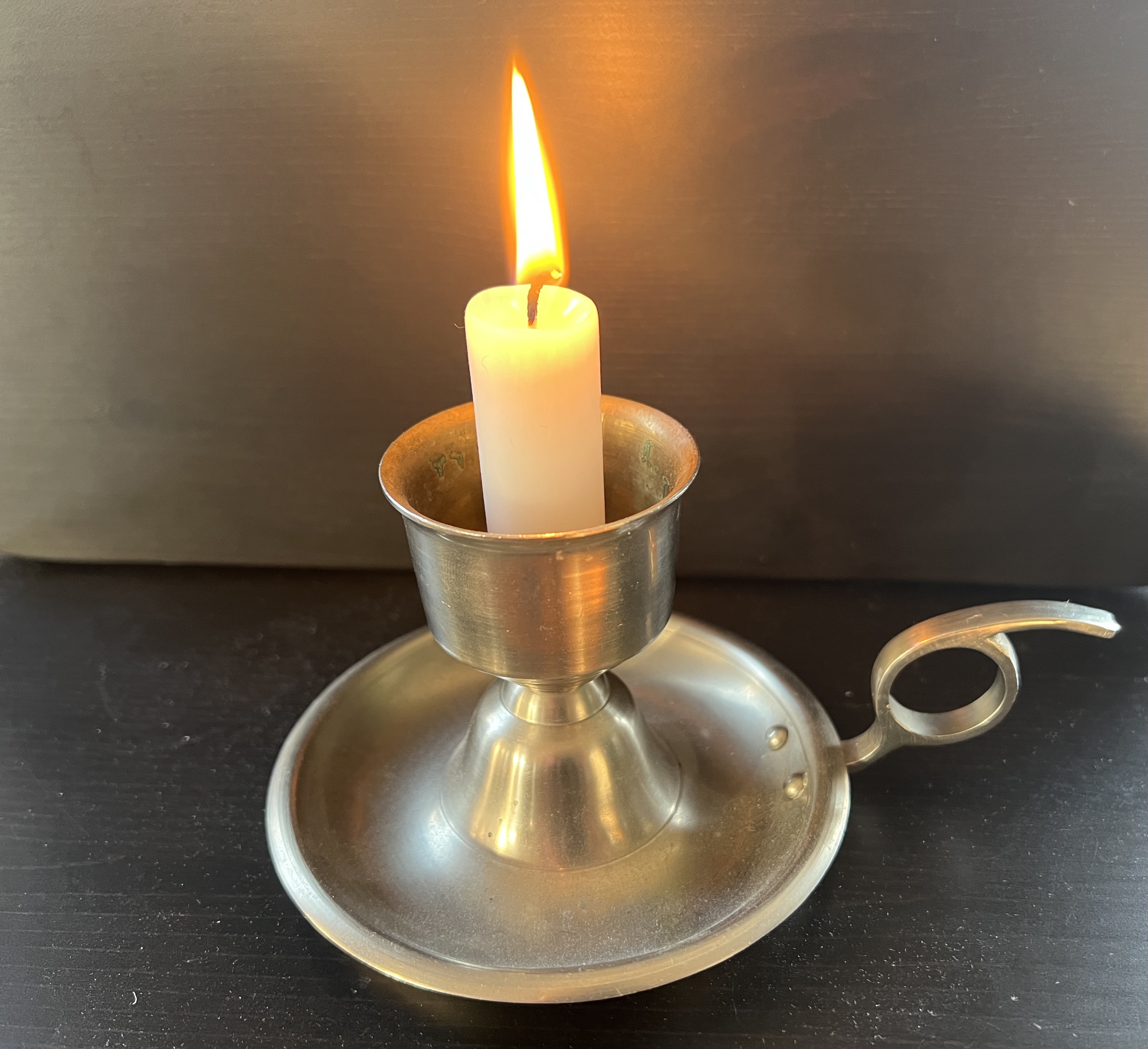
In their book, “Beyond Saints and Superheroes”, authors Allen Jorgenson and Laura MacGregor challenge readers to re-envision our identity in community to be like candleholders rather than trying to be the light ourselves (MacGregor & Jorgenson, 2023).

So, we hold others, especially those unlike us with needs different from our own. And we empathize with them. But true empathy is “not about imagining how you would think or feel in the given situation. Rather, it is about imagining how someone else feels in the situation they are in” (Morris, 2018, p. 171).

This shift in thinking moves us out of our individual self-preoccupation to an other-centred way of thinking. To do this, we first practice simply—but perhaps not easily—just being with another rather than compulsively doing for another. When we can simply hold space with others, the tiny flame has oxygen to breathe, so the light of Christ can shine brightly for the world to notice.

When we practice just being with someone else, we love them by meeting them where they are at. When they have that sense of being seen, that they matter. In that space of grace, then, we recognize the light of Christ which, although it may appear fragile and small, actually gives enough light in the night for all to see.

Listen to the words of Professor Jorgenson who wrote this poem called “Candleholders” :

“Yesterday was All Saints’ Sunday at church and candles lumined the nave to honor the departed, the beloved, the beleaguered.

“We were invited to light one for a soul deep in our heart, and I walked to the altar and lit a candle in honor of you… sadly missed…

“The candles were variously held by brass, by glass holders. Some votives sat free. I took one of these and tipped it toward the Christ light. As it flamed, I breathed a prayer of thanks. I set you – on fire – into a bed of sand, imagining holding your hand once again, but no, you were grasped by grains of sand without number.

“I pondered you then, with all the saints: each one different, each one the same, each one broken, each one whole – together a circle of support.

“As I made my way back to the pew, I thought I heard you say:

“Today is All Saints Sunday, but each day is holy, as are we, as we hold each other and so the Christ” (MacGregor & Jorgenson, 2023, pp. 110-111).

References:

MacGregor, L., & Jorgenson, A. G. (2023). Beyond saints and superheroes: Supporting parents raising children with disabilities: A practical guide for faith communities. Mad and Crip Theology Press.

Malina, D. (2024, October 22). My dad in my dreams. Eternity for Today: Daily Scripture Reading for Reflection and Prayer, 60(4), 30. Evangelical Lutheran Church in Canada.

Morris, S. (2018). Overcoming grief (2nd ed.). Robinson.

Wahrnehmen: What do you do when the past visits you?

You will know the truth, and the truth will set you free (John 8:32).

In an online forum, fans of Leonard Cohen debate the title of his song, “One of us cannot be wrong” (leonardcohenforum.com). The song seems to be about a failing romantic relationship.

The term has also been used as a joke between two people who disagree on something. Any argument, it seems, presumes that someone must always be right. And, therefore, someone else must also always be wrong.

Saint Paul in his letter to the Romans throws a wrench into this kind of dualism. “For all have sinned and fall short of the glory of God” (Romans 3:23). Therefore, no one is right. And no one is wrong. No one, ultimately, can claim higher moral ground.

In today’s Gospel reading for Reformation Sunday, Jesus says, “Everyone who sins is a slave to sin” (John 8:34). In other words, human beings – we are all in the same boat. And, therefore, we need to learn to co-exist, peaceably, even with our enemies.

But only the truth will “set you free” (John 8:32).

Ok. So, what is truth? Pilate asked Jesus this question (John 18:38). It’s normal to go into our heads to figure that one out. In today’s Gospel, those who believed in Jesus misinterpreted his teaching by thinking they didn’t need to be made free because they were not slaves, literally.

We can, and have to this day two thousand years later, argued and debated what this truth is. Martin Luther in the 16th century, who launched the Reformation, offered his interpretation by focusing theological truth on the unconditional grace of God, which implies accepting, loving, and caring for everyone unconditionally.

But not every Christian feels comfortable with that message. We’d rather slip back into that comfortable dualism of believing “one of us cannot be wrong.”

Maybe the way to knowing the truth starts by examining how we receive the truth. Perhaps we first need to set the context for that truth giving and receiving. How is it given? Who is there? What’s going on?

In Martin Luther’s mother tongue, the German language, the word truth is “Wahrheit”. But German offers a helpful nuance by introducing a verb, an action word, for the word truth: “Wahrnehmen” loosely means perceiving, or as I’ve already mentioned, truth-receiving.

Truth is about how we receive it. It is not just a thought, or doctrine floating up here somewhere. It is contextual. It’s on the ground, in our lives. It is integral to what we do as much as what we think.

I can hear the wheels turning in your heads. You might argue with me here, saying the main theological point of Martin Luther’s Reformation is that we are made right with God not by doing good works. We are made right, or justified, with God by God’s grace alone. We can’t earn God’s favour because even the good we try to do has a downside. Nothing we do is a perfect thing with 0-negative consequence. We are truly dependent on God’s grace.

But because our actions – all of them – yield at least some negative consequence, doesn’t mean we remain passive or don’t try. Recognizing our sinful nature doesn’t translate to inactivity based in fear of making a mistake – because we will anyway no matter what we do! Proclaiming the primacy of God’s grace in everyone’s life doesn’t mean we don’t reach out, take risks, and express our faith in loving deeds.

It takes practice. Luther did say, “Sin boldly! But trust in God’s grace even more!” Wahrnehmen.

Mother Theresa said, “Love cannot remain by itself – it has no meaning. Love must be put into action, and that action is service” (Dyer, 2010, p. 99). In other words, love, compassion, mercy and forgiveness – all these grace-words mean absolutely nothing if we let them remain only in our individual lives, or only in our heads. Wahrnehmen.

What Jesus did for us on the cross and empty tomb was that he led the way for us, showed us the way and modelled for us the pattern, the way to follow. What Jesus did for us is not just for our intellectual benefit, not just for disputation in order to arrive at some level of doctrinal purity.

We are created and called for a purpose: To follow faithfully despite the mistakes we are bound to make on the way. It takes practice and exercising our spiritual muscles. Early in any exercise regime, it feels awkward.

In her book on overcoming grief, Sue Morris (2018) suggests writing with your other hand (pp. 26-27). Try writing your name and address with your non-dominant hand. Write as neatly as you can.

How does it feel? How does your writing compare to when you write with your dominant hand? Did you have to concentrate more? Did it feel strange?

“Being able to write effectively with your other hand would require a lot of practice … Even after many years of experience, writing with your non-dominant hand may never feel as effortless as writing with your dominant hand” (pp. 27-28).

A similar thing happens in grief, after a loved one has died. Even though you know how to live just like you know how to write, your life now feels awkward and unfamiliar. It takes more concentration, effort and energy. Any transition in life, even positive ones, involve loss and change. Transitions involve new learning and a period of adjustment.

As we practice, nevertheless, we can experience God’s loving presence. In the receiving of grace, we discover a deep source of strength flowing through us. We discover that in giving we begin to receive even more.

In practising faith, the truth frees us from the prisons of our own compulsive self-centredness. In practising faith, we learn again that, though the results are never perfect and even though our actions are always flawed, the truth of God’s grace is realized in deeds of love, serving others unconditionally, and courage to try something new.

And when we arrive one day at heaven’s gates, one thing we can be certain of: God will never fault us for loving too much, caring too much, showing mercy and compassion too much.

Thanks be to God, for the truth in Christ, who indeed sets us free.

Martin Luther, in his words, offers a blessing to us: “May God, who has led and called you to a knowledge of the truth, strengthen and preserve you to his praise and glory. To him and to his grace I commend you. Amen” (Owen, 1993).

Blast from the past: Ottawa Lutherans celebrate 500 years of Reformation in 2017

References:

Iazariuk. (2007, December 25). I think the title gives the interpretation, but I may be wrong [Comment on the online forum post One of us can’t be wrong – interpretations please.]. leonardcohenforum.com. https://www.leonardcohenforum.com/viewtopic.php?t=9931

Dyer, W. W. (2010). The shift: Taking your life from ambition to meaning. Hay House, Inc.

Morris, S. (2018). Overcoming grief (2nd ed.). Robinson.

Owen, B. (Ed.). (1993). Daily readings from Luther’s writings. Augsburg Fortress.

Holding space for another

Jesus came not to be served but to serve (Mark 10:45). A relationship, any relationship, based on serving another affects the power dynamic. Changing the relationship from “What is in it for me?” to “What is in it for us”?

There is a term called “holding space for people” (Plett, 2015). Have you heard of it? Holding space for another basically means offering unconditional support and letting go of judgement and control. Holding space for another means we are willing to come alongside another person in whatever journey they are on without judging them or making them feel inadequate, without trying to fix them or trying to impact the outcome. Holding space.

Jesus holds space for James and John. Jesus lets James and John, the sons of Zebedee, take the lead. Jesus does not take the command-and-control role of an army general and pander to their desire to simply do what they are told. And so, he asks of them: “What is it you want me to do for you?” (Mark 10:36). Holding space.

James and John take a huge risk, one that Jesus invites them to take. James and John become vulnerable to Jesus. Jesus wants them to be honest. And they are.

And when we take the risk of holding space for another, when we take the risk of being honest and vulnerable sometimes the answer to our questioning and its consequences do not make us feel good and may even create more problems, as it did for James and John. Now the other disciples are upset with them. So, Jesus takes a great risk with them. And with us.

Why does Jesus act this way? He is, after all, the Son of Man. Why, of all people, does he come to serve?

Because Jesus has faith in them. And Jesus has faith in us. Jesus perceives something far beneath the surface of our ego thrashing about that is holy and good.

The question is, will we accept Jesus’ answers to our questions? Will we accept the sometimes-difficult journey of growth and maturity, which includes making mistakes? And, will we trust Jesus who has more faith in us than we do in ourselves?

One thing Jesus will not do: Jesus will not pander to our childish cravings for immediate gratification. Jesus will not pander to our childish compulsions to be told. Rather, Jesus waits for us to take the risk, to declare what we want, to be open and honest and vulnerable with our deepest desires and secrets of the heart, to be willing to take that difficult first step on our journey of transformation to new life in Christ.

When you came in this morning, did you notice the two-story stone house on the corner just beside the parking lot to the church? This house used to belong to Faith Lutheran Church. It was the parsonage, where among other purposes, pastors and their families lived since the 1960s till 2004 when the church sold it to its current owners Anya and Mihailo. Last April, their house was designated a City of Ottawa Heritage Building.

Northern Lights over 43 Meadowlands (photo by Anya Mihailovic, October 2024)

Anya recently told me the story of the last pastor who lived in the parsonage with his family, Pastor Bill Riekert. Shortly before he died, he visited Anya and Mihailo after they had renovated most of the house.

When Pastor Riekert stood at the base of the staircase in their main room and looked up, he paused and surveyed all the original woodwork. And he said in awe: “Was all this here the whole time!?”

You see, until Anya and Mihailo renovated, what covered the floors, the walls and staircase railings was a whole lot of wall-to-wall carpet and paint. The paint and carpets covered up what lay underneath. He couldn’t believe the beauty of the original structure and woodwork of the floors, walls and staircase that had lain there hidden underneath since the house was built over a hundred years ago.

In the book of Hebrews, we read that “Every High Priest chosen from among mortals is put in charge of things pertaining to God on their behalf” (Hebrews 5:1). But, the writer goes on to say, “one does not presume to take this honour, but takes it only when called by God” (5:4). When we hold space for another, and indeed with God, we do not presume to be in charge. We do not presume to know it all, and what is best for the other as if we are the one to judge ultimately these questions.

Instead, we listen for God. We listen to each other. And in all humility we trust this: That someone else sees in you what you may not see in yourself. We trust that someone else can hone-in on something we have neglected to appreciate buried deep within us, even for a very long time, covered up by the trappings of ego. We trust that whatever needs to be uncovered and exposed—good and bad—is held in loving embrace by God in Jesus Christ who gave his life for us. Jesus holds space for us, to be who we are, openly and honestly, so we can hold space for another.

And Jesus waits. Waits for us to commit to this journey of growth which is long, sometimes tiresome, often difficult but will ultimately lead to new life and indescribable joy. That is the promise of faith in Jesus.

References:

Plett, H. (2015, March 11). What it means to ‘hold space’ for people, plus eight tips on how to do it well. Heather Plett. https://heatherplett.com/2015/03/hold-space/

Pass the salt, please and thank you

With gratitude to Diana Butler Bass, this sermon’s words are in large part borrowed and adapted from her September 29, 2024, blog: Sunday Musings entitled “Grateful – and salted”.

At this time of year, the gardens are being cleared. And the very last of the Fall flowers still blooming, like our marigolds at home, are giving their final, glorious bow.

Marigolds bowing out
(photo by Martin Malina 11 Oct 2024)

Autumn is a time for thanksgiving.

Paths of gratitude (photo by Martin Malina 30 Sept 2016 in the Arnprior Grove)

Thanksgivings are usually said at table. In the kitchen at home and at the altar for the holy meal in church. Indeed, the very word, Eucharist, means thanksgiving. Good food tends to make one’s heart thankful, eh?

I like to cook. But I don’t watch any cooking shows. American theologian and writer, Diana Butler Bass, however, confesses in a recent blog that she’s a cooking show fanatic. She loves Top ChefChopped, and pretty much everything on the Food Network. She even likes Halloween Baking Championship. Do you watch any of these?

She claims one of the things that frequently happens on these shows is that the judges will criticize chefs for not putting enough salt on their food.

Judge Geoffrey Zakarian will say, “This needs salt, man.” Or Top Chef host Tom Colicchio says, “There’s not enough salt. You need to learn to season your food. That’s basic.”

You might recall the Gospel text from a couple of weeks ago, when Jesus encouraged his disciples to be like salt (Mark 9:50). Now, please notice Jesus didn’t say or mention pepper. No. Not pepper. Be like salt.

Because pepper is a spice.

When you put pepper on a chicken breast, you’re not getting the taste of the chicken breast. Instead, you’re getting the oil from the cracked pepper on top of the chicken breast. Pepper adds pepper flavor to enhance or complement the chicken. That’s how spices work. They add their flavor to ingredients.

But salt is not pepper. Because it is not a spice. Salt is a mineral. It’s found all over the world, at the edge of the sea, in caves where there was once water. When this mineral — salt — is added to food, something extraordinary happens. Almost like a miracle.

When salted, food undergoes a number of chemical reactions that change the texture and flavor of the food from within. Pepper adds spice on the outside but salt changes the food from the inside out.

We often think of spiritual practices like gratitude — or meditation or prayer — as if they are pepper. Maybe you already have a pretty good life, generally happy, successful, or healthy. We are blessed. Spiritual practices, we presume, give some additional flavor. Value added.

Peppering gratitude is little like sprinkling thanks on top of our blessings. We add a bit of extra spice to give those good things a bit more flavor, an extra kick.

But that’s not what spiritual practice aims at doing, at least not according to the Gospel.

In recent years, science has discovered that practising gratitude is not like seasoning life on the outside. Instead, genuine gratitude, deep gratitude, is more like salt. It changes us from within.

Diana Butler Bass cites a headline from the Washington Post some years back: Can gratitude help you recover from a heart attack? The article said absolutely yes. Indeed, gratitude will actually change your heart.

The piece reported that if people who had heart episodes practiced gratitude through or in advance of that heart event, those patients had better outcomes than people who weren’t practicing gratitude. Medical researchers, psychologists, and social scientists have studied gratitude in relation to heart attacks and a number of other conditions and diseases — and they’ve found that gratitude is not only good for your heart but pretty much every other part of you, too …

Gratitude is really, really good for us.

Scientific studies have shown that gratitude blocks toxic emotions, envy, resentment, regret, and depression. If you have a strong sense of being grateful, it changes the way your brain functions.

Practicing gratitude strengthens empathy, courage, and compassion. It strengthens resilience and gives us a greater capacity to connect with others in community. This is life-changing stuff. Not just religious window-dressing. Thankfulness is not a flavor we add to life.

Rather, gratitude is like the salt of spiritual practice. Gratitude comes from within and changes you from within. We humans possess, yes, have a capacity for an innate inclination to say thank you, to recognize the giftedness of life.

But that innate sense gets clogged up by other things. By cultural biases, negative experiences, worries, and our own doubts and fears. All kinds of stuff spoils innate thankfulness.

And so, we need to practice gratitude — pay more attention to it, be more intentional about gratefulness, purposefully add it to our lives. Gratitude is like salting food, bringing what is deep inside to the surface, intensifying the best flavors of our lives … Everything gets tastier.

Jesus said, “Have salt in yourselves and be at peace with one another” (Mark 9:50). That relationship between a heart of gratitude and healthy relationship is deeply and profoundly true. If we live a life that is salted with gratitude, it opens us toward the world and toward one another in peace.

Brother David Steindl-Rast, a 98-year-old Benedictine monk, gave a TED talk on gratitude that has been viewed almost 10,000,000 times, making it one of the most watched talks ever recorded. His wise words amplify those of Jesus — Have salt in yourself and be at peace with one another.

Brother David said,

If you’re grateful, you’re not fearful. And if you’re not fearful, you’re not violent.
If you are grateful, you act out of a sense of enough and not a sense of scarcity, and you are willing to share.
If you are grateful, you are enjoying the differences between people and are respectful to everybody.

And that changes the power pyramid under which we live.

I think that’s exactly what Jesus says in the Gospel for today. The power pyramid under which we live is the thing that makes us anxious and ungrateful. It is what embitters our souls. “Is not life more than food, and the body more than clothing? … Consider the lilies of the field … Yet I tell you, even Solomon in all his glory was not clothed like one of these” (Matthew 6:25-29). Fear, worry, scarcity, and bigotry sap the flavour from life — as we try to survive in what is really a truly unfair, unjust, and cruel world.

“But strive first for the kingdom of God” (Matthew 6:33). And where is that kingdom of God? Later in the Gospel, Jesus says that the kingdom of God is within you (Luke 17:21). Gratitude draws out the good that resides within us. The gift of God.

Deep inside, we are profoundly aware that God has gifted the whole of the universe, that this life is a gift, and our lives are surrounded by gifts. This is the kingdom of God. And that changes everything.

With gratitude for what we have received, we look to the hunger needs around us. In 2023, the number of people in this city visiting the Ottawa Food Bank nearly doubled since 2020 (Ottawa Food Bank, 2024). These statistics describe in no uncertain terms Ottawa’s food security crisis. Gratitude flowing from our hearts leads us to feed the hungry and the poor, being therefore at peace with everyone.

We are doing our small part, here from Faith Lutheran, by our Faith Garden. Today we give thanks for this garden and its faithful stewards. A couple of our members who have worked in the garden this year will now share some brief words witnessing to the saltiness in their lives.

Courtesy of Faith Ottawa Lutheran, 2024

Have salt in yourselves. Be at peace with everyone. And live in hope. Thank you.

References:

Butler Bass, D. (2024, September 29). Grateful – and salted. Sunday Musings. https://dianabutlerbass.substack.com/sunday-musings/grateful-and-salted

Ottawa Food Bank. (2024). Charity intelligence [website]. https://www.ottawafoodbank.ca/hunger-in-ottawa/charity-intelligence/

Building relationship

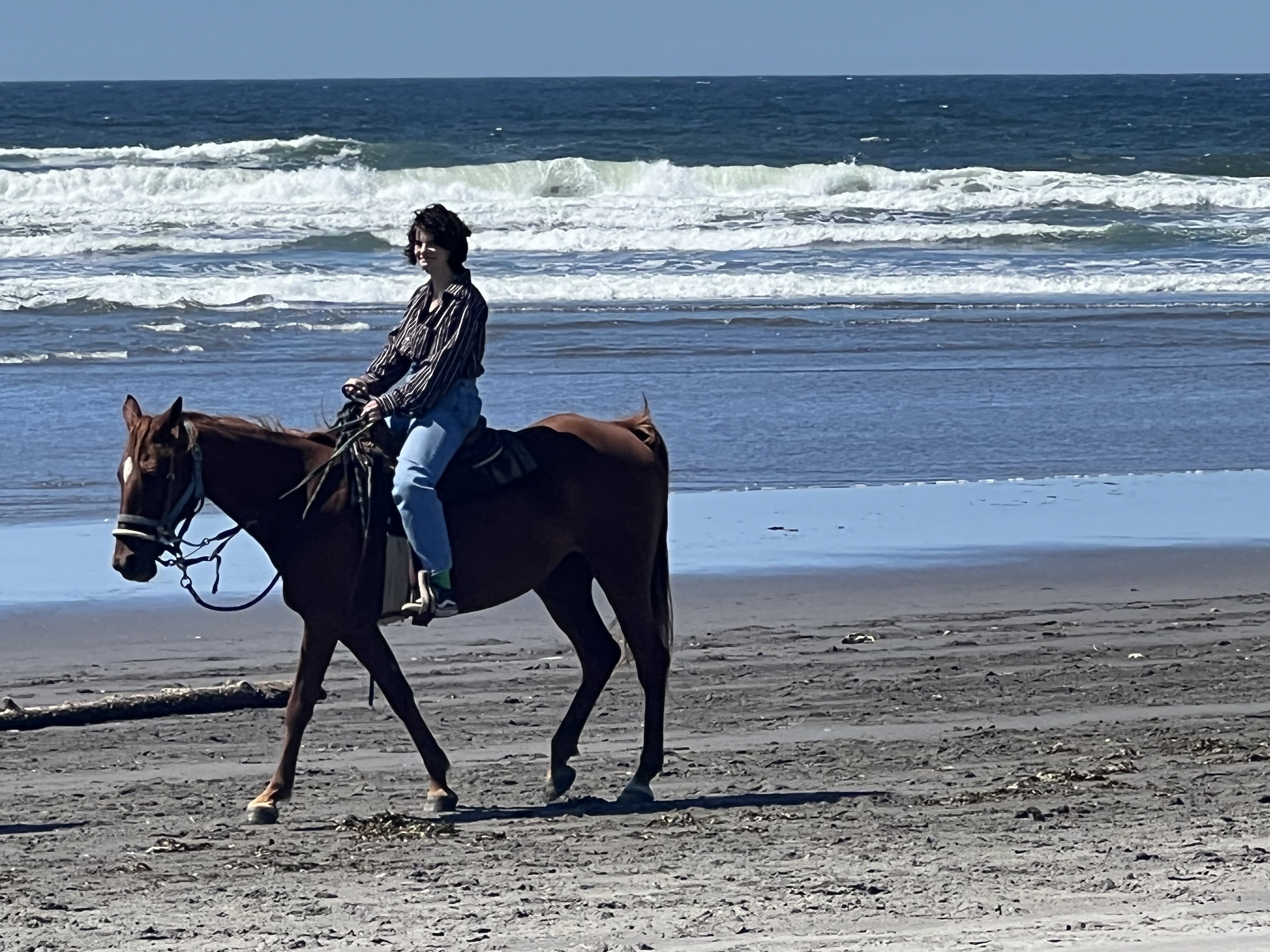
Meeting a horse (photo by Martin Malina 7 Aug 2022 Long Beach WA)

Because I don’t have a pet, I learn by the witness of others who do. And I recently read someone, named KC, reflect on their first experience of getting a pet. When KC was seven, her mom took her to the animal shelter and told her she could pick out a cat.

She walked straight to the back of the rows of cages and found the rattiest little cat you’ve ever seen in your life. Her tail had been severed after she was hit by a car and her rear was oozing from fresh wounds and ointments. Without even looking at the other cats KC announced to her mother that she wanted that one. KC took her home and cared for that cat.

KC got to know her, and she became her friend. But not because this cat appeared worthy. But simply because KC decided to care for her (Davis, 2022, p. 84).

Maybe you wonder like me, how can KC want to care for such a mangy creature? Yet, something about her story reminded me of God. How God is with us.

In order for Adam not to be alone, God created animals in addition to a human partner (Genesis 2:18-24). Creation communicates the message that none of us were meant to be alone. We were created for relationship – including non-human creatures.  Saint Francis of Assisi understood that. And that is why, near the feast day of Saint Francis (Time and Date, 1995-2024), we make time today to reflect on and honour all our relationships, and especially today with the non-human world.

The story of KC choosing her pet suggests nevertheless that getting know one another means, likely, a life-long work of seeing beyond the surface of things. Getting to know another is about going deeper.

Let’s have some fun with that. I have an exercise I invite you to do with me now. It’s a mind game that involves speculation. I will give you a series of clues – they are objects, items – and then I’ll ask you to offer a series of guesses as to what they ultimately represent, what they ultimately are about (Sperry & Sperry, 2020, p. 39). Ok? Ready?

The first two objects you are given are an iPod and a phone charger. What is their link, or commonality? What do these items ultimately represent? … (Electronic devices?)

But then, you are given a book of crossword puzzles. Now, finding a common link with the first two objects is a bit more challenging, isn’t it? What do you think all three objects ultimately represent? … (Things that entertain and pass the time?)

Next, you receive a map and a bottle of water. Now the task has become much more difficult. Any guesses? What do all five objects represent? … (Inanimate objects?)

Then, these two clues are given: two parents and three children. Now, what do all these items represent? Perhaps a concept that links all these items together is a family trip? Wait, though. We need to verify our tentative guess.

Ten other clues are given next, including snacks, sunglasses, and hand wipes. Each of these subsequent clues adds to the common meaning of all these items suggesting you are correct, indeed.

We are talking here not about electronic devices, ultimately. We are not talking ultimately about things that pass the time, nor are we ultimately talking about inanimate objects. Ultimately, we are talking about a family trip.

Taken together, all these items are necessary to get the true picture of what is actually happening. It’s not that our earlier guesses were false per se. But those conclusions were based on a small sample size of objects. We would be in error to announce too soon what it’s all about. We need to dig deeper in order to unveil the truth, to truly know someone.

So, how do we start?

Why do so many adore their pets? I am told dogs and some cats, too, will often approach their human counterparts with unconditional positive regard. They approach relationship with an openness sadly not often matched in human relationships.

We all need unconditional positive regard from each other. That’s what draws anyone to join any groups and social gatherings. Because they are received first and foremost with an unconditional positive regard from those they meet there. Curiosity. Acceptance. Love.

No wonder Jesus’ closing, summary statement from today’s Gospel is the challenge to receive the love of God as a child (Mark 10:13-16). Without our adult ways getting in the way. Without our adult ways of first scrutinizing a situation or person, without first judging them. They say the longest leap in the world is to jump to a conclusion.

How do we train our minds and hearts to suspend our usual launch into pre-conceived, critical, judgemental interpretations?

Father Ed, the priest who helped Bill Wilson start up Alcoholics Anonymous over a century ago said, “Sometimes Heaven is just a new pair of glasses” (Lamott, 2017).

There is so much more to a person than just the first thing you notice during a brief encounter. Looking upon the heart calls for patience and a willingness in all humility to learn more, ask more, about that person. It’s about relationships that go far beneath the surface. And developing those relationships.

When God guided Samuel to choose the next King of Israel, the Lord said to Samuel: “Do not look on his appearance or on the height of his stature, because I have rejected him; for the Lord does not see as mortals see; they look on the outward appearance, but the Lord looks on the heart” (1 Samuel 16:7).

Alongside the challenge in this word, we can also be comforted knowing that what lies on the surface of our lives need not define us. For example, our challenging circumstances need not define us. What first we notice there, on the surface, is real and requires loving care and attention, to be sure.

At the same time, the Lord looks upon and loves what is on our hearts, what is true there, what is good there. And maybe, what mortals cannot initially nor easily perceive. Except, perhaps, some of our dear animal friends.

Let’s put on that new pair of glasses. And let us pray our vision expands to perceive the dignity God sees in everyone. Because there is something beautiful in everything, everyone, every creature God created.

References:

Davis, K. C. (2022). How to keep house while drowning: A gentle approach to cleaning and organising. Penguin.

Lamott, A. (2017). Hallelujah anyway: Rediscovering mercy. Riverhead.

Sperry, L., & Sperry, J. (2020). Case conceptualization (2nd ed.) Taylor & Francis.

Time and Date. (1995-2024). Feast of St Francis of Assisi 2024 in Canada [website]. https://www.timeanddate.com/holidays/canada/st-francis-assisi-feast

In a beginning

Fitzsimmons Creek, Whistler B.C. (photo by Martin Malina, July 18, 2024)

About an hour and a half ago, at 8:44am (EST) today (September 22, 2024), summer gave way to autumn. We are now officially in the Fall season. Today, I am reminded of the cycle of seasons again. Round and round we go. Our lives, indeed, go through cycles.

But we will often couch these repetitive cycles in negative terms. For example, we talk of cycles of violence, cycles of poverty, cycles of addiction, and so on. When do we talk about history repeating itself when it has to do with something positive and good? And depending on your mood today, and which seasons are your favourite in the year, even the autumnal equinox can represent a negative turn.

In observing this season of creation, the church focuses our attention on the basic building blocks of life on this planet – wind, water, light, earth. And the creation stories in the first book of the bible describe how it all began. And begins again.

I add the present form of the verb because two key words from the Hebrew language in the first chapter of Genesis not only provide guideposts in our understanding of cycles of time repeating themselves, but overwhelmingly support a positive viewpoint. The biblical creation stories, while also introducing the concept of sin, offer a resoundingly hopeful message.

The bible begins with those auspicious words: “In the beginning, God created …” (Genesis 1:1). A recent Lutherans Connect (LC) devotion points out that in Hebrew, there is no “the” (LC, 2024). It is, technically, ‘in a beginning’.

While the Genesis story says everything was created in six days in an unspecified moment in time, the grammatical nuance of ‘a beginning’ suggests that God continues to create something new in every time and place. In a beginning.

In fact, some scholars understand that there is no definitive beginning because creation has been happening already for a very long time (LC, 2024). The cycle of creation has gone on longer than we thought.

Based on evidence in the rock formations, for example, on the East Coast of Scotland at Siccar Point, scientists have concluded the earth is approximately 4.5 billion years old (LC, 2024).

This claim is not at odds with the bible if we pay attention to the grammar. Creation happens, happened, and continues to happen. Creation happens at every new beginning. In a beginning.

And what is more, every creative act of God is a cycle that repeats for good, literally. When God creates, the first chapter of Genesis reveals a litany of goods (Genesis 1: 4,10,12,18,21,25,31): “It was good … It was good …. It was good.” In short, God calls all that God has made, “good”.

But in the Hebrew word ‘tov’, ‘good’ is not just a static affirmation. Rather, ‘tov’ means a deeper sense of becoming well, closer to the meaning of ‘shalom’ in Hebrew – peace and well-being. God saw that all creation, including the human, was becoming well and evolving over time (LC, 2024). ‘Good’ from the Hebrew ‘tov’ evokes this sense of movement, of growth and transformation for the better.

Whenever there is a new beginning in life, God is creating for the good. The continuing acts of God’s creation happen at points of starting over. And this is a good thing, part of an evolving creation.

Our faith, we say, begins at baptism. And Ariel’s baptism today at Faith Lutheran Church in Ottawa is a sign for us all that God seeks to start afresh with us. At these beginning points in time, what we really affirm is an ongoing, unending relationship God has with us. Baptism conveys in water and word God’s grace starting over and re-newing our lives.

As we celebrate birthdays – Ariel did yesterday and her mother will on Saturday; as we celebrate anniversaries – Pastor Diane celebrates her 30th year of ordination this month; as we welcome new members at this new stage on their faith journeys; as we pray for Pastor Bavani and Jasmine who begin a new chapter of their lives later this week travelling back home to India; as we baptize Ariel today …. We affirm that life and relationships of love continue refreshed in new ways by God’s grace.

None of the above are a one-time, one-and-done deal. Each of these events are gateways through which we pass and commit to a life-long journey of endings which always signify new beginnings of goodness. I came across a bit of wisdom in my social media recently about grieving the losses of our lives. It is sage advice to those who walk alongside those who grieve:

“When supporting someone who is grieving, understand that you’re not trying to help them get back on track. You’re coming alongside them as they chart a new course.”

Ariel’s immediate family is together today, surrounding her with love at her baptism. We acknowledge the profound and challenging journey over the past few years that eventually brought them to this place at this point in time. We acknowledge all they endured and lost, migrating to Canada and away from difficult circumstances.

We also acknowledge and celebrate that God continues to open doors. God continues to create in this land new beginnings for you. We affirm the waters of baptism that give Ariel and us all the grace and promise of life renewed, and hope sprung again.

Thanks be to God, for a new beginning.

Reference:

Lutherans Connect. (2024, September 5 & 11). On the threshold. Centre for Spirituality and Media at Martin Luther University College. https://lconthethreshold.blogspot.com

With wave and wind

As many of you know, I love to paddle in my kayak and/or canoe, mostly recreationally and on flat water. If there is any one factor, in my experience, that affects how I enjoy the paddle, it is wind speed. In fact, normally I would avoid getting out on the water if wind speeds are gusting over 20 km/h.

This past Spring and Summer I have not been able to get out as often as I usually do. My extra course work has kept me busy during any free time I have.

So, during the latter part of my vacation at the end of August when there was correspondingly a break between semesters, I took full advantage and resolved to get out in my kayak as often as possible.

I was hoping for calm winds and sunny skies, of course.

But when Jessica and I arrived at our riverside camp site on the first day of our camping trip, it was sunny but, oh, it was gusting something fierce. I looked out over the bay in the Ottawa River and noticed the slightly cresting whitecaps. Borderline. But, it was my first opportunity to get out on the water all summer long. How could I not?

With hat strapped securely on my head and uncertainty and fear swirling in my gut, I launched my kayak into the choppy waters and headlong into the stiff breeze. Prayers for safety and confession of fear accompanied me on my way into the water. But I was also curious to test my abilities that had lay dormant for a year.

Wind and Spirit are the same word in both Hebrew – the language of the Old/First Testament – and Greek – the original language of the New Testament (Lutherans Connect, 2024). So, what went through my mind as I tumbled into my tiny vessel was that there surely must be something I can learn from being vulnerable to the wind. What could the wind teach me about the Spirit of God?

There are other places in the world where the winds blow constantly and at fierce velocities. Slope Point, on the southernmost tip of New Zealand, is a rocky shoreline made almost inhabitable by high-powered winds, having soared some 3200 kms across the Antarctic Ocean uninterrupted (Lutherans Connect, 2024). The winds are so strong it is possible to become almost airborne when you lean into it and jump.

The wind, of course, can be dangerous for its unpredictability, uncontrollability and its destructive potential. That, too, went through my mind as I struggled to keep my kayak upright and moving in tandem with wave and wind. I wisely decided not to push it and cross the river to the other side that first time out. Rather, I stayed in the relative safety of the bay. I was getting the hang of it by focusing on my paddling and keeping an even and steady stroke going.

In the Gospel reading today (Mark 8:27-38), we witness an identity crisis that those who follow Jesus appear to be having. They can’t seem to understand who Jesus is. At best, they skirt around the edges of truth and express different perceptions: Some say John the Baptist, some say Elijah, others, one of the prophets. Who is this Jesus? Peter says, the Messiah.

However, Peter has become accustomed to thinking the Messiah as a wonder-worker with the power to banish every difficulty and suffering (Shaia, 2021). Peter has come to expect Jesus to be a miracle-working Messiah.

In contrast, Jesus’ response is firm in describing God who embraces the path of great trial, conflict and loss. Disciples of Jesus will, consequently, not minimize, evade or divert from the hard realities of life. Jesus tells Peter, in other words, that if he is only looking for a “super-parental divine rescuer” (Shaia, 2021, p. 158), then he has not yet understood the nature of his faith.

God is certainly capable of rescuing us. But God will not always rescue us. Because God has faith in us. God gave us resources and gifts to use and employ. God allows us to use our abilities and capacities including our supports and others for help so we will mature and grow in faith.

Peter is just one example from the bible. There are many others. Read the stories of David from the books of Samuel in the First Testament. David had been chosen as a child already. Yet God did not intervene every time in his life to keep him from making mistakes or taking the occasional wrong turn. God did not rescue him, because God wanted him to mature.

Part of the maturity process, apart from learning from past mistakes, is realizing with joy and thanksgiving the resources, capacities and gifts we have that may have gone unrecognized when the proverbial waters of our lives were once calm and still.

Up until my kayak experience that windy day on the Ottawa River, I had never had a wave actually wash over the deck of my kayak and into the cockpit. I had assumed that if that ever happened, I would be in serious trouble, at risk of capsizing and swamping the boat.

I was wrong.

On that day a large wave struck the side of my boat. While the surge of river water soaked my pants, my little craft stayed true when I just kept my arms moving and paddling through it – left, right, left, right ….

From the shores of Driftwood Provincial Park on the Ottawa River
August 21, 2024 (photo by Jessica Hawley Malina)

Then I thought of the design of my craft, built near Algonquin Park for these very waters – a stable, wide hull with a skeg, like a rudder, which I could deploy in deeper waters to keep my tracking straight when current and wind assailed me. I had my life jacket on. It was all good! And I was having a blast! I had underestimated my capacities and resources.

Following Jesus is as if we were in a tiny boat on a menacing sea in a great storm. The storm overwhelms our senses. Emotionally we feel completely directionless. What shall we do?

We have only two helpful choices: We can perform the one simple task we have – we can row: left, right, left, right … keep going. And not give up.

And we can pray. Our prayer is first one of surrender. We surrender our previous evasion, avoidance, assumptions and denial tactics when we realize they are not particularly helpful nor relevant in the present circumstances.

Our prayer is then one of trust with full awareness and acceptance of the path ahead. We trust that the journey is long and full. To believe the journey is long and full, I mean that amidst the storms we all face there will be a time when the waters will be still again, and the breeze soft and calm.

A few days later, I indeed experienced the glory, peace and brightness of a paddle in the river when the water was as still as glass. I stayed out for hours. And I thanked God.

References:

Lutherans Connect. (2024, September 9). On the threshold. Centre for Spirituality and Media at Martin Luther University College. https://lconthethreshold.blogspot.com

Shaia, A. J. (2021). Heart and mind: The four-gospel journey for radical transformation (3rd ed). Quadratos.

Glimmers of grace – a funeral sermon

This past summer, a friend of mine went overseas to participate in an archeological dig. From just the pictures she posted on Facebook I saw her donning a wide-brimmed sun hat and kneeling over carefully turned earth with trowel in hand. She was uncovering a mystery hidden from sight for thousands of years. 

I wonder what she uncovered – a fossil, a bone fragment, a sherd of pottery, a tool or utensil from a bygone age? Or, maybe, as I like to imagine, she was discovering a round, stone decal on which words or images were inscribed, carefully and meticulously sculpted. 

All these possibilities reveal a story, a narrative, of lives lived and cultures celebrated, lives and cultures far removed from our day and age.

Sometimes the truth of someone’s life is not easily accessible nor perceptible, at least from the surface. On the surface of things, we don’t get the complete picture. On top of that, no one can easily plumb the depths to uncover the totality and truth of one’s life buried deeply beneath the surface.

On the surface we conclude many things about what we see, good and bad. We may conclude it’s not worth digging beneath the surface. To uncover it all may be too much for us, even if we wanted to.

When God created Michael, God imprinted an aspect of the divine onto Michael life. Like a potter or sculptor, God fashioned Michael to reflect some unique manifestation of God’s self (Genesis 1:27).

Over the course of Michael’s life, the earth, the world, weighed down heavily on him – as it will onto all of us. Layer upon layer, year after year, the sediment collects and the dirt, sand, and roots which pack down over top the true manifestation of Michael’s life. 

How he positioned himself, responded to the weight of it all, had something to do with how deeply hidden his beauty and true self was hidden from us. Of course, other factors affected the course of his journey as well. But there is a deeper truth to behold in our contemplation of and thanksgiving today for Michael’s life.

Even when you who were closest to Michael struggled in loving him, God is like my archeology friend. God, on bended knee, is faithfully and persistently dedicated to uncovering the original work of God. There is a promise, after all, from scripture told by the prophet Isaiah: That God will never forget the work of God’s hands – “I have inscribed you,” God says, “on the palm of my hands” (49:15-16).

God has etched your being onto God’s own being. And so, God can never forget you, and will always remember each and every one of us no matter how deeply we are buried under the weight of the world.

And sometimes, as God continues to faithfully work at digging, uncovering, and chipping away the packed earth from our souls, we get a glimpse of what lies underneath. We catch a glimmer of grace.

Some of you witnessed moments, revelations, of what lay deep beneath the surface of Michael’s life just days before he died.

He hugged you. He told you he loved you. He held the words of the Lord’s Prayer close to his heart, and confessed this prayer warmed him when he was cold. Graciously, these revelations rose to the surface of his life for you to behold.

God will never stop, with each one of us, until life has gone full circle to the way it was in the beginning, so we can realize our true, unencumbered, unique self, beloved eternally by God. This is the promise of faith. 

Thanks be to God.

Belonging, unconditionally

Artwork by Wendy Newbery on the front cover of Laura MacGregor & Allen Jorgenson “Beyond Saints and Superheroes: Supporting Parents Raising Children with Disabilities”
(published by Mad and Crip Theology Press, 2023)

The stories of healing in the Gospels show Jesus in action – doing what he has been called by God to do. But compared to the other Gospels in the New Testament – Matthew, Luke and John – the narrative that Mark writes to describe Jesus’ activity goes along at a hurried clip. Mark’s story-telling style sails along quickly.

In today’s reading from Mark (Mark 7:24-37) we witness two healings which are told one after the other in Mark’s compressed and concise manner:

First, a young girl is healed, the daughter of the Syrophoenician woman – a Gentile. Then, giving us time only to take a quick breath, Mark tells of a deaf man being healed – a man from the Gentile region of the Decapolis near the Sea of Galilee. Jesus, it feels, is on pace for logging in another eighty-hour work week.

But lest we get side-tracked by Mark’s style or distracted by our fascination of and fixation on the miraculous in these accounts, notice today the pains Mark takes to convey the details of identifying who these people are that Jesus heals. Mark had to be intentional in noting their identity, otherwise he would not have tolerated such excessive verbiage in his brief, succinct script. He wanted to emphasize an important aspect of God’s mission in Christ Jesus.

But it’s not the individual names of the woman’s daughter and the deaf man that Mark shares. It’s where they are from. That’s the point. Mark wants the followers of Jesus to get very clear on the social group, the cultural identifier to which these individuals belong.

Belong. Belonging.

The new school year brings to focus how we belong. After emerging from a summer break marked by individual endeavours and pursuits, summer jobs, private family gatherings, vacations and trips, going to school brings everyone together. Going to school highlights our collective being and our socialization. For many of us, it was schooling that first introduced us to the notions of belonging or not belonging.

It is our experience in school where we learn the criteria, said or unsaid, for what it means to feel part of a community. Do we measure up? Are we good enough? Do we pass the grade, socially and academically? Is our voice heard? Where do we fit, jocks or nerds, science geeks or social rebels, artists or conformists?

How do we belong? Unfortunately, school can create not just positive but also negative experiences about how we belong.

Deacon Michelle Collins in the ELCIC writes that it is possible to belong based on personal initiative, worth, performance, joining a group through membership or application (Collins, 2024). This is the way of the world, isn’t it?

But belonging, according to the Gospel, goes in another direction. Collins (2024) writes that belonging, according to the Gospel, happens because someone is chosen to belong. Belonging is initiated by the chooser and is not contingent on the merit or initiative of the chosen. Belonging, first and foremost, is a gift. Belonging is a particular kind of gift.

Jesus showed no favouritism in his healing ministry. In the second reading from James (2:1-10), Christians are instructed – using the very words from the Gospel, to love others as you love yourself – to show no favouritism. And, James is particular about how we do good works according to the Gospel.

Because Jesus showed no partiality in loving people. Wherever he travelled throughout Palestine, he engaged people in life-giving ways. Jesus shared God’s love to everyone he encountered, even those deemed outsiders or non-deserving. Jesus, by his actions, demonstrated that everyone belongs to God’s community. Without exception.

God chooses you and not because you’ve done well to prove yourself worthy according to our human criteria, conditions, biases, perceptions, achievements or values. God chooses us; therefore, we belong.

Dr. Temple Grandin was born with autism. She didn’t speak until age 4. Her neurodiversity may have been considered a handicap, a negative. As a result of this kind of negative thinking by others, she may have experienced being excluded, marginalized, not belonging.

But her talents and abilities were recognized and supported, thankfully. She is credited for inventing a special livestock restraint system. Her design aimed to calm the cattle down before slaughter, thus making the whole process more humane. Today, Temple Grandin teaches at Colorado State University and makes meaningful contributions to society (Grandin, 2024).

The purpose of the Gospel is to remind all who read and hear it that they are chosen unconditionally by God. Because we belong to God, our relationship with the world is reoriented. We have been changed by being chosen. The reality of unconditional belonging releases us from seeking to belong based on performance or merit. We don’t have to win anyone’s approval because we are already God’s beloved. And we can accept others without condition because they, too, are God’s beloved. Their voice, too, needs to be heard.

Thanks be to God!

References:

Collins, M. (2024, August 26). Belonging as gift. Eternity For Today, www.eft.elcic.ca

Grandin, T (2024). Temple Grandin is the 2024 lifetime achievement award winner. RDC Design Group, www.templegrandin.com

Grace changes us

Imagine you and a friend standing on one side of a tall brick wall. Your friend peers through a tiny, narrow hole and is able to see what’s on the other side. Your friend notices water cascading down like the way water streams off a roof in a downpour.

“It’s raining,” your friend declares with conviction while looking through his very narrow hole.

“Is it really?” you ask, “Is that the truth?” There’s a ladder leaning against the wall nearby, so you climb up to look over the wall. And what you see paints another picture.

A water pipeline runs along the side of a building and has ruptured just in front of, and slightly above, the tiny hole your friend was peering through. Alas, it isn’t raining after all. But you can understand why your friend thought it was.

It’s now up to you to help your friend understand the truth for themself. Will your friend be willing to change their mind and consider another point of view? Will you help them climb the ladder to see for themself? What will you do if your friend continues to insist and persist in believing it is raining on the other side of the wall?

Now, switch roles. Now, you are the one peering through the hole. You are convinced it is raining. What do you say and what do you do when your friend says otherwise?

I’ve just used a metaphor. What is a metaphor? In the context of faith talk, it is something we encounter in our daily lives that lifts up a meaning for us in relation to the story of faith we receive from the Gospel, the bible and what we have learned in the church. We encounter during the course of daily life people, events, experiences and we observe in nature something that reminds us of the faith story.

Using metaphors in faith talk is appropriate. Jesus taught using parables, talking about mustard seeds, fig trees, lost coins and sheep. Abraham and Joseph dreamt. God told Abraham his descendants would number the stars in the sky. In the Gospel today from John 6, Jesus talks about flesh and bread and blood. Of course, we can’t take any of these metaphors literally. They are images that embody meaning for each of us. Metaphors offer us a way to discover fresh perspectives and new learning to renew our faith. So, here is another metaphor ….

Kingdom of the Planet of the Apes (2024) is a post-apocalyptic film, the fourth movie in the Planet of the Apes franchise. All four movies revolve around the character named Caesar, who is an ape.

Early in the days after a virus wiped out most of humanity, Caesar was instrumental in leading the movement to help apes and humans coexist in peace, living together, sharing the land they inhabited.

Of the humans that survived the virus, most had lost the ability to speak and think intelligently. There were exceptions. One of the main characters in this film, May, is able to speak and is very smart.

The virus had another, unexpected effect: It gave apes the ability to speak, matching an intelligence comparable to what humans once had. Apes are now high functioning communicators.

In this latest film it is Caesar’s legacy which is at stake among the apes who now dominate the world. This movie begins with a dramatic scene of the ape clans burning Caesar’s lifeless body on the funeral pyre. Caesar is now dead. And how will his legacy be preserved?

Proximus Caesar is the tyrannical king of the Coastal Ape Colony, a rogue clan of apes that claim to follow the ways and teachings of the late Caesar. Proximus Caesar is the bad guy, who justifies his lust for power by calling on Caesar’s name and words to rally his troops to dominate all other apes and species on the planet. He twists and distorts Caesar’s words, interpreting Caesar in a way that is not true to Caesar and what Caesar originally stood for and valued.

Our main character, a young ape called Noah is on a journey to find his own clan which was attacked and enslaved by Proximus Caesar. On his way he encounters an old ape who was learned in the ways of Caesar and his time. His older friend maintains an interpretation of Caesar that is truer, and insists Noah keep Caesar’s memory in its rightful place.

Eventually both Noah and May are captured by Proximus. An important scene in the movie has Proximus invite his special human guest and Noah to a table for a feast. A private audience with Proximus Caesar appears on the surface a privilege and an honour. That’s the pretence.

But this meal has another sinister purpose, not fundamentally to show hospitality and generosity but to elicit vital information Proximus needs in order to secure the power he craves.

Here is not a table of grace, of communion. Here is not a table celebrating the bond of friendships crossing the boundaries of race and species. Are their tables like this in your life where the pretence of love is overshadowed by unholy intentions?

It seems both our main characters, Noah the ape and May the human girl, are caught in between divided loyalties despite the friendship growing between them. The conflict is heightened around that meal scene, as Proximus tries to drive a wedge of mistrust between them. Proximus entices Noah to be more suspicious of May’s intentions.

Proximus is not altogether wrong, as May relentlessly pursues her secret mission to retrieve a small computer from a fortified facility along the coast into which Proximus tries to gain entrance. May had earlier deceived Noah, pretending she like most other humans couldn’t speak. In the end, she confesses this to Noah and pleads forgiveness. But the damage has been done, and Noah never fully trusts her.

Jesus invites his disciples to another kind of table — the table of wisdom, of communion, of divine love. Jesus tells his disciples that he is the bread in which we find our true sustenance (John 6:55-56) to live out God’s legacy, which is the Gospel of God’s unconditional grace and love in Jesus’ name.

But so many voices compete in the religious landscape. Whose voice is truer? How can we tell? How is Christianity being interpreted?

Right up until almost the end of the movie, we are left wondering if May and Noah, humans and apes, will ever be able to live together in trust and peace. It doesn’t look good by the end of the movie.

Until the very last sequence of scenes. Because the last scenes depict both May and Noah looking up.

Earlier in the movie, Noah had discovered an observatory with a huge telescope still operational aimed at the night sky. After liberating his clan from Proximus’ enslavement, Noah brings his clan back to the telescope. The last scene shows Noah’s face and eyes open wide as he looks up and into the expanse of the heavens above with curiosity, and wonder.

Then we switch to May who is also looking up. But she, now, far away from Noah, is looking at the giant satellite dishes. The computer she found was able to activate them so her tiny group of humans could communicate with other humans around the planet. May is looking up into what is now beyond her capability and efforts thus far. Her mission is over. May is looking up at the forces beyond her control now.

Both May and Noah leave us hopeful at the end. Both, separated by divisions still rife, turn their gaze upward and beyond who and where they are. Their open eyes and looks of wonder leave us hopeful that something bigger than either of them will guide them into a better tomorrow.

Whether or not we are aware, despite all our good intentions and efforts, and in the midst of all that separates Christians, Jews and Muslims, God is there. The Kingdom of the Planet of the Apes is a metaphor for how it is among creatures who share this earth, how we often don’t get along and sometimes get along. But there is always hope and a way forward when all of us look up towards what is bigger and larger than each one of us.

I started with a metaphor which involved a ladder. There’s a famous ladder in the bible as well. I love the scene at the end of Jacob’s encounter with God through the night (Genesis 28, 32). He has dreamed of a ladder reaching to heaven, and he has also struggled while he slept. When Jacob finally awakes and changes his thinking at the dawn of a new day, he discovers who has been with him all along. He says to God, “You were here all the time, and I never knew it!” (Genesis 28:16).

That’s grace.

Walking on Long Beach, Tofino (photo by Jessica Hawley Malina July 12, 2024)