Unknown's avatar

About raspberryman

I am a pastor in the Evangelical Lutheran Church in Canada, serving a parish in Ottawa Ontario. I am a husband, father, and admirer of the Ottawa Valley. I enjoy beaches, sunsets and waterways. I like to write, reflect theologically and meditate in the Christian tradition.

Bright light

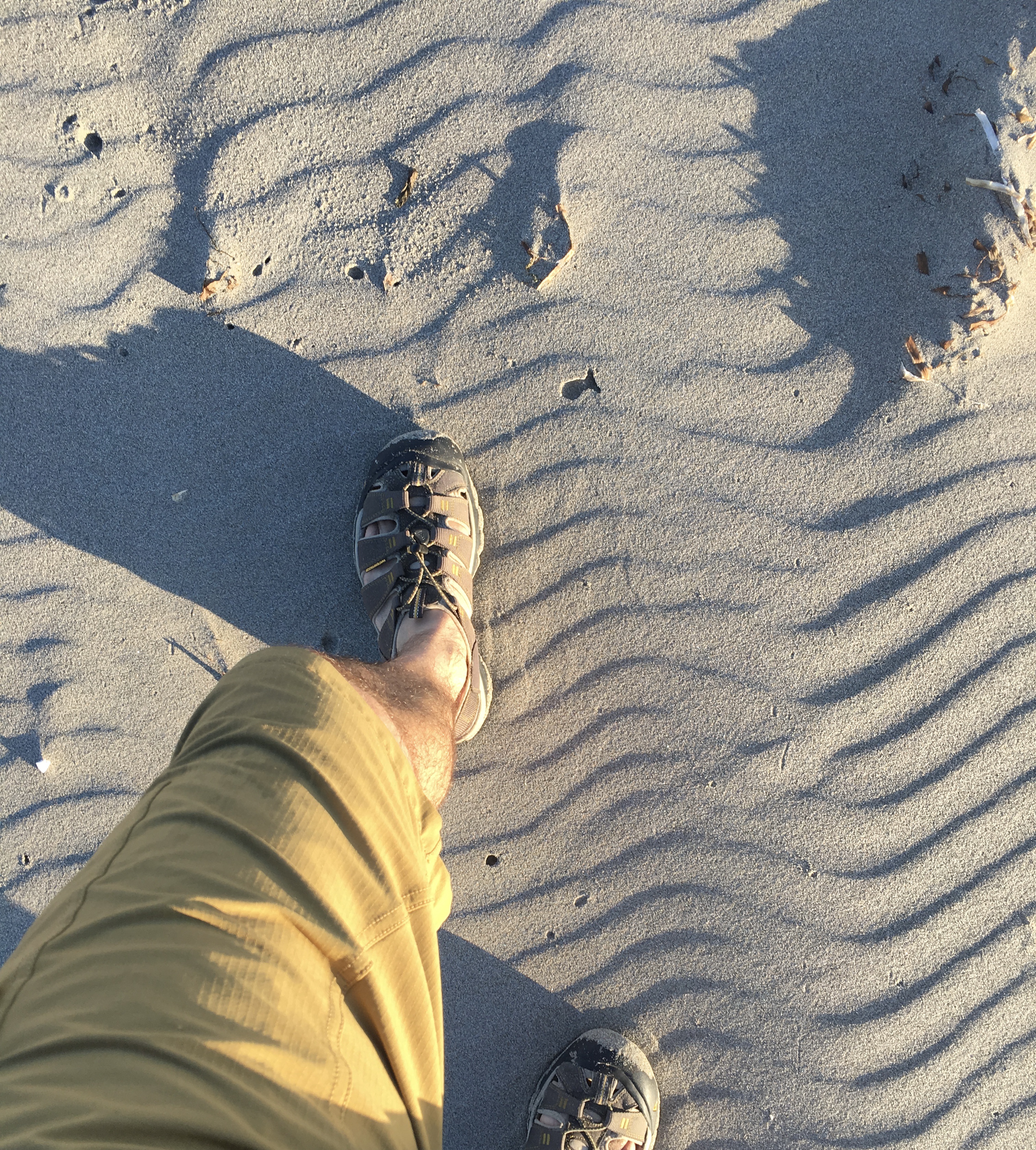
Sunlight on the beach (photo by Martin Malina 5 Aug 2022 Long Beach WA)

Before Christmas, I received a small sunlamp. I think my family knows that in that time of year when daylight is at a premium, I tend to be much grumpier. Seasonal affective disorder, a depressive condition, happens mostly in the winter months in the northern hemisphere when we don’t see much of the sun. Although that, happily, hasn’t been the case in the last week here in Ottawa!

Light therapy—exposure to a bright light for fifteen to thirty minutes each morning after I get up—has been quite effective. It helps keep the cycle of melatonin production in my body functioning well.

Melatonin is important because, among other things, it is our body’s natural way to get drowsy for a good night’s sleep. [1] The brain knows to start flooding our bloodstream with melatonin when it gets dark at night. But it needs to be replenished as well. And being exposed to too little light during the day, can disrupt the body’s natural melatonin cycles.

Maybe that’s why so many Canadians fly south during the time of the year. There are significant benefits to being exposed to sunlight.[2] The research suggests a good dose of sunrays can boost your immune system and increase lifespan. That’s looking on the bright side of things, isn’t it?

In the first book of the bible, the first thing God created was light.[3] And light allowed everything else to be created. And all of it was good![4] Let’s not forget that.

But, as we know, there’s also a downside to over-exposure to sunlight. Skin cancer is one. Ocular damage and prematurely ageing skin are other risks.

Indigenous writer, Richard Wagamese, tells a story in his novel, “A Quality of Light”, about how light first came into the world. It’s a story that presents the coming of light as good but not without its challenges and downsides as well:

He writes: “In the Long-Ago Time there was only darkness. The Animal People moved around within it casually and unafraid. They spoke to each other quietly with honor and respect, for no one saw each other’s differences and there was nothing to fear.

“One day a strange and eerie glow appeared on the horizon to the east. The Animal People gathered to see if any of them had knowledge of what this mystery might be. No one knew.

“Owl, the wise one, volunteered to investigate the nature of this mysterious glow in the sky. He flew off and the Animal People knew that if anyone could comprehend this thing, it was Owl.

“He was gone for several days. As each day passed the Animal People grew more worried for their brother, fearful that the glow to the east had captured him and that he had paid with his life for knowledge of the mystery.

“Then, suddenly, Owl landed, safe and secure, in the boughs of a great pine tree. The Animal People cheered and gathered around the tree to hear Owl’s tale of the glow in the sky.

“But there was something strange about him. Owl had possessed the vision of the eagle before he left. And now he sat in darkness, blinking and blinking as though his eyes were failing him.”

Owl told them that he “had flown directly east towards the strange glow. As he flew nearer, the glow had become brighter and brighter. Finally, he flew right into it and the illumination was so great that it very nearly blinded him. That is why, to this day, Owl feels more secure and hunts more successfully at night and why he still sits high in branches of trees blinking and blinking, trying to comprehend the mystery.

“After a great long talk, they decided that someone [else] must go and return with some of this glow.” Beaver and Raven made the attempts and returned changed in their manner but unsuccessful in bringing back some light. Finally, Spider promised to cool the heat of the sun with her tears if it should prove too hot for her. And off she went towards the Light. When Spider finally returned, the world was filled with the bright glow she carried in her web.

“The Animal People looked around themselves. Suddenly they could see each other for the first time. And they were scared. They ran off in many directions, and it was a long time before they learned how to trust each other again and to live with each other’s differences.

“The coming of the Light meant that they had more to learn of each other and their world. But they learned and they continue to pass on these teachings to each other, and especially to [the humans], the newest and strangest of the Animal People.”[5]

In the Gospel of John, Jesus is described as the light of the world.[6] Jesus is the Son and is bright like the sun! The story of the Transfiguration impresses upon us the brightness of Christ.

But the story doesn’t end with his being “dazzling white.”[7] The story describes the disciples as being afraid, terrified, not sure what was going on. This short version from Mark ends by the disciples going back down the mountain to learn more about each other the world around them.

The Light that continues to shine in our lives and world challenges us to go deeper in our relationships with one another. This journey will yield new aspects of our being we hadn’t first recognized and acknowledged. And, at first it will make us uncomfortable, for that is the function of the light.

The Light challenges us not to be afraid to ‘see’ the world and those around us anew, not without our differences, but in full sight of them. Jesus changes on the Mount of Transfiguration in order to show us that following in his way means we are changed by the light, too. So, we can appreciate the light — the inherent dignity and goodness — in another person, and accept the changes and differences in others.

The reason melatonin is so important to our health is because our bodies function according to a master clock in us, called the circadian rhythm. The technical definition of “Circadian Rhythms” is: “The physical, mental, and behavioral changes an organism experiences in a 24-hour cycle.”[8] Exposure to light literally and spiritually changes our experience of life.

After being exposed to the Light, we, like the disciples, have to go back down the mountain. In a few days we start the Lenten journey. Traditionally, Lent is the season of preparation, the season of confession, reflection, the season of being aware of our own mortality, our own finite being. Lent is traditionally where, in naked awareness of who we are, we practice trusting in the journey of Jesus to his cross, so to learn how to carry our own.

The Lenten journey isn’t easy to undertake. We can be hurt. We will stumble. We will wrestle with our demons. Following the Light through the valley of our lives presents many new challenges on the path to learning and growth.

But we journey towards the Light. We can go on this journey because we know the Light continues to change us for the better. We can go, because we now see others are on this path as well, and we are not alone. We can go, because though it requires work and discipline to follow the way, the Light always shines. And shines brightly.


[1] Melatonin

[2] Geddes, L. (2023, October 1). Let it shine: The unexpected benefits of sun exposure on skin. The Guardian Newspaper

[3] Genesis 1:3

[4] Genesis 1:4,10,12,18,21,25,31

[5] Adapted from Richard Wagamese. (2019). Epilogue. A Quality of Light: A Novel. pp. 387-390

[6] John 1: 1-9

[7] Mark 9:2-9

[8] definition of Circadian Rhythms according to the American National Institute of General Sciences.

Healing

In the Gospel last week Jesus healed someone with an unclean Spirit.[1] This week, Jesus heals again, not only Simon’s mother-in-law but many others with all kinds of different problems.[2] What does it mean that Jesus heals us?

The language has changed in two thousand years. What healing was to people in the first century was expressed in language that has evolved over time. Today, the language we use to describe health, wholeness and healing assumes medical advances and understandings of how our bodies and brains work—something the authors of the letters, books, poetry and sermons of the bible didn’t yet know about.

It’s not to say there is no truth in the words of scriptures. It is to confess, however, that the means of conveying that truth—the language—has changed. Because our perspective has deepened. We have learned more, over time.

Listen to these predictions made almost a century ago, about computers. In 1949, a Popular Mechanics writer predicted, “Computers in the future may weigh more than one and a half tons.” And an IBM executive in 1943 observed, “I think there is a world market for maybe five computers.”[3] Despite their erroneous predictions, computers have since the 1940s changed in size, weight, speed, memory capacity, and market value. And they are an integral part of how we must effectively engage with others and the world today.

Technology is like language. Language is a tool. And while fulfilling an important purpose, tools change with changing needs.

Today, it’s Artificial Intelligence (AI). Maybe one thing we can learn from the mistakes the IBM executive and Popular Mechanics magazine made in the 40s is not to be too certain about our predictions about AI. You never know.

There are, nevertheless, some insightful comments made by those who work closely with AI development. They point to how the technology affects people and what we value. The development of AI presents a desperate need for compassionate, loving human interaction in this world, called “soft skills”.

Although technical skills will always help someone develop an expertise, the research suggests that in the age of AI, ethics skills are more valuable than ever.[4] People who develop and work with AI need to become ethicists to preserve authenticity and trust. Interpersonal communication is another in-demand skill in this field; that is, the ability to build real relationships.

So, what does this have to do with healing? Let’s look again at the Gospel. Jesus heals. That’s what Jesus does: he seeks the healing of all people. The emphasis in this text is on healing for the sake of a good and better life-on-earth, for us and for all people. Jesus came so that we might have “life abundantly”[5] because “God so loved the world.”[6]

God so loved the world, at the time when those words were first written two thousand years ago. But God so loved the world, in the 1940s. And, God so loved the world, today, in 2024.

Jesus’ healing today has to do with reconciling people within community, overcoming barriers and whatever separates people. Healing has to do with strengthening relationship and building community.

And, to this end, God has given us the tools we need. Much of our medicine today derives from plant-life, in other words, from God’s good creation. Our healing from God is found in the gifts God has already given to us in our natural environment.

Listen to this definition of medicine from an Indigenous writer: “Medicine is in every tree, plant, rock, animal, and person. It is in the light, the soil, the water, and the wind. Medicine is something that happened ten years ago that still makes you smile when you think about it. Medicine is that old friend who calls you up out of the blue because he or she was thinking about you. There is medicine in watching a small child play. Medicine is the reassuring smile of an elder. There is medicine in every event, memory, place, person and movement. There is even medicine in empty space if you know how to use it. And there can be powerful medicine in painful or hurtful experiences as well.”[7]

Let’s remember Jesus’ healing didn’t prevent people from dying eventually from something. Healing is not some magical cure for your problems. Healing is not the total eradication of disease from life on earth.

When Jesus healed he showed us, gave us a picture, of love-in-action, healing that happened in community, not in private. Notice the healing was always in the presence of another. That’s how we know these healings happened! There was always somebody around – if not in the crowded synagogue, in a crowded house and in the streets and byways.

Healing is what happens when there is loving connection with oneself, between oneself and others, between oneself and the natural world, between oneself and the Divine. There is balance in all those parts that make us who we are.

And God loves it all. God wants us to know and feel that love. Jesus couldn’t wait to get on to the next town and village to share the message of and demonstrate God’s love-in-action!

Today is Global Mission Sunday in the ELCIC. In Bishop Johnson’s sermon for today,[8] she reflects on our relationship with the Evangelical Lutheran Church in Jordan and the Holy Land (ELCJHL). In the midst of all their troubles, especially war, they continue to live in hope and faith.

Bishop Susan was actually in the Holy Lands last month, and talked with Bishop Ibrahim Azar about the very toned-down Christmas they had just experienced. She asked him how it had gone and he said to her how hard it was. “But,” Bishop Azar said, “Christ was born again in our hearts.” Christ was born again in our hearts.

If the ELCJHL can be faithful and continue ministry in their extremely difficult circumstances— keeping congregations and schools open and serving those in need, what about us?

Here’s a prediction that cannot be denied: We can certainly continue with faith and hope in the midst of the challenges we face!

Thanks be to the God, who continues to heal in Christ’s name, we pray. Amen.


[1] Mark 1:21-28

[2] Mark 1:29-39

[3] Ed Bowen. (2024, January 18). Hold Fast to the Truth. Eternity for Today.

[4] Peter Cardon. (2024, January 23). The Future of Work: New study finds AI makes employers value soft skills more. Fast Company. https://www.fastcompany.com/91012874/new-study-finds-ai-makes-employers-value-soft-skills-more

[5] John 10:10

[6] John 3:16

[7] Garrett, M. T., Garrett, J. T., & Brotherton, D. (2001). Inner circle/outer circle: A group technique based on Native American healing circles. Journal for Specialists in Group Work, 26(1), 17-30.

[8] Click here for Global Mission Sunday  resources (ELCIC, February 4, 2024).

Your voice

22They were astounded at his teaching, for he taught them as one having authority … 27They were all amazed, and they kept on asking one another, “What is this? A new teaching—with authority! He commands even the unclean spirits, and they obey him.”[1]

Our focus may understandably shift, right away, to the extraordinary healing of the man with an unclean spirit in the synagogue. It’s a dramatic scene that catches our attention.

But, in this season after Epiphany when we look again at God’s revelation in Jesus, it is worth our while to put the spotlight on Jesus. What’s with him? And why would we listen to what he has to say in the first place, this son of a carpenter from Nazareth? Is there something more to him?

The word ‘authority’ is mentioned twice in this short Gospel text, coupled with a similar word, ‘command’. Why and how does Jesus command others and speak with authority? What can we learn from the way Jesus exercises his authority?

A good starting place is to reflect on our understanding and practice. How do we exercise authority? How do you?

When I want to speak with authority, I catch myself often referring to someone else—an authority on the subject matter. I will quote so-and-so, say that someone else said this-or-that. I will cite scripture, or scientific studies that are peer-reviewed and published in academic journals. I’ll refer to the owner’s manual to justify my saying anything “with authority” to someone else.

So, the first thing I notice about how Jesus exercises his authority is he doesn’t defer to anyone else. He speaks from his own “I”- place. He doesn’t shift authority to outside himself. He is God, after all. We wouldn’t expect God Almighty to do otherwise.

And yet, examples abound throughout scriptures of humans who spoke with God’s authority. Besides Jesus, or God, who in the bible can you think of, who spoke with authority? What role did they play? Here’s a hint, of someone from our own era – the picture is posted here … Some have called Martin Luther King a modern day prophet.

photo by Martin Malina (May 21, 2018, Washington DC)

Of course, we know the prophets from the First Testament. The prophets spoke God’s word that, yes, was given to them.

But the message they received was curated in their own hearts and expressed through their own unique voice. They may have resisted initially, as did Moses[2], Isaiah[3] and Jeremiah[4]. But in the end, they exercised their God-given authority to speak and to act. In the end, they accepted the call of God to exercise authority based on conviction born in their own hearts.

It’s important to say here that we’re not talking about ‘opinion’. Opinion arises from our heads, our minds which are constantly churning. Speaking with authority is not shooting off opinions about this, that, or the next thing as if we are in some gunfight at the O.K. Corral.

Speaking with authority comes from the heart and experience with tested knowledge. And that’s what makes it more challenging. It’s taking responsibility and acting on a deep conviction of what is right.

Exercising God-given authority comes from recognizing that God gave us brains and voices and bodies and resources to use for God’s purposes. Exercising God-given authority comes from owning the ability we have, to choose what we think and believe, and the power to act on it. That’s on us.

We are not all called to be prophets per se. But we are called to follow Jesus in his way. Our task is to discover our own voice to speak God’s truth in our lives and in our world.

This quest is not an easy one, to learn how to trust the goodness of God in Christ Jesus within you. It’s work to practice accepting the gift of God’s presence in your own life. It’s a lifetime journey.

Listen to this Indigenous legend written by the late Canadian author Richard Wagamese. He writes of the Creator God calling a great meeting of the Animal People. “In those days … [the animals] shared the earth and its riches without conflict. There was harmony and there was peace.

“The Creator said, ’I am going to send a strange new creature to live among you.’” The Creator went on to describe the humans who will be “born without fur or feathers on his body”, who will “walk on two legs and speak a strange language.”

The humans will come into the world bearing a marvelous gift, “the ability to dream”. And because of this ability to dream they will “create many wonderful things.” But their inventions will keep them separate and they will lose their way. ’So,’ said the Creator, ‘I am going to give them a second marvelous gift. I am going to give them the gift of Knowledge and of Truth.’

“’But I want them to have to search for it. Because if they find it too easily, they would take it for granted. So, I need your help. No one knows the world better than you, and I need to know where to hide this gift. Where to place it so humans must search long and hard for Knowledge and Truth. Some place where it will not be an easy search.’

“The Animal People were surprised and honored by the Creator’s request. They were thrilled to hear of the arrival of a new creature …and they were anxious to be the humans’ teachers and to help the Creator find a place to hide the gift of Knowledge and of Truth.

“’Give it to me, My Creator,’ said the Buffalo, ‘and I will put it on my hump and carry it to the very middle of the great plains and bury it there.’

“’That’s a very good idea,’ the Creator said, ‘but it is destined that humans shall visit every place on earth, and they would find it there too easily and take it for granted.’

“’Then give it to me,’ said the Otter, ‘and I will carry it in my mouth and place it at the bottom of the deepest ocean.’

“’Another good idea,’ the Creator said, ‘but with their ability to dream, humans will invent a wonderful machine that will take them even to the depths of the ocean and they will find it too easily and take it for granted.’

“’Then I will take it,’ said the Eagle, ‘and I will carry it in my talons and place it on the very face of the moon.’

“’No’, said the Creator, ‘that is an excellent idea too, but part of human destiny will see them reach even to the moon and they would find it there too easily and take it for granted.’

“One by one the Animal People came forward and offered suggestions on where the Creator could hide the gift of Knowledge and of Truth. One by one the suggestions were turned down. It began to look like they could never find a suitable place.

“Finally, a small voice called from the very back of their circle. All eyes turned to see a tiny mole, a tiny, half-blind mole asking to speak.

“Now, the mole was a very respected member of the Animal People. The mole lived within the earth and so was always in contact with Mother Earth. Because of this the mole possessed great wisdom. And because he had lost the use of his eyes the mole had developed true spiritual insight …

“’I know where to hide it,’ the Mole said, ‘I know where to place this great gift of Knowledge and of Truth.’

“’Where then?’ the Creator asked. ‘Where should I hide this gift?’

“’Put it inside them,’ the Mole said with great dignity. ‘Put it inside them. For then only the bravest and purest of heart will have the courage and the insight to look there.’

“And that is where the Creator placed the gift of Knowledge and of Truth. Inside us.”[5] Do we dare to look there?

In closing, let us pray, using these words of Saint Paul, writing to the Ephesians: “To God who by the power at work within us is able to accomplish abundantly far more than all we can ask or imagine, to God be glory in the church and in Christ Jesus to all generations, forever and ever. Amen.”[6]


[1] Mark 1:21-28, the Gospel reading for the Fourth Sunday after Epiphany, Year B (RCL).

[2] Exodus 3:11

[3] Isaiah 6:5

[4] Jeremiah 1:6

[5] Adapted from Richard Wagamese. (2019). A Quality of Light: A Novel, 261-264. Anchor Canada.

[6] Ephesians 3:20-21

Trusting the instincts of our hearts

Taking off (photo by Martin Malina, Kalaloch Beach WA, August 2022)

“Can anything good come out of Nazareth?”[1] Nathanael asks. The Gospel exposes his bias which was probably more widespread: The Messiah can’t surely come from Nazareth. Nazareth was a “tiny, off-the-beaten-path hamlet” in first century Palestine.[2]

Nathanael’s prejudice was against the people who lived there, the people who lived on the outskirts of the bigger cities around it. If you lived in Nazareth, you lived on the margins of society.

Therefore, those people couldn’t be that special as to warrant everyone else’s attention. What have those people accomplished, anyway? What worth or value, if any, did they bring to the table?

We are like Nathanael. And like him, we need to confess our own biases which contribute to a spiritual blindness. We are like young Samuel, when we find God or hear God’s voice in the places and people we didn’t initially expect.[3]

So, we must turn our attention elsewhere, in the least expected places, the small, seemingly insignificant, the taken-for-granted, forgotten places in our lives. We have to get off the beaten track of our prejudice. To do that, we need first to open our hearts to God’s love.

Last week I said the Incarnation—the coming together of the divine and physical—means, from our human perspective at least, that God loves physicality. And, in Jesus, God embraced our humanity and the fullness thereof.

But what about when our humanity is not perfect—When we’re small in the eyes of the world, when it is wounded, when we are hurt, when our physical bodies break down, become weak, and succumb to the normal ageing process with more and more limitations?

Is God still revealed in the seeming insignificance of our lives? Can we believe that to be true? Can we believe, like Samuel did after he got over his initial misconception, that God’s voice would be heard within himself—within his own youth, his inexperience, his naivety?

In the deserts of Arizona, there’s a cactus that grows there—the saguaro cactus. Apparently, only one saguaro cactus seed out of a quarter million seeds ever makes it even to early maturity, and few reach full growth. It is truly a miracle plant. At the same time, the saguaro seed is a good example that most of nature seems to accept loss, inefficiency, and short life spans as simply the cost of living.[4]

“How can anything good come out of Nazareth?” Have we forgotten to look there, in the wilderness places of our lives and the world, to find Jesus? Have we forgotten to value the places of our own vulnerability, pain, grief and suffering as seeding and breeding grounds for the birth and growth of God’s love and faithfulness?

I read last week about a seed bank that’s buried deep in a mountain in Norway. The Seed Vault safeguards duplicates of over one million seed samples from almost every country in the world, with room for millions more. It contains varieties of seeds from plants to trees, to fruits and vegetables. The purpose is to have backup collections to secure the foundation of humanity’s future food supply. “It’s the world’s reserve in case of mass destruction.”[5]

Almost every country in the world has made a deposit. But only one has ever made a withdrawal, and that only recently: Syria. The war that started over a decade ago now has so devastated the land that they needed to ask the world’s reserve for some seeds to start over again.

It’s fascinating and horrific at the same time, to even consider that a seed bank is needed, that we need a back-up plan to safeguard ourselves against what we’ve forgotten— “how dependent we are on each other, and the planet.”[6]

But imagine also, walking through row after row of all those seeds—the magnitude of all that potential. That mountain vault might as well be holding bars of gold. “Seeds are the precursor to currency. They are the original coin.”[7] So, I feel inescapable hope despite the Vault’s grim justification.

The humanity God chose to enter, embrace and be immersed in fully is not perfect, is not efficient, is not attractive. And yet, it is by facing the grim realities of our lives that we find hope. “Can anything good come out of Nazareth?”

Absolutely, yes!

American writer and theologian Brian McLaren describes one who does the will of God, as “somebody who [first] goes deep into themselves to hear the message that’s being birthed in the midst of their pain and their burdens and their frustrations and their sufferings and their questions and their perplexity and their disillusionments. In the foment and ferment of that inner journey, something begins to emerge …”[8]

Meister Eckhart is claimed to have said: “You can only spend in good works that what you have earned in contemplation.”[9] Right action emerges from spending time listening to the still, small voice of God echoing in the chambers of our hearts.

One of the signs of Spring, still months away, is the sound of the squawking Canadian Geese making their return to the North. You may or may not find the prospect of squawking Canadian Geese appearing again in your neighbourhood park particularly hopeful.

But think of the reverse, when they get in their ‘V’ formation in the late Fall of each year to begin their long journey South. What trust they demonstrate by all their efforts to fly thousands of kilometres!

Look at the geese of the sky in the Fall time of year: “They neither worry nor are anxious about the winter warning of their life. For they know within their deepest selves that their journey will take them to a place of shelter, of comfort, of nourishment, a place where winter harshness cannot reach them. See how they fly, winging homeward with sureness, with trust in their hearts’ instinct.”

Joyce Rupp so profoundly paraphrased one of Jesus’ well-known sermons to his disciples; she continues—

“If these geese, who have not the faith and grace of human hearts, can follow the mystery and secrets of their deepest selves, cannot you, my loved and chosen ones, you whom I care for as my very own, cannot you be in touch with the mystery of your hearts? Cannot you trust in me to guide you on your journey of life? For I have promised to give you rest in seasons of tiredness, comfort in seasons of sorrow, peace in seasons of distress, strength in seasons of great weakness. Trust in me. Do not be afraid. I am with you. I will be your peace.”[10]

So, at the beginning of our New Year’s journey let’s commit to a path that will seek God in the unexpected, small places within. And let’s trust that doing so will eventually lead us home to a place of hope, healing and new beginnings.


[1] John 1:46

[2] “It was just a tiny, little hamlet” – British-Israeli archaeologist Yardenna Alexandre explains

[3] 1 Samuel 3:1-10

[4] Richard Rohr, “A Free ‘Yes’ in Adversity”, Radical Resilience (Center for Action and Contemplation: Daily Meditations), January 2, 2024.

[5] Svalbard Global Seed Vault; Meggan Watterson, Mary Magdalene Revealed: The First Apostle, Her Feminist Gospel & the Christianity We Haven’t Tried Yet, 2nd Edition (New York: Hay House, Inc., 2021), p.6

[6] Ibid.

[7] Ibid.

[8] Brian McLaren, “Jesus as Prophet” The Prophetic Path – Summary (Center for Action and Contemplation: Daily Meditations), December 27, 2023. Emphasis mine.

[9] Cited in Douglas V. Steere, “Don’t Forget Those Leather Gloves,” in Common Ground: Essays in Honor of Howard Thurman on the Occasion of His Seventy-Fifth Birthday […], ed. Samuel Lucius Gandy (Washington, DC: Hoffman Press, 1976), iii.

[10] Joyce Rupp, Praying our Goodbyes: A Spiritual Companion Through Life’s Losses and Sorrows (Notre Dame Indiana: Ave Maria Press, 2009), p.134. She paraphrases Matthew 6:25-34.

Peripheral vision

It’s been hardly two weeks since Christmas Day. It feels like Christmas is already over before it even began. Our culture, and the church, have both conspired to make short shrift of the season.

It’s more obvious in our culture: How many of us already took down the Christmas decorations on Boxing Day? But, the church, too: The liturgical calendar finds us barely twelve days since the first day of Christmas, and Jesus is already being baptized today on this “Baptism of our Lord” Sunday. In a compressed schedule this year, Jesus goes from infant lowly to thirty years old, in fourteen days.

You may argue that is the case because scripture doesn’t have much to say about the birth narrative—a mere four chapters total in Matthew and Luke. There is precious little from Jesus’ life until he appears at his baptism.[1]

But the bottom line is that we spend very little time in the year reflecting solely on the meaning of Jesus’ birth. And it took a long time in history before Christmas even appeared on the liturgical map, so to speak.

Until the 12th century, Easter was by far the major, annual Christian celebration. Then, in the 13th century Saint Francis of Assisi popularized the Christmas message of the Gospel. Since then, Christmas became a more dominant annual festival.

Francis emphasized the Incarnation, in which we celebrate God taking human form in the birth of Jesus. By the blending of lights in the branches of a Christmas tree, Martin Luther emphasized what Francis did a few centuries before him: He saw a beautiful coming together of the divine and earthly—which is, after all, the Christmas and Christian message.

Echoing the oft repeated word in the story of creation[2] – that everything God created was good to begin with, Christmas does a similar thing. The Incarnation means: “It is good to be on this Earth, it’s good to have a body, it’s good to have emotions. We don’t have to be ashamed of any of it! God loves matter and physicality.”[3]

As Saint Paul testifies, the Holy Spirit of God comes into us—our very selves—and enlightens our lives so we can shine the love of God in this bleak world.[4] That says a lot about this God whom we follow.

Jesus immersed himself in the physicality of our lives. He was a real person. He submerged himself in the waters of creation when he was baptized. He got his feet dirty with the dust from the roads in the Judean wilderness. Unlike other rabbis and religious leaders, Jesus lived and taught mostly outside, in the natural world. He hung out with the rebel, John the Baptist who also spent a lot of time in the wilderness.[5]

One of the gifts I received this Christmas was this 1000-piece puzzle of the classical nativity scene. And it made me think of all the nativity sets I have at home. And not one that I have allows you to separate the baby Jesus from his manger; they all have Jesus attached to his crib.

Let me suggest a nativity set that allows you to take the infant out of the manger. Do you have one that lets you take Jesus out of the set, like the one we have here at church where you can leave empty the manger of Bethlehem? That’s because our spiritual aim in the coming year is to carry the infant with us—actually or in our hearts—wherever we go.

And that’s the message of Christmas, and of the Incarnation: Christ is with us and goes wherever we go in our daily, common lives. Our work is to build awareness of that truth, so that we can be caught by the realization and message of the incarnation, not only for a couple short weeks at the end of December but year-round.

I went for a hike by myself in the Gatineau Park hills near Wakefield, Quebec, last week. It was more of a challenging trek than I had anticipated. Yes, there was little snow on the ground and temperatures were hovering above the freezing mark. So, the conditions weren’t the typical wintery ones that would have introduced other challenges.

You see, I had to keep focused on the ground in front of me for each step I took. My head was down. The trail had me scrambling over boulders that were wet and some were glossed over with packed, melting ice; leaves covered some of these patches of ice.

If I wasn’t careful coming down the hill at full speed, I could put my full weight on one of those clumps of leaves and fall badly.

I also had to check my phone periodically to make sure I stayed on the path and not get lost in the waning light of the late afternoon. My attention was thus divided, and I didn’t always maintain my balance. It was dangerous, yet invigorating.

As I took another tentative step over a rock face on the side of the hill, my peripheral vision caught a large, low flying object that swooped down in front of me. And then, it launched high into the crook of a large tree several metres into the bush.

My eyes shot up. I could see the back side of this large, feathered friend. It was beige with white streaks and spots. I was waiting for it to turn around and face me so I could identify it more easily. Was it a Barred Owl? But it didn’t turn around. It kept its face hidden from me. It didn’t want to be directly seen.

Curious, I acknowledged the owl had initiated contact in the first place. It caught my attention. After all, it didn’t need to fly so low in front of me, across the path just ahead of me a few paces. It wanted me to see it.

I took a moment to look up around me. It was a beautiful forest I was hiking through. All was still. All was calm. The fog was moving in, silently. The trees were densely thick, but I could just make out the town far below, seeing between the trunks of the leafless trees. The ground beneath my feet was a rich auburn colour of the dead leaves and needles scattered over the exposed igneous rock and stretches of loamy soil.

Downward and Upward (photo by Martin Malina 29 Dec 2023 Wakefield QC)

I think Jesus catches our attention, too. Especially when our vision tends to narrow, and we become fixated on the ground in front of us. When we focus on the immediate, and what concerns us, when we get wrapped up in our heads too long. Not bad things. But not everything.

At those times our heads are weighed down by all our concerns and routines, we may be surprised by grace. A flutter of wings just beyond the limits of our perception. Something happens, often beyond our control, that causes us to look up, look around, and look far down the path. Get the big picture.

Sometimes in our daily living, we just have to stop what we are doing and look up. Breathe. And enjoy the surprise, the moment, the reminder that we are not alone on this journey. The divine may be just out of our reach but never far away. Should we take the moment and simply behold.

I was enjoying myself on the walk. I didn’t need to see that owl if it didn’t catch my attention, or I missed it somehow. The experience of being outside and in the bush was enough for me to find my rest and exercise and activity. Moving outside felt good!

But that encounter with the owl added something so much more to the experience. That moment gave me the faith to believe that I would be ok, the rest of the way down the hill. In that moment, my heart opened, and my vision expanded. I felt, life is good. And I felt hopeful.

I am grateful for moments throughout the year in all manner of places and people where and when Christ will surprise me with divine reminders of his presence in my life. I hope the same for you in 2024.


[1] See the first two chapters in Matthew and Luke. The Gospel of Mark makes no mention of Jesus’ birth, and opens his gospel with Jesus’ baptism by John, in Mark 1:4-11.

[2] Genesis 1:1-5

[3] Richard Rohr, “Celebrating Incarnation” (Daily Meditations, www.cac.org, 18 Dec 2023)

[4] Acts 19:1-7

[5] Consider where John the Baptist was baptizing. His ritual of repentance took place at the Jordan River, just east of the city of Jericho. Where John baptized was precisely where the Hebrews had crossed into the Promised Land centuries before. John the Baptist stood at the Jordan’s ancient crossing place and points in the direction from which the Hebrews originally came: the wilderness. John the Baptist cries out, “Repent!” and calls for a commitment to go back into the wilderness of their lives, to make radical change and correction. The root of the word, “repentance” is the Greek word poina which means “pain”. Historically, one of the linguistic forks this word took was the meaning of conscience and absolution. In other words, repentance is a correction of one’s heart and mind— “an act of personal, voluntary, inner change” (Alexander John Shaia, Heart and Mind; The Four-Gospel Journey for Radical Transformation. New Mexico: Quadratos LLC, 2021, p.92-93)—which is in a sense a painful process. To repent is to change one’s heart and mind, one’s direction in thinking. That’s not easy. Yet, it is the only way to freedom. The Gospel of Mark invites us to enter the river of our baptism into Christ Jesus and accept a new direction for our lives. Following Jesus will take us into the wilderness, too, where Jesus went immediately after he was baptized, a place of tension, temptation and yes pain (Mark 1:12-13)—growing pains.

Light it up!

“They set out. And there, ahead of them, went the star that they had seen in the East, until it stopped over the place where the child was.”[1]

Ready for a year-end quiz? During this sermon a couple of pictures will appear on the screen. One is of a home near my place lighted up for Christmas. The other is of a star-filled sky with one that shines a little bit brighter than the rest—can you spot it?

Now, the question I have for you is this: Which one of the two photos reflects the way you have celebrated the Christmas holidays this year? The way you would have liked to, perhaps? Maybe a bit of both, ok. But which one, if you had to choose, claimed more of your heart and mind? Be honest.

The first may reflect our wonderful excitement and joy of the season: the coloured and blinking bulbs shouting the triumph of light. And maybe the lights represent a bit of pushback, emotionally, against the long nights at this time of year in the northern hemisphere. I think many of us can relate and lend our hands to congratulate our neighbours’ effort at brightening our lives.

What about the photo of the star lit sky—pinpricks of light against a canvas of predominantly dark space in the universe? And if you spend a bit of time contemplating the sky on a clear night, you might land on one star, that shines particularly bright—brighter than the others. Did you catch the one in the photo?

Which moves your heart more? Which presentation of light directs your heart?

The Magi came from the East, following the star “in the East”. This direction is significant and mentioned twice in the Gospel for today.[2] Not only was it to signify that the first visitors to the revealed Son of God were outsiders, foreigners, from Asia. That’s a sermon on its own.

But today, as the Christmas season carries on through the New Year and the Epiphany, I would like us to consider first why the ‘East’ is so important to the telling of Christ’s birth and his revelation as God’s Son.

I’ve mentioned before how Indigenous spirituality has us face the East to give thanks for all the good things in life, the gifts from the East, such as nourishing rain here in Canada during Spring and Summer.[3] East is the direction from which nature’s gifts to us arrive.

In the bible, the gate into and out of the paradise of Eden was on the East side of the garden.[4] Centuries later, the Great Temple of Jerusalem was specifically constructed and sited so that everyone who entered it would have an inner and symbolic re-entry into the Garden of Eden.[5]

A biblical overview cannot deny the profound connection between the Garden, the Temple, Jesus, and us in Christ through the Holy Spirit. Let me describe this series of connections:

Gift-giving is a major Christmas theme. The Magi bring gifts: gold, frankincense and myrrh. Why these gifts? What’s so unique about them?

These gifts of the Magi, brought from the East, were all references to the Great Temple. Frankincense and myrrh were the precise and essential components of the most important Temple rituals. They were as costly as the gold of the Temple’s vessels.

Moreover, the highly aromatic resin of myrrh was added to the oil used for royal and priestly anointing. And frankincense was burned only for the highest sacrificial offerings.[6]

With these precious materials, the Gospel writer Matthew symbolically transfers the components of the old, physical Great Temple to the infant Jesus, the Messiah of the new, inner temple. Warned in a dream not to return to Herod in Jerusalem, the Magi go home via a different road from one taken in the past. The new temple—our bodies as temples of the Holy Spirit—calls us down a different path, a new way that is here to stay.

Signifying the rising of the sun and the direction priests faced for morning sacrifice, the East represents the direction of new beginnings, of hope arising from the dark night. The Christmas story was meant to encourage the young, fledgling Christian community in the late 1st century. The Christmas story is meant to encourage us, today, to embrace a new beginning—as we do with the change of the calendar to a new year 2024 in a few short hours.

Today many people tell me they believe that each of us has a guardian angel or spirit surrounding and protecting us. People in the 1st century would have related to the story of a star guiding the Magi because of a similar Greek belief.

At the time, people believed that everyone received a star at birth—a gift that served as a guiding and protecting spirit. A star, given at birth. A gift and a blessing.

The star is an enduring metaphor for a spirit that guides us. The Magi describe the star of Bethlehem as “his star”[7]; that is, Christ’s star, that they have followed.

In the ‘down’ days following all the Christmas parties, excessive indulgence in food and drink, in these hangover days following the holidays, we may feel disconnected from ourselves and from what is true. We may be alone, or feel so.

Consider the word, “disaster”. Literally, it means “dis-star”—to be separated from one’s star, from one’s inner guidance. In this day and age, it is important for us to recover this understanding. Because we face “disaster” when we are separated from our deep wisdom where Jesus lives.[8]

And yet, in the middle of the mundane and the ordinary, the spiritual journey to recover the guiding star of our lives begins. It is in the middle of our ordinary life where the journey begins—just as the birth of Jesus is intentionally described as happening in the lives of very ordinary people and places.

Christ lives in our hearts, the new temple of the Holy Spirit. We have heard the invitation to search for the new life, a new way into the new year. We have heard the promises that the Magi will indeed pay us a visit as they did Jesus.

We don’t know what form they will take or what specific gifts of wisdom they will bring. These presents may be small—a piece of our past resolved—or very large—an unshakable conviction. But we can count on them being precious and powerful.[9]

And when we receive their messages, we must be attentive, so that their wisdom can unfold for us as we travel, following our star, in the way of Jesus the Christ.


[1] Matthew 2:9

[2] Matthew 2:1-12. The NRSV translation have the phrase “at its rising” in verses 2 & 9 but provide the option as well: “in the East”.

[3] Raymond Aldred & Matthew Anderson, Our Home and Treaty Land: Walking our Creation Story (Kelowna BC: Woodlake Books, 2022), p.28.

[4] Genesis 2:8; 3:24.

[5] Alexander John Shaia, Heart and Mind: The Four Gospel Journey for Radical Transformation, 3rd Edition (New Mexico: Quadratos LLC, 2021), p.272.

[6] Alexander John Shaia, ibid., p.86-88.

[7] Matthew 2:2

[8] Ibid., p.86.

[9] Ibid., p.88-89.

It’s time to light it up! (sermon during the Christmas season, Rev. Martin Malina, 2023)

The Shepherd Promises: “I’ll be back” – a sermon for a family Christmas Eve

There’s a funny meme I saw on Facebook about getting into heaven. The caption reads: “The Eternal Screening Process”. The scene depicts St Peter at the head of a cordoned off area, on one side, containing a waiting crowd of people. He consults his computer to check which one of the humans are ‘approved’ to enter eternal glory. 

On the other side of the cordoned section is a wide-open corridor, where many dogs are running straight into heaven under a gate that reads: “Pre-Approved”.

So, if you are an animal person—someone who has pets at home or whose significant relationships are with animals—then the Christmas story is for you! Because several of the humans in this story are, frankly, a letdown:

The first roadblock the holy family encounters is a ‘No Vacancy’ sign hanging over the door to the Bethlehem Inn. There is no room for them here. There’s no place among humans for Mary to give birth to, to make room for, baby Jesus.

But the animals have room in their house, the stable, for the Lord. Their place becomes the holy site for Jesus’ birth. The animals are the heroes on the night Jesus was born. Maybe that’s why years later when Jesus told stories about the truth of God’s kingdom, he talked a lot about sheep.[1]

So, maybe the animals and those who cared for them—the shepherds—were always near and dear to Jesus’ heart. You could say that because of Jesus’ experience, God has a special forever-place in his heart for sheep and shepherds.

There are some ‘lost sheep’ in the congregation. Yes, literally. Small sheep figurines or stuffed animals, or ornaments, or cut-out wooden sheep for outdoor nativities—somewhere in sight, tucked away, or on a ledge, or hanging from something, or leaning against a wall. Ok! Those are all the hints I’m giving you!

I would ask the children in the congregation to find those sheep as quietly and as quickly as you can (there are 7) and bring them to the front where you can place them in the manger right beside Jesus where they belong.

After all, they need to go home. And they can take care of Jesus this Christmas night.

I’d like to introduce you to a modern-day shepherd. Her name is Heiða [pronounced ‘Hey-a’]. I first met her by reading the best-selling book, subtitled: “A Shepherd at the Edge of the World”.[2] Her job, as a farmer, is to raise and look after sheep. Some five hundred sheep.

Where do you think she does her shepherding job? What country? Here are a couple of hints: She does this in the last place on earth you would think shepherds do their job. And, while Heiða lives and farms at the edge of the world, her land has been farmed since the 12th century. Any guesses?

Her farm is located in Iceland. She says, “My land, which is vast by Icelandic standards, is mainly wilderness beyond the boundary of the highlands.”[3] There are no fences or walls surrounding this vast pastureland.

From the point of view of sheepherding, this is a significant detail. And might also explain why, in fact, there was room not in the inn but in the stable of Bethlehem. Perhaps not all the sheep were in the barn at the time, but rather out in the fields with the shepherds.

It’s a scary proposition for shepherds, and especially for Heiða whose hundreds of sheep will roam deep into the highlands and wilderness for weeks and months on end. Much of the book talks about how she and her neighbours will round up all the sheep at the end of the season—it’s an extensive, labour-intensive, time-consuming job. There’s lots of ground to cover! Some sheep get lost, indeed. But for the most part, year after year the shepherds herd all of their sheep back into the barns in time for winter.

In his story-telling Jesus implies we are sheep. So, let’s push that image further. Because if Jesus is the shepherd watching us flocks by night, he really does give us a lot of freedom to roam. It must take a very special God indeed to say to us: “Go. Go for a season. Be free. Make your choices. Explore the vast landscape. You’re on your own, for the most part and for a while. Take responsibility for yourself. And see you in a few months!”

We say God is in control. Well, in a metaphysical sense perhaps. Things we don’t really have any control over anyway – like where and when we are born, to whom we are born, what part of the world we are born into, and some of the big events of our lives. Yeah. We’re not in control, for sure. So, it’s good to say, God is.

But God is not in control of us. We are not puppets on a string. We are not forced to conform to others. No. Even though God is our God, our loving shepherd gives us the freedom to roam even at the proverbial “edge” of the world: being your own person, not trying to please everyone, not conforming to someone else’s expectations of you, pushing the boundaries of what’s possible, being creative, taking thought-out risks, changing things up when things need changing, being bold.

The good news is that no matter how far we go, with whom we roam, no matter the number of times we slip and fall, get stuck, get lost, we know one thing: We can count that the Good Shepherd will come and find us at the end of the season. We can trust God to bring us home when it’s time and especially in the night-times of our lives when it’s tough. We’ll never be lost forever. God will come for us, even in the darkest night.

We can echo the words of the Psalmist—

If I flew to the point of sunrise, or westward across the sea, your hand would still be guiding me, your right hand holding me.[4]

Heiða, in her book, talks about the biggest threat to her sheep: Do you know what that is? Hint: It’s been in the news a lot lately—volcanoes. The nearby volcano is called Katla. It erupts on average every fifty years. She lives and works these days expecting the old volcano to erupt and disrupt her efforts to keep the sheep safe.

When Jesus was born, the biggest threat may not have been a local volcano. It was King Herod, but just as volcanic was he in his efforts to kill any threats to his power. Jesus was born, amidst the animals, at a time when the world was under siege.

But we know how the story ends. Come back at Easter time to hear that one. Spoiler alert: In the end, the good guys win.

But for now, at this time of year when the nights are long and we groan under the weight of all the things that threaten, discourage, and dampen our spirits, be rest assured that we will again hear the voice of, and see, our loving shepherd coming over the hill to gather us back home.


[1] For example: “I am the shepherd, you are the sheep” (John 10:1-18); the lost sheep (Luke 15:1-7); the goats and the sheep story (Matthew 25:31-46).

[2] Steinunn Sigurðardóttir, translated by Philip Roughton, “Heiða: A Shepherd at the Edge of the World” (London: John Murray Publishers, 2020).

[3] Ibid., p.2.

[4] Psalm 139:9-10 (trans. Jerusalem Bible)

Turning the calendar – a funeral sermon for December times

It’s not the best time of year to have to bury a loved one. Christmas is already laden with so many emotions that to add another layer of fresh grief can be overwhelming.

It’s not the best time. But, then again, it’s never the right time, or a good time, to do this. Is it? Death always comes unbidden. Even as beloved GG lived under the threat of this day for many years now suffering as she did, her passing this last Sunday still jars us out of a sense of how we would live our lives.

It’s never a good time.

And yet, there are moments that remind us that there is meaning in some of it. Sometimes, there is a convergence in time and place that first surprises us. And then, if we let it, its message can sink deep into our hearts and actually give us hope.

I’ve already reminded the congregation of GG’s gift to the church years ago of our beautiful Advent Wreath. Year after year in the season of Advent—the four weeks leading up to Christmas—the large circular wreath is hauled up on guy wires and hung in place from the ceiling of the sanctuary. Its candles, shining over the congregation, have lighted our steady journey towards Christmas for many years.

Each Sunday before Christmas has a word associated with it, to help us on the journey. The four words are, in order: hope, peace, joy and love. These words describe the experience of living in faith and waiting for the coming of Jesus.

In a broader sense, the Advent calendars and wreaths with their intentional pacing and pausing on the way to Christmas build resilience in our spirit for living in these challenging and difficult times. Because to live well, we need hope, peace, joy and love in our lives.

This past Sunday is traditionally called “Gaudete” Sunday, from the Latin, “Rejoice”. On some wreaths, while the rest of the candles are all purple or blue the third candle, to signify joy, is coloured pink.

The third candle, the ‘Joy’ candle, on GG’s wreath was lighted during worship Sunday morning just moments after she died. Now, if that’s not a meaningful convergence in time and place, I don’t know what is.

Moreover, the month of the year—December—in which she died was also the month of the year she was born. And, December was the month when she first set foot in Canada after arriving from Germany a young woman full of life and ready to turn the calendar on a new year, a new beginning, and always ready for adventure.

The timing may not be the best for doing what we are doing today. But, in another sense, the timing couldn’t be better. Former Czech president and writer, Václav Havel, once gave a definition of hope that resonates with me. He wrote, “Hope is not the conviction that something will turn out well, but the certainty that something makes sense, regardless of how it turns out.”

So, it’s not about whether what happens turns out exactly the way we’ve envisioned it or want it to be. It’s not about my desires or preferred outcomes. That’s not hope. In this season and in these days before Christmas as the world watches and waits for something better, maybe we can lean on those moments of wonderful convergence, and trust that in the end, God’s timing is the best for us all.

From this point in time forward, the light will get brighter. The wreath will shed its full complement of light in the coming days, even as we still gather in darkness for Christmas Eve celebrations. But today we gather on the first day after the longest night of the year. From this point forward, the days will slowly but surely get longer and brighter.

That was GG’s hope and joy. And it is ours.

Amen.

‘Will we be friends?’ Friendship, showing up – Pt4

Canadians on a prayer retreat at Bonnevaux Centre for Peace, Marçay, France (photo by Andrea Siqueira, July 2023)

A group of thirty Canadians held a prayer retreat at the Bonnevaux Centre for Peace near Marçay, France, last summer. Of the half dozen people who live there permanently, one of them stood out for me. And to this day I’m still pondering how it is this person’s presence with us made such an impact on me.

Because this person wasn’t the charismatic and articulate leader of the retreat. He didn’t guide us expertly through the sessions. Unlike the other half dozen permanent residents, he didn’t provide AV support for the presentations, nor did he organize us for mealtimes or get us clean towels when we needed them. Neither did he lead in singing the liturgies. He wasn’t extroverted and the type of person keeping us in stitches all the time. He certainly wasn’t ‘the life’ of the party. And his face wasn’t plastered over all the glossy hand-outs promoting the retreat house.

Well, then, you ask, if he wasn’t all these things, who was he, what did he do, and why was he there?

When he was being introduced to us at the beginning of the retreat, I learned that Tomas was an organic farmer who lived in a tiny house on the other side of the forest with his wife. He farmed a small portion of the 160 acres belonging to the Bonnevaux retreat centre. I suspect he provided much of the produce we ate at mealtimes.

But there were only a few times during the week that I actually saw him: And that was whenever the whole community gathered for prayer in ‘the Barn’—a large gathering place and central meeting hall at Bonnevaux.

Wearing his work clothes, Tomas attended the daily prayer times with us, obviously joining us in the midst of a busy workday. I could tell by his dishevelled manner and muddied work boots that he was literally coming directly from working on the fields.

Tomas is a cherished member of this small community, even though his role wasn’t clearly defined. He just showed up to pray. And yet, of all the residents there, his presence at prayer made a lasting impression.

Tomas was there. And he continues to have a good, relationship with the community. After all, he and his wife were married in the ‘Barn’ the year previous.

Just showing up. I remember the advice of a seminary professor who counselled us newbie pastors decades ago: He said that at least 50% of doing something valuable in relationship-building is just showing up. If you show up, without saying or doing anything beyond that, you have already accomplished the most significant part of restoring, healing and even initiating health in a relationship. Because if you don’t show up, there isn’t even a chance something good can come of it.

Mary showed up. Mary and Elizabeth present one of the most beautiful friendships in all of scripture.[1] They are relatives, but you get the feeling their relationship runs deeper.

What does the scripture reveal about the nature of their friendship? The emphasis in Luke lies on qualities such as humble trust and surrender to a greater mission. The emphasis is on their honesty and unabashed joy. There is, to cap it off, Mary’s faithful response to God which begins by sharing the news of the angel with her friend.

In this relationship, there is no mention of any moral worthiness, social position, nor achievement. I don’t get the impression that Mary, nor Elizabeth for that matter, were prepared for their special encounter. There is no performance principle in operation here. They are not there to prove themselves to each other, or show-off their new maternity clothes. They are not in competition with each other. There’s no agenda.

There is just this simple, in-the-moment vulnerable trust, mutual love, admiration, and respect. In their interaction, they listen to each other, and affirm one another. Their minds, bodies and spirits are caught up in the love and joy of the moment.

At Christmas, the relationships and friendships especially within our families—whether good or not so good—are exposed for what they are. And if there is any kind of hardship in those relationships, you feel it.

It’s just that for most of the year, we can avoid certain people in our extended families, and go about our lives. But that’s what makes Christmas challenging for many: Because we are confronted with the question of whether we will show up this time, or not.

Maybe showing up means we will argue politics. Maybe showing up means we will renew old debates that have caused rancor and division in the family. Maybe showing up means more hard feelings. And, therefore, we will not show up.

We don’t know the background story of Mary and Elizabeth’s extended family relationships. It’s safe to assume, like in every family, there were tensions and personalities that clashed.

There is nevertheless something simple and ordinary about what they share in that one moment, that one interaction. The good happens, because Mary just shows up. And, as a result, their hearts become joyful for the gifts they both receive.

And maybe that is why Tomas is important for the community at Bonnevaux. He just shows up to pray. And that’s what we are doing today and every time we gather together, to pray. Simple, ordinary and different lives. Trying to make the best of it. But still, just showing up. Giving it a shot. And, sharing something special.

Nothing spectacular about the scene. Except for the gift of ordinary, simple love. Nothing to boast about. Except for what God is about to do in the hearts of simple, ordinary friendships.

God shows up – comes to us – as Friend for life, a friend who is faithful through it all, who meets us where we are, in the ordinary even unexpected moments.


[1] Read the entire first chapter of Luke to get the whole picture.

‘Will we be friends?’ Friendship, in place – Pt3

Let’s start the sermon today with a little quiz to test your knowledge of the Ottawa region. The photo below, I took in December of 2020. Where is this? Your clue: It is Sunday morning driving distance to the church, at 43 Meadowlands Dr West in Nepean (west-end Ottawa). At the end of the sermon, you will find the answer.

The Christian calendar makes times for Advent. Advent is an important season before Christmas starts. It’s important because in the wisdom of early Christians, people of faith have acknowledged that our deepest longings must have time and space for expression, without rushing headlong into celebration.

That’s why, here in the sanctuary at the church even though the Christmas Tree was put up a couple of days ago and decorated yesterday—we will refrain from turning on the lights until Christmas Eve.

This time is important to name our longing for connection, relationship. That is why we reflect in this sermon series on friendship from faith’s perspective. We have already identified aspects of true friendship—first, that friendship is for life; and second, that enduring friendship can stand the tests of disagreement and difference.

Today, we ask: Where do we find our friends? Where?

28This took place in Bethany across the Jordan where John was baptizing—the concluding verse from the Gospel text for this Third Sunday of Advent.[1]

I wouldn’t say the interactions recorded in the scripture today scream “friendship”, let alone true friends. In fact, the dialogue carries undertones and overtones of scrutiny, confrontation and cross-examinations. The priests and Levites are sent by the Pharisees to question John the Baptist, just like they would later try to dismantle Jesus with their combative language.

The Pharisees don’t know who John the Baptist is. Is he Elijah? Is he the promised Messiah? Is he some other prophet? Who is he? They send their minions into the desert. But they are not really ‘there’; they are not present to the moment and the situation. They come with an agenda, a strategy.

In short, the Pharisees are lost in their heads, in the realm of abstraction and ideas, trying to pin John the Baptist down, pigeon-hole him into some preconceived construct, trying to defend what is ‘right’ in their minds.

And that’s why they don’t understand. If they would only open their proverbial eyes and actually go and see who is standing before them, listen to him. It can be none other than John the Baptist, preparing the way of the Lord by the river Jordan, crying out in the wilderness. Literally.

We would not normally go into the wilderness to find our friends for life. And yet in all the scriptures we are reading this Advent about John the Baptist, we know that “people from the whole Judean countryside and all of the people of Jerusalem”[2]—very large crowds at least—travelled into the desert to be baptized by John.

They were drawn by this charismatic figure, to what he was doing and saying. And it’s a reasonable assumption to suggest there were friends among the crowds.

Where do you go, and where did you find your friends?

In this third sermon on the theme of friendship from faith’s perspective, we are drawn to the place where relationships happen. And the Gospel stories leading up to and including the birth of Jesus draw our attention on the specific place where all the holy happened—beginning in the wilderness and then in Bethlehem and the surrounding countryside.

In this sermon series I’ve also related the theme of friendship to my experience on a prayer retreat I attended last summer at the Bonnevaux Centre for Peace located in a sprawling valley near Marçay, France. At the centre of the valley lies a cluster of renovated buildings including the original abbey.

In the months leading up to the trip, I wondered, “What is Bonnevaux like?” I had a vision of some ideal, monastic setting, a pastoral vision of rolling fields, stained glass, cathedral ceilings and peaceful waters.

When I saw pictures online of the main building—called ‘the barn’— where our Canadian group would gather for the talks, for meditation and prayer, I formed a mental image and feeling of what it might be like to be in that space with others. Expansive. Ethereal. Set apart. In other words, ‘ideal’.

Well, this fantasy is only partly true. Because, in truth, it is a unique setting like no other. You can’t replicate it, in your mind nor on earth. Reality is not an abstraction. Experience is not a deduction. You have to start from the ground up. You have to place your body, physically, there.

When I first entered ‘the barn’ this summer, it was smaller than I had imagined. Moreover, I realized how close it was to the guest house, just across a cobbled-stoned path separating the two buildings. I was mindful and sometimes distracted by people coming and going through the barn’s massive and creaky doorways when meditating. It was still wonderful!

The Christian religion is rooted in the incarnation: “The Word became flesh and dwelt among us.”[3] Christ is present in one, hidden moment and place in time. Incarnation is always specific and concrete, here and now.

Friendships are born in a place. It starts with where you are: Neighbours who happen to live on the same floor or street, colleagues working in the same office building, life-long buddies who meet at the curling rink, parents using the same childcare, members of the same church, students attending the same school.

We don’t start with a concept of friendship, or concepts of anything for that matter. We don’t need to go to convents, monasteries, churches or any other “holy” place to find the right friend for us. Like any practise of faith, friendship is not what you think. It’s what you experience, here and now.

We may be surprised where we meet our true friends. We start with what or who is with us now, in the flesh, before our own eyes. To find a friend is to discover the gift of one already in your midst, wherever you are. Reality like friendship is not ideal, nor perfect. We are called to engage not the ideal, but what is.

If you’re looking for a friend, and a true friend, maybe start with noticing and appreciating where you are right now. Look around you. Consider with whom you have regular interaction in the place you are, or where you are going to be.

And then, engage. Get to know them. Pray for them. God may be opening your eyes to the gift of a new friend.

[Ok, any thoughts on where the location is, of the photo above? Answer: Rosamond Street at Gillies Bridge over the Mississippi River in Carleton Place]


[1] John 1:6-8,19-28

[2] Mark 1:5

[3] John 1:14