
In Isaiah 50, the prophet draws our attention, specifically, to the servant’s tongue, ear, the cheeks – all parts of the head. But the face – the head – is not the only part of the body we see in the Bible.
In the Gospel of John, Jesus borrows another image from Isaiah’s journey in the desert (58). Jesus says, “Out of the believer’s heart shall flow rivers of living water” (John 7:38). Notice, not out of the believer’s thoughts. Not out of a believer’s power of thinking centred in the head. But out of the believer’s emotional centre, out of the body’s capacity to feel and have compassion. The whole body is important when considering our faith.
If we value thinking over feeling, then you might resist this coming week’s emphasis on Jesus’ suffering, passion, and death. When it comes to suffering, no amount of thinking about it will solve the problem. Avoiding our feelings will only make it worse. Healing will only come by way of the heart.
The word in Greek for “heart” is literally “belly” (Coman, 2026). The belly is even lower than the heart! Our focus shifts deeper into the centre of our bodies.
This perspective allows us to hear how divine life flows from the body’s core. It is the part of the body responsible for the source of all life. Some scholars suggest this verse from John (“Out of the believer’s heart shall flow rivers of living water”) is the origin of the image of water flowing from Jesus’ pierced side in the crucifixion story. The focus here is on the abuse and torture wreaked upon Jesus’ body before he died.
Polish artist Laura Makabresku (2021) painted this depiction of Christ, entitled, “Shelter”. …..
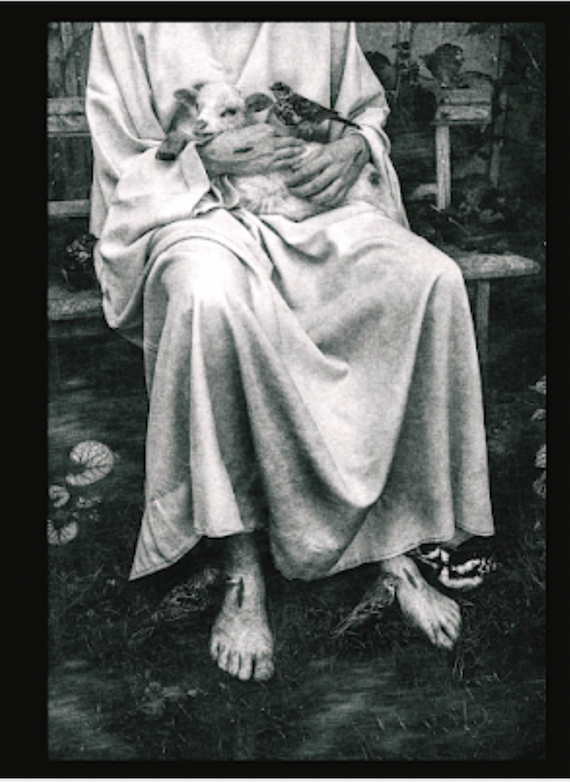
Perhaps the most striking feature in this painting is that it completely omits Jesus’ head and only shows his body with a focus on his torso. What a change in emphasis! Not just the head – like we see in all those familiar Sunday School paintings of Jesus with a halo around his golden, flowing, wavy hair and sparkling blue eyes. Here, we are invited to focus on his body.
Can we move beyond our discomfort, to see only Jesus’ broken body?
Getting into the nitty gritty of the body’s core may make us squirm and feel uncomfortable. We would rather stay with the neat-and-tidy thoughts from our brains rather than blood and water from our guts. We would rather look at Sunday School paintings of Jesus’ perfect, youthful head. And stay away from what is natural, what Jesus came to embody in the fullness of his humanity.
The ancient church believed that Jesus took everything upon himself when he healed, made whole, and cared for all who suffered. Jesus makes all human experiences holy, including the experience of ageing (Coman & Jorgenson, 2026).
Of course, for many of us, being in our bodies, and aging, often involves disappointment and fear and anxiety as memories wane and our bodies cannot do what they could years ago. Our eyes dim, strength slips away, and hearing fades.
As we age, we may not be happy with our changing capacities. How much are we tempted to believe that if we are made in God’s image (Genesis 1:27), it must mean the earliest and most youthful version of ourselves? Just like we would rather see Jesus’ flowing, golden hair, blue eyes and shining face. Not his beaten, bloodied, broken body.
Yet, our bodies communicate the meaning of the Gospel in Christ Jesus, the incarnated God among us, with us, for us. When the aged Simeon sang his thanksgiving in the temple, he held the infant Jesus in his arms (Luke 2:35). Simply holding Christ gave him life.
Can we, like Simeon, remember that each wrinkle, each limitation, each new dependence is a place where Christ is quietly present? Our wrinkles, our pains, our limitations and dependencies all hold Jesus who is right there in us because he himself lived inside the limits of the human body (Coman & Jorgenson, 2026).
To grow older in the body is to follow the same path that Jesus walked: from independence to surrender. The ageing body teaches us that God delights in what God has come to dwell within. Our aging bodies have something, therefore, to tell us. “Our sacred, ageing bodies preach to us” (Coman & Jorgenson, 2026).
Our sacred, ageing bodies preach to us. What do they say? They tell us, ultimately, that human death approaches. Yes. Until that time, they counsel us to ask for help, to slow down, to change our expectations, to respect our limitations, to breathe each breath with gratitude. They remind us that even in death there is hope.
Maybe what sits uncomfortably for us has something important to offer us, something we need to hear, to bring healthy balance and healing ways into our lives. Maybe if we skip any service in the coming week, it ought not to be Maundy Thursday and Good Friday, those holy days that draw our attention to Christ’s suffering body.
Holy Week invites us to listen and pay attention to our feelings, our emotions, and our bodies. In this journey to surrender ourselves, we discover a healing path through the cross of Christ.
References:
Coman, S. (2026, March 10). Day 18; From dust still holy: A daily devotional for lent and holy week. Lutherans Connect. https://fromduststillholy.blogspot.com/2026/03/day-18.html.
Coman, S., & Jorgenson, A. (2026, March 19). The ageing body, day 26; From dust still holy: A daily devotional for lent and holy week. Lutherans Connect. https://fromduststillholy.blogspot.com/2026/03/day-26.html.
Makabresku, L. (2021). Shelter. In Coman, S. (2026, March 2). Day 11; From dust still holy: A daily devotional for lent and holy week. Lutherans Connect. https://fromduststillholy.blogspot.com/2026/03/day-11.html.
 Raspberryman