
How could such a beginning
Ringed in water
Come to such an end
Fixed in fire?
(King, 2019)
When I recently read this poetic lament written by Canadian Indigenous historian and poet, Thomas King, I couldn’t help but immediately think about all the wildfires this summer.
Others are calling on us Canadians to get used to the “new reality” (Reed, 2025, August 11) regarding summertime wildfires. 2025 has been the second worst year for wildfires after the record-setting year in 2023.
The average number of hectares that burn over a 5-year period in Canada is around 4 million. This year alone, seven-and-a-half million hectares of land have burned due to wildfires, about 78% more than the 5-year average.
The warmer it gets the more fires we see. It is a stark manifestation of the climate crisis, with temperatures this past spring already two-and-a-half degrees Celsius above average. The hotter the climate the more the atmosphere sucks moisture out of the dead vegetation and the forest floor, creating ideal conditions for fires to start. The warmer temperatures increase the frequency of lightning that sparks the fires. Lightning is a leading cause of wildfires in remote regions of Canada’s north.
Indeed,
How could such a beginning
Ringed in water
Come to such an end
Fixed in fire?
(King, 2019)
How do you interpret this poem? Likely, we can go in many different directions with it. We could, like I initially did, take his poem literally and refer it to creation and the climate crisis.
We could also read it as a metaphor for faith, describing the journey of faith beginning in the waters of baptism and ending in the fiery passion of living in the Spirit?
Whichever way you go, poetic words are meant to call out from each of us – our own hearts and minds – a unique response. Scripture is meant that way, to elicit and evoke something from us.
Like last week’s Gospel, Jesus’ words in the opening verse of today’s reading from Luke leans into this approach: “I came to cast fire to the earth and how I wish it were already ablaze!” (Luke 12:49). Poetic. But is Jesus angry? Is he vengeful?
Recall, Jesus recently rebuked James and John for wanting retribution, wanting to bring down fire from heaven on unwelcoming Samaritans (Luke 9:54-55). Jesus means a different kind of fire. This is not the fire that incinerates. It’s not the fire of judgement raining down from heaven upon the heads of God’s (read, ‘our’) enemies. Let’s be careful about taking these poetic words literally.
Some bible scholars suggest Jesus is talking about the fire he takes upon himself. This is the “baptism by fire” (Lull, 2010, p. 361) that entails his own suffering, his own passion. God’s work on earth is Jesus’ own self-giving, his own sacrifice on the cross. “How I wish it were already ablaze,” Jesus says. How he wishes his purpose on earth was already accomplished. He was passionate.
So, where does that leave us? Jesus does not let his disciples, nor we, off the hook. In this season after Pentecost we continue to be reminded of the Holy Spirit’s work in our lives, in the church on earth. The fire the Spirit of God brings burns in the hearts and minds of followers of Jesus. “Were not our hearts burning within us?” confessed the disciples after seeing the resurrected Jesus (Luke 24:32). A spiritual awakening, a growth, a movement enflamed by the Spirit’s power continues to burn in the hearts of Jesus’ followers ever since.
So, if the fire in this Gospel refers to the passion of Jesus leading through the suffering of the cross and the empty tomb, the death and resurrection of Jesus introduce us to the paradox of faith. In other words, we cannot bypass the pain on the path to new life. Death before resurrection. Whatever good for which we pray, strive and seek only comes by way of hard, personal work. The good results from the struggle.
At the orientation meeting when I started the Master of Arts in Counselling Psychology over a year and a half ago, the Dean of the program told all of us newbies that, “to learn is to churn.” To churn, like hurricane Erin now does in the eastern Caribbean.
To learn is to churn. I didn’t want to believe him at first. But I can honestly now say that this learning journey, while rewarding and affirming in many ways, has also been a churning, so to speak.
Learning is something we say we are always doing. But the growth and positive change don’t come without the pain of loss. The ‘little deaths’, as Martin Luther liked to put it. This challenge can apply to everything from family relations to politics to community engagement and church work, from caring for ourselves and others to meeting our daily challenges. Solutions don’t come without some churning along the way.
To learn is to churn. On the one hand, churning is about movement. When we confront the ambiguity and nuance and complexity of life, we don’t just give up and stay stuck in this challenging awareness. Churning is about movement. We do something. Our behaviour changes.
At the same time, churning is about a movement that is not rushed nor hastily reactive. Churning turns things over, mixing it all, going deep. We don’t rush the turns of life. We spend time in, embrace, the change as hard as it is. Teilhard de Chardin said, “Above all, trust in the slow work of God” (DotMagis, 2025). Churning.
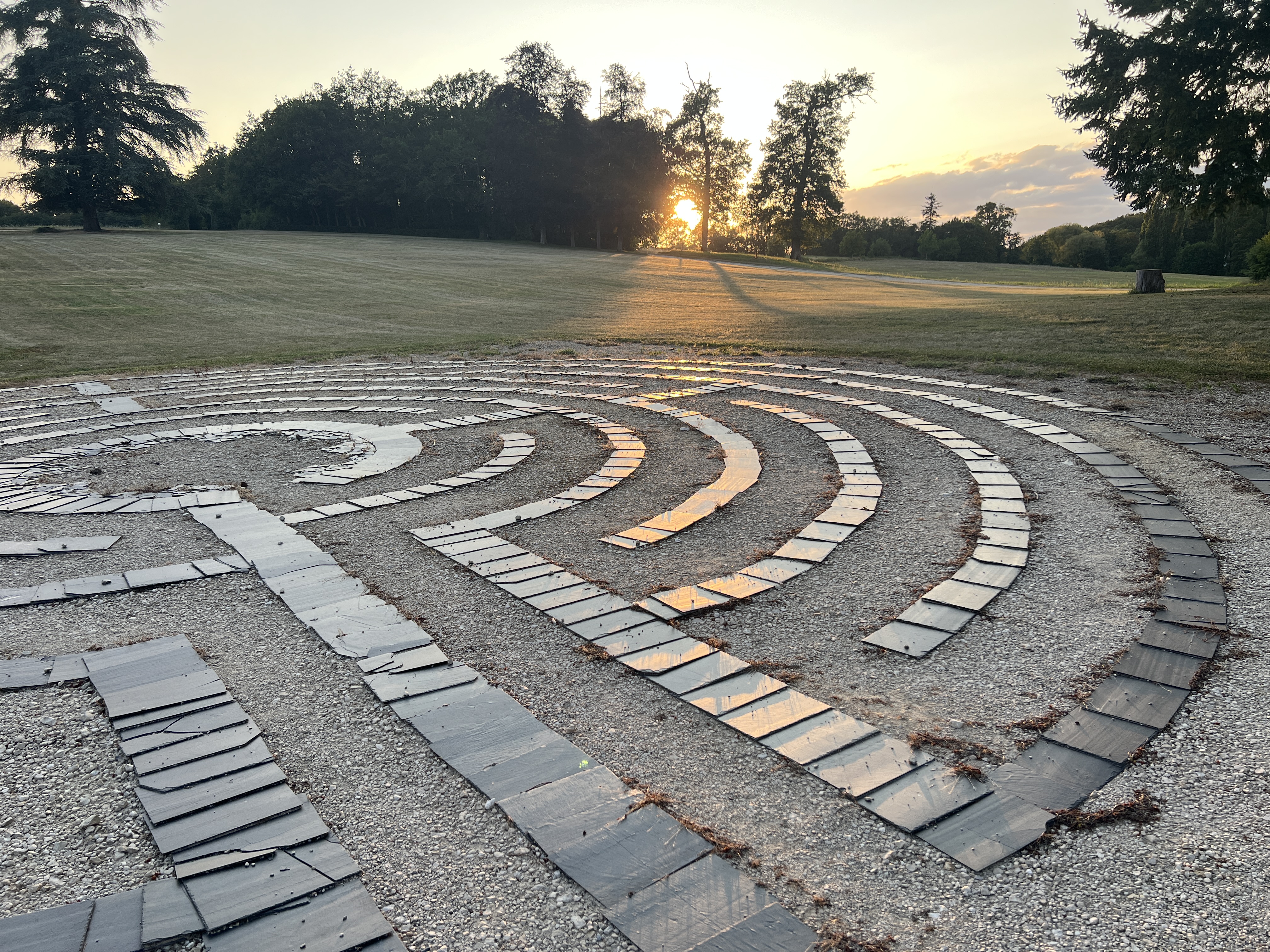
One highlight of the summer for me happened on the first day of summer, when members of three congregations in this community went for a walk from garden to garden to garden. We ended by walking the labyrinth on the floor in the parish hall at Julian of Norwich Anglican Church.
The labyrinth has a history in the Christian tradition. During the Middle Ages, when Christian pilgrimages to Jerusalem were disrupted by conflict, particularly during the Crusades, Christians developed labyrinths as a substitute for the physical journey to the Holy Land.
These labyrinths, often called “Chemins de Jerusalem” (Paths of Jerusalem), provided a way for Christians to symbolically journey to Jerusalem through prayer and meditation, particularly on the Passion of Christ. The most famous of these labyrinths is in the Chartres Cathedral near Paris, France.
When I walked on the labyrinth at Julian of Norwich, praying and reflecting on the journey of life and faith, these words pierced my heart with renewed appreciation: “There is no wrong turn”. On the labyrinth, there is no wrong turn.
The labyrinth, after all, is not a maze. In a maze you may be tricked or mistaken in taking a wrong turn which leads to a dead end, right? But not so in a labyrinth. There is only the one path, leading to the centre. You just need to follow it.
And be mindful of the turns. Those turns take you around 360 degrees. If you are sprinting, you might overshoot and miss the turn. But by remaining faithful to the slow work, by staying on the path, that is all. You just need to take your time at each turn. On the labyrinth, there is no wrong turn. In a life of faith, there is no wrong turn.
These turns, changes of direction, in life, are not easy. But these turns provide the best learning opportunities in your life. And yes, to learn is to churn.
As I focus on my practicum over the next eight months, I will have an excellent opportunity to learn. It will also be an excellent opportunity for you, the congregation, to learn. To learn together in a new way.
Trust the path. On the way, there is no wrong turn. No decision you make is outside the purview of God’s grace, mercy and love. Because the path you are on, even with all the turns, takes you to the center of Jesus’ heart, into the fullness of Christ’s presence and love. This is the eternal journey that begins now, and in eternity never ends.
The promised glory at the end of the road requires us to take that road, and fully embrace ourselves on the path ahead, one step at a time.
Trust in the slow work of God. And be amazed.
References:
DotMagis (Ed.). (2025). Prayer of Teilhard de Chardin: Patient trust [Website]. Loyola Press. https://www.ignatianspirituality.com/prayer-of-theilhard-de-chardin/
King, T. (2019). 77 fragments of a familiar ruin: Poems. Harper Collins.
Lull, P. J. (2010). Luke 12:49-56: Pastoral perspective. In D. L. Bartlett & B. B. Taylor (Eds.), Feasting on the word: Preaching the revised common lectionary, year c volume 3 (pp. 359-362). Westminster John Knox Press.
Reed, B. (2025, August 11). Canada wildfire season already second worst on record as experts warn of ‘new reality’ [website]. The Guardian. https://www.theguardian.com/world/2025/aug/11/canada-wildfire-season
 Raspberryman