Closer to the light

Card crafting by Jasmine Hawley; Image from ‘Creative Stamping Magazine’ (Issue 147, p. 16, 2025)

As the days lengthen and the sun shines higher in the sky, so much more is exposed to the light, and for longer. The journey of the seasons can reflect our own personal, spiritual journeys with God. And one truth becomes clearer at this glorious time of year:

The closer we get to the sun, to the light source, the more of our shadow we see. We get closer to God, or God gets closer to us. And one of the first experiences of this nearing, is exposure to what we’ve wanted to hide, what has embarrassed us, what we’ve kept hidden from view. Nearer my God to Thee, and more of myself I and others see.

It’s like two opposite movements in tension. On the one hand, towards the bright glorious presence of God. And, on the other, towards the revelation of our own truth good and bad.

This can discourage us, and we might rather turn away from getting closer to the light.

Another natural reaction is to blame others. At every level of human interaction – from geo-political affairs to national debates, to community groups, families and inter-personally – it’s easier to locate the source of the problem outside us. It’s much, much harder, to admit the problem at home, in us.

Russian writer Aleksandr Solzhenitsyn put it beautifully: “If only there were evil people somewhere insidiously committing evil deeds, and it were necessary only to separate them from the rest of us and destroy them.

“But the line dividing good and evil cuts through the heart of every human being. And who is willing to destroy a piece of [their] own heart?” (Solzhenitsyn, 1974, p. 168). Jesus himself says that good and evil come from within us, from the heart (Mark 7:20-23; Matthew 12:34; Luke 6:43-45).

So, what does this mean? First, as Solzhenitsyn implies, it is impossible to purge that evil side of us. Jesus in the parable of the weeds, implies the same. “Don’t pull up the weeds because you might uproot the good wheat as well. Let the weeds and the wheat grow together …” (Matthew 13:24-30).

And, in truth, there is more to this than mere tolerating it, or putting up with the less-than-perfect ideal. Because, in truth, therein lies a key, working with both sides in your life, a key to growing and becoming stronger.

Holy is this tension between good and bad within us, not to be spurned. So, spiritual wisdom from the ages has taught: “Pray in the moments light and darkness touch” (Mahany, 2023, p. 125). Pray in the moments when the nearness of God’s light exposes the tender vulnerabilities in you.

The problem, really, are the untruths we believe – the ideals fuelled by perfectionist, purist expectations. When we set up those expectations, it is our vision we seek, rather than God’s. The problem starts when we dream up a vision of the church, for example, as an ideal we have to realize, rather than a reality created by God.

Because when it doesn’t go our way, when reality bursts our bubble, we think we are a failure. When our idealized image is shattered, we see the church falling to pieces. And then we blame others in the church, then we blame God, we blame culture, and finally we blame ourselves (Barnhill, 2005).

But Jesus doesn’t ask us to conform to some perfect ideal. When Jesus says, “Be perfect as your Father in heaven is perfect” (Matthew 5:48) he is not talking about someone who has magically become faultless by their own efforts. Our belonging in Christ is not a race we have to run or some competition to see who conforms to Christ faster or better. Our unity in Christ is not about uniformity based on some ideal to be striven after.

As Bonhoeffer claims, “the church doesn’t need brilliant personalities but faithful servants of Jesus and of one another. It does not lack the former, but the latter” (Barnhill, 2005, p. 140).

Instead, the Gospel is about Jesus who seeks to be formed in us (Galatians 4:19). What we have trouble believing is, what may appear weak and insignificant to us – the long shadow appearing the closer we get to the light – what may appear weak and vulnerable and shameful to us, may be useful to God. May even be great and glorious to God.

How so?

Every year towards the end of the season of Easter, we receive this prayer of Christ from John 17. This morning, we heard again the words of Jesus praying that his followers for all time “may be one” (John 17:20-26). The passage concludes with Jesus’ statement about how the world will know God. They will know God by the love in them and for each other.

When Jesus says, “Be perfect as your Father in heaven is perfect” he is talking about the Father’s love. Love others as your God loves you. What binds us together in unity, how we become one in Christ in the end, is the forgiveness of sins we all receive from God. Why what appears weak in us may be great to God, is that our perceived failures open the door to being aware we are loved despite our failure. We are forgiven.

And not just me. But everyone else I want to blame for the ills of church and society and the world we live in. Our forgiveness for what appears to be a long and scary shadow behind us as we near the light of Christ’s presence is what unites us in Christian community. And that reality, that truth, is great!

We don’t need to strive for perfection, or some ideal vision of what it ought to be like. We only need to receive one another, our leaders, our volunteers, our families in the way Christ also receives us – bathed in the light of God’s loving forgiveness, always and forever.

This forgiveness releases us to be who we are, including all our limitations and failures. God’s forgiveness releases us to take the next step, and follow where Christ leads.

Indeed, they will know we are Christians by our love.

References:

Barnhill, C. (Ed.). (2005). A year with Dietrich Bonhoeffer: Daily meditations from his letters, writings, and sermons. Harper One.

Mahany, B. (2023). The book of nature: The astonishing beauty of God’s first sacred text. Broadleaf Books.

Solzhenitsyn, A. I. (1974). The gulag archipelago, 1918–1956: An experiment in literary investigation (Vols. 1-2). Harper and Row.
Healing for everyone

Each and every one of them in the crowd wanted to be healed (John 5:1-9). That’s why they were there, surrounding the pool. Jesus asks the man a rhetorical question, “Do you want to be made well?” Because based on how the man responds, what Jesus may really have been asking was, “If so, why haven’t you already been into the pool?”

Everyone seeks healing, and that’s why they are there. The question really gets at the barriers to our healing, everyone’s healing.

The story ends well, for the man. In this Gospel, Jesus leads the man to new life. How does he get there? The text reads like all Jesus did was snap his fingers and the story is over. But let’s break it down.

To set him on the path to new life, Jesus provides the necessary support that man needed but never got from anyone else, for 38 long years.

Recall, for context, many more people than usual were in Jerusalem for the festival and passed by the pool on their way to the temple to offer a sacrifice.

This is how Sue Monk Kidd describes the scene at a healing pool in her creative telling of the Gospel. This scene is told from the perspective of someone close to Jesus:

“We crossed the valley with the little lamb on Jesus’ shoulders and entered Jerusalem through the Fountain Gate near the Pool […]. We planned to cleanse ourselves there before entering the Temple, but we found the pool glutted with people. A score of cripples lay on the terraces waiting for some sympathetic soul to lower them into the water.

“’We can purify ourselves at one of the mikvahs near the Temple,’ I said, feeling repulsed by all the infirmities and foul bodies.

“Ignoring me, Jesus thrust the lamb into my arms. He lifted a paralytic boy from his litter; his legs were twisted like tree roots.

“’What are you doing?’ I said, trailing after him.

“’Only what I’d want if I were the boy,’ he replied, carrying him down into the water. I clutched the squirming lamb and watched as Jesus kept the child afloat while he splashed and bathed.

Naturally, his deed set off shouts and pleas from the other cripples, and I knew we would be here a while. [Jesus] bore every one of them into the pool” (Kidd, 2020, pp. 169-170). This is Jesus. This is the beloved character of Jesus.

During the Easter season, we celebrate the resurrection of Jesus. And we see how it is in Jesus’ nature and purpose, exampled by this Gospel text, to lead us to life, beginning in this life. The one you have now, however imperfect, broken, hurting, sinful. Jesus beckons us to new life.

But the path to new life isn’t a solo journey. We understand that everyone is not the same. But that means everyone has different needs. And so, everyone needs everyone else to do their part to help. Interdependence. As the body of Christ in the world today, the church is about following together in Jesus’ way by helping each other.

Jesus models how it’s done in a simple yet vivid way: He acts to remove the barriers that keep others from their path to growth, healing, and new life. Jesus levels the playing field, so everyone at least has an opportunity, like everyone else, to grow and be renewed.

Doing this is not easy and it means taking a risk. Jesus healed the man on the Sabbath. He broke convention and the rules for the sake of the wellbeing of another. Jesus got in trouble with the law for his acts of compassion and healing.

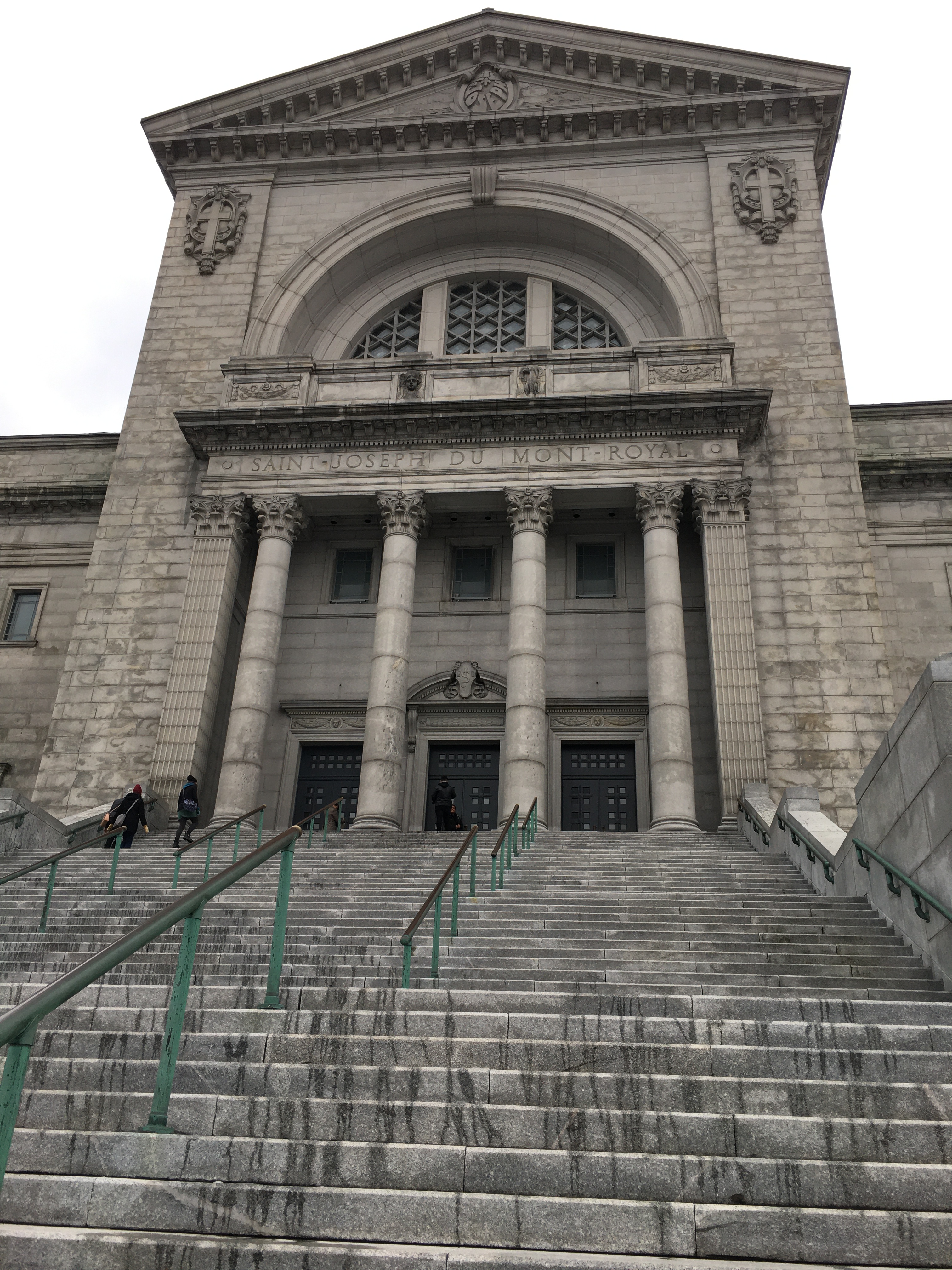
There’s a meme that’s gone around my social media page. It’s an animated picture of the front of a church during a snowstorm. There’s a crowd of people waiting to climb the steps to get into the building. But they are waiting for the lone caretaker to shovel off the pile of snow making entrance impassable for anyone. Amid the crowd is one person in a wheelchair.

The caretaker, before attacking the snow blocking the stairs, begins his work by shovelling the long, switchback ramp leading up to the main doors.

The crowd complains – “Hey, do the stairs first. There’s more of us!”

The caretaker responds – “If I shovel the ramp first, then all of us can enter right away.”

Jesus leads us into new life by removing the barriers. It’s a new life given to us all, not just those in the majority.

Climbing the stairs at St Joseph’s Oratory in Montreal (Nov 2019, photo by Martin Malina)

Dietrich Bonhoeffer said we don’t find truth and freedom by focusing exclusively on our own needs and wants. We find God’s truth and freedom by focusing our attention on another’s needs and wants. In doing that, we free ourselves from whatever blocks us on the journey to new life.

He says it best. Bonhoeffer writes in one of his sermons: “God’s truth alone allows me to see others. It directs my attention, bent in on myself, to what is beyond and shows me the other person. And, as it does this, I experience the love and grace of God … God’s truth is God’s love, and God’s love frees us from ourselves to be free for others” (Barnhill, 2005, p. 151).

There’s a beautiful Taizé song we are chanting before meditation these Easter weeks. It announces and celebrates the living Lord who leads us all into life.

Bless the Lord my soul, and bless God’s holy name. Bless the Lord my soul, who leads me into life. (Berthier, 1981).

What are the barriers you face? What are the barriers others face? And how does God invite you to help level the playing field so that all may come to know new life?

References:

Barnhill, C. (Ed.). (2005). A year with Dietrich Bonhoeffer: Daily meditations from his letters, writings, and sermons. Harper One.

Berthier, J. (1981). Bless the Lord, my soul [Taizé Community]. Les Presses de Taizé, France.

Kidd, S. M. (2020). The book of longings. Penguin.

Gifts from above

I often joke that I’ll let God wash my car. After a long winter when the salt-infused grime cakes on the outside panels, I wait until the pure rains in Spring give the car a good rinse.

Indeed, the rains fall from heaven, often unbidden, to cleanse the earth, to cleanse us. Notice the direction of God’s grace, God’s new thing, God’s vision of our future in the text from Revelation today. The holy city, the new Jerusalem, comes down from heaven to earth (Revelation 21:2). Direction, downward.

Just as in the Inuit language there are about 50 different words to describe various forms of snow (The Canadian Encyclopedia, 2015), the British boast several words and phrases to describe rain’s multiple personalities:

There’s a basking – which is a drenching in a heavy shower; a drisk – which is a misty drizzle; a fox’s wedding – sudden drops out of a clear blue sky; a hurly-burly – thunder and lightning; a slotting – which is rain so hard it bounces up off the ground; and a thunner-pash – which is a heavy shower with thunder (Mahany, 2023). Have you heard of these terms? Most of these, I haven’t. There are different ways the rain comes down.

No matter the form it takes, rain has a way of catching my attention. “One minute it’s barely pebbling the windows, the next it’s making a joke of the downspouts” (Mahany, 2023, p. 90). On the one hand, we pray for it. On the other hand, we roll out tarps to stop it.

No matter the form rain takes, we feel the water-drop touch our skin. It is invasive and so often our first instinct is to get out of it, to find shelter or cover. Rain seeks to grab our attention not just by touch alone, but by smell as well.

There is that unforgettable, indescribable just-after-the-rain earthy smell. There’s a name for that scent – petrichor. It’s caused when rainwater mixes with certain plant oils in dry soil – compounds to which the human nose is highly sensitive. Add to this cocktail of smell ozone which is released if lightning is in the mix. All of this wafts into the air, and we “smell rain” (Mahany, 2023, p. 91).

Like I said, rain has a way of catching our attention in more ways than one. Likewise, there are different ways we experience God’s grace, and not always is it what we want nor expect. But it always catches our attention. Somehow, God’s presence and life touches us, our hearts, our intuition, our perceptions – even subtly.

I joked that I let God wash my car. We also joke, “We’re not made of sugar,” implying that we won’t melt in the rain. Earth and all that is in it is not destroyed, obliterated nor eradicated by rainfall.

When the author of Revelation speaks of “the first earth passing away, and sea was no more” (21:1), it is not the extinction of the earth at the end that we’re talking about. God’s grace, God’s promise of resurrection does not cancel earth, our humanity, our senses – what we see, hear, touch, taste and smell.

Instead, new life is embodied and transformed on earth, from the earth. The direction of grace may be downward. But the reason the promise and vision come down to earth is because God will use the stuff of earth, and embody it. The goal of resurrection is earth’s transformation (Carey, 2009).

Rain, yes, is invasive. But it renews, refreshes and generates growth and life. Out of the old emerges the new.

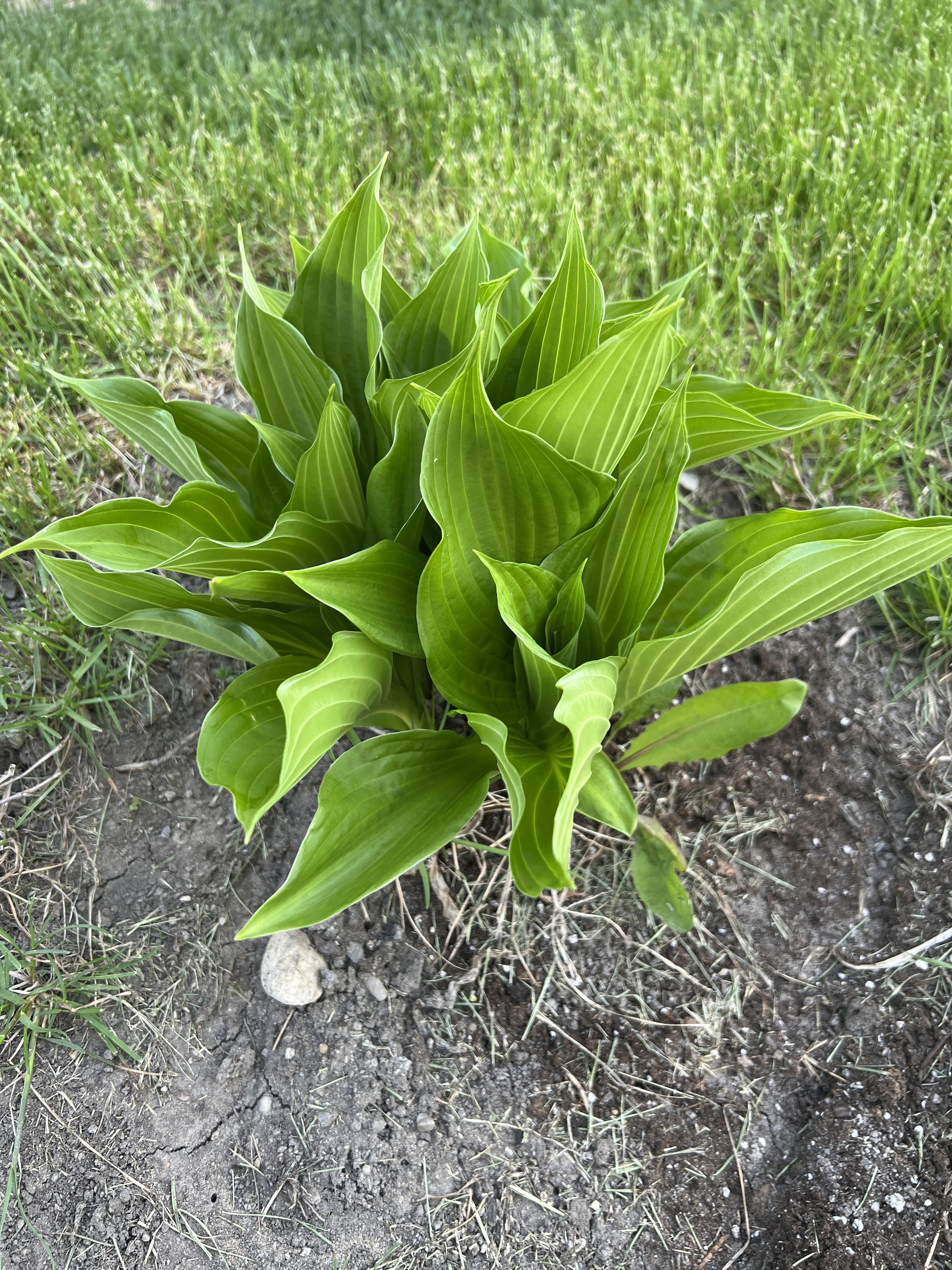
I was given two Hosta plants last year which I planted on the side of our house that receives a lot of sunshine. But these Hosta plants were designed to thrive in more shade than sun. They didn’t look so good by the Fall time. They were sporting large brown spots which covered their large, limping leaves. Honestly, I didn’t expect them to come back up this Spring.

But out they came a week ago, bursting through the less-than-ideal soil and location for these particular plants. The young shoots already showcased their green, lustrous leaves reaching upward to receive the gifts of rain and sun. Coming from above. Downward.

There’s a path on that side of the house, a ravine at the bottom of which the deer will follow. Deer love to munch on Hosta plants. But the Hosta plants will live, I do believe, despite the deer. Despite the hail. Despite thunner-pash, slotting, hurly-burly and basking rain falls those plants will surely endure this summer. I believe!

New life, new beginnings, the promise of resurrection, is not without its difficulties, challenges and little deaths. We may not understand yet its deepest mysteries and paradoxes, death and life, life and death.

But those raindrops will continue to descend from above. Even if we can’t understand it, or when we come up against our own limitations. Despite hearth’s and humanity’s imperfections, God’s work of reviving, renewing and enlivening the earth will not stop. Easter is a forever-promise.

Those raindrops will always be awakening us to the wonderful mystery of God. Those raindrops will remind us that even though we may suffer disruption, and painful transitions in life, the rain of God’s love will continue to nourish us and enliven us to reach forward into the unknown future with trust and assurance.

References:

Carey, G. (2009). Exegetical perspective: Revelation 21:1-6. In D. L. Bartlett & B. B. Taylor (Eds.). Feasting on the Word: Preaching the Revised Common Lectionary Year C, Volume 2 (pp. 463-467). Westminster John Knox Press.

Mahany, B. (2023). The book of nature: The astonishing beauty of God’s first sacred text. Broadleaf Books.

The Canadian Encyclopedia. (2015). Inuktitut words for snow and ice. The Canadian Encyclopedia [Website]. Retrieved from https://www.thecanadianencyclopedia.ca/en/article/inuktitut-words-for-snow-and-ice

Nearer, my God

Jesus says, “My sheep hear my voice” (John 10:27). He doesn’t say, “My sheep see me.” In this Gospel, belief is equated with hearing and listening, not seeing.

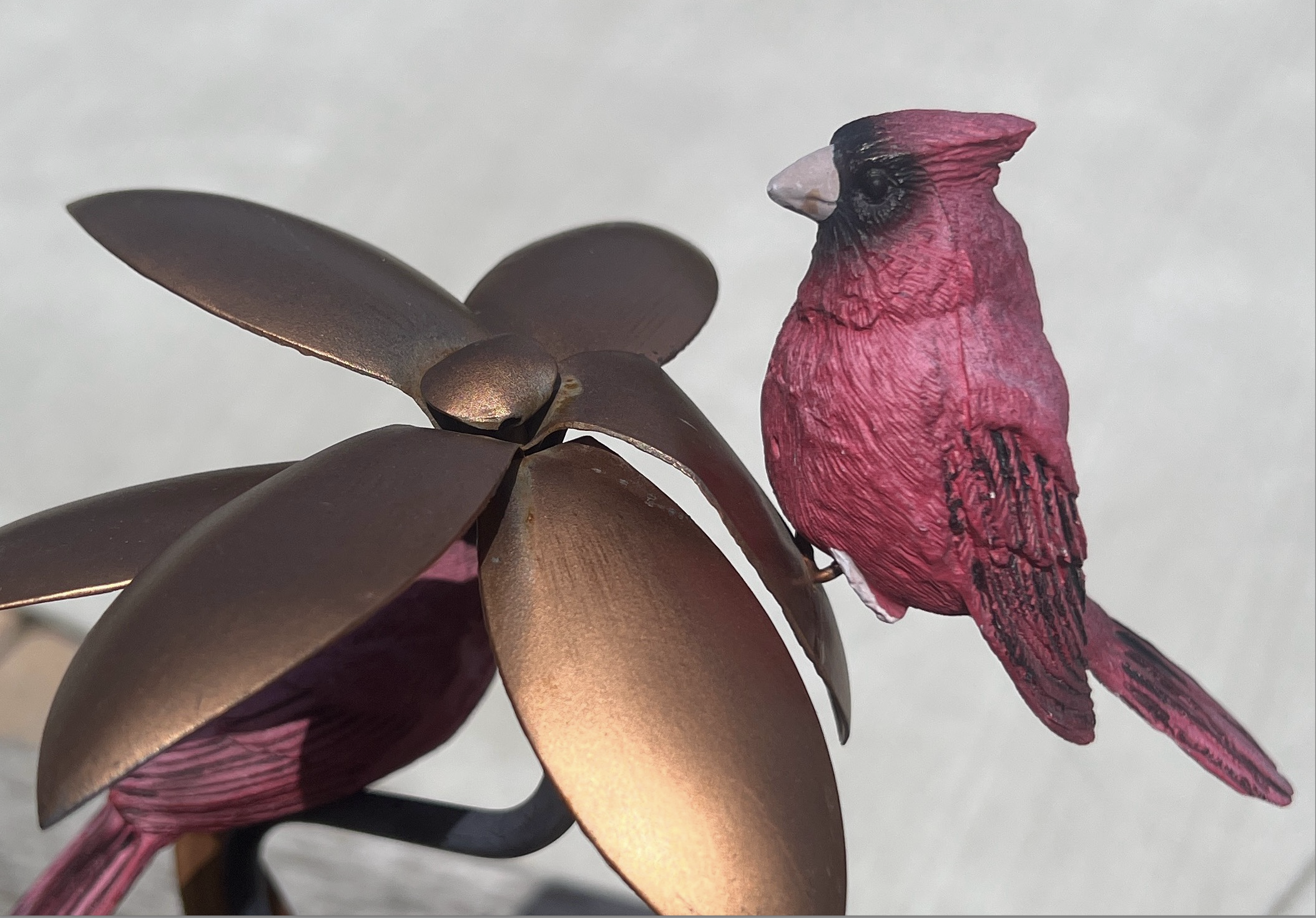
At this time of year, the birds are finally returning to our feeder. And when I go for my walks around the neighbourhood I know where the cardinals live – in a stand of old growth trees near the Algonquin Trail in Arnprior. Almost every time I walk through there, I first hear the cardinal’s distinct song.

photo by Martin Malina (Aug 6, 2023)

The point is, I know the cardinal is there. I will scan the trees, fence lines and roof tops from whence the song comes. Rarely will I first observe the bird nestled deep in the foliage, despite its catchy red coat. But because I can’t see the bird doesn’t mean it’s not true, doesn’t mean it’s not there. I know it is nearby. I believe, not because I have seen it with my own eyes but because I hear it close by.

When I was in public school, at Halloween teachers handed to us students those orange UNICEF boxes. We strung those boxes around our necks and carried them with us trick-or-treating. Some of you may remember those boxes. So, when we went to each house for candy, neighbours would also have the option of dropping some coin into those iconic boxes. All the proceeds were then donated to the United Nations Children’s Fund, originally labelled the United Nations International Children’s Emergency Fund (https://www.unicef.ca/en).

I value that experience of learning. I learned that what I did for myself was not enough to be a good human being. I also had to do something for other children, especially those who were suffering hunger and persecution in faraway lands. Just because I couldn’t see these children with my own eyes, just because these were not my personal friends, didn’t mean I wasn’t called by God’s voice to do something to care for them in their suffering, their hunger, their pain.

Today it’s unfortunately fashionable to openly admit that if some situation that others suffer doesn’t impact me directly, I don’t care and I don’t want anything to do with it. We shy away from taking on the responsibility, collectively, to teach by example younger generations the vital importance of working together to care for those who are not our own, so to speak. If the problem is far away, far removed from my or our reality, then forget it.

My wife Jessica talks about a cherished memory of family friends whose parents created a home environment in Ottawa where neighbourhood kids felt comfortable dropping by at any time of day or night. Not only did those parents care for their own children with fierce love, but their home also became grand central for all the kids in the neighbourhood to hang out and even eat meals together.

Jessica has often remarked how influential that early childhood experience was in forming the desires of her own heart in wanting to be open to others and engage those outside the family with caring acts of compassion, generosity and respect. In response to a need.

God’s voice, God’s call – the root of the word vocation – doesn’t come from far away. God doesn’t come to us from some celestial, otherworldly heaven removed from our day to day. God’s presence is near to us, in fact born in the nitty-gritty of our lives. The call is to live out from our Christian values of compassion and love.

Jesus assures his disciples of two things in the Gospel text for today. First, that he and God “are one” (John 10:30). So, if Jesus will never allow anything or anyone to snatch us away from his care and protection for eternity, neither does God. For Jesus and God are one. In other words, we are never, ever out of the scope, the field of belonging to God’s loving care and attention. Ever.

The second assurance flows from the first. God and Jesus are not only faithful and loyal to us – as a shepherd is to their flock of sheep, using a biblical metaphor. God’s loyalty and faithfulness means that God perseveres. God does not give up. Even if for just one out of the hundred in the flock (Luke 15:1-7). No matter how awful and terrible the human circumstances can get for anyone. No matter how lost one can get. God keeps at it, keeps loving us, finding us, embracing us, forgiving us, protecting us.

That ‘snatch’ verb repeats twice in the conclusion of this Gospel’s short eight verses (in verses 27 and 28). That should draw our attention to the persevering God we worship. Nothing will snatch us away from God’s perseverance.

Dietrich Bonhoeffer translated the word perseverance to mean, literally: “remaining underneath, not throwing off the load, but bearing it” (Barnhill, 2005, p. 72). Bearing it.

How do we recognize God’s voice, today? God’s voice emerges from human suffering and loss.

Bearing the load. God bears the human load. The cross of Jesus indicates the kind of God we worship. We worship a suffering God who knows our pain, our hunger. We worship a God who is revealed to us most poignantly in the lives of those who persevere in their suffering. Bearing the load.

From the UNICEF website (https://www.unicef.ca/en/blog/seven-inspirational-stories-about-mothers-around-world), I read about a brave Mom, named Neveen Barakat, who kept her family strong in the midst of war. Neveen’s husband died in a blast that hit a UN-run school in Gaza. The blast wounded three of her children and left Neveen with a permanent disability. A photo from the webpage cited above shows Neveen comforting her six-year-old daughter, Rosol.

The mothering love of Neveen is bearing a huge load. And that is why we must care with the mothering love God reveals to us in Jesus. Because while God’s revelation comes to us daily in our human suffering and pain, God’s grace calls us to care for others in the way of Christ who bears their suffering, too.

We can care for others close and far because God is never far away. God doesn’t care from a distance. God will hear our voice when we call out, just as we know and listen to the voice of our loving God who will never give up on us. Even if it’s just a whisper under our breath, God is near and hears us. God is close and will help us persevere.

References:

Barnhill, C. (Ed.). (2005). A year with Dietrich Bonhoeffer: Daily meditations from his letters, writings, and sermons. Harper One.

UNICEF. (2025). Seven inspirational stories about mothers around the world [website]. https://www.unicef.ca/en/blog/seven-inspirational-stories-about-mothers-around-world.