
This humorous story reflects the conundrum faced by those of us who tend to over-think and stay trapped in the mind:
A celebrated holy man is on his deathbed. His students are lined up in order of seniority to pay their respects, awaiting his final words with bated breath. Eventually, and with effort, the holy man opens his eyes, then addresses his most senior student.
“Life,” he declares, “is a river.” The student turns to the next most senior, and the message gets carried down the line: “The master says life is a river.” “The master says life is a river.” Only the most junior student, the last to receive the words, is naïve enough or daring enough to venture a question: “But what does the master mean, ‘life is a river’?” The query comes back up the line, until the senior student, trembling at the audacity of questioning the master, manages to blurt it out. “My master, I’m sorry, but what do you mean, ‘life is a river’?”
The old man is moments from expiring. But for one last time, he opens his eyes and regards the student in unblinking silence. Then, he shrugs and turns up his palms.
“All right,” he says, “So it’s not a river!” (adapted from Burkeman, 2024).
Moral of the story: Real wisdom doesn’t lie in getting life figured out. It lies in grasping the sense in which you will never get it completely figured out.
This proposition can be unsettling for those of us whose starting gift is being in our head. This is the gift of analysis, of thinking through and solving problems by acquiring more knowledge.
A “head spirituality” (Ware, 2000) favours what it can see, touch, and vividly imagine. It’s a concrete spirituality often expressed in concepts. Thought and belief are central to this highlighted quadrant on the Gifts and Growth Wheel. This spirituality is often recognized by focusing on doctrines, position papers, and theological argument. This gift is so important to the church and has likely dominated in the church since the Protestant Reformation.
The temptation can be to drill down deeper and remain stuck in the world of mental constructs and abstraction. The excess of this gift; that is, if head-types don’t commit to a journey of growth, is over intellectualizing one’s faith. It is to depend exclusively on rationalism and certainty.
The path of growth for the head type is first toward the Receivers who know to receive reality is at is without an initial compulsion to have to rationalize it or solve an intellectual problem. The Receivers, as we learned last week, are particularly gifted in simply experiencing the presence and celebrating the grace of God without having to understand it fully.
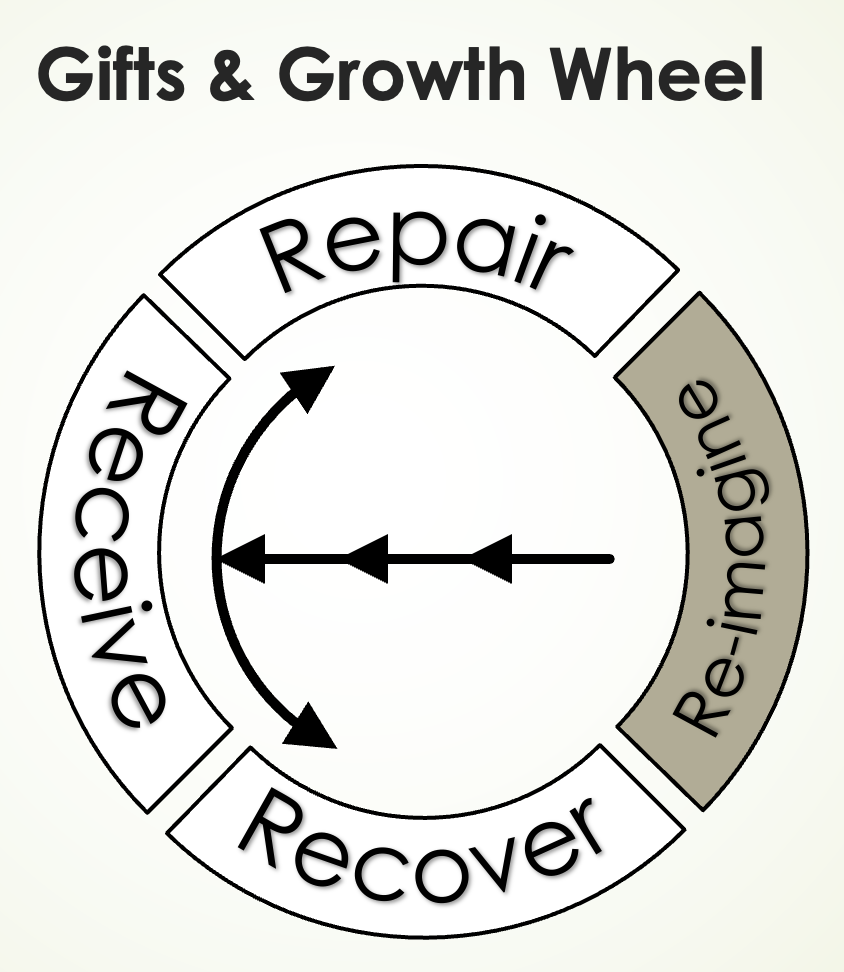
When the thinker follows the path of growth their true gift can bear fruit in the community and they become the Re-imaginers (Bailey, 2021). They come with solutions, but no longer according to the exclusivist agenda of the powers that be. Without going to the opposite side first can make head spirituality exclusive – either by creating a community only of like-minded people and/ or pursuing a course of action that excludes others and paints a line in the sand between ‘them and us’.
In the world of the bible, Jerusalem represented the powers that be. Jerusalem was the seat of religious and political power in the region. Jesus knew that prophetic ministry in the face of power was a dangerous activity. Jerusalem personified the power of the world that sowed division and discord. Those that spoke the truth of God’s kingdom in Jerusalem risked their lives. Jesus knew he was in the crosshairs. But what is surprising in this Gospel text (Luke 13:31-35) is Jesus’ reaction (Reese, 2016).
In the face of threats from Herod and the religious authorities, Jesus responds with love. He responds with a longing of love for the people of Jerusalem. Jesus’ response is the compassion of a mother. His lament evokes powerful imagery of mother hen embracing her chicks in protection and love. This is the longing of God for us, expressed through Jesus’ imagination. He re-imagines what it could be like even though Jerusalem would refuse the grace of God, even though Jerusalem will crucify him.
In the last century, the Berlin Wall represented a physical manifestation of the ideological battle between communism in the east and capitalism in the west.
In the early days of the Berlin Wall during the 1960s, emotions—anxiety, fear, anger—were running high.
Hostilities flared when truckloads of stinking garbage were dumped over the wall into West Berlin by those living in the eastern sector of the city.
West Berlin Mayor Willie Brandt was flooded with demands for revenge at this offence.
Understandable. Tit for tat. You throw garbage at us. We’ll throw it right back!
But Willie Brandt responded in a unique way.
Mayor Brandt requested that flowers—hundreds of colourful, beautiful flowers—be brought to a specific place at the wall. Then, truckloads of these flowers were poured over the wall into East Berlin (Hays, 1997).
That act in the 1960s may not have immediately felled the wall. But history bears witness to the power of non-violent solutions. Almost thirty years later, in 1989, a peaceful candlelight vigil that started in a church and gathered tens of thousands brought down the Berlin Wall.
May we re-imagine our response in the conflicts and struggles of our days and lives. May we learn to start with grace, and love – the grace that Jesus imagined for us. May the flowers reign down where division and strife pretend to define the reality that God, over time, is shaping into something good, gracious and beautiful for everyone.
This is our Lenten hope.
References:
Bailey, J. (2021). To my beloveds: Letters on faith, race, loss, and radical hope. Chalice Press.
Burkeman, O. (2024). Meditations for mortals: Four weeks to embrace your limitations and make time for what counts. Allen Lane.
Hays, E. (1997). The old hermit’s almanac: Daily meditations for the journey of life. Forest of Peace.
Reese, R. A. (2016). Commentary on Luke 13:31-35. https://www.workingpreacher.org/commentaries/revised-common-lectionary/second-sunday-in-lent-3/commentary-on-luke-1331-35-3
Ware, C. (2000). Discover your spiritual type: A guide to individual and congregational growth. Alban Institute.
 Raspberryman
Beautiful message. God is doing something wonderful and we are the generati