Gifts & Growth: Repair

A verse from Saint Paul captured my attention this week. He writes to the Romans: Do not be conformed to this age, but be transformed by the renewing of the mind, so that you may discern what is the will of God—what is good and acceptable and perfect (12:2).

Life in Christ, being a Christian, being faithful means renewing your mind. During this season of Lent, we are called in the liturgy to repent and return to the Lord.

Repentance means “an action or process” (Miriam-Webster Dictionary) of changing something. It is a changed action as much as a change of mind, toward what is good and right.

What stops you from living out the best version of yourself? Because God has entrusted you with gifts. I know many of you share your gifts with others and the church. There are many! And there are different kinds of gifts. But sometimes we hold back. Sometimes we feel we don’t have what it takes. So, what keeps you from celebrating those gifts and offering them in the community?

Thankfully, the Gospel of Luke emphasizes the persistence of God’s mercy and grace despite the stubborn obstacles that keep us from experiencing the joy of life in Christ. In today’s story from Luke 15 – the famous story of the Prodigal Son – it is God’s grace in the wake of estrangement, sin, and jealousy.

The focal point in the story is, of course, the youngest son who leaves home. The reader is invited to follow his story, his perspective. We are drawn to his journey. This is the person of interest.

It’s not that God doesn’t identify with the Father’s actions. It’s not that God doesn’t care for the older son, or any other character in the story. But God is particularly interested in the Prodigal Son.

Why? Is it because this person changes? The youngest son follows through on a different course of action when he realizes that things are not working out very well for him. So, when he hits rock bottom, he changes direction. That’s the gift, the grace upon which this story hinges.

It’s not to say, “Go and make mistakes!” It’s not to say, “Go, intentionally hit rock bottom in your life!” No. Rather, it is to say, “Don’t let your mistakes keep you from continuing to act, reaching out, trying to do good.” It is to say, “Don’t let fear keep you from taking risks, changing your tack, and trying something better.”

But beware! For those who value action—doing something—and want to do better to repair the problems in the world, we may be tempted to cheat and take a short cut.
copyright Martin Malina, 2025

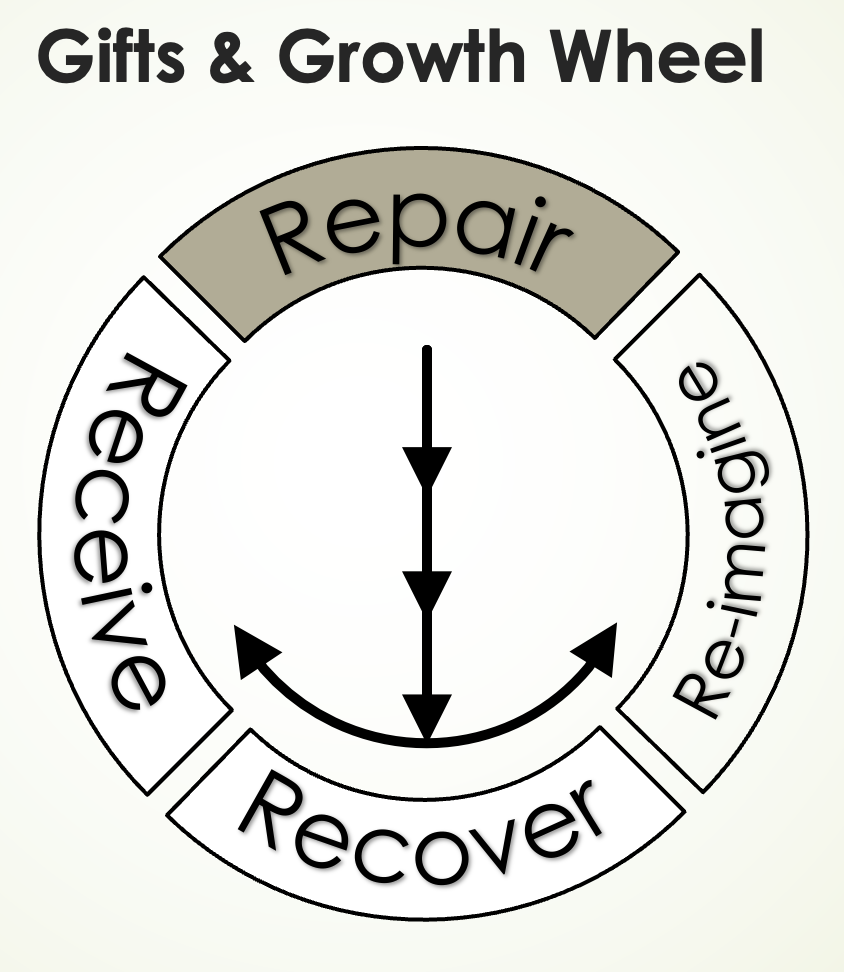
Because to go to the thinker/Re-imaginers closest to you on the Wheel first, this might keep you trapped in justifying inaction, ironically. There’s always a reason, a rationale, not to do something, even good. We may over-think it.

Or, if you first go to the Receivers closest to you on the other side, you may trip into despair and isolation. In other words, you may just give up. It’s easy to get discouraged when your action, your work, your decisions take a downward turn.

No, for the action-oriented person to grow, they must first cross the floor and visit the Recover quadrant on the opposite side of the Wheel. To recover the heart, the feelings, the source of one’s identity. To recover the story of one’s life. To recover a sense of belonging to oneself, to others, to creation and to God. The heart-centred gifts of others will complement your own. You need them as much as they need you.

A concrete way to do this is to recover the lost traditions, rituals of one’s own faith and history. To find the anchor, again. And like a rubber band, to pull back in order to fly ahead with integrity and effectiveness.

But this means changing directions, changing one’s response to the world. What are some examples of right action?

Ask for help when you need it, seek forgiveness, embrace with open arms someone who has chosen a different path, embrace with open arms and accept the person who holds different values than you, take the initiative to reach out to others, to be with them and do good things together with them, care for creation with concrete acts of generosity and grace, vote in elections, commit to a spiritual discipline and practice of daily prayer, act and make different lifestyle choices, for the better. Etc. Etc.

In recent history, who are people you know who have experienced changes in their lives because of their faith? Who might first come to mind? In our church history it may be the likes of Martin Luther from the 16th century, and even Dietrich Bonhoeffer in the 20th century. But what about Martin Niemöller, who was a contemporary of Bonhoeffer’s? Have you heard of Martin Niemöller?

Martin Niemöller was a German Lutheran pastor. Most North Americans associate his name with the famous words inscribed on the wall of the United States Holocaust Memorial Museum in Washington:

First they came for the Communists
And I did not speak out
Because I was not a Communist
Then they came for the Socialists
And I did not speak out
Because I was not a Socialist
Then they came for the trade unionists
And I did not speak out
Because I was not a trade unionist
Then they came for the Jews
And I did not speak out
Because I was not a Jew
Then they came for me
And there was no one left
To speak out for me.

“Pastor Niemöller wasn’t just being poetic. That’s his life story. He was a German nationalist who, in the 1920s and early 1930s, supported Hitler and the Nazis. He hated Communism and socialism and workers — he believed that they had betrayed Germany in the aftermath of WWI. He worked against the Weimar Republic, thinking it to be politically weak and corrupt. Indeed, Niemöller voted for the Nazis, even in the 1933 elections which handed Germany over to Hitler.

“In short, Martin Niemöller not only did not speak out. He actively worked for a political movement to go after Communists, socialists, workers, and Jews … anyone whom he believed undermined the honor of the German nation.

“But Niemöller began to change his mind when Hitler interfered with church policies and applied racial tests to both clergy and laity, even insisting that German churches refrain from teaching or reading from the Old Testament.

“Niemöller’s resistance started when the Nazis applied their brutal and racist agenda to the church — Niemöller’s church, the community he most cared about, was vowed to serve, and led.” His changed action came about because he recovered the heart of his faith, his identity in the church, and the practices that made him Christian. And acted on it.

“Then, [Niemöller] realized that they were coming for him, too. It took him a while. It was a process. But he spoke out. He preached against Hitler and Nazism. He was one of the founders of the Confessing Church. He was detained several times between 1934 and 1937. Then, in 1937, he was arrested for treason and spent the next seven years in various prisons and concentration camps, including Dachau” (Butler Bass, 2025).

After recovering their authenticity, their true identity, action-oriented people can become Repairers. Being a Repairer as a spiritual gift is a greatly needed gift today. It is doing the right thing at the right time which will have positive effects even when those effects might not be immediately apparent. The church needs more Repairers today especially.

The last few weeks we have visited three of the four quadrants on the Gifts and Growth Wheel. Are you a Receiver – someone who reminds the rest of us of the faithfulness, the grace and the prevalence of God’s mercy? Or, are you a Re-imaginer – who thinks and reimagines a vision of God’s meaning and purpose in today’s world? Finally, are you a Repairer who will act righteously and guide others into active service in Christ’s name?

We have one more quadrant to visit next week. And no matter where you begin on this Wheel, we need everyone’s gifts to balance the wheel and help empower the church to faithfulness as we seek – like the Prodigal Son – to return to our home and be embraced by the Father at the end of all our toiling. Thanks be to God!

References:

Butler Bass, D. (2025, February 19). Forget Bonhoeffer. This is the Niemöller moment [Blog]. The Cottage/Substack. https://dianabutlerbass.substack.com/p/forget-bonhoeffer-this-is-the-niemoller?utm_campaign=email-half-post&r=66hlp&utm_source=substack&utm_medium=email

Miriam-Webster Dictionary. (2025). https://www.merriam-webster.com/dictionary/repentance
Gifts & Growth: Re-imagine

This humorous story reflects the conundrum faced by those of us who tend to over-think and stay trapped in the mind:

A celebrated holy man is on his deathbed. His students are lined up in order of seniority to pay their respects, awaiting his final words with bated breath. Eventually, and with effort, the holy man opens his eyes, then addresses his most senior student.

“Life,” he declares, “is a river.” The student turns to the next most senior, and the message gets carried down the line: “The master says life is a river.” “The master says life is a river.” Only the most junior student, the last to receive the words, is naïve enough or daring enough to venture a question: “But what does the master mean, ‘life is a river’?” The query comes back up the line, until the senior student, trembling at the audacity of questioning the master, manages to blurt it out. “My master, I’m sorry, but what do you mean, ‘life is a river’?”

The old man is moments from expiring. But for one last time, he opens his eyes and regards the student in unblinking silence. Then, he shrugs and turns up his palms.

“All right,” he says, “So it’s not a river!” (adapted from Burkeman, 2024).

Moral of the story: Real wisdom doesn’t lie in getting life figured out. It lies in grasping the sense in which you will never get it completely figured out.

This proposition can be unsettling for those of us whose starting gift is being in our head. This is the gift of analysis, of thinking through and solving problems by acquiring more knowledge.

A “head spirituality” (Ware, 2000) favours what it can see, touch, and vividly imagine. It’s a concrete spirituality often expressed in concepts. Thought and belief are central to this highlighted quadrant on the Gifts and Growth Wheel. This spirituality is often recognized by focusing on doctrines, position papers, and theological argument. This gift is so important to the church and has likely dominated in the church since the Protestant Reformation.

The temptation can be to drill down deeper and remain stuck in the world of mental constructs and abstraction. The excess of this gift; that is, if head-types don’t commit to a journey of growth, is over intellectualizing one’s faith. It is to depend exclusively on rationalism and certainty.

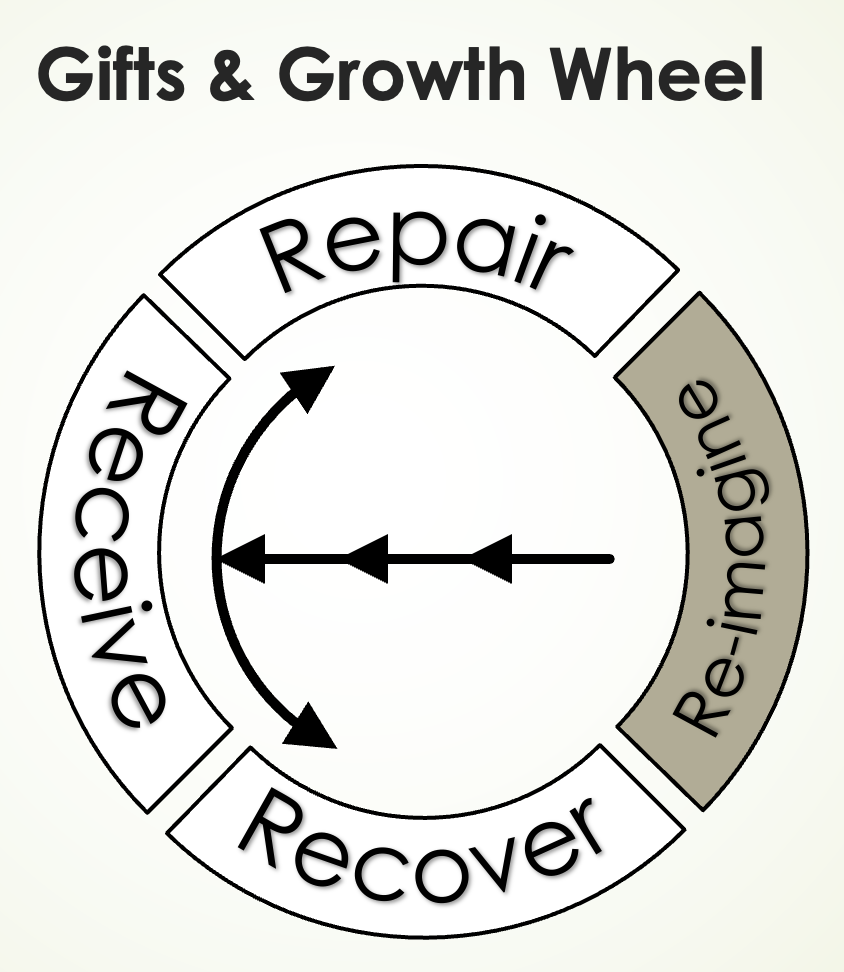
The path of growth for the head type is first toward the Receivers who know to receive reality is at is without an initial compulsion to have to rationalize it or solve an intellectual problem. The Receivers, as we learned last week, are particularly gifted in simply experiencing the presence and celebrating the grace of God without having to understand it fully.

copyright Martin Malina, 2025

When the thinker follows the path of growth their true gift can bear fruit in the community and they become the Re-imaginers (Bailey, 2021). They come with solutions, but no longer according to the exclusivist agenda of the powers that be. Without going to the opposite side first can make head spirituality exclusive – either by creating a community only of like-minded people and/ or pursuing a course of action that excludes others and paints a line in the sand between ‘them and us’.

In the world of the bible, Jerusalem represented the powers that be. Jerusalem was the seat of religious and political power in the region. Jesus knew that prophetic ministry in the face of power was a dangerous activity. Jerusalem personified the power of the world that sowed division and discord. Those that spoke the truth of God’s kingdom in Jerusalem risked their lives. Jesus knew he was in the crosshairs. But what is surprising in this Gospel text (Luke 13:31-35) is Jesus’ reaction (Reese, 2016).

In the face of threats from Herod and the religious authorities, Jesus responds with love. He responds with a longing of love for the people of Jerusalem. Jesus’ response is the compassion of a mother. His lament evokes powerful imagery of mother hen embracing her chicks in protection and love. This is the longing of God for us, expressed through Jesus’ imagination. He re-imagines what it could be like even though Jerusalem would refuse the grace of God, even though Jerusalem will crucify him.

In the last century, the Berlin Wall represented a physical manifestation of the ideological battle between communism in the east and capitalism in the west.

In the early days of the Berlin Wall during the 1960s, emotions—anxiety, fear, anger—were running high.

Hostilities flared when truckloads of stinking garbage were dumped over the wall into West Berlin by those living in the eastern sector of the city.

West Berlin Mayor Willie Brandt was flooded with demands for revenge at this offence.        

Understandable. Tit for tat. You throw garbage at us. We’ll throw it right back!

But Willie Brandt responded in a unique way.

Mayor Brandt requested that flowers—hundreds of colourful, beautiful flowers—be brought to a specific place at the wall. Then, truckloads of these flowers were poured over the wall into East Berlin (Hays, 1997).

That act in the 1960s may not have immediately felled the wall. But history bears witness to the power of non-violent solutions. Almost thirty years later, in 1989, a peaceful candlelight vigil that started in a church and gathered tens of thousands brought down the Berlin Wall.

May we re-imagine our response in the conflicts and struggles of our days and lives. May we learn to start with grace, and love – the grace that Jesus imagined for us. May the flowers reign down where division and strife pretend to define the reality that God, over time, is shaping into something good, gracious and beautiful for everyone.

This is our Lenten hope.

References:

Bailey, J. (2021). To my beloveds: Letters on faith, race, loss, and radical hope. Chalice Press.

Burkeman, O. (2024). Meditations for mortals: Four weeks to embrace your limitations and make time for what counts. Allen Lane.

Hays, E. (1997). The old hermit’s almanac: Daily meditations for the journey of life. Forest of Peace.

Reese, R. A. (2016). Commentary on Luke 13:31-35. https://www.workingpreacher.org/commentaries/revised-common-lectionary/second-sunday-in-lent-3/commentary-on-luke-1331-35-3

Ware, C. (2000). Discover your spiritual type: A guide to individual and congregational growth. Alban Institute.

Gifts & Growth: Receive

Over the past year and a half, I’ve only looked at my guitar sitting in the corner of my home office. It has sat there, lonely, untouched, collecting dust. I have not picked it up once during this time.

So, when I finally did a few days ago, and started plucking a few notes, I wondered – what’s the point? What purpose does it serve to spend valuable time messing around on a musical instrument?

I’m not being really productive playing around on it. Learning a new song won’t yield perfection (to be sure!) and only reminds me of how much my skills have deteriorated by not playing it. Even though, for Lent, I’ve committed to picking it up each day for at least a few minutes at a time, those thoughts plague me: For what purpose? Is it worth the time?

You may have heard of the so-called “Marshmallow Experiments” (Burkeman, 2024), the first of which was conducted at Stanford University by Doctor Walter Mischel in 1970.

In these experiments, Mischel and his colleagues presented children with a single marshmallow and offered them a choice: They could eat it. Or they could wait alone in the room with it for ten minutes. If they succeeded in waiting ten minutes without eating that one marshmallow, they got one more. And so on.

As these experiments unfolded over time, the scientists were able to make some evidence-based conclusions. For one thing, participants who were able to resist temptation went on to enjoy better academic performance and physical health in later childhood, and demonstrated other positive differences as adults (Burkeman, 2024).

The self-discipline not to grab the first marshmallow became an invaluable trait for what’s commonly thought of as a successful, productive life.

Self-denial is a common messaging that we impose on ourselves, often without being aware we are doing so. In other words, we remain perpetually a Lenten people because we never really enjoy the gifts we have received, have amassed, have saved over time. In this mindset, we never get to Easter because we either don’t know how to embrace and receive the treasures we have been given and/or we feel guilty for enjoying gifts from God when we do receive them.

A Canadian Benedictine, the late John Main, was known to say that the greatest sin was not succumbing over and over again to tantalizing temptations. No, the greatest sin was not fully enjoying the good gifts that we have received from God’s bounty and grace.

What gifts have you received? Are they material blessings? But gifts are more than having lots of stuff. There is the gift of music, the talent for precision and patience in woodworking and building things, the gift of listening to another, the care for animals, for growing plants, flowers and vegetables. Gifts are also the gifts of our personalities, our characters, our abilities, our passions, our interests, what we’re good at doing, what we love doing, what we enjoy in each other and in the world.

What today’s scriptures point to is the temptation to believe that we are the source of and engine behind all these gifts and good things we experience in life.

What resulted in Jesus overcoming temptation in the desert was acknowledging the true source of his power in God (Luke 4:1-13). In the accompanying text from Deuteronomy (26:1-11), the temptation is not hunger but prosperity.

When things go well and the harvest is plentiful, the Israelites will be tempted to think that they are self-made. They will be tempted to believe that they have earned their prosperity. They have worked hard for it.

To counter this temptation, God instituted the ritual of first fruits to remind the Israelites that thanksgiving always had priority over self-congratulation (Oldenburg, 2025 March 9).

On this First Sunday in Lent it is good therefore to begin with the gift of receiving. Maybe Lent can be a reminder to us that what we may be so proud to boast about is not our doing. God is the source. We are the vessels. When we recognize our primary role as receptors of God’s grace, we can then let that gift flow through us and to the world around us.

This year, the Gospel of Luke travels with us throughout Lent. And Luke’s emphasis is celebrating the persistence of God’s grace and mercy despite stubborn obstacles.

In the series of sermons this Lent, I’ll look at four ‘R’s’ of faithful practice and growth: Receiving, Re-imagining, Repairing and Recovering (Bailey, 2021). Each of these is a great and important gift for the community of faith. We need Receivers as much as we need Re-imaginers, Repairers and Recoverers.

copyright Martin Malina, 2025

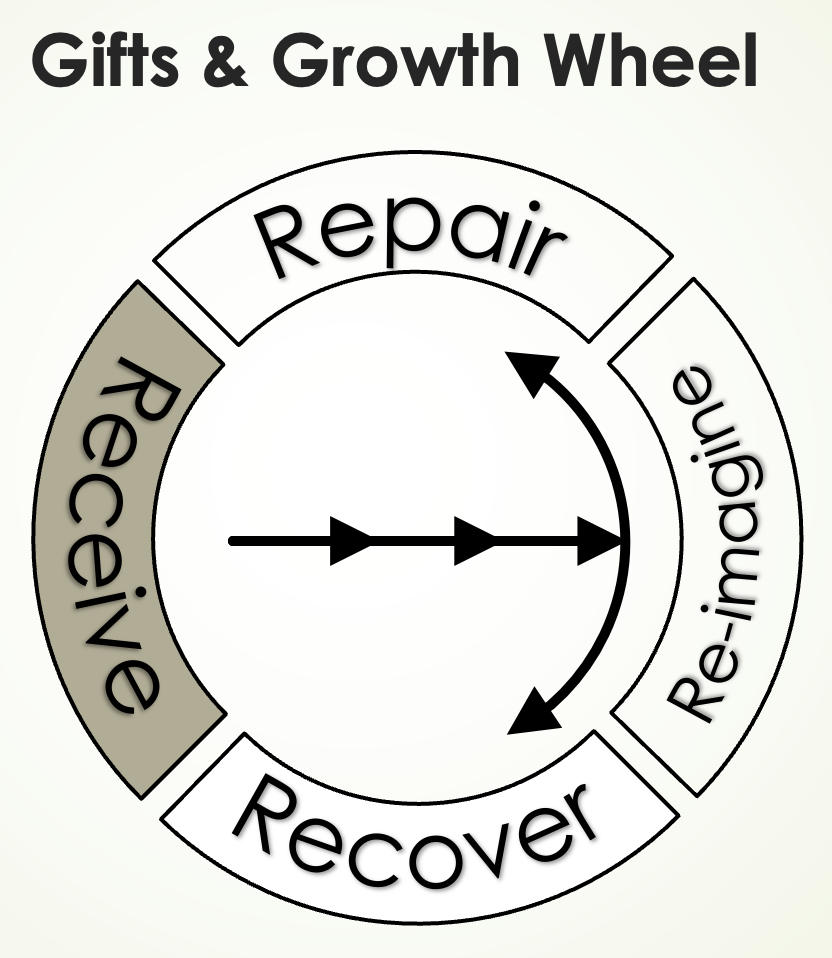
Each of us, depending on our individual strengths and gifts, will start in a different quadrant. There are some who are best positioned, because of their God-given personality and character, to start at the receiving end. Others will naturally begin by re-imagining; others first will move into repairing and others still will be best suited to start in the recovering quadrant of this circle.

But for growth and wholeness, a journey of faith is necessary. We can’t remain stuck in just one of the four quadrants. For the gift to bear fruit we need the whole circle, the whole community.

So, what do the Receivers offer? The Receivers are naturally disposed to acknowledge reality as it is – the good and the bad. The receivers among us can more easily accept their lot and enjoy what they have and who they are – without judgement.

Receiving – being able to accept what is – is an incredible gift. To see God’s work in all things. To trust in God’s grace to keep us going into an unknown and uncertain future. To be, as we are.

This spiritual gift is useful in both tempering the productivity bias in our hustle culture. It is to consider that all our accomplishments are for naught, and even a temptation, if they are not placed in the broader perspective of the origin of all good things. It is God’s mercy and grace that are fundamentally operative in our lives. Our gifts bear fruit when we acknowledge the true Source of them in God and God’s mercy.

But, as I said, remaining in this quadrant without the input of the other ‘Rs’ can leave the Receivers – or “mystics”, as they are sometimes called (Ware, 1995)—stuck. They are tempted into distorted thinking that in order to experience God’s presence they need to escape or check-out from the reality of this world.

It’s ironic that the Receivers can, on the one hand, more naturally than all others receive reality as it is. But, on the other hand, the Receivers are also the ones most likely tempted to remove and displace themselves from it. To avoid all the confusion and chaos of the world, Receivers are tempted to retreat into the comforts of their self-created worlds, their private realms.

That two-sides-of-the-same-coin dynamic is characteristic of all the gifts in the circle. Indeed, our greatest gift can be our greatest blind spot.

We all start somewhere on the wheel of gifts and growth. But, for growth to happen, where do we go from there?

The next movement for the receivers is towards the opposite quadrant. For the receivers, it’s towards re-imagining. The Re-imaginers are those who start with the gift of the mind, the gift of clear and constructive thinking. This is what the Receivers need. We’ll talk about the Re-imaginers next week.

Why, you ask, do we first go to the opposite side, and not to either side of the starting point? If the Receivers would first look to the Repairers on one side, Receivers’ action might not be the best course of action in a given situation. It would be like the Receiver realizing they had to do something good in the world, but choose an activity that isn’t relevant, or particularly helpful. Likely, because the Receiver hasn’t done their homework.

On the other side, if the Receivers would first look to the Recoverers, their action might lead to boundary issues. They might over-function, burn out and feel like they needed to do everything to take on the weight of the world and care for everyone, which of course is impossible.

We first need the opposite gift to correct the distortions associated with our starting place on the circle, before moving to the last two quadrants.

This arrowed pattern in the middle of the circle looks like an anchor, intentionally. This pattern of gifts and growth keeps us anchored in our movement towards balance and healthy growth for everyone. The writer to the Hebrews affirmed: “We have this hope as an anchor for the soul, firm and secure” (Hebrews 6:19).

Today, at the start of our Lenten pilgrimage the Receivers among us will say: Thank God! Receive, enjoy and delight in the gifts of God’s doing and grace in your life. You can enjoy that marshmallow that someone gives you today. Don’t deny it. It’s Ok!

In the words of the late Indigenous author Richard Wagamese: “Sure there’s stuff that needs doing, stuff to wade through and stuff to fix but there’s also the joy of small things: a hug, a conversation, playing a song all ragged and rough on an instrument, walking on the land, listening to great music or enjoying silence and a cup of tea. Rejoice. Fill yourself again” (Wagamese, 2021).

Receive.

References:

Bailey, J. (2021). To my beloveds: Letters on faith, race, loss, and radical hope. Chalice Press.

Oldenburg, M. W. (2025, March 9). Crafting the sermon; First Sunday in Lent, Year C. Augsburg Fortress. https://members.sundaysandseasons.com

Wagamese, R. (2021). Richard Wagamese selected: What comes from spirit. Douglas & McIntyre.

Ware, C. (1995). Discover your spiritual type: A guide to individual and congregational growth. Alban Institute.