Mirror mirror

Lake Kioshkokwi at Kiosk, Ontario (photo by Martin Malina, Sept 2022)

There’s always a reason not to act, not to do something. Even if that something is good, is right, is just and kind. Even if that something is God’s call on your life.

It can be dealing with something as ordinary as exercising or picking up the phone to call or text someone. Or it can be deciding on the big issues – relationships, jobs, opportunities – that can change the course of your life. There’s always a reason or reasons not to do those things.

At least we are in good company when we initially think and/or say, “no”, and justify our reasons for not acting on the nudge to pursue a good course of action. The prophet Jeremiah resisted the call of God because he believed himself not up to the task. He disqualified himself by not believing he had the abilities and the confidence to do what God asked him (1:4-10).

There’s always a reason not to do something. Fear is a powerful force. But fear is not evil per se. We have good cause to be afraid. But when our fearful avoidance and resistance overwhelms our pursuit of the good, “our overwhelming fears need to be overwhelmed by bigger and better things” (Bader-Saye, 2007, p. 60).

From where do these bigger and better things come? Contrary to what may first come to mind, these bigger and better things don’t stem from our achievements nor confidence in our abilities. These don’t qualify us in God’s eyes. Neither our resumé nor personality style justify our suitability for doing good. What does, is embracing, being and living out who we are created to be.

God saw who Jeremiah was in the goodness of his heart. God called Jeremiah back to himself, his true self. With all the conditioning of the world around him stripped bare, Jeremiah was called to embrace God’s love for and in himself.

“Mirror, Mirror, on the wall who is the fairest of them all?” The evil queen in the Snow-White fairytale is surprised not to see herself in the mirror. Instead, she sees Snow White. This revelation triggers a conflict between the queen and young Snow White and the Seven Dwarfs (Grimm & Grimm, 1812).

When we look for answers, what does the mirror reveal to us? In the face of conflict, it’s like a mirror is held up to expose the battle going on inside of us. Like the evil queen, we would rather see ourselves, have our opinions validated, have everyone else be like us, reflect who we are. The rage we direct at outsiders, others who are different, others who don’t reflect us, only reveals the conflict raging within ourselves. Being angry at the foreigner indicates a self-hatred more than anything.

Indeed, “We see in a mirror dimly,” writes Saint Paul in his treatise on love in 1 Corinthians 13. “But faith, hope and love remain. And the greatest is love.” Because we shall, one day, see face to face who we truly are in Christ. Beloved. Wipe that mirror clean! To see the goodness in others, the same goodness in you — the good we share.

When our mind’s eye clouds our vision, is it because we have forgotten who we truly are? How smudgy is our mirror? How distorted is our vision? Saint Paul says it is! So, then, look at Jesus.

When faced with the violence and acrimony of the crowd, notice Jesus neither disputes nor argues with them when they lead him to the edge of a cliff. Nor does he back down. He remembers who he is. He is solid in his identity.

And Jesus simply passes through them. He simply goes about his business of showing love to the outsider, just as Elijah was sent by God to care for the widow at Zarephath, and just as Naaman the Syrian was healed from his leprosy by the command of God (Luke 4:21-30).

Who are we? How do we keep from forgetting who we are as people of faith? Martin Luther understood Confession and Forgiveness as “a return and approach to baptism” (Luther, 2000, p. 466). Baptism is the sacrament sealing who we are – our identity in Christ. Every time we face the mirror and come true and honestly to ourselves, we recommit ourselves to baptism. In Confession and Forgiveness, we are being renewed by the love of God Paul described.

God’s love binds us together, not as isolated individuals, but into a whole community in Christ called to care for others and the world God created.

“Before I formed you in the womb I knew you, and before you were born, I consecrated you” (Jeremiah 1:5).

“I have been sustained by you ever since I was born; from my mother’s womb you have been my strength” (Psalm 71:6).

Though these words originated in the context of their lives, these two texts are not just for Jeremiah and the Psalmist. These two passages offer powerful words of hope for us as well: God knows us. God declares us, each of us, as sacred. We can lean on God. God protects us. These passages illustrate a lifelong conversation and a loving relationship between us and God.

Indeed, “today the scripture has been fulfilled in your hearing,” Jesus told the crowd in the synagogue (Luke 4:21), and Jesus tells us.

So, like to the prophets before us, God nudges us, whispering in our hearts the truth of who we are. And when we feel the tensions rise around and in us, we look for where God is in the world.

Maybe not in Nazareth. Maybe not in our own backyard, so to speak. Maybe God is active somewhere else, even in places and in people we least expect.

But that’s where God is, right now. And that’s where God is calling us to join in the Holy Spirit’s work there. Will we follow? Will we trust in the bigger and the better something that can overwhelm our fear?

Because there’s always a reason not to do something good. But what about the reasons to do something good? Remember who we are as followers of Jesus. Because divine love will never forget us.

References:

Bader-Saye, S. (2007). Following Jesus in a culture of fear. Brazos.

Grimm, J. & Grimm, W. (1812). Children’s and household tales. Germany.

Luther, M. (2000). Baptism, the large catechism. In R. Kolb & T. J. Wengert (Eds.), The book of concord (p. 466). Fortress.
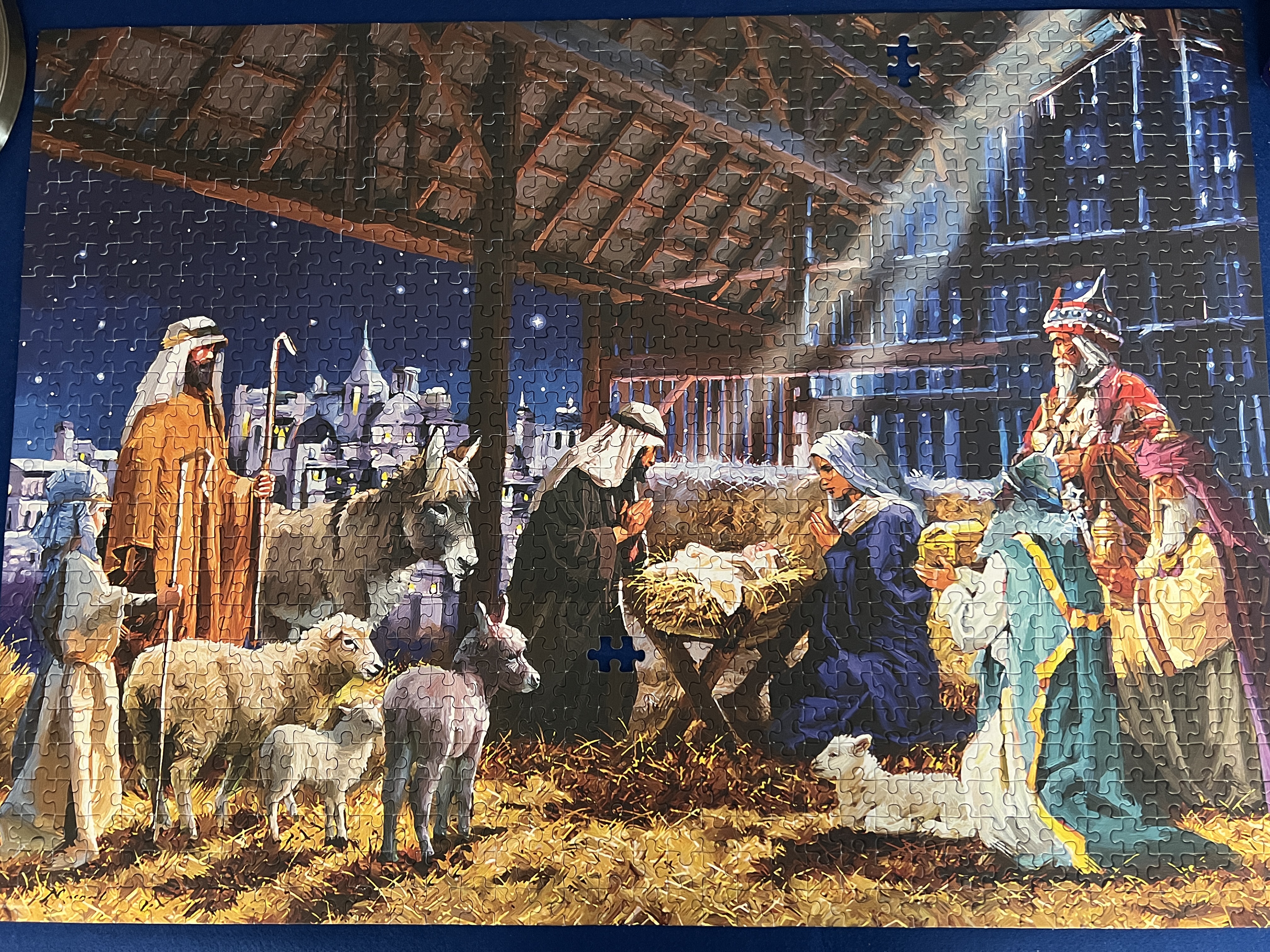

Which pieces are missing?

(photo by Martin Malina)

It is finished! The 1000-piece nativity puzzle is now done. Thank you to all who contributed – whether you fitted only one piece or sat for hours in the narthex over the past month and a half, putting it all together. It is complete.

Or is it?

Upon closer observation of the photo above you might notice there are two pieces missing. Just two, out of a 1000. But two, nonetheless. Sucked up in the vacuum cleaner, stuck on the bottom of someone’s boots, or dropped inadvertently in someone’s pant pocket. Who knows? How does that make you feel?

You might think, like me, of parables in the bible where Jesus leaves the 99 sheep to go searching for the one lost sheep (Luke 15:1-7), or the parable in which a woman searches her whole house to find that one, lost coin (Luke 15:8-10).

Whatever you may want to say about Paul’s writing in his letter to the Corinthian church, it has a clear meaning: Every piece matters. Every part is important for the whole (1 Corinthians 12:12-31a) to function well. All the gifts perform vital roles for the overall health and wellbeing of the body.

Paul even goes as far to say, “those members of the body that we think less honorable we clothe with greater honor, and our less respectable members are treated with greater respect, whereas our more respectable members do not need this” (v. 23-24).

In her book Fierce Love, the Rev. Dr. Jacqui Lewis refers to the Zulu concept of ubuntu which means, “I am who I am because we are who we are.” This phrase resonates with Paul’s words in 1 Corinthians. We, the body of Christ, are deeply interrelated, united by one Spirit. Perhaps we could say, “I am Christ in the world because we are Christ in the world” (Lewis, 2021, p. 11).

If each of us is worthy because together we are, this leads us to ask a very relevant question for all our families, communities, teams, groups, neighbourhoods, and nations: What parts are missing? Whose voices are not being heard? What members of the body have been ignored, overlooked, even marginalized, treated as unimportant?

In preparation for the annual meeting later this winter, the council is now searching, as we normally do at the end of terms, for a couple new members to serve. In choosing leaders on council, we can ask the same question: Whose voices in the congregation are not yet represented, nor being heard? Who is not at the table?

I love the children’s book I’ve used for Communion instruction. It’s called, “A Place for You.” The theme is inclusion. That is why in the invitation to the Communion table I will often say, “You are invited without exception.” Because Jesus loves everyone and welcomes all to the table of God’s grace.

The missing pieces challenge us to support and lift up everyone.

In the Gospel for today (Luke 4:14-21) Jesus returns to his hometown Nazareth, the place he grew up, the place where everyone knew who he was as a child. The scroll is given to him – the scroll of the prophet Isaiah – to read publicly. He has no choice which scroll to use. But, from everything Isaiah has to say, Jesus chooses this one particular text.

He could have read anything. The prophet’s words fill a big book, some 66 chapters long. Yet, Jesus focuses on this part. He makes it a point to remind the good people of Nazareth whose marginalized voices God has heard, and whom now God’s people are called to lift up.

What captivates the crowd, as all the eyes of those in the synagogue were fixed on him, was that Jesus distinguished himself, his new role, his mission now as the voice of God to declare what people of faith were called to do with Jesus: to bring good news to the poor, to release the captive, to recover the sight of those who are blind and let the oppressed go free – the economically poor, the incarcerated, the disabled, and the migrant. They belong at the table, too.

This is now the job of the body of Christ to proclaim, in our words and actions. How do we proclaim the words of Jesus in our daily lives? How do we follow Jesus?

In the science fiction dystopian television series Silo (Yost, 2023), 10,000 people have lived for decades in an underground bunker in the shape of a cylinder over a hundred floors deep. They’ve lived in the silo because the air outside is poisoned. At least that’s what they’ve been told.

A mechanic, Juliette Nichols, uses a modified hazmat-type suit to leave the silo and survive outside. But all the people inside don’t know where she has gone or whether she’s still alive. People start to question the truth. A rebellion grows.

A group of mechanics living at the bottom of the silo claim those privileged living closer to the top have not been telling the truth about what is really going on outside the silo. The rebels rally around a spray-painted symbol “JL” and chant “Juliette Lives!” to galvanize their faith.

In Jesus’ day, we have to remember they didn’t have microphones. The Nazarenes would pack the synagogue to listen to the speaker. To make sure everyone got the gist of the speaker’s message especially those at the back of the room, those closest to the speaker would repeat in a loud voice together a phrase the speaker just said. This method of getting the word out is called “the people’s microphone,” the practice of amplifying voices without a sound system (Augsburg Fortress, 2025).

This method requires attentive ears—those nearest must hear and respond to the call of the speaker—and it requires the community’s unified work, lifting up the speaker’s voice together.

Yes, “JL” is our call, too. But for us it is “Jesus Lives!” “Jesus Lives!” is a sign of hope for the fulfillment of what is being called upon the living body of Christ today

But if bringing good news to the poor and releasing the captive was Jesus’ purpose and mission, all evidence today points to the contrary. Had Jesus failed? Has the church failed? Many today, I know, feel that it has on many levels. Because so many people still suffer. And will suffer.

Perhaps a vision of a perfect world free from all suffering is not what Jesus meant. Because if we follow in his steps: From that early synagogue worship service to the hills of Galilee, on the road to Jerusalem, and the way of the cross, we discover that suffering is not God’s will.

Rather, what is God’s will is life in the face of suffering. What is God’s will is courage in the face of fear. What is God’s will is faith in the face of doubt and love in the face of hatred and prejudice. God’s will is to call these things out of the hurt and brokenness that we are and that we find around us. “With Christ, the prophecy is fulfilled, in you and in me” (Evenson, 2025). Because “JL!” Jesus lives. Thanks be to God!

References:

Evenson, B. (2025, January 26). Comments from the cloud of witnesses; Third Sunday after Epiphany /lectionary 3, year C. Augsburg Fortress. https://members.sundaysandseasons.com

Lewis, J. (2021). Fierce love: A bold path to ferocious courage and rule-breaking kindness that can heal the world. Harmony Books.

Yost, G. (Creator). (2023-present). Silo [TV series]. Apple TV+.

Present to Presence

photo by Martin Malina

About once a month I have lunch at Denny’s on Merivale with a dear friend of mine. His name is Jack Murta. He is a retired politician. He was a Member of Parliament from Manitoba in the late 1980s. A member of the Progressive Conservative Party, Jack served as the Minister of Tourism in the Brian Mulroney government.

Today, he sits on the Board of the Mission in downtown Ottawa and leads Christian Meditation groups there for people who are homeless. Jack and I spend a lot of our time talking about politicians and how they related with one another back in the day. Indeed, much of our conversation recalls the past.

In the Gospel reading for today (John 2:1-11), guests to a wedding party in Cana, Galilee, meet most likely in a garden setting, to celebrate a joyous occasion.

Certain clues in the story attract our attention. I’d like to point out, first, the empty jars normally filled with water used for the Jewish rite of purification. People engaging this rite did not drink the water. It stayed on the outside of their bodies when they immersed themselves in the bath.

The jars in this story direct peoples’ attention to their past, their Jewish tradition and ritual. The garden also was the usual setting where Jewish weddings took place, a reference to the Garden of Eden in the first book of the bible – Genesis (Shaia, 2021). The jars and garden are indicative of tradition, the past, the way things had always been done.

And not only does the Gospel look to the past, it points us to the future as well. “My hour has not yet come.” Jesus hints to Mary about his future path, when Jesus’ purpose will be fulfilled on the cross and by the empty tomb.

But it’s the present moment where the miracle—the sign—happens. It’s into the present moment that the Gospel ultimately draws us. “You have kept the good wine until now.” The steward recognizes Jesus’ act of bringing an unexpected gift for the guests.

And Jesus’ action in the present does more than merely get the bridegroom out of an embarrassing social faux pas. The unexpected gift is good wine, not normally offered late in the party. It’s in the present moment, even in an unpleasant situation, when people enjoy themselves.

Brain studies have examined where most of our time is spent thinking. They show that we spend most of our time thinking either about the past or the future; and, between these two, most of it is about the past. In other words, being fully present in the moment is not where we spend most of our time. And this is true even among young adults (Bellana et al., 2017).

Our thinking, entrenched in the past or fantasizing about the future, is also closely related to speech. Thoughts and words go hand in hand. Talking a lot is related to thinking a lot (about the past).

But in the Gospel, it’s more about what is not said that draws my attention. Mary does not tell Jesus what to do. She merely points to the problem. And leaves it up to her son.

The head steward didn’t know where the wine came from, but the servants knew because they drew the water for the jars as per Jesus’ instruction. How did they know it had turned to wine? Did they taste it, before and after? If it were left up to the dialogue alone, what was said out loud, we would be missing important pieces. There would be gaps in the story filled in only by observing behaviour.

As much as 80% of what is communicated takes place on the nonverbal level: our tone of voice, our body position and movement, our facial expressions, the direction of our eyes (Mehrabian, 1972).

What is more, if you want to be friendly, or hostile, your body language is over 12 times stronger in getting the message across than anything you might say (Argyle et al., 1971). What we do and how we do it speaks volumes. Words are important but have power only when anchored in the present reality. Simply pointing to the reality without judgement nor instruction, without any hint of direction nor evaluation, Mary said to Jesus: “They have no wine.” Fact.

Events and situations that bring us into the present reality are often not initially pleasant. We resist the present moment because we may be afraid of what we encounter there.

From the garden to the hospital. There aren’t other settings that bring us, force us, to the present moment more as in the hospital. When we are sick or visiting someone who is ill, or working in the hospital setting as a nurse, PSW, doctor – being there makes us grapple with the sometimes-harsh realities of the present moment.

And in that present moment, very few words are necessary when it comes down to it. The past, the future, these are all important and good. But when it comes down to it, presence is all we need in the present moment.

My friend, the retired Member of Parliament, Jack Murta, was also good friends with one of Speakers of the House of Commons at the time. And when you think about it – a politician Member of Parliament and a Speaker of the House – you can imagine the jokes about them entering a bar: There would be a lot of words spoken to say the least! Even the name – “Speaker” of the House – evokes images of a whole lot of verbiage. Words. Words. Words!

And yet, at the end of his long life, when this Speaker of House was dying in the hospital, he indicated he wanted to see Jack one last time. So, Jack drove to the hospital. And at this point the Speaker was no longer saying much of anything. But when Jack sat down beside him, the Speaker reached out and Jack took his hand in his own. And for many minutes they just sat there without saying a word. The touch of his hand was all the Speaker wanted and needed in that moment.

What mattered, what really mattered, was not the past on earth nor the future on earth. What mattered, what really mattered, was not saying a whole lot of words anymore. Because the joy of living even in that desperate moment, the true joy was found in the simple touch of another in the present moment.

I mentioned the water for the purification rite. It stayed on the outside of the human body. We don’t normally drink our bath water. Jesus performed a miracle of transformation: from water to wine.

When we celebrate Holy Communion, wine is offered. Jesus transformed an understanding of religion from external ritual to internal reality. We don’t wash our bodies with wine. We drink it. We bring it inside of us. We consume it. We digest it. It becomes part of us.

Holy Communion invites us to be present in the moment. To touch. To feel. To drink. To taste. To eat. Let this sacrament in which we participate weekly give us an occasion to practice being present to the holy Presence of God in Christ Jesus. So, with Christ’s presence in us now, we can be God’s loving presence in the world by what we say and what we do.

Behold, now is a very acceptable time; Behold, now is the day of salvation (2 Corinthians 6:2).

References:

Argyle, M., Akema, F., & Gilmour, R. (1971). The communication of friendly or hostile attitudes by verbal and nonverbal signals. European Journal of Social Psychology, 1, 385–402.

Bellana, B., Liu, Z. X., Diamond, N. B., Grady, C. L., & Moscovitch, M. (2017). Similarities and differences in the default mode network across rest, retrieval, and future imagining. Human Brain Mapping, 38, 1155-1171. https://doi.org/10.1002/hbm.23445

Mehrabian, A. (1972). Nonverbal communication. Aldine.

Shaia, A. J. (2021). Heart and mind: The four-gospel journey for radical transformation. Quadratos.

Washed in the waters of love

The Jordan River
(photo by Jean Housen, CC BY-SA 3.0 https://creativecommons.org/licenses/by-sa/3.0, via Wikimedia Commons)

There is this sense of judgement in today’s Gospel (Luke 3:15-17, 21-22). Taken alongside the imagery of gathering the wheat and burning the chaff, the announcement of a baptism with Holy Spirit and fire leaves an impression of division, exclusion and judgement (Honig, 2025).

Last weekend my brother and his wife noticed that their outdoor Christmas lights, particularly the spotlight on their nativity scene set up in the flowerbed by the front of their house was mysteriously disconnected during the night.

Examining the scene the following morning they found the bulb lying on the snow a couple feet from the extension cord. Human footprints leading from the sidewalk were evident in the snow. They also noticed what looked like a dog’s footprints in the front yard.

Who did this? Why did they do this? My brother and I came up with a list of several reasons and scenarios that might lead someone to this act of aggression. And they weren’t positive reasons. Our imaginations swirled, as I’m sure you can understand, around worst-case motivations.

If it weren’t for a chance encounter in the local grocery store the next day, I wonder how long and how deep those judgements would burrow into and affect our hearts and minds.

Thankfully, in the grocery store my brother bumped into their next-door neighbour. And immediately the neighbour apologized for their dog’s erratic behaviour the previous night.

Out for their daily late evening walk, the dog had bolted and escaped its leash, and then leapt onto my brother’s yard. The dog began digging up the cords embedded in the snow and pulled apart the outdoor lights, resulting in the displacement of the nativity spotlight. The neighbour promised to replace any damaged cords or lights.

Truth be told.

The New Testament, taken as a whole, proclaims ours is not to judge (Romans 114). In this Gospel text, there is debate about who is the Messiah – John or Jesus (Luke 3: 15-17). The people wondered if it should be John. But even John makes an error in judgement when he expresses by his false humility – “I am unworthy to untie the thong of his sandals.”

Because recall that at the Last Supper, Jesus gets down on his hands and knees to untie the shoes and wash the feet of his disciples (John 13). In his confession, John’s idea of Messiahship was mixed up because being the Messiah was not about fright, might and right – the assumption of many at the time (and today).

Rather, to be the Messiah was to be servant of all, as Jesus modelled. It was God’s choice to make, not the crowds. It was God to judge who was to be the Messiah and who wasn’t. And at Jesus’ baptism (Luke 3:21-22) what was important was the voice of God making it clear on whom God’s mission would fall.

The beloved.

Baptism is a sign and promise of God to confer the blessing of love — to gather together, to end division, to bridge difference and to welcome all into a life that is beloved (Quivik, 2025).

The reason people make great mistakes in judgement and in their behaviour, I suspect, is because they never heard what Jesus heard on the day of his baptism (Rohr, 2021). They have never heard another human voice, much less a voice from heaven bless them by saying, “You are a beloved son. You are a beloved daughter. And in you I am well pleased.”

If we’ve never had anyone believe in us, take delight in us, affirm us, call us beloved, we don’t have anywhere to begin. There’s nothing exciting and wonderful to start with, so we spend our whole lives trying to say those words to ourselves: “I’m okay, I’m wonderful, I’m great.” Which can be helpful, to a point.

But we may not really believe it until that word also comes to us from someone else, someone we adore or at least respect — a partner, a friend, a parent. And when we do hear those words directed at us, we are changed. We are empowered.

Henri Nouwen wrote, “We are the Beloved. We are intimately loved long before our parents, teachers, spouses, children and friends loved or wounded us. That’s the truth of our lives. That’s the truth I want you to claim for yourself. That’s the truth spoken by the voice that says, ‘You are my Beloved’” (Nouwen, 1992, p. 30). This is our greatest need, to hear those words spoken to us. It is the greatest need of everyone.

The banner hanging right behind me is one of my favourites in our church: Christ’s light shines in us. In us. It’s not just that Christ’s light shines. But that it shines in us. And, therefore, like Jesus, because we shine in the light, we, too, are beloved.

That new year’s fright of finding the spotlight on Jesus torn from its extension cord in the front yard of my brother’s house and then finding out the truth of what actually happened, taught me something about how quick I am to judge others.

So, I invite you to consider with me a new year’s resolution that on paper may seem rather soft. But it is more difficult, I imagine, than any new year’s resolution you can make:

Rather than judging others or evaluating them for where they fit on our scales or standards, can we, near the start of the new year and in the way of Jesus, commit to compassionately understand every person we encounter, approaching everyone with humility, with empathy, no exceptions? Can we resolve to begin every encounter with everyone we meet, in our hearts and in our words, with grace and love?

Let us be renewed in the waters, in the river, of God’s never-ending love.

References:

Honig, C. (2025, January 12). Crafting the sermon; Baptism of our Lord /lectionary 1, year C. https://members.sundaysandseasons.com

Nouwen, H. J. M. (1992). Life of the beloved: Spiritual living in a secular world. Crossroad Publishing.

Rohr, R. (2021, October 28). Beginning as beloved; Original goodness. Daily Meditations. https://cac.org/daily-meditations/beginning-as-beloved-2021-10-28/

Quivik, M. A. (2025, January 12). Crafting the sermon; Baptism of our Lord /lectionary 1, year C. https://members.sundaysandseasons.com

Love, in the book of life – a funeral sermon for losing someone you loved dearly

God’s love can’t be washed away (photo by Martin Malina, July 2018, Long Beach WS)

The ‘book of life’ is mentioned not only once in Revelation – this last book of the bible – but several times (3:5, 20:12, 20:15, 21:27), as well as in Philippians (4:3) and Exodus (32:32-33). The book of life is mentioned throughout the bible.

The book of life is an image that came to my mind after something you said to me recently that made me think about the length of the books we read.

Normally I don’t like reading big books with hundreds if not thousands of pages in it. I feel I don’t have time nor energy to plumb the depths and breadth of long books. I prefer short books, under a couple-hundred pages.

While a short book I can easily get a handle on, understand and keep track of all the characters, plot lines, and themes, there is one problem with short books. If it’s a good book, I don’t want it to end. When I reach the last page, I want more. So, it’s tough putting down a quick read that I really enjoyed.

Your beloved’s last words to you were, “I love you.” Indeed, you had a love story that ended too soon. In other words, the book was too short. And reading this love story, we all wanted more.

The thing about the book of life in the bible is that it is ongoing. People’s names are written in it. But it’s not closed, reserved only for the names of those who lived thousands of years ago. It is open, and names are continually added including, today, your loved one’s.

In the life of spirit, of faith, nothing ever ends. And while our flesh withers away on earth, our relations continue forever. While your relationship with your loved one changed at their death, it is not over. And therefore, your relationship with them is not lost. It has just changed. Their name, after all, is written in the book life, forever.

Your love story is not over. Another book in the series is being published. Part two. Because it is the book of life. Life and love never end.

Jesus said, “The hour has come for the Son of Man to be glorified. Very truly, I tell you, unless a grain of wheat falls into the earth and dies, the seed remains just a single grain; but if it dies, it bears much fruit.” (John 12:23-24)

Cats and birds – an epiphany

photo by Martin Malina (Aug 24, 2022, Driftwood Provincial Park, Ontario)

I was amazed at the dark and rich red colour of the cardinals I saw in Gatineau Park last week. I’ve seen cardinals before, but for some reason my experience of these many cardinals I saw in the trees along the Gatineau River appeared differently to me.

At first, I wondered if I was encountering the scarlet tanager. But no, the peaked heads, black collars and red wings were give-aways. Definitely cardinals.

The Day of Epiphany is tomorrow, January 6. It is, every year. So, today, we celebrate Epiphany Sunday. Epiphany means something revealed for what it truly is. In other words, ‘revelation’.

When it comes to the bible, we normally associate Epiphany with the star shining over Bethlehem and the arrival of visitors from the East bearing gifts for the Christ child (Matthew 2). The light image of the star goes with a common phrase we use when we have an epiphany: A light bulb comes on.

Two other very important biblical stories we will encounter in this season of Epiphany reveal Jesus for who he truly is. The first one is the Baptism of our Lord; we will read that story next week (Luke 3). The second is the Transfiguration of our Lord on the first Sunday in March which is the last Sunday in the season after Epiphany this year (Luke 9).

These stories show Jesus is not just a son of a carpenter born in Bethlehem and raised in Nazareth with common human interests, relationships and activities. Jesus is also given a mission on earth as the Son of God.

There are several common elements in both stories. Perhaps the most obvious is the voice from heaven – from a cloud – God’s voice declaring Jesus as God’s beloved. In the baptism story, the drama is made complete by a descending dove. Epiphany is about a great uncovering, a revealing of something important and worth paying attention to.

Therefore, how we respond is important. Our response to the stars, the doves and voices booming from heaven influences when and if the proverbial light comes on. Do we expect God to be revealed in our lives? What will we believe about what happens? Will we reject it outright? Or, will we accept the signal, the sign, as God’s way of speaking to our hearts?

Often, God’s revelation catches us by surprise. Like when a bird visits us at our window, when we notice something we hadn’t before, or we receive an unexpected text or phone call from a friend, or a visitor drops by. An unexpected gift. These epiphany moments happen when our perception changes, in the moment.

Terry Tempest Williams offered an astute observation about birds who will often catch our attention. Birds, he wrote, “mediate between heaven and earth”. But then he goes further to detail the eyes of certain birds:

“The eye of the cormorant is emerald. The eye of the eagle is amber. The eye of the grebe is ruby. The eye of the ibis is sapphire. Four gemstones mirror the minds of birds … We miss the eyes of the birds, focusing only on feathers” (Williams, 1998). About birds, why do we focus only on feathers, their coat, their tails, and colours? When was the last time you looked at a bird’s eyes? Can you get close enough to see them?

Our perspective can change. The Epiphany story that launches us into the season – the visit of the magi to Bethlehem – is about what happens once we encounter the newborn Jesus. Like the magi, we are called to search out Jesus. And that moment surprises us on our search. And changes our trajectory moving forward.

The wise ones cannot return to their country by the same road they used getting to Bethlehem. While they cannot go the same way because of Herod, we cannot go the same way once we’ve met Christ. We emerge from every encounter with Jesus changed people. The path ahead is now different.

Speaking of birds and their eyes, scientists studied how birds perceive colour in the world. Birds do not see ‘blue’ in the sky in the way we do. Instead, most birds see ultraviolet light, rendering the sky on a bright sunny day not in blue but in magenta tones (Coman, 2024).

Whose reality is truer? Is the sky blue or magenta? I guess that depends on whose perspective we take, the birds’ or the humans’.

Despite the question, God’s capacity for creating this diversity of perception holds all perspectives together. Indeed, God’s view knows no bounds and extends farther than we can ever imagine.

Epiphany for the church is a season in which we are invited to consider and experience Another’s perspective. It can be as simple as realizing it’s not all about us, or something isn’t in fact what we have always made of it.

From birds to cats. In the 18th century William Cowper wrote a poem entitled, “The Retired Cat” (2022). It’s a lengthy poem so I won’t read it but will summarize for you.

There was a cat who indulged in her master’s attention. The cat had full reign of the house wandering wherever she pleased whenever she pleased. It was a good life. She believed she was the centre of her universe.

It was cold one day in the winter, and the cat wanted to find a more comfortable place to lounge. So, going into the master’s bedroom where she assumed a snug spot would await, she noticed an open drawer atop the dresser and leapt into it.

As she sunk indulgently into the fine linen folded layer upon layer, suddenly the maid, not seeing the cat inside, shut the drawer closed!

There the cat remained the rest of the day, trapped inside, not able to escape. Certainly, someone would notice her absence and come find her. But no, time passed. And she was left alone. Day turned into evening. Fearing she would be there entombed, the cat remained unattended until in the middle of the night the master in bed heard a mewing and scratching. Alas, she sprung from her cage the moment the master opened the drawer.

Now modest, sober, cured of all her notions of self-conceit and hubris, now to her more ordinary place of rest downstairs she returned.

From that day on, the master noticed a change in the retired cat and reflected on the folly of the person who dreams themselves so great, and their importance of such weight.

Like the retired cat, we too can learn from our experience about the limitations of our perceptions and expectations. No perspective commands the complete corner on truth. Life experiences, good and bad, can be our epiphany moments because they allow us to enter a wider field if we choose to go there.

Life can teach us that while our individual perspective may be valid and true and good, we are part of a much larger and glorious web of relationships and perspectives. “The more perspectives we can learn to see, the greater our understanding” (Rubin, 2023). We are then no longer just seeing through our own narrow sliver, but broadening our scope so we can more accurately approach what truly is.

A bigger world is, after all, what God created us to live in. Let us, therefore, rejoice and be glad in it!

Glory be to God!

References:

Coman, S. (2024, December 5). Seeds of hope. Lutherans Connect. https://lcseedsofhope.blogspot.com/2024/12/day-5.html

Cowper, W. (2022). The retired cat. In J. M. Hunter (Ed.), A nature poem for every winter evening (pp. 25-29). B. T. Batsford, Ltd.

Rubin, R. (2023). The creative act: A way of being. Penguin.

Williams, T. T. (1998). Refuge: An unnatural history of family and place. In J. Gardiner (Ed.), The sacred earth: Writers on nature and spirit (p. 42). New World Library.