Re-storied in us

You are enjoying today a service full of singing. And, since today is the fifth day of Christmas, all the songs are intentionally and exclusively Christmas carols. And hopefully, you are singing some of your favourites.

When I hear you share their favourite memories of Christmas, often those memories include singing Christmas carols. Indeed Christmas is a time for singing.

What you are doing today is the heart of worship. And you are in good company. Singing was the primary mode of praising God since ancient times. The Psalms formed the first songbook for people of faith in the centuries before Christ. That is why we normally sing the Psalms in worship.

The tradition of singing comes from scripture itself. In the Christmas narrative, the angels sing “Glory to God in the highest” in the brilliant skies over Bethlehem. And, from last Sunday we read and sung the Magnificat.

The Magnificat is a Latin word meaning, “My soul magnifies.” Of course, it is the Song of Mary, a canticle she sung to magnify the Lord, to sing God’s praises at receiving the news from the angel Gabriel that she would bear the Christ child.

From early Christianity on, this text was associated with the Christmas celebration, but not just at this time of year. According to the lectionary, the Annunciation falls on March 25 every year, which is exactly nine months prior to Christmas.

The date of March 25 was then recognized as the historical date of Christ’s death. This is significant because, according to ancient Jewish mythologies—as well as very often in Christian traditions—great prophets died on the same day as their births or conceptions. This forms a strong symbolic connection: Jesus was conceived on March 25, was born on December 25, and died on March 25 exactly 33 years later. Interesting, eh?

But that’s not the only curiosity surrounding the Magnificat. From a literary perspective, the form of the Magnificat – this beautiful poetry—resembles the Song of Hannah, from 1 Samuel 2.

Hannah was the mother of Samuel who we meet in the scripture for today. Samuel was a young boy still wearing the linen garment or apron called an ephod. We know Samuel will become one of Israel’s great prophets.

What’s remarkable in the stories about young Samuel, are the similarities between the Song of Hannah and the Magnificat.

Some background: Hannah and her husband Elkanah have not been successful in having a child. Hannah continually prays to the Lord for a child, and she is distressed because for the longest time, it’s not working out. She persists in prayer, offers more sacrifice in the temple and expresses her longing. 

Finally the Lord “remembers” (1 Samuel 1:19) her, and Hannah conceives and bears a son, who is Samuel. The Song of Hannah is her response in thanksgiving to God for giving her a son.

The phrasing in Hannah’s song echoes the words in the Magnificat: “My heart exults in the Lord” in the opening line; “The bows of the mighty are broken, but the feeble gird on strength”; “He raises up the poor from the dust; he lifts up the needy from the ash heap, to make them sit with princes …”

And then in the readings today we note how both the young Samuel with his parents Elkanah and Hannah, and the young Jesus with his parents Mary and Joseph, make their annual pilgrimage to the temple. Fascinating to notice the similarities and compare those texts – one from the Hebrew scripture and the other from the Gospel yet both from the bible.

While on my annual retreat this week, I make it a point to read through my journal from the past year. I figure, as we turn the calendar to a new year in a couple of days, it’s an appropriate time to look back.
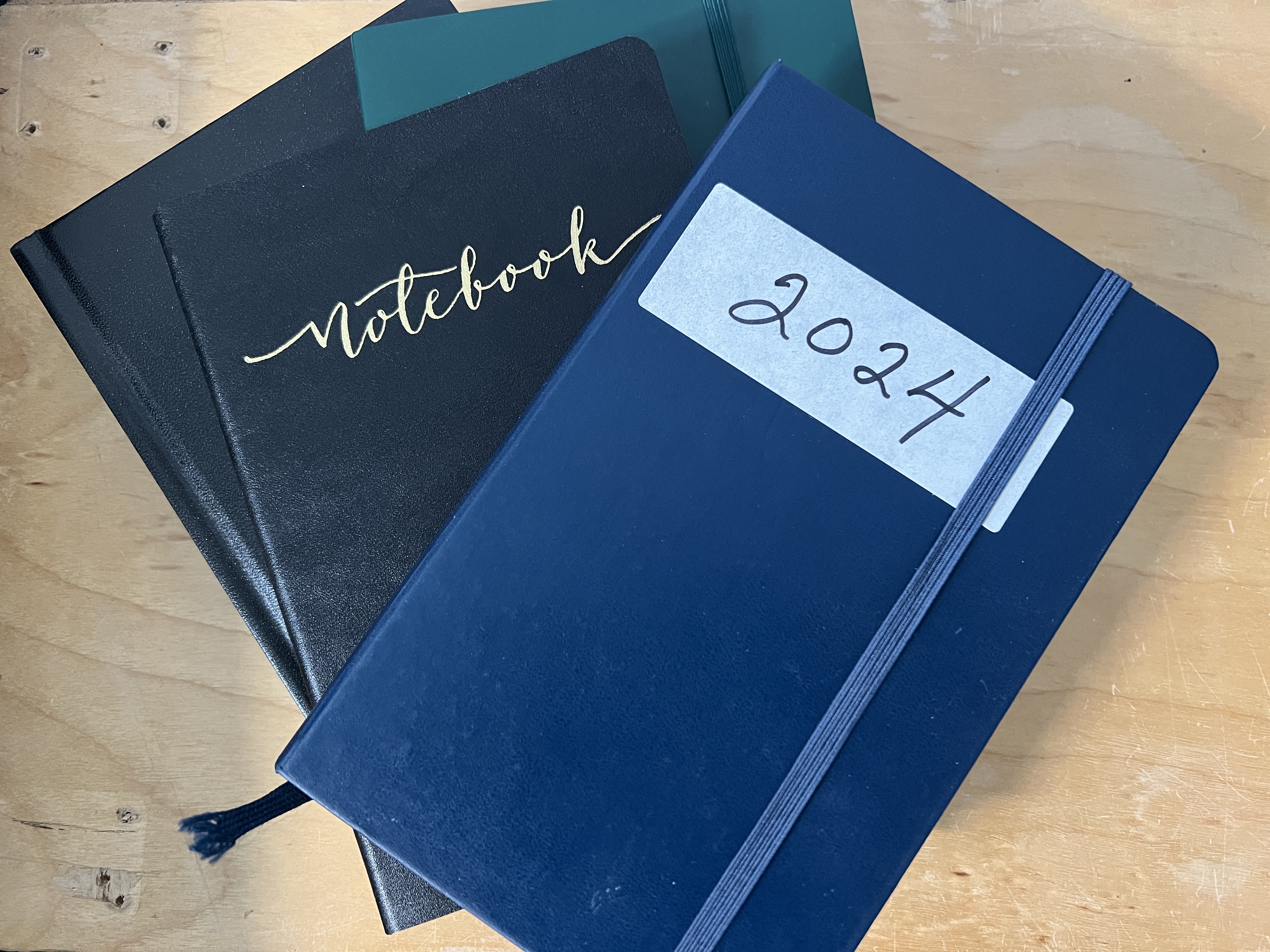
My journal contains first drafts of some of my sermons, quotes that have inspired me, thoughts and aha moments I had for different reasons wanted to write down, prayers, key learnings from my studies, etc.

It’s an important exercise for me to look back and review my journal. It is just as important for us to review our history and see those connections between past and present. Reading through I notice the changes in myself. Sometimes I laugh at myself and sometimes I am embarrassed for having thought certain things. Other times I’m impressed by the way I’ve expressed a thought. It’s inspiring to do this. And it builds hope, courage and confidence.

In a yearly review, I can note the progress, the change, the growth in perception, in life. And through it all, I am encouraged that despite the challenges we all must face, God delivers. God responds. And while some doors close, God opens others, makes stuff happen that is good, and worthy of our attention and faithful response.

Participating in worship at Christmas is a way to remember the story of Jesus’ birth and early life. It is also a way to remember the stories that preceded Jesus. When we gather in the name of the triune God, these holy stories are “re-storied in us” (Coman, 2024)!

So let’s live out the sacred story. Let us, like Mary and Hannah before her, sing God’s praises and give thanks for the gift of divine grace, the gift of Christ’s presence, and the love that holds us all.

Happy New Year!

References:

Coman, S. (2024, December 11). Seeds of Hope: Day 10. Lutherans Connect.
https://lcseedsofhope.blogspot.com/2024/12/day-10.html
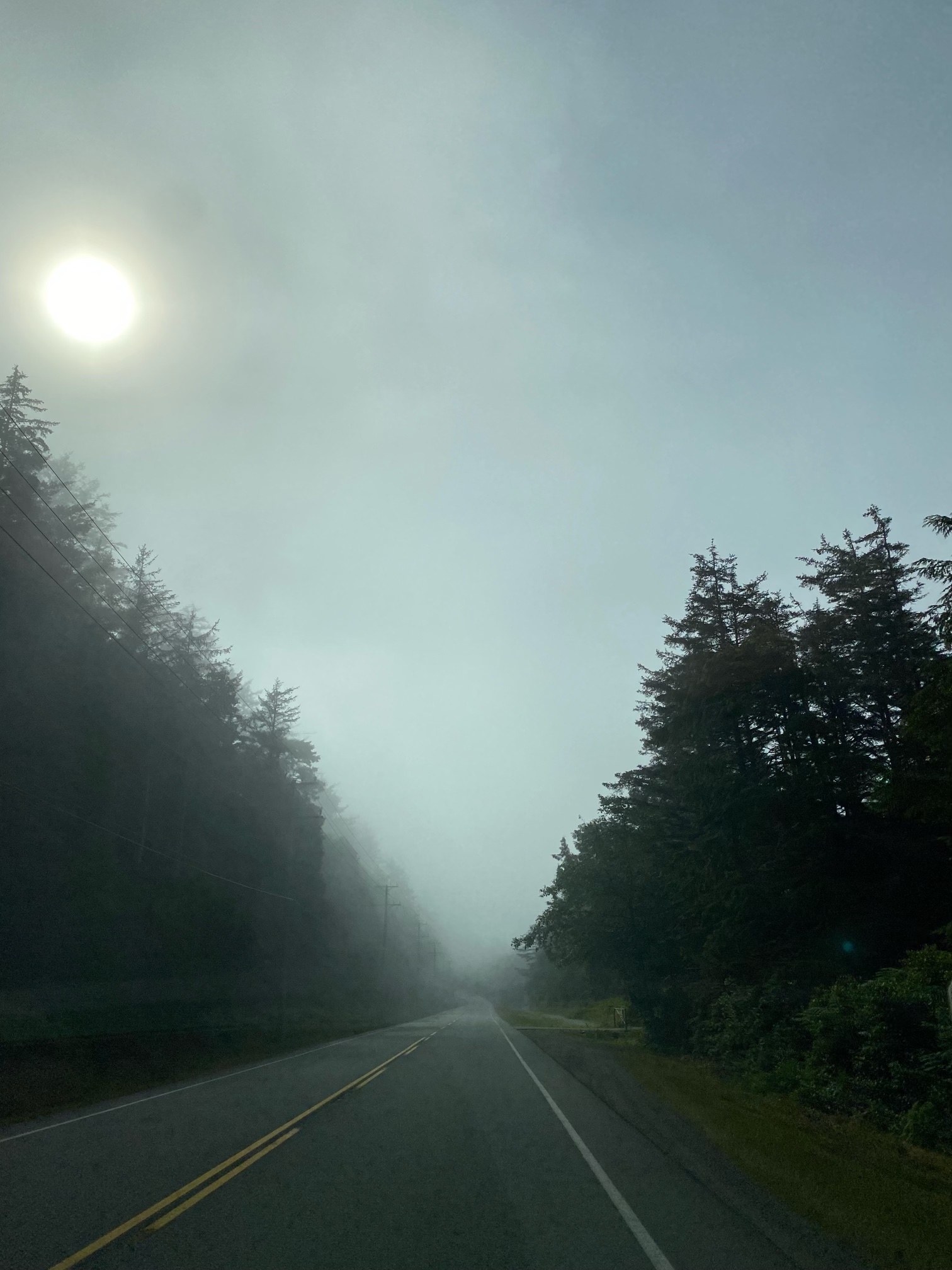
On the road to Bethlehem

photo by Jessica Hawley Malina (July 16, 2024 / Hwy 4 between Ucluelet & Tofino BC)

It is a dark night. The cedars drape over the narrow, rocky path, blanketing out what dim starlight shines from the sky above.

A pregnant woman travels with her husband through dangerous territory in a tyrannical age, on the road to Ephrath – a small town on the outskirts of Jerusalem otherwise known as Bethlehem.

Who is this woman with her husband travelling at night?

This story is familiar in the bible. It is Rachel, going where the Lord God commanded. But the story doesn’t end well for Rachel. She dies in labour, on that road to Bethlehem, giving birth to Benjamin. And Rachel’s husband Jacob buries her by the road. He erects a grave in her honour and memory (Genesis 35:16-26).

Generations later, the lamenting prophet Jeremiah picks up the image of Rachel’s tomb on the road to Bethlehem, when the Babylonian captives are forced to march by it into exile (Jeremiah 31:15).

Tonight, Mary and Joseph follow the same path (Luke 2). After passing Rachel’s tomb on the way, Mary would no doubt have remembered the story of Rachel’s tragic end.

When she and Joseph make their anxious way on a dangerous road in the night to be registered in Joseph’s birthplace, what goes through Mary’s mind? Would she, like the faithful Rachel before her, also die on this road in labour? Would she, despite saying yes to God’s call, fail like the captives on their way to Babylon?

That dark night on the dangerous road to Bethlehem no doubt challenged her faith. Anyone who traveled on that rocky, darkened path to Bethlehem was reminded of the often-difficult realities facing God’s people throughout history.

You may be on an uncertain path, this Christmas. Thinking you are nonetheless on the right path, you still question your decision. Because there are reminders along the way from past experiences and memories, that cause you to doubt. And even though you believe you are on the right path, it is dark and hard to see the way. And you question God. Is God even there? Indeed, we travel a dangerous road tonight.

Like the prophet Isaiah, we complain God is nowhere in sight. We cry, O God, “You have hidden your face from us” (Isaiah 64:7).

When we find ourselves in the dark, what do we do?

Like Mary and Joseph making their way on the road to Bethlehem in the night, we can’t wait for sunny days. We keep moving forward in the dark, little by little. Like Mary and Joseph, we move, trusting that whatever challenges we face are already solved. The answer is out there, somewhere in the dark. We just haven’t come across it yet.

Let’s not forget, much of God’s created world relies on darkness as much as light. We need not fear the darkness. For plants and trees, seed germination takes place in the darkness of the soil below the ground. It is in darkness that the roots seek nutrients (Coman, 2024).

We require darkness for birth and growth in the human world as well, not just the seed in the ground, but the seed in the womb, the seed in our souls.

In the dark lie possibilities for intimacy, for rest, for healing. Although we may find journeying in the dark fearsome or confusing, it teaches us to rely on senses other than sight. In the process we learn that darkness bears the capacity for good, gives birth to the good.

What do we do when we find ourselves in the darkness of our own making or what the world has done?

Our work is to name the darkness for what it is and to find what it asks of us. What does the nighttime call us to do? Does the darkness ask a wrong to be made right, for justice to bring the dawn of hope to a night of terror? Does it ask for a candle to give warmth to the shadows, or for companions to hold us in our uncertainty and unknowing, or for a blanket to enfold us as we wait for the darkness to teach us what we need to know?

We need not fear the darkness of this Christmas Eve. It is a holy birth, after all, we celebrate this night.

At home this past Fall we installed LED sensor lights on the outside of the house. Our yard borders on a town pathway that leads into a back field. Sometimes people will take a short cut and walk down that path which has no lighting.

After being installed, two of the three sensor lights worked properly, coming on when sensing movement and shutting off after a minute or so. But the third one would not shut off. It remained on, even during the daytime. And no amount of fiddling with the settings could I get that light to turn off, apart from shutting down all three of them on the same breaker.

It was the light that would not turn off, the light that kept shining in the day when we didn’t notice it. The light was on, even when we didn’t see it.

“God came to us because God wanted to join us on the road, to listen to our story, and to help us realize that we are not walking in circles but moving towards the house of peace and joy.

“This is the great mystery of Christmas that continues to give us comfort and consolation: we are not alone on our journey [in the dark] … Christmas is the renewed invitation not to be afraid and let him – whose love is greater than our own hearts and minds can comprehend – be our companion” (Nouwen, 2004).

“In these … days of darkness and waiting, it may indeed seem that [at first] God’s face is hidden from our sight. But the sacred presence is there, breathing in the shadows” (Richardson, 1998, pp. 1-3).

It is a call to faith, darkness invites. A call to trust in the dawn and the sun that never stops shining. A call to trust in those who come alongside to travel with us to Bethlehem.

On that first Christmas Eve, indeed Mary was reminded of how not so well things turned out for the faithful people who went before her on that dangerous road to Bethlehem.

Yet, if anything, Mary was reminded of how God is there, in the darkness, once again, trying again. Trying again with people of faith to make a place in their lives for the coming of the Lord.

If anything, Mary was reminded that she was indeed on the right path in the dark, going in the direction God was making ready.

Mary Oliver, in her poem entitled “The Uses of Sorrow”, wrote:

Someone I loved once gave me
a box full of darkness
It took me years to understand that this, too, was a gift.

In the Christmas story, God’s face is revealed. The stars in the night sky over Bethlehem shine on a tiny baby’s face. In the midnight hours of that first Christmas, God came into the world in the face of a baby. The dark night gave birth to the greatest gift ever.

Thanks be to God! Merry Christmas!

References:

Coman, S. (2024, December 4). Seeds of hope. Lutherans Connect. https://lcseedsofhope.blogspot.com

Nouwen, H. (2004). Advent and Christmas wisdom from Henri J. Nouwen. Liguori Publications.

Richardson, J. (1998). Night visions: Searching the shadows of Advent and Christmas. United Church Press.

Colouring the world with love

After receiving the visit from the angel Gabriel announcing to her that she would bear the Christ child, Mary came in haste to meet with her cousin and friend, Elizabeth. In the midst of conversations between people – the angel and Mary, then Elizabeth and Mary (Luke 1:39-55) — the word of God comes. The Word doesn’t come outside of a conversation.

I read recently a definition for the Word made flesh as Conversation (Loorz, 2021). Yes, conversation. God speaks existence into being (Genesis 1-2). God creates by issuing forth a word.

But then that Word needs to be received. That word needs a response in order to take root and grow. The Word of God, Jesus Christ, as the Great Conversation, is given and received. The first Christmas didn’t happen without conversation, lovingly given and lovingly received. God spoke Christmas into being.

As they say, the world is black and white until you fall in love. Then you see the world in colour. In her book entitled Love in Colour cataloguing love stories and myths from around the world, Bolu Babalola (2021) wrote, “Love is the prism through which I see the world.”

If we will keep Christ in Christmas then we need to start with love, because “God so loved the world that He gave his only Son” (John 3:16).

Speaking of colours, then, what is your favourite Christmas colour? Red and green likely top the list. Others like white with gold. The classic debate in households is whether to go with multi-coloured lights on the tree or stick with pin-prick white to mimic the stars in the sky. Or, mix them all together? Which do you prefer?

Blue is the colour now used in churches during the season before Christmas, the season called Advent. The colour blue is an interesting choice. Why, blue? At this time of year when the days are short, we hear the colour blue perhaps associated more with our mood – the winter blues.

Some believe blue is the colour of Advent because it represents the colour of the sky at the time of Jesus’ birth (Coman, 2024). The 13th century Italian artist, Giotto, tried to replicate blue in his depiction of the nativity:

https://www.worldhistory.org/image/12682/the-nativity-by-giotto/

We see blue whenever we look up and far into the distance towards the horizon where sea and sky meet. Looking into the distance likely means we are, from the perspective of feet on the ground, looking at a whole lot of blue, pointing us to the limitless expanse of the universe. And so, blue is the colour of hope, yearning and longing.

Yet, here on earth the colour blue is extremely rare in nature. Less than 10% of all plant species are blue and even so, most of the time their blue is an optical illusion.

It’s an optical illusion created by the refraction of light against what is actually red pigment. The only plant with genuinely blue leaves lives on the floor of the rainforest in South America.

But what really stands out is that while all other plant material changes colour when it dies, blue flowers are the only flowers that retain their colour in death. They retain their colour in death – maybe to remind the world that they haven’t gone away, that they have made their mark, that they, in some way we can’t explain or see with our eyes, live on. Blue is then also the colour of steadfastness. From everlasting to everlasting.

In the end, as we still walk by faith on this planet, it really doesn’t matter what colour you prefer. It doesn’t matter whether the Advent candles are all red or all blue, or all purple or some purple and one pink, or all blue and one white or all white.

The important thing is that you know why you are using the colours you are using. What is the story behind the colours you use? And how do those colours reflect a part of the Christmas story surrounding the arrival of God and God’s love to this earth?

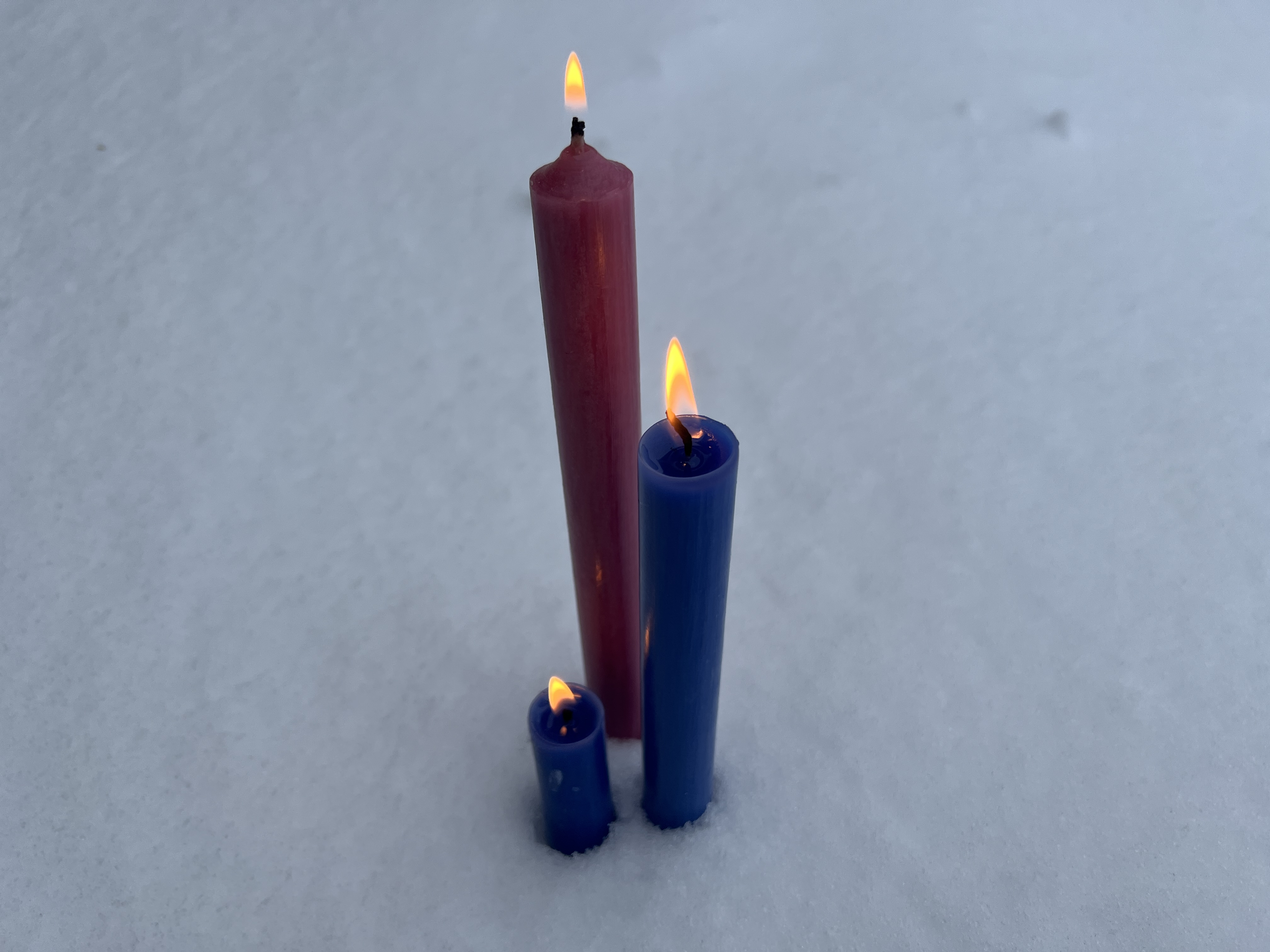
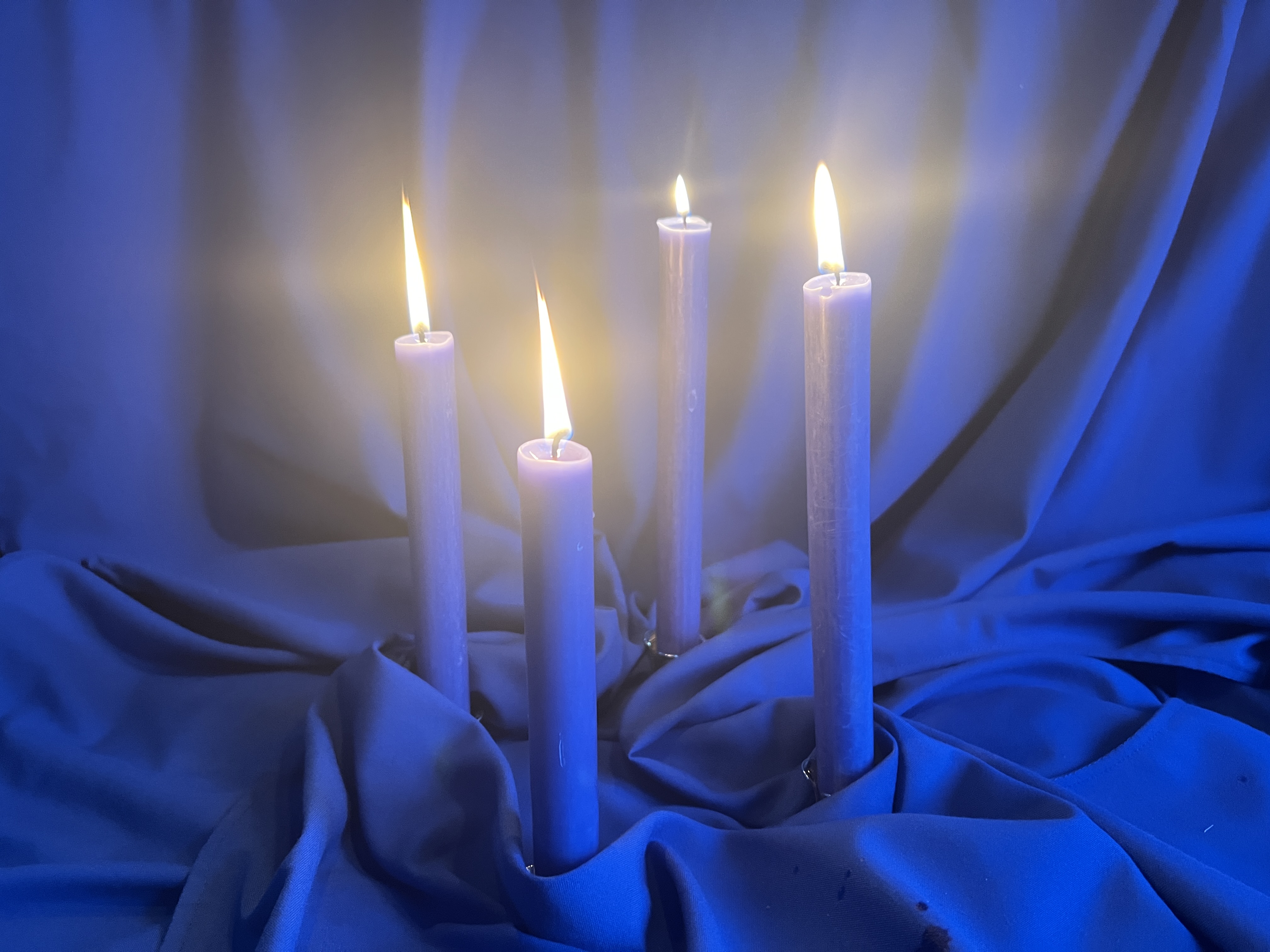
Today we lit the fourth and final candle on the wreath. This fourth candle is called the Love candle. When we know why we do certain things, we can then appreciate why others do it differently. We practice love. What are the reasons they have for the choices and decisions they make – regarding their traditions, their background stories?

We don’t love because others start behaving as we do. Love isn’t about making others conform to our way of doing things. Instead, love is appreciating and being genuinely curious about where the other person is coming from, and letting them know it!

And that’s how we respond in love. That’s how we keep the conversation going. Loving others is behaving in ways and saying things in order to keep the conversation going. The goal at Christmas is to love. The Christmas story lives in us when we keep the conversation going, when we don’t shut it down.

Mary said yes to the angel’s Word from God. Her heart opened even though her mind must have had many questions. Her heart expanded to include the Word of God into her life. She kept the great conversation of God’s love going in her. And her responses in love got the whole ball rolling. And Christmas happened. Thanks be to God!

References:

Babalola, B. (2021). Love in colour: Mythical tales from around the world, retold. William Morrow.

Coman, S. (2024). Seeds of hope: Day 5. Lutherans Connect. https://lcseedsofhope.blogspot.com/2024/12/day-5.html

Loorz, V. (2021). Church of the wild: How nature invites us into the sacred. Broadleaf.

Funeral sermon for an infant at Christmas

Let us pray. Heavenly God, you formed us in our mother’s womb and, in Jesus, welcomed children to come to you. Today we grieve the untimely end to a life that delighted you and us. Our hearts are torn, and we are burdened by our grief. Be with us as we walk this shadowed valley. Receive our tears. Hold space within us for hope’s return. Amen (All Creation Sings, 2020).

No words I can say will take the pain away. Our actions now must speak louder than any words. And what you are doing today, dear family, is showing up. And more than that you do an act of love, and an act of courage amidst this horrible loss. We are grieved, deeply saddened, our hearts are torn, as we prayed. Yet, you have given each other space and permission to feel what you must.

In this collective effort and in our humble actions today, we honour the life given to Leyla. We stake our ground, together today, and affirm that Leyla’s life made a difference in the world, and in the universe. Her life was a precious gift.

Recently I read (Coman, 2024) about a giant sycamore gap tree that enjoyed enormous popularity among visitors to Northumberland Park in England. This tree was used in many films. Because of its location it was a beautiful beacon and focal point in the park.

But in September 2023, the tree was felled in an act of vandalism. The outpouring of grief and anger was unprecedented, and a testament to the beauty and meaning it had offered many.

Was it over? Was this tree, that had offered such joy and beauty in the lives of many, no more?

In the following year seeds were harvested from the downed tree. Now, the seeds have grown to become saplings and are thriving. In a project called “Trees of Hope”, these tiny saplings from the felled tree are being given to people in prison, and many charities. In this way, the Sycamore Gap Tree will not only have its own offspring, but whose seeds are now being used for good.

When the tree came down, it wasn’t the end of it. It wasn’t over. And whatever is not over, is not lost. Never lost.

Dear family, you’ve experienced a seismic shift in your life these past weeks. The earth underneath you has opened up. And grief can sometimes feel like free-falling into the unknown abyss. It is true, life will never be the same again.

But when the ground shakes as in an earthquake, the trees shake. The pinecones fall to the ground. And the seeds within come out and are planted in the earth.

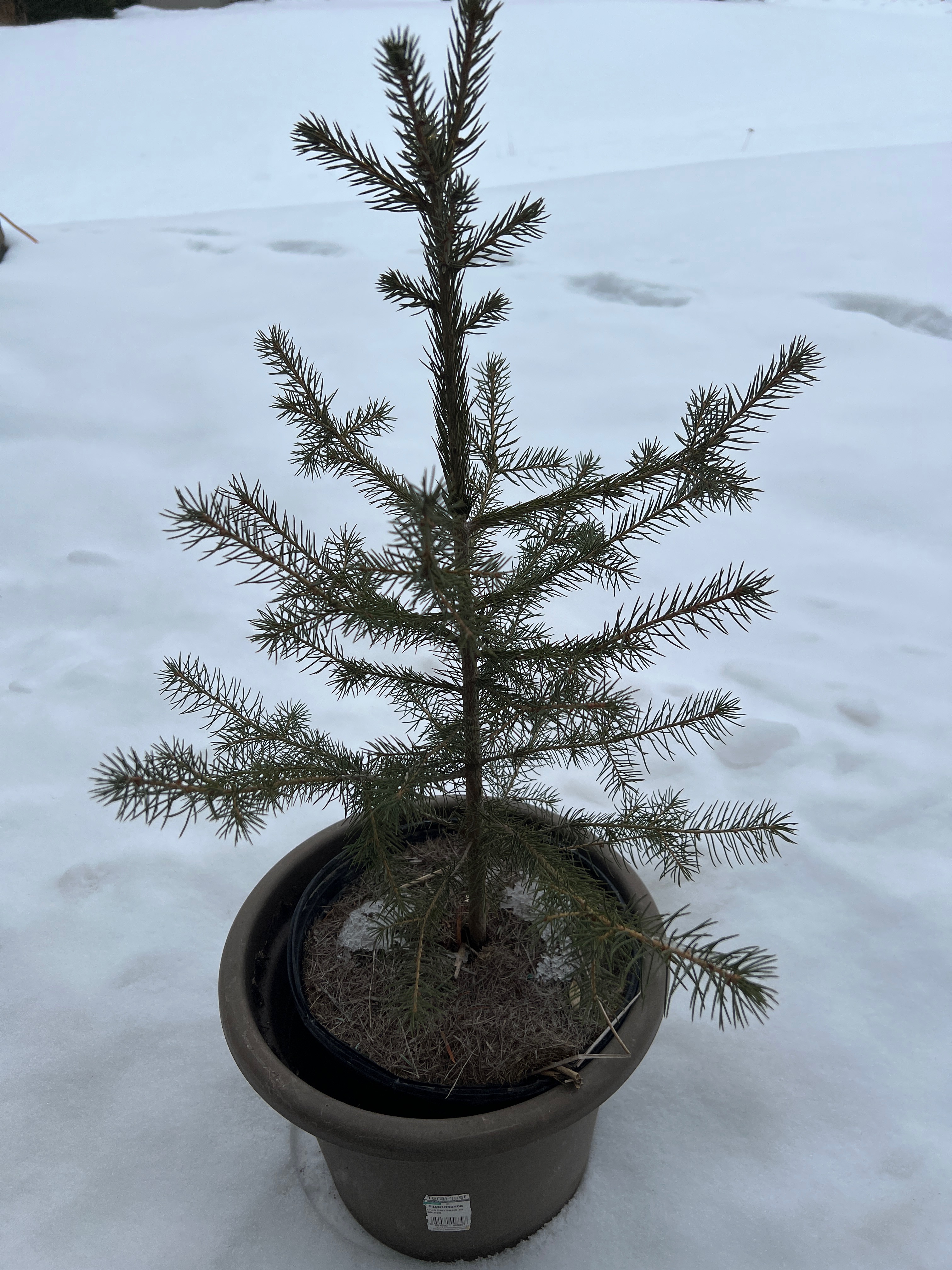
The Norway Spruce is common in Eastern Canada. One unique feature of this tree is its cones are the largest among all spruce varieties (Audubon, 2021). What does that mean? That means, lots and lots of seeds.

This sapling of Norway Spruce is now dormant for winter. It will need to be planted in the earth in the coming Spring. It needs lots of water, and it will grow. Perhaps during this wintertime, you can think of a place you’d like to plant it. In that simple act of planting a tree, there is this seed of hope that says maybe it’s not over; and because it’s not over, it’s not lost.

The cross of Christ, various legends have it, was made of varieties of wood ranging from dogwood to olive, to oak, to cypress. Whatever the blend or variety, the wood upon which Jesus died can be a sign and symbol of this close relationship between death and life. What dies finds a way to endure. What dies finds a way to live again. Our relationship with Leyla has changed, to be sure. But it isn’t over.

It is called the “tree of life”, both in the first book of the bible – Genesis (2:9) – and in the last book of the bible – Revelation (22:2). In the end, just as in the beginning, the tree of life promises that every ending marks a new beginning.

References:

All Creation Sings, Leaders Edition. (2020). Life passages and circumstances (p. 92) [adapted]. Augsburg Fortress.

Coman, S. (2024, December 9). Seeds of Hope: Day 8. Lutherans Connect. https://lcseedsofhope.blogspot.com/2024/12/day-8.html

National Audubon Society. (2021). Trees of North America. Knopf.

Expected yet unexpected

The gift of Christmas is not what we first expect it to be.

Time seemed to accelerate beginning with Canadian Thanksgiving in October. Then before we knew it was Remembrance Day, then Black Friday, Cyber Monday, Giving Tuesday in November, then the planning for the Christmas holidays, decorating, making New Year’s reservations, attending the social office parties, family gatherings, choral concerts, organizing shopping days and finalizing all our lists in December. My head starts to spin just thinking about everything we associate with those markers on the calendar.

We wrap up our expectations of Christmas around these activities. Indeed, participating in all of it creates expectations about the destination, intended or not. What do you expect when Christmas Day finally arrives? What do you want Christmas to be for you?

Part of the challenge at this time of year is trying to match what we want with what we actually end up doing.

The Gospel today describes the people in first century Palestine as filled with expectation (Luke 3:15). What were they expecting? They were looking for someone to come and save them, a Messiah. They were a people who walked in darkness (John 1), in a troubled time in history. They yearned for a saviour to liberate them from oppression.

And they suspected that maybe this saviour was John the Baptist – a charismatic speaker with a magnetic personality that could captivate the crowds with shock-and-awe oration never-mind his poor taste in fashion.

The gift of Christmas is not what we first expect it to be.

When I think deeply about my favourite Christmas memories, they were moments that happened despite the planning and to-do lists. What sticks, what made the greatest impression on me from Christmas times past, they were all moments that were unexpected.

These precious memories came more as a surprise: a serendipitous encounter with a friend, an unexpected moment outside on a winter’s night under starlit skies, walking on snow-packed streets, delivering gifts, listening or singing to a certain piece of Christmas music, a smile and healing tears in the midst of sorrow and terrible loss.

The gift of Christmas is not what we first expect it to be. John the Baptist redirects the attention of his followers to the one who is the expected Messiah, but not in the way they expected. Jesus is the gift of Christmas who still surprises in the way he comes to us.

We’ve been taught to consider Jesus today not as a political leader to free people from military oppression. But we’ve also been taught that Jesus comes to us mainly as a ‘caring’ God, a God who is gentle, who cares, coddles, protects and watches over us.

But Jesus was also someone to reckon with. There was this no-nonsense, straight-from-the-shoulder truthfulness about the way Jesus related not just to his opponents, the Pharisees, but to his very own disciples as well.

And he was not always necessarily nice. Jesus called Peter, “Satan” in one sizzling exchange (Matthew 16:23). Jesus never said, “Blessed are the nice”. He publicly expressed his anger, causing a social ruckus on temple grounds. There he physically disrupted the unjust practices of the money changers (John 2).

The Christmas narrative is not just about coddling and comforting the privileged. John the Baptist, if no other character from the Christmas story does it better, calls us out of our comfort zone, and challenges us in our image of the Christ, the gift at Christmas. Jesus, both the expected and the unexpected one.

The true gift at Christmas makes us think twice about what we are receiving. In the One who comes to us at Christmas in ten short days, we may not expect what we actually receive. The gift may surprise us, catch us off guard. This may make us feel uncomfortable at first. That part of Christmas is unsung.

Yet, one other truth of Christmas gleaned from the biblical narrative: The gift came at the right time. God gave the people what they needed, when they needed it most.

The baby born in Bethlehem had a forerunner to get the people ready for the gift. Even though they were warned, they were still surprised and bewildered when the gift arrived: The messy stable. The crying infant. The bloody cross. The empty tomb.

Because what they got in Jesus was not a Messiah riding a chariot at the head of tens of thousands of warriors thundering up the Kidron Valley to Jerusalem. What they got was a vulnerable human who showed us the very face of God.

Today we lighted the ‘joy’ candle on the wreath. This third Sunday of Advent is traditionally called ‘Gaudete’, and it is rose coloured. ‘Gaudete’ is from Latin which means, “rejoice”, from Philippians (3:1/4:4) – “Rejoice, rejoice in the Lord always! Again I say rejoice!” Gaudete Sunday gives us permission to praise God and give God thanks for the gift, expected yet unexpected, that soon arrives.

Do you expect to be surprised? When you are, that experience brings the joy of Christmas.

Stoppage time: the waiting game

“Prepare the way of the Lord!” shouts John the Baptist in the wilderness (Luke 3:1-6).

There was a child who was asked to read a part in a Christmas pageant at church. She had the part of John the Baptist. She was perfect for the role, a firecracker of a personality, a born leader. She had many friends who listened to her and followed her on the playground.

But she was worried that she would make a mistake or forget her lines. She told her parents that she didn’t want to go in front of so many people. It made her stomach upset and she felt scared.

Her parents told her stage fright was normal and that the best way to deal with her fear was to be prepared. Being prepared meant going over her lines 10,000 times in the weeks leading up to the play until she could fall asleep reciting her lines perfectly.

She protested. What if her mind would blank out when getting on stage? What if all that practice would mean nothing if she froze under the lights? Why should she even bother trying?

Preparation is the virtue we hail in Advent, when we are called to watch and wait – and prepare! – for the coming of the Lord at Christmas.

But what happens when we don’t have time to prepare everything just right? What happens when we are not prepared, when it comes down to it?

The notion that during Advent we are to wait, at first seems ludicrous. There is no time. How can we wait when there is so much to do (to prepare!)?

But what if the key to being prepared is learning and practising the art of waiting?

Because the truth is, no amount of preparation can prevent a tragedy from happening just as no amount of preparation can have you ready for the birth of a child when it happens. When it happens, at some profound level, we know we can never be fully prepared. When it happens, we know that we could never have anticipated and controlled for every contingency. So, what if being prepared means we know how to wait for it? Could it be, maybe we need first to learn how to wait?

From the Gospel, waiting first means we need to slow down. When shopping malls, parking lots and highways in December indicate everything but, slowing down is vital to receiving the Word of God this season. To practice, notice how you read scripture. So, in the Gospel reading today resist the temptation to skip through the first couple of verses (Luke 3:1-2) – it’s a list of names we have difficulty pronouncing.

Yet, there is purpose here. Luke, the Gospel writer, is intentional about naming all the political and religious rulers of the day and the time they presided. Luke firmly plants the message in a particular place and time in history. We can’t rush through this. Read those words intentionally as if they were a prerequisite for what comes after. And this takes practise. Read slowly.

Every valley shall be lifted and every mountain made low. Not just one valley. Not just one mountain. Not just the valleys associated with Friday night. Not just the mountains confronted Monday morning. Not just the valleys and mountains experienced during worship. In every valley of our lives. On every mountain encountered in daily living.

God’s message needs to land in time and place. We need to slow it down in order to notice it everywhere.

Luke is also quite clear, and intentional, about placing John the Baptist in the wilderness. Not in the crowded confines of a stuffy boardroom or lecture hall. Not in the opulent chancels and temple sanctuaries. Not in the public square in the middle of the city. Not even around the kitchen table or comfy living rooms of our private homes.

In the wilderness, there is lots of space, open areas yielding infinite horizons and unexplored terrain. There is this expansiveness associated with receiving God’s word. We rarely give thought to these conditions when the message is delivered. But there is always context. Waiting is preparing the ground, turning the proverbial soil of our hearts in order to receive the gift. God works from the inside out as much as God works from the outside in. Those expansive contexts of our lives, inner and outer, must be nurtured and practised.

Here is something you can do this Advent to illustrate this practice of slowing it down. For example, I know exchanging and mailing Christmas cards is not as popular today as it was a few decades ago. But maybe some of you can relate.

So, when you receive a hand-delivered Christmas card or in the mail after the postal strike is over, don’t open it right away. If you live with someone else, wait until you can sit down with them for a meal or coffee later that day to open it together, read it and give thanks for the person sending it. Or, if you live alone, wait until your next devotional time, or quiet time to open it, read it and give thanks for whomever sent it.

Advent is about slowing down, opening up time and space, and marking time.

Finally, waiting is becoming aware that the message is for you. Not for someone else. Not for the wayward children or grandchildren. Not for those who disagree with you. Not for those from other parts of the world. Not for those who behave differently from you. Not some part of the culture you do not participate in.

When John the Baptist spoke of a baptism of forgiveness, his opponents – the Pharisees – didn’t at first think this baptism referred to them. They, after all, had already participated in the mikvah, the Jewish ritual of immersing into the purity bath.

The rug was pulled from underneath the Pharisee’s feet when the message that John the Baptist brought was meant for them. And not just for the Gentiles, but for Jewish people as well – everyone who does not receive the message of repentance and forgiveness for themselves.

Waiting opens up regions of the soul to admit the call of repentance and promise of forgiveness into each and every one of us. Waiting allows us to contemplate what that changed life means for us. It’s very personal.

But what if we are like the little girl preparing for the Christmas pageant? What if we can’t or don’t prepare? What if we insist, “It’s not for me.”

When we are not ready for what happens in life, when there is no amount of work that can adequately prepare us for whatever comes our way, God still puts extra time on the clock. Just like at the end of a 90-minute soccer match, there’s always stoppage time to account for injuries that delayed the play of the game during the first 90 minutes. There’s extra time added. Always.

God’s patience is infinite. God waits for us. Even when we get injured, are delayed, or for whatever reason can’t seem to get our ducks in a row. God’s pacing and timing operate on a different level which we cannot fully understand, except that God makes time and space for us. And God’s message is to each one of us, personally. That message is conveyed in love and mercy.

“I am confident of this,” writes Saint Paul to the Philippians, “that the one who began a good work among you will bring it to completion by the day of Jesus Christ” (1:6).

The second candle we light today is called the Peace Candle. When we wait for the Lord by slowing down, creating space, and we receive the message for us personally, we prepare in a way that brings peace into our lives. Because of God’s grace and love, peace reigns.

Zechariah, the father of John the Baptist, sings God’s praise in the temple at the news of John’s birth:

78 In the tender compassion of our God
  the dawn from on high shall break upon us,
79 to shine on those who dwell in darkness and in the shadow of death,
  and to guide our feet into the way of peace. (Luke 1)

Having peace is about living daily with ourselves and others in the mercy, forgiveness and love modelled by the one for whom we wait, Jesus Christ the Lord.