
In a beginning

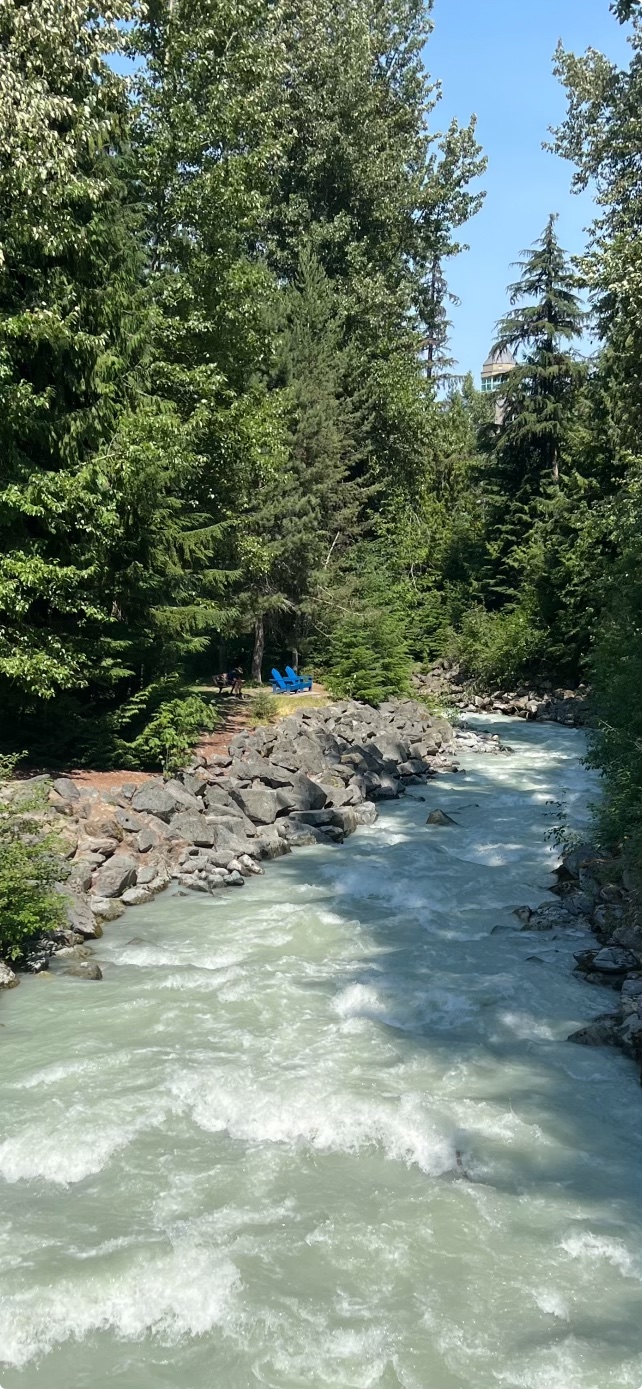
Fitzsimmons Creek, Whistler B.C. (photo by Martin Malina, July 18, 2024)

About an hour and a half ago, at 8:44am (EST) today (September 22, 2024), summer gave way to autumn. We are now officially in the Fall season. Today, I am reminded of the cycle of seasons again. Round and round we go. Our lives, indeed, go through cycles.

But we will often couch these repetitive cycles in negative terms. For example, we talk of cycles of violence, cycles of poverty, cycles of addiction, and so on. When do we talk about history repeating itself when it has to do with something positive and good? And depending on your mood today, and which seasons are your favourite in the year, even the autumnal equinox can represent a negative turn.

In observing this season of creation, the church focuses our attention on the basic building blocks of life on this planet – wind, water, light, earth. And the creation stories in the first book of the bible describe how it all began. And begins again.

I add the present form of the verb because two key words from the Hebrew language in the first chapter of Genesis not only provide guideposts in our understanding of cycles of time repeating themselves, but overwhelmingly support a positive viewpoint. The biblical creation stories, while also introducing the concept of sin, offer a resoundingly hopeful message.

The bible begins with those auspicious words: “In the beginning, God created …” (Genesis 1:1). A recent Lutherans Connect (LC) devotion points out that in Hebrew, there is no “the” (LC, 2024). It is, technically, ‘in a beginning’.

While the Genesis story says everything was created in six days in an unspecified moment in time, the grammatical nuance of ‘a beginning’ suggests that God continues to create something new in every time and place. In a beginning.

In fact, some scholars understand that there is no definitive beginning because creation has been happening already for a very long time (LC, 2024). The cycle of creation has gone on longer than we thought.

Based on evidence in the rock formations, for example, on the East Coast of Scotland at Siccar Point, scientists have concluded the earth is approximately 4.5 billion years old (LC, 2024).

This claim is not at odds with the bible if we pay attention to the grammar. Creation happens, happened, and continues to happen. Creation happens at every new beginning. In a beginning.

And what is more, every creative act of God is a cycle that repeats for good, literally. When God creates, the first chapter of Genesis reveals a litany of goods (Genesis 1: 4,10,12,18,21,25,31): “It was good … It was good …. It was good.” In short, God calls all that God has made, “good”.

But in the Hebrew word ‘tov’, ‘good’ is not just a static affirmation. Rather, ‘tov’ means a deeper sense of becoming well, closer to the meaning of ‘shalom’ in Hebrew – peace and well-being. God saw that all creation, including the human, was becoming well and evolving over time (LC, 2024). ‘Good’ from the Hebrew ‘tov’ evokes this sense of movement, of growth and transformation for the better.

Whenever there is a new beginning in life, God is creating for the good. The continuing acts of God’s creation happen at points of starting over. And this is a good thing, part of an evolving creation.

Our faith, we say, begins at baptism. And Ariel’s baptism today at Faith Lutheran Church in Ottawa is a sign for us all that God seeks to start afresh with us. At these beginning points in time, what we really affirm is an ongoing, unending relationship God has with us. Baptism conveys in water and word God’s grace starting over and re-newing our lives.

As we celebrate birthdays – Ariel did yesterday and her mother will on Saturday; as we celebrate anniversaries – Pastor Diane celebrates her 30th year of ordination this month; as we welcome new members at this new stage on their faith journeys; as we pray for Pastor Bavani and Jasmine who begin a new chapter of their lives later this week travelling back home to India; as we baptize Ariel today …. We affirm that life and relationships of love continue refreshed in new ways by God’s grace.

None of the above are a one-time, one-and-done deal. Each of these events are gateways through which we pass and commit to a life-long journey of endings which always signify new beginnings of goodness. I came across a bit of wisdom in my social media recently about grieving the losses of our lives. It is sage advice to those who walk alongside those who grieve:

“When supporting someone who is grieving, understand that you’re not trying to help them get back on track. You’re coming alongside them as they chart a new course.”

Ariel’s immediate family is together today, surrounding her with love at her baptism. We acknowledge the profound and challenging journey over the past few years that eventually brought them to this place at this point in time. We acknowledge all they endured and lost, migrating to Canada and away from difficult circumstances.

We also acknowledge and celebrate that God continues to open doors. God continues to create in this land new beginnings for you. We affirm the waters of baptism that give Ariel and us all the grace and promise of life renewed, and hope sprung again.

Thanks be to God, for a new beginning.

Reference:

Lutherans Connect. (2024, September 5 & 11). On the threshold. Centre for Spirituality and Media at Martin Luther University College. https://lconthethreshold.blogspot.com
With wave and wind

As many of you know, I love to paddle in my kayak and/or canoe, mostly recreationally and on flat water. If there is any one factor, in my experience, that affects how I enjoy the paddle, it is wind speed. In fact, normally I would avoid getting out on the water if wind speeds are gusting over 20 km/h.

This past Spring and Summer I have not been able to get out as often as I usually do. My extra course work has kept me busy during any free time I have.

So, during the latter part of my vacation at the end of August when there was correspondingly a break between semesters, I took full advantage and resolved to get out in my kayak as often as possible.

I was hoping for calm winds and sunny skies, of course.

But when Jessica and I arrived at our riverside camp site on the first day of our camping trip, it was sunny but, oh, it was gusting something fierce. I looked out over the bay in the Ottawa River and noticed the slightly cresting whitecaps. Borderline. But, it was my first opportunity to get out on the water all summer long. How could I not?

With hat strapped securely on my head and uncertainty and fear swirling in my gut, I launched my kayak into the choppy waters and headlong into the stiff breeze. Prayers for safety and confession of fear accompanied me on my way into the water. But I was also curious to test my abilities that had lay dormant for a year.

Wind and Spirit are the same word in both Hebrew – the language of the Old/First Testament – and Greek – the original language of the New Testament (Lutherans Connect, 2024). So, what went through my mind as I tumbled into my tiny vessel was that there surely must be something I can learn from being vulnerable to the wind. What could the wind teach me about the Spirit of God?

There are other places in the world where the winds blow constantly and at fierce velocities. Slope Point, on the southernmost tip of New Zealand, is a rocky shoreline made almost inhabitable by high-powered winds, having soared some 3200 kms across the Antarctic Ocean uninterrupted (Lutherans Connect, 2024). The winds are so strong it is possible to become almost airborne when you lean into it and jump.

The wind, of course, can be dangerous for its unpredictability, uncontrollability and its destructive potential. That, too, went through my mind as I struggled to keep my kayak upright and moving in tandem with wave and wind. I wisely decided not to push it and cross the river to the other side that first time out. Rather, I stayed in the relative safety of the bay. I was getting the hang of it by focusing on my paddling and keeping an even and steady stroke going.

In the Gospel reading today (Mark 8:27-38), we witness an identity crisis that those who follow Jesus appear to be having. They can’t seem to understand who Jesus is. At best, they skirt around the edges of truth and express different perceptions: Some say John the Baptist, some say Elijah, others, one of the prophets. Who is this Jesus? Peter says, the Messiah.

However, Peter has become accustomed to thinking the Messiah as a wonder-worker with the power to banish every difficulty and suffering (Shaia, 2021). Peter has come to expect Jesus to be a miracle-working Messiah.

In contrast, Jesus’ response is firm in describing God who embraces the path of great trial, conflict and loss. Disciples of Jesus will, consequently, not minimize, evade or divert from the hard realities of life. Jesus tells Peter, in other words, that if he is only looking for a “super-parental divine rescuer” (Shaia, 2021, p. 158), then he has not yet understood the nature of his faith.

God is certainly capable of rescuing us. But God will not always rescue us. Because God has faith in us. God gave us resources and gifts to use and employ. God allows us to use our abilities and capacities including our supports and others for help so we will mature and grow in faith.

Peter is just one example from the bible. There are many others. Read the stories of David from the books of Samuel in the First Testament. David had been chosen as a child already. Yet God did not intervene every time in his life to keep him from making mistakes or taking the occasional wrong turn. God did not rescue him, because God wanted him to mature.

Part of the maturity process, apart from learning from past mistakes, is realizing with joy and thanksgiving the resources, capacities and gifts we have that may have gone unrecognized when the proverbial waters of our lives were once calm and still.

Up until my kayak experience that windy day on the Ottawa River, I had never had a wave actually wash over the deck of my kayak and into the cockpit. I had assumed that if that ever happened, I would be in serious trouble, at risk of capsizing and swamping the boat.

I was wrong.

On that day a large wave struck the side of my boat. While the surge of river water soaked my pants, my little craft stayed true when I just kept my arms moving and paddling through it – left, right, left, right ….

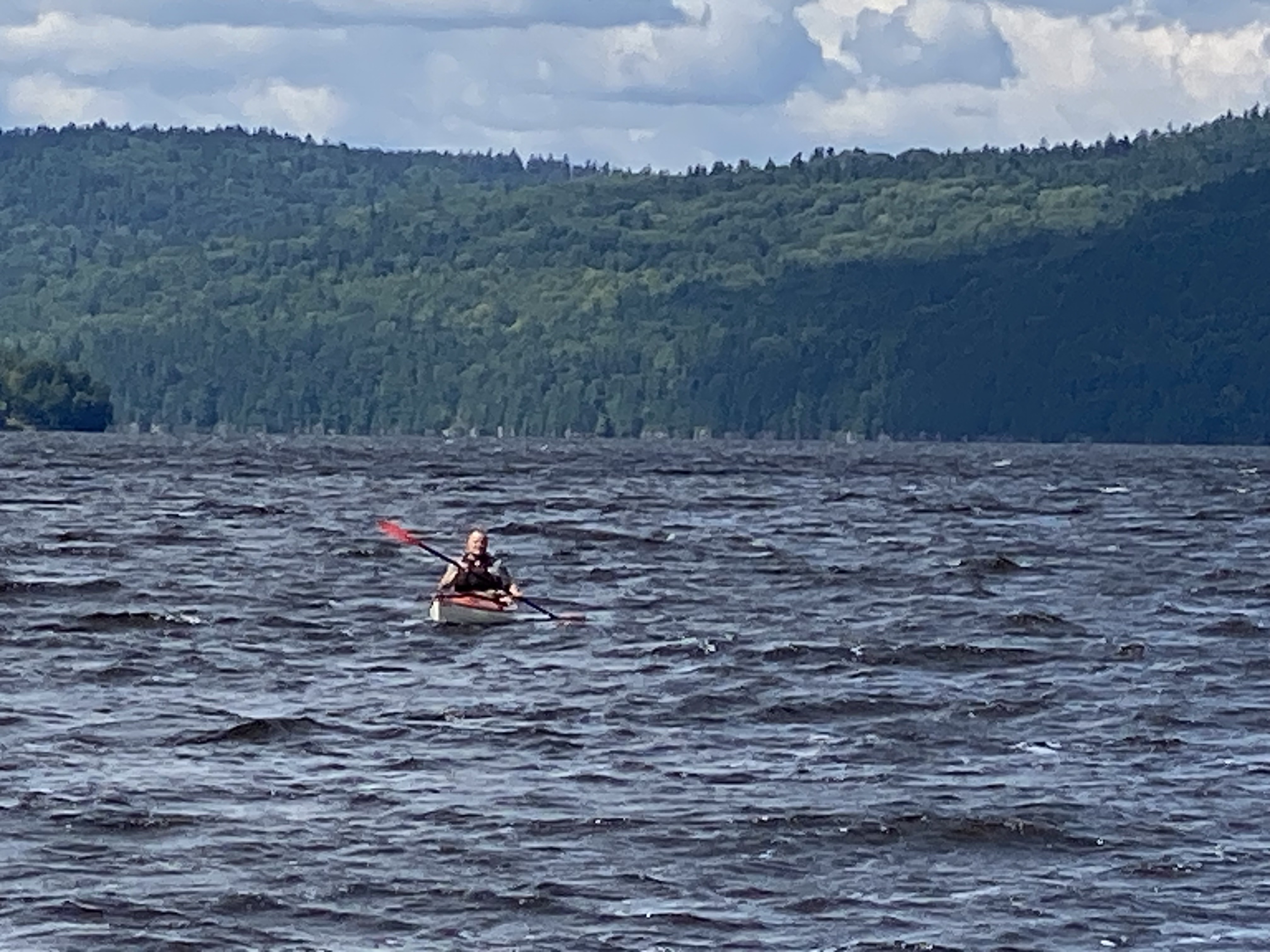
From the shores of Driftwood Provincial Park on the Ottawa River
August 21, 2024 (photo by Jessica Hawley Malina)

Then I thought of the design of my craft, built near Algonquin Park for these very waters – a stable, wide hull with a skeg, like a rudder, which I could deploy in deeper waters to keep my tracking straight when current and wind assailed me. I had my life jacket on. It was all good! And I was having a blast! I had underestimated my capacities and resources.

Following Jesus is as if we were in a tiny boat on a menacing sea in a great storm. The storm overwhelms our senses. Emotionally we feel completely directionless. What shall we do?

We have only two helpful choices: We can perform the one simple task we have – we can row: left, right, left, right … keep going. And not give up.

And we can pray. Our prayer is first one of surrender. We surrender our previous evasion, avoidance, assumptions and denial tactics when we realize they are not particularly helpful nor relevant in the present circumstances.

Our prayer is then one of trust with full awareness and acceptance of the path ahead. We trust that the journey is long and full. To believe the journey is long and full, I mean that amidst the storms we all face there will be a time when the waters will be still again, and the breeze soft and calm.

A few days later, I indeed experienced the glory, peace and brightness of a paddle in the river when the water was as still as glass. I stayed out for hours. And I thanked God.

References:

Lutherans Connect. (2024, September 9). On the threshold. Centre for Spirituality and Media at Martin Luther University College. https://lconthethreshold.blogspot.com
Shaia, A. J. (2021). Heart and mind: The four-gospel journey for radical transformation (3rd ed). Quadratos.

Glimmers of grace – a funeral sermon

This past summer, a friend of mine went overseas to participate in an archeological dig. From just the pictures she posted on Facebook I saw her donning a wide-brimmed sun hat and kneeling over carefully turned earth with trowel in hand. She was uncovering a mystery hidden from sight for thousands of years. 

I wonder what she uncovered – a fossil, a bone fragment, a sherd of pottery, a tool or utensil from a bygone age? Or, maybe, as I like to imagine, she was discovering a round, stone decal on which words or images were inscribed, carefully and meticulously sculpted. 

All these possibilities reveal a story, a narrative, of lives lived and cultures celebrated, lives and cultures far removed from our day and age.

Sometimes the truth of someone’s life is not easily accessible nor perceptible, at least from the surface. On the surface of things, we don’t get the complete picture. On top of that, no one can easily plumb the depths to uncover the totality and truth of one’s life buried deeply beneath the surface.

On the surface we conclude many things about what we see, good and bad. We may conclude it’s not worth digging beneath the surface. To uncover it all may be too much for us, even if we wanted to.

When God created Michael, God imprinted an aspect of the divine onto Michael life. Like a potter or sculptor, God fashioned Michael to reflect some unique manifestation of God’s self (Genesis 1:27).

Over the course of Michael’s life, the earth, the world, weighed down heavily on him – as it will onto all of us. Layer upon layer, year after year, the sediment collects and the dirt, sand, and roots which pack down over top the true manifestation of Michael’s life. 

How he positioned himself, responded to the weight of it all, had something to do with how deeply hidden his beauty and true self was hidden from us. Of course, other factors affected the course of his journey as well. But there is a deeper truth to behold in our contemplation of and thanksgiving today for Michael’s life.

Even when you who were closest to Michael struggled in loving him, God is like my archeology friend. God, on bended knee, is faithfully and persistently dedicated to uncovering the original work of God. There is a promise, after all, from scripture told by the prophet Isaiah: That God will never forget the work of God’s hands – “I have inscribed you,” God says, “on the palm of my hands” (49:15-16).

God has etched your being onto God’s own being. And so, God can never forget you, and will always remember each and every one of us no matter how deeply we are buried under the weight of the world.

And sometimes, as God continues to faithfully work at digging, uncovering, and chipping away the packed earth from our souls, we get a glimpse of what lies underneath. We catch a glimmer of grace.

Some of you witnessed moments, revelations, of what lay deep beneath the surface of Michael’s life just days before he died.

He hugged you. He told you he loved you. He held the words of the Lord’s Prayer close to his heart, and confessed this prayer warmed him when he was cold. Graciously, these revelations rose to the surface of his life for you to behold.

God will never stop, with each one of us, until life has gone full circle to the way it was in the beginning, so we can realize our true, unencumbered, unique self, beloved eternally by God. This is the promise of faith. 

Thanks be to God.

Belonging, unconditionally

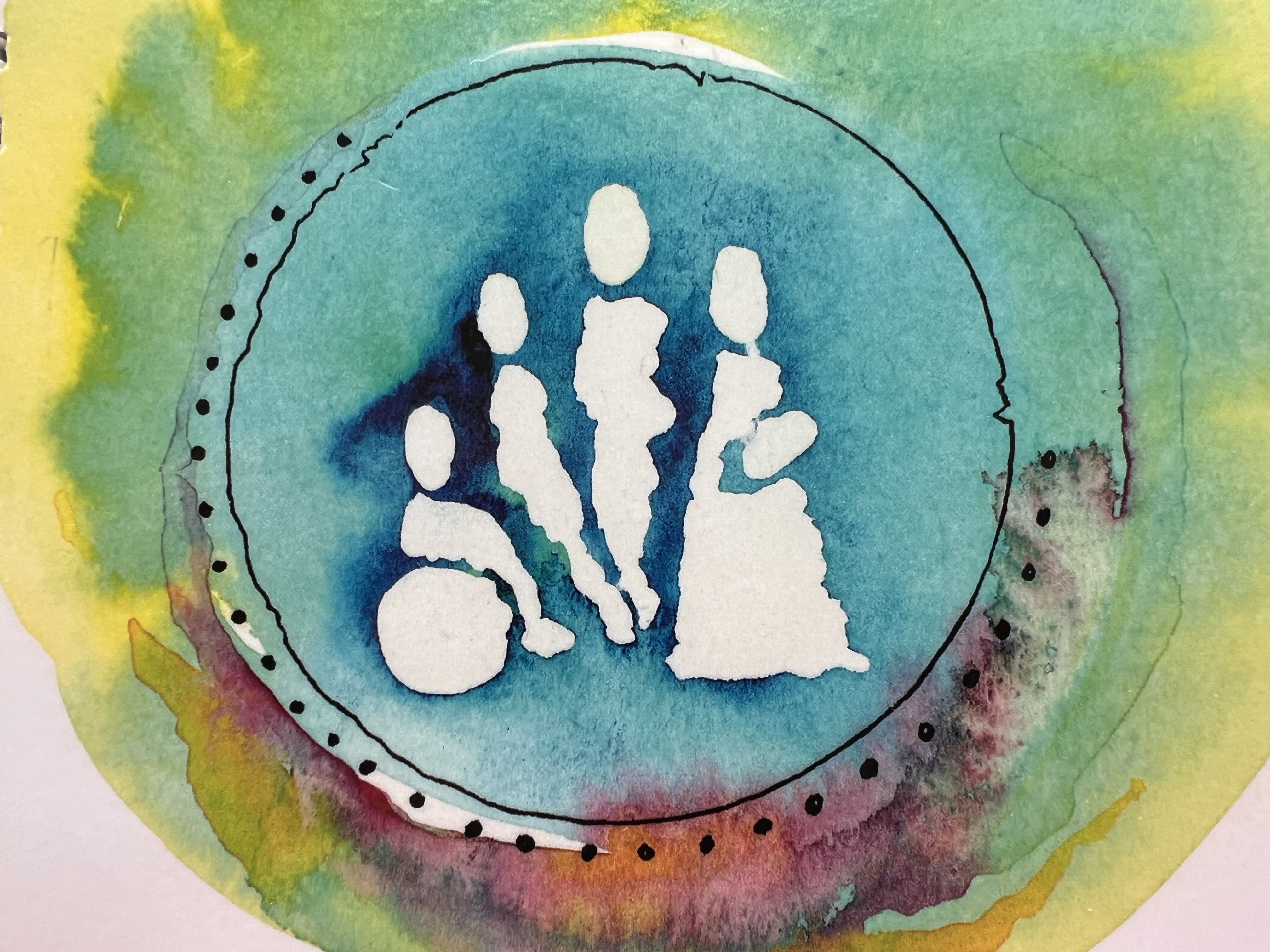
Artwork by Wendy Newbery on the front cover of Laura MacGregor & Allen Jorgenson “Beyond Saints and Superheroes: Supporting Parents Raising Children with Disabilities”
(published by Mad and Crip Theology Press, 2023)

The stories of healing in the Gospels show Jesus in action – doing what he has been called by God to do. But compared to the other Gospels in the New Testament – Matthew, Luke and John – the narrative that Mark writes to describe Jesus’ activity goes along at a hurried clip. Mark’s story-telling style sails along quickly.

In today’s reading from Mark (Mark 7:24-37) we witness two healings which are told one after the other in Mark’s compressed and concise manner:

First, a young girl is healed, the daughter of the Syrophoenician woman – a Gentile. Then, giving us time only to take a quick breath, Mark tells of a deaf man being healed – a man from the Gentile region of the Decapolis near the Sea of Galilee. Jesus, it feels, is on pace for logging in another eighty-hour work week.

But lest we get side-tracked by Mark’s style or distracted by our fascination of and fixation on the miraculous in these accounts, notice today the pains Mark takes to convey the details of identifying who these people are that Jesus heals. Mark had to be intentional in noting their identity, otherwise he would not have tolerated such excessive verbiage in his brief, succinct script. He wanted to emphasize an important aspect of God’s mission in Christ Jesus.

But it’s not the individual names of the woman’s daughter and the deaf man that Mark shares. It’s where they are from. That’s the point. Mark wants the followers of Jesus to get very clear on the social group, the cultural identifier to which these individuals belong.

Belong. Belonging.

The new school year brings to focus how we belong. After emerging from a summer break marked by individual endeavours and pursuits, summer jobs, private family gatherings, vacations and trips, going to school brings everyone together. Going to school highlights our collective being and our socialization. For many of us, it was schooling that first introduced us to the notions of belonging or not belonging.

It is our experience in school where we learn the criteria, said or unsaid, for what it means to feel part of a community. Do we measure up? Are we good enough? Do we pass the grade, socially and academically? Is our voice heard? Where do we fit, jocks or nerds, science geeks or social rebels, artists or conformists?

How do we belong? Unfortunately, school can create not just positive but also negative experiences about how we belong.

Deacon Michelle Collins in the ELCIC writes that it is possible to belong based on personal initiative, worth, performance, joining a group through membership or application (Collins, 2024). This is the way of the world, isn’t it?

But belonging, according to the Gospel, goes in another direction. Collins (2024) writes that belonging, according to the Gospel, happens because someone is chosen to belong. Belonging is initiated by the chooser and is not contingent on the merit or initiative of the chosen. Belonging, first and foremost, is a gift. Belonging is a particular kind of gift.

Jesus showed no favouritism in his healing ministry. In the second reading from James (2:1-10), Christians are instructed – using the very words from the Gospel, to love others as you love yourself – to show no favouritism. And, James is particular about how we do good works according to the Gospel.

Because Jesus showed no partiality in loving people. Wherever he travelled throughout Palestine, he engaged people in life-giving ways. Jesus shared God’s love to everyone he encountered, even those deemed outsiders or non-deserving. Jesus, by his actions, demonstrated that everyone belongs to God’s community. Without exception.

God chooses you and not because you’ve done well to prove yourself worthy according to our human criteria, conditions, biases, perceptions, achievements or values. God chooses us; therefore, we belong.

Dr. Temple Grandin was born with autism. She didn’t speak until age 4. Her neurodiversity may have been considered a handicap, a negative. As a result of this kind of negative thinking by others, she may have experienced being excluded, marginalized, not belonging.

But her talents and abilities were recognized and supported, thankfully. She is credited for inventing a special livestock restraint system. Her design aimed to calm the cattle down before slaughter, thus making the whole process more humane. Today, Temple Grandin teaches at Colorado State University and makes meaningful contributions to society (Grandin, 2024).

The purpose of the Gospel is to remind all who read and hear it that they are chosen unconditionally by God. Because we belong to God, our relationship with the world is reoriented. We have been changed by being chosen. The reality of unconditional belonging releases us from seeking to belong based on performance or merit. We don’t have to win anyone’s approval because we are already God’s beloved. And we can accept others without condition because they, too, are God’s beloved. Their voice, too, needs to be heard.

Thanks be to God!

References:

Collins, M. (2024, August 26). Belonging as gift. Eternity For Today, www.eft.elcic.ca

Grandin, T (2024). Temple Grandin is the 2024 lifetime achievement award winner. RDC Design Group, www.templegrandin.com