Rooted and grounded, growing and life-giving

Many thanks to my colleague the Rev. Kimber McNabb who provided most of the ideas and words for this sermon. You can read the original at her blog —https://revkimber.blogspot.com/2024/04/jesus-proclaims-i-am-to-each-forest.html

In the Gospel of John, Jesus proclaims a variety of I AM statements: I AM the Bread of Life, I AM the Light of the world, I AM the Door, I AM the Resurrection and the Life. I AM the Good Shepherd. I AM the Way, the Truth, and the Life. The final I AM appears in today’s Gospel: “I AM the Vine.” (John 15:1-8)

Why is this image the last I AM revelation from Jesus? And why is it included as one of the Easter Gospel readings?

Martin Luther’s words can get us started. He wrote, “Our Lord has written the promise of Resurrection, not in books, but in every leaf in springtime.”

It’s interesting, isn’t it, how often Jesus uses the natural world to describe God’s realm and truth. Admittedly, the Gospels were written in a predominantly agrarian culture. I suppose Jesus could have talked about the tallest buildings in Jerusalem and how they were built. He could have talked about the Roman aqueducts and the ingenuity involved. He could have talked about the Roman chariots and their power. But that’s not what we have a record of in the Bible. We have stories of seeds, birds and trees.

The vine metaphor is quite relevant for us today. Recently I read about a beautiful living practice that expresses a vine and branches idea. It expands the ‘I AM the vine’ into our context today. “I AM the Vine” speaks hope and resurrection to a people living in a world today in crisis.

I AM the vine – resurrected in DAISUGI.
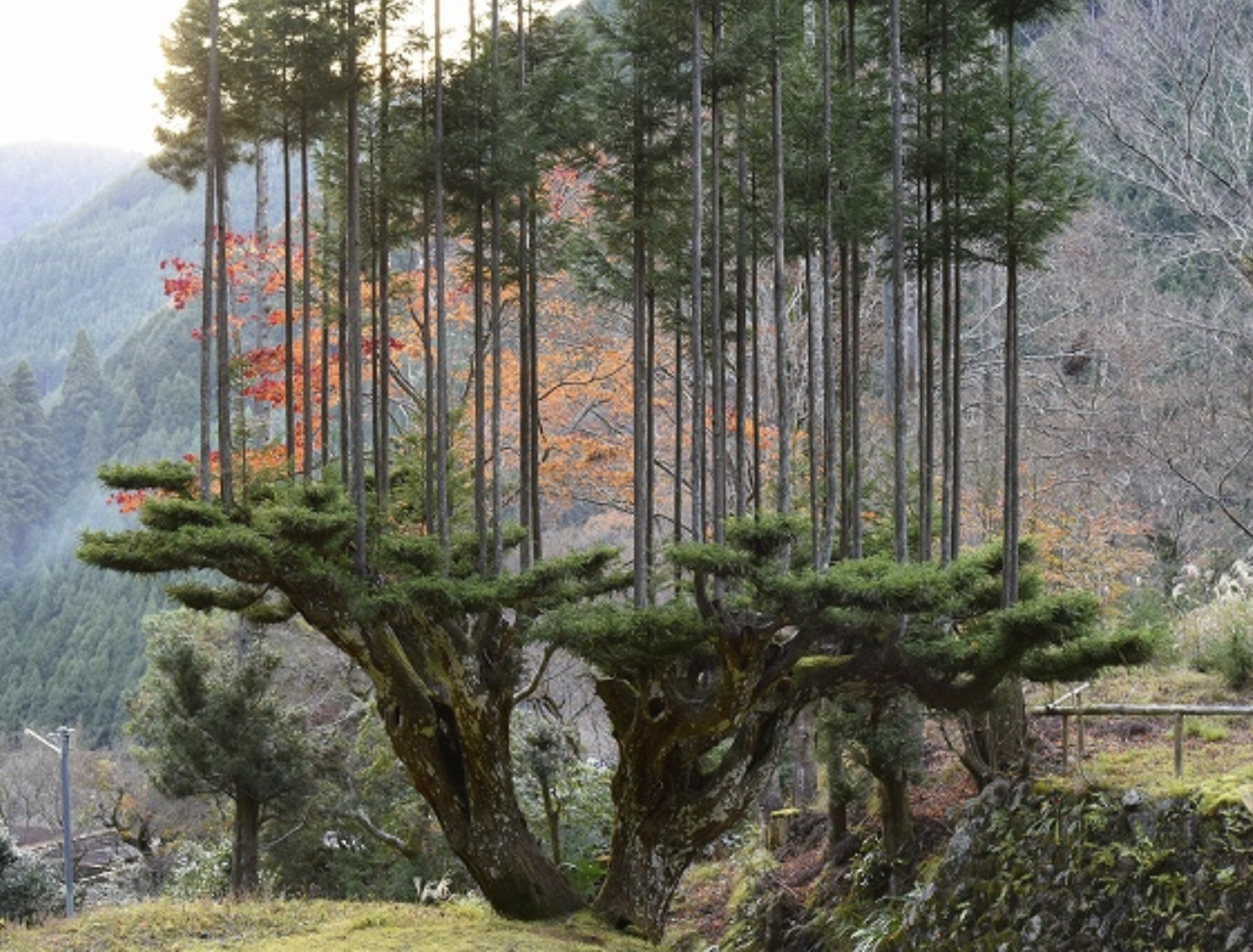
photo via https://twitter.com/wrathofgnon/status/1250287741247426565

Daisugi is an ancient Japanese forestry technique developed in the 14th century in the Kitayama region of Japan. It is an example of silviculture; the science and art of growing and cultivating forest.

The practice chooses an established old growth tree, usually a variety of Japanese cypress. This mother tree is cropped straight across, removing its top canopy. Cedar shoots are grafted onto the cropped branches of the mother tree. These shoots are pruned every few years to ensure straight and knot free lumber come harvest time.

So the picture is a large tree trunk with strong branches reaching up. From what would be the middle of the tree there is a straight line. From here a whole forest grows on top of the other tree.

The cultivated forest takes 20 years to mature. At harvest time the strong established mother tree remains ready to grow the next forest.

Forests that are nourished from Mother Tree mature quicker and produce more wood than other cedar forests. The wood is more flexible, denser, and stronger than standard cedar. This process has created a sustainable supply of raw material for over 700 years.

Revisiting Jesus’ statement, I AM the Vine, during the season of Easter, brings forward the promises Jesus spoke before his death and brings them into the realm of resurrection. This opens a myriad of possibilities for life, for resurrection appearances amid whatever the suffering and crisis of the day.  The All Creation Sings hymnbook concludes one of its creation prayers:

“In the name of the one who from a wounded tree birthed a new creation”—pg 47ACS

So, the question, “What difference does this image make as the last I AM revelation of Jesus?” From a wounded tree – from the cross – I AM did not die. I AM rooted in all that was, and is, and is to come, is resurrected – I AM alive!  I AM a hearty vine with energy and love and wisdom to cultivate a forest of branches to produce abundant fruit.

Canadian forest ecologist, Suzanne Simard, in her book “Finding the Mother Tree” discusses the interconnectedness of trees and how -rather than competing for resources- they share nutrients and resources with each other. Mother Trees are relational, with vast underground networks connected over the centuries. They are energy and the source of ancient life.

Jesus saying, “I AM the Vine,” takes us back to Genesis with I AM moving over the waters in creation and the Word creating by speaking “let there be.” In the garden was the Tree of Life, a Mother Tree, connecting all the way through to I AM the Vine; connecting all the way to today.

The Tree of Life – Mother Tree, to the tree of the cross, to a rooted vine, to a faithful forest.

When I heard about the living practice of daisugi I was excited. I am a lover of trees. When I think about growing a whole forest on top of one tree, I am filled with so much hope for the earth’s future and its health. The abundance of this practice is astonishing. And to know that that forest matures faster, stronger, more flexible and durable, because of the sustenance flowing from the Mother Tree – amazing! And to know that the growing of a new forest can be done continually. Wow!

When I hear about the living practice of daisugi I am excited. I am a lover of Jesus. When I think about baptism and being grafted into God’s family, I never considered being grafted onto the vine as being that which has roots to the Mother Tree. Because of Jesus rootedness, the disciples matured – strong, durable, flexible- as they shared Jesus’ story with others. The early church grew quickly by their witness.

In our context, consider the living practice of daisugi as one to be practiced in the church. Would we be less fretful of what is and more hopeful of what will be, if we understood and experienced rootedness? If we considered our present congregation as one forest, in a line of consecutively cultivated faith forests on the vine, the Mother Tree, I AM?

Can we wrap our heads and hearts around the living practice of every 20 years the beautiful straight and knot-free trees bearing fruit? Meaning cut into lumber; fruit is distributed and used, as the next forest begins to grow. It means that every 20 years we let go, in some way we let the church of the day give up its life to be resurrected again; resurrected strong, durable, and flexible.

Sometimes we get stuck trying to keep the old forest growing, rather than harvesting the forest, sharing the fruits and letting the next forest grow. We forget that the forest was never meant to be permanent, only the trunk – the Source of Life- which continues rooted and grounded and full of life.

The I AM the Vine is spoken as the final I AM because it is Jesus’ proclamation that branches will come, bear fruit, and die. But the Vine remains, as does the life that comes from the Vine – for it has a deep ancient source, the Mother Tree.

As Easter people we bear witness to resurrection appearances. We have witnessed life and death and life.

On this side of Easter, 2000 years later, we bear witness to the millions of forests that have grown from Mother Tree. The forests have embraced, believed, and lived the promises of Jesus brought forward into the resurrection. Jesus proclaims I AM! To each forest, Jesus proclaims I AM the Vine, therefore, you are!

Thanks be God. Amen.
He gave it all: a funeral sermon

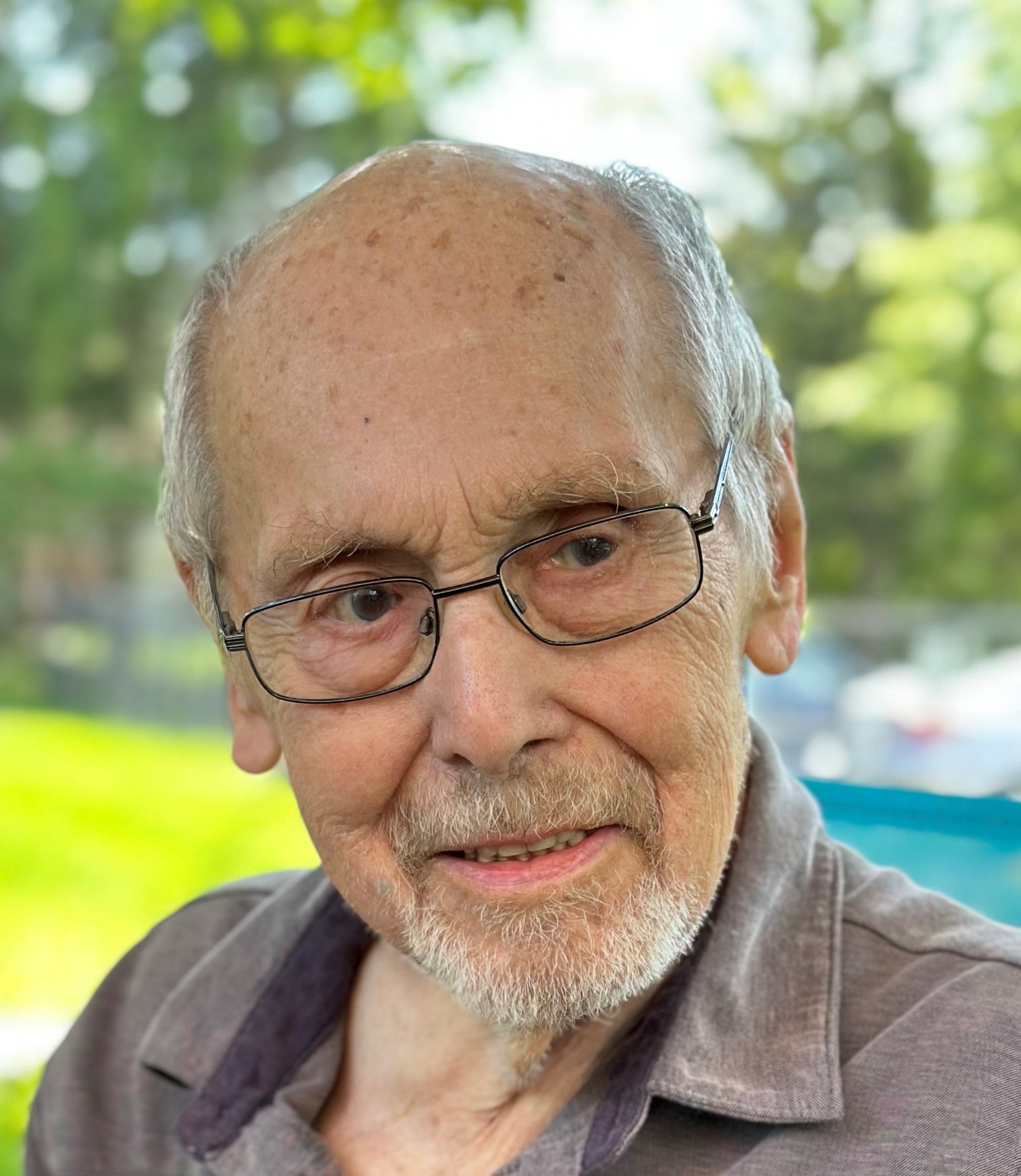
Rolf Meier (1932-2023)

1 My God, my God, why have you forsaken me?
   Why are you so far from helping me, from the words of my groaning?
2 O my God, I cry by day, but you do not answer;
   and by night, but find no rest.

3 Yet you are holy,
   enthroned on the praises of Israel.
4 In you our ancestors trusted;
   they trusted, and you delivered them.
5 To you they cried, and were saved;
   in you they trusted, and were not put to shame …

29 To him, indeed, shall all who sleep in the earth bow down;
   before him shall bow all who go down to the dust,
   and I shall live for him.
30 Posterity will serve him;
   future generations will be told about the Lord,
31 and proclaim his deliverance to a people yet unborn,
   saying that he has done it.

Last week there was a resurrection, of a kind.

The famed “men’s breakfast” at Faith Lutheran Church resumed after the pandemic had shut it down. Nearly a dozen of us from the church gathered in the same place that had been the venue for the monthly breakfast for years. We even sat in the same part of the restaurant. I couldn’t help but think of some of the guys who used to attend who for whatever reason weren’t or couldn’t be there this time.

Rolf was one of them.

Eating is what we do as humans. Perhaps that is why Jesus in his resurrection appearance to his disciples made it a point to eat “broiled fish” (Luke 24:36-42) right in front of them. He wanted to show that his resurrection did not deny the value of our humanity as people of faith.

Embracing our humanity makes all the difference in understanding God’s love for us. God doesn’t love us because we are spiritual or have achieved enlightenment in some esoteric way. God loves us just as we are because God is good!

The glory of God, Saint Irenaeus of Lyons (135-202) wrote, is the living human. We don’t experience God or get closer to God by being more spiritual, but by being more human. God comes near to us when we accept and embrace all of who we are including our human frailty, imperfections as well as all the good things that emerge from our true humanity.

Whenever we gather for prayer and worship, we give it all to God. Not just the polished, nice parts. Not just the parts we want to show off and impress others with.

Someone told me a story about what Rolf did years ago, before I came to Faith Lutheran, on a Maundy Thursday during Holy Week. The focus of the service was the suffering of Christ. And it is tradition on Maundy Thursday to read Psalm 22 which Jesus cited from the cross before he died. The words spoken by Jesus are recorded in the Gospel: “My God, my God, why have you forsaken me?” (Mark 15:34)

But on that Maundy Thursday, for whatever reason, the person assigned to read Psalm 22 did not show up. The pastor at the time quickly looked for someone else to read it. At the last minute, Rolf, who was there as an usher, agreed.

But what really shocked someone there was how Rolf read it. At first, they wondered who it was. Because Rolf punched out the words in as loud a voice as he could muster: “My God! My God! Why have you forsaken me?” – with full dramatic effect.

Rolf gave it all. In that moment Rolf lived into the full range of his emotions, giving it all to God. And what Rolf showed in that moment, I believe, was an energy he did not often show to others, especially in the church.

You see, in the community Rolf preferred to work behind the scenes. He didn’t want to be the centre of attention. He probably only agreed to read Psalm 22 that night because on Maundy Thursday that Psalm is read from the back of the church while the altar is being stripped.

In responding to the call to read Psalm 22, Rolf perhaps had to step out of his comfort zone. But in doing so, he revealed his inner strength and truth. And conveyed the truth of the Gospel in so doing.

Jesus’ humanity was exposed on the cross, to be sure. Psalm 22 begins in lament. But it doesn’t end there. It continues into glory, as a celebration of trust and faith in the midst of agony and even death. “I shall live for him,” concludes the Psalmist. It is possible that a time of deepest abandonment can open within us feelings of peace, trust and even thanksgiving.

Rolf may not have been physically present with us at the breakfast last week. But every time the church gathers around food and drink, at the sacrament or whenever you, dear family and friends, gather for a regular meal in a restaurant or at home, we can celebrate Rolf’s life with us and around the eternal banquet feast of heaven. Thanks be to God.

Love and freedom

[Jesus said] “My Father has a great love for me, for I lay my life down to take it back again. No one takes my life from me, for I lay it down on my own. I have the right to lay my life down and the right to take it back. It is my Father who gives me this right” (John 10:17-18; First Nations Version, 2021).

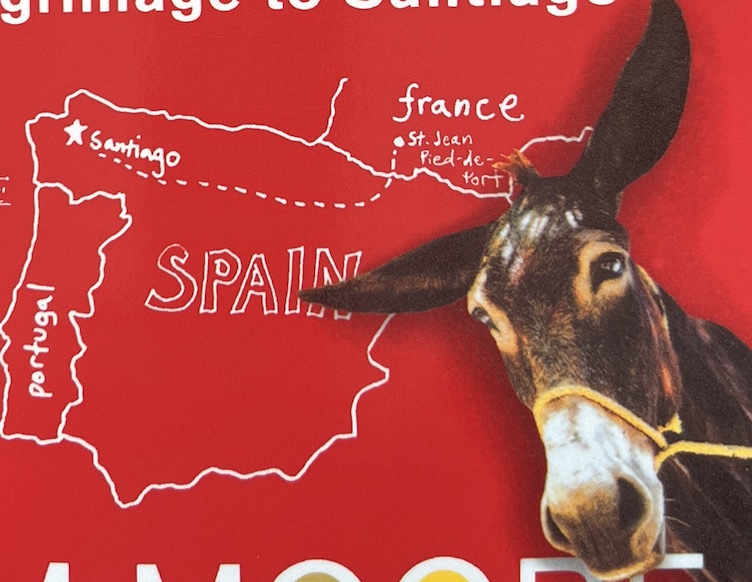
The Ottawa Lutherans online book club just finished reading about going on a pilgrimage. Specifically we read Tim Moore’s book about his pilgrimage to Santiago (Moore, 2004).

But what sets his book apart from all the other Camino books is that Tim Moore completed the 800-kilometre trek with a donkey, named Shinto. The entertaining account centres on this relationship between man and donkey, and their many adventures.

Screenshot

Shinto was by far my favourite character even though, of course, he doesn’t say a word. Shinto’s intentions, aversions, foibles and reactions are all revealed by his behaviour and physical expression.

If you have walked the Camino de Santiago, you may recall the many bridges you crossed on this journey through northern Spain, from narrow foot bridges over shallow streams to large, urban multi-lane highway bridges spanning major rivers.

But one thing Shinto would never, ever do is walk over any body of water. He would just dead stop right before the bridge and there was very little anything Tim could do to goad, force, shoo, push, haul that beast across. Shinto won that argument most of the time. And so, for much of the Camino, Tim would have to lead Shinto the long way around in order to avoid crossing those bridges.

As you can imagine, it was the source of major friction between the two of them. Shinto’s stubbornness caused Tim so much exhaustion and frustration.

Nearing the end of the Camino, Tim was joined by his family for a few days, including his young daughter, Lilja. Tim Moore describes a moment when the three of them approached the next bridge:

“…There was a bridge over an irrigation culvert, a sheet of galvanized metal which sang like a saw when I planted a boot on it. This sensory experience had a predictable effect on Shinto, and with a sag of the shoulders I turned around.

“’What are you doing?’ asked Lilja.

“’We’re going back to find another way,’ I said, lightly massaging a tender spot on my right temple, and at this stage of the day I had no wish to expose my daughter to scenes incorporating adult language and strong graphic horror.

“As I’d seen so many others do, she grimaced sceptically at first donkey, then bridge. ‘But it’s really small.’ I nodded vacantly, then set about wheeling Shinto round. ‘Have you tried holding out some of his favourite stuff from the other side?’

“’I’ve tried everything.’

“She twisted out a frond of alfalfa from the pathside. ‘Can I try again?’

“I suppressed a sigh. ’Quickly, then.’

“Lilja looked at Shinto in mock reproach, one hand on hip and the other proffering the vegetable lure. Then she leant forward, and whispered, ‘Now, Shinty, it’s only a little bridge.’ His ears shot up and without hesitation or deviation he clanged straight over” (p. 229-230).

Tim Moore doesn’t explain his daughter’s gift of having that special connection with Shinto, apart from observing Lilja successfully do “her donkey-whisperer thing” (p. 234) for a few more days on the Camino.

And I don’t know why I thought of Shinto when reading the perennial Gospel text for this fourth Sunday of Easter. Today is traditionally called Shepherd’s Sunday. Jesus is the good shepherd. I think of the metaphors describing Jesus’ relationship with us in terms of animals, and sheep no less. What’s about those sheep, and what’s about God who knows how to relate to us?

Maybe the sheep in the gospels are there to remind us that we cannot control matters of faith in our relations—divine, human and non-human. And maybe that’s the point. We cannot force the issue, make others do things we are convinced are right. There is something here beyond our capacity to manage and control. And that’s what makes our faith journeys, individually and in community, such a challenge and such a joy!

Because love begins in freedom. Love is not love unless it starts in freedom. Jesus “lays down” his life and “takes it up again” of his own volition, his own freedom. This is the basis of the Father’s love for him.

Jesus “lays down” his life for the sheep. When you can’t force, control or manage outcomes, you’re giving up without giving up. You have to, like many beasts of the field, “center down” and trust God.

How do we do that? Jesus says that the sheep “will know my voice”. There was something about Lilja’s manner and the sound of her voice that convinced Shinto to cross the bridge. Shinto’s ears are a prominent feature in Tim Moore’s descriptions throughout the book. Listening for the deeper truth, the deeper reality. And trusting in it.

A story is told about Howard Thurman—20th century American author, Christian mystic, civil rights leader and theologian. “As a seminary student walking home late one night, Howard Thurman noticed the sound of water. He had taken this route many times, and he had never heard even a drip.

“The next day Thurman discussed his observations with one of his professors, who told him that a canal ran underneath the street. Because the noises of streetcars, automobiles, and passersby were absent late at night, Howard could discern the sound of water.”

Later, “Thurman equates these sounds … to the inner chatter within our minds that prevents us from being aware of God’s presence. Quieting the surface noise in our minds is what Thurman urges us to do when he instructs us … to ‘center down’” (Coleman Brown, 2023, pp. 121-123). 

For most of our wanderings in life, we are probably not aware of what is underneath us and how deep it goes. We can’t hear it. And when we’re faced with challenges in life, meet obstacles on the journey of faith, and we begin to sense what we’re walking over, maybe like Shinto we need to stop.

But here’s the crux of the matter, potentially the turning point of our lives. We don’t need to stay frozen in place. And we don’t always have to turn around and go backwards. In that moment of uncertainty, we can “center down” and listen. Listen to her voice, the whispering voice of God’s Spirit reaching deep into our hearts, to urge us forward in faith.

We wonder today how to witness our faith, how to relate in faith to our children and grandchildren. Maybe we need to be reminded again that Jesus doesn’t force us to do anything. Because God loves us and gives us the freedom and the responsibility to respond however we will. Following God does not come from willfulness but from listening (Palmer, 1999, p. 4).

And we, in turn, don’t will ourselves or will others into ways of being. Our task is first to listen. And trust in the ever-present movement of God’s Spirit flowing through, underneath and all around all our relations. Amen.

References:

Coleman Brown, L. (2023). What makes you come alive: A spiritual walk with Howard Thurman. Broadleaf Books.

First Nations version: An Indigenous translation of the New Testament. (2021). InterVarsity Press.

Moore, T. (2004). Travels with my donkey: One man and his ass on a pilgrimage to Santiago. St. Martin’s Press.

Palmer, P. (1999). Let your life speak: Listening for the voice of vocation. Jossey-Bass.

My upper room

Home base (photo by Martin Malina in Mikołow Poland 23 Sept 2023)

A large extended table centred the crowded dining room. Three times a day, at least, and hours in-between, this table was our gathering place, our home-base. 

Even when we travelled into the mountains of the south, or the cities toward the northeast, when we came back this was the first place we went to in the house. Up the stairs, by the kitchen, across the hall and into that dining room to that table.

The trip to Poland last Fall was like a homecoming. Not so much for me, individually. Home for me is here — Arnprior, Ottawa, the Ottawa Valley. Not Poland.

But the trip to Poland last Fall was a homecoming of sorts. For my mother, more so. It was, from a family point of view, a pilgrimage into a land that birthed my family history, a return to the land that culturally conditioned me. After years and decades of absence, with a few exceptions, it felt for me like a return to a place of genesis. Reconnecting with cousins and uncles thrice removed, etc., who personally knew my father and mother, I was plugging again into the source.

And that table upstairs in the dining room of my aunt’s and uncle’s house was the magnet force. Around food and drink, we came back here, no matter how far afield and distant each of us may have stretched the proverbial rubber band, here we snapped back and gathered, again.

I’ve reflected on the meaning of the last week in the events of Jesus’ death and resurrection, and I keep coming back to the table. Let’s just pause at the first sentence of this perennial Gospel text for the Easter season recounting Jesus’ first post-resurrection appearance:

When it was evening on that day, the first day of the week, and the doors of the house where the disciples had met were locked for fear of the Jews, Jesus came and stood among them and said, “Peace be with you.” (1)

Like for theologian Diana Butler Bass, this phrase popped out for me: “The house where the disciples had met.”(2) What house?

Of course, it was the house where, just a few days before, the disciples had met with Jesus to celebrate the Passover meal. It was the upper room of the house where Jesus had washed their feet and called them friends. It was around the table in that house where they had shared bread and wine.

After Jesus’ crucifixion at Golgotha, and in the wake of the outlandish reports from Mary Magdalene of Jesus in the garden, the frightened disciples had gone back to the upper room in that house. Why?

Maybe, to grieve. Maybe, to await what they expected would be their own arrest. But perhaps they went back to remember. They had gone back to the dining room with the table. Their last place where they had all gathered.

This was the place where memory was encoded into their hearts, a place of sharing food and intimacy. And it was here where Jesus first showed up on the night of the resurrection, to be with his friends. On Easter, Jesus went from the tomb back to the table.

Those three holy days last week started at table. And when all was said and done, those three holy days ended up back at the table.

We normally think of Maundy Thursday as the run-up to the real show on Good Friday. And because we have placed such an emphasis on Good Friday we interpret Maundy Thursday through the events of the cross, the meal prefiguring Jesus’ broken body and the shedding of his blood for the forgiveness of sins.

But what if his disciples didn’t see it that way? What if they weren’t thinking about a cross or a blood sacrifice? What if they saw Good Friday through Thursday’s meal? After all, they came to Jerusalem to celebrate the Passover. They were in Jerusalem “with friends and family (not just twelve guys at a long table – sorry, Leonardo).” They were in Jerusalem “at a big, busy, bustling holiday meal to commemorate God freeing their ancestors from slavery.”

“Passover is a joyful meal” and as such the disciples were “thinking about their history and their future, and they were enjoying the supper together.” Jesus loved meals, and they knew that. They had shared so many with so many people.

In the resurrection stories, as it had always been for Jesus and the disciples, the table was the point. The table was, and is, as Diana Butler Bass claims, “the hinge of history.”(3)

What are your table memories? Where do you go, literally or in your heart, to return home, after a tumultuous season in your life? Entering a new chapter of life, where is your anchor-point, your homeland, so to speak, or home-base? 

To take the metaphor further, in this Easter season as you worship the risen Lord, recall those special experiences in those special places.

“Can you remember a moment when you experienced God, in a surprising way, in a vivid way, in a way that changed you? A moment when you were in touch with God and with the deepest, wisest part of yourself?

“Perhaps this was a moment [or place] in childhood, or a more recent moment, in nature, in church, looking at an artwork, or dancing. A time when you had a feeling of ease or transcendence or oneness with something outside yourself. Feel this moment. Taste it. What does it feel like in your body? What are the sights and sounds that you associate with this feeling? 

“Let’s make some space [these Easter days] … for that part of yourself that you are feeling and tasting. Spend some time with it and reflect on how to nurture and protect it. [And if you can’t bring such a moment to bear] … just now, I invite you to simply trust that God is at work in the way you have made the effort to come [to church] … today, and open yourself to this … experience [of worship].”(4)

And come to the table, just as you are. Pull up a chair. Because Jesus is alive! Christ is with us here and now!

——

(1) John 20:19-31

(2) Diana Butler Bass, “The Holy Thursday Revolution: Pull Up A Chair”, The Cottage. https://dianabutlerbass.substack.com/p/the-holy-thursday-revolution-pull 

(3) ibid.

(4) Lindsay Boyer, Centering Prayer for Everyone: With Readings, Programs, and Instructions for Home and Group Practice. Oregon: Cascade Books, 2020. p. 72.