Your voice

22They were astounded at his teaching, for he taught them as one having authority … 27They were all amazed, and they kept on asking one another, “What is this? A new teaching—with authority! He commands even the unclean spirits, and they obey him.”[1]

Our focus may understandably shift, right away, to the extraordinary healing of the man with an unclean spirit in the synagogue. It’s a dramatic scene that catches our attention.

But, in this season after Epiphany when we look again at God’s revelation in Jesus, it is worth our while to put the spotlight on Jesus. What’s with him? And why would we listen to what he has to say in the first place, this son of a carpenter from Nazareth? Is there something more to him?

The word ‘authority’ is mentioned twice in this short Gospel text, coupled with a similar word, ‘command’. Why and how does Jesus command others and speak with authority? What can we learn from the way Jesus exercises his authority?

A good starting place is to reflect on our understanding and practice. How do we exercise authority? How do you?

When I want to speak with authority, I catch myself often referring to someone else—an authority on the subject matter. I will quote so-and-so, say that someone else said this-or-that. I will cite scripture, or scientific studies that are peer-reviewed and published in academic journals. I’ll refer to the owner’s manual to justify my saying anything “with authority” to someone else.

So, the first thing I notice about how Jesus exercises his authority is he doesn’t defer to anyone else. He speaks from his own “I”- place. He doesn’t shift authority to outside himself. He is God, after all. We wouldn’t expect God Almighty to do otherwise.

And yet, examples abound throughout scriptures of humans who spoke with God’s authority. Besides Jesus, or God, who in the bible can you think of, who spoke with authority? What role did they play? Here’s a hint, of someone from our own era – the picture is posted here … Some have called Martin Luther King a modern day prophet.
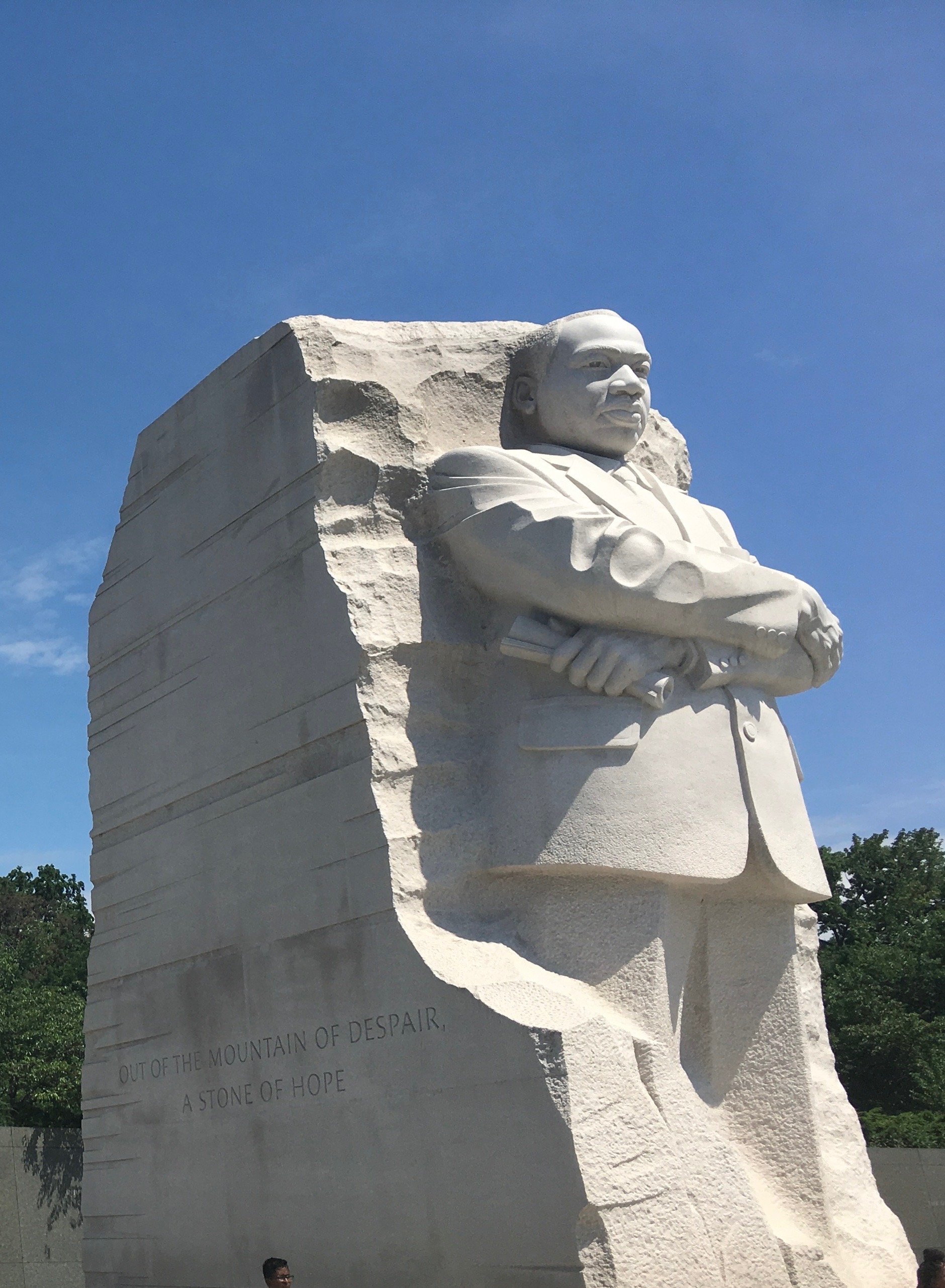
photo by Martin Malina (May 21, 2018, Washington DC)

Of course, we know the prophets from the First Testament. The prophets spoke God’s word that, yes, was given to them.

But the message they received was curated in their own hearts and expressed through their own unique voice. They may have resisted initially, as did Moses[2], Isaiah[3] and Jeremiah[4]. But in the end, they exercised their God-given authority to speak and to act. In the end, they accepted the call of God to exercise authority based on conviction born in their own hearts.

It’s important to say here that we’re not talking about ‘opinion’. Opinion arises from our heads, our minds which are constantly churning. Speaking with authority is not shooting off opinions about this, that, or the next thing as if we are in some gunfight at the O.K. Corral.

Speaking with authority comes from the heart and experience with tested knowledge. And that’s what makes it more challenging. It’s taking responsibility and acting on a deep conviction of what is right.

Exercising God-given authority comes from recognizing that God gave us brains and voices and bodies and resources to use for God’s purposes. Exercising God-given authority comes from owning the ability we have, to choose what we think and believe, and the power to act on it. That’s on us.

We are not all called to be prophets per se. But we are called to follow Jesus in his way. Our task is to discover our own voice to speak God’s truth in our lives and in our world.

This quest is not an easy one, to learn how to trust the goodness of God in Christ Jesus within you. It’s work to practice accepting the gift of God’s presence in your own life. It’s a lifetime journey.

Listen to this Indigenous legend written by the late Canadian author Richard Wagamese. He writes of the Creator God calling a great meeting of the Animal People. “In those days … [the animals] shared the earth and its riches without conflict. There was harmony and there was peace.

“The Creator said, ’I am going to send a strange new creature to live among you.’” The Creator went on to describe the humans who will be “born without fur or feathers on his body”, who will “walk on two legs and speak a strange language.”

The humans will come into the world bearing a marvelous gift, “the ability to dream”. And because of this ability to dream they will “create many wonderful things.” But their inventions will keep them separate and they will lose their way. ’So,’ said the Creator, ‘I am going to give them a second marvelous gift. I am going to give them the gift of Knowledge and of Truth.’

“’But I want them to have to search for it. Because if they find it too easily, they would take it for granted. So, I need your help. No one knows the world better than you, and I need to know where to hide this gift. Where to place it so humans must search long and hard for Knowledge and Truth. Some place where it will not be an easy search.’

“The Animal People were surprised and honored by the Creator’s request. They were thrilled to hear of the arrival of a new creature …and they were anxious to be the humans’ teachers and to help the Creator find a place to hide the gift of Knowledge and of Truth.

“’Give it to me, My Creator,’ said the Buffalo, ‘and I will put it on my hump and carry it to the very middle of the great plains and bury it there.’

“’That’s a very good idea,’ the Creator said, ‘but it is destined that humans shall visit every place on earth, and they would find it there too easily and take it for granted.’

“’Then give it to me,’ said the Otter, ‘and I will carry it in my mouth and place it at the bottom of the deepest ocean.’

“’Another good idea,’ the Creator said, ‘but with their ability to dream, humans will invent a wonderful machine that will take them even to the depths of the ocean and they will find it too easily and take it for granted.’

“’Then I will take it,’ said the Eagle, ‘and I will carry it in my talons and place it on the very face of the moon.’

“’No’, said the Creator, ‘that is an excellent idea too, but part of human destiny will see them reach even to the moon and they would find it there too easily and take it for granted.’

“One by one the Animal People came forward and offered suggestions on where the Creator could hide the gift of Knowledge and of Truth. One by one the suggestions were turned down. It began to look like they could never find a suitable place.

“Finally, a small voice called from the very back of their circle. All eyes turned to see a tiny mole, a tiny, half-blind mole asking to speak.

“Now, the mole was a very respected member of the Animal People. The mole lived within the earth and so was always in contact with Mother Earth. Because of this the mole possessed great wisdom. And because he had lost the use of his eyes the mole had developed true spiritual insight …

“’I know where to hide it,’ the Mole said, ‘I know where to place this great gift of Knowledge and of Truth.’

“’Where then?’ the Creator asked. ‘Where should I hide this gift?’

“’Put it inside them,’ the Mole said with great dignity. ‘Put it inside them. For then only the bravest and purest of heart will have the courage and the insight to look there.’

“And that is where the Creator placed the gift of Knowledge and of Truth. Inside us.”[5] Do we dare to look there?

In closing, let us pray, using these words of Saint Paul, writing to the Ephesians: “To God who by the power at work within us is able to accomplish abundantly far more than all we can ask or imagine, to God be glory in the church and in Christ Jesus to all generations, forever and ever. Amen.”[6]


[1] Mark 1:21-28, the Gospel reading for the Fourth Sunday after Epiphany, Year B (RCL).

[2] Exodus 3:11

[3] Isaiah 6:5

[4] Jeremiah 1:6

[5] Adapted from Richard Wagamese. (2019). A Quality of Light: A Novel, 261-264. Anchor Canada.

[6] Ephesians 3:20-21

Trusting the instincts of our hearts

Taking off (photo by Martin Malina, Kalaloch Beach WA, August 2022)

“Can anything good come out of Nazareth?”[1] Nathanael asks. The Gospel exposes his bias which was probably more widespread: The Messiah can’t surely come from Nazareth. Nazareth was a “tiny, off-the-beaten-path hamlet” in first century Palestine.[2]

Nathanael’s prejudice was against the people who lived there, the people who lived on the outskirts of the bigger cities around it. If you lived in Nazareth, you lived on the margins of society.

Therefore, those people couldn’t be that special as to warrant everyone else’s attention. What have those people accomplished, anyway? What worth or value, if any, did they bring to the table?

We are like Nathanael. And like him, we need to confess our own biases which contribute to a spiritual blindness. We are like young Samuel, when we find God or hear God’s voice in the places and people we didn’t initially expect.[3]

So, we must turn our attention elsewhere, in the least expected places, the small, seemingly insignificant, the taken-for-granted, forgotten places in our lives. We have to get off the beaten track of our prejudice. To do that, we need first to open our hearts to God’s love.

Last week I said the Incarnation—the coming together of the divine and physical—means, from our human perspective at least, that God loves physicality. And, in Jesus, God embraced our humanity and the fullness thereof.

But what about when our humanity is not perfect—When we’re small in the eyes of the world, when it is wounded, when we are hurt, when our physical bodies break down, become weak, and succumb to the normal ageing process with more and more limitations?

Is God still revealed in the seeming insignificance of our lives? Can we believe that to be true? Can we believe, like Samuel did after he got over his initial misconception, that God’s voice would be heard within himself—within his own youth, his inexperience, his naivety?

In the deserts of Arizona, there’s a cactus that grows there—the saguaro cactus. Apparently, only one saguaro cactus seed out of a quarter million seeds ever makes it even to early maturity, and few reach full growth. It is truly a miracle plant. At the same time, the saguaro seed is a good example that most of nature seems to accept loss, inefficiency, and short life spans as simply the cost of living.[4]

“How can anything good come out of Nazareth?” Have we forgotten to look there, in the wilderness places of our lives and the world, to find Jesus? Have we forgotten to value the places of our own vulnerability, pain, grief and suffering as seeding and breeding grounds for the birth and growth of God’s love and faithfulness?

I read last week about a seed bank that’s buried deep in a mountain in Norway. The Seed Vault safeguards duplicates of over one million seed samples from almost every country in the world, with room for millions more. It contains varieties of seeds from plants to trees, to fruits and vegetables. The purpose is to have backup collections to secure the foundation of humanity’s future food supply. “It’s the world’s reserve in case of mass destruction.”[5]

Almost every country in the world has made a deposit. But only one has ever made a withdrawal, and that only recently: Syria. The war that started over a decade ago now has so devastated the land that they needed to ask the world’s reserve for some seeds to start over again.

It’s fascinating and horrific at the same time, to even consider that a seed bank is needed, that we need a back-up plan to safeguard ourselves against what we’ve forgotten— “how dependent we are on each other, and the planet.”[6]

But imagine also, walking through row after row of all those seeds—the magnitude of all that potential. That mountain vault might as well be holding bars of gold. “Seeds are the precursor to currency. They are the original coin.”[7] So, I feel inescapable hope despite the Vault’s grim justification.

The humanity God chose to enter, embrace and be immersed in fully is not perfect, is not efficient, is not attractive. And yet, it is by facing the grim realities of our lives that we find hope. “Can anything good come out of Nazareth?”

Absolutely, yes!

American writer and theologian Brian McLaren describes one who does the will of God, as “somebody who [first] goes deep into themselves to hear the message that’s being birthed in the midst of their pain and their burdens and their frustrations and their sufferings and their questions and their perplexity and their disillusionments. In the foment and ferment of that inner journey, something begins to emerge …”[8]

Meister Eckhart is claimed to have said: “You can only spend in good works that what you have earned in contemplation.”[9] Right action emerges from spending time listening to the still, small voice of God echoing in the chambers of our hearts.

One of the signs of Spring, still months away, is the sound of the squawking Canadian Geese making their return to the North. You may or may not find the prospect of squawking Canadian Geese appearing again in your neighbourhood park particularly hopeful.

But think of the reverse, when they get in their ‘V’ formation in the late Fall of each year to begin their long journey South. What trust they demonstrate by all their efforts to fly thousands of kilometres!

Look at the geese of the sky in the Fall time of year: “They neither worry nor are anxious about the winter warning of their life. For they know within their deepest selves that their journey will take them to a place of shelter, of comfort, of nourishment, a place where winter harshness cannot reach them. See how they fly, winging homeward with sureness, with trust in their hearts’ instinct.”

Joyce Rupp so profoundly paraphrased one of Jesus’ well-known sermons to his disciples; she continues—

“If these geese, who have not the faith and grace of human hearts, can follow the mystery and secrets of their deepest selves, cannot you, my loved and chosen ones, you whom I care for as my very own, cannot you be in touch with the mystery of your hearts? Cannot you trust in me to guide you on your journey of life? For I have promised to give you rest in seasons of tiredness, comfort in seasons of sorrow, peace in seasons of distress, strength in seasons of great weakness. Trust in me. Do not be afraid. I am with you. I will be your peace.”[10]

So, at the beginning of our New Year’s journey let’s commit to a path that will seek God in the unexpected, small places within. And let’s trust that doing so will eventually lead us home to a place of hope, healing and new beginnings.


[1] John 1:46

[2] “It was just a tiny, little hamlet” – British-Israeli archaeologist Yardenna Alexandre explains

[3] 1 Samuel 3:1-10

[4] Richard Rohr, “A Free ‘Yes’ in Adversity”, Radical Resilience (Center for Action and Contemplation: Daily Meditations), January 2, 2024.

[5] Svalbard Global Seed Vault; Meggan Watterson, Mary Magdalene Revealed: The First Apostle, Her Feminist Gospel & the Christianity We Haven’t Tried Yet, 2nd Edition (New York: Hay House, Inc., 2021), p.6

[6] Ibid.

[7] Ibid.

[8] Brian McLaren, “Jesus as Prophet” The Prophetic Path – Summary (Center for Action and Contemplation: Daily Meditations), December 27, 2023. Emphasis mine.

[9] Cited in Douglas V. Steere, “Don’t Forget Those Leather Gloves,” in Common Ground: Essays in Honor of Howard Thurman on the Occasion of His Seventy-Fifth Birthday […], ed. Samuel Lucius Gandy (Washington, DC: Hoffman Press, 1976), iii.

[10] Joyce Rupp, Praying our Goodbyes: A Spiritual Companion Through Life’s Losses and Sorrows (Notre Dame Indiana: Ave Maria Press, 2009), p.134. She paraphrases Matthew 6:25-34.

Peripheral vision

It’s been hardly two weeks since Christmas Day. It feels like Christmas is already over before it even began. Our culture, and the church, have both conspired to make short shrift of the season.

It’s more obvious in our culture: How many of us already took down the Christmas decorations on Boxing Day? But, the church, too: The liturgical calendar finds us barely twelve days since the first day of Christmas, and Jesus is already being baptized today on this “Baptism of our Lord” Sunday. In a compressed schedule this year, Jesus goes from infant lowly to thirty years old, in fourteen days.

You may argue that is the case because scripture doesn’t have much to say about the birth narrative—a mere four chapters total in Matthew and Luke. There is precious little from Jesus’ life until he appears at his baptism.[1]

But the bottom line is that we spend very little time in the year reflecting solely on the meaning of Jesus’ birth. And it took a long time in history before Christmas even appeared on the liturgical map, so to speak.

Until the 12th century, Easter was by far the major, annual Christian celebration. Then, in the 13th century Saint Francis of Assisi popularized the Christmas message of the Gospel. Since then, Christmas became a more dominant annual festival.

Francis emphasized the Incarnation, in which we celebrate God taking human form in the birth of Jesus. By the blending of lights in the branches of a Christmas tree, Martin Luther emphasized what Francis did a few centuries before him: He saw a beautiful coming together of the divine and earthly—which is, after all, the Christmas and Christian message.

Echoing the oft repeated word in the story of creation[2] – that everything God created was good to begin with, Christmas does a similar thing. The Incarnation means: “It is good to be on this Earth, it’s good to have a body, it’s good to have emotions. We don’t have to be ashamed of any of it! God loves matter and physicality.”[3]

As Saint Paul testifies, the Holy Spirit of God comes into us—our very selves—and enlightens our lives so we can shine the love of God in this bleak world.[4] That says a lot about this God whom we follow.

Jesus immersed himself in the physicality of our lives. He was a real person. He submerged himself in the waters of creation when he was baptized. He got his feet dirty with the dust from the roads in the Judean wilderness. Unlike other rabbis and religious leaders, Jesus lived and taught mostly outside, in the natural world. He hung out with the rebel, John the Baptist who also spent a lot of time in the wilderness.[5]

One of the gifts I received this Christmas was this 1000-piece puzzle of the classical nativity scene. And it made me think of all the nativity sets I have at home. And not one that I have allows you to separate the baby Jesus from his manger; they all have Jesus attached to his crib.

Let me suggest a nativity set that allows you to take the infant out of the manger. Do you have one that lets you take Jesus out of the set, like the one we have here at church where you can leave empty the manger of Bethlehem? That’s because our spiritual aim in the coming year is to carry the infant with us—actually or in our hearts—wherever we go.

And that’s the message of Christmas, and of the Incarnation: Christ is with us and goes wherever we go in our daily, common lives. Our work is to build awareness of that truth, so that we can be caught by the realization and message of the incarnation, not only for a couple short weeks at the end of December but year-round.

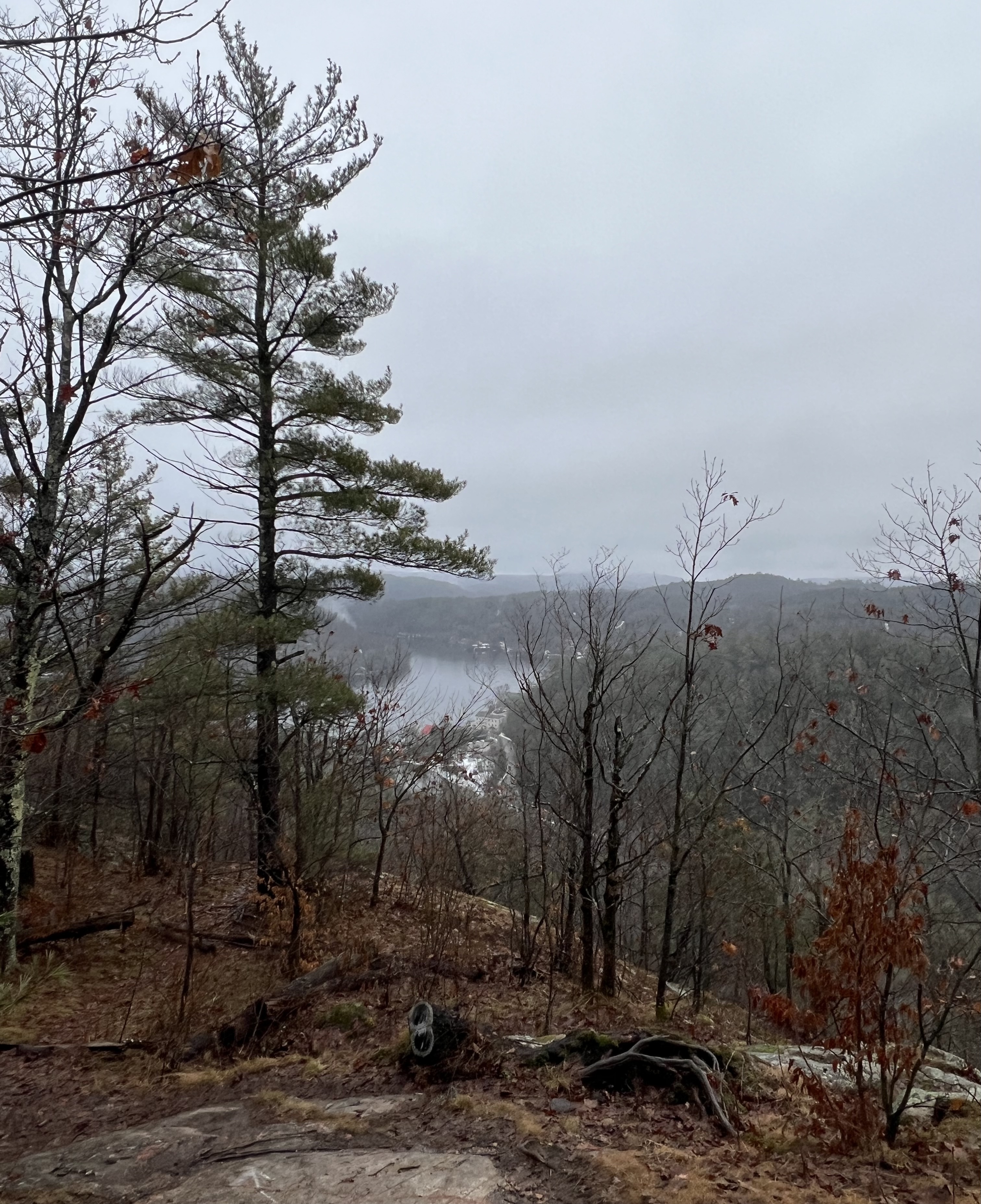
I went for a hike by myself in the Gatineau Park hills near Wakefield, Quebec, last week. It was more of a challenging trek than I had anticipated. Yes, there was little snow on the ground and temperatures were hovering above the freezing mark. So, the conditions weren’t the typical wintery ones that would have introduced other challenges.

You see, I had to keep focused on the ground in front of me for each step I took. My head was down. The trail had me scrambling over boulders that were wet and some were glossed over with packed, melting ice; leaves covered some of these patches of ice.

If I wasn’t careful coming down the hill at full speed, I could put my full weight on one of those clumps of leaves and fall badly.

I also had to check my phone periodically to make sure I stayed on the path and not get lost in the waning light of the late afternoon. My attention was thus divided, and I didn’t always maintain my balance. It was dangerous, yet invigorating.

As I took another tentative step over a rock face on the side of the hill, my peripheral vision caught a large, low flying object that swooped down in front of me. And then, it launched high into the crook of a large tree several metres into the bush.

My eyes shot up. I could see the back side of this large, feathered friend. It was beige with white streaks and spots. I was waiting for it to turn around and face me so I could identify it more easily. Was it a Barred Owl? But it didn’t turn around. It kept its face hidden from me. It didn’t want to be directly seen.

Curious, I acknowledged the owl had initiated contact in the first place. It caught my attention. After all, it didn’t need to fly so low in front of me, across the path just ahead of me a few paces. It wanted me to see it.

I took a moment to look up around me. It was a beautiful forest I was hiking through. All was still. All was calm. The fog was moving in, silently. The trees were densely thick, but I could just make out the town far below, seeing between the trunks of the leafless trees. The ground beneath my feet was a rich auburn colour of the dead leaves and needles scattered over the exposed igneous rock and stretches of loamy soil.

Downward and Upward (photo by Martin Malina 29 Dec 2023 Wakefield QC)

I think Jesus catches our attention, too. Especially when our vision tends to narrow, and we become fixated on the ground in front of us. When we focus on the immediate, and what concerns us, when we get wrapped up in our heads too long. Not bad things. But not everything.

At those times our heads are weighed down by all our concerns and routines, we may be surprised by grace. A flutter of wings just beyond the limits of our perception. Something happens, often beyond our control, that causes us to look up, look around, and look far down the path. Get the big picture.

Sometimes in our daily living, we just have to stop what we are doing and look up. Breathe. And enjoy the surprise, the moment, the reminder that we are not alone on this journey. The divine may be just out of our reach but never far away. Should we take the moment and simply behold.

I was enjoying myself on the walk. I didn’t need to see that owl if it didn’t catch my attention, or I missed it somehow. The experience of being outside and in the bush was enough for me to find my rest and exercise and activity. Moving outside felt good!

But that encounter with the owl added something so much more to the experience. That moment gave me the faith to believe that I would be ok, the rest of the way down the hill. In that moment, my heart opened, and my vision expanded. I felt, life is good. And I felt hopeful.

I am grateful for moments throughout the year in all manner of places and people where and when Christ will surprise me with divine reminders of his presence in my life. I hope the same for you in 2024.


[1] See the first two chapters in Matthew and Luke. The Gospel of Mark makes no mention of Jesus’ birth, and opens his gospel with Jesus’ baptism by John, in Mark 1:4-11.

[2] Genesis 1:1-5

[3] Richard Rohr, “Celebrating Incarnation” (Daily Meditations, www.cac.org, 18 Dec 2023)

[4] Acts 19:1-7

[5] Consider where John the Baptist was baptizing. His ritual of repentance took place at the Jordan River, just east of the city of Jericho. Where John baptized was precisely where the Hebrews had crossed into the Promised Land centuries before. John the Baptist stood at the Jordan’s ancient crossing place and points in the direction from which the Hebrews originally came: the wilderness. John the Baptist cries out, “Repent!” and calls for a commitment to go back into the wilderness of their lives, to make radical change and correction. The root of the word, “repentance” is the Greek word poina which means “pain”. Historically, one of the linguistic forks this word took was the meaning of conscience and absolution. In other words, repentance is a correction of one’s heart and mind— “an act of personal, voluntary, inner change” (Alexander John Shaia, Heart and Mind; The Four-Gospel Journey for Radical Transformation. New Mexico: Quadratos LLC, 2021, p.92-93)—which is in a sense a painful process. To repent is to change one’s heart and mind, one’s direction in thinking. That’s not easy. Yet, it is the only way to freedom. The Gospel of Mark invites us to enter the river of our baptism into Christ Jesus and accept a new direction for our lives. Following Jesus will take us into the wilderness, too, where Jesus went immediately after he was baptized, a place of tension, temptation and yes pain (Mark 1:12-13)—growing pains.