‘Will we be friends?’ Friendship is for life – Pt1

31Heaven and earth will pass away, but my words will not pass away. (Mark 13)

If this Gospel was depicted in images on the big screen, you would get the sense that time is passing in an odyssey linking events and characters over days, weeks, months, years, decades, centuries. The video would speed up, showing clouds careening through the sky, daytime and nighttime running through several 24-hour cycles in a few seconds, a flower blooming from seed in a few, short frames.

The passage of time frames this Gospel text.[1] This story is told in a broad sweep encompassing all of history and eternity. Jesus says that life is like going on a journey whose way is not certain, but one thing is: God comes to us somewhere along the way. Somewhere in a particular situation, surprise! You can count on it. God comes to us, even where and when we least expect.

Have you had the experience of meeting an old friend after a long absence or being apart, someone you haven’t seen for years even decades? And then, whether by chance or by design your paths cross? Some confess it feels like a day hadn’t passed since the last time they met. You just pick up where you left off. It’s a delightful experience. And it serves to strengthen the relationship, doesn’t it?

That’s a taste of who a true friend of yours is. In this Advent sermon series, I want to explore important aspects of a friendship that endures. And the first such building block of spiritual friendship is that it is for life, and beyond!

Jesus said, “The water that I will give will become in them a spring of water gushing up to eternal life.”[2]
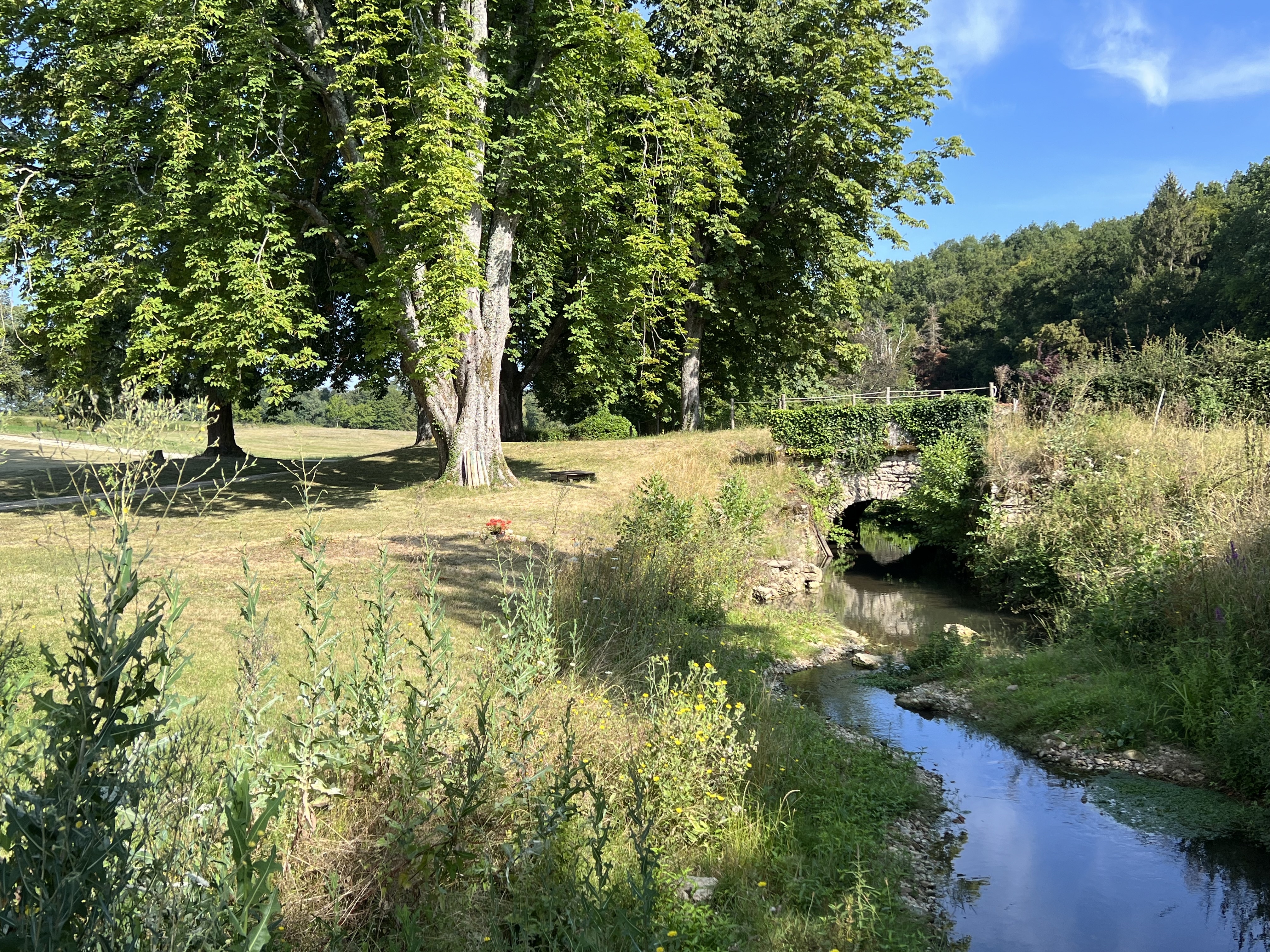
Spring-fed stream giving life (photo by Martin Malina at Bonnevaux, Centre for Peace, France, July 2023)

When I was on retreat in France this past summer, I visited three ancient springs found on the expansive grounds of the Bonnevaux Centre for Peace.[3] After centuries, these springs still bring forth water from deep in the earth and were probably the reason people originally gathered together in this pristine valley near the town of Marçay. In fact at least one of those springs has been flowing from the earth there for over a thousand years.

It is natural for humans to gather around sources for life. And we share in the blessings of the nourishment and growth that water provides. But human beings are not the only creatures these springs fed. Giant, sycamore maples trees hundreds of years old dot the landscape in that valley in France.

Green leaf, Sycamore life (photo by Martin Malina at Bonnevaux, Centre for Peace, France, July 2023)

The maple leaves hanging from these enormous trees reminded me of the symbol on the Canadian flag. Even though I was in France, far away from home, the maple leaf served to remind me of the many maple trees populating landscapes near my home (near Ottawa, Canada).

You don’t need to be in constant physical proximity for a friendship to endure over the years. Though it may certainly help, physical closeness is not the defining ingredient for lasting friendship.

In Christ, God calls us “friends”.[4] Yet, there may be times in our lives, even long stretches of time, when we don’t feel close to God. Our friendship may be blocked on our part, for whatever reason. But the water can only be dammed up for so long before it finds a way. Even another way. And water will find a way, like those ancient springs found a way to bubble up to the surface and flow to where the nurturing of all those trees could happen.

Because though we may be apart and not see each other for a while, we are still joined in a mystical union with one another as friends. The bond of unity runs deep and draws from the source of life, the living Christ, our eternal Friend.

I visited France in the summertime. The leaves I saw were not the colour we normally associate with the one on our Canadian flag. They definitely weren’t blue! But neither were they red, nor orange nor yellow. They were green. Green is the colour of life, life that continues and grows.

Friendship is for life. True, spiritual friendship never dries up. It is like an eternal spring that flows forever. It is full of life that continues to give and provide nourishment for all other creatures.

That is what we do in baptism today. Mikayla receives the water of life. And Christ Jesus comes to her today in the water and the word. In the bread of Communion. But not just today. Today is just the beginning, the beginning of a friendship with God and the church that will last a lifetime, and beyond!

“Will We Be Friends?” is the question I ask in this sermon series. It’s rhetorical, admittedly. Because the answer is an unequivocal, “Yes!”

Somehow, somewhere, sometime God comes to us: In a word, in a song, beholding a moment of nature’s beauty, and in actions of love and care from and for others.  God is near, even now, in this time. Thanks be to God!


[1] Mark 13:24-37

[2] John 4:14

[3] Bonnevaux Retreat Centre

[4] John 15:15

It matters who, and it doesn’t matter who.

For the Lord is our God,
  and we are the people of God’s pasture and the sheep of God’s hand.         (Psalm 95:7)

Unfortunately, not every one of God’s creatures has a home. In Ottawa alone, there are 12,000 families who are without safe and affordable housing. 12,000 households—not individuals—households. Newcomers to Canada are literally getting off the plane in Ottawa looking to find housing that is not available to them. The Mission downtown is where many of these refugees first end up.

By the Fall of this year, a record 74% of all new intakes at the Mission were newcomers to Canada. And, for the first time in history the shelter system in Ottawa—comprising mainly of the Salvation Army, Shepherds of Good Hope and the Mission—was at full capacity in the summer. The shelters were never before at capacity in the summer when sleeping outdoors is an option. Today, 450 families use the shelter system at a cost to the city of $3000/month for each family. A dire situation is looming this winter when already some 260 people live on the street. An alarming housing crisis is only growing.

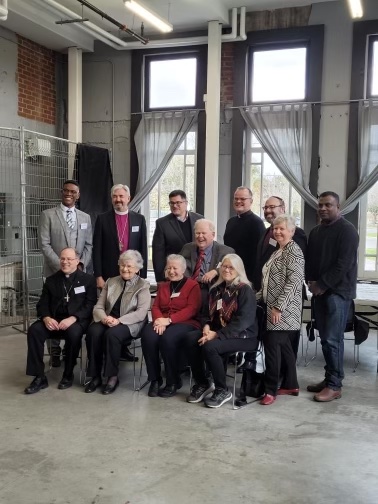
Last Sunday on National Housing Day in Canada, as a patron of Multifaith-Housing-Initiative I attended an event hosted by MHI. Speakers, including Ottawa Mayor, Mark Sutcliffe, mentioned how important it is to work together to help those in need who don’t have a home.

I have a comfortable, safe home to live in. I suspect most of you here and watching at home do. And I ask, as followers of Christ, how do we respond to the needs around us, in light of the Gospel? Do we just focus on helping our own? Is that our mission? What is God’s mission? What does God call us to do?

On the one hand, I believe it matters whom we help.

Patrons of Multifaith Housing Initiative together on National Housing Day in Canada, 19 Nov 2023

In the Gospel text for today, Jesus describes the activity of the sheep who are the good guys in this story.[1]

So, it also matters who we are, as followers of Christ.

But what I find curious is that both the sheep—the good guys—and the goats—the bad guys—share the same problem. Both of them ask the King the same question which exposes the failure of their initial perception. “When did we feed, clothe, visit, you?” and “When did we not …?” Both sheep and goats had a break-down in recognizing, being aware, being conscious of doing good, or not doing good.

In the end, it matters what we do, as followers of Christ.

While their perceptive abilities failed all of them, the good news is at least half of them got their activity right. That should indicate what the main gist of this Gospel story is about. Because it’s not ultimately about knowing who’s in and who’s out. It’s not about us making the final judgement about who’s going to heaven and who is going to hell. It’s not about making doctrinal statements about eternity and predestination.

If anything, let’s avoid these red-herring interpretations and extrapolations of the story. Because the main point is not the knowing but the doing. It is feeding the hungry, clothing the naked, visiting the sick and imprisoned regardless of who they are.

One of the attractions of Multi-Faith-Housing Initiative for me is the multi-faith part. Because where religion has been and still is used as a tool for division and war, MHI bears witness in concrete ways to how faith unites people of different religions. Faith is a way of unity rather than division.

On National Housing Day, MHI had to adjust to a last-minute change in venue. That’s because originally, we were going to have the meeting at City Hall, downtown. But because of the weekly Sunday demonstrations about the ongoing war in Palestine clogging up the downtown core, security officials deemed the City Hall area unsafe for us to meet. And so they were going to cancel the event outright.

Fortunately, through some back-room advocacy on MHI’s part, the city was able to provide us with the Horticulture Building at Lansdowne Park instead. For me this was a powerful statement showing our commitment to religious unity, where Jews and Muslims, Protestants and Catholics, Baha’i’s and Hindus, sat shoulder to shoulder in one room to witness to the power of religious unity by participating in a common divine mission to meet a growing need in our city, our province and in our nation. As one of the speakers at the MHI event said, “Never waste a crisis” for the opportunity it creates.

When we want to introduce Christianity to others, especially younger people, sometimes the language of our faith and the words we use are not good starting places. Getting cerebral with definitions of salvation and hell and judgement don’t help as much in witnessing to our faith as it is to do something good together, simply and concretely, to make a positive difference in our world.

It doesn’t matter, who. I think that is the point of the Gospel. There are differences, to be sure, between sheep and goats. But it’s difficult sometimes to tell the difference between sheep and goats, honestly. In the larger scheme of all of creation, those differences are not as great as we often make them out to be.

If we can’t know really who’s in and who’s out, if we fail in our perceptive capability, then perhaps we should leave that part of it alone. Leave the final judgement to God. Judging is not our primary job. Ours is simply to act and help no matter who it is, no matter where they come from, no matter the colour of their skin, the clothes they wear, the language they speak or the creed they follow. It doesn’t matter, who.

In conclusion, let’s turn the clock back to the 13th century. I’d like you to meet Mechthild of Magdeburg, a religious who lived her final years in a monastery of Cistercian nuns. She gradually lost her physical abilities, and this affected her faith. Not only did she go blind and not only could she not do anything for herself, but she felt God’s love had abandoned her. She came to the end of her life in a state of powerlessness which left her feeling bereft of God. A crisis of faith, you might say.

And yet in this state of powerlessness, she rediscovered God in a new way. She began to express deep gratitude for the nuns and the way they cared for her. She began to understand that the way they cared for her was the way she experienced God’s love for her, in her powerlessness.

And she talked to God, that though she had lost her pride in possession of things, “You now clothe and feed me through the goodness of others.” Though she was blind, she prayed, “You serve me through the eyes of others.” Though she had lost the strength of her hands and the strength of her heart, she prayed, “You now serve me with the hands and hearts of others”.[2]

Maybe in seasons of our lives when we experience our own powerlessness, our own weakness and are open to others with our own vulnerabilities and needs, therein lies the way to finding God’s presence, God’s love and God’s power: serving another’s needs, receiving another’s care. And whether we are the one serving, or the one receiving the help, both experience a divine connection.

In the end, it doesn’t matter who. In the end, it is the quality of the relationship that grows and endures: The relationship between people, our relationship with the world and all that is, including the tensions in between—that is what is important in living our faith.

Could it be that in relationships of trust and loving action, it can all belong? And nothing and no one is lost? Indeed,

The Lord is our God,
  and we are the people of God’s pasture and the sheep of God’s hand.        
(Psalm 95:7)


[1] Matthew 25:31-46

[2] Cited in James Finley, “Unraveled by Love” (Richard Rohr’s Daily Meditation: www.cac.org) 27 October 2023.

Learning to let go

Normally at this time of year, there is already a thin layer of snow covering the ground, in these parts.

When I was walking in the Arnprior Grove last week – a protected conversation area which boasts Ontario’s tallest Eastern White Pine tree – it dawned on me that by now I should be hearing the crunch of snow underfoot. I also would not be scrambling down the steep ravine to the banks of the Ottawa River. The snow and ice on the hill would prohibit such a daring descent.

So, I counted my blessings at being able still to enjoy where my feet were taking me, stepping directly on the ground. With this awareness I noticed the thick layer of fallen leaves blanketing the trail in spots—usually not far from the base of a bare, skeletal frame of a maple, walnut or oak tree.

I reflected again on how these trees must have felt, doing what they do. They are alive, after all, even without leaves on branches. They are alive, after all, creatures like you and me designed by the Creator’s imagination and love.

Something very normal was happening again in the cyclical rhythms of the seasons. Once again, they had to let go of their leaves—the leaves which had been such an important part of their identity, their purpose and function. Their leaves had provided other creatures around them with pleasure to behold their colourful beauty and offer protection and comfort.

The trees had to let go of them. And not just once in a lifetime, but every year.

Letting go of something important is part of the normal rhythm of life on earth. Similarly, it is something important for people of faith, as Christ-followers especially, to learn how to let go as we grow and mature over the years.

What must we learn to let go of, as we age? For each of us, it will be different, as unique as each leaf is to each tree: Certain ideas, attitudes and beliefs that once made sense but no longer help, now; certain goals, dreams, aspirations, desires; certain relationships, social status, privilege; material wealth, employment, security; physical health; etc. Not bad things in and of themselves, even good.

Good news and bad news. Good news is that today we receive the last parable of Jesus from Matthew this church year! (It’s good news because these parables from Matthew are tough! They are hard work). The bad news is that we still have to wrestle with this one, today.

The good news is that again, like last week, there really is some good news in this parable, but not from what appears on the surface. The bad news is that in order to uncover the good news we need to let go of some familiar and easy explanations associated with this parable of the talents.[1] We have to practice letting go, even in our reading of the bible.

To begin, the parables of Jesus, in general, are not easy-to-read policy manuals or employee handbooks on ‘how to live your life of faith’. They are not instructions for good living. It’s easy, admittedly, from a policy-instruction-manual-approach to take-away from this parable that we are to invest aggressively in the markets of our lives to yield a maximum return. Just like the two servants did with their talents.

Those who risk it all and participate fully in the economy of competition and profit-making will be rewarded. And that’s our three-step stewardship program for the year!

But would you be shocked to learn that the parable of the talents is not a lesson in stewardship?[2] So, you ask: If parables aren’t meant to be dissected and decoded for a moral lesson, what is their purpose?

Any interpretation falls short when it overlooks the context of this Gospel, and its Christ-centred meaning. I’m taking my cue from 16th century reformer Martin Luther who advocated an approach that first seeks Christ in the reading of any scripture.

And I found that this parable of the talents happens to be the last parable Jesus tells, in Matthew’s Gospel, before being arrested and put on trial. The largest section of each of the Gospels for that matter—Mathew, Mark, Luke and John—is the passion narrative. The suffering of Jesus is the longest and most developed plotline in the entire Gospel. Christ’s passion demands our attention in reading the Gospels.

We need to read this parable from the perspective of Jesus’ passion.

In telling this parable, Jesus is first naming the truth that salvation is not about a transaction that takes place in the market economy of our lives. Just hours before the crowds will turn on him, just before Jesus will be arrested, tried and executed, Jesus tells his disciples that faith is not about proving our value to God by our efforts alone, our own good works.

Let’s admit it, money is a powerful symbol of our efforts, our deserving, our reward, our work. Money is a powerful symbol for defining our self-worth, our value.

And Jesus turns this symbol on its head.

Faith isn’t about material accumulation and earning your way to heaven. Faith isn’t about a prosperity gospel that says the measure of our faith is how much money you have. The quality of your faith is not equated with the size of your nest egg.

Faith is about the trees. Living a faithful life is learning, season after season, how to let go of what is important, a letting go whose natural outcome is experiencing the grace and mercy and forgiveness of God. It is God who gives freely, who is abundant in generosity and grace. Before a beautiful, new thing can happen in our lives, we need to let go of that ‘something’ that once gave us much joy and meaning.

So, the second thing Jesus is doing here was preparing his disciples, and us, for letting go. It was the passion and death of Jesus where he let go of all the security and defenses, where he became fully vulnerable to the pain of the human condition which was his. Here, on the cross, Jesus introduced his disciples to embrace a life of what it means to let go[3]—a life of practising forgiveness, a life of sacrifice. Jesus was preparing his disciples, and us, to embrace a God of mercy and faithfulness instead of a God of wrath.

Looking at the world can lead us every easily to embrace a false image and perception of God. The master in this parable is not God. The master demonstrates what the world values and how the world operates. So, who does the master represent, specifically?

This parable was written to the Messianic Jews after the destruction of the Jerusalem temple in 70AD. The Christian minority was being persecuted by the Roman Emperor Vespasian. They were violently forced to let go of all the symbols of their religion and literally the building blocks of their identity.

This parable displays for its original listeners in the first century how destructive and wrathful the “master” of the Roman Empire was, where there was indeed “weeping and gnashing of teeth.”

And in Matthew’s Gospel this wrathful image is set alongside the image of a suffering Christ. Early Christians had to make difficult decisions. Who were they going to trust? Who were they going to follow? The master of the world, or the suffering servant? They were encouraged to embrace the new reality with hope, trusting that as Christ suffered loss and found new life, so too their loss would lead to a joyful new beginning.

Which is it, for you? Which image and perception of God dominates your imagination? Because how you perceive God is very likely how you respond in your life of faith.

If God is vengeful and retributive in judgement, then we will, like the servant, “be afraid”. If, on the other hand, we know God to be a God of compassion who is faithful to the end even through all the letting go, how will our actions demonstrate this quality?

In the Epistle for today from First Thessalonians, we read “For God has destined us not for wrath but for obtaining salvation through our Lord Jesus Christ, who died for us, so that whether we are awake or asleep we may live with him. Therefore, encourage one another and build up each other, as indeed you are doing!”[4]

Jesus showed us to let go, and trust God to do the work of salvation for us. Our job, in every season of life, is to learn and practise letting go as painful and difficult as it is. Because on the other side, there is a great promise. On the other side, there is joy indescribable. Even during our lives on earth, as it is in heaven.


[1] Matthew 25:14-30

[2] Erik Parker, The Millennial Pastor blog (2017)

[3] See Philippians 2:6-11; and, Joyce Rupp, Praying our Goodbyes; A Spiritual Companion through Life’s Losses and Sorrows (Notre Dame, Indiana: Ave Maria Press, 2009), p.34-35.

[4] 1 Thessalonians 5:9-11

Blessed be what we need

September evening in Krakow (photo by Martin Malina, 12 Sept 2023)

For me, the parable of the “foolish bridesmaids” sounds almost like an anxiety dream I’d wake up from in a panic.[1]

It feels like Jesus is saying the Kingdom of God is like a bad dream where I’m supposed to go pick up someone famous at the airport, like … Keanu Reeves.

But, in this nightmare, I forget to fill my gas tank and then I’m idling in the cell phone parking lot for so long I doze off and then when Keanu Reeves finally texts that he’s arrived, my car starts beeping that it’s nearly out of gas.

But then I realize the guy beside me has a gas tank strapped in the back of his monster truck and I ask if he can help me out but he just points to the overpriced gas station outside the airport. And in a panic I use the fumes to get there.

But then when I’m filling up my Volkswagen I see Keanu Reeves drive off in the passenger side of that guy’s F150 and he doesn’t even return my wave—like he doesn’t even know me.

So, stay alert! The kingdom of God is like that. So, where is the good news in this parable?

We receive this story nearing the end of the church year. We are also approaching the end of 2023. I don’t think I’m alone in saying 2023 was a tough year, to say the least. For many, personally, dealing with losses; and, in the world—all the wildfires, floods, droughts, the wars in Ukraine, Sudan and Gaza with millions fleeing and dying from brutal violence.

We are like those bridesmaids waiting for the groom to come. Perhaps we can feel their desperation. Waiting is hard and is often tinged with uncertainty and anxiety.[2] We all have to do it.

We may even be praying for the Lord to come. And come now. We may feel that there isn’t enough oil in the world can keep our lamps lighted in this long, dark night. No matter how hard we try, we may not feel we have enough proverbial gas in the tank to endure it all.

We need some good news.

The usual interpretation is not good news. The “wise” bridesmaids, though I’m not sure “wise” is the word, refuse to help those without enough oil. Are we to conclude that we should not rely on others? That we should not give to those who ask of us?

I mean, that would be strange wouldn’t it, if Jesus just suddenly took back everything he said about generosity and self-giving and instead gave us a parable about how we should be stingy and self-reliant?

This parable doesn’t sound like most of the other stuff Jesus said. Here is a smattering of three other sayings of Jesus from Matthew’s Gospel:

“Give to everyone who begs from you, and do not refuse anyone who wants to borrow from you.” (Matthew 5:42)

“If you wish to be perfect, go, sell your possessions and give to the poor.” (Matthew 19:21)

“Woe to you, teachers of the law and Pharisees, you hypocrites! You shut the kingdom of heaven in people’s faces!” (Matthew 23:13)

No, the good news in this parable isn’t about reiterating a Boy Scout sentiment of always being prepared. Because I think if we peel off another layer of meaning, there is some really good news hidden underneath all the surface drama going on in this parable, good news that actually helps us claim who we truly are in relationship with God.

So, what is the good news that Jesus has hidden for us in this parable?

Sometimes in approaching a difficult biblical text, we need other stories from scripture to release for us the good news.

Three, I want to relate to this parable: First, the snake in the Garden of Eden; Second, the Light in Book of Revelation; Third, The Feeding of the 5000.

First, remember that wily snake—the devil—in the Garden of Eden, from Genesis? The snake tempted Adam and Eve to eat the forbidden fruit from the tree of life. Consequently, Adam and Eve became self-consciously ashamed.

Filled with shame, they tried to hide from God. When God finds them, they say they are naked and afraid. And God says, “Wait, who told you that you were naked?”

My money is on the snake.[3] Adam and Eve listened to the false voice of the snake. They believed that voice more than they believed God’s voice.

Which brings us back to the bridesmaids. The foolish bridesmaids weren’t foolish because they didn’t bring extra oil. Or because they fell asleep. I think they were foolish for listening to the other bridesmaids tell them what to do.

And they were certainly foolish for doing it. I think they were foolish in the exact same way we are foolish. They were foolish because they listened when voices other than God’s tried to tell them who they were. They listened to those whispering voices telling them that they can only approach the groom if they have already met all their own needs first.

Because in the last book of the bible, Revelation, we read: “In the city of God, they will not need the light of a lamp, for the Lord God will give them light.”[4]

Think about it. If at midnight the guy who was on watch said, “Hey, wake up, the groom is coming!” the groom must have had a lamp or torch of some kind, right? How else could the groom have been seen coming from a distance at midnight?

The foolish bridesmaids weren’t foolish because they didn’t bring back-up oil. They were foolish because instead of trusting that the light of Christ was enough to shine the way, they wasted all that time and energy and money trying to get their own. Someone shamed them into thinking they could never approach the Lord with what they lacked.

Rather than just trusting that the light of those around them and the light of the groom was enough, they assumed they had to provide their own—and then they were so consumed by the shame of not having and being enough, they busied themselves trying to fix it—so much so that they missed the wedding banquet, altogether!

They missed everything.

Of course, the bridegroom said, “I don’t know you” because they hadn’t come to him in their need and lack and want. But Jesus knows us not by our independence from him, Jesus knows us not by showing our resourcefulness. No. Jesus knows us by our need of him, for which we should never be ashamed.

They, perhaps not unlike us, mistakenly assumed that all God is interested in is our strength, our preparedness, our exceptionality. When what God really asks of us is to know our need for him.

When Jesus asks the disciples on the remote mountainside what they have with them to feed the crowd—do you remember? He asked, “What do you have?” and they said, “Nothing – nothing but a couple loaves and a few fish.” They said it like it was a problem.[5]

But do we not have a God who created the universe out of ‘nothing’?[6] Do we not have a God who can put flesh on dry bones ‘nothing’?[7] Do we not have a God who can put life in a dusty womb ‘nothing’?[8]

‘Nothing’ is God’s favourite raw material to work with! God looks upon that which we dismiss as ‘nothing’, ‘insignificant’, ‘worthless’, and says, “Ha! Now that I can do something with.”

So, all that is to say, the Kingdom of God is not like an existential anxiety dream.

Maybe you are sitting here today having listened to a voice other than God’s: That we have to be better than others. Our church has to be bigger and more entertaining and attractive. Maybe you are thinking, “I have to bring my best to the Lord for God to take notice, etc., etc.” And maybe the story that voice says is so familiar that you think it’s the truth.

But consider that maybe you’ve been listening to the wrong voices all along. Listen and maybe you can hear God saying, “Wait, who told you that you were naked? Who told you that you have to lie to be loved? Who told you your body is not beautiful? Who told you that your only value is in your excellence, and how much you have accomplished in life? Who told you that what you have done (good or bad) is actually who you are? Who told you that you don’t have enough? Who told you all that?

My money is on the snake. And he’s a damned liar. Always has been.

So, when snakes and well-prepared bridesmaids start talking blasphemy, don’t listen. You don’t have to show up with everything you need. The light of Christ is bright enough. Always has been.

And always will.


[1] Thank you, to Nadia Bolz-Weber, for her brilliant take on this Gospel. It’s her sermon I basically preach here. Read it in its original:  “Listening to Snakes and Bridesmaids: A Sermon on How Self-Reliance is Overrated” (Substack: The Corners, 26 February 2023). Read also Matthew 25:1-13.

[2] David Lose, “Pentecost 22A: Hope and Help for Foolish Bridesmaids” in Dear Partner (www.davidlose.net) 3 November 2014.

[3] Genesis 3.

[4] Revelation 22:5.

[5] Matthew 14:13-21; Mark 6:31-44; Luke 9:12-17; John 6:1-14.

[6] Genesis 1:1-2.

[7] Ezekiel 37.

[8] Genesis 15-17, Luke 1:7-24

10,001 smiles: a sermon for All Saints

The war continues in the middle east, in lands long considered ‘holy’. The violence there today has confounded us, saddened us, grieved us to the core. Even though many here may not have close connections to the region, we nevertheless feel a great and unresolvable human travesty continues to happen in a place that feels anything but holy.

Even pithy old sayings don’t seem to make sense anymore. Have you ever used this one: “Those who cannot remember the past are condemned to repeat it.”?[1] As if the problem can be solved merely by knowing more facts about history.

We are coming to realize, however, that the solution is not just knowing more. Rather, we need to learn how to know. What version of history? Whose history are we listening to? There is more that needs to happen than defending a certain point of view, right or wrong, if this conflict will ever end.

This is probably why Albert Einstein, the greatest mind of the 20th century, said decades before the current conflicts in the Middle East first erupted: “Imagination is more important than knowledge. Knowledge is limited. Imagination encircles the world.”[2]

Jesus’ preaching doesn’t satisfy the analytical, rational mind. The Beatitudes are not easy to understand from a rational perspective.[3] How can the poor be blessed? How can the reviled have their reward? How can the peacemakers lead the way to the kingdom of God? Our rational world is at complete odds with the meaning of blessing and saintliness.

If you asked someone today to describe people who are saintly, they probably wouldn’t respond by quoting the Beatitudes. More to the point, we have a pretty good idea of what makes a blessed life: Blessed are the rich … Blessed are the sexy and glamorous … Blessed are the powerful … Blessed are those who get everything they want … Blessed are those who are famous …[4]

The paradoxical style of Jesus’ teaching instead activates another part of our minds and hearts— the intuitive, imaginative mind. It’s a knowing that the heart knows full well even if the left brain can’t contain it. You have to experience the love of God yourself. The solution is having a change of heart.

Today is the festival of All Saints. The Protestant reformation made the bold claim that we are all saints. Martin Luther said this is possible because at the same time we are all sinners.[5] Maybe it’s not easy to understand this. But at the heart level, it is because all the saints in history were also all human beings living a very human life. They made mistakes. They weren’t always faithful. They were afraid, anxious and angry at times. They had their passions and desires.

Yet the truth is, despite their sin, even because of their sin, these saints were beloved by God. It is a simple truth when before we engage our minds, we open our hearts to it.

Saint Bonaventure taught that we are each “loved by God in a particular and incomparable manner …”[6] Other saints of old, such as Francis of Assisi, taught that the love of God for each soul is unique and made to order. And that is why any “saved” person feels beloved, chosen, and even ‘God’s favourite’. God’s love is always and precisely particular, and thus intimate.

Many people in the bible also knew and experienced this specialness. Yes, ‘secret’, or even ‘hidden secret’ is what King David[7] and other saints of old—such as Saint Paul—called this special, particular love of God for them. The love of God is not something you can explain. It must be personally experienced: Because God seeks and desires intimacy with each human being.

And once we experience such intimacy, we forgive ourselves. We know our sin, our shortcomings. We have failed. Yet, at the same time, we are unconditionally loved. Once we experience such intimacy, we recognize it in the other. It is not a selfish love, not a what’s-in-it-for-me mentality; that’s the calculating left-brain, analytical side, again.

Rather, it’s a generous, giving kind of love based on the vision, the expansive imagination, of God’s love for all people regardless their skin colour, their religion, their political ideology, etc.

Today we not only name the new saints, baptized in the last year, we also remember our beloved saints of old. An important part of marking All Saints is recalling to our imagination those who have made a difference in our lives, people who took the time to teach us and show us—maybe even from childhood—that we are deeply loved by God.[8]

How do we remember someone? What is their legacy? More importantly, how does their legacy affect your behaviour, your being, in life today? So, I ask you to bring to your mind a vision of your loved one. What do you see?

The late American writer Brian Doyle wrote a poem about his sister. And her smile is what he remembers about her—seen in his mind’s eye. He writes a poem entitled, “Ten Thousand Smiles”:

“I was just calculating that my sister, whom I have known for 700 months, which is nearly three thousand weeks, which is nearly twenty thousand days (which is a remarkable number of days when you think about it; I mean, that’s a stunning heap of pain and laughter), has smiled at me roughly 10,000 times, give or take a few thousand. Now, did she also occasionally snarl and shriek? O yes she did.

But ten thousand smiles, that’s a remarkable number of smiles, and I want to stay with the smiles here. Q: what are the cumulative effects of so many smiles? Can you get smile burns? Can your interior warmth go up a point after so many smiles? Does each smile register somehow permanently in you, like a scar? Can you get smiling scars?

We can see the effect of smiles on faces, the cheerful lines that smiles cut in skin after years of use; do smiles also get cut into people who have been smiled upon? If everything we know about everything is hardly anything, could smiles be food?”[9]

God smiles at each of us. That’s the vision of God we must hold on to. God’s face turns to us in Christ and we are welcomed with arms outstretched. When our hearts find their home in the love of God for each of us, we are indeed, all of us, saints in Christ.

Pastor Ted told me of an “accident” that happened during the worship service one All Saint’s Sunday service in a former parish of his years ago. The white pillar candles were all lighted in a row on the altar—remembering each one of the saints.

As the candles burned down during the service, he realized with growing concern the problem: There was a draft coming across the altar. And the candles were too close to each other. It had been a busy year. The flames from the candles, therefore, conspired to melt the wax in an accelerated, agitated fashion. By the end of the service the melted wax pooled quickly into one amorphous blob covering most of the altar.

All of it belongs to the One. It may be hard to believe. But God’s love overcomes whatever is between us, whatever separates and divides us. In our common humanity, like all the wax pooling together on the altar, we find our unity in the Creator who lovingly made us all in God’s image.


[1] The quote is attributed to writer and philosopher George Santayana.

[2] “What Life Means to Einstein: An Interview by George Sylvester Viereck,” The Saturday Evening Post, October 26, 1929: 117.

[3] Matthew 5:1-12; the Gospel for All Saints Sunday, Year A (Revised Common Lectionary).

[4] Diana Butler Bass, “Unexpected Saintliness” Sunday Musings (Substack: The Cottage /Diana Butler Bass), 5 November 2023.

[5] simul justus et peccator; simultaneously saint and sinner.

[6] Cited in Richard Rohr, “God’s Passionate Love” (Daily Meditation: http://www.cac.org, 22 October 2023).

[7] Psalm 25:14

[8] Lindsey Jorgensen-Skakum, “Blessed Saints” Eternity for Today (Winnipeg: ELCIC, 1 November 2023).

[9] Brian Doyle, “Ten Thousand Smiles” The Kind of Brave You Want To Be (Minnesota: Liturgical Press, 2016), p.52.