Beach presence

Beach front in Algonquin (photo by Martin Malina 26 August 2023)

27“For the Son of Man is to come with his angels in the glory of his Father, and then he will repay everyone for what has been done. 28Truly I tell you, there are some standing here who will not taste death before they see the Son of Man coming in his kingdom.” (Matthew 16:27-28)

The early church expected and hoped that Christ would return to earth in their lifetime. Christians have called this expectation: ‘the second coming’.

After the complete destruction of the Jerusalem temple by Roman armies in the late first century, the early followers of Christ found comfort in the promise of the glorious return of Jesus to earth. The last two verses of today’s Gospel reflect their belief and hope.

But what about us? How do we respond to these verses, two thousand years later?

I wonder if the passage of time and history has affected our understanding of God. I wonder, therefore, if we hear the Gospel for today[1] as threatening or punitive, as if Jesus is saying, “I’m coming back so you’d better watch out! You’d better do it right, or I’m going to get you.” Such a reaction reflects a God of vengeance, of punishment, does it not? Is that our dominant image of God—as someone who is ready to pounce on our every misdeed and mistake?

Peter, in the verses just preceding this Gospel for today, made a bold statement of belief in Jesus as the Messiah. And he got it right. But then he gets it wrong. Over and over again. Jesus even calls Peter “Satan” at one point.

If Jesus was all about judgement and punishment, Peter would not have been given the privilege and great responsibility of being the rock upon which Jesus would build the church.[2]  Would we entrust the fortunes of a new enterprise, company, or business to someone who demonstrates Peter’s kind of immaturity, impulsiveness, and lack of consistent mental clarity?

But Jesus is not talking about judgment. He’s not threatening us or talking about coming to punish us because we’ve been bad and our faith is weak; or, not coming to us because our faith is weak. He is not pointing a condemning finger at those who make big mistakes and who fail in life, time and time again.

Of course, two thousand years of history has proven those early Christians wrong, in the sense of a bodily return of Jesus as Messiah who would liberate them from Roman oppression. Jesus didn’t come back ‘immanently’ in the way they and Christians since the first century expected him. But that doesn’t mean Jesus was not true to his word.

Like reward and judgement, our perception and our image of God needs to change. Our understanding of God’s presence and return to us needs to deepen and grow. Rather than a dominant image of a vengeful God, what about a God who is about forgiveness, mercy, compassion, patience and love? How would we experience the presence of such a God?

At the beginning of this summer I was worried that I would miss out on one thing I love to experience every summer: Being on a sandy beach under the warm summer sun by the lapping waves. Despite all the wonderful travelling I’m doing, a beach was not in the plans.

You wouldn’t think that a backcountry canoe camping trip into the northern reaches of Algonquin Park would render a sandy beach experience. Most of this area is Canadian shield rock and pine. Along the portage routes and shoreline put-ins you’d be lucky to find a narrow space at any campsite to dock your canoe and disembark.

But to my happy surprise the camp site I found with my friends on Cedar Lake had a beach—and a big one—including a gently sloping sandy bottom into the refreshing water. Uncommon and incredible by Algonquin Park standards. And all for us!

So, on one afternoon when the sun was shining its brilliant warmth I lied down on the soft, white sand by the water, covered my face with my Tilley and just rested. I imagined being on a tropical island or resort in the Caribbean or some exotic place we Canadians like to escape during winter.

But something was wrong with that vision. It didn’t coincide with my experience of that moment. On that beach by Cedar Lake, I did not hear any human-generated sounds: no jet skis, no people laughing, talking, no highway traffic in the distance, no airplanes roaring overhead, no jack hammers or construction noise nearby, no background music. Just absolute, natural silence. I experienced reality in a much different way than I routinely do.

Even though at some level that moment was disquieting for me, I felt profoundly grateful for my summer beach experience. I felt thankful for the simple things in my life. I felt the joy of a divine gift and presence. God is in my life always. Even in unexpected places and different experiences.

Sunset over Cedar Lake, Algonquin Park (photo by Nick Forte, 23 August 2023)

In the Gospel, Jesus is not talking about a one-time, judgement-motivated coming of God out of the thunder clouds. He’s talking about the forever coming of Christ, the eternal coming of Christ … now … and now … and now.

Christ is always coming; God is always present. It’s we who are not! Jesus tells us to be awake, to be fully conscious and present to every moment we experience. It’s the key to all spirituality, because we usually are not.  

Most of us just repeat the same routines every day, and we’re upset if there are any interruptions to our patterns. Yet, “For those who want to save their life will lose it, and those who do, will find it.”[3] It’s ironic that to save our lives we need to stop our usual patterns and pay attention to those moments and places and people that take us off our routine and out of our comfort zone. This grace of God often comes to us unexpectedly.

Because God is found in the interruptions, the exceptions, the surprises, the space in-between the noise of our life. God has to catch us literally “off guard”![4]

When we are present, we will know the Presence. It is that simple and that hard. In the Garden of Gethsemane, the last words Jesus spoke to his apostles were, “Stay awake.” In fact, he says it twice.[5] We need to practice staying awake to recognize Jesus with us.

A word of caution: We need to practice being present to Presence, yes. But staying awake does not come from willpower but from a wholehearted surrender to the moment as it is. It’s largely a matter of letting go. We let go of our resistance to what the moment offers. We quit clinging to a past moment. It is an acceptance of the full reality of what is right here and now. Practising this is the task of a lifetime.  

We cannot get there by any willful method or any technical fixes whatsoever. We can only be there. The purest form of spirituality is to find God in what is right in front of us—the ability to accept what the 17th century French Jesuit Jean Pierre de Caussade called the “sacrament of the present moment.”[6]  

Let’s practice, shall we? Let’s practice the presence of Christ here, among the church, and especially now as we receive the sacrament of Christ’s presence at the holy meal.

Christ is with us. Because God is love. Thanks be to God!


[1] Matthew 16:21-28

[2] Matthew 16:18

[3] Matthew 16:25

[4] Richard Rohr, “Be Awake” A Contemplative Heart (Daily Meditations: www.cac.org) 29 August 2023

[5] Matthew 26:38-41

[6] Cited in Rohr, ibid.
“Beach Presence” sermon by Rev. Martin Malina

Following the water-way: a sermon at baptism

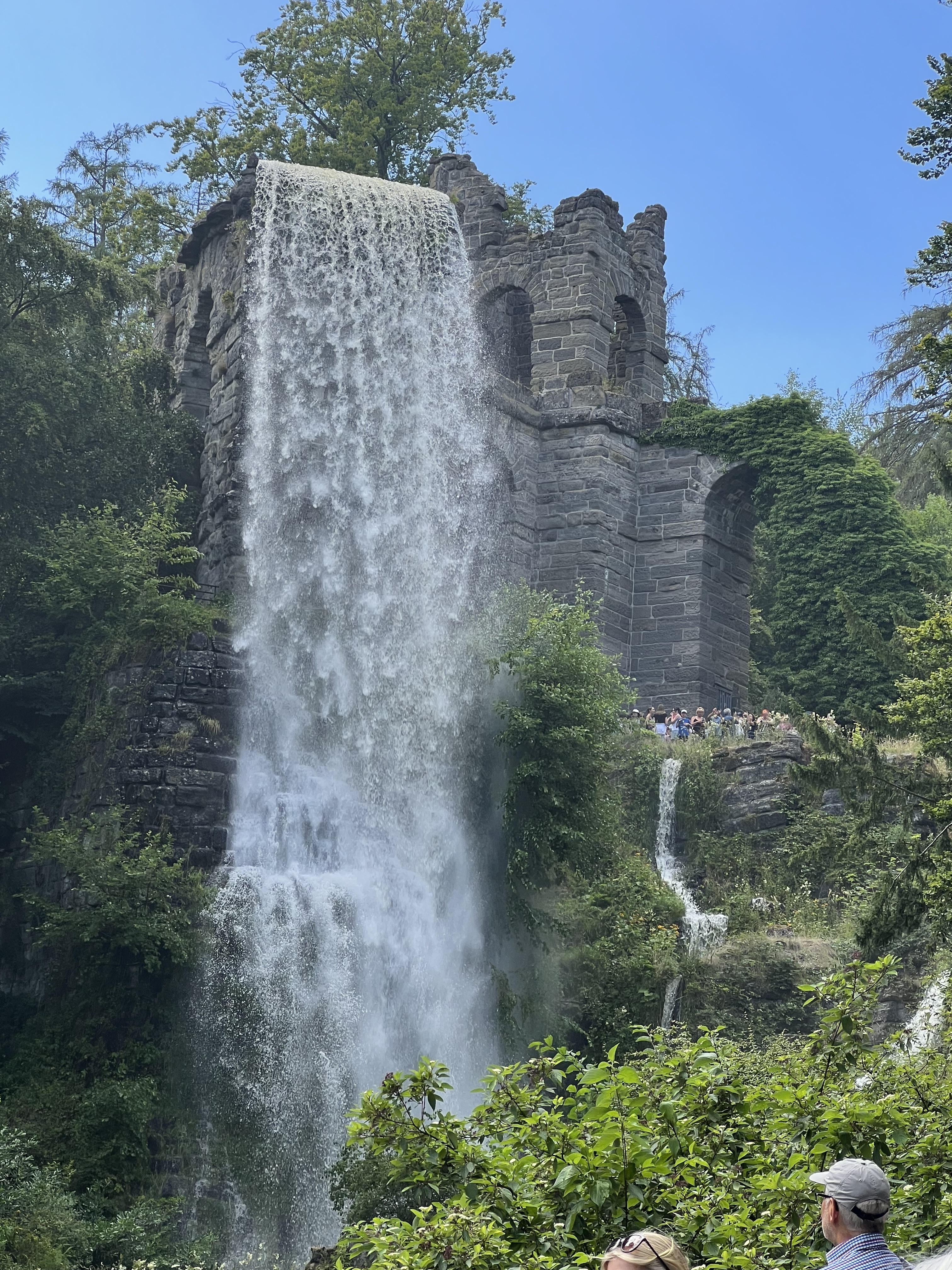
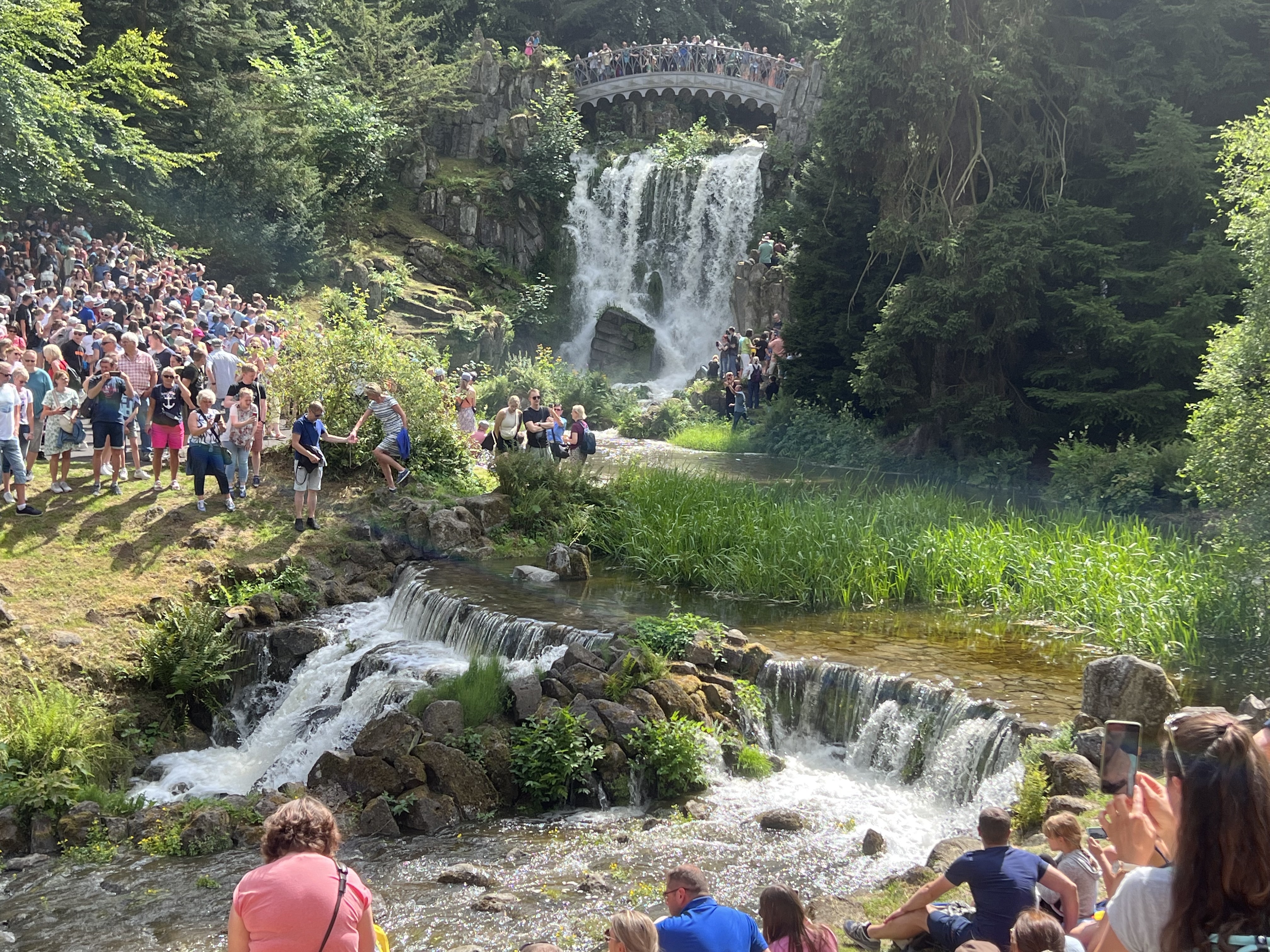
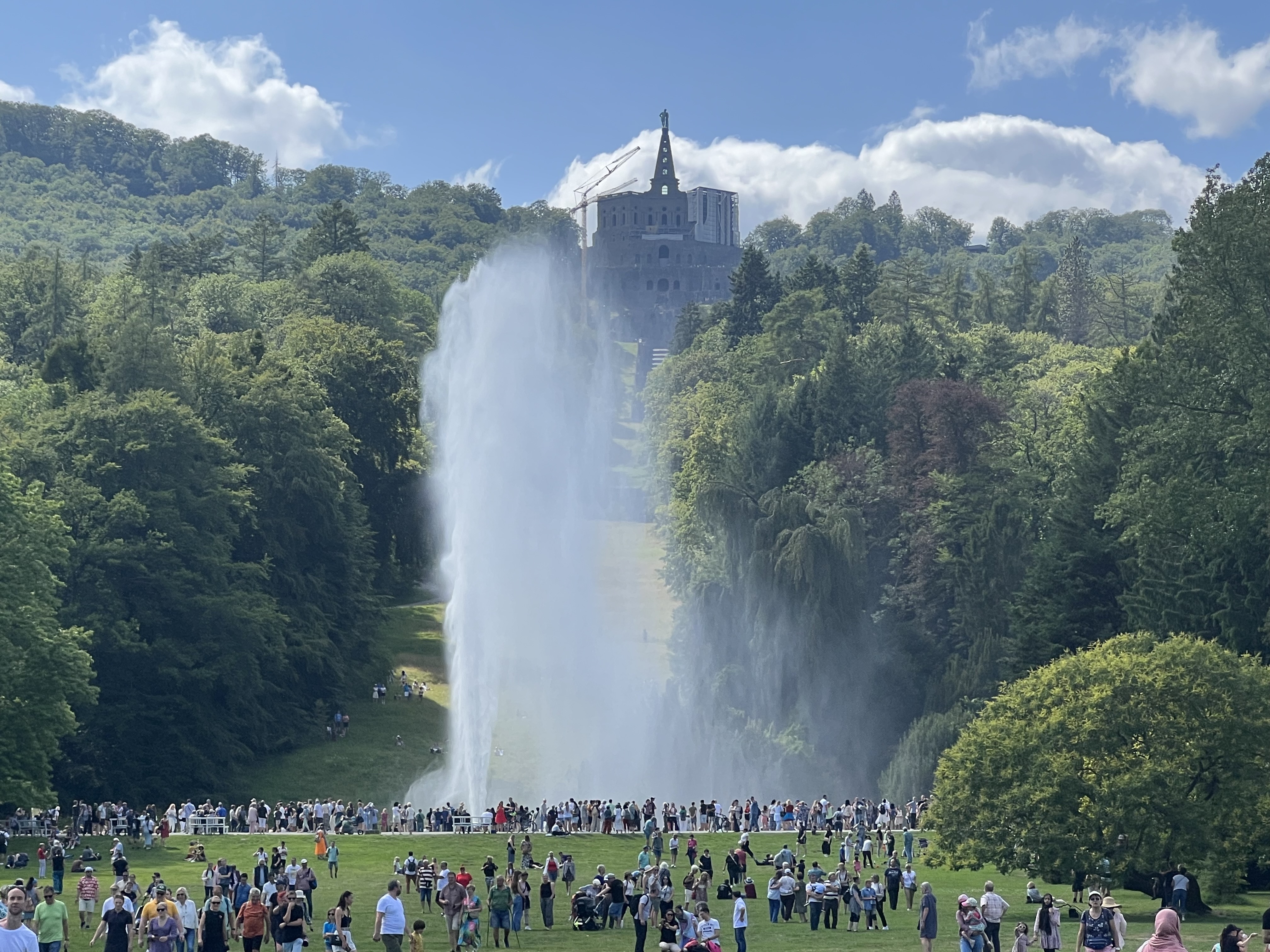
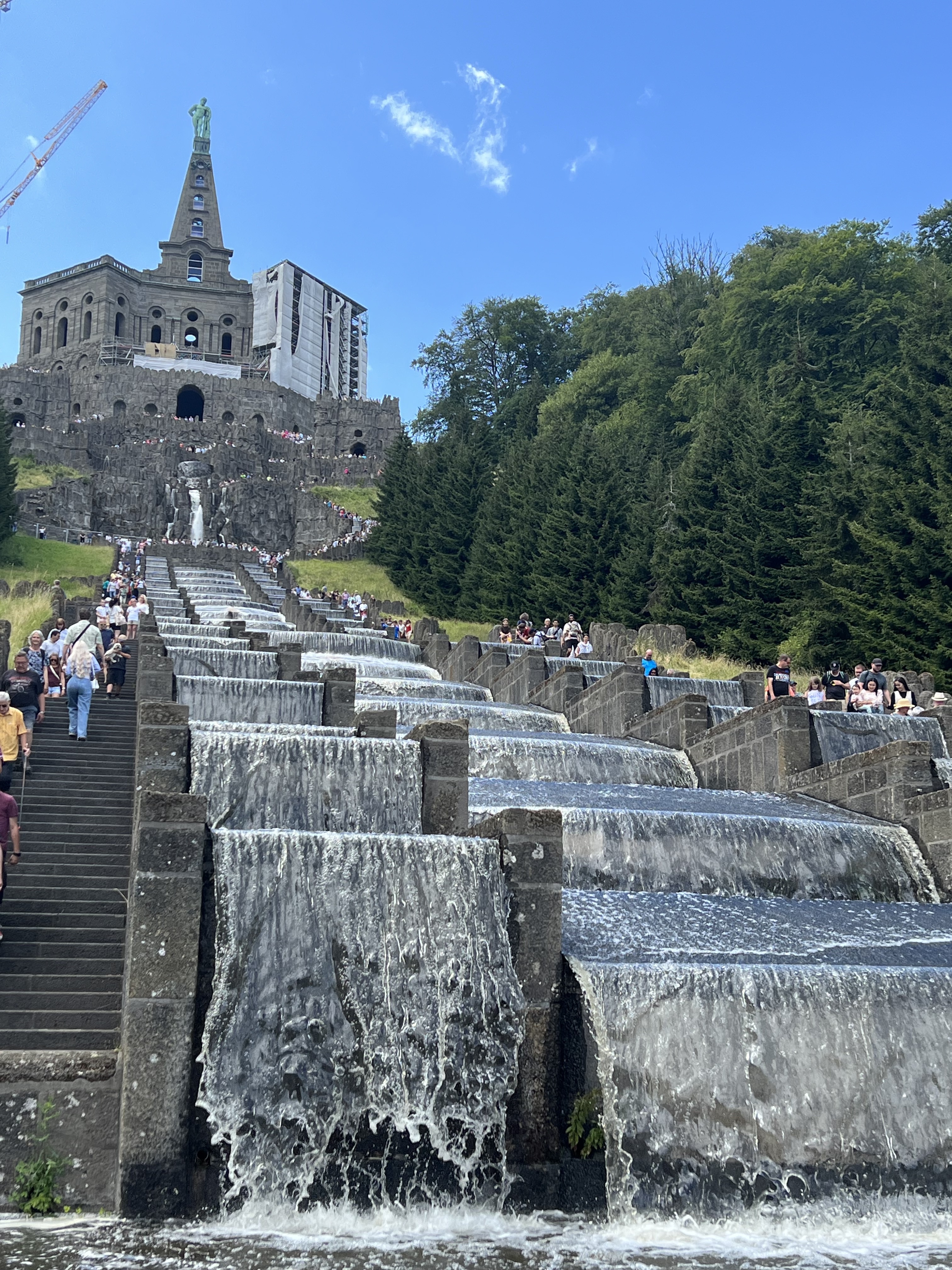
Images in this post depict the waterfall at Wilhelmshöhe Bergpark in Kassel Germany (photos by M. Malina on 16 July 2023)

I had to experience it for my own.

And that meant a rather long, not unenjoyable but challenging, hike up and down a tall mountain and tower in Kassel, Germany, on a sunny, hot day last month. This mountain park called “Wilhelmshöhe” covers an area of over 560 hectares. As such it is the largest of its kind in Europe.[1]

At first, up. We had to get to the top before the water started flowing so we could witness its spectacle. Years ago, I had visited the mountain, saw it from a distance, but for various reasons didn’t ‘experience’ the wonder of its water works.

You see, behind the Hercules monument atop the mountain lies a vast matrix of reservoirs and channels which supply water to mostly underground cataracts and chutes.

Only twice a week during the summer at a specified time of day, a loud horn signals the start. And then water begins to flow all the way down the mountain finishing its trek by fueling a spectacular 50-metre high fountain in a small lake at the bottom.

Visitors can follow the waterway all the way down just ahead of the rush of water, stopping at various viewing platforms to see the water as it first appears flowing over cliff faces, or rapids or over ancient aqueducts. You can time it just right on your march down the mountain to witness this incredible flow of water.

I couldn’t help but relate my experience to the imagery surrounding baptism. Baptism, for many of us, happens near the beginning of our lives. It involves water, the pouring of water over us. Water and baptism are inseparable.

Of course, water flows down the hill. Its trajectory is downward. The life of faith, flowing from our baptism has a similar trajectory. Following Jesus means going down into the valley of our lives. The meaning of faith really hits home when we respond to Jesus’ invitation to “come” and “follow” him, just like Peter did in our Gospel text today when he got out of the boat and into the storm to meet Jesus.[2]

And more often than not, the baptismal life leads to a place where we will be open to Christ’s invitation to follow the water-way and come off the mountain top of our securities and out of our comfort zones.

That is where baptism leads. Follow the water way. Downward mobility is the direction of growing our faith, paradoxically. That is what following Jesus means. This journey down the mountain is the way of love, grace, and acceptance.

In the Baptism liturgy we heard the water references from the bible: when God’s Spirit moved over the waters at creation, when God delivered Noah from the flood, when God led Israel through the sea, when Jesus was baptized by John in the river Jordan.[3] And, at the end of the Gospels when Jesus died on the cross, water flowed from his side.[4] Water dominates the stories of salvation throughout the Bible.

When he encounters people on his earthly journey, and us today, Jesus offers the “living water” that he says he is, an eternal spring that will flow from the hearts of all the faithful.[5]

In the Gospel text for today Jesus encounters his disciples during a storm on Lake Galilee. You get the impression that Peter doesn’t really know what he is getting himself into, when he wants to go to the Lord.

Well, he knows, intellectually. He is a fisherman, after all. He knows the lake. From inside the boat, he sees the waves growing, the winds intensifying. The storm is already unleashing its fury when Peter makes what amounts to his cerebral expression of faith: “If it is you, Lord, command me to come to you on the water.”[6]

But soon Peter will know what he’s getting himself into. “Come,” says Jesus.[7] The difference is that when he leaves the boat, Peter is investing more than just his mind. He is all-in, now.

Peter, in order to know the truth of Jesus, had to follow the way of the water. He had to immerse his entire self—mind, body and spirit. He had to get out of his head and experience a relationship with Jesus. He had to put his whole self on the line, not just what he thinks about Jesus. It’s when he first really notices the waves and is afraid that he knows for himself God’s saving act.

Truth is not an idea. It is a relationship.

Christ Jesus calls us to follow the waterway. Our baptism is neither a private affair occasioned in isolation, nor is it a debate. It is an experience of a relationship. It is conducted among the church—the people of God. We move en masse, together ‘down’ the proverbial mountain and into experiencing God in our daily lives which includes all the challenges of living.

Jesus doesn’t call us to escape the storms. Jesus doesn’t call us to get back into the harbour where it is safe. He calls us to meet the challenges of the world head on, out on the open water. And he calls us to trust in Christ who is present, there, when the storms come. And come they will.

Because especially amid the turbulent storms of life – and that is the message of the Gospel – we experience the love and intimacy of God who created us, lives in us, and invites us into adventures of faith. “Come” says Jesus to you and to me. “Come”, follow the water of life and love that flows on forever.

And Christ Jesus will be right there beside you.


[1] Bergpark Wilhelmshohe

[2] Matthew 14:22-33

[3] Evangelical Lutheran Worship, Pew Edition, Holy Baptism (Evangelical Lutheran Church in America: Augsburg Fortress Press, 2006), p.230

[4] John 19:34

[5] John 4:1-42; 7:38

[6] Matthew 14:28

[7] Matthew 14:29

“I am here, now” – a funeral sermon

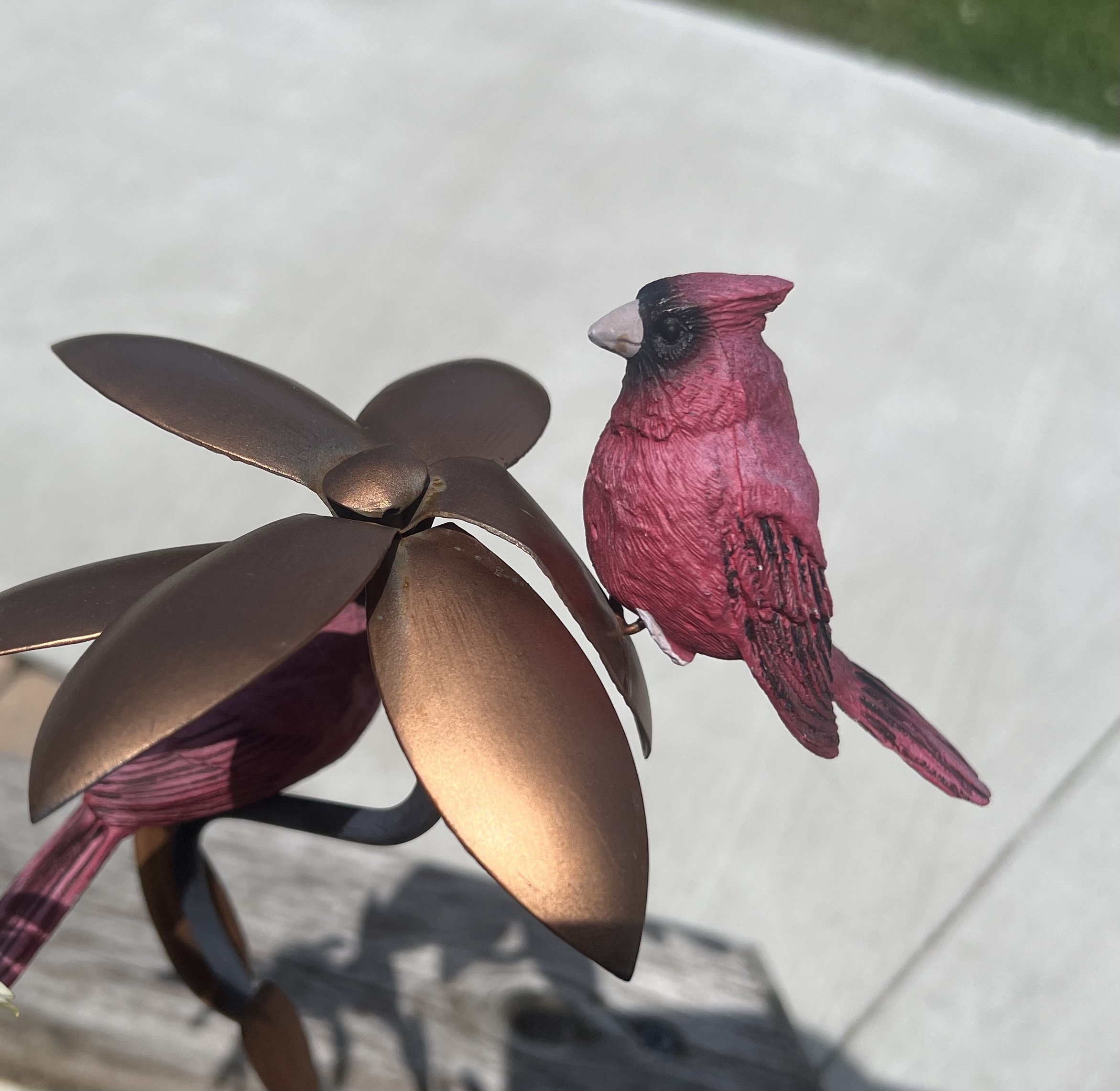
cardinal in garden (photo by Martin Malina 6 August 2023)

It has been a year this month when we first heard of Marie’s diagnosis. It goes without saying this news came as a devastating shock.

This past year has been a journey to say the least, a journey of ups and downs, of hope and despair. And not just Marie’s suffering but ours as well especially you, Wayne and dear family.

The time seems to have gone by both quickly, and at the same time feels like a long haul. It’s as if time itself expanded in each moment of living: This year was only one, short year in the large scheme of things. But it contained billions of seconds that filled each day and place where Marie spent time – various rooms in the General Hospital, the apartment in Sarsfield, and the hospice in Kanata.

The meaning of this time played out in each ordinary moment. And each of those moments was a gift to us, each interaction with Marie and one another a blessing.

I have two Tim Horton’s mugs in front of me. Wayne told me the funny story of when Marie was selling mugs at the Tim Horton’s counter in the Canada Post building. Typical of Marie’s sense of humour, and trying to increase sales, she turned some of the mugs on display half-way around, so the handles were pointing the opposite way vis-à-vis all the other mugs.

And when potential customers came to take a closer look, she would, with a smile on her face and mischievous twinkle in her eye, announce that these were very special mugs because some of them were left-handed, and others were right-handed.

Her sense of humour caused and causes us to laugh. And laughter always gets us out of our heads and brings us into the present moment. Laughter is the key to an understanding of faith that Marie’s life exemplified.

Her jokes and humour not only brought people of the same mind together, but also people who are different in their beliefs, backgrounds and life experiences. That was her gift. Her presence brought us together into a moment in time that all of us shared, a moment in time that was quite common and ordinary for us all.

Indeed, Marie expressed her extraordinary faith in very ordinary situations and ways. Her faith was not sophisticated. Her faith was not born from a lot of book knowledge, education degrees nor ivory-tower language. Her faith was not so much about ideas and theories about which you could be ‘right or wrong’. It was more concrete and specific, formed in love.

We gather to celebrate Marie’s life today during Ordinary Time, in the church year. It is the ‘green’ season of church colour, signifying the simple life and growth of all creation.

Jesus told stories about ordinary life – planting seeds, harvest time, growing vines, losing coins and sheep, money and wages, the birds of the air, the flowers of the field; and ordinary people in the middle of it all. Jesus even laughed with others at a party.[1] Humour and laughter are the key to understanding something very important about God:

God comes to us “disguised as our life.”[2] Folks who get this are deeply spiritual people. Because they know God is revealed not in church services inside church buildings on Sunday mornings alone.

Rather, more importantly, God is revealed in every moment of ordinary living. God is revealed if we pay attention—and that is the work of our lives—in those moments of grace and beauty in the midst of it all, good and bad. That is where God is.

So, in the last year I’ve been on a birding kick. I’ve even gotten myself a fancy app to identify bird calls. It’s hard sighting a bird from the back deck or even in the woods walking. I hear the bird first, and then go looking wondering if I can spot it in the trees or bushes. Not easy.

But there is one bird that catches my attention time and time again without much effort on my part. Marie’s favourite. It’s almost as if the cardinal wants to be spotted. You don’t have to be a life-long birder whose memorized every page of some comprehensive archive of all North American birds. Because grace comes uninvited and often unexpected.

There it is, right before my eyes, whether I’m ready for it or not. There it is, contrasted against the green foliage of the maple, oak or spruce tree at this time of year. I can see it, the brilliant red covering its entire body, popping out at me. As if it wants to say to me— and probably is in its sweet song—the very words of a God who now embraces Marie under loving, caring, protective wings:

“I am here. I am with you, always. I will never leave you, no matter what.” Thanks be to God!


[1] Read through Matthew, Mark, Luke, John – the four Gospels in the Bible.

[2] Richard Rohr, Things Hidden; Scripture as Spirituality (Cincinnati, Ohio: St Anthony Messenger Press, 2008), p.17.

You do it

The Feeding of the Eight (CCMC meditation group Calgary, 28 June 2023, at Lake Minnewanka)

The parable of the feeding of the five thousand is very well known among Christians.[1] And I must admit to you, as the years go by, I find it increasingly challenging to preach on well-known texts. To find a new angle. But this story can be looked at in a variety of different ways.

You can look at it as a math problem: Twelve disciples, with five loaves and two fish. Five thousand people to feed, multiplied by a miracle we will call ‘x’. Divided and eaten in the amount of ‘y’ equals twelve baskets of leftovers. I hated doing problems like that in school.

Last month when I hiked with other Christians near Banff, our mountain and lake-side journey concluded with a picnic near the beach. Since I was the only out-of-province hiker who arrived late the night before I did not have time to put together a lunch. However, my hosts who put me up the night before had provided a hearty breakfast for me so I wasn’t really all that hungry. And, given the time change, I would be fine until we arrived back in Calgary later that afternoon.

When everyone sat down at the picnic table, out came the lunch packs: Individuals brought sushi, fruit, hummus, wraps and then began eating what they packed for themselves. I had my water bottle and during our lunch break was totally content simply to visit and behold the pristine mountain vista before our eyes.

But to my pleasant surprise, someone handed me a bun, then some sliced meat, with cut-up lettuce and mayo. Then someone else slid over some sliced apple and a container of cherries. Totally unexpected, I realized how hungry I actually was after the morning hike. And I appreciated the kindness and generosity of my friends to share their food with me.

The Feeding of the Five Thousand story emphasizes the compassion of Jesus, his heart for the crowd. It underscores, as well and once again, the reluctance and disbelief of the disciples. And of course, it’s a miracle story.

I think perhaps my favourite interpretation of this text is that the sharing of the five loaves and the two fish is the miracle. The sharing of the five loaves and two fish is the miracle.

I think the crowd is moved by seeing the disciples scrounging for their meagre supplies. And I think they get motivated and realize they have gifts to offer as well. So, someone finds they have a piece of cheese, and someone has some olives, and someone else has some dried meat and someone else has some wine. And one by one people bring forward what they have been hoarding and it becomes a giant potluck with twelve baskets left over. It’s like the hearts of the crowd are opened.

And maybe that is the miracle: that Jesus is able to bring out the best in those present. The generous, giving, selfless best. But there’s more.

I think perhaps the most important part of the text is when the disciples say, “This is a deserted place, and the hour is now late; send the crowds away so that they may go into the villages and buy food for themselves.”[2] They want to be let off the hook.

Don’t we all? They see trouble coming: an hangry crowd of five thousand, and they want to avoid it. But Jesus turns around and says, “You give them something to eat.”[3] You give them something to eat. You do it. It reminds me of the story of the raising of Lazarus. After Lazarus comes out of the tomb, Jesus tells his disciples, “You unbind him.”[4] You do it.

It was all fine and good to depend on Jesus to do everything when he was with them. But Jesus was preparing his disciples for the time when he would not be there. Not that he ever abandons them. We know his promise to be with them and us until the end of time.

But as Jesus called the disciples, they were being trained to carry on Jesus’ ministry after his time on earth.

We are Jesus’ called disciples. And now Jesus calls and asks us the same thing. Delegates to the Special Convention of the ELCIC earlier this summer in Calgary received that message: “You” do it. You address climate change. You feed the hungry. You take a stand on what it means to be in healthy relationships with all people, and not just with those who are like us.

It’s not someone else’s job. As Christians who worship Jesus Christ today, we are responsible, as Christ-bearers, for using the resources we have been given to do the mission of God in the world today. In whatever way we have been equipped and gifted to do it.

It won’t be easy. We will be vulnerable to others. We will make some mistakes. We have to be ready for that. But when the value, the measure and the goal is the love of God in Christ Jesus for all people, and for all God’s creation, then we can trust this God to see us through. Because Jesus will also bring out the best in us—the generous, giving, selfless best.

We may not recognize the gifts we have. We may at first be reluctant to use them. We may be blocked by some reason to release our gifts to the world. But when we try, take the first small step, in our vulnerability but out of a heart of love for others, Jesus will bring out the best in us. And then we, too, like the disciples of old shall behold the wonder of God.


[1] Matthew 14:13-21; This sermon was inspired by the words of national bishop Susan Johnson who preached on this story at the closing service of the special convention of the ELCIC meeting in Calgary (June 28-July 2, 2023).

[2] Matthew 14:15

[3] Matthew 14:16

[4] John 11:44

“You do it” sermon by Rev. Martin Malina, Pentecost 10A, 6 Aug 2023