
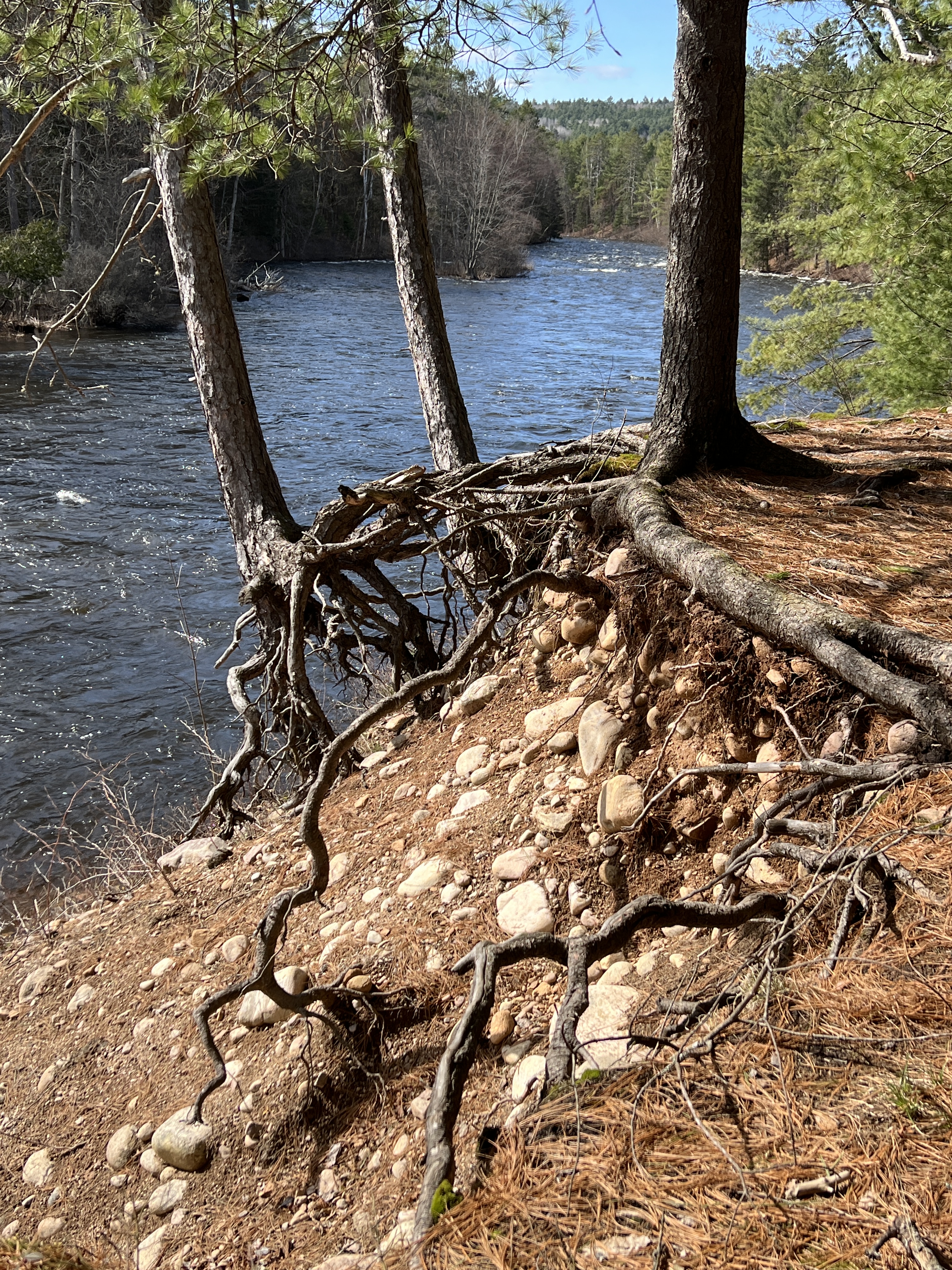
This past week the in-person grief group concluded our weekly meetings by planting a spruce tree in the church yard. It is a memorial tree, in memory of baby Leyla who died last December. We also dedicated it to the losses shared by all group members, in the hope of continued connection and love over time.
When I was digging the hole for the tree earlier in the day, I was about a foot down in the earth when, thunk! my shovel hit something hard. And it wasn’t a stone. It was long and cylindrical, and at first I feared I was boring into some underground pipe or cable. Upon further inspection I realized it was a gigantic tree root.
I looked up and around and then noticed that some thirty feet away in the corner of the yard close to our neighbour’s hedge line was a towering spruce tree reaching over eighty feet into the sky. From its base, facing me, one large root dove into the ground heading my way.
Well, here at the bottom of the hole, lined in the same direction was the same root upon which we would be planting a baby spruce tree.
I also realized that, before I knew what I was digging into I had damaged the root by cutting it and chipping away surface layers during my initial inspection. The giant spruce thirty feet away must have felt the pain of this violent, threatening incursion upon its body and territory.
How would this old tree heal its fresh wounds?
In the Gospel today, we witness a dramatic healing story (Luke 8:26-39). A man is besieged by demons who have possessed him and left him isolated from his community for years.
In today’s language, we might say he was mentally compromised. Nobody wanted him around. He was deranged and unpredictable in his shocking behaviour and appearance. Consequently, the man was shackled and left alone in some cave distant from the city.
After the drama with the drowning of the pigs, we suddenly see the man calmly sitting at Jesus’ feet, “in his right mind” (v. 35). He has been healed.
Naturally, he wants to stick with Jesus, travel with him. He even begs to go with Jesus. Who could blame him? His own community had shunned him when he was sick. What does he owe them? And Jesus is this man who made him well, who finally showed him some mercy and compassion.
But Jesus refuses his plea. “Return to your home (v. 39),” Jesus instructs him. Now that you are healed, share with others in your community the meaning of your healing, that this is what God wants for everyone: Restoration of relationships that have been divided, that have been hurt and damaged.
Today, we typically think of illness and disability as biological, with Western medicine set up “to find and cure disease directly” (Kenny, 2022, p. 5). People in Jesus’ day, however, thought about healing in a much broader sense. They talked about healing as integrating someone back into their social and religious life. The Greek word often used in scripture for healing means “to make whole” or “to save” (Kenny, 2022, pp. 8-9). It’s the same word used to talk about salvation.
Modern medicine still recognizes the difference between curing and healing. Curing is a physical process. Healing focuses on restoring interpersonal, social, and spiritual dimensions of our lives (Kenny, 2022).
Jesus’ healing is not just a cure. It’s not purely about a physical, biological, alteration but about reestablishing right relationship between humanity and God, and hopefully, between individuals and their community (Kenny, 2022). Jesus was sending the man back to his community, to restore his relationship with them.
And maybe that’s why the crowds who witnessed this healing were so afraid – “seized with great fear” (v. 35-37) in fact – so much so they asked Jesus to leave them. They may have understood the implications of Jesus’ healing action. They would have been much more comfortable to remain in their self-created world of perceived purity which drew dividing lines between ‘them’ and ‘us’, between those who were acceptable and those who were not. They were afraid because now they would have to change their ways.
Are we willing to change our ways so that we can be healed, so that others can be healed? Because, how else can we?
So, how was the tree root I dug into going to heal its wounds?
Well, I believe the addition of another spruce tree into its environment, its community of trees beside the church, will contribute to its healing. It will help that the new sapling was planted right over top of the wounded root. The new tree’s roots are practically touching it.
Not only will the old spruce continue to live, but it will be healed for a purpose of supporting the new member in the community. How will it do that?
Tree roots are interconnected by fungal networks, thereby creating a system of mutual support and protection. These fungi form symbiotic relationships with tree roots, creating an extensive underground network, where two or three are gathered. This network functions like a living internet, facilitating the exchange of nutrients, water, and even warnings about potential dangers between trees (Wall Kimmerer, 2015).
Not only will the damaged root heal and survive, but the new spruce will also integrate into a healthier ecosystem and contribute to the overall well-being and resilience of the entire tree community in this area.
Following in Jesus’ way, healing happens when relationships can experience mercy and compassion, grace and love. And this process of healing takes time. Just think about the time it takes for new plants to establish themselves, and trees to become integrated in a new fungal network underneath the ground.
Healing is not a switch we or God just turn on and it happens. For that healed man, it wasn’t going to be easy for him to get used to life in the city. Neither was it going to be easy for the city folks to get used to him being around.
The healing, the restoration, is a lifelong process. So, for now, just a little bit of grace and love. A little bit of grace, love and compassion can help us reach out to welcome and support others who at first may seem far away from where we are. Those roots can go a long way underground over time. A little bit of grace and love can serve to bring us all just a bit closer together.
Because, in the end, we are not divided, isolated and cut-off. Saint Paul, in that beautiful text from his letter to the Galatians, emphasizes the inclusive nature of the community in faith, “For all of you are one in Christ Jesus” (Galatians 3:28). Above the ground, we may be distracted by focusing on the space between us. From what is visible, those trees are not side-by-side. There’s lots of grassy area in between. Just ask Norm how long it takes to cut the grass here!
But underneath the surface, the truth comes out. Without denying or glossing over our differences, we are connected. We are in a relationship. We are one.
For our healing, just a little bit of God goes a long way.
References:
Kenny, A. (2022). My body is not a prayer request: Disability justice in the church. Brazos Press.
Wall Kimmerer, R. (2015). Braiding sweetgrass: Indigenous wisdom, scientific knowledge, and the teaching of plants. Milkweed Editions.
 Raspberryman