
I often joke that I’ll let God wash my car. After a long winter when the salt-infused grime cakes on the outside panels, I wait until the pure rains in Spring give the car a good rinse.
Indeed, the rains fall from heaven, often unbidden, to cleanse the earth, to cleanse us. Notice the direction of God’s grace, God’s new thing, God’s vision of our future in the text from Revelation today. The holy city, the new Jerusalem, comes down from heaven to earth (Revelation 21:2). Direction, downward.
Just as in the Inuit language there are about 50 different words to describe various forms of snow (The Canadian Encyclopedia, 2015), the British boast several words and phrases to describe rain’s multiple personalities:
There’s a basking – which is a drenching in a heavy shower; a drisk – which is a misty drizzle; a fox’s wedding – sudden drops out of a clear blue sky; a hurly-burly – thunder and lightning; a slotting – which is rain so hard it bounces up off the ground; and a thunner-pash – which is a heavy shower with thunder (Mahany, 2023). Have you heard of these terms? Most of these, I haven’t. There are different ways the rain comes down.
No matter the form it takes, rain has a way of catching my attention. “One minute it’s barely pebbling the windows, the next it’s making a joke of the downspouts” (Mahany, 2023, p. 90). On the one hand, we pray for it. On the other hand, we roll out tarps to stop it.
No matter the form rain takes, we feel the water-drop touch our skin. It is invasive and so often our first instinct is to get out of it, to find shelter or cover. Rain seeks to grab our attention not just by touch alone, but by smell as well.
There is that unforgettable, indescribable just-after-the-rain earthy smell. There’s a name for that scent – petrichor. It’s caused when rainwater mixes with certain plant oils in dry soil – compounds to which the human nose is highly sensitive. Add to this cocktail of smell ozone which is released if lightning is in the mix. All of this wafts into the air, and we “smell rain” (Mahany, 2023, p. 91).
Like I said, rain has a way of catching our attention in more ways than one. Likewise, there are different ways we experience God’s grace, and not always is it what we want nor expect. But it always catches our attention. Somehow, God’s presence and life touches us, our hearts, our intuition, our perceptions – even subtly.
I joked that I let God wash my car. We also joke, “We’re not made of sugar,” implying that we won’t melt in the rain. Earth and all that is in it is not destroyed, obliterated nor eradicated by rainfall.
When the author of Revelation speaks of “the first earth passing away, and sea was no more” (21:1), it is not the extinction of the earth at the end that we’re talking about. God’s grace, God’s promise of resurrection does not cancel earth, our humanity, our senses – what we see, hear, touch, taste and smell.
Instead, new life is embodied and transformed on earth, from the earth. The direction of grace may be downward. But the reason the promise and vision come down to earth is because God will use the stuff of earth, and embody it. The goal of resurrection is earth’s transformation (Carey, 2009).
Rain, yes, is invasive. But it renews, refreshes and generates growth and life. Out of the old emerges the new.
I was given two Hosta plants last year which I planted on the side of our house that receives a lot of sunshine. But these Hosta plants were designed to thrive in more shade than sun. They didn’t look so good by the Fall time. They were sporting large brown spots which covered their large, limping leaves. Honestly, I didn’t expect them to come back up this Spring.
But out they came a week ago, bursting through the less-than-ideal soil and location for these particular plants. The young shoots already showcased their green, lustrous leaves reaching upward to receive the gifts of rain and sun. Coming from above. Downward.
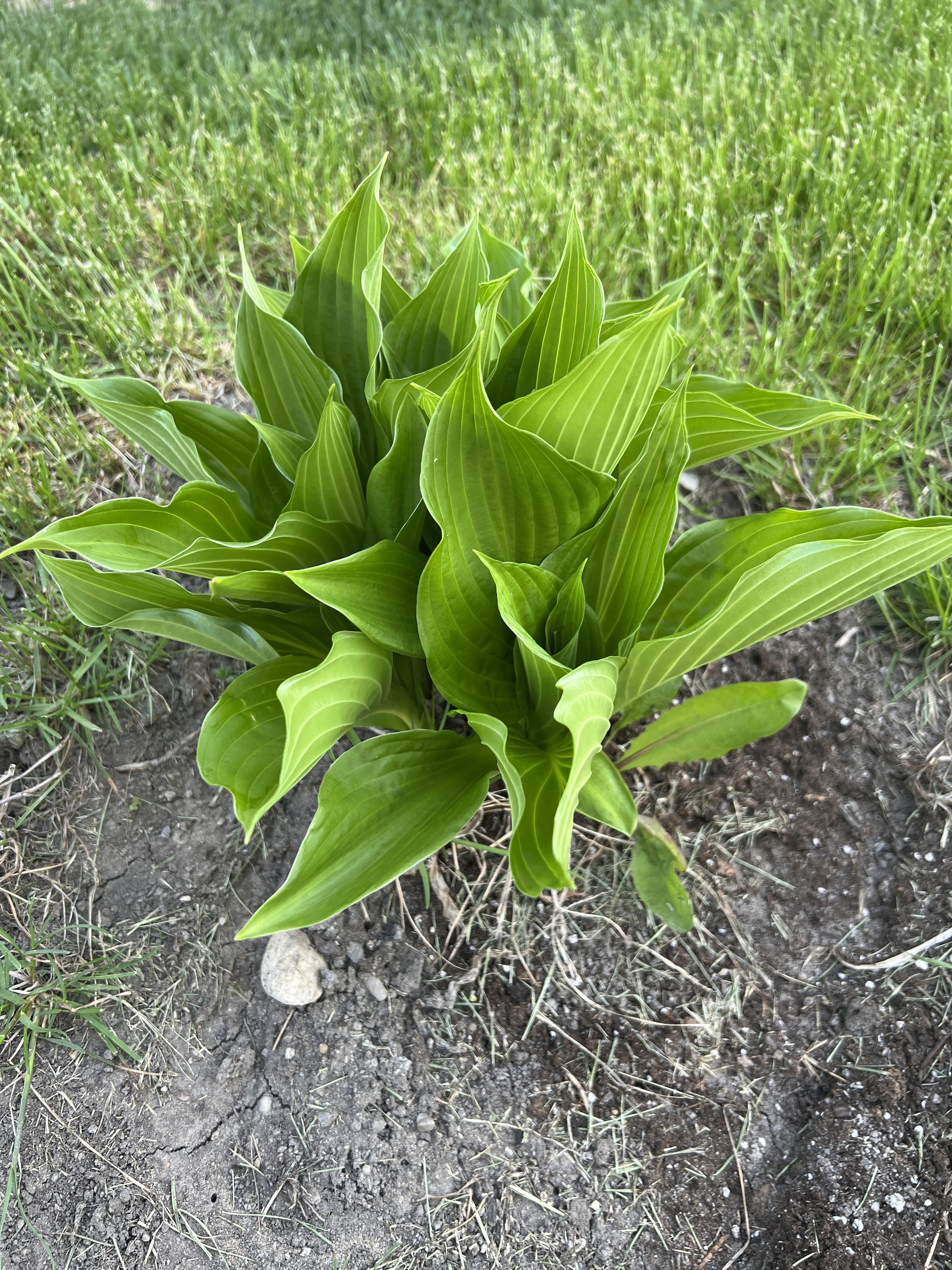
There’s a path on that side of the house, a ravine at the bottom of which the deer will follow. Deer love to munch on Hosta plants. But the Hosta plants will live, I do believe, despite the deer. Despite the hail. Despite thunner-pash, slotting, hurly-burly and basking rain falls those plants will surely endure this summer. I believe!
New life, new beginnings, the promise of resurrection, is not without its difficulties, challenges and little deaths. We may not understand yet its deepest mysteries and paradoxes, death and life, life and death.
But those raindrops will continue to descend from above. Even if we can’t understand it, or when we come up against our own limitations. Despite hearth’s and humanity’s imperfections, God’s work of reviving, renewing and enlivening the earth will not stop. Easter is a forever-promise.
Those raindrops will always be awakening us to the wonderful mystery of God. Those raindrops will remind us that even though we may suffer disruption, and painful transitions in life, the rain of God’s love will continue to nourish us and enliven us to reach forward into the unknown future with trust and assurance.
References:
Carey, G. (2009). Exegetical perspective: Revelation 21:1-6. In D. L. Bartlett & B. B. Taylor (Eds.). Feasting on the Word: Preaching the Revised Common Lectionary Year C, Volume 2 (pp. 463-467). Westminster John Knox Press.
Mahany, B. (2023). The book of nature: The astonishing beauty of God’s first sacred text. Broadleaf Books.
The Canadian Encyclopedia. (2015). Inuktitut words for snow and ice. The Canadian Encyclopedia [Website]. Retrieved from https://www.thecanadianencyclopedia.ca/en/article/inuktitut-words-for-snow-and-ice
 Raspberryman