
An episode during the first season of The Crown on Netflix depicts the controversial televised coronation of Queen Elizabeth in 1953. The TV monitors are all switched off in the moment when the archbishop approaches the Queen with the holy oil.
The Duke of Windsor explains that this is the most sacred part of the ritual. “When someone asks why the anointing is the holiest part of the ceremony, too holy even for it to be televised, the former king explains that the anointing is the moment when the divine is infused into Elizabeth’s human form. It’s when she is no longer just Elizabeth, but Queen Elizabeth II. The holy oil marks that transformation from only human to now also divine.
“The archbishop hesitates before making the sign of the cross with the oil on her chest, and then her forehead. This is the part of the coronation that converts her from a woman into a queen” (Watterson, 2019, p. 199).
In the 16th century Martin Luther talked about the ‘joyous exchange’ in which by taking on the sin of humanity on the cross, Jesus imputed divine righteousness onto humanity. Giving and receiving. Receiving and giving.
So, we don’t speak of either human or divine, or a one-way relationship, but rather the two becoming one, going both ways. The boundary between heaven and earth is not fixed. Earth and heaven are intermingled, because of Jesus.
And Mary. Thanks to the persistent grace shown by this woman of faith.
There is this passage from the Gospel of Philip discovered in 1945 which aligns with John’s Gospel story today of Mary anointing Jesus with expensive perfume made from nard, or oil (John 12:1-8): “To be anointed with oil is higher than being immersed in water. It is when we are anointed … that we become Christians.[Because] Christ was called Messiah [which literally means ‘the anointed one’]…” (Watterson, 2019, p. 199).
Jesus receives the gift of anointing through the persistence of Mary, who perseveres in her gift-giving despite Judas’s attempt to shame her. Grace knows no bounds, no obstacles. The anointing is an extravagance. Oil gets everywhere, seeps into all places even hidden places. It covers our whole body. In the famous prayer of King David in Psalm 23, the Psalmist declares: “Thou anointest my head with oil; my cup runneth over.”
Mary knew what actions would convey heartfelt affection, honour and respect for Jesus. Mary is one biblical character who embodies the fullness of being human. She uses what she has been given. And she is the bridge connecting, in this passage, the divine love with human passion. She is the quintessential Recoverer.
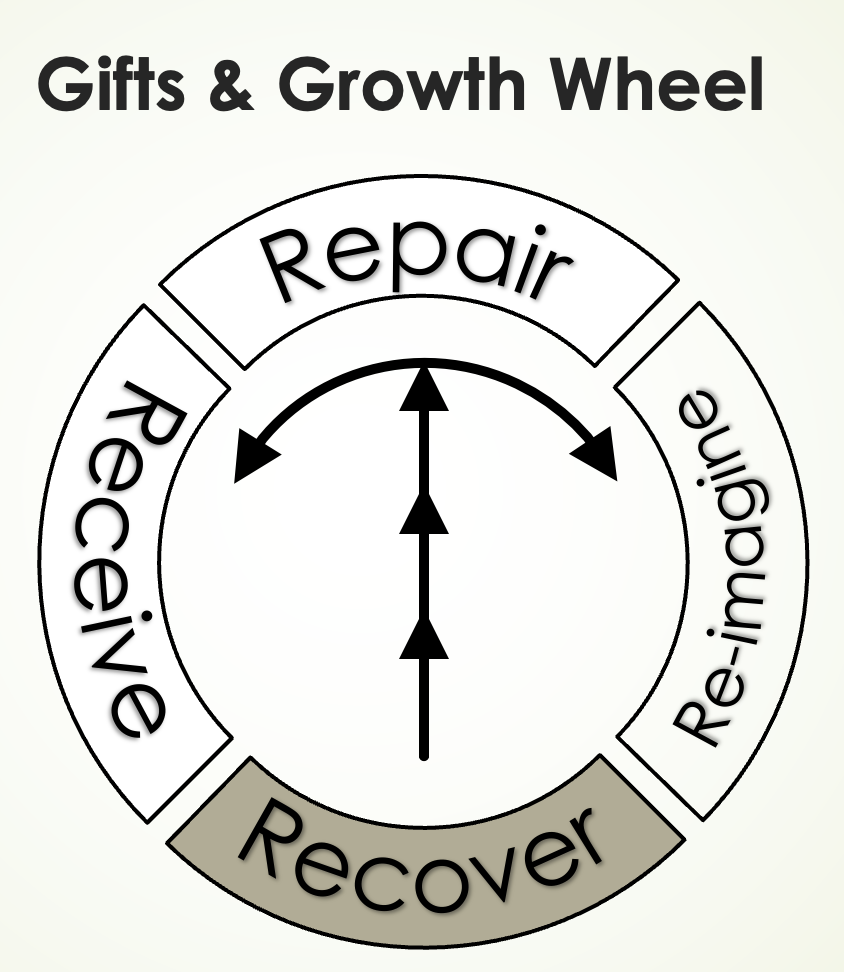
Like the Receivers, Recoverers on the Gifts and Growth Wheel are good at spotting the need, reading the room, sensing the mood. But Recoverers are especially good at giving compassion and empathy which comes from the ability to pay attention to their social surroundings. And acting on the heart’s nudge.
Paying attention. In Hebrew, the command form of “pay attention” literally means, “put forth your heart” (Mahany, 2023, p. 24).
“Putting your heart forward” means doing something that reveals your truth. By your caring actions the world sees your heart full of love. The world sees who you are, truly. Your love is expressed genuinely, and you are not hiding it nor squandering it in denial. You don’t hold yourself back because you know a genuine, self-less love motivates you.
It’s never perfect, of course. We are human. Sometimes, our desire to care is manipulative when we don’t realize our acts of care really motivated by our need to be needed. In this case we are cheating by going to the nearest quadrant on our right, the thinking/re-imaginer’s side. Caring for another, in this case, becomes a self-justifying action more than a genuine other-centred care.
“Putting your heart forward” is also not without healthy boundaries. Boundaries are crossed and blurred when the Recovers on the Wheel first move to the Receivers closest to them on their left side. This mistake is about imposing one’s care on another presuming everyone needs the same thing from you in the same way.
In this case the act of caring does not respect another’s wishes sometimes not to be cared for in the way you want to give it. Recoverers must learn that sometimes, with some people, the greatest caring act is to accept you are not the one to offer them care.
For growth to happen, Recoverers have to cross the centre of the Gifts and Growth Wheel. Healthy Recoverers reflect this commitment to action, which Repairers are especially good at. But, for Recoverers, it is an action that serves another from the heart, the source of divine love.
Caring and repairing is obviously active. If we are helpers, it’s easy for us to give help. But it’s sometimes difficult to receive help. Yet, receiving help also first requires action. You can’t receive help without acting on it: Asking for help. Accepting the help. Expressing gratitude.
In the giving and receiving of genuine love and care, there is always opposition. We witness this in the Gospel for today. Judas here represents the authorities. And authoritarian regimes try to strip everything away from people, especially their empathy and grace.
My mother and her family left Poland with nothing. The communists had taken their home, their property, all their belongings. The authoritarian government impeded their freedom and bridled their speech.
But my Mom taught me from a young age that there are some things no one can ever take away from you. In my Mom’s case, it was education. But in a broader sense, it’s what is inside you – your values, your truth, your mind, your heart, your action, your beliefs. God. No one can take those things away from you.
Recoverers teach us the importance of knowing who you are, centering on what the great American teacher and theologian Howard Thurman called “the sound of the genuine” (McLaren, 2025 March 31) within us. Recoverers are non-conformists because with wisdom and courage, they engage acts of compassion in sometimes extraordinary ways, like Mary Magdalene did, never losing sight of who they are and what they truly value never mind what others think.
On this day we give thanks for the Marys in our lives who operate from hearts full of love and caring, whose passion sometimes unbridled will get them and us in trouble with the authorities. But whose actions nevertheless demonstrate the holy bridge between the divine and the human, perfectly embodied by Jesus whose heart of love never wanes for each one of us.
Dietrich Bonhoeffer wrote, “The more we received [help], the more we were able to give; and the more meager our love for one another, the less we were living by God’s mercy and love. Thus God taught us to encounter one another as God encountered us in Christ. ‘Welcome one another, therefore, as Christ has welcomed you, for the glory of God’ (Romans 15:7)” (cited in Barnhill, 2005, p. 48).
May we learn and grow, receive and give love, listening always for the sound of God’s love ringing within us, anchoring us in Christ.
Thanks be to God.
References:
Barnhill, C (Ed.). (2005). A year with Dietrich Bonhoeffer: Daily meditations from his letters, writings, and sermons. Harper One.
Mahany, B. (2023). The book of nature: The astonishing beauty of God’s first sacred text. Broadleaf Books.
McLaren, B. (2025, March 31). Protecting our own light: Contemplative nonconformity. Richard Rohr’s Daily Meditations [Website]. https://www.cac.org
Watterson, M. (2019). Mary Magdalene revealed. The first apostle, her feminist gospel & the Christianity we haven’t tried yet. Hay House Inc.
 Raspberryman
Pastor;
I think am the reader this Sunday however I do not have the material.
Thanks,
Michael
I sent you a couple of emails today with those documents. Thanks!
Thank you Pastor;
Michael
Pastor;
Sorry about that. The first message was OK. My fault, I read my messages from top down. The only issue is that the most recent message is at the top of the list. In this case you gave me everything I needed; I I just needed me to read further down.