
Over the past year and a half, I’ve only looked at my guitar sitting in the corner of my home office. It has sat there, lonely, untouched, collecting dust. I have not picked it up once during this time.
So, when I finally did a few days ago, and started plucking a few notes, I wondered – what’s the point? What purpose does it serve to spend valuable time messing around on a musical instrument?
I’m not being really productive playing around on it. Learning a new song won’t yield perfection (to be sure!) and only reminds me of how much my skills have deteriorated by not playing it. Even though, for Lent, I’ve committed to picking it up each day for at least a few minutes at a time, those thoughts plague me: For what purpose? Is it worth the time?
You may have heard of the so-called “Marshmallow Experiments” (Burkeman, 2024), the first of which was conducted at Stanford University by Doctor Walter Mischel in 1970.
In these experiments, Mischel and his colleagues presented children with a single marshmallow and offered them a choice: They could eat it. Or they could wait alone in the room with it for ten minutes. If they succeeded in waiting ten minutes without eating that one marshmallow, they got one more. And so on.
As these experiments unfolded over time, the scientists were able to make some evidence-based conclusions. For one thing, participants who were able to resist temptation went on to enjoy better academic performance and physical health in later childhood, and demonstrated other positive differences as adults (Burkeman, 2024).
The self-discipline not to grab the first marshmallow became an invaluable trait for what’s commonly thought of as a successful, productive life.
Self-denial is a common messaging that we impose on ourselves, often without being aware we are doing so. In other words, we remain perpetually a Lenten people because we never really enjoy the gifts we have received, have amassed, have saved over time. In this mindset, we never get to Easter because we either don’t know how to embrace and receive the treasures we have been given and/or we feel guilty for enjoying gifts from God when we do receive them.
A Canadian Benedictine, the late John Main, was known to say that the greatest sin was not succumbing over and over again to tantalizing temptations. No, the greatest sin was not fully enjoying the good gifts that we have received from God’s bounty and grace.
What gifts have you received? Are they material blessings? But gifts are more than having lots of stuff. There is the gift of music, the talent for precision and patience in woodworking and building things, the gift of listening to another, the care for animals, for growing plants, flowers and vegetables. Gifts are also the gifts of our personalities, our characters, our abilities, our passions, our interests, what we’re good at doing, what we love doing, what we enjoy in each other and in the world.
What today’s scriptures point to is the temptation to believe that we are the source of and engine behind all these gifts and good things we experience in life.
What resulted in Jesus overcoming temptation in the desert was acknowledging the true source of his power in God (Luke 4:1-13). In the accompanying text from Deuteronomy (26:1-11), the temptation is not hunger but prosperity.
When things go well and the harvest is plentiful, the Israelites will be tempted to think that they are self-made. They will be tempted to believe that they have earned their prosperity. They have worked hard for it.
To counter this temptation, God instituted the ritual of first fruits to remind the Israelites that thanksgiving always had priority over self-congratulation (Oldenburg, 2025 March 9).
On this First Sunday in Lent it is good therefore to begin with the gift of receiving. Maybe Lent can be a reminder to us that what we may be so proud to boast about is not our doing. God is the source. We are the vessels. When we recognize our primary role as receptors of God’s grace, we can then let that gift flow through us and to the world around us.
This year, the Gospel of Luke travels with us throughout Lent. And Luke’s emphasis is celebrating the persistence of God’s grace and mercy despite stubborn obstacles.
In the series of sermons this Lent, I’ll look at four ‘R’s’ of faithful practice and growth: Receiving, Re-imagining, Repairing and Recovering (Bailey, 2021). Each of these is a great and important gift for the community of faith. We need Receivers as much as we need Re-imaginers, Repairers and Recoverers.
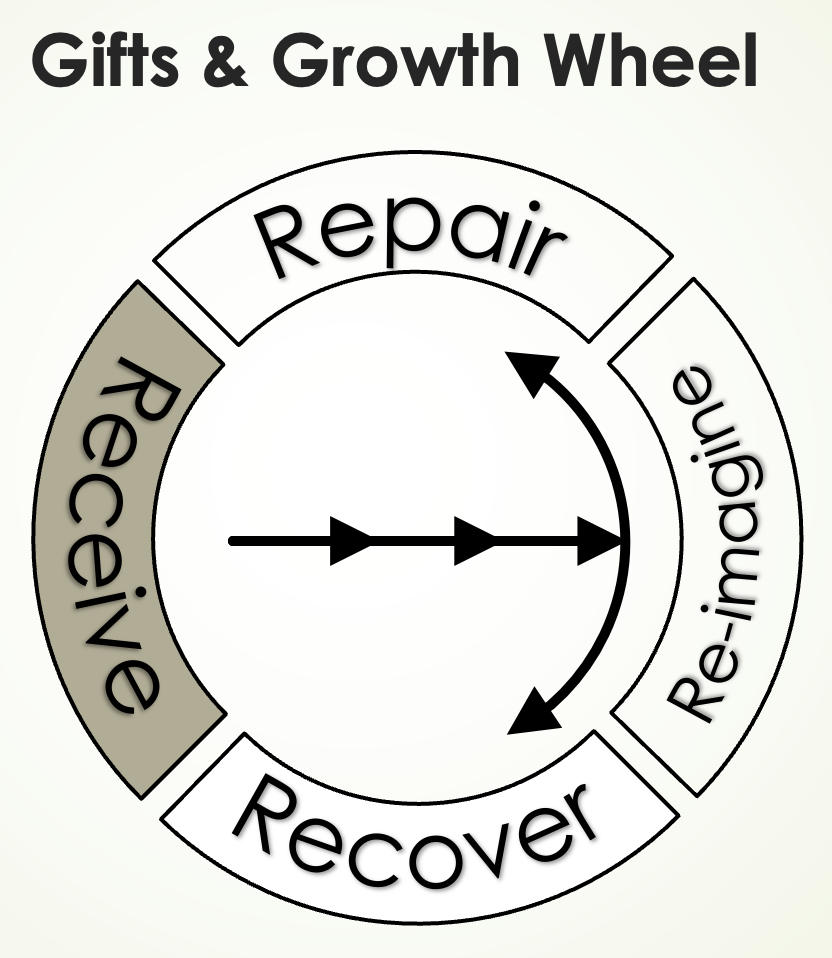
Each of us, depending on our individual strengths and gifts, will start in a different quadrant. There are some who are best positioned, because of their God-given personality and character, to start at the receiving end. Others will naturally begin by re-imagining; others first will move into repairing and others still will be best suited to start in the recovering quadrant of this circle.
But for growth and wholeness, a journey of faith is necessary. We can’t remain stuck in just one of the four quadrants. For the gift to bear fruit we need the whole circle, the whole community.
So, what do the Receivers offer? The Receivers are naturally disposed to acknowledge reality as it is – the good and the bad. The receivers among us can more easily accept their lot and enjoy what they have and who they are – without judgement.
Receiving – being able to accept what is – is an incredible gift. To see God’s work in all things. To trust in God’s grace to keep us going into an unknown and uncertain future. To be, as we are.
This spiritual gift is useful in both tempering the productivity bias in our hustle culture. It is to consider that all our accomplishments are for naught, and even a temptation, if they are not placed in the broader perspective of the origin of all good things. It is God’s mercy and grace that are fundamentally operative in our lives. Our gifts bear fruit when we acknowledge the true Source of them in God and God’s mercy.
But, as I said, remaining in this quadrant without the input of the other ‘Rs’ can leave the Receivers – or “mystics”, as they are sometimes called (Ware, 1995)—stuck. They are tempted into distorted thinking that in order to experience God’s presence they need to escape or check-out from the reality of this world.
It’s ironic that the Receivers can, on the one hand, more naturally than all others receive reality as it is. But, on the other hand, the Receivers are also the ones most likely tempted to remove and displace themselves from it. To avoid all the confusion and chaos of the world, Receivers are tempted to retreat into the comforts of their self-created worlds, their private realms.
That two-sides-of-the-same-coin dynamic is characteristic of all the gifts in the circle. Indeed, our greatest gift can be our greatest blind spot.
We all start somewhere on the wheel of gifts and growth. But, for growth to happen, where do we go from there?
The next movement for the receivers is towards the opposite quadrant. For the receivers, it’s towards re-imagining. The Re-imaginers are those who start with the gift of the mind, the gift of clear and constructive thinking. This is what the Receivers need. We’ll talk about the Re-imaginers next week.
Why, you ask, do we first go to the opposite side, and not to either side of the starting point? If the Receivers would first look to the Repairers on one side, Receivers’ action might not be the best course of action in a given situation. It would be like the Receiver realizing they had to do something good in the world, but choose an activity that isn’t relevant, or particularly helpful. Likely, because the Receiver hasn’t done their homework.
On the other side, if the Receivers would first look to the Recoverers, their action might lead to boundary issues. They might over-function, burn out and feel like they needed to do everything to take on the weight of the world and care for everyone, which of course is impossible.
We first need the opposite gift to correct the distortions associated with our starting place on the circle, before moving to the last two quadrants.
This arrowed pattern in the middle of the circle looks like an anchor, intentionally. This pattern of gifts and growth keeps us anchored in our movement towards balance and healthy growth for everyone. The writer to the Hebrews affirmed: “We have this hope as an anchor for the soul, firm and secure” (Hebrews 6:19).
Today, at the start of our Lenten pilgrimage the Receivers among us will say: Thank God! Receive, enjoy and delight in the gifts of God’s doing and grace in your life. You can enjoy that marshmallow that someone gives you today. Don’t deny it. It’s Ok!
In the words of the late Indigenous author Richard Wagamese: “Sure there’s stuff that needs doing, stuff to wade through and stuff to fix but there’s also the joy of small things: a hug, a conversation, playing a song all ragged and rough on an instrument, walking on the land, listening to great music or enjoying silence and a cup of tea. Rejoice. Fill yourself again” (Wagamese, 2021).
Receive.
References:
Bailey, J. (2021). To my beloveds: Letters on faith, race, loss, and radical hope. Chalice Press.
Oldenburg, M. W. (2025, March 9). Crafting the sermon; First Sunday in Lent, Year C. Augsburg Fortress. https://members.sundaysandseasons.com
Wagamese, R. (2021). Richard Wagamese selected: What comes from spirit. Douglas & McIntyre.
Ware, C. (1995). Discover your spiritual type: A guide to individual and congregational growth. Alban Institute.
 Raspberryman