
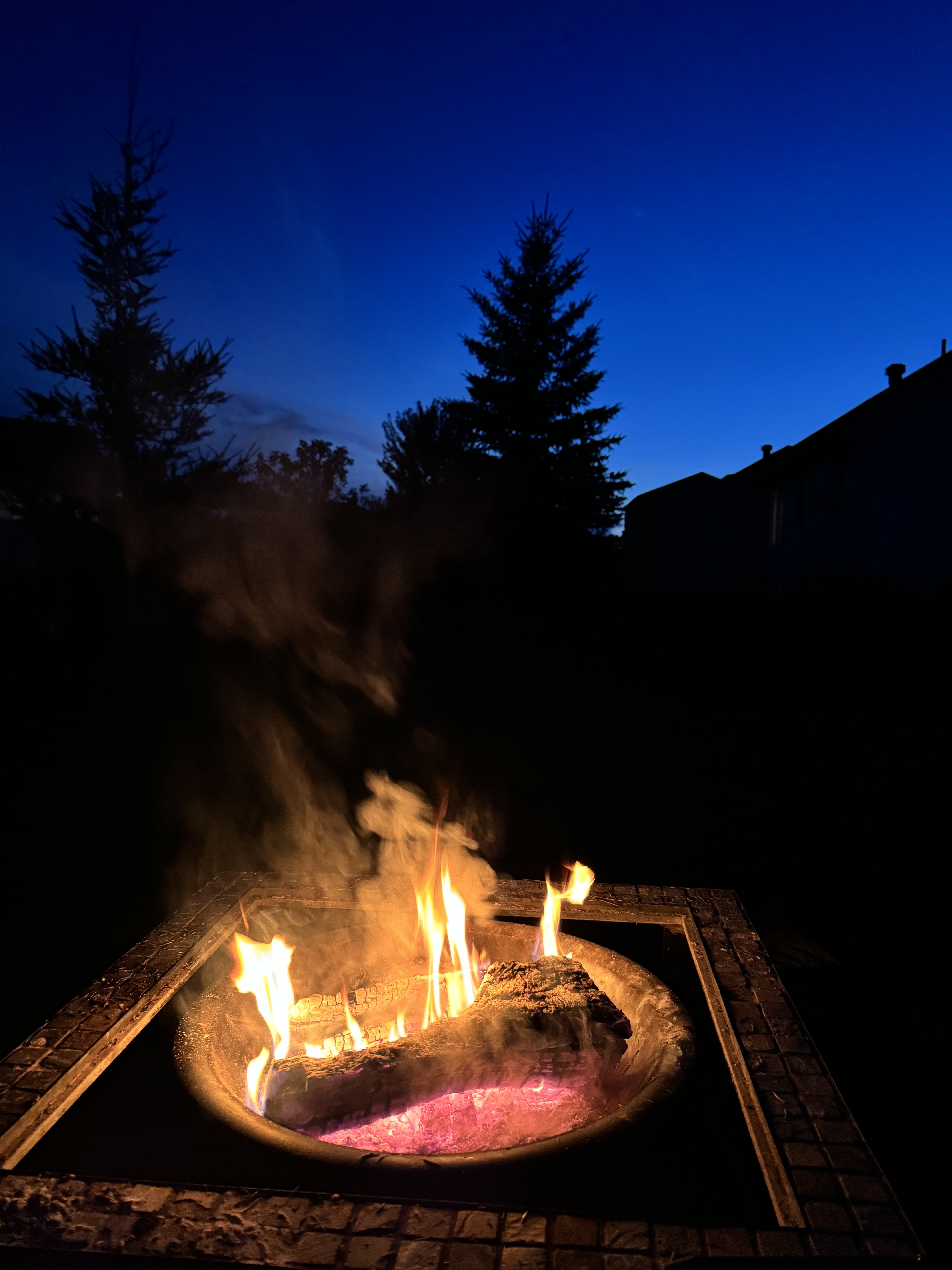
Despite condemnation of these acts by public leaders (Alhmidi, 2024), temples, synagogues, mosques and churches in Canada are burning.
A House of Commons report published in September catalogued a chart of statistics showing, by a breakdown of provinces and territories, how between 2010 and 2022 the number of police-reported cases of arson causing significant damage to religious institutions steadily increased from 13 incidents annually to 74.
These stats reflect not only damage to material property but acts of violence against people on site (Government of Canada, 2024 September 16).
Religion has become a target for people’s pain. A church near Eganville (Ottawa Valley) covered their building with tin late last century to protect it in the wake of suspicious fires that destroyed the Lutheran and Catholic church buildings in town at the time. They call it “the tin church”.
Visions of burning churches capture our imaginations. These visions stir up fear and despair. And one of the first things we want to do is to circle the wagons. What is the world coming to?
The Gospel for today (Mark 13:1-8) was first heard in the Jewish-Roman war of 66-70 C.E. Ultimately, in this war the temple in Jerusalem was demolished never to be rebuilt. It didn’t look good for the people of faith in the day, as the outward signs of their religion were torn down and burned.
It feels like ‘the end’ whenever the beloved symbols, forms, and outward appearances of our lives at best change, at worst are destroyed, especially in dramatic fashion and/or through violent conflict.
We feel like we are in the midnight hours of a life when we suddenly lose what we have cherished and become attached to over time. It is a trauma from which many do not recover. Some people struggle under the weighty pain of regret regarding past behaviours. Many today face incredible and what can often feel like and may actually be insurmountable obstacles.
We shake our heads in disbelief. How can the goodness of God prevail in the midst of this harsh reality? Is faith just a pipe dream? Is the kingdom of God merely some illusion to distract ourselves in one of many ways we amuse ourselves to escape from this reality? We look to the Black Friday deals.
There is word, a phrase and an image of Jesus the writer to the Hebrews uses that caught my attention. In verse 12 (Hebrews 10), “When Christ had offered for all time a single sacrifice for sins, he sat down at the right hand of God, and since then he has been waiting …”
The writer of Hebrews bears witness to God’s great acts in Jesus of overcoming death and the grave and rising to new life. And then the writer of Hebrews pictures Jesus as sitting down and waiting. You can almost hear a pin drop. There is Jesus dusting off his hands with an attitude of mission-accomplished and slumping into an easy chair with a satisfied grin (Wallace, 2009).
Is this a picture of Christ the first hearers of scripture needed to hear as their temple burned? Isn’t Jesus supposed to rescue people in trouble? Swoop down and pull us out of the hellfire? Doesn’t he care? We get a rather passive image of Jesus sitting, waiting, and doing nothing. We don’t want this Jesus – a God who waits!
Facing the craziness of this world today, trying to cope with all our losses, we want a strong man who will make things right and make us great again!
Hebrews (chapter 10) cites a beloved passage from Jeremiah (31:33-34) where the prophet announces God’s vision of writing God’s covenant, God’s promise, on our hearts and minds (Hebrews 10:16).
What is implied is that the life of faith is not a matter of living under external measures. Our minds, our hearts – that’s where God goes. The life of faith is not validated by blind compliance to the outside demands of the law. The life of faith, rather, is Spirit-driven and a Spirit-given ability to live into the new covenant (Fahey, 2009). In other words, people of faith are called to live a new life, a changed life, from the inside out.
The early church had to hear again the gracious word of God. That is the purpose of this letter to the Hebrews. In facing their losses, they needed to hear again the Gospel promise that God will be faithful (Hebrews 5:12). God has faith in us. God believes in us, trusts us to do our part, to make our move. To be loving. To see in the hearts of everyone we meet the face of God, to be gracious and compassionate, and generous.
This is not a cockeyed optimism. It is not a life based on emotional reactions to outward circumstances. Rather, it is a life practised in hope and trust.
Jesus waits for us to take responsibility for our actions – past and present. Jesus waits for us to forgive ourselves, show compassion to ourselves, as God has already forgiven us and first loved us. We cannot have outward renewal unless and until we experience for ourselves inner renewal and change.
We may not see the victory of God in Christ with the naked eye. But we can hear it again with the naked ear (Long, 2009). The message here is that if you want to know the truth, pay attention not to the evil you see out there, but to the Gospel you hear and receive in here.
We do not rely on external circumstances or outward legalities or protocols to validate our faith nor to justify our actions. Instead, we find, in and through God’s grace, a pathway through devastation and suffering to freedom and salvation.
The time of loss and change signifies an ending to be sure. It is also a new beginning for people of deep faith. To have new life, all things must grow and change. It is no accident that the final words of today’s Gospel are: “This is but the beginning of the birth pangs” (Mark 13:8).
The midnight hour feels heavy buried deep in the shadows. The nighttime of our lives hides all things true from view. But dawn is just a few hours away. In the concluding words of Hebrews 10 (25): “Encourage one another, and all the more as you see the Day approaching.”
We need to make the move, towards the light. Because the sun will rise. The son is coming. And that is the surest promise of faith.
References:
Alhmidi, M. (2024, October 15). Video of Trudeau remarks edited to remove his condemnation of church fires. The Canadian Press. https://www.thecanadianpressnews.ca/fact_checking/video-of-trudeau-remarks-edited-to-remove-his-condemnation-of-church-fires/article_d82061e0-4cf5-55c7-83f0-f586a1016a1a.html
Fahey, J. E. (2009). Hebrews 10:11-14 (15-18), 19-25; Theological perspective. In D. Bartlett & B. Brown Taylor (Eds.), Preaching the revised common lectionary; Feasting on the word; Year B, volume 4 (pp. 302-307). WJK Press.
Government of Canada. (2024, September 16). Inquiry of ministry Q-2825. House of Commons. Retrieved on 14 November 2024 from https://smartcdn.gprod.postmedia.digital/nationalpost/wp-content/uploads/2024/11/Q-2825-Order.pdf
Long, T. G. (2009). Hebrews 10:11-14 (15-18), 19-25; Exegetical perspective. In D. Bartlett & B. Brown Taylor (Eds.), Preaching the revised common lectionary; Feasting on the word; Year B, volume 4 (pp. 302-307). WJK Press.
Wallace, P. M. (2009). Hebrews 10:11-14 (15-18), 19-25; Homiletical perspective. In D. Bartlett & B. Brown Taylor (Eds.), Preaching the revised common lectionary; Feasting on the word; Year B, volume 4 (pp. 302-307). WJK Press.
 Raspberryman